forge
Health Uyari
- License — License: MIT
- Description — Repository has a description
- Active repo — Last push 0 days ago
- Low visibility — Only 5 GitHub stars
Code Gecti
- Code scan — Scanned 12 files during light audit, no dangerous patterns found
Permissions Gecti
- Permissions — No dangerous permissions requested
Bu listing icin henuz AI raporu yok.
One command keeps Claude Code (and Codex) configured the same way across all your projects: skills, MCP servers, hooks and per-project profiles, synced at session start, with a doctor that names what is broken and how to fix it.
forge
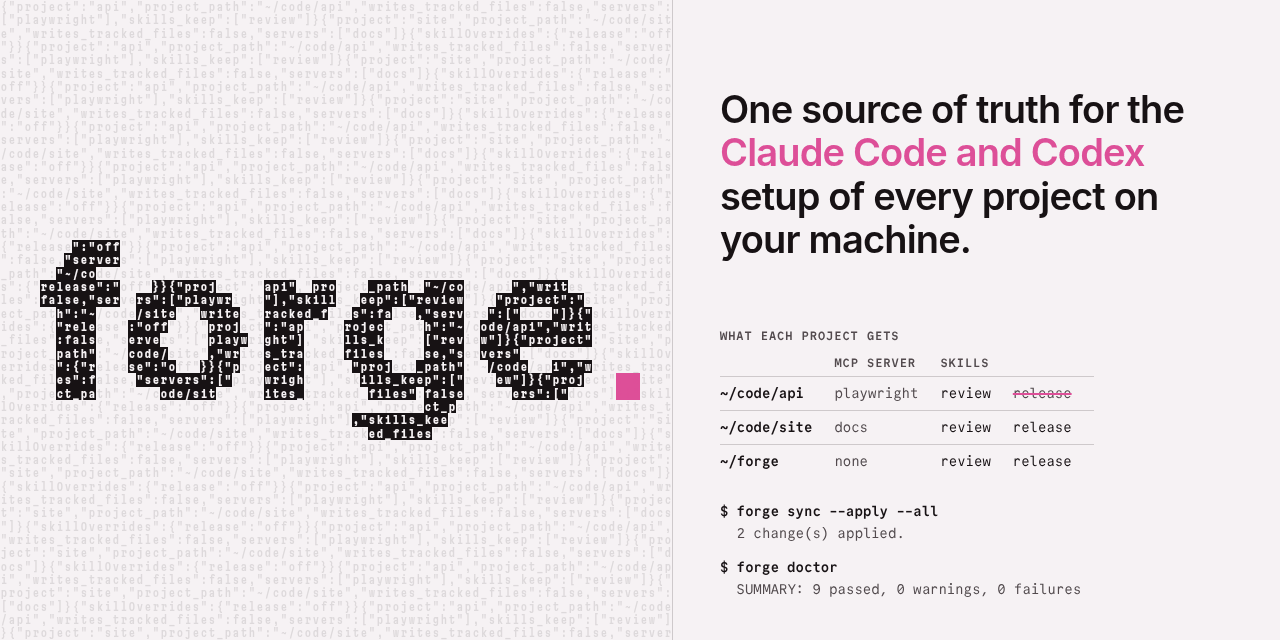
One source of truth for the Claude Code and Codex setup of every project on your machine.


Every project you work on with an agent grows its own skills, MCP servers, hooks and permissions. Copy them
by hand and they drift: one project has the new server, another still has the old token, a third lost a hook
months ago. forge keeps all of it in one checkout. Each project gets a small profile, one generator writes
every project's files from it, and a SessionStart hook brings the project you open up to date before the
session starts.
Why forge
- One command.
forge sync --apply --allregenerates every project's configuration from the same source. - Per-project profiles. Each project picks its MCP servers, skills, plugins, permissions, env and hooks in
one JSON file. Untrimmed, it loads everything you have. - Dry-run first, every write declared. Without
--apply,forge synconly lists what would change. With
it, every file written is named. forge doctornames what is broken and the command that fixes it. One PASS / FAIL / SKIP / WARN line
per check, exit 1 on a FAIL.- Optional integrations that switch off cleanly. Codex, GSD and Hindsight are each one switch.
Turning one off removes only the entries forge wrote. - A personal-data guard.
forge check-publicand the git hooks refuse a commit that carries a home path,
an email address, a private IP or a private key, so your own config never leaks into a public repository.
Quickstart
git clone https://github.com/danitrrga/forge ~/forge
cd ~/forge
python3 bin/forge init                  # checks your tools, writes your data, syncs, runs doctor
python3 bin/forge add ~/code/myproject  # registers a project and syncs it
python3 bin/forge doctor                # what is broken, and how to fix it
python3 bin/forge sync                  # dry-run: what would change
python3 bin/forge sync --apply          # write it
To type forge instead, link it onto your PATH: ln -s ~/forge/bin/forge ~/.local/bin/forge.
forge init checks python, git, claude, pnpm and codex, one line each. It asks at most two questions,
and only for tools it found: manage Codex's config too, and install GSD. --yes takes every detected default,--with a,b and --without a,b switch integrations, and --track gives your data its own local git history.
It then writes your data into the checkout: config/forge.json (your switches), a profile for the checkout
itself, an empty MCP registry, credentials/secrets.json (mode 600), docs/AGENT-SYSTEM.md and an emptyskills/. With GSD on, it runs GSD's own installer (pnpm dlx @opengsd/gsd-core@latest --claude --global).
Then it runs forge skills --apply, then forge sync --apply --all, which installs the SessionStart hook, and
exits with forge doctor's status.
forge add PATH [--name NAME] [--writes-tracked-files] writes config/profiles/NAME.claude.json and runsforge sync --apply --project NAME. It refuses a path that is not a directory, a name already registered and
a name that is not kebab-case. By default forge writes no file git tracks in the project: no pointer in itsCLAUDE.md, no .gitignore line. The flag allows it.
How it works
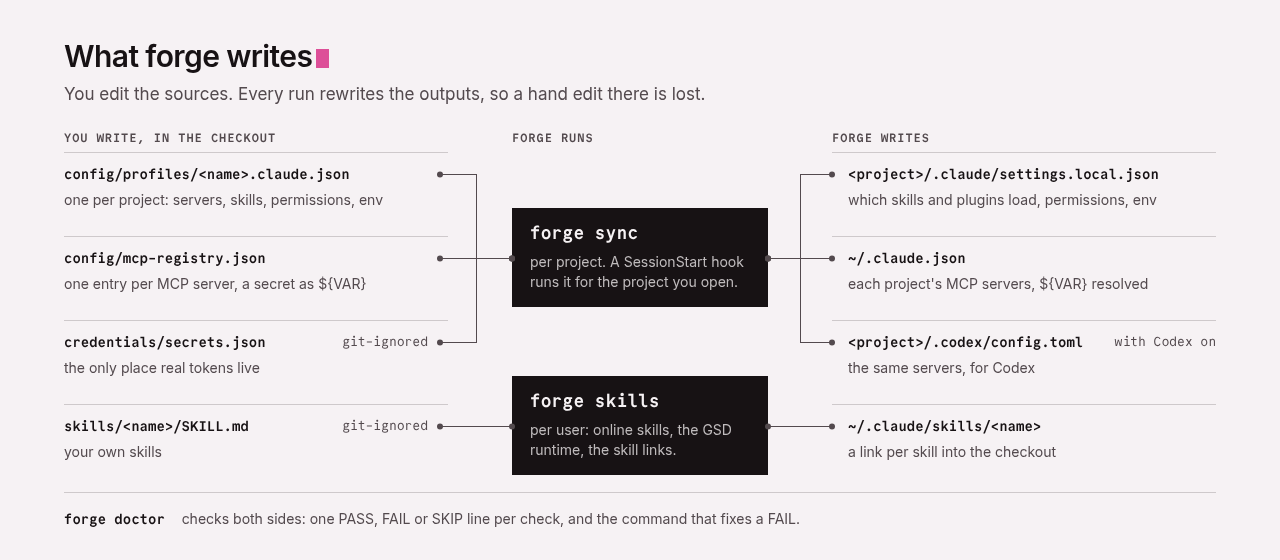
A profile, config/profiles/<name>.claude.json, holds a project's path, the MCP servers it gets fromconfig/mcp-registry.json, the skills and plugins it keeps, permissions, env and hooks. The accepted fields
and their types are PROFILE_FIELDS in forge/lib.py, and forge sync names a field of the wrong type
instead of guessing.
forge sync writes the per-project keys in ~/.claude.json, each project's .claude/settings.local.json,
the hook rows in ~/.claude/settings.json (merged, never replaced) and, with Codex on, ~/.codex/ and each
project's .codex/config.toml. forge skills writes what belongs to the user rather than to a project: the
online skills, the GSD runtime and the links in ~/.claude/skills. These files are generated and overwritten on
every run, so edit the profile, not them. The SessionStart hook runs forge session-start, which syncs only
the project you opened, reports only what changed or failed, and always exits 0: a broken sync never blocks a
session. A profile marked frozen gets nothing.
forge/hooks.py also writes a few hook rows that are safe on any machine and need no switch: the SessionStart
sync, the memory check, a desktop notifier that exits quietly without omarchy-notification-send, and a router
that reads infra/ref/ref-index.tsv when a project has one. Your own rows go in user_hooks inconfig/forge.json.
Integrations
Each one is a switch under integrations in config/forge.json. Set it to true and runforge sync --apply --all. Switching one off removes only the entries forge itself wrote, never a hook you
installed another way.
| Integration | What it adds | What it needs | Default |
|---|---|---|---|
codex |
~/.codex/skills, each project's .codex/config.toml and .agents/skills links, so Codex sees the same skills; with codex_harness true in config/forge.json also its hook rows in ~/.codex/hooks.json and each project's MCP servers in .codex/config.toml, with it false (the default, Codex as a reviewer) neither, and forge takes out only what it wrote |
codex on PATH |
off; init offers it when codex is found |
gsd |
the gsd-* skills, agents and engine from @opengsd/gsd-core, installed unpatched by forge init, and its three hooks |
pnpm, node |
off; init offers it when pnpm is found |
hindsight |
the Hindsight coding-agent memory hooks and its rendered config | Hindsight's coding-agents package, config/hindsight-coding-agents.json, node; written for one machine's layout, so read forge/memory.py first |
off |
Bring your own skills
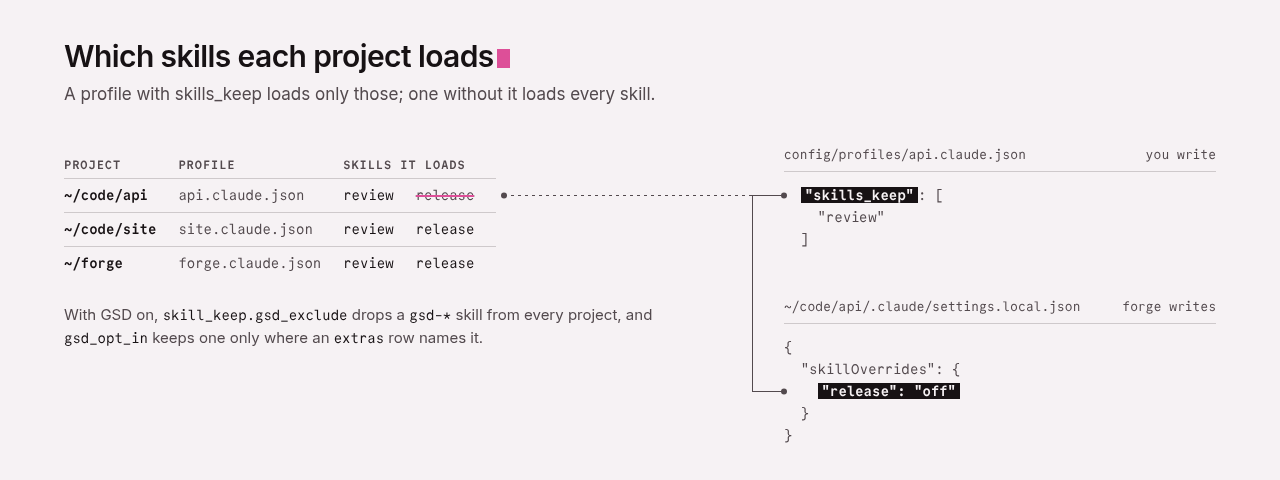
forge ships no skills. Put yours in skills/<name>/SKILL.md inside the checkout and runforge skills --apply. forge links each one into ~/.claude/skills, and each profile's skills_keep decides
which of them a project loads (["*"] for all). The engine's git ignores skills/, so git pull never
conflicts with them. forge init --track gives your data a second, local history when you want it versioned.
Third-party skills come from their own repositories, for example Anthropic's skill-creator,kepano/obsidian-skills, pbakaus/impeccable and Panniantong/Agent-Reach. The gsd-* skills are GSD's own,
installed unpatched from its package when the gsd integration is on. forge does not touch them afterwards
(gsd_patches in config/forge.json is false, which is what forge init writes). To trim them, name skills inskill_keep.gsd_exclude (no profile keeps them, and forge does not link them) or skill_keep.gsd_opt_in (kept
only by a profile whose skill_keep.extras row names them); forge doctor's skill keep row fails on a name
no skill has, a name in both lists, or an excluded name in an extras row.
Measure a skill: skill-bench
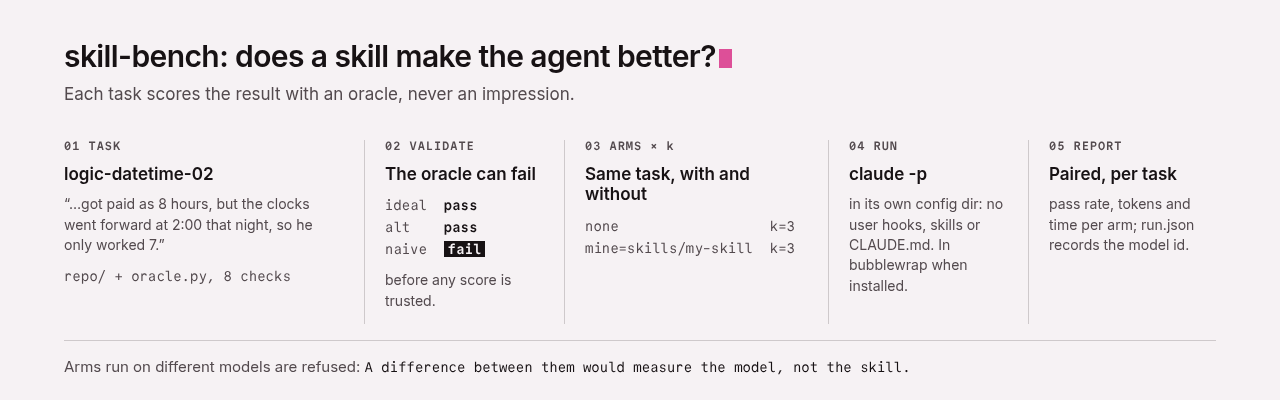
Does a skill make the agent better, and at what cost? scripts/bench/skill_bench.py answers with numbers. Each
task in benchmarks/skill-bench/tasks/ is a small repository, a prompt in the owner's voice and an oracle that
scores the result, plus a correct answer, a second correct answer built differently and the plausible wrong one.validate proves every oracle can fail and can pass before any score is trusted.
python3 scripts/bench/skill_bench.py validate          # every task: the ideal and alt answers pass, the naive one fails
python3 scripts/bench/skill_bench.py run --arm none --arm mine=skills/my-skill --k 3
python3 scripts/bench/skill_bench.py report --base none # paired comparison, tokens and time per arm
Each run is claude -p in its own config directory (no user hooks, skills or CLAUDE.md), inside bubblewrap
when installed. Results go to $XDG_DATA_HOME/forge/skill-bench/runs/. Every run records its model id and Claude
Code version, and report refuses to compare arms that ran on different models. calibrate and --tasks hard
keep only the tasks a model can still fail. A project can keep its own tasks, with hidden tests, in.bench/tasks/. The format and the statistics are in benchmarks/skill-bench/README.md, the sources and their
licences in SOURCES.md.
Safety
- Never writes outside its scope. Only the installed checkout writes: a linked worktree or a plain copy of
it writes nothing, and a toy HOME may only write its own toy world. Your ownCLAUDE.md,AGENTS.mdand.gitignorein a project are never written byforge add. - Dry-run by default.
forge syncwithout--applylists every file it would write and writes none. - Secrets stay in one place. The registry refers to a secret as
${VAR}, resolved from the git-ignoredcredentials/secrets.json. A server whose secret is missing is not written. - No personal data in the public history.
forge check-public --allscans every engine file for home
paths, email addresses, private IPv4 ranges, tailnet host names, private-key headers, files over 1 MiB and
font or image files, except an image pinned by path and sha256 inPUBLIC_ASSETS(forge/publish.py) after
someone has looked at it. An optionalconfig/publish-deny.txtadds your own patterns. The hooks ingithooks/
run it on every commit, commit message and push.
Commands
forge init [--yes] [--with a,b] [--without a,b] [--track]   first run for a new checkout
forge add PATH [--name NAME] [--writes-tracked-files]       register a project and sync it
forge sync [--apply] [--project NAME | --all]               what would change (or change it), per project
forge skills [--apply]                                      online skills from the manifest, the skill links in ~/.claude/skills, the GSD runtime
forge doctor [NAME]                                         one line per check; exit 1 on a FAIL
forge log [--since DATE] [NAME]                             the journal of what sync --apply and session start wrote
forge test [--mutants]                                      every tracked test_*.py, at nice 19
forge toolchain [--fix]                                     the third-party tools config/toolchain.json pins, installed by mise
forge lock [--apply]                                        record the versions mise does not install (plugins, outside skills, GSD, MCP packages)
forge versions [--md]                                       those and the toolchain pins, for release notes
forge commit -m MESSAGE (PATH... | --all)                   commit each changed path to the history that owns it
forge check-public --all                                    personal data in the files the engine publishes
forge metrics NAME [--baseline]                             a project's harness cost, from its Claude Code transcripts
forge uninstall [--integration N | --project N] [--apply]   take out what forge wrote (see Uninstall)
Every command takes --help. A doctor check with nothing to look at (no skills, an integration that is off,
no toolchain file) prints SKIP ... NOT RUN, NOT ARMED, which is neither a pass nor a failure. A check that is
on and broken is a FAIL that names the fix. forge doctor NAME shows only the rows that concern one project.
The project roots row fails a project that has skills of its own and sits inside another project's git
repository: Claude Code applies the outer project's settings there too, and the outer "off" wins over the inner
"on". The fix is one repository per project.
forge commit stages each changed path in the history that owns it: a path the engine's .gitignore does not
ignore goes to the engine history, every other path to your data history when you have one (--track).
Requirements
- Linux.
- Python 3.10 or newer, git, and Claude Code (
claude). - Optional:
codexfor the Codex integration,pnpmfor GSD,nodefor the GSD and Hindsight hooks.
forge init checks each one and says which are missing.
Uninstall
forge uninstall lists what it would take out; forge uninstall --apply takes it out. It removes what forge
wrote and nothing else: each value its ownership record (~/.local/state/forge/owned.json) says forge wrote and
that is still unchanged, then what is forge's by construction (the skill links into the checkout, a project's.agents/skills links, the guard hook entries, the copy of AGENT-SYSTEM.md, the pointer block in CLAUDE.md,
GSD's defaults while they are forge's copy, ~/.cache/forge), then forge's SessionStart row and last the record
itself. A value you edited stays and is named on a ! line; a setting forge removed falls back to Claude Code's
default, nothing earlier is restored. Your own hooks, permission rules and .gitignore lines stay.
It leaves, and says so: GSD's agents and engine in ~/.claude (with the command that removes them), any .bak
older than the record, and the checkout, whose deletion command it prints and never runs.--integration N takes out one integration's share once it is off in config/forge.json; --project N one
project's, once its profile is frozen or deleted.
Not a fit?
forge is a per-machine registry. If you want configuration that travels with each repository, look at
rulesync and ruler.
Contributing
CLAUDE.md (also AGENTS.md) is the guide for working on the engine. Before you open a pull request:
python3 bin/forge test                    # every test, in sandboxes that never touch your HOME
python3 bin/forge check-public --all      # no personal data in the engine
git config core.hooksPath githooks        # run the personal-data guard on every commit and push
forge init sets core.hooksPath for you. CI runs check-public and a fresh-install test on every push and
pull request.
License
Yorumlar (0)
Yorum birakmak icin giris yap.
Yorum birakSonuc bulunamadi