mssql-mcp
Health Gecti
- License — License: MIT
- Description — Repository has a description
- Active repo — Last push 0 days ago
- Community trust — 39 GitHub stars
Code Gecti
- Code scan — Scanned 7 files during light audit, no dangerous patterns found
Permissions Gecti
- Permissions — No dangerous permissions requested
Bu listing icin henuz AI raporu yok.
mssql mcp server
MSSQL MCP Server
Overview
MSSQL MCP Server, provides database interaction and business intelligence capabilities. This server enables running SQL queries, analyzing business data, and automatically generating business insight memos.
Refer to the official website's SQLite for modifications to adapt to MSSQL.
Built on the official MCP Python SDK (FastMCP), supporting the MCP 2025-06-18 specification: structured tool output (structuredContent), tool annotations, resource templates, and elicitation-based write confirmation.
Highlights:
- Multi-database — mount dev/staging/prod connections in one server; every tool takes an optional
databaseparameter, each connection with its ownreadonly/query_timeout/max_rows/confirm_writessettings - Stored procedures — list signatures and execute procedures with full multi-result-set harvesting
- Resource templates —
schema://{database}/{schema}/{table}serves table structures on demand without burning tool-schema tokens every turn - Safety guardrails — SQL whitelisting, read-only mode, row limits, query timeouts, optional elicitation confirmation before writes
Components
read_query- Execute SELECT / WITH queries with structured output (columns / rows / row_count / truncated), limited by
max_rows
- Execute SELECT / WITH queries with structured output (columns / rows / row_count / truncated), limited by
write_query- Execute INSERT, UPDATE, DELETE or MERGE queries, returns affected row count
create_table- Create new tables in the database
list_tables- Get a list of all tables in the database (schema + table name)
list_views- Get a list of all views in the database
describe_table- View full schema for a specific table (type, nullable, default, primary key, identity, foreign keys, indexes)
list_databases- List configured database connections (name, readonly, is_default)
list_procedures- List stored procedures with parameter signatures
execute_procedure- Execute a stored procedure (supports multiple result sets)
append_insight- Add new business insights to the memo resource
Resources
memo://insights— a living business-insights memo, updated in real time viaappend_insightschema://{schema}/{table}— table structure of the default database (JSON: columns / PK / identity / FKs / indexes)schema://{database}/{schema}/{table}— table structure of a named database connection
Resource templates are fetched on demand: unlike tool schemas they are not resent to the LLM every turn, which keeps long conversations lean.
Security
All SQL goes through static validation before execution:
read_queryonly accepts a single SELECT / WITH statement and rejects any write or EXEC keyword (blocks e.g.WITH c AS (...) DELETE FROM t)write_queryuses a whitelist (INSERT / UPDATE / DELETE / MERGE only);EXEC,DROP,TRUNCATE,ALTERare rejected- Multi-statement batches (separated by
;) are rejected trusted_connection: trueswitches to Windows integrated auth (the connection string usesTrusted_Connection=yes, no username/password needed);falsekeeps the configured SQL account loginreadonly: truedisables all write operations, including stored procedures (they are black boxes that may write)- Stored procedure names are strictly validated as 1–3 dotted identifier parts before being embedded into
{CALL ...} - Results are truncated at
max_rowsrows; queries are aborted afterquery_timeoutseconds - With
confirm_writes: true, write operations first ask the user for confirmation via MCP elicitation (clients without elicitation support fall back to executing directly) - Comments and string literals are stripped before validation, so they cannot be used to bypass checks
Demo
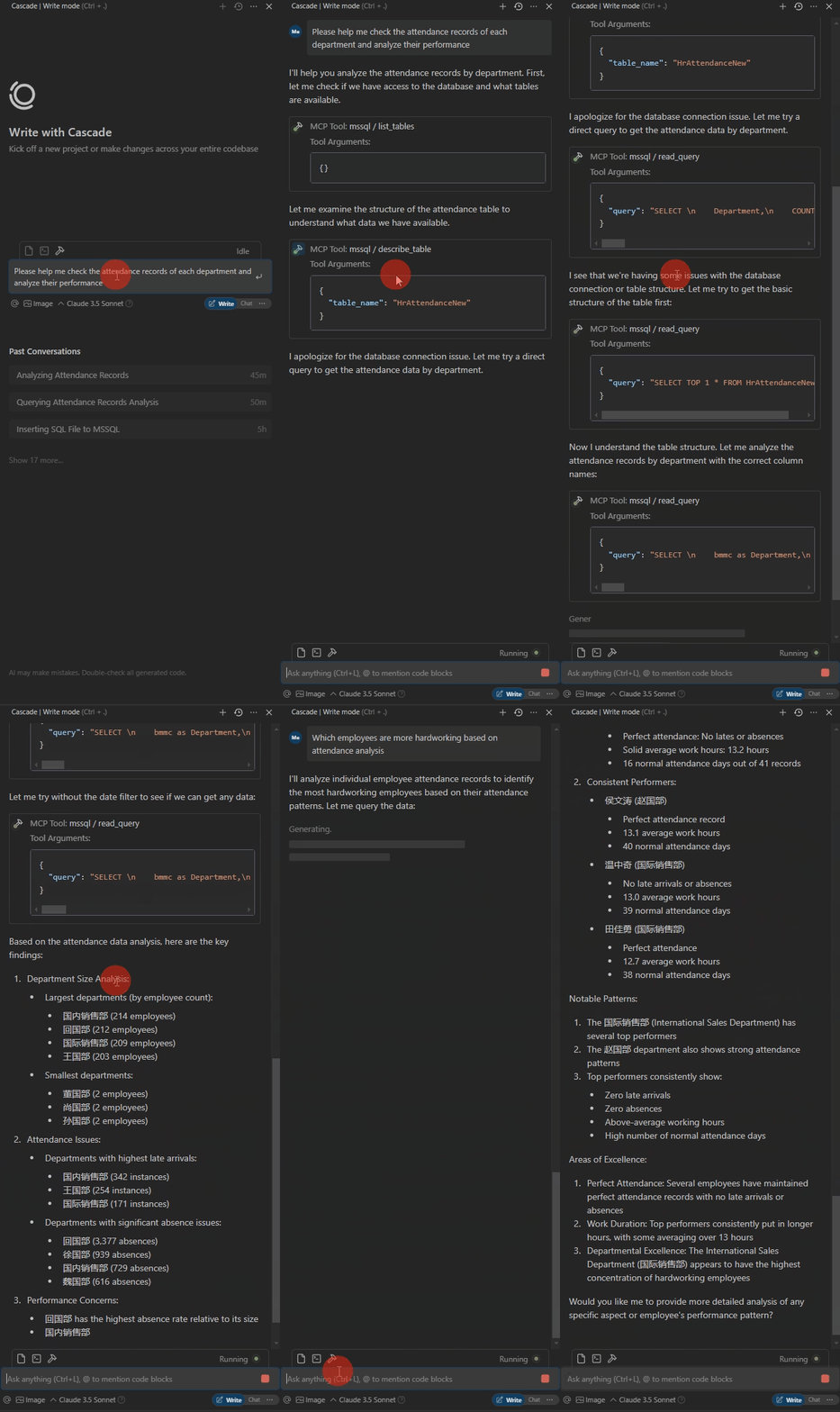
The database table is as follows. The column names are not standardized, and AI will match them on its own. Errors during SQL execution will self correct.

The following is the demo.
Operating environment
Python 3.10+Packages- pyodbc>=4.0.39
- pydantic>=2.0.0
- mcp>=1.9.0,<2.0.0
ODBC Driver 17 / 18 for SQL Server
Usage
Install packages
From source:
git clone <this repo>
CD /d ~/mssql-mcp
pip install -r requirements.txt
Or as a package (pip >= 21.3):
pip install .
config
Create config.json. Single-database format:
{
    "database": {
        "driver": "ODBC Driver 17 for SQL Server",
        "server": "server ip",
        "database": "db name",
        "username": "username",
        "password": "password",
        "trusted_connection": false,
        "readonly": false,
        "query_timeout": 30,
        "max_rows": 200,
        "confirm_writes": false
    },
    "server": {
        "name": "mssql-manager",
        "version": "0.2.0"
    }
}
Multi-database format (recommended — each connection has independent settings, e.g. prod stays read-only):
{
    "databases": {
        "default": { "server": "localhost", "database": "dev_db", "...": "..." },
        "prod":    { "server": "10.0.0.5", "database": "prod_db", "readonly": true, "...": "..." }
    },
    "default_database": "default",
    "server": { "name": "mssql-manager", "version": "0.2.0" }
}
Connection names and the default connection: the keys in databases are the connection names — the LLM passes one of them as the database parameter to switch connections. Keys are arbitrary (you do not have to call one of them default). default_database decides which connection is used when database is not passed, resolved in this order:
- If
default_database: "xxx"is explicitly set, use the connection namedxxx - Otherwise, if a connection named
defaultexists, use it - Otherwise, use the first connection in the dictionary
Recommended: explicitly set default_database and also keep a connection literally named default as a safety net — this way adding new connections (which may end up first in iteration order) won't silently change the default.
Config file lookup order: MSSQL_MCP_CONFIG env var → config.json next to server.py → config.json in the working directory.
Optional fields (per connection):
| Field | Default | Description |
|---|---|---|
readonly |
false |
Read-only mode: blocks all write operations (incl. procedures) |
query_timeout |
30 |
Query timeout in seconds |
max_rows |
200 |
Max rows per result set; extra rows are truncated |
confirm_writes |
false |
Ask for user confirmation (elicitation) before writes |
encrypt |
(none) | ODBC encryption, for Driver 18 (true / false) |
trust_server_certificate |
false |
Trust self-signed certificates, useful with Driver 18 |
Environment variables:
| Variable | Default | Description |
|---|---|---|
MSSQL_MCP_CONFIG |
(none) | Path to an alternative config file |
MSSQL_MCP_LOG_LEVEL |
INFO |
Log level (DEBUG / INFO / WARNING / ERROR) |
Client Configuration (Claude Desktop / Cursor / Windsurf, etc.)
Mainstream stdio clients (Claude Desktop, Cursor, Windsurf, Cline, etc.) share the same mcpServers JSON format. Take Claude Desktop as an example — for other clients, add the same entry to their MCP config file:
# add to claude_desktop_config.json. Note:use your path
{
    "mcpServers": {
        "mssql": {
            "command": "python",
            "args": [
                # your path,e.g.:"C:\\mssql-mcp\\src\\server.py"
                "~/server.py"
            ]
        }
    }
}
If installed as a package, the command can simply be mssql-mcp (no args needed).
MCP Inspector
# Note:use your path
npx -y @modelcontextprotocol/inspector python C:\\mssql-mcp\\src\\server.py
Run tests
pip install pytest
python -m pytest tests -q
tests/test_validation.py— SQL / procedure-name validation (no database needed)tests/test_config.py— config parsing: legacy single-db compatibility, multi-db, error cases (no database needed)tests/test_integration.py— end-to-end against the database insrc/config.json(writes only touch dedicatedmcp_upgrade_*test objects, cleaned up automatically)
Project Structure
mssql-mcp
├── .git
├── .gitignore
├── LICENSE
├── README.md
├── README_en.md
├── README_zh.md
├── imgs
│   ├── table.png
│   └── demo.gif
├── pyproject.toml        (packaging: src/ is installed as the mssql_mcp package)
├── requirements.txt
├── src
│   ├── __init__.py
│   ├── config.json      (gitignored, local database config)
│   └── server.py
└── tests
    ├── test_validation.py
    ├── test_config.py
    └── test_integration.py
License
MIT License
Yorumlar (0)
Yorum birakmak icin giris yap.
Yorum birakSonuc bulunamadi