claude-of-alexandria
Health Warn
- License — License: GPL-3.0
- Description — Repository has a description
- Active repo — Last push 0 days ago
- Low visibility — Only 5 GitHub stars
Code Pass
- Code scan — Scanned 12 files during light audit, no dangerous patterns found
Permissions Pass
- Permissions — No dangerous permissions requested
No AI report is available for this listing yet.
Claude plugin for rigorous biblical study. TDD-built to prevent AI failures: psychologizing texts, moralistic applications, genre mistakes, and exegetical shortcuts. Faithful, Christ-centered analysis for teaching, sermon prep, and research.
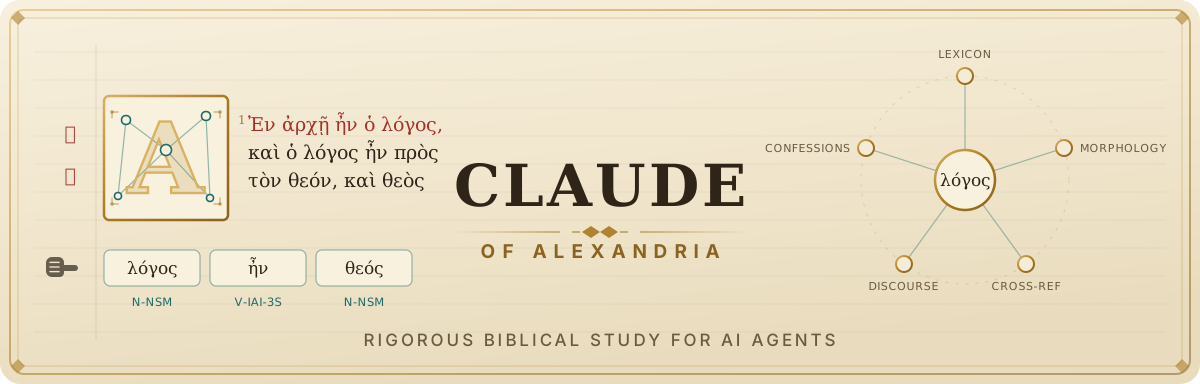





Structured frameworks that prevent AI agents from committing exegetical malpractice. Every skill is built with Test-Driven Development: document the failure, build the fix, verify it works.
The Problem
Frontier models make predictable errors when handling Scripture. These are documented by 53 RED-phase tests that run the same prompts without skills and record what goes wrong:
- Fabricating linguistic data from training memory — inventing morphological parsings, frequency counts, and hapax claims without querying actual data
- Inventing arbitrary divisions to satisfy session counts ("8 weeks on Philemon") without checking manuscript markers
- Presenting single frameworks for contested books as if scholarly consensus exists
- No confidence tiering — treating training-data guesses and parser-verified data with equal certainty
- Moralistic drift — "try harder" applications and therapeutic framing without gospel grounding
- Yielding to user pressure — skipping data verification when asked to "just be brief" or "skip the Greek"
- Accepting truncated pericopes — validating famous verses (John 3:16) as standalone units based on familiarity, not discourse evidence
- Genre-blind analysis — applying epistolary methods to wisdom literature, forcing narrative arcs on proverbial collections
- Ignoring ancient manuscript markers like Masoretic paragraph divisions and Levinsohn discourse features
- Auto-selecting options instead of presenting scholarly alternatives with evidence
The Evidence
136 automated tests verify that skills prevent documented failures. Tests run against claude-agent-sdk with live MCP data — not mocked responses.
| Phase | Tests | What it does |
|---|---|---|
| RED | 53 | Runs prompts against a bare model (no skills, no MCP). Documents what goes wrong. |
| GREEN | 50 | Core failure-mode corrections. One targeted assertion per documented failure. CI-friendly. |
| EXTENDED | 32 | Quality, adversarial, and stress scenarios — run on-demand during skill development. |
| Smoke | 1 | Verifies the skill-to-agent pipeline works end-to-end. |
GREEN assertions use an Opus grader for LLM-rubric evaluation plus structural checks (icontains, section presence). Each GREEN scenario targets one documented RED failure mode. If a skill cannot demonstrate that it prevents a documented failure, it does not ship.
Current Collection
6 skills + 6 sub-agents, all production. Coverage: all 66 canonical books.
Skills
biblical-segmentation
Divides biblical books into coherent teaching units with integrity safeguards:
- Refuses impossible divisions (you cannot divide Philemon into 12 sessions)
- Presents multiple scholarly-grounded options
- Validates against Masoretic paragraph markers and Levinsohn discourse features
- Handles contested books with multiple frameworks
24 maintainer-run eval scenarios (12 RED + 12 GREEN) + 6 extended scenarios.
pericope-delimitation
Validates whether a proposed passage holds together as a discourse unit:
- Checks boundaries against Levinsohn discourse features (NT) and Masoretic markers (OT)
- Returns verdict: VALID, EXTEND, CONTRACT, or ADJUST
- Recommends the smallest coherent unit if passage is too short
12 maintainer-run eval scenarios (6 RED + 6 GREEN) + 8 extended scenarios. Resists memory-based validation of famous passages.
exegetical-notes
Produces exegetical notes for sermon or teaching preparation:
- 10-section schema from literary context through verification
- Parser-verified lexical data (not training memory guesses)
- 4-tier interpretive labels: linguistic, discourse, scholarly, agent assessment
- Genre-graduated redemptive-historical connections (epistles vs. wisdom literature vs. short letters)
37 maintainer-run eval scenarios (20 RED + 17 GREEN) + 12 extended scenarios (adversarial + stress tests for Philemon, Proverbs, 3 John).
consult-biblical-scholar
Scholarly Q&A for biblical texts. Three auto-detected modes:
- MEANING — lexical and linguistic explanation
- VALIDATE — checks analogies, illustrations, or claims against text; returns formal verdict
- CROSS-REFERENCE — finds related passages with scholarly evidence
14 maintainer-run eval scenarios (7 RED + 7 GREEN) + 3 extended scenarios. Graduated confidence declared before every answer.
argument-flow
Maps the logical argument of a biblical passage using discourse markers:
- Produces connective-anchored proposition chains
- Calls MCP tools for conjunction and discourse data before composing analysis
- Grounds every interpretive claim in retrieved data
16 maintainer-run eval scenarios (8 RED + 8 GREEN) + 3 extended scenarios. For epistles and discourse-heavy passages.
passage-glossary
Assembles a passage reader with a deduplicated lemma glossary:
- Pulls the lemmas of a passage via morphology, deduplicates them, and renders each distinct headword once
- Grounds every gloss in MCP lexicon data; supports multi-passage spans
- Always English output
Composes existing morphology and lexicon tools into a graded-reader study artifact.
Sub-Agents
Skills delegate specialized work to sub-agents. You do not invoke these directly — skills spawn them automatically.
study-evaluator (Sonnet)
    └── biblical-scholar (Sonnet)
            └── data-retriever (Haiku)
| Agent | Model | Role |
|---|---|---|
data-retriever |
Haiku | Fetches MCP data and compresses into structured summaries with testament-aware routing |
biblical-scholar |
Sonnet | Scholarly analysis with three modes (ANALYZE, VALIDATE, TRACE), confidence tiers, source attribution |
study-evaluator |
Sonnet | Evaluates bible study outlines and transcripts against exegetical standards with drift classification |
pericope-delimitation |
Sonnet | Boundary validation with structured verdicts grounded in discourse markers |
argument-flow |
Sonnet | Logical structure mapping with connective-anchored proposition chains |
smoke-test |
Haiku | Pipeline verification (returns a known marker string) |
Agent correctness is tested indirectly through skill GREEN suites, plus 11 dedicated RED-phase tests that document bare-model failure modes.
Development Setup
Pre-commit hook
ln -sf ../../scripts/pre-commit.sh .git/hooks/pre-commit
This runs secret scanning, TypeScript typecheck, and server tests before every commit.
Installation
Claude Code (Marketplace)
/plugin marketplace add davebream/claude-of-alexandria
/plugin install claude-of-alexandria@claude-of-alexandria
The MCP server is included and auto-configured.
Claude Code 2.1.217
and later require an explicit opt-in for nested sub-agent delegation. Set the
maximum spawn depth to 3, which supports the deepest current chain
(main → study-evaluator → biblical-scholar → data-retriever).
POSIX shells (bash, zsh):
export CLAUDE_CODE_MAX_SUBAGENT_SPAWN_DEPTH=3
Fish:
set -x CLAUDE_CODE_MAX_SUBAGENT_SPAWN_DEPTH 3
If the variable is unset, scholar agents keep working through their direct-MCP
fallback, but they skip the data-retriever compression step and may report
reduced confidence.
Claude Code (Manual)
git clone https://github.com/davebream/claude-of-alexandria.git
cd claude-of-alexandria
ln -s $(pwd)/plugins/claude-of-alexandria ~/.claude/plugins/claude-of-alexandria
The MCP server runs remotely on Cloudflare Workers.
Claude Desktop
Step 1: Download skill ZIPs from the latest release and add SKILL.md contents as project knowledge.
Step 2: Add to your Claude Desktop MCP configuration:
- macOS:
~/Library/Application Support/Claude/claude_desktop_config.json - Windows:
%APPDATA%\Claude\claude_desktop_config.json
{
  "mcpServers": {
    "claude-of-alexandria-mcp": {
      "command": "npx",
      "args": ["mcp-remote", "https://coa.davebream.com/mcp"]
    }
  }
}
Requires Node.js. Restart Claude Desktop after saving.
Verify Installation
- Claude Code: Run
/skillsand look for all five skills and/agentsfor sub-agents - Claude Desktop: Ask Claude to use
query_vocabularyfor any biblical book
Reference Server
The MCP server provides linguistic data via Cloudflare Workers + D1 (edge SQLite). No local installation required.
Successful responses include a required provenance object identifying every dataset used on that page. Full license detail is at coa.davebream.com/legal/datasets. The v5 contract also keeps native JSON arrays, explicit modes, and page.next_cursor pagination from v4. See the MCP v5 migration guide.
| Tool | What It Queries | Coverage |
|---|---|---|
list_books |
Available biblical books and thematic keyword groups | Both testaments |
query_discourse_features |
Levinsohn NT discourse features | NT |
query_paragraph_breaks |
Masoretic petuchah/setumah markers | OT |
query_ot_structure |
Verse-edge syntax, participant, and speech boundary context from Macula Hebrew lowfat XML | OT |
query_vocabulary |
Lemma frequencies, thematic keywords, clustering | Both testaments |
query_morphology |
Word-level morphological parsing | Both testaments |
query_ot_quotes |
OT quotations and allusions in the NT | NT |
query_themes_for_lemmas |
Resolve morphology lemmas to vocabulary theme names | Both testaments |
query_lemmas |
Cross-book lemma distribution | Both testaments |
query_theme_distribution |
Cross-book distribution of a thematic keyword group | Both testaments |
query_lexicon |
Strong's, lemma, or definition search across bundled lexica | Both testaments |
check_versification |
Hebrew-English verse-numbering differences | OT |
query_cross_references |
Pageable verse adjacency in the cross-reference graph | Both testaments |
trace_cross_reference_path |
Bounded path traversal through cross-references | Both testaments |
query_people |
People named in a passage | Both testaments |
query_places |
Places named in a passage | Both testaments |
query_events |
Events associated with a book or chapter range | Both testaments |
query_person_network |
Relationships and co-appearances for a person | Both testaments |
query_speakers |
Speaker-attributed quotation spans | Both testaments |
query_syntax |
Clause-level syntax annotations | NT |
query_variants |
Textual variant edition comparisons | NT |
bible_lookup |
Verse text in a selected translation | Both testaments |
commentary_lookup |
Public-domain commentary entries | Both testaments |
parallel_text |
Verse-aligned translation comparison | Both testaments |
confessional_lookup |
Confessional and catechetical documents from Reformed, Baptist, Lutheran, and ancient traditions — lookup by slug, scripture citation, keyword, or list | Non-biblical |
liturgical_lookup |
Church-year season → recommended passages + themes, and reverse passage → season(s) lookup (curated, Protestant-oriented) | Non-biblical |
query_controversies |
Look up academically contested topics (historicity/dating/authorship) by topic or passage → rating + balanced both-sides positions with sources. Also surfaces a chapter_contested discovery flag via query_events when a queried chapter overlaps known controversial passages. |
Non-biblical |
Skills call these automatically. You can invoke them directly if needed.
Hermeneutical Framework
Skills use historical-grammatical method with explicit theological guardrails:
| Guardrail | What It Prevents |
|---|---|
| Anti-moralism mandate | "Try harder" applications without gospel grounding |
| Christ-centeredness | Missing the redemptive-historical arc |
| Context primacy | Ripping verses from literary and canonical context |
| Genre governance | Applying wrong methods to text types |
| Covenantal awareness | Flattening testaments into a proof-text database |
Acknowledgments
Linguistic foundations: Stephen H. Levinsohn (Greek NT discourse analysis) and the OpenScriptures Hebrew Bible / OSHB (Masoretic Text paragraph data, Westminster Leningrad Codex).
Hermeneutical framework: Historical-grammatical method. The Alexandrian school gave us systematic textual criticism. The Antiochene school insisted interpretation stay anchored to the historical sense. The Reformers inherited both. So do we.
Namesake: Clement of Alexandria (c. 150-215 AD), who demonstrated that rigorous scholarship and faithful theology are not in tension.
Contributing
See CLAUDE.md for development guidelines. The head librarian is strict about TDD.
License
GNU General Public License v3.0
6 skills, 6 sub-agents, 136 maintainer-run eval scenarios total — 104 core-CI (53 RED + 50 GREEN + 1 smoke) plus 32 on-demand extended. All 66 biblical books. 358 server unit tests (these run in CI).
Reviews (0)
Sign in to leave a review.
Leave a reviewNo results found