AI-TadPole-OS
Health Warn
- License — License: MIT
- Description — Repository has a description
- Active repo — Last push 0 days ago
- Low visibility — Only 5 GitHub stars
Code Warn
- network request — Outbound network request in .agent/skills/frontend-design/scripts/ux_audit.py
Permissions Pass
- Permissions — No dangerous permissions requested
No AI report is available for this listing yet.
AI-Tadpole-OS a local-first "development platform" a Lily Pad to jump from for running autonomous AI agent teams on your own hardware. Coordinate parallel workflows, maintain full data privacy, and oversee every decision — no cloud required.
[!IMPORTANT]
AI Assist Note (Knowledge Heritage):
This document is part of the "Sovereign Reality" documentation.
- @docs ARCHITECTURE:Core
- Failure Path: Information drift, legacy terminology, or documentation mismatch.
- Telemetry Link: Search
[README]in audit logs.AI Assist Note
Core technical resource for the Tadpole OS Sovereign infrastructure.
🔍 Debugging & Observability
Traceability via
execution/parity_guard.py.
🐸 AI-Tadpole-OS
Sovereign Intelligence. Deterministic Execution. Zero Data Leaks.
The high-performance, local-first runtime for orchestrating autonomous multi-agent swarms.
Version: 1.1.173







🚀 Start a Mission • 🏗️ Architecture Hub • 🛡️ Security Model • 🌐 Product Website • 💬 Join Discussions
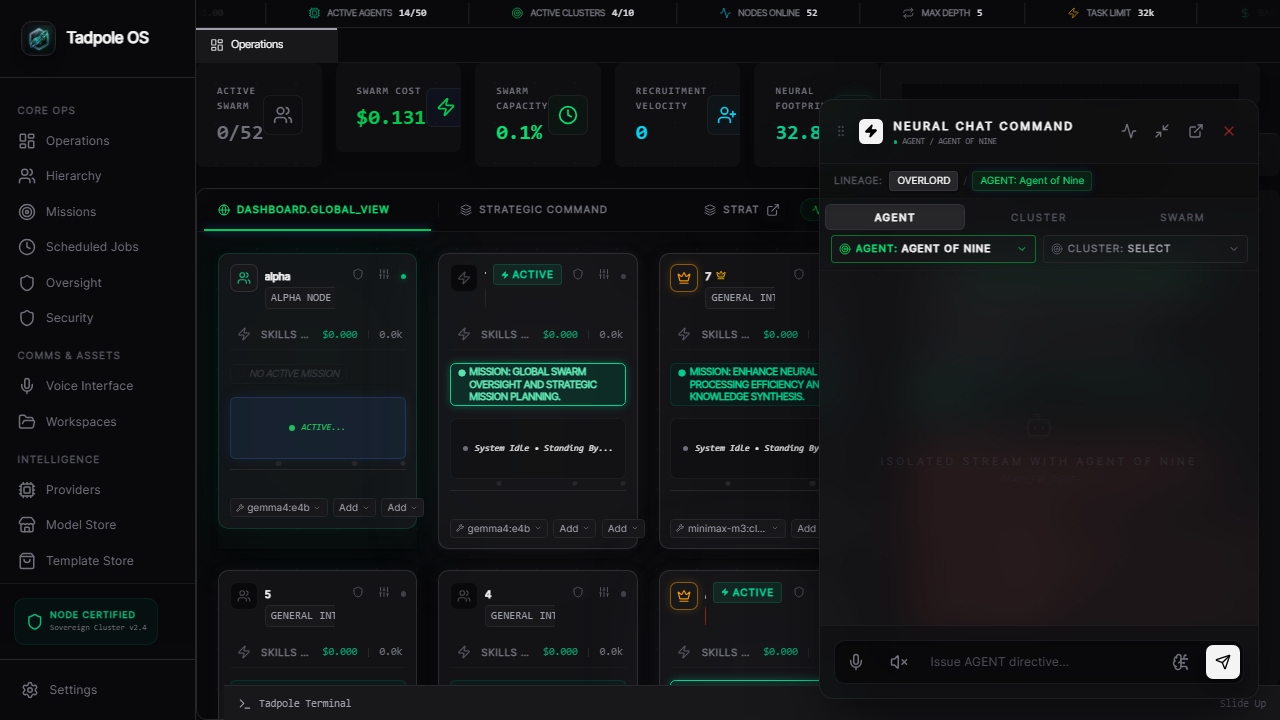
AI-Tadpole-OS is a local-first runtime for orchestrating autonomous teams of AI agents — without sending your data to the cloud. Define a goal, assign a hierarchy of specialized agents, and watch the engine coordinate them in parallel.
Designed for teams requiring uncompromising data sovereignty, Tadpole OS bridges the gap between probabilistic LLM outputs and deterministic business logic.
🛡️ Sovereignty starts with a Clone
In a world of "AI-as-a-Service," true independence is a local copy. We prioritize Git Clones because a clone is the ultimate act of data sovereignty:
- Total Ownership: No one can "unplug" your intelligence stack.
- Privacy by Default: Your data never leaves your infrastructure.
- Air-Gapped Ready: Run missions in completely disconnected environments.
- Deterministic Control: You own the code, the directives, and the memory.
Clone the repo. Own your intelligence.
🏗️ The 3-Layer Architecture
Why Tadpole OS is more reliable than a standard agent wrapper.
| Layer | Component | Purpose |
|---|---|---|
| L1: Directive | directives/ |
Intent: Human-defined SOPs and goals. Non-negotiable rules for the swarm. |
| L2: Orchestration | Agent 99 |
Decision: Intelligent routing, self-correction, and wisdom extraction. |
| L3: Execution | execution/ |
Action: Deterministic Python/Rust scripts. No "hallucinated" code execution. |
🧠 Feature Spotlight: Agent 99 (Self-Annealing)
The system that learns from its own history.
Tadpole OS doesn't just run tasks; it performs Self-Annealing. After every mission, Agent 99 autonomously:
- Extracts Architectural Wisdom: Analyzes logs to find what worked and what didn't.
- Updates Institutional Memory: Writes learnings back to
LONG_TERM_MEMORY.md. - Refines Protocols: Adjusts its own directives to prevent future drift.
🧩 Core Capability Pillars
🖥️ 1. Reactive Interface & ObservabilityBuilt for high-density swarm oversight with sub-millisecond telemetry.
- Detachable Portals: Spread tactical sectors across multiple physical displays.
- 10Hz Swarm Pulse: Real-time MessagePack telemetry for agent performance.
- God-View Visualizer: High-performance 2D Force-Graph of your agent hierarchy.
- Codebase Knowledge Graph HUD: Traversal history stack with Back/Forward controls, and double-scale high-res canvas PNG exports.
- BFS Dependency Pathfinder: Computes and highlights shortest dependency or call traces between symbols on the graph.
- Resilient Sanitizer: Fault-tolerant client-side parsing utility ensuring data schema and referential integrity.
- Hardware Telemetry: Real-time CPU, RAM, and Process load visualization.
Hierarchical coordination powered by a Rust-native engine.
- CEO/COO Patterns: Strategic-to-tactical delegation protocols.
- Parallel Swarming: High-throughput sub-agent recruitment via
FuturesUnordered. - Triple-Slot Routing: Primary, Secondary, and Tertiary model slots per agent.
- Autonomic Fallback: Self-healing quantization adjustment on hardware limits.
Split-brain architecture for semantic and relational data.
- LanceDB Vector Store: Cross-session institutional knowledge.
- Mission Sandboxing: Localized RAG scopes that cleanup automatically on completion.
- Hybrid Search: Combines SQLite deterministic logs with high-dimensional embeddings.
Zero-trust governance with human-in-the-loop gates.
- Sapphire Shield: Flags
budget:spendandshell:executefor manual approval. - Hard Privacy Gate: Explicitly blocks external traffic for 100% air-gapped runs.
- OBLITERATUS Hardening: 100% audit-verified code paths and Merkle trails.
- Active Documentation Guard (ADG): Static analysis engine (Symbol Gate & Markdown Validator) that prevents conceptual drift by validating that all backticked code symbols in file headers match implementation code, and all path references in directives exist on disk.
🚀 Quick Start (60 Seconds)
1. Prerequisites
- Rust (1.80+) & Node.js 20+
- Ollama (for local models) or an API Key (OpenAI, Anthropic, Google, Groq).
2. Installation
# Clone and install dependencies
git clone https://github.com/DDS-Solutions/AI-Tadpole-OS.git
cd AI-Tadpole-OS
npm install

# Setup environment
cp .env.example .env
# Edit .env and set your NEURAL_TOKEN and API Keys
3. Launch the Swarm
# Terminal A: Start the Rust Engine
npm run engine

# Terminal B: Start the React Dashboard
npm run dev
🛰️ Scalability & Topology: The Max-Scale Swarm
Visualizing what a Full-Capacity Swarm (10 Clusters, 25 Agents) looks like.
View Swarm Hierarchy Diagramgraph TD
classDef cluster fill:#222,stroke:#444,stroke-width:2px,color:#fff;
classDef node fill:#333,stroke:#666,color:#eee;
subgraph Cluster0 ["Executive Core (Google)"]
CEO["ID 1: CEO (Google Gemini 3 Pro)"]
end
CEO -->|issue_alpha_directive| COO["ID 2: COO (Claude Opus 4.5)"]
CEO -->|delegate| CTO["ID 3: CTO (GPT-5.3 Codex)"]
subgraph Cluster1 ["Operations Hub (Anthropic)"]
COO --> Ops1["ID 22: HR Manager"]
COO --> Ops2["ID 10: Support Lead"]
end
subgraph Cluster2 ["Engineering Sector (Groq/OpenAI)"]
CTO --> Eng1["ID 7: DevOps"]
CTO --> Eng2["ID 8: Backend Dev"]
end
subgraph Cluster3 ["Marketing/Sales (Meta/xAI)"]
CEO --> CMO["ID 4: CMO"]
CMO --> Mark1["ID 17: Copywriter"]
CMO --> Mark2["ID 19: SEO Specialist"]
end
subgraph Cluster4 ["Security Center (Mistral)"]
Eng1 --> Sec1["ID 12: Security Auditor"]
end
CEO --> CMO
class Cluster0,Cluster1,Cluster2,Cluster3,Cluster4 cluster;
class CEO,COO,CTO,CMO,Ops1,Ops2,Eng1,Eng2,Mark1,Mark2,Sec1 node;
Resource Allocation Matrix (Sample)
| Cluster | Focus | Provider | Model Capacity |
|---|---|---|---|
| Executive Core | Strategic Direction | Pro / Flash | |
| Operations Hub | Orchestration | Anthropic | Opus / Sonnet |
| Engineering Sector | Implementation | Groq / OpenAI | Llama / Codex |
| Security Center | Auditing | Mistral | Medium / Large |
🏭 Industry-Specific Solutions
Deploy specialized "One-Click" swarms for your sector.
- 💸 Finance: Automated bookkeeping and real-time audit trails.
- 📣 Marketing: Full-funnel content and SEO optimization.
- ⚖️ Legal/Medical: Compliance-first intake and document review swarms.
- 🏭 Manufacturing: Multi-tier templates for Job Shops to Smart Factories.
👉 Explore the Template Registry
🔱 Sovereign Forking Protocol
Tadpole OS is built to be forked. Create your own tactical branch:
- Fork this Repository to your own account.
- Customize Agents via the SQLite database or Swarm Templates.
- Deploy using the provided
deploy-bunker.ps1scripts.
Licensed under MIT. Sovereign Intelligence for all.
Reviews (0)
Sign in to leave a review.
Leave a reviewNo results found