llm-wiki
Health Warn
- License — License: MIT
- Description — Repository has a description
- Active repo — Last push 0 days ago
- Low visibility — Only 5 GitHub stars
Code Warn
- process.env — Environment variable access in apps/web/bin/llm-wiki.mjs
- network request — Outbound network request in apps/web/bin/llm-wiki.mjs
Permissions Pass
- Permissions — No dangerous permissions requested
No AI report is available for this listing yet.
Open source local-first knowledge base maintained by an LLM agent. Implements Andrej Karpathy's LLM Wiki pattern.
LLM Wiki
A personal Wikipedia an LLM maintains for you. Drop in articles, papers, notes, PDFs, or URLs — an agent compiles them into a cross-linked markdown wiki you fully own. Knowledge compounds: each new source makes every page richer, not just one new page longer.
Open source · Local-first · Bring-your-own-key · MIT · v1.1.1
This is a from-scratch implementation of Andrej Karpathy's LLM Wiki pattern, released April 2026.
Why this exists
| Existing tools | What they miss |
|---|---|
| RAG chat (NotebookLM, ChatGPT files) | Stateless. Rediscovers your corpus from scratch on every query. Never accumulates anything you can read later. |
| Note-taking apps (Obsidian, Notion) | All the maintenance burden on the human. You write, you cross-link, you check for contradictions. Nothing scales. |
| LLM Wiki | Sits between them. The LLM does the maintenance; the wiki accumulates value; you own the markdown files. |
After a few weeks of feeding it sources, you have a navigable, cited, deliberately-organized body of knowledge about whatever you care about — without ever having written a page yourself.
Screenshots
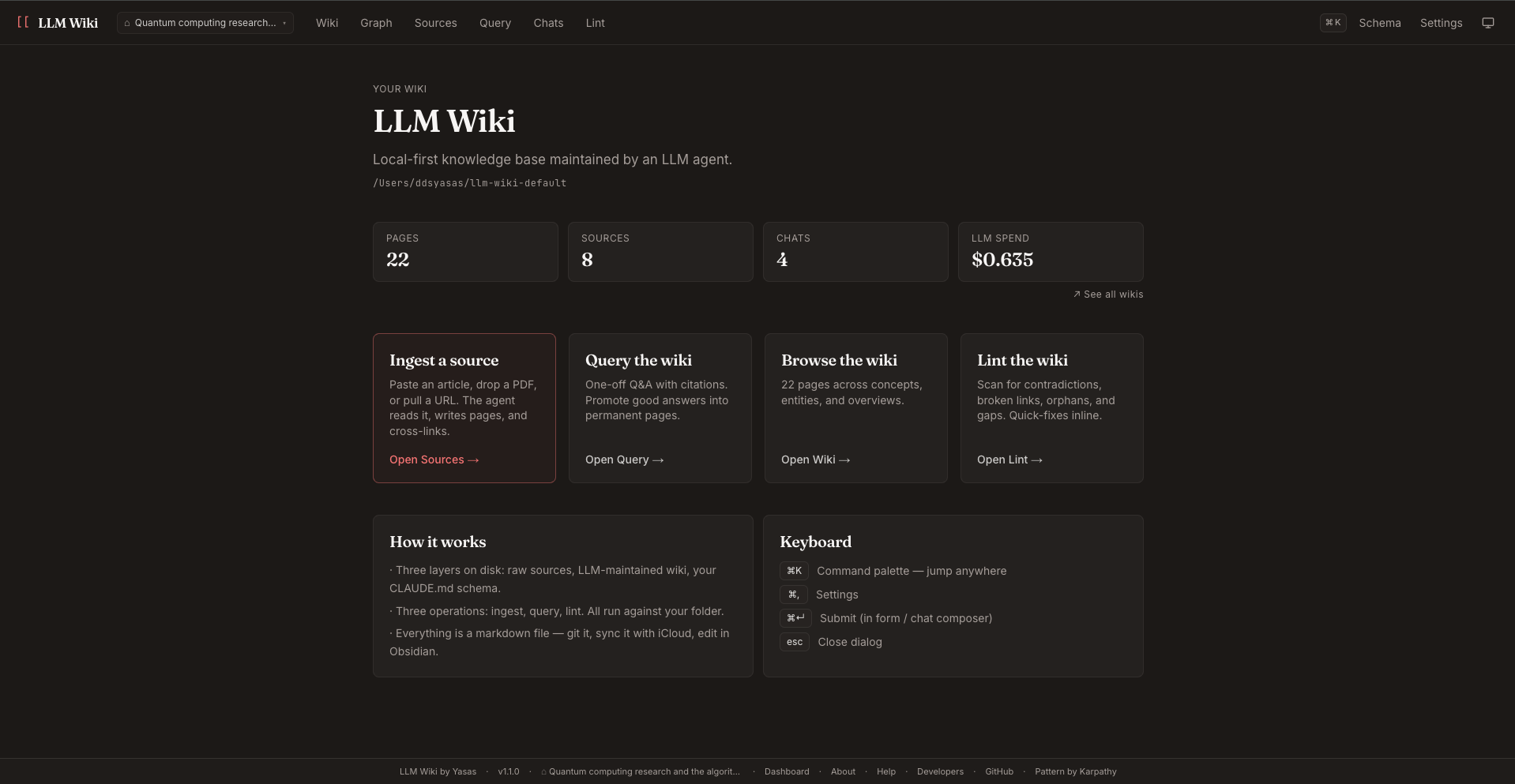
Home — per-wiki page / source / chat counts, cumulative LLM spend (click → cross-wiki dashboard), and the four primary actions. Footer chips reach every meta-surface (About, Help, Developers, Dashboard).
The wiki layer
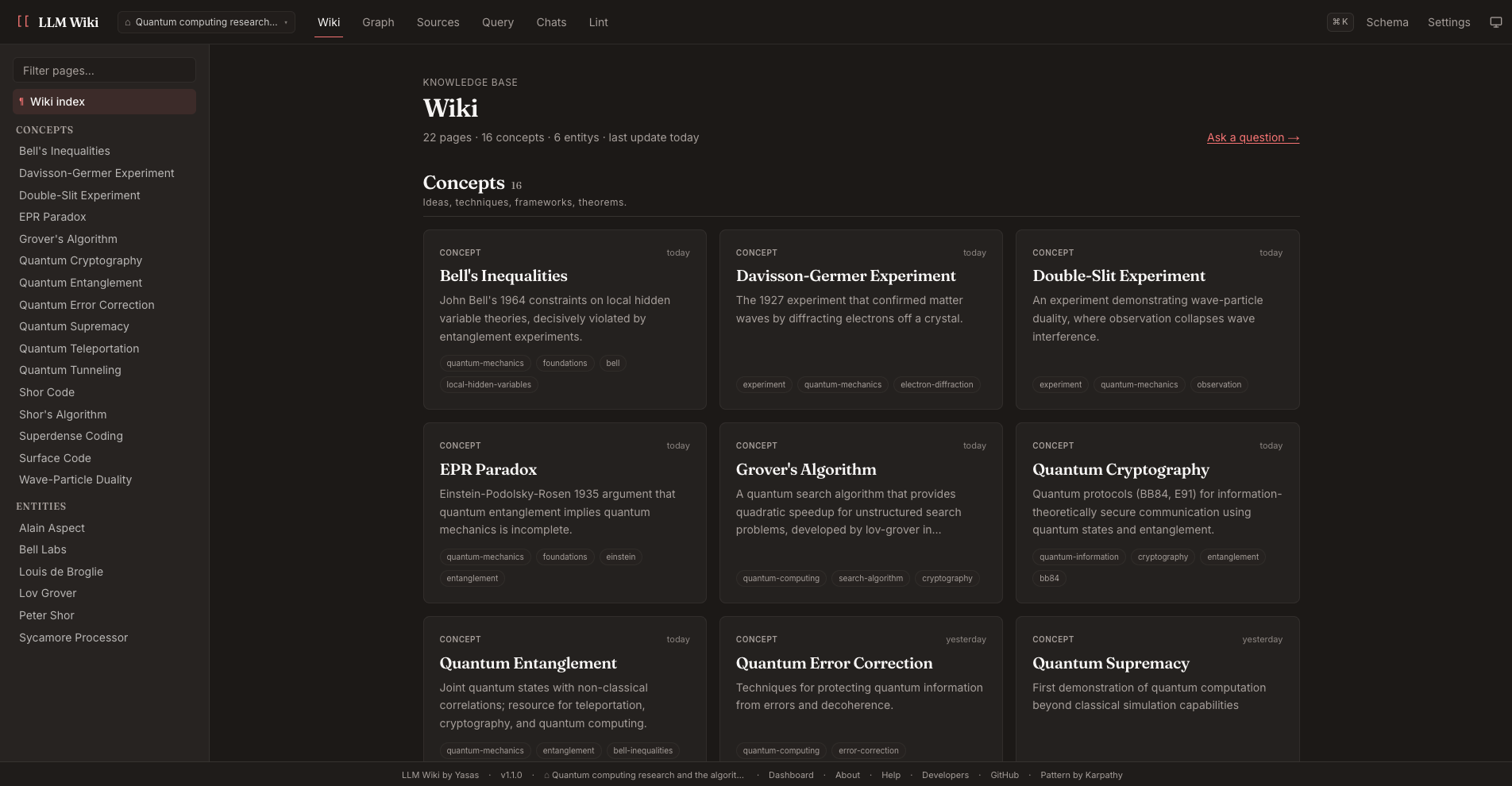
/wiki — pages grouped by type (Concepts, Entities, Comparisons, Overviews). Sidebar has search + filter; clicking any card opens the page with backlinks and source lineage.
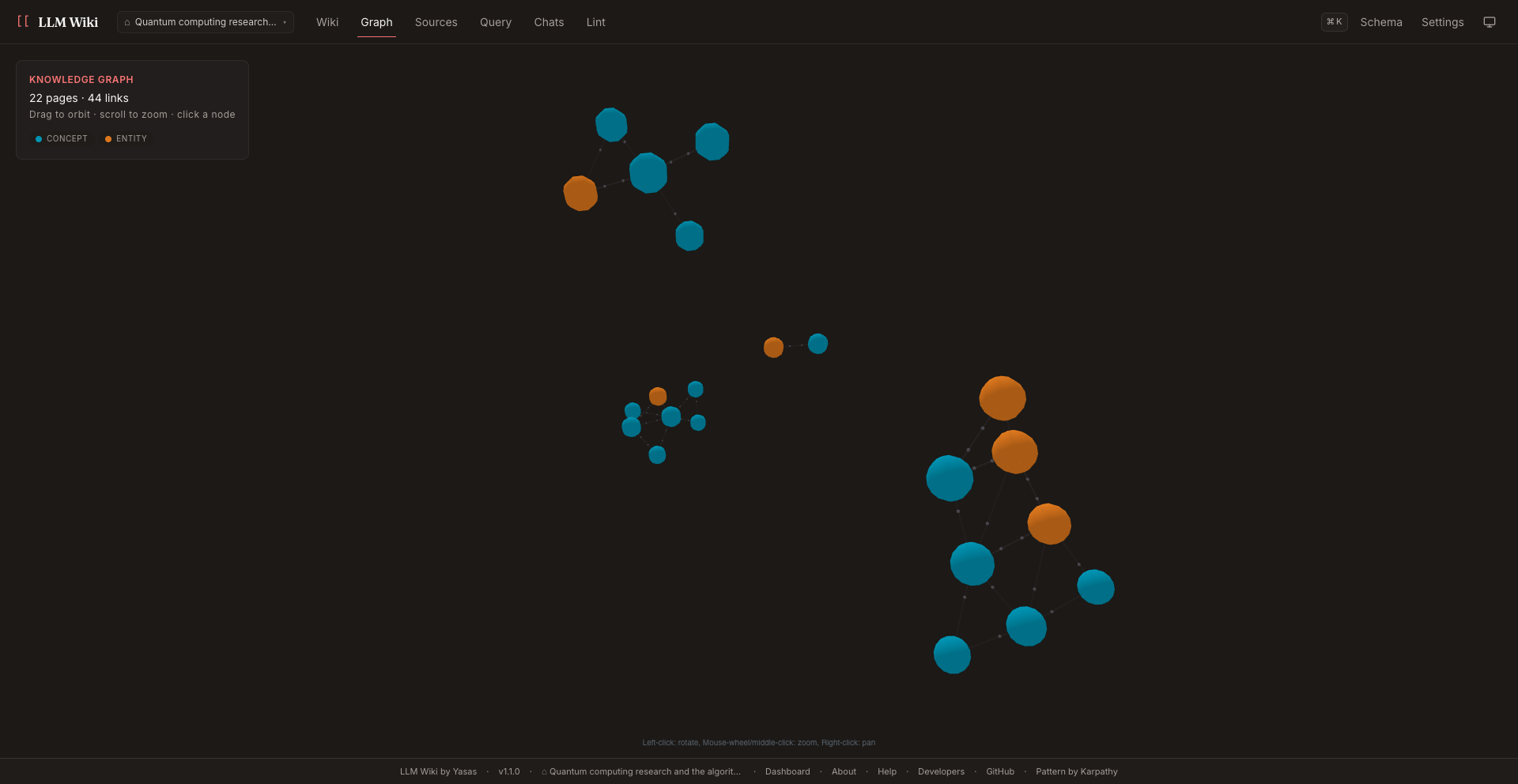
/graph — every page and every [[wikilink]] as a 3D force-directed network, colored by page type. Drag to orbit, scroll to zoom, click any node to focus.
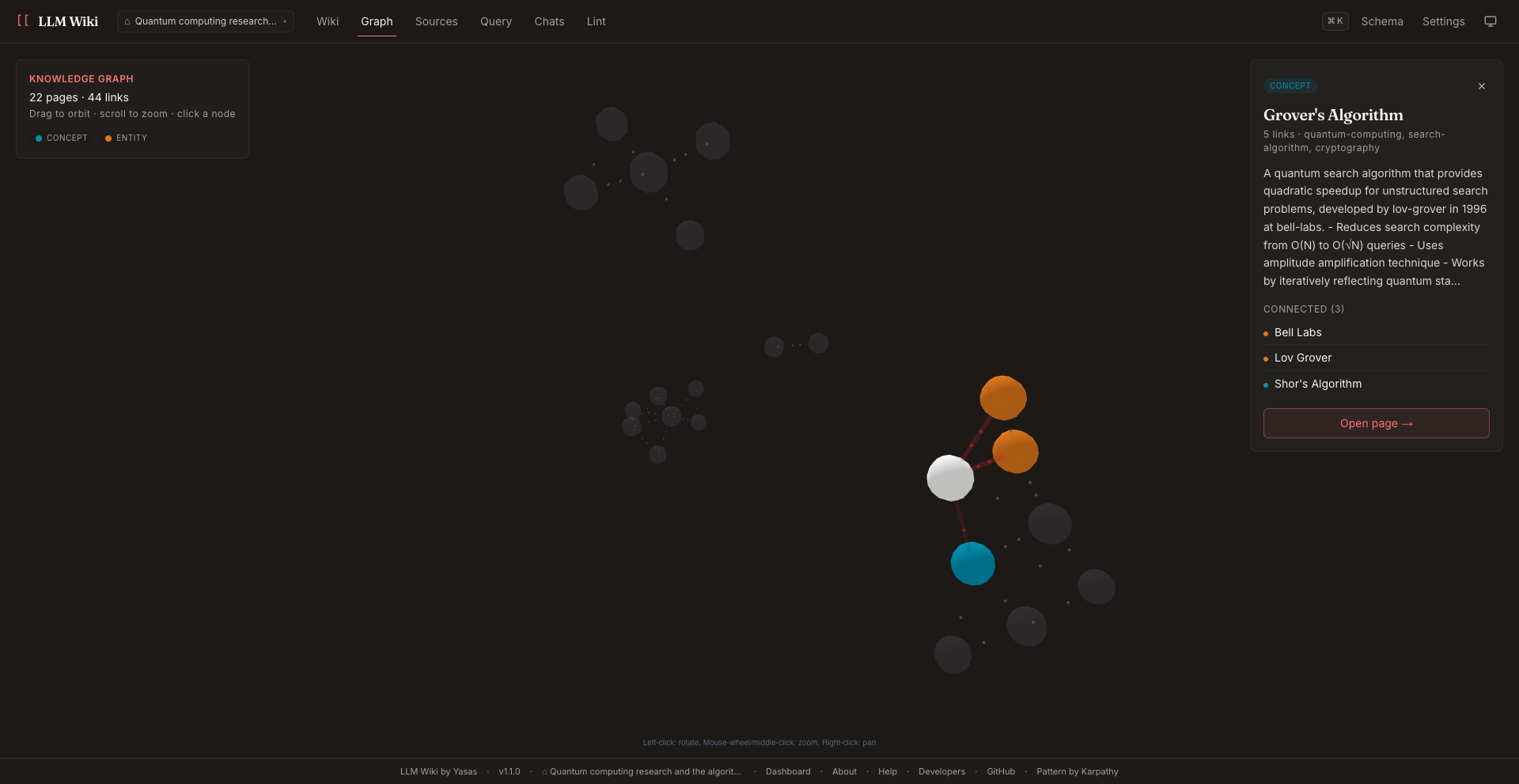
Clicking a node opens a side panel: outgoing links, full summary, connected pages. "Open page →" jumps to the wiki view of that node.
Operations
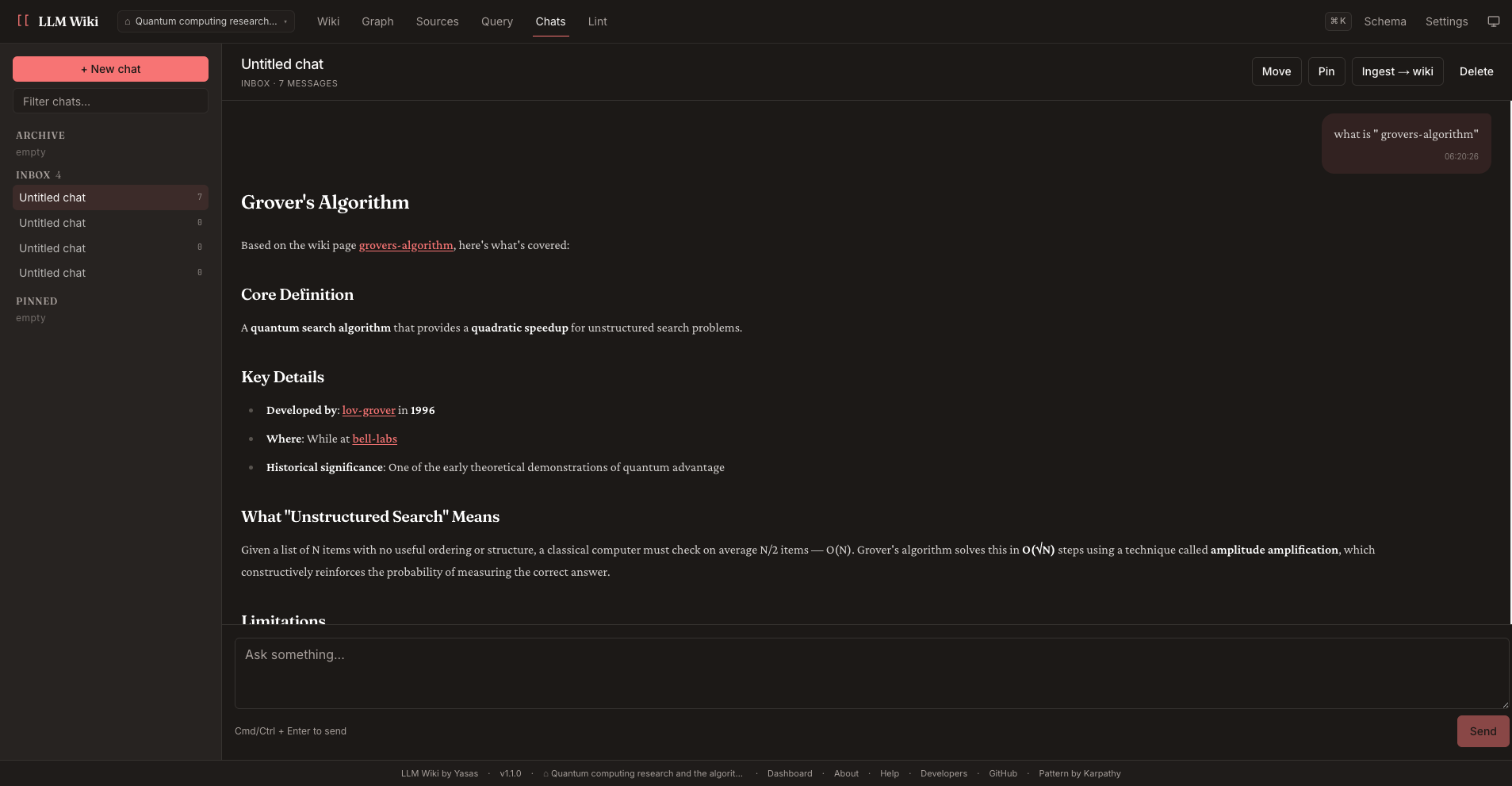
/chats/[id] — multi-turn conversations over your wiki, saved as plain markdown in chats/. "Ingest → wiki" promotes the conversation into permanent pages; per-message "Save as wiki page" promotes a single answer.
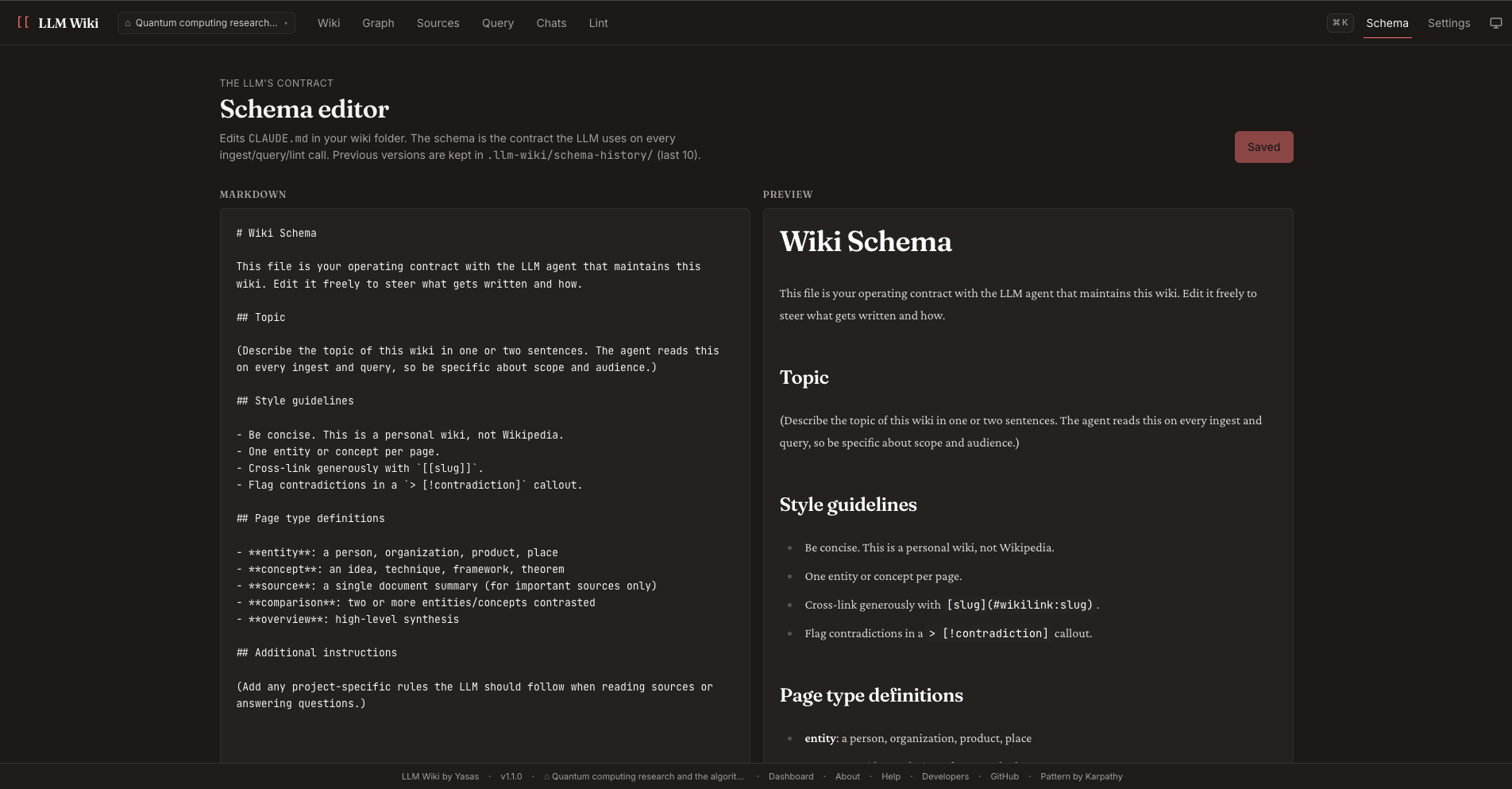
/schema — edit CLAUDE.md (the LLM's operating contract) with a split-pane markdown editor + live preview. Auto-backup to .llm-wiki/schema-history/ on every save.
Settings + multi-wiki
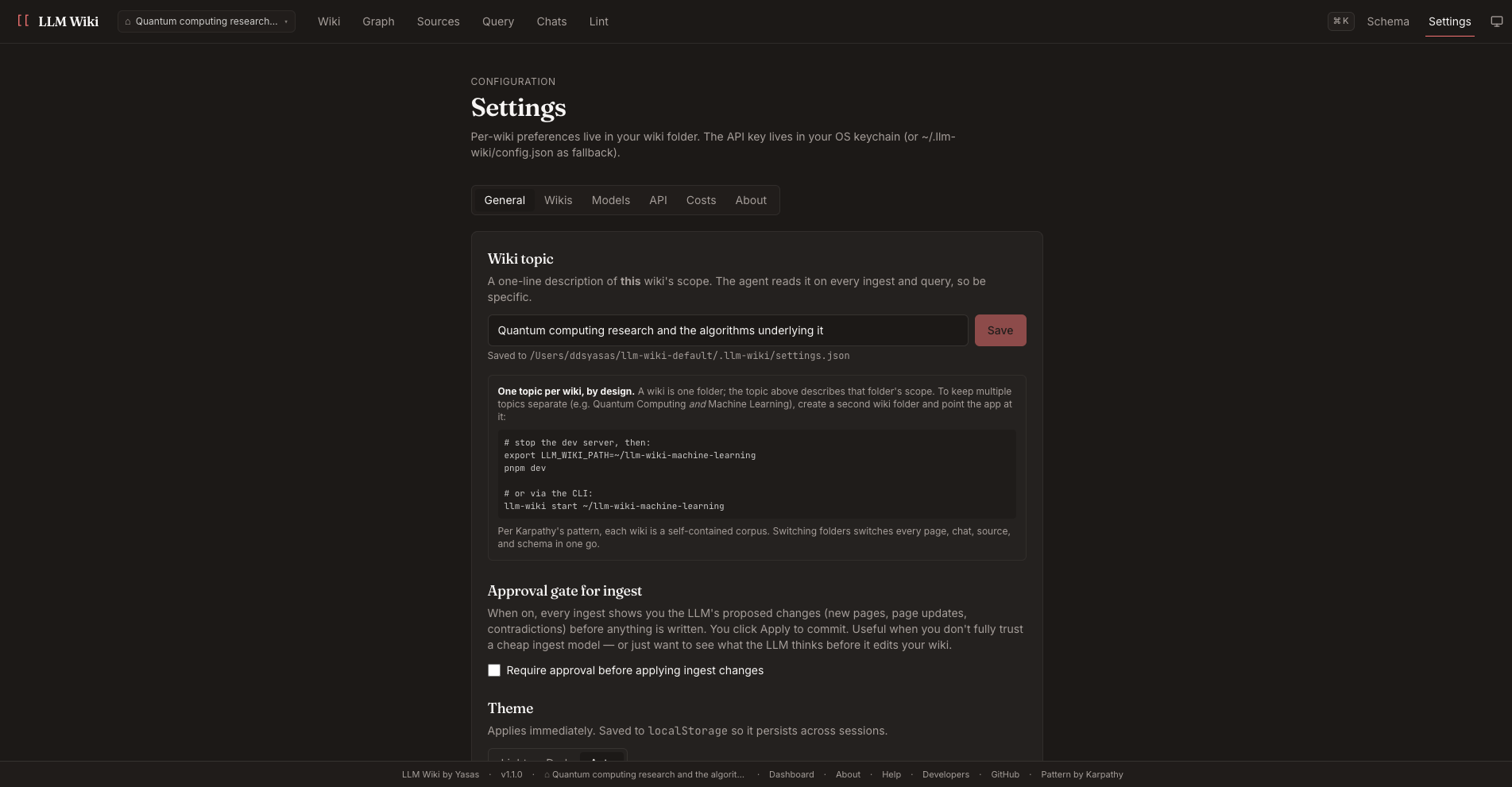
/settings — one-line wiki topic (the LLM reads this on every operation), optional approval gate for ingest, theme picker, default models per operation slot.
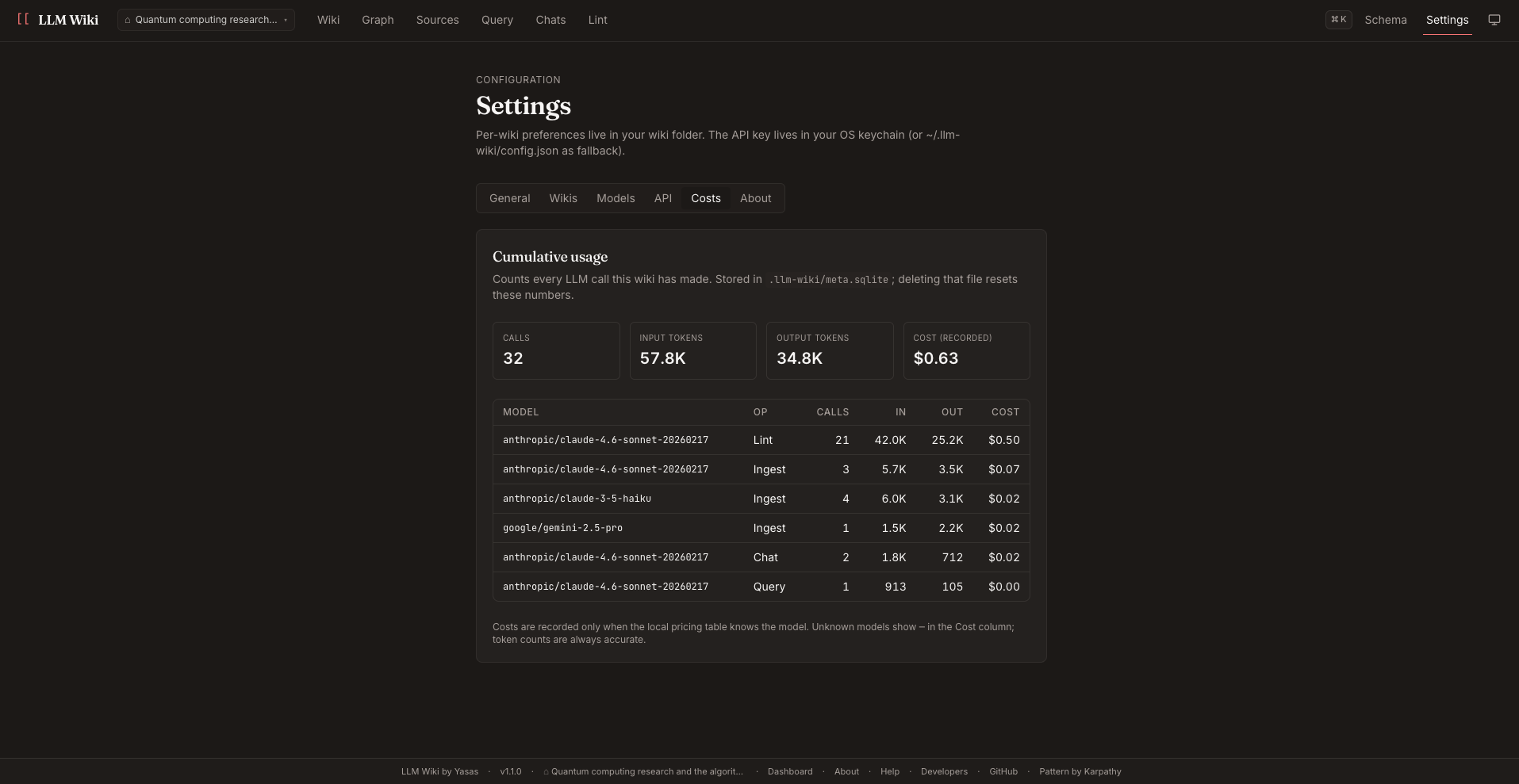
/settings → Costs — cumulative tokens + spend per (model, operation) pair. The Cost (recorded) column populates as new LLM calls land; historical rows get backfilled from the pricing table on next startup.
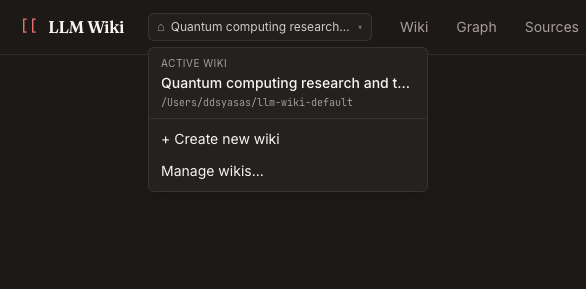
Header chip → dropdown with the active wiki (topic + folder path), plus quick links to Create / Manage. Same actions are reachable from ⌘K ("Switch to…" group) and /dashboard (per-wiki cards with Switch buttons).
What's in v1.1
The three operations (Karpathy's pattern)
- Ingest — Drop a source (text / file / URL / PDF / image) → the LLM reads it + your existing wiki, writes new pages, updates older pages where context shifts, refreshes the index, logs the change. Each ingest is a refactor pass, not an append.
- Query — One-shot Q&A against the whole wiki with cited pages. "Save as wiki page" promotes useful answers into permanent entries.
- Lint — Two-pass health check: local scan (broken links, orphans) + LLM pass (contradictions, gaps, stale claims, missing pages). Every issue ships with one-click fixes — including LLM-powered ones that write the page edit for you.
Workflow features
- Sources page — Add via paste, drag-and-drop, or URL. Auto-detects format. Cost preview before every ingest. Per-source detail view shows the raw text, contributing wiki pages, and metadata.
- Wiki landing — Cards grouped by type (Overviews → Concepts → Entities → Comparisons → Sources). Search/filter sidebar. Click any card → page view with backlinks + source lineage + inline edit.
- 3D Graph view (new in v1.0) — Force-directed graph of every page and every
[[wikilink]]. Same engine as Obsidian's 3D Graph plugin, but colored by page type (not free-form tag), so the structure of your knowledge is visible at a glance. Click-to-focus reveals neighbors; drag/scroll to orbit; URL-state for deep links. Spec:docs/12-graph-view.md. - Chats — Multi-turn conversations saved as
.mdfiles in folders. Per-message "Save as wiki page" + whole-chat "Ingest → wiki" buttons close the loop from exploratory thinking back into the permanent layer. - Schema editor — Edit the
CLAUDE.mdcontract the LLM reads on every operation. Split-pane preview, auto-backup to.llm-wiki/schema-history/. - Log timeline —
/logshows every ingest / edit / lint / schema-save in chronological order. Wikilinks inside log entries are clickable. - Multiple wikis — keep separate wikis for separate topics (e.g. "Physics", "ML research", "Personal KB"). Switch from the active-wiki chip in the header, the
Cmd+Kpalette, or Settings → Wikis (full CRUD). Switching is in-place — you stay on whatever page you're on, the data refreshes around you. Spec:docs/13-multi-wiki.md. - Wiki health dashboard at
/dashboard(new in v1.x) — cross-wiki overview: per-wiki page / source / chat counts, cumulative LLM spend, last-touched timestamps, sortable by recency. Roll-up totals at the top. One-click switch into any wiki.
Quality / safety
- First-run gate — A real wizard collects the wiki topic + OpenRouter key before letting you wander. No silent failures on first ingest.
- Page-history backups — Every page edit (manual or LLM-driven) backs up the prior version to
.llm-wiki/page-history/. - Cost transparency — Estimated cost shown before every LLM operation; running cumulative tally in Settings → Costs.
- Source lineage — Every wiki page lists which raw sources it was compiled from; every source lists which wiki pages it contributed to. Bidirectional graph traversal.
- Index integrity —
index.mdauto-refreshes on every page edit. Click "Rebuild index" anytime for a full re-sweep.
Settings
Five model slots tunable per-operation: ingest / query / chat / lint / vision. Curated dropdowns + custom-slug field for anything OpenRouter supports. Light / dark / auto theme. OpenRouter key stored in OS keychain when available.
The on-disk shape
~/llm-wiki-default/                  # your wiki folder (set with LLM_WIKI_PATH)
├── CLAUDE.md                        # the schema you edit at /schema
├── index.md                         # auto-maintained catalog of pages
├── log.md                           # every operation, browsable at /log
├── raw/                             # original source files, untouched
├── wiki/                            # LLM-maintained pages (Markdown + frontmatter)
├── chats/                           # chat threads as .md files
└── .llm-wiki/                       # SQLite metadata + page-history + schema-history
Everything is plain markdown. Delete the app, open the folder in Obsidian / VS Code / vim — your wiki still works.
Install + run
Two paths. Pick one.
Quick start — install the CLI (recommended)
npm install -g @syasas/llm-wiki
llm-wiki start
That's it — no git clone, no monorepo, ~30 second install. The CLI auto-initializes your wiki folder, picks a free port (3737 by default), and opens the browser. Verified on macOS / Linux (incl. WSL) / Windows.
Package on npm: npmjs.com/package/@syasas/llm-wiki. Release notes + tarball mirror: GitHub Releases. If npm is unavailable for some reason, you can install directly from the GitHub tarball: npm install -g https://github.com/ddsyasas/llm-wiki/releases/download/v1.1.1/syasas-llm-wiki-1.1.1.tgz.
From source — for development or contributing
git clone https://github.com/ddsyasas/llm-wiki.git
cd llm-wiki
pnpm install
pnpm dev
Open http://localhost:3000 → the first-run wizard collects your wiki topic + OpenRouter key → you're in.
Prerequisites
| Tool | Minimum | How to get it |
|---|---|---|
| Node.js | 20.x | nodejs.org or nvm install 20 (recommended) |
| OpenRouter key | — | openrouter.ai/keys — pay-as-you-go, ~$5 lasts most users 2-4 weeks at default models |
| pnpm (source path only) | 8.x | npm install -g pnpm |
Check with node --version before you start.
llm-wiki: command not found after install
The package installed fine — npm just put the binary somewhere your shell isn't looking. Common on WSL Ubuntu when Node was installed via apt with a non-standard npm prefix. Diagnostic:
# Find where npm put the binary
npm prefix -g

# Confirm it landed there
ls -la "$(npm prefix -g)/bin/llm-wiki"

# One-off: run via full path
"$(npm prefix -g)/bin/llm-wiki" doctor
Permanent fix (one-time):
echo 'export PATH="$(npm prefix -g)/bin:$PATH"' >> ~/.bashrc
source ~/.bashrc
llm-wiki doctor
(On zsh, swap ~/.bashrc for ~/.zshrc. On Windows PowerShell, npm install -g normally puts bins in %AppData%\npm\ which is on PATH by default — if you hit this on Windows, run npm config get prefix and add <that>/bin to your user PATH via System Properties.)
Per-OS install notes
macOS — verified end-to-end. Works out of the box with Node from nodejs.org or nvm. Xcode Command Line Tools are usually already present; if npm install complains: xcode-select --install.
Linux (Ubuntu / Debian / Fedora / Arch / WSL) — verified end-to-end. If npm install -g fails on the native deps (better-sqlite3, keytar), install build tools first:
# Debian / Ubuntu / WSL
sudo apt install build-essential python3 libsecret-1-dev

# Fedora / RHEL
sudo dnf install gcc-c++ make python3 libsecret-devel

# Arch
sudo pacman -S base-devel python libsecret
libsecret is what keytar talks to for the system keychain (GNOME Keyring, KWallet). Without it keytar still installs, but secret storage falls back to a chmod-600 file in ~/.llm-wiki/.
Windows — verified end-to-end via PowerShell + Node 20. keytar uses Windows Credential Manager natively, no extra setup. If npm install -g fails on the native deps, install the C++ build tools component of Visual Studio Build Tools 2022 — most recent Node versions skip this since prebuilt binaries are usually available.
ChromeOS — enable Crostini Linux dev environment, then follow the Linux path.
Docker — not officially shipped, but works fine: node:20-bookworm base image, install the tarball, bind-mount your wiki folder. PR with a Dockerfile welcome.
Mobile (iOS / Android) — not supported. LLM Wiki is a local server, not a packaged mobile app. The V2 Tauri installer (roadmapped) targets desktop OSes, not phones.
Run the dev server
From the repo root:
pnpm dev
Output:
- Local:        http://localhost:3000
✓ Ready in 1.5s
First page load takes 10-30 seconds while Next compiles routes lazily — watch the terminal for ✓ Compiled / in XXXms, then the page renders. Subsequent loads are instant.
To point at a wiki folder other than the default ~/llm-wiki-default:
# macOS / Linux / WSL
export LLM_WIKI_PATH=~/my-research-wiki
pnpm dev

# Windows PowerShell
$env:LLM_WIKI_PATH = "C:\Users\you\my-research-wiki"
pnpm dev

# Windows cmd
set LLM_WIKI_PATH=C:\Users\you\my-research-wiki
pnpm dev
You can also switch wikis at runtime from Settings → Wikis without restarting the server.
Using the CLI
After npm install -g <tarball>, the llm-wiki command is on your PATH globally:
# Start (uses current directory as the wiki folder)
llm-wiki start

# Start in a specific folder (auto-initializes it if empty)
llm-wiki start ~/research/quantum

# Initialize a folder as a wiki without starting the server
llm-wiki init ~/research/quantum

# Probe install + OpenRouter connectivity
llm-wiki doctor

# Full command + flag list
llm-wiki help
If you're working from source (didn't npm install -g), invoke via Node directly: node apps/web/bin/llm-wiki.mjs <command> — or use the workspace shortcut pnpm --filter @llm-wiki/web cli -- <command>.
The CLI defaults to port 3737 (vs. pnpm dev's 3000) and auto-picks the next free port if it's taken. Brand-new directories become working wikis on first start — no separate init step required unless you want one.
Flags:
| Flag | Effect |
|---|---|
--port 4000 |
Bind a specific port (also reads LLM_WIKI_PORT env var) |
--no-open |
Don't auto-launch the browser |
--quiet |
Suppress non-error logs |
--debug |
Verbose logs with stack traces |
doctor output:
$ llm-wiki doctor
Checking installation...
  ✓ llm-wiki version: 1.1.1
  ✓ Node version: v20.11.0
  ✓ Platform: darwin arm64

Checking config...
  ✓ Config dir: /Users/you/.llm-wiki
  ✓ OpenRouter API key set in config file (sk-or-v1...abc1)

Checking OpenRouter connectivity...
  ✓ Reachable
  ✓ API key valid (account: your-label)

Recent wikis:
  · /Users/you/research/quantum
  · /Users/you/llm-wiki-default

All checks passed. ✓
If doctor reports the API key as "NOT set in config file", that's expected — the app prefers the OS keychain for keys, which the CLI can't inspect from outside the running server. Use the Settings page in the browser to verify the keychain entry.
Updating
git pull
pnpm install   # picks up any new deps
Database migrations run automatically on the next server start.
Building a publishable tarball
Want to package the app as a standalone npm tarball you can host yourself (or publish under your own scope)? After pnpm install:
pnpm --filter @llm-wiki/web build:publish    # produces apps/web/dist-publish/
cd apps/web/dist-publish
npm pack                                      # 29MB tarball, fully self-contained
# or:
npm publish --access public                   # ship it to npm
The published artifact is a single package with one runtime dep (open, for browser auto-launch). Everything else — Next, React, native deps, workspace packages — is inlined into the standalone bundle. The bin field exposes the llm-wiki CLI verbatim.
Uninstalling
The app is a Next.js server plus a SQLite metadata cache. To remove it:
# Remove the repo
rm -rf llm-wiki/

# Remove the global config (OpenRouter key file-fallback + recent-wiki list)
rm -rf ~/.llm-wiki/                           # macOS / Linux / WSL
Remove-Item -Recurse -Force $HOME\.llm-wiki   # Windows PowerShell

# Optionally delete the wiki folder itself (it's just markdown — you may want to keep it)
rm -rf ~/llm-wiki-default
If you used the OS keychain for your API key (the default), also delete the llm-wiki / openrouter-api-key entry from Keychain Access (macOS) / GNOME Keyring (Linux) / Credential Manager (Windows).
Your wiki folder is plain markdown — keep it, open in Obsidian / VS Code / vim, sync with git or iCloud, archive it. The app leaving doesn't take your knowledge with it.
Recovery / common gotchas
See docs/dev-setup.md for: stuck ports, native-dep rebuilds, "module not found" after pnpm install, clearing the Next cache, and other rescue procedures.
Documentation
The app ships with three in-browser doc pages, reachable from the footer on every screen:
| In-app | For |
|---|---|
/about |
Story, Karpathy framing, who-it's-for, design principles |
/help |
User-facing how-to (every feature explained, TOC, troubleshooting) |
/developers |
Stack, monorepo tree, the three operations as code, JSON contracts, extension recipes |
For the design contract + execution history, see /docs in this repo:
| Spec | What it covers |
|---|---|
01-vision.md |
What this is and who it's for |
02-architecture.md |
Stack, repo layout, distribution |
03-data-model.md |
On-disk structure + SQLite schema |
04-features-v1.md |
Exact V1 feature scope (with shipped/deferred status) |
05-llm-integration.md |
OpenRouter, prompts, JSON contracts |
06-ingest-pipeline.md |
How sources become wiki pages |
07-chat-threads.md |
Chat feature spec |
08-ui-design.md |
Design language and key screens |
09-cli-distribution.md |
CLI behavior and npm packaging |
10-build-order.md |
Sequenced build plan |
11-attribution-license.md |
Naming, credits, license |
12-graph-view.md |
3D graph view design + decisions (v1.0 addition) |
13-multi-wiki.md |
Multi-wiki switcher: in-app picker, header chip, Cmd+K integration |
14-roadmap.md |
What's remaining. V1.x quick wins + V2/V3 ideas + known issues, consolidated from every other doc's "deferred" list. |
dev-log.md |
Execution history. What was built + why, dated entries. Read with 14-roadmap.md as the matched pair (history vs. future). |
dev-setup.md |
Run / stop / recover / troubleshoot |
Project status (v1.1.1)
All P0 features shipped. All three Karpathy operations (ingest / query / lint) wired end-to-end with cost previews, error recovery, and one-click fixes. Chats, schema editor, settings, log timeline, source-lineage UI, and the 3D graph view all live.
Test suite: ~158 core + 25 llm + 11 ingestion ≈ 194 passing tests. (One chokidar live-watch test is a known flake.)
Cross-platform install: verified end-to-end on macOS / Linux / Windows. v1.1.1 ships as a single 28MB tarball; native deps (better-sqlite3, keytar) install fresh per-platform via npm.
Distribution: published on npm as @syasas/llm-wiki. npm install -g @syasas/llm-wiki is the canonical install. GitHub Releases mirror the same tarball for direct download.
Deferred to V2 / V3 (tracked in docs/14-roadmap.md):
- Tauri desktop installer (V2)
- MCP server mode (V3)
- Embeddings-based search + 2D graph toggle + persistent camera state (V2)
- Ollama / local-model support (V2)
- Scheduled lint runs (V2)
The full V1.x sprint (14 items across sections P + Q + R — mobile sidebar, diff view, approval gate, export-to-zip, wiki templates, cross-wiki search, setup gate completion, wiki health dashboard, replay-tour fix, LLM cost calculation, production build, publish pipeline, cross-platform tarball) shipped on 2026-05-24 — see docs/dev-log.md.
Stack
| Layer | Choice |
|---|---|
| Language | TypeScript strict |
| Framework | Next.js 14 (App Router) |
| UI | React, Tailwind, shadcn-style primitives, Fraunces / Crimson Pro / Inter / JetBrains Mono |
| Storage | Plain markdown + SQLite (better-sqlite3) for metadata, FTS5 for search |
| LLM | OpenRouter via openai npm SDK (BYOK) |
| Schema validation | zod |
| Frontmatter | gray-matter |
| File watch | chokidar |
| Source extractors | mammoth (DOCX), officeparser (XLSX/PPTX), @mozilla/readability (HTML/URL), vision models for PDF/image |
| Graph view | react-force-graph-3d + three.js |
| Secrets | OS keychain via keytar, with chmod-600 file fallback |
| Tests | vitest |
| Package manager | pnpm workspaces |
Hard rules from the design contract: TypeScript everywhere (no Python sidecars), cross-platform from day one (Mac, Windows, Linux), no Electron / Tauri / React Native in V1 (the app is a local Next.js server you run yourself).
Contributing
PRs welcome. Before opening one:
- Read
CLAUDE.mdat the repo root — the do/don't list. - Skim
docs/01-vision.mdfor the design contract — V1 scope is deliberately small. - Check
docs/dev-log.md"Open questions for future sessions" — that's the work-needed list. - Run the tests:
pnpm -r --filter @llm-wiki/core test --run - Typecheck:
pnpm -r exec tsc --noEmit
Credits
Built by Yasas as a from-scratch implementation of the LLM Wiki pattern described by Andrej Karpathy in his April 2026 gist.
Not affiliated with Andrej Karpathy or Anthropic. The pattern is his, the implementation is independent.
License
MIT. See LICENSE.
Reviews (0)
Sign in to leave a review.
Leave a reviewNo results found