OpenGTM
Health Warn
- License — License: NOASSERTION
- Description — Repository has a description
- Active repo — Last push 0 days ago
- Low visibility — Only 5 GitHub stars
Code Pass
- Code scan — Scanned 12 files during light audit, no dangerous patterns found
Permissions Pass
- Permissions — No dangerous permissions requested
No AI report is available for this listing yet.
Open-source, self-hosted Clay alternative for lead sourcing, enrichment waterfalls, AI research, buying signals, and outbound automation.

OpenGTM
Build pipeline. Not busywork.
The open-source, self-hosted Clay alternative for sourcing, enrichment,
AI research, buying signals, and outbound workflows.





OpenGTM is a free, open-source, self-hostable alternative to
Clay.com, licensed under AGPLv3.
Source leads, run enrichment waterfalls, research them with AI, and push the
results to your CRM, Sheets, or a webhook — all on your own infrastructure, with
your own provider keys, and with the bill shown to you before you run.
Read the docs · Run it locally · Request a provider
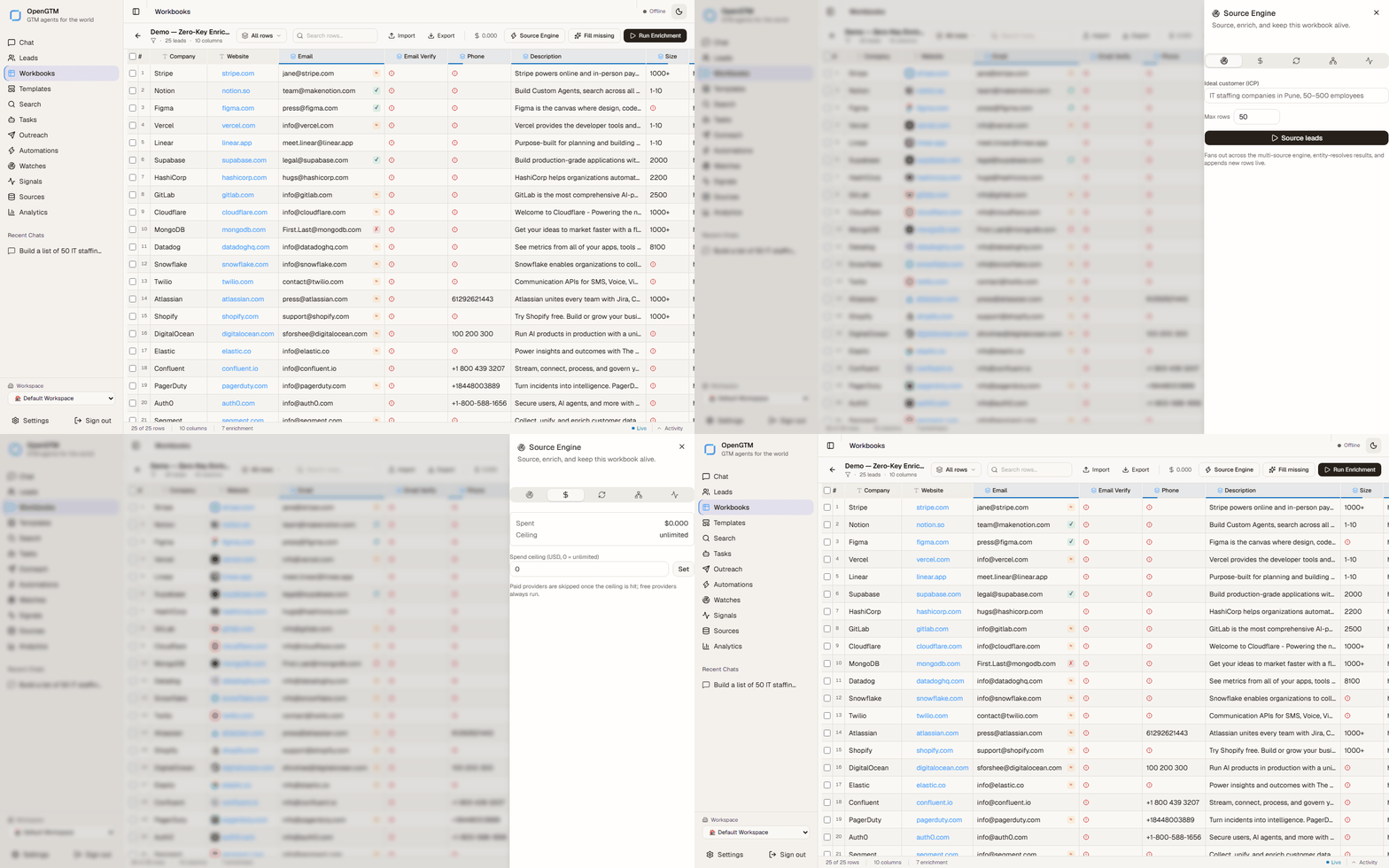
The 30-second version: give OpenGTM a market, a list, or a workbook. It
sources companies, enriches rows through cost-ordered provider waterfalls,
researches the hard cells with agents, and sends qualified results where your
team works. You keep the data, keys, and infrastructure.
In plain terms, OpenGTM combines lead enrichment, AI sales research, buying
signals, and programmable GTM automation in one self-hosted application.
Quickstart · Features · Compare with Clay · API · Contribute
Why OpenGTM
- See the exact bill before you run. Every workbook has a spend estimate
endpoint that prices a run asrows × providers = $Xwith a per-column
breakdown of paid providers, so the UI can gate the run behind a confirmation
("N rows, worst-case $X — proceed?"). Set a spend ceiling and paid
providers are skipped once the budget is spent. - Bring your own keys (BYOK). LLM providers, enrichment vendors, and
destinations are all configured with your API keys via the Settings UI (or.env). OpenGTM is the engine; you own the spend and the data. - Self-host the whole thing. No seats, no per-credit markup, no data leaving
your box. AGPLv3.
One engine, four GTM loops
| Start with | OpenGTM does | Finish with |
|---|---|---|
| A market definition | Sources matching companies and people | A deduplicated workbook |
| Domains or names | Runs cost-ordered provider waterfalls | Verified, provenance-backed fields |
| An account question | Browses and researches within bounded steps | A cited answer in each row |
| Qualified rows | Applies conditions and idempotent outputs | CRM, Sheet, webhook, or sequence |
Our promises (in writing)
These are structural commitments, not marketing — the whole point of OpenGTM is
that a closed, seat-priced, credit-metered incumbent cannot match them without
undoing its own business model:
- The REST API, webhooks, and MCP tools are never plan-gated. Automating
OpenGTM from your terminal, your own agent, or n8n is a first-class use, not an
upsell. Metering the API is the single most-hated move of the tools we're an
alternative to; we commit, in writing, never to make it. - BYOK at direct cost, zero markup. You pay the LLM/enrichment vendor
directly with your own key. Any future managed-key option bills at provider
cost plus one disclosed flat fee — never a per-credit markup. - See the bill before you run — always. The spend estimate and per-provider
cost ledger are core, not a premium tier. - Self-host is fully functional, forever. No feature is held back to force a
cloud upgrade; the paid cloud line will be governance (SSO/audit/DPA/support),
never capability.
What it does
OpenGTM is a spreadsheet-shaped enrichment engine ("workbooks") plus an agentic
layer that can build and run those workbooks for you.
| Capability | What it is | Status |
|---|---|---|
| Lead sourcing | ~90 discovery sources plus typed connectors. Durable connector runs page, checkpoint, resume, deduplicate by provider record ID, and report whether the requested target was actually met | Implemented |
| Enrichment waterfalls | A column tries providers in sequence (cost-ordered) until one returns a confident value, with cross-row caching and confidence early-exit | Implemented |
| Providers | ~35 enrichment providers (32 built-in + declarative YAML manifests) across email find/verify, phone, firmographics, decision-makers, social, tech-stack, hiring, IP/domain, scoring | Implemented |
| AI columns | LLM transforms over row data (classify, rewrite, extract) | Implemented |
| Research / "Claygent" columns | A bounded ReAct agent that browses the web per row to answer a question and cite a source | Implemented |
| Agent columns | Goal-directed enrichment — the agent picks tools dynamically and records a reasoning trace per cell | Implemented |
| Agentic chat / autopilot | CopilotKit-style chat that can draft a plan from a goal ("build a list of 50 IT firms in Pune and find founders' emails") and execute it: create a sourcing workbook, add agent columns, set refresh | Implemented |
| Output / push loop | output columns push each row to a webhook, HubSpot, Salesforce, Google Sheets, Airtable, or an email sequencer — run-once idempotent, executed after enrichment |
Implemented |
| Email outreach | Multi-step SMTP sequences with per-lead state and rate limiting | Implemented |
| Buying signals | Detects 7 signal types (hiring, funding, tech change, website change, news, growth, social) | Implemented |
| Dedup | Blocking + Jaro-Winkler fuzzy matching to find/merge duplicate leads | Implemented |
| Multi-tenancy | Workspace roles at the API boundary plus fail-closed PostgreSQL RLS on leads, signals, workbooks, connector runs, automations, outreach, ingest, and audit data | Implemented for the single-node deployment; control-plane HA remains |
| Spend transparency | Pre-run cost estimate + per-provider cost/yield ledger + spend ceiling | Implemented |
| SSRF-guarded scraping | Tenant-facing custom HTTP, scraper, webhook, research, and website-enrichment paths reject private/loopback/metadata targets and re-check redirects/browser requests | Implemented; hosted deployments should add an egress proxy |
Workbook column types
lead_field · source · enrichment · waterfall · ai_formula · agent ·conditional · output · research · http (call any API + JSONPath extract) ·formula.
Quickstart
One command brings up the full stack — web app, API, worker, scheduler,
Postgres, Redis, and nginx — with a populated zero-key demo:
git clone https://github.com/debpalash/opengtm.git
cd opengtm
cp .env.example .env        # boots without keys; add providers later in Settings
docker compose up           # API + worker + Postgres + Redis + nginx
Open http://localhost:3000 and sign in with admin / admin. The seeded
workbook uses free, no-key providers, so you can inspect the complete workflow
before connecting a paid service. Change the demo password before exposing the
deployment beyond your machine.
Your first five minutes
- Open Workbooks → Demo — Zero-Key Enrichment.
- Inspect any populated cell to see its provider and provenance.
- Open the cost control to preview the next run and set a spend ceiling.
- Add a provider key in Settings → API Keys when you want paid enrichment
or AI research. - Export the grid or add an output column for your CRM, Sheet, or webhook.
To point at an existing database instead of the bundled Postgres, setDATABASE_URL in .env (SQLite is also supported for local dev).
Stable local URLs with Portless
Portless is included as a development
dependency. It gives the Vite app a stable opengtm hostname and can also alias
the Docker/nginx service that already listens on port 3010:
# Local machine: HTTPS at https://opengtm.localhost
bun --cwd apps/web dev

# Existing Docker stack: register its stable name
bun run portless:docker

# LAN sharing on an unprivileged port (Linux requires avahi-utils)
portless proxy stop
bun run portless:lan
bun run portless:docker
# http://opengtm.local:1355
Run bun run portless:list to inspect routes and bun run portless:doctor to
check proxy, DNS, certificates, and route health. A root-installed proxy may use
ports 80/443 for a URL without :1355.
You need at least one LLM provider key for AI/agent/research features
(OpenRouter, Google AI, Groq, Cerebras, NVIDIA, Mistral, and GitHub Models all
have free tiers — see .env.example). Enrichment vendors (Hunter, Apollo,
AbstractAPI, NumVerify, IPInfo, LeadMagic, …) and destinations (HubSpot,
Salesforce, Sheets, Airtable) are all optional and configurable at runtime in
Settings → API Keys.
Local dev (without Docker)
uv sync                                                      # Python backend deps
uv run uvicorn apps.api.main:app --reload --port 8000       # API
cd apps/web && bun install && bun run dev                    # frontend
Background enrichment and source imports run on the durable SQL-queue worker:python -m apps.api.worker (claims jobs atomically; scale withdocker compose up --scale worker=N). Redis is optional for single-process
development and carries tenant-isolated live progress plus bounded reconnect
history in Compose. A scheduler recovers stale jobs and enqueues
recurring refreshes; it does not execute user work itself.
Frequently asked questions
What is OpenGTM?
OpenGTM is an open-source GTM platform for sourcing leads, enriching company
and contact data, researching accounts with AI, tracking buying signals, and
routing results into sales tools.
Is OpenGTM an alternative to Clay?
Yes. It covers the core workbook, enrichment-waterfall, AI-column, sourcing,
and output workflow while taking a self-hosted, BYOK approach. It is not a
pixel-for-pixel clone and its integration catalog is still growing. See the
detailed comparison.
Is OpenGTM free?
The software is free under AGPLv3. You pay infrastructure and any third-party
providers you connect. The seeded demo works without provider keys.
Does OpenGTM send data to its own cloud?
No OpenGTM-operated cloud is required for the self-hosted edition. Data stays
on the infrastructure you run, except when a workflow calls providers or
destinations you configure.
Can agents and automations use OpenGTM?
Yes. OpenGTM exposes a REST API, webhooks, an MCP server, and an n8n community
node in addition to the web interface.
Architecture
apps/
├── api/          FastAPI backend (Python 3.11+)
│   ├── routers/  HTTP/WS endpoints (auth, leads, workbooks, copilotkit,
│   │             signals, scraper, crm, outreach, settings, analytics, …)
│   ├── services/ workbook engine, enrichment providers + waterfalls,
│   │             agent/autopilot, crm, outreach, signals, workspace, dedup
│   └── core/     config, SSRF url_guard, shared utilities
├── web/          React + TypeScript + ShadcnUI + Tailwind (Vite)
├── docs/         Documentation site (Astro + Starlight) → opengtm.palash.dev
└── mcp/          MCP server exposing OpenGTM tools to agents
packages/
├── chrome-extension/   Capture tables / LinkedIn results into a workbook
└── n8n-nodes-yupcha/   n8n community node
| Layer | Technology |
|---|---|
| API | FastAPI, SQLAlchemy 2 |
| Database | Postgres (recommended; SQLite supported for dev) |
| Queue / pub-sub | Postgres job queue + isolated worker processes; Redis pub/sub for live UI updates |
| Frontend | React, TypeScript, ShadcnUI, Tailwind, Vite |
| Scraping | httpx, curl-cffi, Playwright, BeautifulSoup |
| Agentic chat | CopilotKit-style chat protocol with a gated ReAct tool loop |
| Monorepo | Turborepo + Bun |
Durable source orchestration
REST / agent tool
      │ validates workspace role and source query
      ▼
connector_runs + jobs  ── one atomic transaction
      │
      ▼
SQL queue worker ── fetch page ── normalize typed records
      │                              │
      ├── checkpoint cursor          └── stable provider + record identity
      ▼
workbook_rows upsert + run counters ── one page transaction
      │
      └── Redis event → workbook table + progress indicator
Connector adapters return a shared page/collection contract with source totals,
pagination state, exhaustion, warnings, and explicit partial-result status. A
worker commits each page and its cursor together, so a crash repeats at most one
idempotent upsert instead of losing or duplicating rows. Postgres enforces unique(workbook_id, source_provider, source_record_id) identities, and both rows and
run history are protected by fail-closed workspace RLS.
See docs/architecture.md for the complete process/data
ownership map, queue state machine, tenant boundary, failure behavior, and
scaling limits.
Not yet / Roadmap
The production data plane is tenant-scoped and PostgreSQL/RLS protected, and all
user work runs through the durable worker. The remaining boundaries are:
- The workspace control plane is single-node. Workspace membership, active
workspace selection, encrypted per-workspace secrets, and the detailed
collection-stage ledger live in SQLite files on the shareddata/volume.
This is reliable for the documented Compose topology, but replicas on
separate hosts need those stores moved to PostgreSQL first. - A few legacy utilities are global and admin-only. The legacy
person/scrape history, CRM-data utility, and reusable-function catalog
are isolated from normal workspace users rather than fully tenantized. - Hosted-SaaS hardening is not complete. Before exposing OpenGTM to mutually
hostile public tenants, add a controlled outbound egress proxy, managed KMS,
SSO/audit export, backup/restore drills, and an external security review. - Billing is an optional mechanism, not a hosted billing operation. The
feature-flagged credit ledger, idempotent debit, 402 gate, and Stripe top-up
webhook exist. Tax, refunds, subscriptions, and customer lifecycle operations
do not. - Clay's breadth and polish remain a product gap. The open provider catalog,
very-large-grid ergonomics, direct Clay API migration beyond the shipped
schema-aware CSV importer, reactive dependency recomputation, templates,
integrations, and real-user accuracy benchmarks need continued work.
See docs/plans/clay-parity-specs.md for the work-item
breakdown and sequencing.
License & "can I use this at work?"
OpenGTM is licensed under the GNU Affero General Public License v3.0
(LICENSE).
In plain terms:
- Self-host it for your own team — free, no strings on internal use. Use it,
modify it, run it on your own servers. - The AGPL network clause applies only if you offer OpenGTM (or a modified
version) as a service to other people over a network. In that case you must
make your modified source available to those users. Running it internally does
not trigger that obligation.
This is not legal advice — read the full license if you plan to offer
it as a hosted service.
Docs & Contributing
- https://opengtm.palash.dev — guides, self-hosting, configuration, CLI,
MCP, integrations, and the generated REST API reference.
Source lives inapps/docs(Astro + Starlight); the API
reference is regenerated withuv run python scripts/export_openapi.py. docs/plans/clay-parity-specs.md— Clay-parity
implementation specs and roadmap (WI-1…WI-10)docs/architecture.md— runtime topology, data
ownership, queue semantics, tenant isolation, and scale boundariesdocs/research/sources-master-inventory.md—
every data source, where it lives, and quality notesdocs/research/clay-alternatives-research.md/docs/research/clay-alternatives-ingestion-catalog.md
— competitive landscape and ingestion catalogdocs/research/data-source-test-report.md— source
health/test results
Contributions welcome — open an issue or a PR. Code is grounded with file/line
references in the docs above; start there to find the right entry point. SeeCONTRIBUTING.md (DCO sign-off, conventions),SECURITY.md (private vulnerability reporting), andCHANGELOG.md.
Releasing
Maintainers: scripts/release/preflight.sh checks a ref for anything that must
not ship (databases, .env, lead exports, submodule pointers, credential-shaped
strings); scripts/release/build-public-snapshot.sh builds the public/main
branch with maintainer-only paths stripped, and prints — but never runs — the
push command. Pushing a v* tag builds the container image on GHCR and drafts a
GitHub release.
Reviews (0)
Sign in to leave a review.
Leave a reviewNo results found