deepmem
Health Uyari
- License — License: MIT
- Description — Repository has a description
- Active repo — Last push 0 days ago
- Low visibility — Only 8 GitHub stars
Code Gecti
- Code scan — Scanned 12 files during light audit, no dangerous patterns found
Permissions Gecti
- Permissions — No dangerous permissions requested
Bu listing icin henuz AI raporu yok.
Drop-in AI memory layer with 2x faster response and 10x lower cost. Fully compatible with Mem0 API. Migrate in 5 minutes without any code changes. Self-host for free.
DeepMem
Drop-in AI memory layer with 2× faster response and 10× lower cost.
Fully compatible with Mem0 API. Migrate in 5 minutes - one import line.
Self-hostable. No auth, no payment, no lock-in. Or use the managed cloud at deepmem.dev.



Cloud · Self-host · Benchmarks · Reproduce them
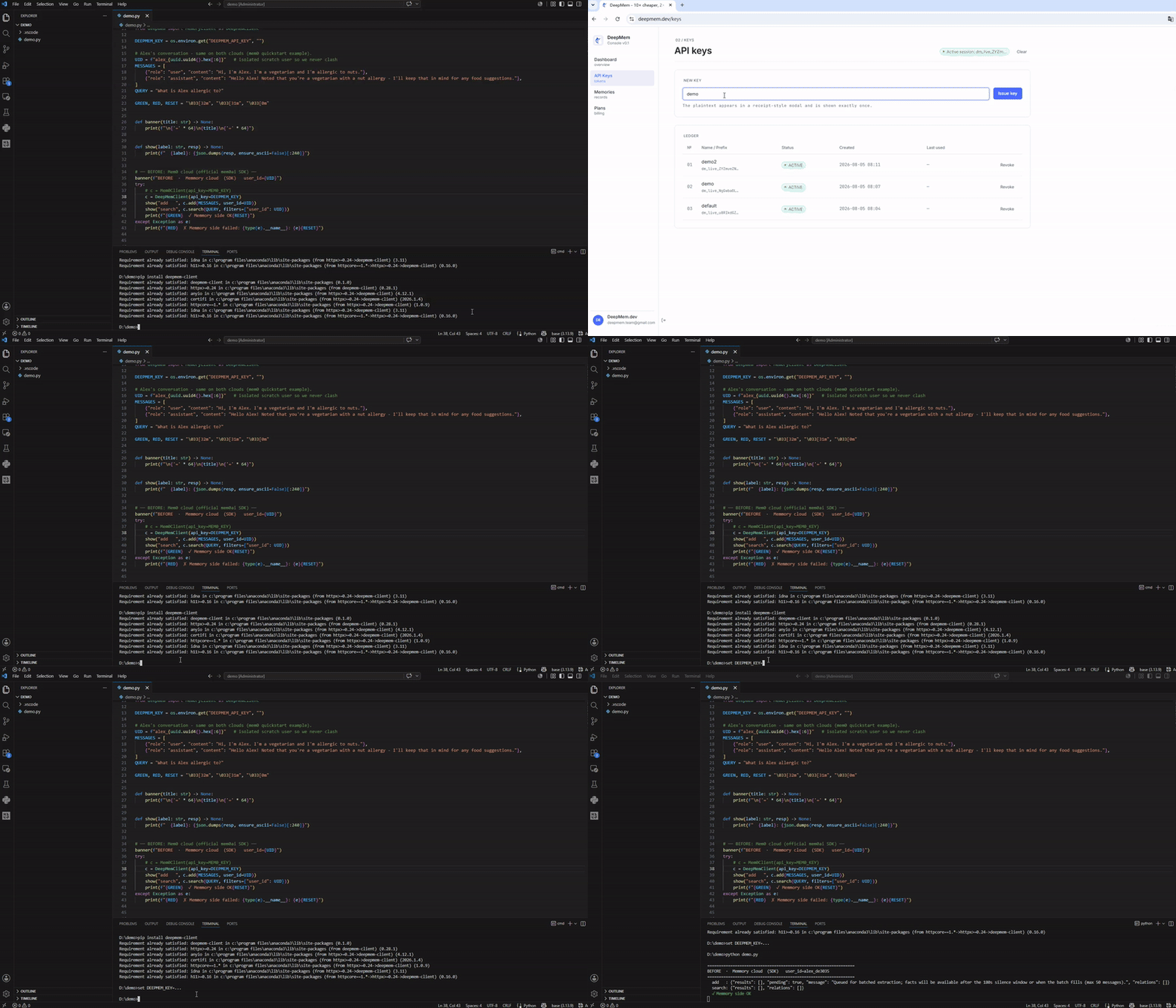
Migrate from Mem0 in one line - same MemoryClient, same method signatures:
# Before - Mem0
from mem0 import MemoryClient
client = MemoryClient(api_key="m0-...")

# After - DeepMem (only the import changes)
from deepmem import MemoryClient
client = MemoryClient(api_key="dm_live-...")   # get a key at deepmem.dev
pip install deepmem-client
Turn conversations into searchable long-term memory: a FastAPI HTTP API in
front of a Qdrant vector store, with LLM fact extraction, hybrid retrieval
(vector + BM25 + entity boost + time-decay), semantic caching, async batched
distillation, GDPR controls, and a built-in MCP server. It runs in open
mode - no API key, no user registration - so you can deploy it for your own
agents in minutes. Multi-tenant isolation is driven by user_id in the
request body.
Prefer not to self-host? DeepMem Cloud is the managed version of
this exact engine at deepmem.dev - same API, no
infra. Sign up, grab a key (dm_live_...), point your base URL athttps://deepmem.dev, done. The cloud and the open-source server speak the
same Mem0-compatible API, so client code is identical.
Migrate from Mem0
Already using Mem0? Switch to DeepMem cloud in one line. The deepmem-client
package mirrors mem0.MemoryClient - same class name, same method signatures,
same filters={"user_id": ...} style - so everything after the import stays
untouched.
pip install deepmem-client
# before (Mem0)
from mem0 import MemoryClient
client = MemoryClient(api_key="m0-...")
client.add(messages, user_id="alex")
client.search("What can Alex cook?", filters={"user_id": "alex"})

# after (DeepMem cloud) - change one import line
from deepmem import MemoryClient
client = MemoryClient(api_key="dm_live_...")        # key at https://deepmem.dev
client.add(messages, user_id="alex")                # identical calls
client.search("What can Alex cook?", filters={"user_id": "alex"})
add(infer=True)(the default) is asynchronous on DeepMem cloud - it
returnspending=Truewithresults=[]and extracted facts land a few
seconds later. (Mem0 cloud'saddis async too - it returnsPENDING.) Passinfer=Falsefor synchronous raw-text storage that's immediately searchable.- No graph relations - DeepMem uses hybrid vector retrieval (vector + BM25
- time-decay), so
relationsis always[]. Mem0's graph features aren't
replicated.
- time-decay), so
resetdiffers - Mem0's is account-wide; DeepMem's is per-user_idwith
a confirm guard.
Pricing
DeepMem Cloud is 10x cheaper than Mem0 at every paid tier - the same shape
of plans, a tenth of the price.
| Tier | DeepMem | Mem0 cloud |
|---|---|---|
| Hobby | Free | Free |
| Starter | $1.9/mo | $19/mo |
| Growth | $7.9/mo | $79/mo |
| Professional | $24.9/mo | $249/mo |
Self-host instead and it's $0 - you pay only your own LLM/embedding
provider (the same LLM cost Mem0 charges on top of its plan price), with no
memory-service markup. Batched distillation also cuts LLM calls ~80%, so even
your provider bill is smaller than per-message extractors.
Plans and limits: deepmem.dev · mem0.ai.
Benchmarks
No cherry-picked headline. The scripts and workload ship in/benchmarks - run them yourself. Here's what we
measured and the exact config that produced it:
| Metric | DeepMem self-hosted ¹ | DeepMem cloud | Mem0 cloud |
|---|---|---|---|
| Search p50 | 73 ms | 643 ms | 653 ms |
| Search p95 | 86 ms | 811 ms | 710 ms |
| Search hits (40 queries) | - | 195 | 84 |
| Add p50 (raw store) | 899 ms ² | 792 ms | 695 ms ³ |
¹ BGE-M3 on a GTX 1070 GPU (2016-era), local file Qdrant,
infer=False,
100 ops, concurrency 1. ² Dominated by local-file Qdrant I/O - a Qdrant
server cuts this sharply. ³ Mem0 has no raw-store mode;addalways runs
LLM extraction, so this row isn't apples-to-apples.
- Self-hosted is where intrinsic latency lives - no internet RTT, your
embedder, your Qdrant. 73 ms p50 search on an old consumer GPU. - DeepMem cloud beats Mem0 cloud on search p50 (643 ms vs 653 ms) and
returns ~2.3x more candidates per search (195 vs 84 hits across 40
queries). - Cloud latency is RTT-dominated - both cloud columns were measured
through a proxy from mainland China; run-to-run jitter is ~±10%. Run/benchmarksfrom a low-RTT location for your own
numbers.
Why DeepMem
Agent frameworks keep re-discovering that they need persistent, retrievable
memory. The hosted options bill per call and send your data to someone else's
cloud. DeepMem is the self-hostable alternative: the same Mem0-shaped API you
can drop in, but it runs on your box, with your embedder, your LLM key, and
your Qdrant - and the code is right here to verify it.
How does DeepMem compare to other Mem0 alternatives? Most are hosted-only or layer memory on top of someone else's vector DB. DeepMem combines three things at once: it's self-hostable (your data stays on your box - $0 beyond your own LLM key), MCP-native (Claude Desktop / Cursor read and write memories directly as tools), and fully open-source - and the managed cloud runs the exact same engine, so cloud and self-host are one API, not two products.
| Without DeepMem | With DeepMem |
|---|---|
| Re-explain who you are and what you're working on every session | The agent recalls identity, projects, and preferences automatically |
| Lose debugging and research context between sessions | Past root causes, dead ends, and findings are recalled, so work isn't repeated |
| Manually restate preferences every session | Preferences persist across sessions, agents, and projects |
| Hosted memory services that bill per call and hold your data | Self-host on your infra, or use the cloud - your call, same API |
What it is (honestly)
- Hybrid retrieval, not a knowledge graph. Search fuses vector similarity,
BM25 keyword match, entity boost, and time-decay scoring. There is no
temporal graph layer; if that's what you need, look at Zep. - Stores preferences, not code dumps. Large fenced code blocks are
stripped before LLM extraction, so the store fills with durable
user/project facts instead of pasted implementations. - BYOK, multi-provider. Bring your own LLM (OpenAI / Anthropic / any
OpenAI-compatible endpoint) and embedding (BGE-M3 / Google / OpenAI-compatible). - MCP-native. Ships an MCP server so Claude Desktop / Cursor can read and
write memories directly.
Quick start
Three ways to run. All speak the same Mem0-compatible API.
1. Cloud (zero ops)
export DEEPMEM_API_KEY=dm_live_...      # from https://deepmem.dev
curl https://deepmem.dev/v1/memories \
  -H "Authorization: Bearer $DEEPMEM_API_KEY" -H "Content-Type: application/json" \
  -d '{"messages":[{"role":"user","content":"I am Pat, I live in Lisbon."}],"user_id":"pat","infer":false}'
curl https://deepmem.dev/v1/memories/search \
  -H "Authorization: Bearer $DEEPMEM_API_KEY" -H "Content-Type: application/json" \
  -d '{"query":"Where does Pat live?","user_id":"pat"}'
2. Docker (one command)
cp .env.example .env          # add an LLM key
docker compose up --build     # DeepMem (HTTP :8000 + MCP :8001) + Qdrant sidecar
curl http://localhost:8000/health
Or pull the published image:
docker pull langdeepmem/deepmem:latest
docker run -p 8000:8000 -p 8001:8001 -e DEEPSEEK_API_KEY=sk-... langdeepmem/deepmem:latest
The image exposes :8000 (HTTP) and :8001 (MCP). The Dockerfile
and docker-compose.yml cover the GPU variant (CUDA torch + BGE_DEVICE=cuda)
and BGE-M3 model-download options (HF mirror, proxy, or local mount).
3. From source
git clone https://github.com/deepmemteam/deepmem.git && cd deepmem
pip install -r requirements.txt
cp .env.example .env          # add an LLM key + embedder config
python server/start.py        # HTTP :8000 + MCP :8001
Write and search in three lines:
import httpx
httpx.post("http://localhost:8000/v1/memories",
    json={"messages":[{"role":"user","content":"I'm Pat, I live in Lisbon."}],
          "user_id":"pat"})
print(httpx.post("http://localhost:8000/v1/memories/search",
    json={"query":"Where does Pat live?","user_id":"pat"}).json()["results"])
user_idis optional (defaults to"default"); send differentuser_ids
to isolate end-users.infer: falsestores raw text immediately
(test-friendly); the defaultinfer: truequeues for LLM fact extraction.
Feature highlights
Multi-provider by config, not code. Both layers switch on env vars:
| Layer | Options | Selector |
|---|---|---|
| LLM (fact extraction) | OpenAI · Anthropic (native SDK) · any OpenAI-compatible (DeepSeek / vLLM / Ollama / Groq / LM Studio) | LLM_PROVIDER + LLM_API_KEY / ANTHROPIC_API_KEY / DEEPSEEK_API_KEY |
| Embeddings | BGE-M3 (local, GPU/CPU) · Google Gemini · any OpenAI-compatible | EMBEDDING_PROVIDER + BGE_M3_PATH / GOOGLE_API_KEY / OPENAI_API_KEY |
BGE_DEVICE=auto|cpu|cuda picks GPU when available, else CPU (force cpu
on small-VRAM cards to avoid multi-process contention). BYOK overrides the
LLM per-request.
Hybrid retrieval. Vector similarity + BM25 keyword + entity boost +
time-decay, fused into one score. Over-fetch, re-rank, return.
Async batched distillation. Writes queue behind a silence window and are
extracted in batches - ~80% fewer LLM calls than per-message extraction.
Semantic cache. Repeat adds/searches hit a similarity-gated cache and
return cached facts without re-embedding or re-querying Qdrant.
Stores preferences, not code. extraction_filter strips large fenced
code blocks before LLM extraction, so the store fills with durable facts,
not pasted implementations.
MCP server. deepmem_write / deepmem_search / deepmem_delete tools
for Claude Desktop, Cursor, and any MCP client.
GDPR. Soft-delete with retention window, hard-delete reset, SHA-256
id masking in logs, export/import for portability.
API
| Method | Path | Description |
|---|---|---|
| POST | /v1/memories |
Write messages; LLM-extract facts (infer=false stores raw) |
| POST | /v1/memories/search |
Semantic search (vector + BM25 + entity + time-decay) |
| GET | /v1/memories |
List all for a user_id (paginated) |
| GET | /v1/memories/{id} |
Get one by ID |
| PUT | /v1/memories/{id} |
Update one memory's text |
| DELETE | /v1/memories/{id} |
Soft-delete one |
| DELETE | /v1/memories |
Soft-delete all for a user_id (GDPR) |
| GET | /v1/memories/{id}/history |
ADD/UPDATE/DELETE audit log |
| POST | /v1/reset |
Hard-delete all + history (needs confirm_user_id) |
| GET | /v1/export · POST /v1/import |
Portable JSON export / import |
| GET | /health · /ready |
Liveness / readiness probes |
agent_id / run_id optionally scope writes/reads (mirrors Mem0's three-level
isolation: user -> agent -> run). Interactive docs at /docs.
MCP integration
{
  "mcpServers": {
    "deepmem": {
      "command": "python",
      "args": ["server/mcp_server.py"],
      "env": { "DEEPMEMORY_BASE_URL": "http://localhost:8000" }
    }
  }
}
Open mode needs no API key - DEEPMEMORY_API_KEY stays empty.
Architecture
client (HTTP / MCP)
  -> FastAPI (:8000)
       -> rate-limit middleware (per-IP token bucket on add/search)
       -> SemanticCache.check            (return cached facts on similarity hit)
       -> AsyncBatchDistiller.enqueue    (POST /v1/memories, infer=true)
            ↳ silence-window or max_batch triggers on_batch_ready
                ↳ VectorStore.process_batch  (LLM extraction -> Qdrant upsert)
       -> VectorStore.search             (vector + BM25 + entity + time-decay)
  -> LLM: OpenAI / Anthropic / OpenAI-compatible (fact extraction)
  -> BGE-M3 / Gemini / OpenAI-compatible (embeddings)
  -> Qdrant (vectors)  +  SQLite (audit history)
  -> MCP server (:8001)  deepmem_write / deepmem_search / deepmem_delete
Single Qdrant collection (memories), hard-filtered by user_id payload.TenantValidator NFC-normalizes and enforces a [A-Za-z0-9._:-]{1,256}
charset on user_id - never trust the raw request value.
Configuration
Config loads once from env vars (.env, auto-loaded) > config.json > defaults.
Key variables:
| Variable | Required | Description |
|---|---|---|
DEEPSEEK_API_KEY / LLM_API_KEY / ANTHROPIC_API_KEY |
one LLM key | LLM for fact extraction |
LLM_PROVIDER |
no | auto / openai / anthropic / openai_compatible (default auto) |
EMBEDDING_PROVIDER |
no | bge-m3 / google / openai (default bge-m3) |
BGE_M3_PATH |
no | local BGE-M3 dir or HF model id (default BAAI/bge-m3) |
BGE_DEVICE |
no | auto / cpu / cuda (default auto) |
QDRANT_URL / QDRANT_API_KEY |
no | remote Qdrant; omit for local file store |
CORS_ORIGINS |
yes | comma-separated allowed origins (no * in prod) |
RATE_LIMIT_ADD / RATE_LIMIT_SEARCH |
no | per-minute limits (default 30 / 60) |
Backends auto-switch on env vars - no code changes:
QDRANT_URLset -> remote Qdrant; unset -> local file Qdrant under./data/qdrant.CORS_ORIGINS=*is refused at boot unlessDEEPMEMORY_DEBUG=1.
Production (systemd)
systemctl restart deepmem.service     # scripts/start.sh -> uvicorn :8000
journalctl -u deepmem -f
For HTTPS, put Caddy or Nginx in front; scripts/start.sh runs under systemd
or any process manager.
Benchmarks
Two reproducible scripts in /benchmarks:
- Cloud vs cloud - DeepMem cloud vs Mem0 cloud. Register keys at
deepmem.dev + mem0.ai, thenpython benchmarks/benchmark_cloud.py. - Self-hosted - your DeepMem, your hardware (no key, no external service):
python benchmarks/run_benchmark.py.
Both ship a self-contained workload and report P50/P95/P99 + throughput. The
numbers at the top of this README were produced with these scripts - rerun
them and read your own percentiles.
FAQ
Do I need the cloud? No. The open-source server is fully functional on its
own. The cloud (deepmem.dev) is the zero-ops option -
same API.
Does it work offline? Retrieval and raw-store (infer=false) work with no
network. LLM fact extraction (infer=true) needs an LLM key - or run a local
OpenAI-compatible model (Ollama / vLLM / LM Studio) and point LLM_BASE_URL
at it.
Where is my data? In your Qdrant (local file or server) + a SQLite audit
log. Nothing leaves your machine except the LLM/embedding calls you configure.
Multi-tenant? Yes - single Qdrant collection hard-filtered by user_id.agent_id / run_id add agent and session scope.
Is it production-ready? Used in production under systemd with a remote
Qdrant. Local file Qdrant is fine for dev/single-worker; use a Qdrant server
for multi-worker or high-throughput.
Development
pip install -r requirements.txt
DEEPMEMORY_DEBUG=1 python -m uvicorn server.main:app --reload --host 0.0.0.0 --port 8000
pytest tests/ -x -v
License
MIT.
Yorumlar (0)
Yorum birakmak icin giris yap.
Yorum birakSonuc bulunamadi