definable.ai
Health Gecti
- License — License: Apache-2.0
- Description — Repository has a description
- Active repo — Last push 0 days ago
- Community trust — 22 GitHub stars
Code Basarisiz
- rm -rf — Recursive force deletion command in .claude/server/fix-issue.sh
- rm -rf — Recursive force deletion command in .claude/settings.json
- rm -rf — Recursive force deletion command in .github/workflows/fix-issue.yml
Permissions Gecti
- Permissions — No dangerous permissions requested
Bu listing icin henuz AI raporu yok.
Agent Framework that just works out of the box ⭐


A Python framework for building agent applications with tools, RAG, persistent memory, guardrails, skills, file readers, browser automation, messaging platform integrations, and the Model Context Protocol. Switch providers without rewriting agent code.
Install
pip install definable
Or with uv:
uv pip install definable
Quick Start
from definable.agent import Agent
from definable.model.openai import OpenAIChat

agent = Agent(
  model=OpenAIChat(id="gpt-4o-mini"),
  instructions="You are a helpful assistant.",
)

output = agent.run("What is the capital of Japan?")
print(output.content)  # The capital of Japan is Tokyo.
Or use string model shorthand — no explicit import needed:
from definable.agent import Agent

agent = Agent(model="gpt-4o-mini", instructions="You are a helpful assistant.")
output = agent.run("What is the capital of Japan?")
Add Tools
from definable.agent import Agent
from definable.tool.decorator import tool


@tool
def get_weather(city: str) -> str:
  """Get current weather for a city."""
  return f"Sunny, 72°F in {city}"


agent = Agent(
  model="gpt-4o-mini",
  tools=[get_weather],
  instructions="Help users check the weather.",
)

output = agent.run("What's the weather in Tokyo?")
The agent calls tools automatically. No manual function routing.
Structured Output
from pydantic import BaseModel
from definable.agent import Agent
from definable.tool.decorator import tool


@tool
def get_weather(city: str) -> str:
  """Get current weather for a city."""
  return f"Sunny, 72°F in {city}"


class WeatherReport(BaseModel):
  city: str
  temperature: float
  conditions: str


agent = Agent(model="gpt-4o-mini", tools=[get_weather])

output = agent.run("Weather in Tokyo?", output_schema=WeatherReport)
print(output.content)  # JSON string matching WeatherReport schema
Pass any Pydantic model to output_schema and get validated, typed results back.
Streaming
from definable.agent import Agent

agent = Agent(model="gpt-4o-mini", instructions="You are a helpful assistant.")

for event in agent.run_stream("Write a haiku about Python."):
  if event.content:
    print(event.content, end="", flush=True)
run_stream() yields events as they arrive — content chunks, tool calls, and completion signals.
Multi-Turn Conversations
from definable.agent import Agent

agent = Agent(model="gpt-4o-mini", instructions="You are a helpful assistant.")

output1 = agent.run("My name is Alice.")
output2 = agent.run("What's my name?", messages=output1.messages)
print(output2.content)  # "Your name is Alice."
Pass messages from a previous run to continue the conversation.
Persistent Memory
from definable.agent import Agent
from definable.memory import Memory, SQLiteStore

agent = Agent(
  model="gpt-4o-mini",
  memory=Memory(store=SQLiteStore("memory.db")),
  instructions="You are a personal assistant.",
)

await agent.arun("My name is Alice and I prefer dark mode.", user_id="alice")
# Later, even in a new session...
await agent.arun("What's my name?", user_id="alice")  # Recalls "Alice"
Memory stores session history automatically and summarizes when messages exceed max_messages. For quick testing, use memory=True for an in-memory store. Three backends available: SQLite, file-based, and in-memory.
Knowledge Base (RAG)
from definable.agent import Agent
from definable.knowledge import Knowledge, Document
from definable.embedder import OpenAIEmbedder
from definable.vectordb import InMemoryVectorDB

kb = Knowledge(
  vector_db=InMemoryVectorDB(),
  embedder=OpenAIEmbedder(),
  top_k=3,
)
kb.add(Document(content="Company vacation policy: 20 days PTO per year."))

agent = Agent(
  model="gpt-4o-mini",
  instructions="You are an HR assistant.",
  knowledge=kb,
)

output = agent.run("How many vacation days do I get?")
The agent retrieves relevant documents before responding. Supports embedders (OpenAI, Voyage), vector DBs (in-memory, PostgreSQL, Qdrant, ChromaDB, MongoDB, Redis, Pinecone), rerankers (Cohere), and chunkers.
Note:
Agent(knowledge=True)raisesValueError— unlikememory=True, knowledge requires explicit configuration with a vector DB.
Guardrails
from definable.agent import Agent
from definable.agent.guardrail import Guardrails, max_tokens, pii_filter, tool_blocklist
from definable.tool.decorator import tool


@tool
def get_weather(city: str) -> str:
  """Get current weather for a city."""
  return f"Sunny, 72°F in {city}"


agent = Agent(
  model="gpt-4o-mini",
  instructions="You are a support agent.",
  tools=[get_weather],
  guardrails=Guardrails(
    input=[max_tokens(500)],
    output=[pii_filter()],
    tool=[tool_blocklist({"dangerous_tool"})],
  ),
)

output = agent.run("What's the weather?")
Guardrails check, modify, or block content at input, output, and tool-call checkpoints. Built-ins include token limits, PII redaction, topic blocking, and regex filters. Compose rules with ALL, ANY, NOT, and when().
Skills
from definable.agent import Agent
from definable.skill import Calculator, WebSearch, DateTime

agent = Agent(
  model="gpt-4o-mini",
  skills=[Calculator(), WebSearch(), DateTime()],
  instructions="You are a helpful assistant.",
)

output = agent.run("What is 15% of 230?")
Skills bundle domain expertise (instructions) with tools. Built-in skills include Calculator, WebSearch, DateTime, HTTPRequests, JSONOperations, TextProcessing, Shell, FileOperations, and MacOS. Create custom skills by subclassing Skill.
MCP
from definable.agent import Agent
from definable.mcp import MCPConfig, MCPServerConfig, MCPToolkit

config = MCPConfig(
  servers=[
    MCPServerConfig(
      name="filesystem",
      command="npx",
      args=["-y", "@modelcontextprotocol/server-filesystem", "/tmp"],
    )
  ]
)

async with MCPToolkit(config=config) as toolkit:
  agent = Agent(model="gpt-4o-mini", toolkits=[toolkit])
  await agent.arun("List files in /tmp")
Connect to any MCP server. Use the same tools as Claude Desktop.
File Readers
from definable.agent import Agent
from definable.media import File

agent = Agent(
  model="gpt-4o-mini",
  readers=True,
  instructions="Summarize the uploaded document.",
)

output = agent.run("Summarize this.", files=[File(filepath="report.pdf")])
Pass readers=True to enable automatic parsing. Supports PDF, DOCX, PPTX, XLSX, ODS, RTF, HTML, images, and audio. AI-powered OCR available via Mistral, OpenAI, Anthropic, and Google providers.
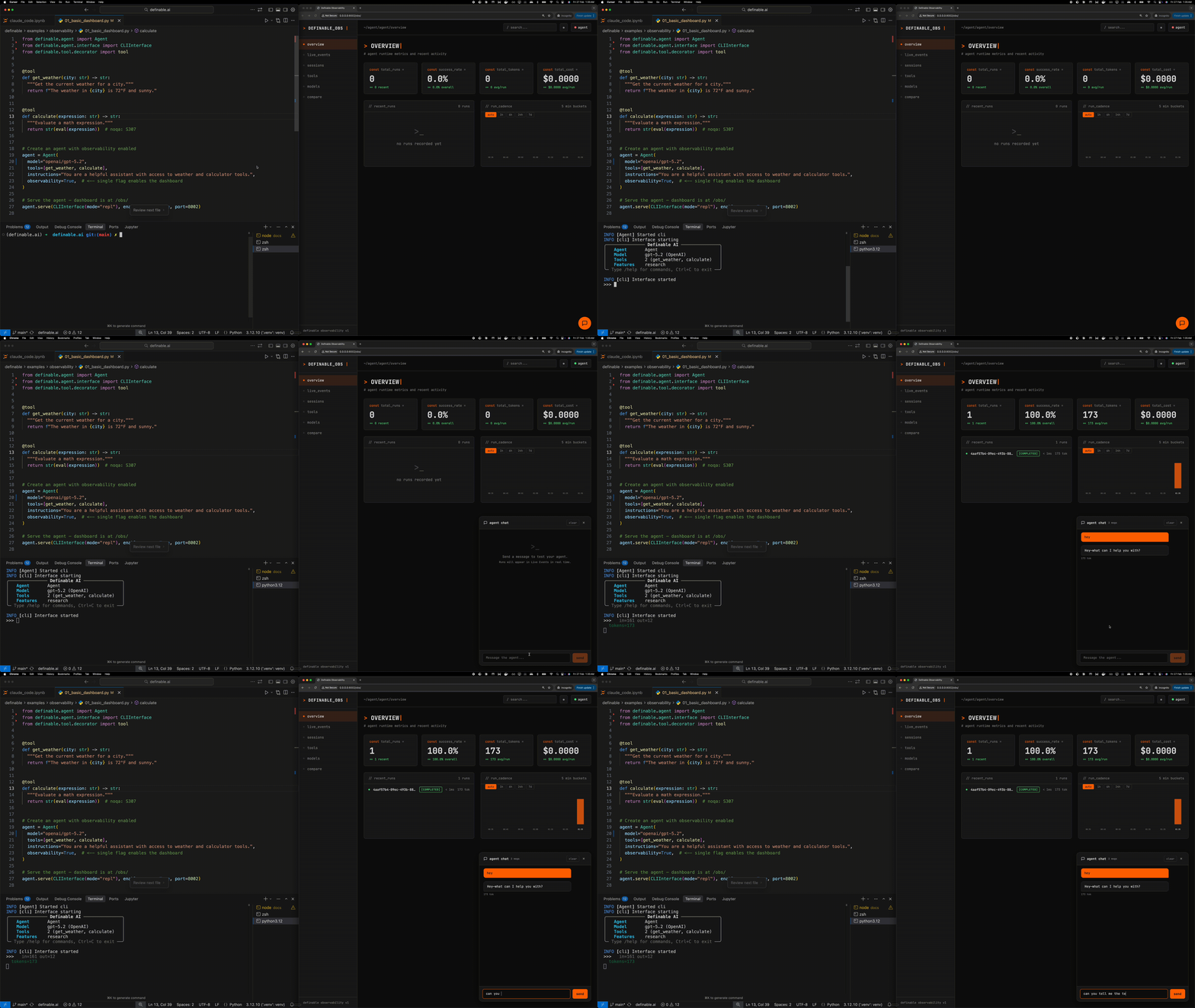
Observability Dashboard
from definable.agent import Agent

agent = Agent(
  model="gpt-4o-mini",
  observability=True,  # enables live dashboard at /obs/
  instructions="You are a helpful assistant.",
)

agent.serve(enable_server=True)
# Open http://localhost:8000/obs/ in your browser
Live events (SSE), session history, run comparison, per-tool and per-model metrics — all in a single-page dashboard. Use ObservabilityConfig for fine-grained control (trace dir, buffer size, theme).
Deploy It
from definable.agent import Agent
from definable.agent.trigger import Webhook, Cron
from definable.agent.auth import APIKeyAuth

agent = Agent(model="gpt-4o-mini", instructions="You are a support agent.")

agent.on(Webhook(path="/support", method="POST"))
agent.on(Cron(schedule="0 9 * * *"))
agent.auth = APIKeyAuth(keys={"sk-my-secret-key"})
agent.serve(host="0.0.0.0", port=8000, dev=True)
agent.serve() starts an HTTP server with registered webhooks, cron triggers, and interfaces in a single process. Add dev=True for hot-reload during development.
Connect to Platforms
from definable.agent import Agent
from definable.agent.interface.telegram import TelegramInterface

telegram = TelegramInterface(bot_token="BOT_TOKEN")

agent = Agent(model="gpt-4o-mini", instructions="You are a Telegram bot.")
agent.serve(telegram)
One agent, multiple platforms. Discord, Desktop, and CLI interfaces also available.
Thinking (Reasoning Layer)
from definable.agent import Agent
from definable.agent.reasoning import Thinking

agent = Agent(
  model="gpt-4o-mini",
  thinking=Thinking(),  # or thinking=True for defaults
  instructions="Think step by step.",
)

output = await agent.arun("What is 127 * 43?")
The thinking layer adds chain-of-thought reasoning before the final response.
Tracing
from definable.agent import Agent
from definable.agent.tracing import Tracing, JSONLExporter

agent = Agent(
  model="gpt-4o-mini",
  tracing=Tracing(exporters=[JSONLExporter("./traces")]),
  instructions="You are a helpful assistant.",
)

output = agent.run("Hello!")
# Traces saved to ./traces/{session_id}.jsonl
Or use tracing=True for default console tracing.
Replay & Compare
from definable.agent import Agent
from definable.model.openai import OpenAIChat

agent = Agent(model="gpt-4o-mini", instructions="You are a helpful assistant.")

# Inspect a past run
output = agent.run("Explain quantum computing.")
replay = agent.replay(run_output=output)
print(replay.steps)  # Each model call and tool invocation
print(replay.tokens)  # Token usage breakdown

# Re-run with a different model and compare
new_output = agent.replay(run_output=output, model=OpenAIChat(id="gpt-4o"))
comparison = agent.compare(output, new_output)
print(comparison.cost_diff)  # Cost difference between runs
print(comparison.token_diff)  # Token usage difference
Replay lets you inspect past runs, re-execute them with different models or instructions, and compare results side by side.
Testing
from definable.agent import Agent
from definable.agent.testing import MockModel

agent = Agent(
  model=MockModel(responses=["The capital of France is Paris."]),
  instructions="You are a geography expert.",
)

output = agent.run("What is the capital of France?")
assert "Paris" in output.content
MockModel returns canned responses — no API keys needed. Use it in unit tests to verify agent behavior deterministically.
Features
| Category | Details |
|---|---|
| Models | OpenAI, DeepSeek, Moonshot, xAI, Anthropic, Mistral, Google Gemini, Perplexity, Ollama, OpenRouter, any OpenAI-compatible provider. String shorthand: Agent(model="gpt-4o") resolves automatically |
| Agents | Multi-turn conversations, structured output, configurable retries, max iterations |
| Agentic Loop | 8-phase pipeline, parallel tool calls via asyncio.gather, HITL pause/resume, cooperative cancellation, EventBus, hooks, ToolRetry, phase metrics |
| Tools | @tool decorator with automatic parameter extraction from type hints and docstrings |
| Toolkits | Composable tool groups, KnowledgeToolkit for explicit RAG search |
| Skills | Domain expertise + tools in one package; 9 built-in skills (incl. MacOS), custom Skill subclass |
| Knowledge / RAG | Embedders, vector DBs, rerankers (Cohere), chunkers, automatic retrieval |
| Memory | Session-history memory with auto-summarization |
| Memory Stores | SQLite, file-based, in-memory |
| Readers | PDF, DOCX, PPTX, XLSX, ODS, RTF, HTML, images, audio |
| Reader Providers | Mistral OCR, OpenAI, Anthropic, Google (AI-powered document parsing) |
| Guardrails | Input/output/tool checkpoints, PII redaction, token limits, topic blocking, regex filters |
| Guardrails Composition | ALL, ANY, NOT, when() combinators for complex policy rules |
| Interfaces | Telegram, Discord, Desktop, CLI, session management, identity resolution |
| Browser Toolkit | 55 browser automation tools via Playwright CDP — role-based refs, AI-friendly errors, console/network diagnostics |
| Claude Code Agent | Zero-dep subprocess wrapper for Claude Code CLI with full Definable ecosystem integration |
| Runtime | agent.serve(), webhooks, cron triggers, event triggers, dev=True hot-reload |
| Auth | APIKeyAuth, JWTAuth, AllowlistAuth, CompositeAuth, pluggable AuthProvider protocol |
| Streaming | Real-time response and tool call streaming |
| Replay | Inspect past runs, re-execute with overrides, agent.compare() for side-by-side diffs |
| Middleware | Request/response transforms via agent.use(), logging, retry, metrics |
| Tracing | JSONL trace export for debugging and analysis |
| Observability | Live dashboard at /obs/ with real-time events (SSE), session browser, run comparison, tool/model metrics — Agent(observability=True) |
| Thinking | Chain-of-thought reasoning layer with configurable triggers |
| Compression | Automatic context window management for long conversations |
| Testing | MockModel, AgentTestCase, create_test_agent utilities |
| MCP | Model Context Protocol client for external tool servers |
| Pipeline | 8-phase execution (Prepare → Recall → Think → GuardInput → Compose → InvokeLoop → GuardOutput → Store), custom phases, hooks (before/after/instead) |
| Debug Mode | Agent(debug=True), DebugExporter with color-coded model call breakdown, DebugConfig for step-mode inspection |
| Sub-Agents | SubAgentPolicy, spawn_agent tool, concurrent child agents with semaphore-limited execution |
| Cancellation | CancellationToken for cooperative cancellation, AgentCancelled exception |
| Types | Full Pydantic models, py.typed marker, mypy verified |
Supported Models
from definable.agent import Agent
from definable.model.openai import OpenAIChat        # GPT-4o, GPT-4o-mini, o1, o3, ...
from definable.model.deepseek import DeepSeekChat    # deepseek-chat, deepseek-reasoner
from definable.model.moonshot import MoonshotChat    # moonshot-v1-8k, moonshot-v1-128k
from definable.model.xai import xAI                  # grok-3, grok-2-latest
from definable.model.anthropic import Claude         # claude-sonnet-4-20250514, claude-haiku, ...
from definable.model.mistral import MistralChat      # mistral-large-latest, mistral-small, ...
from definable.model.google import Gemini            # gemini-2.0-flash-001, gemini-1.5-pro, ...
from definable.model.ollama import Ollama            # llama3, mistral, codellama, ...
from definable.model.openrouter import OpenRouter    # any model via OpenRouter
from definable.model.perplexity import Perplexity    # pplx-70b-online, pplx-7b-chat, ...

# Or use string shorthand — no model import needed:
agent = Agent(model="gpt-4o-mini")
agent = Agent(model="anthropic/claude-sonnet-4-20250514")
agent = Agent(model="google/gemini-2.0-flash-001")
Any OpenAI-compatible API works with OpenAIChat(base_url=..., api_key=...). Anthropic, Mistral, Google, and Ollama use their native SDKs (optional deps). Perplexity and OpenRouter use the OpenAI-compatible interface.
Optional Extras
Install only what you need:
pip install definable[readers]          # PDF, DOCX, PPTX, XLSX, ODS, RTF parsers
pip install definable[serve]            # FastAPI + Uvicorn for agent.serve()
pip install definable[cron]             # Cron trigger support
pip install definable[jwt]              # JWT authentication
pip install definable[runtime]          # serve + cron combined
pip install definable[discord]          # Discord interface
pip install definable[browser]          # Browser automation (Playwright CDP)
pip install definable[desktop]          # macOS Desktop Bridge
pip install definable[postgres-memory]  # PostgreSQL memory store
pip install definable[research]         # Deep research (DuckDuckGo + curl-cffi)
pip install definable[mistral-ocr]      # Mistral AI document parsing
pip install definable[mem0-memory]      # Mem0 hosted memory store
Vector DB backends:
pip install definable[pgvector]         # PostgreSQL + pgvector
pip install definable[qdrant]           # Qdrant
pip install definable[chroma]           # ChromaDB
pip install definable[mongodb]          # MongoDB
pip install definable[redis]            # Redis
pip install definable[pinecone]         # Pinecone
Documentation
Full documentation: docs.definable.ai
Project Structure
definable/definable/
├── agent/              # Agent orchestration, config, middleware, loop
│   ├── auth/           # APIKeyAuth, JWTAuth, AllowlistAuth, CompositeAuth
│   ├── compression/    # Context window compression
│   ├── guardrail/      # Input/output/tool policy, PII, token limits, composable rules
│   ├── interface/      # Telegram, Discord, Desktop, CLI integrations
│   ├── observability/  # Live dashboard, metrics, trace browser, SSE events
│   ├── pipeline/       # 8-phase execution pipeline, hooks, ToolRetry, DebugConfig
│   ├── reasoning/      # Thinking layer (chain-of-thought)
│   ├── replay/         # Run inspection, re-execution, comparison
│   ├── research/       # Deep research: multi-wave web search, CKU, gap analysis
│   ├── run/            # RunOutput, RunEvent types
│   ├── runtime/        # AgentRuntime, AgentServer, dev mode
│   ├── tracing/        # JSONL trace export, DebugExporter
│   └── trigger/        # Webhook, Cron, EventTrigger
├── browser/            # BrowserToolkit — 55 tools via Playwright CDP
├── claude_code/        # ClaudeCodeAgent — subprocess wrapper for Claude Code CLI
├── knowledge/          # RAG: embedders, vector DBs, rerankers, chunkers
├── mcp/                # Model Context Protocol client
├── media.py            # Image, Audio, Video, File types
├── memory/             # Session-history memory + 3 store backends (SQLite, File, InMemory)
├── model/              # OpenAI, DeepSeek, Moonshot, xAI, Anthropic, Mistral, Gemini, Perplexity, Ollama, OpenRouter
├── reader/             # File parsers + AI reader providers
├── skill/              # Built-in + custom skills, skill registry
├── tool/               # @tool decorator, Function wrappers
├── toolkit/            # Toolkit base class
├── vectordb/           # Vector database interfaces (7 backends)
└── utils/              # Logging, supervisor, shared utilities
Contributing
Contributions welcome! To get started:
- Fork the repo and clone it locally
- Install for development:
pip install -e . - Make your changes — follow existing code patterns (2-space indentation, 150 char lines)
- Add tests in
definable/tests/for new features - Run
ruff checkandruff formatfor linting - Run
mypyfor type checking - Open a pull request
See definable/examples/ for usage patterns.
License
Apache 2.0 — see LICENSE for details.
Yorumlar (0)
Yorum birakmak icin giris yap.
Yorum birakSonuc bulunamadi