AgenticX
Health Pass
- License — License: Apache-2.0
- Description — Repository has a description
- Active repo — Last push 0 days ago
- Community trust — 100 GitHub stars
Code Pass
- Code scan — Scanned 12 files during light audit, no dangerous patterns found
Permissions Pass
- Permissions — No dangerous permissions requested
This tool is a comprehensive, production-ready multi-agent platform. It provides a Python SDK and CLI for building, orchestrating, and managing complex collaborative AI agent systems.
Security Assessment
Overall Risk: Medium. The platform is designed to integrate with over 15 external LLM providers, which inherently requires making external network requests and handling sensitive API keys. The light code audit did not find any hardcoded secrets or dangerous code patterns, and it does not request highly dangerous local permissions. However, a notable positive is the project's transparency: the documentation explicitly warns users about recent malicious releases of a downstream dependency (LiteLLM) designed to exfiltrate API keys, showing active security awareness.
Quality Assessment
Overall Quality: High. The project is highly active, with its most recent code push occurring today. It has gained 100 GitHub stars, indicating a good level of early community trust and validation. It uses the Apache-2.0 license, making it fully open source and safe for commercial and private use. The documentation is detailed, outlining a clear 5-tier system architecture.
Verdict
Safe to use, but maintain standard security hygiene (such as verifying dependency versions and securing your LLM API keys) due to the network-heavy nature of the platform.
AgenticX is a unified, production-ready multi-agent platform — Python SDK + CLI (agx) + Studio server + Machi desktop app. Features Meta-Agent orchestration, 15+ LLM providers, MCP Hub, hierarchical memory, avatar & group chat, skill ecosystem, safety sandbox, and IM gateway (Feishu/WeChat).
AgenticX: Unified Multi-Agent Framework





Security advisory
LiteLLM (PyPI): Malicious releases litellm 1.82.7 and 1.82.8 were removed from PyPI after reports that they could exfiltrate API keys. If you ever installed either version, uninstall them, rotate any credentials that may have been exposed, and upgrade to a release the upstream project and PyPI list as safe (for example 1.82.9+, per current upstream guidance). Check your environment with pip show litellm.
Vision
AgenticX aims to create a unified, scalable, production-ready multi-agent application development framework, empowering developers to build everything from simple automation assistants to complex collaborative intelligent agent systems.
System Architecture
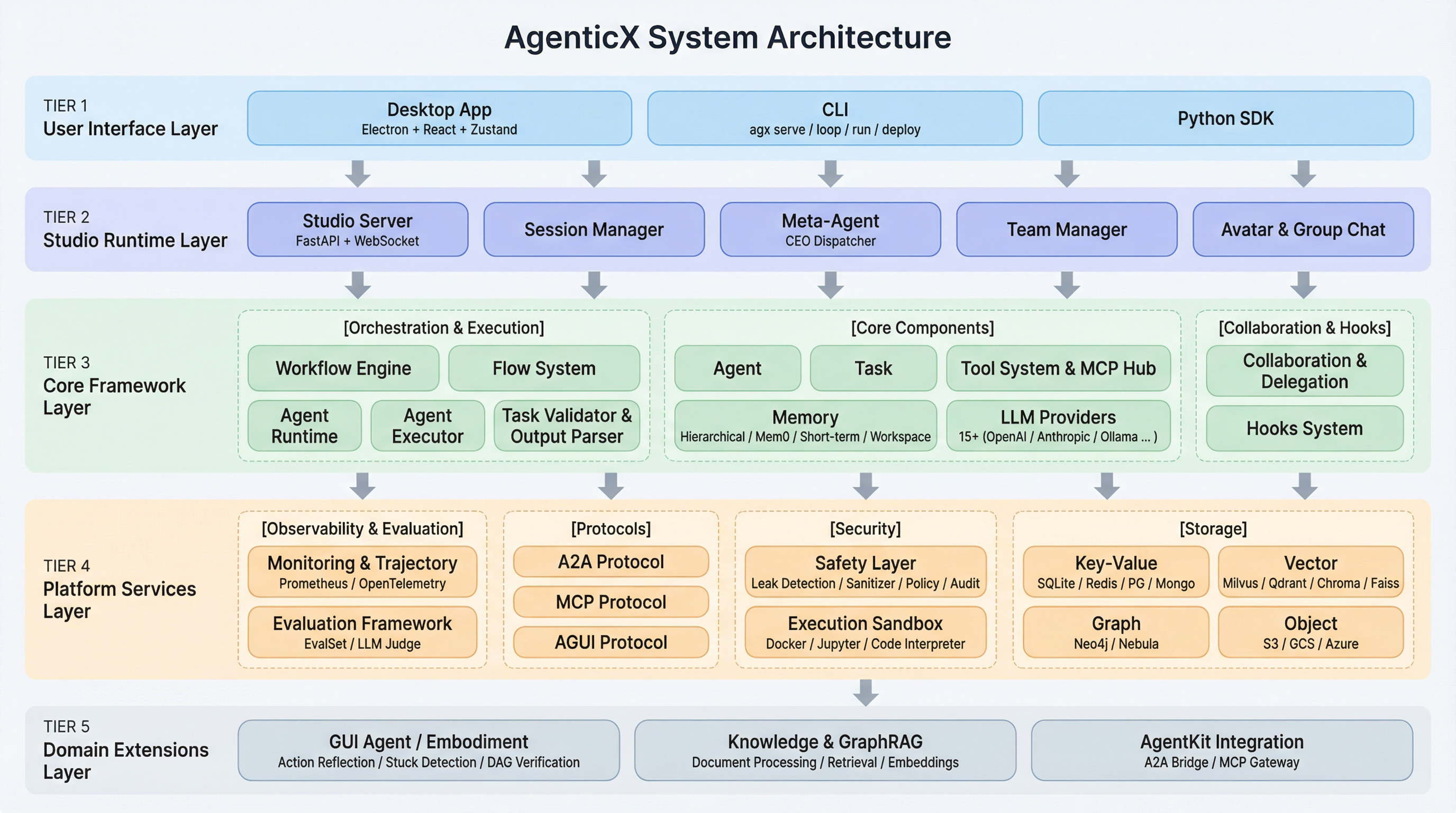
The framework is organized into 5 tiers: User Interface (Desktop / CLI / SDK) → Studio Runtime (Session Manager, Meta-Agent, Team Manager, Avatar & Group Chat) → Core Framework (Orchestration, Execution, Agent, Memory, Tools, LLM Providers, Hooks) → Platform Services (Observability, Protocols, Security, Storage) → Domain Extensions (GUI Agent, Knowledge & GraphRAG, AgentKit Integration).
Core Features
Core Framework
- Agent Core: Agent execution engine based on 12-Factor Agents methodology, with Meta-Agent CEO dispatcher, agent team management, think-act loop, event-driven architecture, self-repair, and overflow recovery
- Orchestration Engine: Graph-based workflow engine + Flow system with decorators, execution plans, conditional routing, and parallel execution
- Tool System: Unified tool interface with function decorators, MCP Hub (multi-server aggregation), remote tools v2, OpenAPI toolset, sandbox tools, skill bundles, and document routers
- Memory System: Hierarchical memory (core / episodic / semantic), Mem0 deep integration, workspace memory, short-term memory, memory decay, hybrid search, compaction flush, MCP memory, and memory intelligence engine
- LLM Providers: 15+ providers — OpenAI, Anthropic, Ollama, Gemini, Kimi/Moonshot, MiniMax, Ark/VolcEngine, Zhipu, Qianfan, Bailian/Dashscope — with response caching, transcript sanitizer, and failover routing
- Communication Protocols: A2A inter-agent protocol (client / server / AgentCard / skill-as-tool), MCP resource access protocol
- Task Validation: Pydantic-based output parsing, auto-repair, and guiderails
Avatar & Team Collaboration
- Avatar System: Avatar registry (CRUD), group chat with multiple routing strategies (user-directed / meta-routed / round-robin)
- Meta-Agent Runtime: CEO dispatcher with dynamic sub-agent orchestration, team management with concurrency limits, archived snapshots, and session isolation
- Collaboration Patterns: Delegation, role-playing, conversation management, task locks, and collaboration metrics
Knowledge & Retrieval
- Knowledge Base: Document processing pipeline with chunkers, readers, extractors, and graph builders (GraphRAG)
- Retrieval System: Vector retriever, BM25 retriever, graph retriever, hybrid retriever, auto-retriever, and reranker
- Embeddings: OpenAI, Bailian, SiliconFlow, LiteLLM, with smart routing
Developer Experience
- CLI Tools (
agx): serve, studio, loop, run, project, deploy, codegen, docs, skills, hooks, debug, scaffold, and config management - Web UI (Studio): FastAPI-based management server with session management, real-time WebSocket, and protocol support
- Desktop App: Electron + React + Zustand + Vite, Pro/Lite dual mode (multi-pane / single-pane), command palette, settings panel, avatar sidebar, sub-agent panel, session history, and workspace panel
Enterprise Security
- Safety Layer: Leak detection, input sanitizer, advanced injection detector, policy engine (rules / severity / actions), input validator, sandbox policy, and audit logging
- Sandbox: Docker, Microsandbox, and Subprocess backends; Jupyter kernel manager, stateful code interpreter, sandbox templates
- Session Security: Database-backed sessions, write locks, in-memory sessions
Observability & Evaluation
- Monitoring: Complete callback system, real-time metrics, Prometheus/OpenTelemetry integration, trajectory analysis, span tree, WebSocket streaming
- Evaluation Framework: EvalSet-based evaluation, LLM judge, composite judge, span evaluator, trajectory matcher, trace-to-evalset converter
- Data Export: Multi-format export (JSON / CSV / Prometheus), time series analysis
Storage Layer
- Key-Value: SQLite, Redis, PostgreSQL, MongoDB, InMemory
- Vector: Milvus, Qdrant, Chroma, Faiss, PgVector, Pinecone, Weaviate
- Graph: Neo4j, Nebula
- Object: S3, GCS, Azure
- Unified Manager: Storage router, migration support, unified storage interface
GUI Agent / Embodiment
- Action Reflection: A/B/C result classification with heuristic and VLM reflection modes
- Stuck Detection & Recovery: Consecutive failure detection, repeat pattern recognition, intelligent recovery strategy recommendation
- Action Caching: Action-tree-based trajectory caching with exact and fuzzy matching (up to 9x speedup)
- REACT Output Parsing: Standardized REACT format parsing with compact action schema
- Device-Cloud Routing: Dynamic selection of on-device or cloud model based on task complexity and sensitivity
- DAG Task Verification: DAG-based multi-path task verification with dual semantic dependencies
- Human-in-the-Loop: Collector, component, and event model for human oversight
Quick Start
Installation
Option 1: Install from PyPI (Recommended)
# Core install (lightweight, no torch, installs in seconds)
pip install agenticx

# Install optional features as needed
pip install "agenticx[memory]"      # Memory: mem0, chromadb, qdrant, redis, milvus
pip install "agenticx[document]"    # Document processing: PDF, Word, PPT parsing
pip install "agenticx[graph]"       # Knowledge graph: networkx, neo4j, community detection
pip install "agenticx[llm]"         # Extra LLMs: anthropic, ollama
pip install "agenticx[monitoring]"  # Observability: prometheus, opentelemetry
pip install "agenticx[mcp]"         # MCP protocol
pip install "agenticx[database]"    # Database backends: postgres, SQLAlchemy
pip install "agenticx[data]"        # Data analysis: pandas, scikit-learn, matplotlib
pip install "agenticx[ocr]"         # OCR (pulls in torch ~2GB): easyocr
pip install "agenticx[volcengine]"  # Volcengine AgentKit
pip install "agenticx[all]"         # Everything
Tip: The core package includes only ~27 lightweight dependencies and installs in seconds. Heavy dependencies (torch, pandas, etc.) are optional extras - install only what you need.
Browser automation: To run browser-use as an MCP server from AgenticX (
mcp_connect/mcp_call), see examples/browser-use-mcp.md.
Option 2: Install from Source (Development)
# Clone repository
git clone https://github.com/DemonDamon/AgenticX.git
cd AgenticX

# Using uv (recommended, 10-100x faster than pip)
pip install uv
uv pip install -e .                  # Core install
uv pip install -e ".[memory,graph]"  # Add optional features
uv pip install -e ".[all]"           # Everything
uv pip install -e ".[dev]"           # Development tools

# Or using pip
pip install -e .
pip install -e ".[all]"
Environment Setup
# Set environment variables
export OPENAI_API_KEY="your-api-key"
export ANTHROPIC_API_KEY="your-api-key"  # Optional
Complete Installation Guide: For system dependencies (antiword, tesseract) and advanced document processing features, see INSTALL.md
CLI Quick Start
After installation, the agx command-line tool is available:
# View version
agx --version

# Create a new project
agx project create my-agent --template basic

# Start the API server
agx serve --port 8000

# Parse documents (PDF/PPT/Word etc.)
agx mineru parse report.pdf --output ./parsed
Full CLI Reference: See docs/cli.md for complete command documentation.
Create Your First Agent
from agenticx import Agent, Task, AgentExecutor
from agenticx.llms import OpenAIProvider

# Create agent
agent = Agent(
    id="data-analyst",
    name="Data Analyst",
    role="Data Analysis Expert",
    goal="Help users analyze and understand data",
    organization_id="my-org"
)

# Create task
task = Task(
    id="analysis-task",
    description="Analyze sales data trends",
    expected_output="Detailed analysis report"
)

# Configure LLM
llm = OpenAIProvider(model="gpt-4")

# Execute task
executor = AgentExecutor(agent=agent, llm=llm)
result = executor.run(task)
print(result)
Tool Usage Example
from agenticx.tools import tool

@tool
def calculate_sum(x: int, y: int) -> int:
    """Calculate the sum of two numbers"""
    return x + y

@tool
def search_web(query: str) -> str:
    """Search web information"""
    return f"Search results: {query}"

# Agents will automatically invoke these tools
Complete Examples
We provide rich examples demonstrating various framework capabilities:
Agent Core (M5)
Single Agent Example
# Basic agent usage
python examples/m5_agent_demo.py
- Demonstrates basic agent creation and execution
- Tool invocation and error handling
- Event-driven execution flow
Multi-Agent Collaboration
# Multi-agent collaboration example
python examples/m5_multi_agent_demo.py
- Multi-agent collaboration patterns
- Task distribution and result aggregation
- Inter-agent communication
Orchestration & Validation (M6 & M7)
Simple Workflow
# Basic workflow orchestration
python examples/m6_m7_simple_demo.py
- Workflow creation and execution
- Task output parsing and validation
- Conditional routing and error handling
Complex Workflow
# Complex workflow orchestration
python examples/m6_m7_comprehensive_demo.py
- Complex workflow graph structures
- Parallel execution and conditional branching
- Complete lifecycle management
Agent Communication (M8)
A2A Protocol Demo
# Inter-agent communication protocol
python examples/m8_a2a_demo.py
- Agent-to-Agent communication protocol
- Distributed agent systems
- Service discovery and skill invocation
Observability Monitoring (M9)
Complete Monitoring Demo
# Observability module demo
python examples/m9_observability_demo.py
- Real-time performance monitoring
- Execution trajectory analysis
- Failure analysis and recovery recommendations
- Data export and report generation
Memory System
Basic Memory Usage
# Memory system example
python examples/memory_example.py
- Long-term memory storage and retrieval
- Context memory management
Healthcare Scenario
# Healthcare memory scenario
python examples/mem0_healthcare_example.py
- Medical knowledge memory and application
- Personalized patient information management
Human-in-the-Loop
Human Intervention Flow
# Human-in-the-loop example
python examples/human_in_the_loop_example.py
- Human approval workflows
- Human-machine collaboration patterns
- Risk control mechanisms
Detailed documentation: examples/README_HITL.md
LLM Integration
Chatbot
# LLM chat example
python examples/llm_chat_example.py
- Multi-model support demonstration
- Streaming response handling
- Cost control and monitoring
Security Sandbox
Code Execution Sandbox
# Micro-sandbox example
python examples/microsandbox_example.py
- Secure code execution environment
- Resource limits and isolation
Technical blog: examples/microsandbox_blog.md
Intent Recognition Service
Intelligent Intent Recognition System
# Intent recognition service example
python examples/agenticx-for-intent-recognition/main.py
A production-grade, layered intent recognition service built entirely on the AgenticX framework, demonstrating real-world usage of Agents, Workflows, Tools, and Storage systems.
Architecture:
- Agent Layer: Hierarchical agent design — a base
IntentRecognitionAgent(LLM-powered) with specialized agents (GeneralIntentAgent,SearchIntentAgent,FunctionIntentAgent) for fine-grained classification - Workflow Engine: Pipeline-based orchestration — preprocessing → intent classification → entity extraction → rule matching → post-processing; plus dedicated workflows for each intent type
- Tool System: Hybrid entity extraction (
UIE+LLM+Ruleextractors with confidence-weighted fusion), regex/full-text matching, and a full post-processing suite (confidence adjustment, conflict resolution, entity optimization, intent refinement) - API Gateway: Async service layer with rate limiting, concurrent control, batch processing, health checks, and performance metrics
- Storage: SQLite-backed data persistence for training data management via
UnifiedStorageManager - Data Models: Pydantic-based type-safe data contracts for API requests/responses and domain objects
Key capabilities:
- Three-tier Intent Classification: General dialogue (greetings, chitchat), information search (factual/how-to/comparison queries), and function/tool invocation
- Hybrid Entity Extraction: Combines UIE models, LLM, and rule-based extractors with intelligent fusion strategies
- Full Post-processing Pipeline: Confidence adjustment, conflict resolution, entity optimization, and intent refinement
- Extensible Design: Add new intent types by simply creating a new agent and workflow — zero changes to existing code
See: examples/agenticx-for-intent-recognition/
GUI Agent / Embodiment (M16)
GUI Automation Agent
# GUI Agent example
python examples/agenticx-for-guiagent/AgenticX-GUIAgent/main.py
- Complete GUI automation framework with human-aligned learning
- Action reflection (A/B/C classification) and stuck detection
- Action caching system for performance optimization
- REACT output parsing and compact action schema
- Device-Cloud routing for intelligent model selection
- DAG-based task verification
Key capabilities:
- Action Reflection: Automatic action result classification (success/wrong_state/no_change)
- Stuck Detection: Continuous failure detection and recovery strategy recommendation
- Action Caching: Trajectory caching with exact and fuzzy matching (up to 9x speedup)
- REACT Parsing: Standardized REACT format output parsing
- Smart Routing: Dynamic device-cloud model selection based on task complexity and sensitivity
- DAG Verification: Multi-path task verification with dual-semantic dependencies
See: examples/agenticx-for-guiagent/
More Application Examples
| Project | Description | Path |
|---|---|---|
| Agent Skills | Skill discovery, matching, and SOP-driven skill execution for agents | examples/agenticx-for-agent-skills/ |
| AgentKit | Volcengine AgentKit integration with Docker-ready agent deployment | examples/agenticx-for-agentkit/ |
| ChatBI | Conversational BI — natural language to data insights | examples/agenticx-for-chatbi/ |
| Deep Research | Multi-source deep research and report generation | examples/agenticx-for-deepresearch/ |
| Doc Parser | Intelligent document parsing (PDF, Word, PPT) | examples/agenticx-for-docparser/ |
| Finance | Financial news hunting and analysis | examples/agenticx-for-finance/ |
| Future Prediction | Predictive analysis and forecasting | examples/agenticx-for-future-prediction/ |
| GraphRAG | Knowledge graph-enhanced retrieval-augmented generation | examples/agenticx-for-graphrag/ |
| Math Modeling | Mathematical modeling assistant | examples/agenticx-for-math-modeling/ |
| Model Architecture Discovery | Automated model architecture search and discovery | examples/agenticx-for-modelarch-discovery/ |
| Query Optimizer | SQL/query optimization agent | examples/agenticx-for-queryoptimizer/ |
| Sandbox | Secure code execution sandbox | examples/agenticx-for-sandbox/ |
| Spec Coding | Specification-driven code generation | examples/agenticx-for-spec-coding/ |
| Vibe Coding | AI-assisted creative/vibe coding | examples/agenticx-for-vibecoding/ |
Technical Architecture
graph TD
    subgraph "User Interface Layer"
        Desktop["Desktop App (Electron + React)"]
        CLI["CLI (agx serve / loop / run / project)"]
        SDK[Python SDK]
    end

    subgraph "Studio Runtime Layer"
        StudioServer["Studio Server (FastAPI)"]
        SessionMgr[Session Manager]
        MetaAgent["Meta-Agent (CEO Dispatcher)"]
        TeamMgr[Agent Team Manager]
        AvatarSys["Avatar & Group Chat"]
    end

    subgraph "Core Framework Layer"
        subgraph "Orchestration"
            WorkflowEngine[Workflow Engine]
            Flow["Flow System"]
        end
        subgraph "Execution"
            AgentRuntime["Agent Runtime (Studio)"]
            AgentExecutor["Agent Executor (Core)"]
            TaskValidator[Task Validator & Output Parser]
        end
        subgraph "Core Components"
            Agent[Agent]
            Task[Task]
            Tool[Tool System & MCP Hub]
            Memory["Memory (Mem0 / Short-term / Workspace)"]
            LLM["LLM Providers (OpenAI / Anthropic / Ollama / 10+)"]
        end
        Collaboration["Collaboration & Delegation"]
        Hooks["Hooks System"]
    end

    subgraph "Platform Services Layer"
        subgraph "Observability"
            Monitoring["Monitoring & Trajectory"]
            Prometheus[Prometheus / OpenTelemetry]
        end
        subgraph "Protocols"
            A2A["A2A Protocol"]
            MCP["MCP Protocol"]
        end
        subgraph "Security"
            Safety["Safety Layer (Leak Detection / Sanitizer / Policy)"]
            Sandbox["Execution Sandbox"]
        end
        subgraph "Storage"
            KVStore["Key-Value (SQLite / Redis)"]
            VectorStore["Vector (Milvus / Qdrant / Chroma)"]
            GraphStore["Graph (Neo4j / NetworkX)"]
        end
    end

    subgraph "Domain Extensions"
        Embodiment["GUI Agent / Embodiment"]
        Knowledge["Knowledge & GraphRAG"]
    end

    Desktop --> StudioServer
    CLI --> StudioServer
    SDK --> AgentExecutor

    StudioServer --> SessionMgr
    SessionMgr --> MetaAgent
    MetaAgent --> TeamMgr
    MetaAgent --> AvatarSys
    TeamMgr --> AgentRuntime

    AgentRuntime --> Agent
    AgentExecutor --> Agent
    WorkflowEngine --> AgentExecutor

    Agent --> Tool
    Agent --> Memory
    Agent --> LLM
    Agent --> Hooks

    AgentRuntime --> Monitoring
    AgentExecutor --> Monitoring
    Agent --> A2A
    Tool --> MCP

    Agent --> Safety
    Memory --> KVStore
    Memory --> VectorStore
    Knowledge --> GraphStore
Development Progress
✅ Completed Modules (M1-M11, M13-M17)
| Module | Status | Description |
|---|---|---|
| M1 | ✅ | Core Abstraction Layer — Agent, Task, Tool, Workflow, Event Bus, Component, and Pydantic data contracts |
| M2 | ✅ | LLM Service Layer — 15+ providers (OpenAI / Anthropic / Ollama / Gemini / Kimi / MiniMax / Ark / Zhipu / Qianfan / Bailian), response caching, failover routing |
| M3 | ✅ | Tool System — Function decorators, MCP Hub, remote tools v2, OpenAPI toolset, sandbox tools, skill bundles, document routers |
| M4 | ✅ | Memory System — Hierarchical (core / episodic / semantic), Mem0, workspace, short-term, memory decay, hybrid search, memory intelligence engine |
| M5 | ✅ | Agent Core — Meta-Agent CEO dispatcher, think-act loop, event-driven architecture, self-repair, overflow recovery, reflection |
| M6 | ✅ | Task Validation — Pydantic-based output parsing, auto-repair, guiderails |
| M7 | ✅ | Orchestration Engine — Graph-based workflow engine + Flow system with decorators, execution plans, conditional routing, parallel execution |
| M8 | ✅ | Communication Protocols — A2A (client / server / AgentCard / skill-as-tool), MCP resource access, AGUI protocol |
| M9 | ✅ | Observability — Callbacks, real-time monitoring, trajectory analysis, span tree, WebSocket streaming, Prometheus / OpenTelemetry integration |
| M10 | ✅ | Developer Experience — CLI (agx with 15+ commands), Studio Server (FastAPI), Desktop App (Electron + React + Zustand, Pro/Lite dual mode) |
| M11 | ✅ | Enterprise Security — Safety layer (leak detection / sanitizer / injection detector / policy / audit), Sandbox (Docker / Microsandbox / Subprocess / Jupyter kernel / code interpreter) |
| M13 | ✅ | Knowledge & Retrieval — Knowledge base with document processing, chunkers, graphers (GraphRAG), readers; retrieval (vector / BM25 / graph / hybrid / auto); embeddings (OpenAI / Bailian / SiliconFlow / LiteLLM) |
| M14 | ✅ | Avatar & Collaboration — Avatar registry, group chat (user-directed / meta-routed / round-robin), delegation, role-playing, conversation patterns, team management |
| M15 | ✅ | Evaluation Framework — EvalSet, LLM judge, composite judge, span evaluator, trajectory matcher, trace converter |
| M16 | ✅ | Embodiment — GUI Agent framework with action reflection, stuck detection, action caching, REACT parsing, device-cloud routing, DAG verification, human-in-the-loop |
| M17 | ✅ | Storage Layer — Key-Value (SQLite / Redis / PostgreSQL / MongoDB), Vector (Milvus / Qdrant / Chroma / Faiss / PgVector / Pinecone / Weaviate), Graph (Neo4j / Nebula), Object (S3 / GCS / Azure) |
🚧 Planned Modules
| Module | Status | Description |
|---|---|---|
| M12 | 🚧 | Agent Evolution — Architecture search, knowledge distillation, adaptive planning |
| M18 | 🚧 | Multi-tenancy & RBAC — Per-tenant data isolation, fine-grained permission control |
Core Advantages
- Unified Abstraction: Clear and consistent core abstractions, avoiding conceptual confusion
- Pluggable Architecture: All components are replaceable, avoiding vendor lock-in
- Enterprise-Grade Monitoring: Complete observability, production-ready
- Security First: Built-in security mechanisms and multi-tenant support
- High Performance: Optimized execution engine and concurrent processing
- Rich Ecosystem: Complete toolset and example library
System Requirements
- Python: 3.10+
- Memory: 4GB+ RAM recommended
- System: Windows / Linux / macOS
- Core Dependencies: ~27 lightweight packages, installs in seconds (see
pyproject.toml) - Optional Dependencies: 15 feature groups available via
pip install "agenticx[xxx]"
Contributing
We welcome community contributions! Please refer to:
- Submit Issues to report bugs or request features
- Fork the project and create feature branches
- Submit Pull Requests, ensuring all tests pass
- Participate in code reviews and discussions
Acknowledgements / Upstream Credits
The personal WeChat (iLink) channel integration in AgenticX was built on top of the openilink-sdk-go library from OpeniLink Hub. We specifically relied on:
- QR code binding flow —
FetchQRCode/PollQRStatusAPIs for the scan-to-bind UX - Message monitoring —
client.Monitor()for real-time inbound message streaming - Outbound messaging —
SendText/Pushfor reply delivery withcontext_tokenrouting - CDN media handling —
DownloadMedia/DownloadVoicefor encrypted WeChat media
OpeniLink Hub's OpenClaw App also demonstrated an AI Agent gateway integration pattern that informed our adapter architecture.
We did not include OpeniLink Hub's web console, App Marketplace, or multi-bot management features. AgenticX's core multi-agent runtime, session management, and Desktop UI remain fully independent implementations.
OpeniLink Hub — MIT License — github.com/openilink/openilink-hub
Additional reference: WorkBuddy — WeixinBot Guide for iLink protocol usage patterns.
Desktop development: The iLink Go sidecar binary is not committed to this repository. Before using the personal WeChat bridge locally, run make build in packaging/wechat-sidecar/ (requires Go 1.22+). See packaging/wechat-sidecar/README.md.
License
This project is licensed under the GNU Affero General Public License v3.0 (AGPL-3.0) - see LICENSE file for details
Star History
Acknowledgments
AgenticX would not exist in its current form without the inspiration, architectural ideas, and engineering wisdom we drew from the open-source community. We have studied the following projects in depth, and we are genuinely grateful to every author, contributor, and community behind them.
| Project | Repository | What we learned |
|---|---|---|
| A2A | a2aproject/A2A | Agent-to-Agent protocol design |
| AgentCPM-GUI | OpenBMB/AgentCPM-GUI | Compact GUI action schema & RFT training |
| ADK Python | google/adk-python | Agent lifecycle, runner abstractions |
| ag-ui | ag-ui-protocol/ag-ui | Agent–UI streaming protocol |
| AgentKit SDK | volcengine/agentkit-sdk-python | Agent deployment & skill packaging |
| AgentRun SDK | Serverless-Devs/agentrun-sdk-python | Serverless agent runtime patterns |
| AgentScope | agentscope-ai/agentscope | Multi-agent communication & pipeline |
| Agno | agno-agi/agno | Lightweight agent framework design |
| Camel | camel-ai/camel | Role-playing agents & society simulation |
| Cherry Studio | CherryHQ/cherry-studio | Desktop UX, MCP integration, skill system |
| Claude Code | anthropics/claude-code | Agentic CLI UX & plugin architecture |
| CLI-Anything | HKUDS/CLI-Anything | CLI-native agent harness |
| ClawTeam | HKUDS/ClawTeam | Multi-agent team coordination |
| CodexMonitor | Dimillian/CodexMonitor | Desktop monitoring & Tauri app patterns |
| CrewAI | crewAIInc/crewAI | Crew orchestration, flow & memory system |
| DeepWiki Open | AsyncFuncAI/deepwiki-open | Repository-level knowledge indexing |
| Deer Flow | bytedance/deer-flow | Deep research workflow & skill harness |
| Eigent | eigent-ai/eigent | Multi-agent workforce & SSE event spec |
| Iron Claw | nearai/ironclaw | Agent evaluation & benchmark harness |
| JoyAgent / JD Genie | jd-opensource/joyagent-jdgenie | Enterprise agent orchestration |
| Khazix Skills | KKKKhazix/Khazix-Skills | Skill module structure & packaging |
| Lobe Icons | lobehub/lobe-icons | AI provider icon design system |
| LoongSuite Python Agent | alibaba/loongsuite-python-agent | OpenTelemetry GenAI instrumentation |
| MAI-UI | Tongyi-MAI/MAI-UI | Device-cloud collaboration & GUI grounding |
| Microsandbox | zerocore-ai/microsandbox | Lightweight sandboxed code execution |
| MobiAgent | IPADS-SAI/MobiAgent | Mobile multi-stage planning |
| MobileAgent | X-PLUG/MobileAgent | Multi-agent mobile GUI automation |
| Model Context Protocol | modelcontextprotocol/modelcontextprotocol | Standardized LLM tool/resource protocol |
| NVIDIA NemoClaw | NVIDIA/NemoClaw | GPU-accelerated agent plugin system |
| OpenClaw | openclaw/openclaw | Open desktop agent platform & extensions |
| OpenSandbox | alibaba/OpenSandbox | Container-based code sandbox |
| OpenShell | NVIDIA/OpenShell | Rust-based secure agent shell |
| OpenSkills | numman-ali/openskills | Skill registry & discovery |
| OWL | camel-ai/owl | Embodied multi-agent collaboration |
| Pydantic AI | pydantic/pydantic-ai | Type-safe agent & eval framework |
| Refly | refly-ai/refly | AI-native knowledge canvas UX |
| Serverless Devs | Serverless-Devs/Serverless-Devs | Serverless agent deployment toolchain |
| Skills | anthropics/skills | Skill definition format & lifecycle |
| Spring AI | spring-projects/spring-ai | Enterprise AI abstraction patterns |
| SWE-agent | SWE-agent/SWE-agent | Software engineering agent & ACR loop |
| VE ADK | volcengine/veadk-python | Skills system & cloud-native A2A |
| ZeroBoot | zerobootdev/zeroboot | Zero-config agent bootstrapping |
Thank you for building in the open. Your work has been a constant source of insight and motivation for the AgenticX team.
If AgenticX helps you, please give us a Star!
Reviews (0)
Sign in to leave a review.
Leave a reviewNo results found