codebase-index
Health Warn
- License — License: MIT
- Description — Repository has a description
- Active repo — Last push 0 days ago
- Low visibility — Only 5 GitHub stars
Code Fail
- rm -rf — Recursive force deletion command in adapters/claude.sh
Permissions Pass
- Permissions — No dangerous permissions requested
No AI report is available for this listing yet.
Local-first codebase indexing for Claude Code, Codex CLI, OpenCode & AI coding agents — hybrid FTS5 + Tree-sitter + graph search, fully offline.
codebase-index
Give AI coding agents a precise map of your codebase — locally, privately, and with evidence.
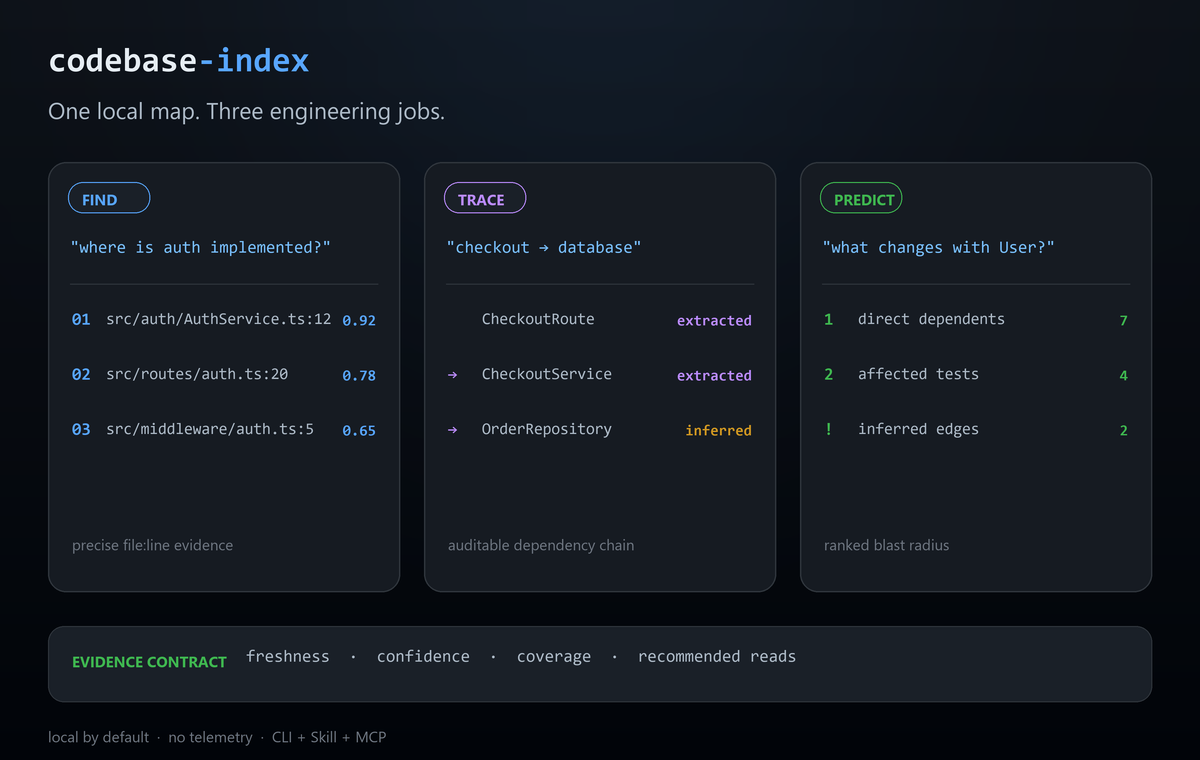
Find implementations. Trace behavior. Predict change impact.
Quick start · Install · Benchmarks · Security · MCP




The short version
codebase-index is a local retrieval and code-graph layer for Claude Code,
Codex CLI, OpenCode, and MCP clients. It indexes a repository into SQLite,
extracts symbols and relationships with Tree-sitter, and gives agents rankedfile:line evidence instead of making them scan broad sets of files.
Question → ranked retrieval → dependency evidence → precise answer
It is not an IDE and not another coding agent. Your existing agent remains the
interface; codebase-index gives it better aim.
Find. Trace. Predict.
| Job | Question | Command |
|---|---|---|
| Find | Where is authentication implemented? | codebase-index search "authentication" |
| Trace | How does checkout reach the database? | codebase-index explain "checkout flow" |
| Trace | How are two components connected? | codebase-index path ApiController Database |
| Predict | What breaks if User changes? |
codebase-index impact User |
| Predict | What does my current diff affect? | codebase-index diff-impact |
Every retrieval packet carries:
- ranked matches and the reason each match scored;
- exact line ranges to read next;
- index freshness;
- answer confidence and targeted fallbacks;
- graph coverage and edge confidence where relevant.
That evidence contract lets an agent distinguish “nothing references this” from
“the graph is partial, so verify with a targeted search.”
Install in five minutes
pip install codebase-index
cd your-project
codebase-index init
codebase-index index
codebase-index search "where is authentication implemented?"
init can install resources for Claude Code, Codex CLI, OpenCode, and detected
MCP clients:
codebase-index init --target auto
codebase-index init --target codex
codebase-index init --target claude
codebase-index init --target opencode
pipx install codebase-index is supported as an isolated alternative. See the
installation guide for pinned releases, editable
installs, hooks, Windows details, and troubleshooting.
Claude Code plugin
/plugin marketplace add denfry/codebase-index
/plugin install codebase-index@codebase-index
The plugin provisions a private environment on first use. Later sessions run
offline, and the first codebase question builds the index automatically.
What the agent receives
{
  "query": "where is authentication implemented?",
  "confidence": "high",
  "results": [
    {
      "path": "src/auth/AuthService.ts",
      "line_start": 12,
      "line_end": 148,
      "score": 0.92,
      "reason": "exact symbol match, 4 callers"
    }
  ],
  "recommended_reads": [
    {
      "path": "src/auth/AuthService.ts",
      "line_start": 12,
      "line_end": 148
    }
  ],
  "index": {
    "exists": true,
    "stale": false
  }
}
Snippets are skeletonized when that preserves evidence while saving tokens.
Unrelated bodies collapse, but imports, signatures, matched lines, and exact
read ranges remain.
Core commands
# Find
codebase-index search "auth token refresh"
codebase-index symbol AuthService

# Trace
codebase-index explain "authentication flow"
codebase-index refs send_email
codebase-index path ApiController Database
codebase-index describe Database
codebase-index architecture

# Predict
codebase-index impact User --direction up --depth 2
codebase-index diff-impact --base HEAD --direction up --depth 2

# Inspect and visualize
codebase-index graph User --direction both --depth 2 --output graph.html
codebase-index stats
codebase-index doctor
Add --json for agents and automation. Search supports hybrid, fts,symbol, and opt-in vector modes.
Why not just grep?
Grep is excellent when you know the exact text. Repository questions often
need more:
| Capability | rg / grep |
codebase-index |
|---|---|---|
| Exact text matching | Yes | Yes |
| Ranked results | No | Yes |
| Symbol definitions vs calls | No | Yes |
| Dependency and impact graph | No | Yes |
| Token-budgeted read plan | No | Yes |
| Freshness and coverage signals | No | Yes |
| Local and scriptable | Yes | Yes |
Use grep for one known string. Use codebase-index when the agent must locate,
understand, or assess a change across a repository.
The comparison guide also covers Cursor, Aider repo-map,
Sourcegraph, Continue, Amp, and Codebase-Memory MCP—including when those tools
are the better choice.
Measured results
On the published 55k LOC Java benchmark:
- Recall@3: 70% for
codebase-indexversus 40% for thergbaseline; - answer-context tokens: approximately 13× fewer;
- raw results and methodology are checked into the repository.
These results are evidence for that benchmark, not a claim of universal
superiority. Large public-repository and framework-graph evaluations remain on
the roadmap. Read the complete methodology and limitations in
BENCHMARKS.md.
Local by default
The base install:
- makes no network requests;
- sends no telemetry;
- stores the derived index inside the project cache;
- excludes dependency, build, binary, oversized, generated, and secret-like
files before indexing; - redacts secret patterns again at output time;
- exposes
doctor --strictfor CI and security checks.
Embeddings are optional. Local embeddings stay on the machine; external
embeddings require explicit configuration, an API key, and an endpoint
acknowledgement.
See the security model for trust boundaries, gates,
failure modes, and residual risks.
How it works
Repository
   │
   ├─ discovery + ignore and secret gates
   ├─ Tree-sitter symbols and relationships
   ├─ line and symbol-aligned chunks
   └─ optional embeddings
          │
          ▼
      local SQLite
   FTS5 + symbols + graph
          │
          ▼
 intent routing → hybrid retrieval → rerank → token budget
          │
          ▼
 ranked file:line evidence for CLI, Skill, and MCP
The three product surfaces share one service layer, so retrieval behavior does
not drift between the CLI, installed agent skills, and MCP tools.
Detailed internals:
Supported surfaces
| Surface | Integration |
|---|---|
| Claude Code | Skill, plugin, optional hooks |
| Codex CLI | AGENTS.md plus project skill |
| OpenCode | Command, agent, and skill resources |
| MCP clients | stdio server with versioned JSON envelopes |
| Shell and automation | CLI, --json, and local SQLite |
Run the MCP server with:
codebase-index mcp --root /path/to/repository
Available MCP tools include search, explain, symbols, references, impact,
diff impact, architecture, shortest path, node description, health, and index statistics.
See MCP.md for client configuration.
Project status
The latest released line is 1.7.0. It includes:
- hybrid and optional vector retrieval;
- Tree-sitter symbol extraction across the documented language tiers;
- import, call, reference, and inheritance graphs;
- architecture communities, central nodes, and surprising cross-module links;
- shortest dependency paths and node descriptions;
- token-budgeted and skeletonized retrieval packets;
- CLI, Skill, plugin, and MCP delivery;
- incremental updates, watch hooks, diagnostics, skill rollback, and diff-aware
impact analysis.
Planned work is deliberately separated from shipped capability. The next
product priorities are stronger real-repository evaluations, typed framework
edges, and an even more direct task-context workflow. See the
roadmap.
Documentation
| Start here | Deep dives | Project trust |
|---|---|---|
| Quick start | Retrieval | Benchmarks |
| Installation | Architecture | Security |
| FAQ | MCP | Release checklist |
| Skill design | Schema | Changelog |
Contributing
Contributions should preserve three invariants:
- retrieval quality is measured, not asserted;
- the default path remains local and fails closed at security boundaries;
- machine-readable contracts stay stable across CLI and MCP.
Before opening a pull request:
pytest
ruff check .
mypy src
python scripts/sync_skill_copies.py --check
Add user-visible changes under [Unreleased] in CHANGELOG.md.
See CONTRIBUTING.md if present and the repository
instructions for branch and review policy.
License
Reviews (0)
Sign in to leave a review.
Leave a reviewNo results found