agentgate-ai

skill
Security Audit
Pass
Health Pass
  • License — License: MIT
  • Description — Repository has a description
  • Active repo — Last push 0 days ago
  • Community trust — 19 GitHub stars
Code Pass
  • Code scan — Scanned 12 files during light audit, no dangerous patterns found
Permissions Pass
  • Permissions — No dangerous permissions requested

No AI report is available for this listing yet.

SUMMARY

Use Codex with DeepSeek and Xiaomi MiMo through a local AI gateway. AgentGate converts OpenAI Responses API, Anthropic Messages and Chat Completions with model routing, failover and GUI config.

README.md

AgentGate Logo

AgentGate

Local AI Gateway for Codex, Claude Code, Gemini CLI, OpenCode & AtomCode
Convert when needed, pass through when possible; one local entry point for 24 providers

Release Stars Downloads License

中文 · Download · 5-Minute Quick Start · Codex + DeepSeek · Codex + MiMo


AgentGate is a local model gateway for AI coding agents. It gives Codex, Claude Code, Gemini CLI, OpenCode, and AtomCode one local endpoint, then routes requests to 24 providers including Xiaomi MiMo, DeepSeek, OpenAI, Anthropic, Kimi, GLM, DashScope, SiliconFlow, Volcengine, and more.

It is built for real integration problems:

  • Codex speaks the Responses API, while many providers only expose Chat Completions or Anthropic-compatible Messages.
  • Claude Code can directly use DeepSeek / MiMo Anthropic-compatible endpoints, but base URLs, model names, and mapping rules are easy to misconfigure.
  • Different models from the same provider have different capabilities; sending images, tools, or web_search to the wrong model often causes 400 errors.
  • Multiple providers and multiple API keys should fail over automatically, with request logs, token stats, and cost tracking.
  • Switching models should not mean hand-editing ~/.codex/config.toml or ~/.claude/settings.json.

AgentGate's job is: one local gateway + protocol conversion + native pass-through + smart routing + GUI configuration.

Common Use Cases

Guides: Use Codex with DeepSeek · Use Codex with Xiaomi MiMo

Goal What AgentGate does
Use Codex with DeepSeek Converts Codex's OpenAI Responses API requests to DeepSeek-compatible Chat Completions or Anthropic-compatible endpoints.
Use Codex with Xiaomi MiMo Routes Codex through a local gateway to MiMo models with model mapping, reasoning support, and capability checks.
Use Claude Code with DeepSeek / MiMo Uses Anthropic-compatible pass-through plus model mapping for DeepSeek and MiMo endpoints.
Switch Codex between providers One local endpoint lets Codex switch between DeepSeek, MiMo, OpenAI, Kimi, GLM, DashScope, and more without hand-editing config files.

5-Minute Quick Start

  1. Download AgentGate from Releases and install it.
  2. Open the app, go to Quick Setup or Providers, and paste your provider API key.
  3. AgentGate detects known key prefixes and fills base URL, protocols, default model, and capability matrix. If the prefix is ambiguous, select the provider type manually.
  4. On Overview or Gateway, click Start Gateway. The default address is 127.0.0.1:9090. Note: 1420 is the development UI port, not the client API gateway.
  5. On Clients, click Apply Config for Codex / Claude Code / OpenCode / Gemini CLI / AtomCode.
  6. Send a test message in the client. Click Switch to Official whenever you want to restore the original client config.

Most users only need these steps. Model mapping, protocol endpoints, and capability matrices can be left alone at first; AgentGate fills the common defaults for you.

Three Modes

Mode When it happens Model handling Typical case
Protocol Conversion Client protocol differs from upstream protocol Model Mapping wins; otherwise provider default model is used as a compatibility fallback Codex Responses → DeepSeek / MiMo Chat
Native Pass-through Client protocol matches a native upstream endpoint Request model is preserved unless a Model Mapping matches; the virtual agentgate model resolves to the model selected by routing OpenCode / curl → Chat Completions
Pass-through + Model Mapping Protocol matches, but client model names differ from upstream names Model Mapping rewrites model Claude Code claude-* → DeepSeek / MiMo model

Rule of thumb: protocol match decides pass-through vs conversion; Model Mapping only renames models. For one-click client integrations, agentgate is a virtual model name that means "let AgentGate pick the provider model for this request."

Features

Protocol Conversion — 4 formats, bidirectional

  • OpenAI Responses API (/v1/responses) → Chat Completions / Claude Messages / Gemini API, for Codex
  • Anthropic Messages API (/v1/messages) → Chat Completions conversion / Anthropic pass-through, for Claude Code
  • Google Gemini API (/v1beta/models/:model:generateContent) → Chat Completions conversion, for Gemini CLI
  • Chat Completions (/v1/chat/completions) pass-through forwarding
  • Native Anthropic Claude API: tool_use/tool_result, input_schema, thinking.budget_tokens
  • Native Gemini API: contents/functionCall/functionResponse, generationConfig
  • Full DeepSeek reasoning_content (thinking mode) support without degradation
  • Automatic request retry (429/5xx, exponential backoff, Retry-After)

Cost Tracking & Multi-Key Pooling

  • 22+ built-in model prices, auto-calculate cost per request
  • Dashboard: total/today/average cost cards
  • Settings: inline price editing, custom price overrides
  • Multi-API-key per provider: round-robin rotation, auto-switch on 429

Smart Routing

  • Task-level routing conditions: route by input size, images, tools, system keywords
  • Preset scenes: Image Requests / Reasoning / Background / Long Text / Tool-Heavy
  • Prompt cache injection for Anthropic (auto cache_control, ~90% input cost savings)
  • Cache support auto-detection on provider test

Multimodal Support & Per-Model Capability Matrix

  • Image content is fully preserved during protocol conversion (input_image/image_url → Chat Completions image_url, Anthropic image source format)
  • Per-model capability matrix tracks 8 dimensions per model: text / vision / audio_in / tts / video_in / reasoning / tools / web_search
  • Capability-aware promotion: when a request includes images, the gateway auto-swaps to a sibling model that supports vision (e.g. routes image requests to mimo-v2.5 instead of mimo-v2.5-pro on the same provider)
  • Promotion ranking prefers the substitute that preserves the most of the original model's other capabilities, with supported_models order as tiebreak
  • The capability matrix also drives tool emission: unchecking web_search for a model stops the gateway from sending the builtin to that model
  • Matrix auto-seeded from model-name patterns: built-in rules for MiMo / DeepSeek / Kimi / Moonshot, with a generic fallback for others
  • Provider test button now combines connectivity check + non-destructive matrix autofill (preserves manual edits)
  • In failover mode, requests with images skip providers whose matrix declares no vision-capable model
  • Providers that don't support images at the chosen model strip the image content at the provider-specific layer, avoiding upstream 400/404

Multi-Provider Management

  • 24 built-in presets (auto-fill base URL / protocols / Anthropic endpoint / default model):
    • Domestic: Xiaomi MiMo, DeepSeek, Kimi/Moonshot, MiniMax, GLM (Zhipu BigModel), DashScope (Aliyun Qwen), SiliconFlow, Volcengine (Doubao), Baichuan, StepFun, Yi (01.AI)
    • International: OpenAI, Anthropic (Claude), Google Gemini, xAI (Grok), Mistral, Groq, Together, Fireworks, Cerebras, Perplexity, Cohere
    • Aggregator: OpenRouter
    • Custom: any OpenAI-compatible endpoint (vLLM / Ollama / LiteLLM / local proxies)
  • MiMo first-class support: 5 chat models (mimo-v2.5-pro / mimo-v2-pro / mimo-v2.5 / mimo-v2-omni / mimo-v2-flash), multi-turn reasoning_content round-trip, sk-* / tp-* keys auto-route to the correct Open API or Token Plan host, region-aware Token Plan URLs (cn / sgp / ams), and automatic web_search degradation when the paid plugin is unavailable
  • Claude Code passthrough for MiMo / DeepSeek uses ordinary provider model IDs by default; AgentGate no longer auto-configures [1m] suffixed models.
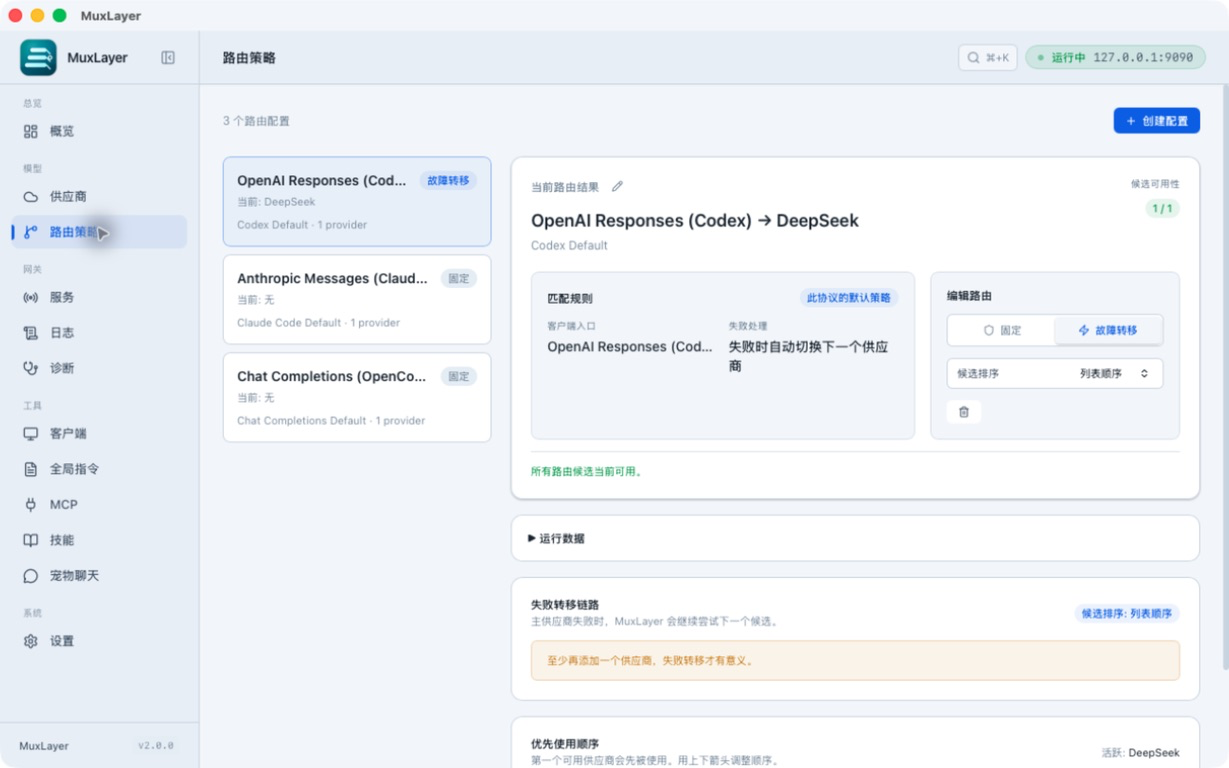
  • Route Profiles with multi-provider priority chains, auto-matched by protocol
  • Manual switching or automatic failover
  • Provider cooldown and runtime status tracking
  • Per-request failover: Provider A fails → automatically tries Provider B
  • Capability-aware routing: requests with images / audio / etc. auto-route to capable models within a provider, fall back to capable providers across the chain
  • New providers are automatically added to all route chains
  • Automatic model list fetching from providers
  • Connection stability: HTTP client tuned with pool_idle_timeout and tcp_keepalive, plus app-layer retry on transient connect/timeout errors (avoids stale keep-alive failures after a pause)

Client Configuration

  • Codex: one-click config + toggle between official and AgentGate (preserves conversations)
  • Claude Code: one-click config + toggle between official and AgentGate
  • OpenCode: one-click config
  • Local gateway access token (ag_local_*) authentication

Desktop Experience

  • System tray background operation when the window is closed
  • Auto-start on system boot, in-app updates, bilingual UI
  • Optional desktop pet for gateway status, request stats, and error bubbles; it can be disabled in Settings

Quick Setup & Diagnostics

  • First-run onboarding: paste API key → auto-detect provider → select tools → one-click setup
  • Quick-add provider: paste an API key; known prefixes are detected automatically, ambiguous prefixes can be selected manually
  • Connection test: 3-step status bar (Config → Gateway → Provider) on the Clients page
  • Quick Setup page in sidebar (auto-hidden after providers configured, re-enable in Settings)

Diagnostics & Observability

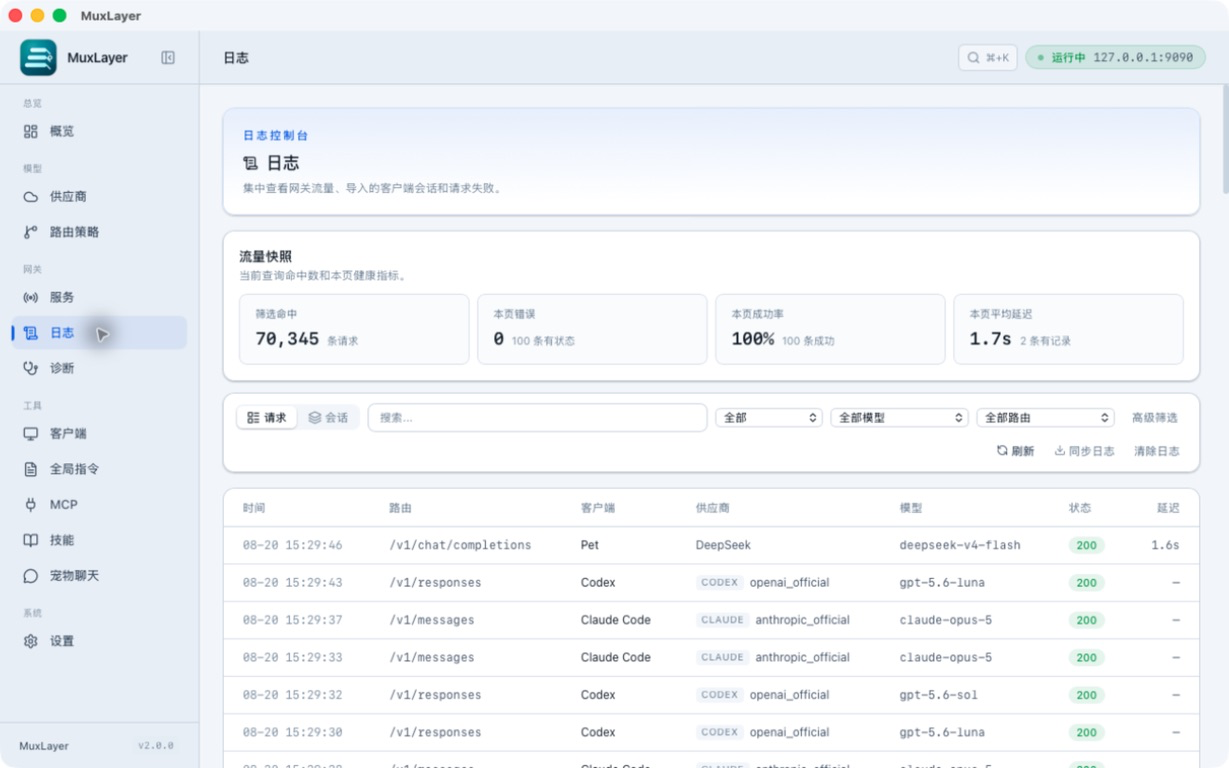
  • Request logs, token stats, cost estimates, and provider runtime status
  • Self-check and redacted diagnostic bundle export
  • Capability degradation events: image stripping, web_search downgrade, MCP advisory, and omitted tool-output images

Screenshots

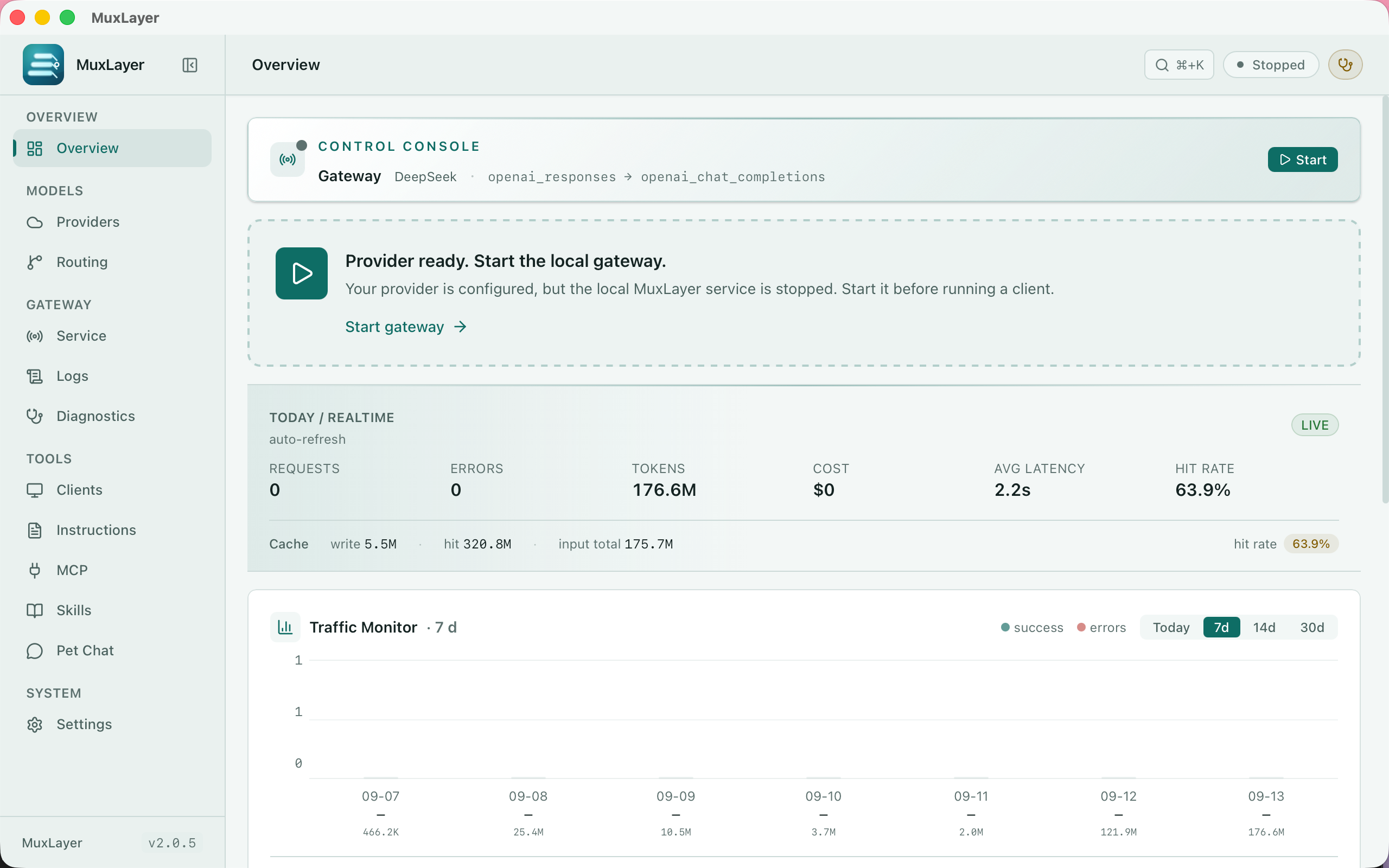
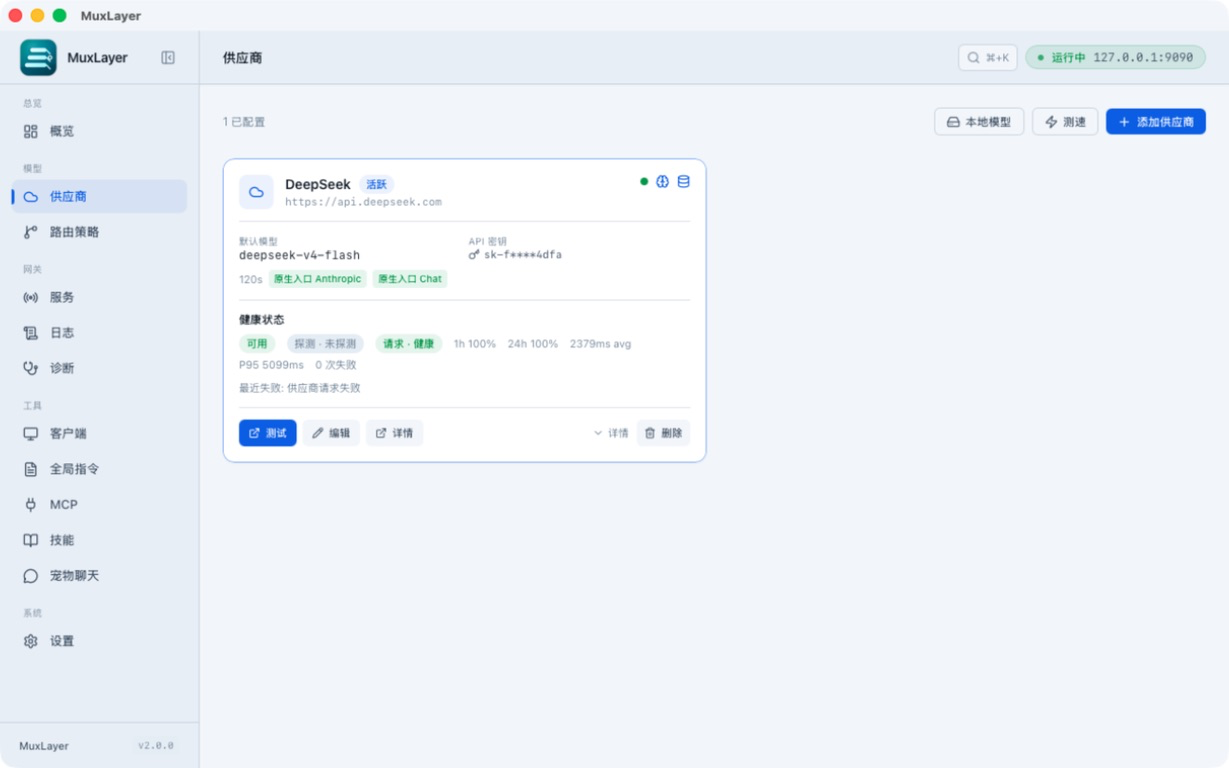
Overview Providers
Overview Providers
Routes Gateway
Routes Gateway
Clients Logs
Clients Logs
Diagnostics Settings
Quick Setup Pet Settings
Desktop Pet
Pet

Tech Stack

Layer Technology
Desktop Framework Tauri v2
Frontend React 19 + TypeScript + Tailwind CSS v4
Backend Rust + Tokio + Axum
Database SQLite (rusqlite, WAL mode)
HTTP Client reqwest

Installation & Build

Download

Download the installer for your platform from the Releases page.

Platform Format
macOS (Apple Silicon) .dmg (aarch64)
macOS (Intel) .dmg (x86_64)
Windows .exe
Linux .AppImage / .deb
macOS: "Cannot verify the developer"? (click to expand)

If macOS Gatekeeper blocks the app, use one of these options:

Option 1: System Settings (recommended)

  1. Double-click AgentGate, click Cancel on the prompt
  2. Open System Settings → Privacy & Security
  3. Scroll down, find "AgentGate" was blocked → click Open Anyway
  4. Open AgentGate again, click Open

Option 2: Right-click open

  1. Find AgentGate.app in Finder
  2. Hold Control and click (or right-click) → select Open
  3. Click Open on the prompt

Option 3: Terminal

xattr -d com.apple.quarantine /Applications/AgentGate.app

Only needed once.

Windows SmartScreen warning? (click to expand)

On first run, SmartScreen may show a warning:

  1. Click More info
  2. Click Run anyway

Only needed once.

Build from Source

Prerequisites

  • Node.js >= 20
  • pnpm >= 10
  • Rust >= 1.75
  • macOS / Windows / Linux

Install Dependencies

pnpm install

Development Mode

pnpm tauri dev

Build

pnpm tauri build

Headless / Server Mode

Run AgentGate without GUI — for servers, CI, Docker, and team deployments.

# Add a provider
agentgate-serve provider-add -t deepseek -k sk-xxx

# Start the gateway
agentgate-serve serve --host 0.0.0.0 --port 9090

# Other commands
agentgate-serve provider-list          # list all providers
agentgate-serve provider-remove NAME   # remove provider
agentgate-serve token                  # show access token
agentgate-serve status                 # show config summary

Provider presets auto-fill base URL and model for: deepseek, openai, anthropic, kimi, minimax, groq, together, google_gemini, xai, mistral.

Docker:

docker compose up
# or
docker build -t agentgate . && docker run -p 9090:9090 \
  -e AGENTGATE_PROVIDER=deepseek -e AGENTGATE_API_KEY=sk-xxx agentgate

Environment variables: AGENTGATE_HOST, AGENTGATE_PORT, AGENTGATE_DB_PATH, AGENTGATE_PROVIDER, AGENTGATE_API_KEY.

Usage Guide

1. Add a Provider

Launch AgentGate → ProvidersAdd Provider

Fast path (recommended) — paste API key:

  1. Paste your provider API key into the top input
  2. AgentGate detects known key prefixes (sk-ant- / deepseek- / gsk_ / …). If the prefix is ambiguous, select the provider type manually
  3. Click Create — name, base URL, protocols, default/reasoning model, capabilities are all filled in for you. Done.

Manual mode — 3 sections, only Section A is required:

Section Fields Notes
Basic Type · Name · API Key (+ Base URL only if custom type) Picking a type auto-fills everything else from the preset
Models & Capabilities Default model · Reasoning model · Fetch & detect button · capability matrix toggle On a freshly created provider, this is auto-run in the background — you get newest non-mini model as default + newest reasoning model + per-model capability matrix without clicking anything
Advanced (collapsed, "usually no need to touch") Protocols + their endpoints (Chat / Responses / Anthropic) · Extra Headers · Timeout · Auto cache control · Model Mapping Each protocol you tick shows its own URL — one place to read "which native endpoints this upstream supports"

Model Mapping is at the bottom of Advanced for a reason: usually not needed. AgentGate auto-fills recommended MiMo / DeepSeek mappings when you create the provider, fetch models, test the provider, or apply Codex / Claude Code config. Existing mappings are preserved. Native pass-through keeps model unchanged unless a mapping matches or the client sends the virtual agentgate model; protocol conversion uses mapping first, then falls back to default_model for compatibility with clients like Codex, Claude Code, and Gemini CLI.

Provider configuration examples:

DeepSeek
Field Value
Name DeepSeek
Type deepseek
Base URL https://api.deepseek.com
Default Model deepseek-v4-flash
Reasoning Model deepseek-v4-pro
Model Mapping gpt-5.5deepseek-v4-flash, o3deepseek-v4-pro
Anthropic Endpoint https://api.deepseek.com/anthropic (supports Claude Code pass-through)
KimiCoding (Moonshot)
Field Value
Name KimiCoding
Type kimi
Base URL https://api.moonshot.cn
Default Model kimi-k2
Extra Headers {"User-Agent":"KimiCLI/1.40.0"}
Model Mapping gpt-5.5kimi-k2

KimiCoding supports Vision and can serve as a failover target for image requests.

OpenAI
Field Value
Name OpenAI
Type openai
Base URL https://api.openai.com
Default Model gpt-4o
Responses API Endpoint https://api.openai.com (OpenAI natively supports Responses API, uses pass-through)
Model Mapping Usually not needed (client model names used directly)
Anthropic (Claude)
Field Value
Name Anthropic
Type anthropic
Base URL https://api.anthropic.com
Default Model claude-sonnet-4-6
Model Mapping gpt-5.5claude-sonnet-4-6

When type is set to Anthropic (Claude), Codex requests are automatically converted using Claude Messages API native format (tool_use/tool_result/input_schema), rather than being converted to Chat Completions.

MiniMax
Field Value
Name MiniMax
Type minimax
Base URL https://api.minimax.chat
Default Model MiniMax-M1
Model Mapping gpt-5.5MiniMax-M1
OpenRouter
Field Value
Name OpenRouter
Type openrouter
Base URL https://openrouter.ai/api
Default Model deepseek/deepseek-v4-flash
Model Mapping gpt-5.5deepseek/deepseek-v4-flash
Custom OpenAI Compatible
Field Value
Name Your custom name
Type custom_openai_compatible
Base URL Your server URL, e.g., http://localhost:8000
Default Model Your model name

Works with any OpenAI Chat Completions API-compatible service (e.g., vLLM, Ollama, LiteLLM).

After saving:

  • Fetch + capability detection runs automatically in the background — no manual action needed
  • Click Test Connection to verify the config — it opens a single dialog with 3 live steps: Connectivity & authCapability autofillPrompt cache detection (auto-skipped for non-Anthropic providers)

2. Start the Gateway

Overview or Gateway page → Start Gateway

Listens on 127.0.0.1:9090 by default.

3. Configure Codex

ClientsCodexApply Config

AgentGate will automatically:

  • Save original ~/.codex/config.toml and auth.json
  • Write AgentGate provider settings and local token

Click Switch to Official to restore the original config at any time — conversations are preserved.

4. Configure Claude Code

ClientsClaude CodeApply Config

AgentGate writes to ~/.claude/settings.json, setting ANTHROPIC_BASE_URL to the local gateway and ANTHROPIC_API_KEY to the AgentGate local token.

Click Switch to Official to restore the original settings.json.

5. Configure OpenCode

ClientsOpenCodeApply Config

AgentGate writes to ~/.config/opencode/opencode.json, configuring an OpenAI-compatible provider pointing to the local gateway. It uses openai/agentgate as a virtual model so switching providers in AgentGate does not require editing OpenCode again.

6. Configure Gemini CLI

ClientsGemini CLIApply Config

AgentGate writes Gemini CLI's config to point at the local gateway's /v1beta/... route (Gemini-compatible). One-click toggle back to official.

7. Configure AtomCode

ClientsAtomCodeApply Config

AtomCode integration writes its config to use AgentGate as the upstream — same toggle pattern as the others. It uses agentgate as a virtual model so the gateway can resolve DeepSeek / MiMo / other provider model names at request time.

8. Direct API Calls

All endpoints (except /health) require a local access token.

Getting the token:

  • Copy from UI: AgentGate → SettingsGateway Auth → click the copy button next to the token
  • Read from terminal:
    TOKEN=$(cat ~/.agentgate/token)
    
  • Regenerate: SettingsRegenerate Token (old token is immediately invalidated)

The token format is ag_local_*. It is only used for local gateway auth and is never forwarded to upstream providers.

Chat Completions (Pass-through)

curl -X POST http://127.0.0.1:9090/v1/chat/completions \
  -H "Authorization: Bearer $TOKEN" \
  -H "Content-Type: application/json" \
  -d '{"model":"deepseek-v4-flash","messages":[{"role":"user","content":"Hello"}]}'

Responses API (Codex Protocol)

curl -X POST http://127.0.0.1:9090/v1/responses \
  -H "Authorization: Bearer $TOKEN" \
  -H "Content-Type: application/json" \
  -d '{"model":"gpt-5.5","input":"Hello","stream":true}'

Messages API (Claude Code Protocol)

curl -X POST http://127.0.0.1:9090/v1/messages \
  -H "Authorization: Bearer $TOKEN" \
  -H "Content-Type: application/json" \
  -d '{"model":"claude-sonnet-4-6","max_tokens":1024,"messages":[{"role":"user","content":"Hello"}]}'

Model List

curl http://127.0.0.1:9090/v1/models -H "Authorization: Bearer $TOKEN"

Health Check (No Auth Required)

curl http://127.0.0.1:9090/health

Client says “network connection failed”?

First check whether the gateway port is actually running:

curl http://127.0.0.1:9090/health
  • If the connection fails: go back to AgentGate Overview / Gateway / Clients and click Start Gateway.
  • If health works: use the Clients page connection test to narrow it down: Config → Gateway → Provider.
  • http://localhost:1420 is only the development UI; Codex / Claude Code / OpenCode / Gemini CLI / AtomCode call http://127.0.0.1:9090.

9. Multi-Provider & Failover

Configure Route Profiles on the Routes page:

  1. Default routes are auto-created per protocol (Codex / Claude Code / OpenCode)
  2. Add multiple providers to the provider chain, adjust priorities
  3. Switch mode: manual / failover
  4. In failover mode, 429/402/5xx/timeout errors automatically try the next provider

10. Capability-Aware Routing (Multimodal & Reasoning)

AgentGate tracks per-model capabilities across 8 dimensions and uses them for routing — when your request contains images / audio / tools, the gateway picks a model that actually supports it.

Capability matrix per model:

text · vision · audio_in · tts · video_in · reasoning · tools · web_search

Setup:

  1. Add a provider — model list, capabilities, and best default/reasoning model are detected automatically right after creation
  2. On the Providers page, the card shows capability icons + native pass-through chips (Native Chat, Native Anthropic, …)
  3. To re-detect manually: open Edit → click Fetch & detect capabilities
  4. On the Routes page, switch mode to failover

How it works:

  • After provider creation: gateway calls upstream /models, runs name-pattern seeding for capabilities, picks newest non-mini model as default and newest reasoning-style model as reasoning_model
  • When a request includes images, the gateway:
    • First tries to swap to a sibling model on the same provider that supports vision (e.g., mimo-v2.5-promimo-v2.5 for images)
    • If no sibling on the current provider, failover to next provider in the chain whose matrix declares a vision-capable model
  • Capability matrix also gates tool emission — unchecking web_search for a model stops the gateway from sending the web_search builtin to that model
  • Promotion picker prefers the candidate that preserves the most of the original model's other capabilities; supported_models order is the tiebreak
  • Providers without any vision-capable model strip image content at the provider transform layer, avoiding upstream 400/404 on text-only fallback

Example scenario:

Codex sends a request with images
  → Gateway sees request has images
  → MiMo's matrix: mimo-v2.5-pro = text, mimo-v2.5 = text + vision
  → Promote mimo-v2.5-pro → mimo-v2.5 (same provider, capability match)
  → Request goes through, full image + text preserved

11. Diagnostics

On the Diagnostics page:

  • Run Self-Check — checks gateway, provider, config, and database status
  • Export Diagnostic Bundle — generates a redacted diagnostic report for troubleshooting
  • Request log trace_json includes degradation_events when AgentGate strips unsupported capabilities such as images, native web search, MCP connectors, or tool-output images.

Supported Providers

Providers marked Provider-specific handling have dedicated transform code in src-tauri/src/transform/providers/. The rest go through the generic Chat Completions / Anthropic pass-through path and work out-of-the-box.

Provider Type Native Protocols Provider-Specific Handling
Xiaomi MiMo mimo Chat + Anthropic Multi-turn reasoning_content round-trip, region-aware tp-* host auto-routing, temperature strip in thinking mode, tool_choice non-auto strip, omni web_search strip, web_search builtin gated by matrix, Web Search Plugin auto-degrade / retry
DeepSeek deepseek Chat + Anthropic Image stripping with explicit notice, DeepSeek V4 thinking history reasoning backfill, schema cleaning, message reordering
Anthropic (Claude) anthropic Anthropic tool_use/tool_result, input_schema, thinking budget, native cache_control
OpenAI openai Chat + Responses None (Responses passthrough or Chat conversion)
Google Gemini google_gemini Chat None
Kimi / Moonshot kimi Chat web_searchbuiltin_function/$web_search, thinking control
MiniMax minimax Chat Strip reasoning_effort / response_format, <think> extraction
GLM (Zhipu) glm Chat Generic
DashScope (Qwen) dashscope Chat Generic
SiliconFlow siliconflow Chat Generic
Volcengine (Doubao) volcengine Chat Generic
Baichuan baichuan Chat Generic
StepFun stepfun Chat Generic
Yi (01.AI) yi Chat Generic
xAI (Grok) xai Chat Generic
Mistral mistral Chat Generic
Groq groq Chat Generic
Together together Chat Generic
Fireworks fireworks Chat Generic
Cerebras cerebras Chat Generic
Perplexity perplexity Chat Generic
Cohere cohere Chat Generic
OpenRouter openrouter Chat None
Custom custom_openai_compatible Chat None (set Base URL yourself)

Vision / reasoning / tools / web_search capability is tracked per-model in the capability matrix, not at the provider level. See Capability-Aware Routing below.

Data Flow

AgentGate separates protocol handling from model naming. There are three common request modes:

How to tell? First check whether the client protocol matches a native provider endpoint. If it matches, the request is forwarded without protocol conversion. Model names are a separate concern: a matching Model Mapping can still rename model.

Client Sends Downstream Provider AgentGate Mode Trigger
Codex Responses API Chat Completions Protocol Conversion Default (no special URL)
Codex Responses API Claude Messages API Protocol Conversion provider_type is anthropic
Codex Responses API Responses API Native Passthrough responses_base_url is configured
Claude Code Messages API Chat Completions Protocol Conversion No anthropic_base_url
Claude Code Messages API Anthropic-compatible endpoint Native Passthrough + Model Mapping anthropic_base_url is configured and claude-* maps to provider model
OpenCode Chat Completions Chat Completions Native Passthrough Same protocol and upstream model name
curl / New API etc. Chat Completions Chat Completions Native Passthrough Same protocol and upstream model name

Protocol Conversion

When the client protocol differs from the downstream provider, AgentGate converts the format. This is the most complex path, including vision-aware routing and provider-specific processing.

┌──────────────────┐    ┌──────────────────┐
│      Codex       │    │    Claude Code    │
│  (Responses API) │    │  (Messages API)   │
└────────┬─────────┘    └────────┬─────────┘
         │                       │
         ▼                       ▼
┌─────────────────────────────────────────────────────────────────────────┐
│                    AgentGate (127.0.0.1:9090)                           │
│                                                                         │
│  ① Auth: validate local token (ag_local_*)                              │
│                         ▼                                               │
│  ② Route Matching: match Route Profile by protocol                      │
│     /v1/responses → Codex Default                                       │
│     /v1/messages  → Claude Code Default                                 │
│                         ▼                                               │
│  ③ Protocol Conversion (shared layer)                                   │
│     Responses API → Chat Completions (input_image → image_url)          │
│     Messages API  → Chat Completions (image → image_url)                │
│                         ▼                                               │
│  ④ Capability-Aware Routing (failover mode)                             │
│     Has images → promote to vision sibling on same provider, or         │
│                  failover to next provider with a vision-capable model  │
│     No images  → select by priority as normal                           │
│                         ▼                                               │
│  ⑤ Provider-Specific Transform                                          │
│     DeepSeek   → strip images + reasoning_content + schema fix          │
│     KimiCoding → web_search conversion + thinking control               │
│     Anthropic  → convert to Claude Messages (image→source.base64)       │
│     Others     → send directly                                          │
│                         ▼                                               │
│  ⑥ Failover: 429/402/5xx/timeout → cooldown → try next provider        │
│                         ▼                                               │
│  ⑦ Logging → SQLite                                                    │
│                         ▼                                               │
│  ⑧ Response reverse-conversion: back to original protocol for client    │
└─────────┬───────────────────────────────┬───────────────────────────────┘
          │                               │
          ▼                               ▼
   ┌──────────────┐               ┌──────────────┐
   │   DeepSeek   │               │  KimiCoding  │  ...
   │  (text only) │               │ (text+image) │
   └──────────────┘               └──────────────┘

Native Passthrough

When the client protocol matches the downstream provider, AgentGate does not convert the request format. It replaces the URL and credentials. Model handling follows one rule: Model Mapping wins; otherwise the request model is preserved. If the request model is agentgate or openai/agentgate, AgentGate resolves it to the model selected by routing for that request. If the client omits model, AgentGate uses the provider default.

┌──────────────────┐  ┌──────────────────┐  ┌──────────────────┐
│    Claude Code   │  │     OpenCode     │  │  curl / New API  │
│  (Messages API)  │  │(Chat Completions)│  │(Chat Completions)│
└────────┬─────────┘  └────────┬─────────┘  └────────┬─────────┘
         │                     │                      │
         ▼                     ▼                      ▼
┌─────────────────────────────────────────────────────────────────────────┐
│                    AgentGate (127.0.0.1:9090)                           │
│                                                                         │
│  ① Auth: validate local token (ag_local_*)                              │
│                         ▼                                               │
│  ② Route Matching: match Route Profile by protocol                      │
│     /v1/messages          → Claude Code Default                         │
│     /v1/chat/completions  → OpenCode Default                            │
│                         ▼                                               │
│  ③ Native Passthrough                                                   │
│     Replace target URL (base_url or anthropic_base_url)                 │
│     Inject provider API key                                             │
│     Optional model mapping (claude-* → mimo/deepseek model)             │
│     Forward request body as-is ──→ Proxy response stream as-is         │
│                         ▼                                               │
│  ④ Logging → SQLite                                                    │
└─────────┬───────────────┬───────────────────┬───────────────────────────┘
          │               │                   │
          ▼               ▼                   ▼
  ┌──────────────┐ ┌──────────────┐   ┌──────────────┐
  │  DeepSeek    │ │   OpenAI     │   │  New API     │  ...
  │  /anthropic  │ │              │   │  / aggregator│
  └──────────────┘ └──────────────┘   └──────────────┘

Trigger conditions:
  • /v1/messages    + Provider has anthropic_base_url → Messages API native passthrough
  • /v1/chat/completions → Chat Completions native passthrough (all providers)

Flow Examples

Codex with images (protocol conversion + vision-aware routing):

Codex sends input_image
  → /v1/responses (Responses API)
  → ① Auth passes
  → ② Matches Codex Default Route Profile
  → ③ Protocol conversion: input_image → image_url (image preserved)
  → ④ Vision routing: image detected → skip DeepSeek (No Vision) → select KimiCoding (Vision)
  → ⑤ KimiCoding transform: no image stripping, send directly
  → ⑥ KimiCoding returns success → mark healthy
  → ⑦ Log request
  → ⑧ Reverse-convert to Responses API format → return to Codex

Claude Code → DeepSeek (native passthrough + model mapping):

Claude Code sends Messages API request
  → /v1/messages
  → ① Auth passes
  → ② Matches Claude Code Default Route Profile
  → ③ DeepSeek has anthropic_base_url → native passthrough
  → Model Mapping: claude-sonnet-4-6 → deepseek-v4-pro
  → Replace URL with api.deepseek.com/anthropic + inject API key
  → Request body proxied as-is → SSE response stream proxied as-is
  → ④ Log request

OpenCode / curl / New API (native passthrough):

Client sends Chat Completions request
  → /v1/chat/completions
  → ① Auth passes
  → ② Matches Route Profile
  → ③ Native passthrough: replace URL + API key; model unchanged unless mapping matches
  → Request body forwarded as-is → SSE response stream proxied as-is
  → ④ Log request

Gateway Routes

Method Path Mode Description
GET /health internal Health check (no auth)
GET /v1/models internal Model list
POST /v1/responses auto responses_base_url set → pass-through; Anthropic type → Claude conversion; otherwise → Chat Completions conversion
POST /v1/chat/completions pass-through Chat Completions direct
POST /v1/messages auto anthropic_base_url set → pass-through; otherwise → Chat Completions conversion

Project Structure

AgentGate/
├── provider-catalog/             # Provider/model source of truth for generated defaults
├── src/                          # Frontend (React)
│   ├── app/App.tsx               # App entry point
│   ├── pages/                    # Pages (Overview/Quick Setup/Providers/Routes/Gateway/Clients/Logs/Diagnostics/Settings)
│   ├── components/               # UI components (layout/common/dashboard/providers/logs/tools/onboarding)
│   ├── pet/                      # Desktop pet system (PetApp/Bubble/greetings/9 pet SVG components)
│   ├── lib/                      # API wrapper, i18n, utilities
│   └── types/                    # TypeScript type definitions
├── src-tauri/                    # Backend (Rust)
│   └── src/
│       ├── gateway/              # HTTP gateway (server/routes/SSE/SSE Anthropic/pass-through/failover)
│       ├── protocol/             # Protocol types (Responses/ChatCompletions/Messages/SSE events)
│       ├── transform/            # Protocol conversion (responses→chat/responses→anthropic/schema cleanup/tool_calls/reasoning store/providers)
│       ├── providers/            # Provider adapters
│       ├── storage/              # SQLite storage layer
│       ├── models/               # Data models
│       ├── tools/                # Client config management (Codex/Claude Code/OpenCode)
│       ├── security/             # Authentication & redaction
│       ├── diagnostics/          # Diagnostics & self-checks
│       ├── app/                  # Tauri commands & app state
│       └── errors/               # Unified error types
├── scripts/                      # Test and generation scripts
└── package.json

Security

  • Gateway uses local token authentication by default
  • Provider API keys are stored only in local SQLite and never sent to clients
  • Client tokens are never forwarded to upstream providers
  • Logs and diagnostic bundles automatically redact sensitive information
  • Gateway binds only to 127.0.0.1 by default; 0.0.0.0 is rejected
  • Token file permissions set to 0600 (Unix)

Development

Provider Catalog

Built-in provider/model data is maintained in provider-catalog/providers/*.json.
Run this after editing catalog files:

pnpm provider:catalog:generate
pnpm provider:catalog:check
pnpm provider:catalog:sync:check

provider:catalog:sync:check calls provider /models endpoints when the matching API key environment variable is present, and skips providers without credentials. It fails when a catalog model is no longer returned upstream; pass --strict to also fail on newly discovered upstream models. To refresh a provider explicitly, run:

pnpm provider:catalog:sync -- --provider deepseek --update
pnpm provider:catalog:generate

The generated TS/Rust files feed provider presets, endpoint defaults, capability seeds, pricing defaults, supported-model gates, and recommended mapping policy. Provider-specific runtime behavior still lives in code, not in the catalog.

Upstream model sync is intentionally a local maintenance step, not part of the GitHub release workflow. Release CI only checks that generated catalog artifacts are up to date.

Test Scripts

# Health check
./scripts/test-gateway-health.sh

# Auth test
./scripts/check-gateway-auth.sh

# Responses API test
./scripts/test-responses-stream.sh

# Chat Completions test
./scripts/test-chat-completions-pass-through.sh

License

MIT

Reviews (0)

No results found