loomcycle
Health Uyari
- License — License: Apache-2.0
- Description — Repository has a description
- Active repo — Last push 0 days ago
- Low visibility — Only 5 GitHub stars
Code Gecti
- Code scan — Scanned 12 files during light audit, no dangerous patterns found
Permissions Gecti
- Permissions — No dangerous permissions requested
Bu listing icin henuz AI raporu yok.
The runtime substrate for agentic systems — one Go binary, six LLM providers, MCP-native, configurable as a managed sandbox or full agentic dev environment. Where agents live, talk, and learn.

The agentic runtime, in a sidecar.
One Go binary alongside your application — hardened agent loop, MCP on both sides, multi-replica HA. Apache-2.0.
🌐 loomcycle.dev · 📝 Engineering blog · 📐 Architecture




🌳 v1.0 shipped — multi-replica HA in production, external contributions open. The core primitives stabilised through v0.8 → v0.12 → v1.0. We welcome bug reports, security disclosures, feature contributions, downstream consumers, and forks. See
CONTRIBUTING.md.
What it is
The agentic runtime, in a sidecar. loomcycle is one sub-40 MB Go binary that runs alongside your application — not inside it. Your app calls loomcycle over HTTP, gRPC, MCP, or via the TypeScript adapter; the agent loop, multi-provider routing, memory and channel primitives, MCP server identity, OpenTelemetry traces, and multi-replica coordination all live in the binary. It's the substrate your agents live on — and your application stays in whatever language you wrote it in.
The shape that's different. The agentic-systems market today gives you three choices — embed a Python or TypeScript library inside your process, rent a managed cloud service tied to one vendor's IAM, or proxy your model calls through a gateway that doesn't actually run agents. loomcycle is the fourth shape: a lightweight self-hostable runtime that owns the loop and speaks every wire format your stack already uses.
What's shipped
| Capability | Released in |
|---|---|
Six providers, native HTTP, no vendor SDK — Anthropic, OpenAI, DeepSeek, Gemini, Ollama cloud, Ollama local — behind one Provider interface with resolver-based routing per tier and effort |
v0.4 → v0.8.x |
| Nineteen built-in tools including Claude Code parity (Read, Write, Edit, Grep, Glob, NotebookEdit), HTTP, WebFetch, WebSearch, Bash, Agent, Skill, Memory, Channel, AgentDef, SkillDef, Evaluation, Interruption, Context | v0.4 → v0.8.24 |
| AgentDef + SkillDef + MCPServerDef substrate — content-addressed by SHA-256, runtime-mutable, push-at-boot from your container image; verify-or-fork across deployments | v0.8.5 / v0.8.22 / v0.9.x |
Vector Memory with semantic search — embed: true on writes, op: search on reads. sqlite-vec or pgvector; Voyage / OpenAI / Gemini / nomic-embed on the embedding side |
v0.9.0 |
| MCP on both sides — loomcycle is both an MCP client (mounts external MCP servers as tools) and an MCP server (Claude Code and external orchestrators drive it via 21 meta-tools) | v0.8.15 |
| OpenTelemetry across loop + providers + tools + MCP — no transcripts in spans | v0.10.0 |
| Per-tenant fairness on the run-admitting semaphore (single-replica), cluster-wide (multi-replica) | v0.10.1 / v0.12.1 |
LLM Gateway + OpenAI-compatible shims — POST /v1/_llm/chat, POST /v1/chat/completions, POST /v1/embeddings. Drop loomcycle in front of any LangChain / LlamaIndex / n8n / RAG pipeline that speaks OpenAI's wire format |
v0.11.0 → v0.11.4 |
n8n community package — @loomcycle/n8n-nodes-loomcycle. Five cluster sub-nodes, action nodes, two trigger nodes, six example workflows |
v1.x (community) |
Anthropic MAX subscription OAuth for dev workflow — reverse-engineered, dev-only, opt-in; see docs/PROVIDERS.md |
v0.11.10 |
| Pause / Resume / Snapshot — runtime-wide quiesce + cross-version-portable JSON snapshot. In-place upgrades, snapshot-based replica handoff | v0.8.17 → v0.8.18 |
| Multi-replica HA — Redis cancel pubsub, cross-replica run status, cluster-wide pause/resume + bus fanout, singleton sweepers, DB-backed session locks. Single binary scales from a cheap VPS to a multi-replica fleet | v0.12.0 → v0.12.5 |
| UNIX-style trust model — operator config is the floor; callers narrow per-request but never widen. Bearer auth at the HTTP frontier; sandbox (Posture A) vs operator-trusted (Posture B) selected via env | v0.4 → ongoing |
Embedded React Web UI at /ui — Library admin (agents / skills / MCP servers), Activity Monitor, Channels view, audit log |
v0.8.21 → v0.11.6 |
| v1.0 capstone — docs + hardening pass | v1.0 |
Full per-version log: REVISIONS.md.
Two postures, one binary
Same Go binary, same config schema. Operator flips a few env vars to pick the posture.
| Posture | Configuration shape | Use case |
|---|---|---|
| True managed sandbox | LOOMCYCLE_BASH_ENABLED=0, LOOMCYCLE_READ_ROOT / LOOMCYCLE_WRITE_ROOT unset, LOOMCYCLE_HTTP_HOST_ALLOWLIST empty, LOOMCYCLE_HTTP_CALLER_AUTHORITATIVE=1. Every tool default-deny; agents can only reach what the caller's per-request allowed_hosts says. |
Shared-server deployments processing untrusted prompts. The runtime survives contact with adversarial input. |
| Agentic dev environment | Bash enabled, filesystem roots set to your workspace, broad allowed_hosts, optional local Ollama for offline work. |
Local development. Internal trusted operators. Single-user research workstation. |
The trust boundary is operator/caller — the operator config is the floor, callers can narrow per-request but never widen. The bearer token (LOOMCYCLE_AUTH_TOKEN) is the authority. Treat anyone with the token as fully trusted to drive the runtime. For true isolation in the sandbox posture, run loomcycle inside a container or VM — Bash is restricted (cwd, env scrub, output bounds, timeouts) but is not a kernel-level sandbox.
Install
Pick the path that fits. All four ship the same single static binary
plus the v0.11.1 init / doctor first-run flow. Context.help installation covers each in detail.
# Homebrew (macOS + Linux)
brew install denn-gubsky/loomcycle/loomcycle

# Docker (v0.11.2+; pull works on amd64 + arm64 including Apple Silicon)
docker pull denngubsky/loomcycle:latest

# go install from source (skips Web UI embedding — for dev only)
go install github.com/denn-gubsky/loomcycle/cmd/loomcycle@latest

# Direct tarball (one of darwin-arm64 / darwin-amd64 / linux-arm64 / linux-amd64)
curl -L https://github.com/denn-gubsky/loomcycle/releases/latest/download/loomcycle-darwin-arm64.tar.gz | tar xz
Quick start
loomcycle init       # bootstrap ~/.config/loomcycle/loomcycle.yaml + README.md
# set $LOOMCYCLE_AUTH_TOKEN + at least one provider key in your shell rc
loomcycle doctor     # verify env + provider keys + storage + listen
loomcycle            # start the server on 127.0.0.1:8787

# Smoke
curl http://127.0.0.1:8787/healthz
# {"ok":true}

# Open the Web UI (one-time per browser session — sets HttpOnly cookie)
open "http://127.0.0.1:8787/ui?token=$LOOMCYCLE_AUTH_TOKEN"
Real call (from another terminal):
curl -N http://127.0.0.1:8787/v1/runs \
  -H "Authorization: Bearer $LOOMCYCLE_AUTH_TOKEN" \
  -H "Content-Type: application/json" \
  -d '{"agent":"default","segments":[{"role":"user","content":[{"type":"trusted-text","text":"Hello"}]}]}'
Build from a checkout (for development):
make build-all       # UI + binary in one shot; output → ./bin/loomcycle
./bin/loomcycle --config loomcycle.example.yaml
Multi-replica cluster demo (v0.12.x): for a one-command docker compose up cluster (2 loomcycle replicas + Postgres + nginx LB) with a verify script, see examples/cluster/README.md. Full operator runbook in docs/MULTI-REPLICA.md.
Current and planned
Shipped through v0.11.x:
- v0.11.12 — Hash CLI yaml-name mode + Channels UI source-tag filters. Two small DX items bundled. (a)
loomcycle hash agent --config <yaml> <name>extends the existing v0.9.x path-mode hash CLI with a name-lookup mode — operators whose agents live inloomcycle.yaml(not standalone.mdfiles) can now compute the localcontent_sha256to compare againstAgentDef.verifyfor pre-deploy drift detection. Path-mode unchanged. (b) Web UI Channels view filter chip row gainsyaml/runtime/orphansource-tag chips alongside the existing scope chips (all/_system/*/global/user/agent) — closes the v0.11.5 UX gap where operators had to scan visually for source on each row. Zero server-side changes; web UI 0.7.6 → 0.7.7;@loomcycle/clientstays at 0.11.5. - v0.11.11 — Explicit no-guarantee disclaimer for OAuth-dev. Documentation + visible-warning patch on top of v0.11.10. Four operator-facing surfaces now carry consistent explicit language about the reverse-engineered OAuth flow:
docs/PROVIDERS.md⚠ NO GUARANTEES callout, CLIloomcycle anthropic loginprints the full disclaimer block before any auth work, boot-log warning, README v0.11.10 entry. Zero behavior change. - v0.11.10 — Anthropic OAuth-dev stealth-mode parity. ⚠ NO GUARANTEES. The Anthropic OAuth flow used by this provider is not an official integration — it's reverse-engineered (Pi reference + loomcycle replication). loomcycle mimics Claude Code's wire shape so calls pass Anthropic's subscription-billing detection, but Anthropic can change the flow, the wire shape, or the detection at any time and the integration will break. Operators are running this against their own Claude Pro/Max subscription; Anthropic's terms historically restrict programmatic use outside their SDK; operators carry all risk including account flag/revocation. loomcycle and its maintainers offer no warranty, no liability, and no support guarantees for this path. Resolution of any account issues is between the operator and Anthropic. If those terms are unacceptable, use the production
anthropicprovider (API key) instead. Seedocs/PROVIDERS.mdfor the full risk acknowledgement. — Closes the v0.11.9 deferrals by converging the live-data findings against a real MAX subscription. Three wire-shape adaptations were needed for Anthropic's OAuth-billing path to accept loomcycle's calls: (1)redirect_urimust use literallocalhostnot127.0.0.1(string match against the registered client_id whitelist); (2) token-exchange body requires astatefield (non-standard for OAuth2 but Anthropic enforces it); (3) the system prompt must lead with the verbatim"You are Claude Code, Anthropic's official CLI for Claude."block — without it the validator returns a misleading"messages: Input should be a valid array"400. Plus two mechanical fixes:CanonicalizeToolNamenow wired intoMaskOutbound(lowercaseallowed_tools: [read, write]in yaml canonicalize toRead,Writeoutbound);ErrSubscriptionQuotaExhaustedpromoted from stub to real detection on the synchronous error path (429+"subscription" body wraps with a type that preserves the original error text — sointernal/providers/errclass.go's regex still matches and the existing tier-fallback path still fires — and addsIs()soerrors.Is(err, ErrSubscriptionQuotaExhausted)matches for callers). Cache-control verification: writes report under OAuth but reads aren't served — kept on for Pi wire-parity, documented as 25% per-call premium. Live verified end-to-end:provider: anthropic-oauth-devagent getspongfrom claude-sonnet-4-6 against the operator's MAX subscription. v0.11.9 was never tagged independently; v0.11.10 supersedes it functionally. - v0.11.9 — Anthropic OAuth-dev provider (research/dev only). Opt-in subscription-billed Anthropic provider via reverse-engineered OAuth (Pi's
pi-aipackage is the reference; github.com/earendil-works/pi, 51K stars). Strategic shift: research workloads at ~$750-$3,750 per 100-iteration cycle move to $200/month MAX subscription billing without changing the production posture for paying customers. RFC-locked atdoc-internal/rfcs/anthropic-oauth-dev.md. Opt-in viaLOOMCYCLE_ANTHROPIC_OAUTH_DEV_ENABLED=1+loomcycle anthropic login. New provider IDanthropic-oauth-dev(separate from productionanthropic). HTTP transport wraps the existing Anthropic driver — stripsx-api-key, setsAuthorization: Bearer <token>(from a background refresher with 5-min slack), appendsclaude-code-20250219,oauth-2025-04-20toanthropic-beta, setsuser-agent: claude-cli/2.1.75(overrideable viaLOOMCYCLE_CLAUDE_CODE_VERSION). All loomcycle tools admissible — the 10-tool Claude-Code canonical overlap passes through unchanged; loomcycle-only built-ins (Memory / Channel / Agent / AgentDef / etc.) are exposed under themcp__loomcycle__*wire mask so Anthropic's subscription-billing layer treats them as MCP tools; realmcp__*MCP tools pass through unchanged. New CLI:loomcycle anthropic {login, status, logout}, all gated on the env var. Token persistence at~/.config/loomcycle/anthropic-oauth.json(chmod 0600 enforced). Newdocs/PROVIDERS.md(300+ lines) covers operator setup + risk acknowledgement (TOS gray zone, account-revocation risk, drift exposure, single-machine deployment). NOT for production deployment. Multi-replica HA explicitly unsupported. v0.11.10 follow-up will land stealth-mode parity (system-prompt adaptation, cache-control rules, MCP schema audit) once OAuth shell is operator-validated against a real MAX subscription. - v0.11.8 — Multi-agent fan-out:
Agent.parallel_spawnop + per-agentmax_concurrent_childrencap. Formalizes the locked v0.9.x backlog item fromlangchain-comparison.mdTier A. JobEmber's job-searcher has been spawning sub-agents sequentially in prod for months; v0.11.8 gives the model a first-class API to fan out concurrently. Newopdiscriminator on the existingAgenttool (matches the Memory/Channel/AgentDef multi-op convention) —op:"spawn"(default, omittable) keeps the v0.4.0 single-child shape byte-identical;op:"parallel_spawn"takes{spawns: [{name,prompt,def_id?}, ...]}and returns a JSON envelope{results:[{index,agent,ok,output?,error?}]}in input order when ALL children complete. Per-child errors stay inside the envelope (parent runs never torn down by child failures). Concurrency cap layered: per-agentmax_concurrent_children: Nyaml/substrate field (default 4) throttles parallel goroutines per call; hard ceilingMaxParallelSpawns=32refuses runaway-spawns arrays up-front; depth guard fires once per call. New bundledContext.helptopicfan-out-patternsexplains when to use parallel vs sequential vs Channel.publish. Web UI Library modal gainsmax_concurrent_childrennumber input. Zero adapter changes — TS stays at 0.11.5. 12 new unit tests + end-to-end smoke verified. - v0.11.7 — Post-v0.11.6 polish. Three small unrelated improvements bundled into one release. (a) Promoted
--fg-muted+--bg-inputfrom inline-fallback-only into first-class:rootCSS tokens — continues the v0.11.6 theming-consistency treatment. (b) Library modal: the v0.11.6 custom-tier warning was buried in the per-tier models grid at the bottom; operators forking just to tweaksystem_promptcould miss it. Hoisted to the top of AgentFields so it's visible the moment the modal opens. (c)publish-ts-adapterworkflow now skips cleanly on Web-UI-only or binary-only releases (whenadapters/ts/package.jsonversion doesn't match the tag) instead of hard-failing the publish job. Zero server-side changes;@loomcycle/clientstays at 0.11.5; web UI 0.7.4 → 0.7.5. - v0.11.6 — Library admin modal: fully structured form for agent + skill definitions. The v0.10.4 hybrid (structured inputs + JSON catch-all textarea) was failing operators in real use: raw newlines inside
system_promptproduced invalid JSON, a single missing comma sank the whole submit, and the JSON catch-all hid the schema behind manual typing. Every editable agent overlay field is now its own structured input —system_promptis a markdown textarea (raw newlines preserved),allowed_tools/skills/providersare comma-separated text inputs,max_tokens/max_iterations/memory_quota_bytesare number inputs,memory_scopesis a checkbox group, and the per-tiermodelsmap is a small dynamic table editor (three fixed tier slots: low/middle/high). The JSON catch-all is gone — the modal is now the authoritative schema view. Skill modal gets a small polish pass (markdown body class renamed.library-prompt-textareafor intent clarity; inline hint text added). MCP-server modal unchanged (already fully structured since v0.10.4). Zero server-side changes — wire shape identical to v0.11.5. Pure Web UI release; binary functionally identical to v0.11.5.@loomcycle/clientstays at 0.11.5. - v0.11.5 — yaml-static channels + memory + Web UI CRUD. The last v0.11.x slice before the multi-replica HA capstone. Two operator pain points: n8n integration tests can now programmatically create channels + pre-seeded memory entries as fixtures (no yaml + restart between tests), and static substrate deployments can declare the entire substrate — agents, channels, memory entries — purely in yaml. yaml additions:
channels.<name>.description: "..."for operator docs, plus a newmemory.entries:block with{scope, scope_id, key, value, embed?}rows pre-seeded on boot (idempotent — existing rows are preserved;embed: truetriggers a synchronous embed via the configured embedder). Channel admin HTTP CRUD:POST /v1/_channels/PATCH /v1/_channels/{name}/DELETE /v1/_channels/{name}against a newchannelssubstrate table; yaml-declared channels refuse mutations with HTTP 409channel_yaml_immutable.GET /v1/_channelsnow tags each row withsource: "yaml" | "runtime" | "orphan". Memory entry admin HTTP CRUD:PUT /v1/_memory/scopes/{scope}/{scope_id}/keys/{key}(idempotent upsert, optional?embed=true) +DELETE(204 even on missing rows). Web UI: Channels view gains "+ New channel" + per-row Edit/Delete (runtime only) + source chips; Memory view gains "+ New entry" + per-row Edit/Delete with a JSON-value editor + optional embed toggle + TTL. TS adapter (@loomcycle/client0.11.4 → 0.11.5): 5 new methods (createChannel/updateChannel/deleteChannel/setMemoryEntry/deleteMemoryEntry) + 4 typed exports + 12 new vitest tests. Storage: newchannelstable on sqlite + postgres (0021 migration); 4 newStoreinterface methods. Cursor namespace untouched — runtime channels reusechannel_messages+channel_cursors; delete cascades both. Two new bundledContext.helpsections (channel-adminruntime-substrate CRUD;vector-memoryyaml-static entries + admin PUT/DELETE). 42 → 47 methods on@loomcycle/client. - v0.11.4 — OpenAI Embeddings compatibility shim. Closes the OpenAI-ecosystem story v0.11.3 started. New
POST /v1/embeddingsendpoint serves OpenAI's exact wire shape; every RAG tool / vector DB integration / LangChainOpenAIEmbeddingsconsumer / "use OpenAI embeddings" tutorial works by changing only the base URL + auth token. Dispatches to the single configuredproviders.Embedder(the same instance Memory tool uses internally forembed:true) — no resolver path, no tier overlay, no streaming since OpenAI's embeddings API is synchronous. Wire translation:inputpolymorphic (string OR string[]); tokenized inputs (number arrays per OpenAI) refused with a clear error since loomcycle's substrate embedders (OpenAI / Gemini / Voyage-via-Anthropic) accept text only.encoding_format: "float"(default) emits each vector as a JSON array;"base64"packs each float32 little-endian then base64-encodes per OpenAI spec (~25% smaller wire bytes on 1536-dim vectors).modelechoed in the response for drop-in compatibility — the configured embedder always runs, and the audit log records both requested + served so operators spot drift.userfield auto-maps to loomcycle's per-user quota tracking.dimensionsaccepted-but-ignored in v1 (lands when theproviders.Embedderinterface grows it). No embedder configured → HTTP 503 with a pointer atmemory.embedder.*yaml. Same security policy as the v0.11.3 chat shim: per-user semaphore viaAcquireForUser, bearer-authed admin scope, structured audit log line per request. 10 new Go tests + 6 new TS tests; full Go suite + 144 TS tests pass. Newembeddings()method on@loomcycle/clientwith 4 new typed exports (LLMEmbeddingsOptions/LLMEmbeddingsResponse/LLMEmbeddingItem/LLMEmbeddingsUsage) — consumers using the typed adapter get richer typing than dropping the OpenAI SDK at loomcycle. Extends the bundledopenai-compatContext.help topic with an Embeddings section + Python/TypeScript SDK examples. Zero changes tointernal/providers/,internal/resolve/,internal/loop/, or the embedder interface itself.@loomcycle/client0.11.3 → 0.11.4 (41 → 42 methods). - v0.11.3 — OpenAI Chat Completions compatibility shim. New
POST /v1/chat/completionsendpoint serves OpenAI's exact wire shape; consumers using the OpenAI SDK (Python / TypeScript / Aider / Goose / Continue / Cursor / Cody / every "use OpenAI as your LLM" tutorial) point at loomcycle by changing only the base URL + auth token. Same dispatch path as the native/v1/_llm/chat(resolver routing, per-user quota, audit logging all in one place via the newprepareGatewayDispatchhelper); the shim is a pure wire-format translator. Wire translation: OpenAI'smessages[].contentpolymorphic field (string / array of text parts / null) → flat string. OpenAI's wrappedtools[]envelope → loomcycle's flat ToolSpec. OpenAI's JSON-stringfunction.arguments→ parsed object. Response: native content blocks →choices[0].message.content+tool_calls(OpenAI function envelope).stop_reason→finish_reasonper OpenAI spec (end_turn→stop,max_tokens→length,tool_use→tool_calls). Streaming:data: <json>chunks in thechat.completion.chunkshape, terminated bydata: [DONE](baredata:lines, NO named SSE events — matches OpenAI's protocol). Routing extensions via namespaced fields:loomcycle_provider,loomcycle_tier,loomcycle_user_id,loomcycle_user_tier. OpenAI's standarduserfield auto-maps toloomcycle_user_idso SDK callers get per-user quota tracking for free. Accepted-but-ignored OpenAI fields:n,presence_penalty,frequency_penalty,top_p,seed,response_format,logit_bias,tool_choice,top_logprobs,stop— accepted so SDKs don't validation-error, ignored because loomcycle doesn't apply them. RefactoredhandleLLMChatto extractprepareGatewayDispatch(~70 LOC moved); both handlers share validation/resolve/quota/audit. 11 new tests covering happy path / tool-call / streaming / array-content / ignored-fields / user-id mapping / finish-reason matrix / auth / validation. New bundledContext.help openai-compattopic with Python + TypeScript SDK examples. Zero new substrate logic; zero changes tointernal/providers/,internal/resolve/,internal/loop/.@loomcycle/client0.11.2 → 0.11.3 (lockstep version bump; no method changes — consumers using@loomcycle/clientshould still preferllmChat()/llmStream()over the OpenAI SDK shim for richer typing). - v0.11.2 — Docker image + Homebrew formula polish. Closes the install-path loop opened by v0.11.1. Multi-arch Docker image at
docker.io/denngubsky/loomcycle(linux/amd64 + linux/arm64; ~6 MB total based ongcr.io/distroless/static:nonroot; no shell, no package manager, runs as uid 65532). NewDockerfilefor local builds +Dockerfile.releasefor goreleaser's pre-built-binary path; both produce identical runtime images. Newdocker-compose.example.yamlat the repo root with mount + env-var + port-mapping defaults plus a commented-out Postgres upgrade block. goreleaserdockers:+docker_manifests:publish multi-arch manifests on every release tag — stubbed behind aDOCKER_PUBLISH_ENABLEDrepo variable so the pipeline ships tarballs + brew formula alone until the operator configures Docker Hub credentials (then flipping the var enables Docker push without further changes). Brew formula caveats refreshed to referenceloomcycle init/loomcycle doctor(v0.11.1 commands) instead of the obsolete "drop your loomcycle.yaml" manual flow. New bundledContext.help installationtopic walks all four install paths (Homebrew, Docker, direct tarball,go install) with verification + troubleshooting. README "Install" section promoted above "Quick start" so the four paths appear before the build-from-source flavor. Zero Go code changes — pure release-pipeline + docs work.@loomcycle/client0.11.1 → 0.11.2 (lockstep version bump; no method changes). - v0.11.1 — First-run UX:
loomcycle init+loomcycle doctor+ config auto-discovery. Closes the "bare binary fails to start" gap that bit every new operator.loomcycle initwrites~/.config/loomcycle/loomcycle.yaml+~/.config/loomcycle/README.mdfrom bundled assets — auto-on minimal wizard (3 questions: provider / env-var / listen-addr) when stdin is a TTY, non-interactive otherwise. CLAUDE.md security rule §2 holds: the wizard prints env-var lines for the operator to paste into their shell rc; never writes secrets to disk.loomcycle doctorruns 6 checks (config found + parses, auth token, per-provider API-key env vars, storage backend writable, listen address bindable) and prints[PASS]/[WARN]/[FAIL]per check; exits 0 clean, 1 on any FAIL. Config auto-discovery — when--configis left at default AND./loomcycle.yamlis absent, the binary walks$XDG_CONFIG_HOME/loomcycle/loomcycle.yaml→~/.config/loomcycle/loomcycle.yaml. When nothing's found, a friendly first-run hint replaces the old confusing "open loomcycle.yaml: no such file" error. Explicit--config /pathsemantics unchanged. Bundled documentation: the example yaml moved tocmd/loomcycle/embedded/(symlinked back at repo root) and is//go:embed'd alongside a new per-machine quickstartREADME.md(distinct from the repo's existingdocs/CONFIGURATION.mddeep-dive — they're complementary). New bundledContext.help getting-startedtopic for the agent-facing surface. Purely additive — zero HTTP surface changes, zero schema changes. 7 new init tests + 10 new doctor tests pass.@loomcycle/client0.11.0 → 0.11.1 (lockstep version bump; no method changes). - v0.11.0 — LLM Gateway: direct provider routing without the agent loop. New
POST /v1/_llm/chatendpoint exposes the resolver + provider auth + retry layer as a direct LLM call surface. Bypasses the agent loop entirely — consumers who only need provider routing (no tools, no memory, no agent semantics) skip the ~50-200 ms per-turn overhead of a fullrunStreamingspawn. The immediate use case is n8n's AI Agent Chat Model slot:@loomcycle/n8n-nodes-loomcyclewill ship aLoomCycleChatModelcluster sub-node consuming the gateway directly, replacing the v0.10.x "passthrough agent" workaround. The broader product positioning competes with LiteLLM / Portkey: one credential + one quota + one observability surface across all providers (Anthropic, OpenAI, DeepSeek, Gemini, Ollama, Ollama-cloud). Wire shape: LangChain-friendly request (flatmessages[]withtool_calls/tool_call_idcorrelation) → Anthropic-style content-block response ({type:"text"|"tool_use"}). Routing precedence:provider+model(explicit pin) >provideralone >modelalone > resolver default. Tool calling works: the existing per-provider schema translation (Anthropic input_schema vs OpenAI function.parameters vs Gemini function_declarations) is reused from each driver'sbuildRequestBody()— zero new translation code. Streaming SSE mirrors Anthropic's event names (provider_chosen→content_block_start/delta/stop→message_delta→done). Per-user quotas honored whenuser_idis set; anonymous calls bypass the per-user cap. Audit: lightweight structured log line per request + OTEL span when configured (v0.11.1 follow-up will add a dedicatedgateway_eventstable). No new server packages — handler lives ininternal/api/http/llm_gateway.goreusingProvider.Call,Resolver.Resolve,Semaphore.AcquireForUser, and the existing SSE writer. No runs-table row per gateway call — gateway calls are too high-cardinality (n8n workflows fire dozens per execution).@loomcycle/client0.10.4 → 0.11.0 addsllmChat()+llmStream()typed methods (36 → 41 methods total). 8 new Go tests + 10 new TS tests. New bundledContext.help llm-gatewaytopic.
Shipped before v0.11.x (per-feature detail in REVISIONS.md):
- v0.10.x — production-grade-ops sweep: OpenTelemetry distributed traces (v0.10.0); per-tenant fairness on the run-admitting semaphore +
GET /v1/_concurrency/statsadmin endpoint (v0.10.1); Voyage AI embedder +sqlite_vecbuild tag + heartbeat-sweeper flake fix (v0.10.2); typed Library v2 enumeration on@loomcycle/client(v0.10.3); Web UI Library admin — manual CRUD on agents / skills / MCP servers via/ui/library(v0.10.4). - v0.9.x — vector memory + substrate maturity: Vector Memory with semantic search, pluggable embedders (OpenAI / Gemini / Voyage), pgvector + sqlite-vec backends, admin reembed flow (v0.9.0); transcript first-cycle visibility —
system_prompt+user_inputevents at run start (v0.9.1); n8n integration Phase 0 + 1 (GET /v1/_channels,GET /v1/users/{id}/agents/stream); content signatures on AgentDef + SkillDef rows +verifyop +loomcycle hashCLI; dynamic MCP server registration (MCPServerDef); Channel CRUD wire-API (publish / subscribe / peek / ack on HTTP + gRPC + MCP + TS); Web UI Library v2 + dynamic-agent resolver consolidation (internal/lookup) + transcript USER/SYSTEM card disambiguation (v0.9.3). - v0.8.x — substrate + infrastructure foundation: Ollama provider split into
ollamacloud +ollama-local(v0.8.3);Channeltool — persistent inter-agent message bus (v0.8.4); Self-Evolution Substrate —AgentDeftool with versionedagent_defs+ lineage +Evaluationtool, sub-agentdef_idpinning (v0.8.5); system channels + deferred publish —_system/*namespace,SystemPublisher,deliver_at(v0.8.6);Contexttool with 9 ops (v0.8.7);Context.helpop + bundled topic registry with FS overlay (v0.8.8); Gemini schema sanitizer —$refinline +oneOf/anyOf/allOfmerge + sqlite migration ordering fix (v0.8.9–v0.8.10); process-resource metrics sampler +/v1/_metrics/*admin API (v0.8.11); stripreasoning_contenton cross-provider fallback +EventReasoningInvalidated(v0.8.12); pin-after-success fallback policy + per-run MCP bearer tokens (${run.user_bearer}) + auto-version fromruntime/debug(v0.8.13–v0.8.14); LoomCycle MCP server — loomcycle as a stdio MCP server with 20 meta-tools + newconnector.ConnectorGo interface (v0.8.15);Interruptiontool — human-in-the-loop primitive withask/notify/cancelops + Web UI / MCP / CLI delivery backends (v0.8.16); Pause / Resume / Snapshot — runtime-wide quiesce + cross-version-portable JSON snapshot envelope + CLI mirrors + Web UI surface (v0.8.17); cross-transport hardening — real Connector method bodies + 9 gRPC RPCs + Python adapter v0.6.0 + TypeScript adapter v0.8.18 (v0.8.18); Activity Monitor + audit view + UI polish —/ui/activitycharts,/ui/auditoverGET /v1/_events, splitter panes, await-state tints (v0.8.21);SkillDefruntime-mutable skill substrate (v0.8.22);SkillDef+AgentDefon every wire surface — HTTP + gRPC + MCP + TS + Python withSubstrateToolRefusedError(v0.8.23); Claude Code parity built-ins —Grep+Glob+NotebookEdit(v0.8.24). - v0.8.2 and earlier — foundation: six provider drivers (Anthropic, OpenAI, DeepSeek, Gemini, Ollama cloud, Ollama local); ten built-in tools including persistent
Memory; MCP integration (stdio pool + Streamable HTTP with lazy retry on first agent call); embedded React Web UI at/ui; per-tier provider policy with runtime fallback; agent directory discovery (.mdfiles + yaml override); gRPC + HTTP+SSE wire surfaces; TypeScript + Python adapters; SQLite + Postgres backends.
Planned for v0.9.x → v1.0:
- v0.9.x — Semantic Memory (vector retrieval) extends the v0.8.0 Memory tool with a
searchop and anembed: truefield onset; newmemory_embeddingstable joined on(scope, scope_id, key); pgvector (Postgres) + sqlite-vec (SQLite) backends gated on operator env opt-in; server-side embedding via a newproviders.Embedderinterface (Anthropic + OpenAI + Gemini drivers). Snapshot Memory section schema reserves the optionalembeddingfield today so v0.8.17 snapshots round-trip cleanly into a future loomcycle that has vector ops. - v0.9.x — high-load capacity sweep: per-tenant fairness, OTEL traces, multi-replica HA via Redis cancel pubsub, in-memory run-status cache, heartbeat-sweeper hardening.
- v1.0 — distribution channels (Homebrew, Docker, Helm), settings UI, operator cookbook of postures.
Full per-version release notes: REVISIONS.md.
Public roadmap with v0.8.x → v1.0 design details: docs/PLAN.md.
Architecture
Three diagrams cover different views of the same runtime:
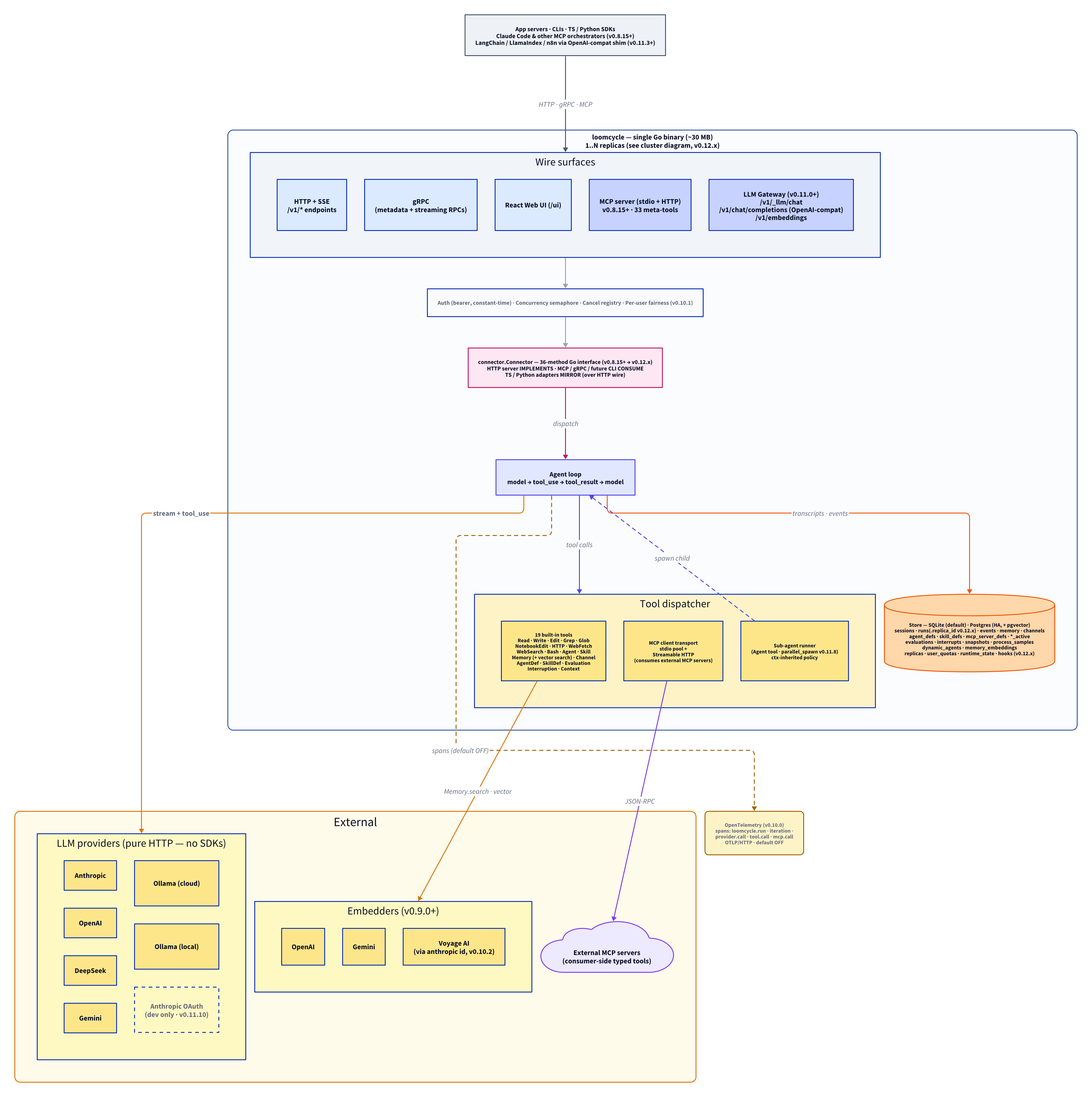
Diagram source: docs/architecture.d2 (regenerate with d2 docs/architecture.d2 docs/assets/architecture.png).
Connector detail — the v0.8.15 Connector abstraction layer (the pink block in the middle of the main diagram) is the architectural anchor every wire transport dispatches through. The detail diagram enumerates all 36 methods + shows which transports IMPLEMENT, CONSUME, and MIRROR the interface:
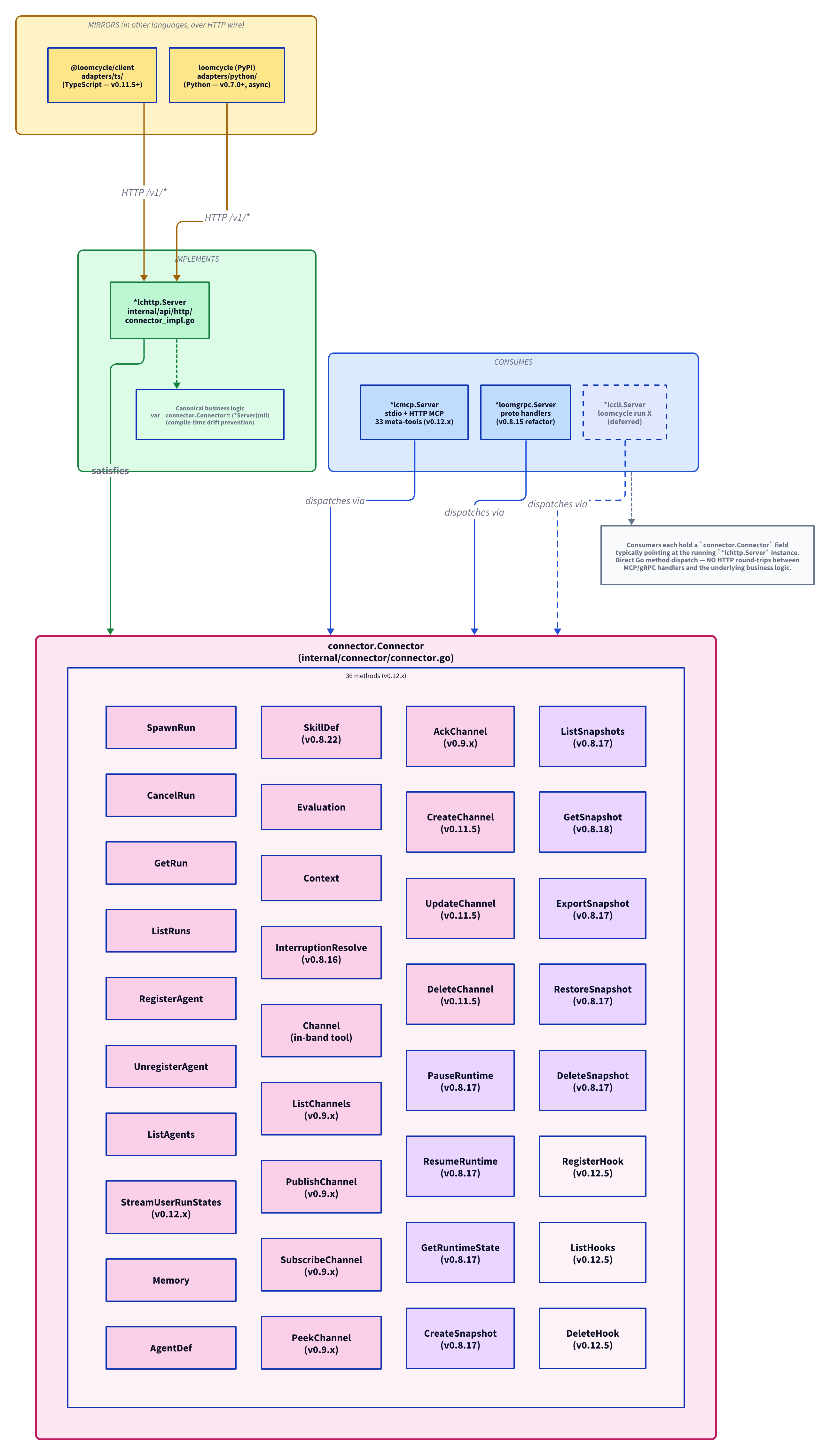
Source: docs/architecture-connector.d2.
Multi-replica cluster mode (v0.12.x) — when LOOMCYCLE_REPLICA_ID is set per process and the Postgres backend is used, loomcycle runs as a cluster behind any HTTP load balancer. The shared Postgres doubles as the LISTEN/NOTIFY backplane for cross-replica cancel, pause/resume, run-state fanout, and quota notifications. SQLite refuses cluster mode at boot.
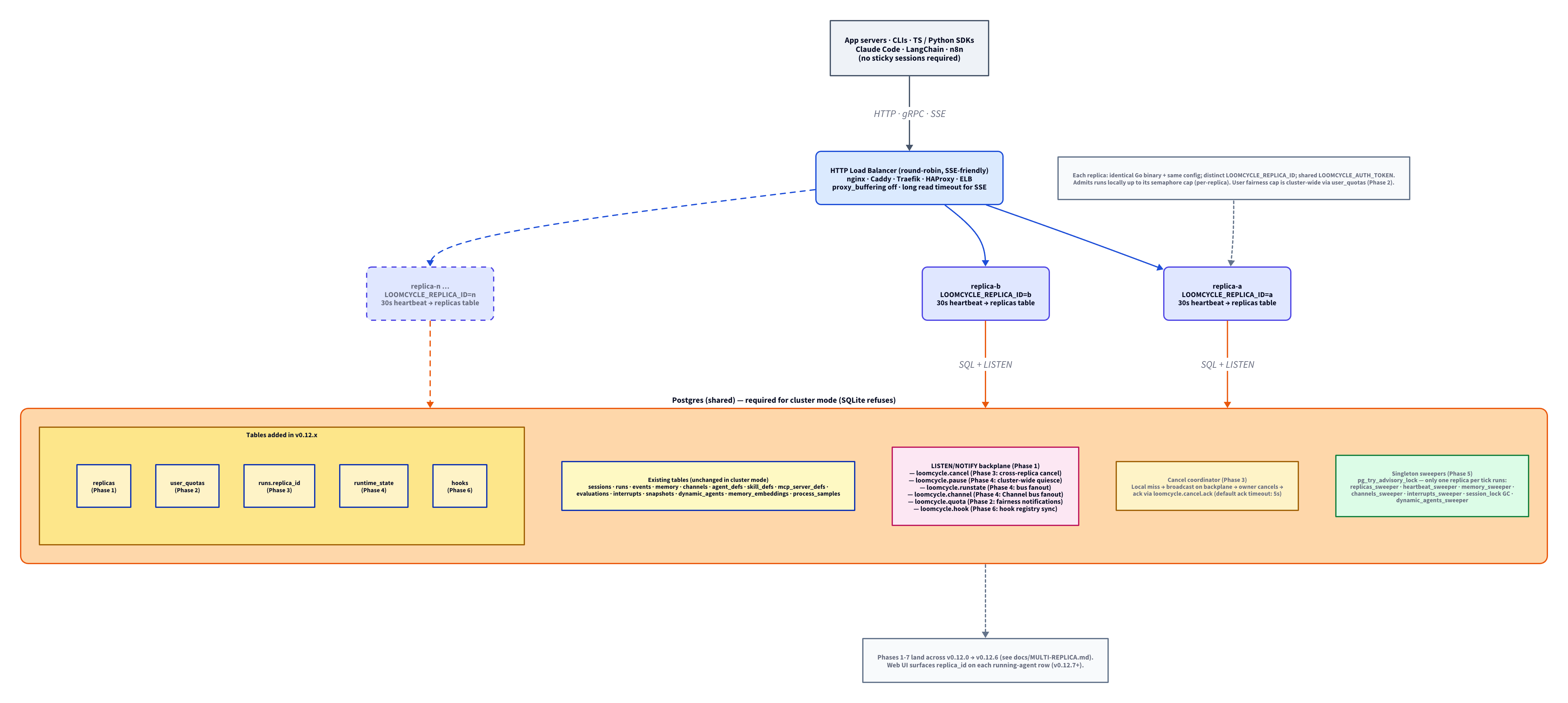
Source: docs/architecture-cluster.d2. Operator runbook: docs/MULTI-REPLICA.md. Demo: examples/cluster/README.md.
Full request flow, abstractions, and concurrency model: docs/ARCHITECTURE.md.
Adapters
- TypeScript —
npm install @loomcycle/client→ seeadapters/ts/. HTTP+SSE. - Python —
pip install loomcycle→ seeadapters/python/. Async overgrpc.aio.
Security highlights
- No vendor binary in the loop. Pure HTTP to provider APIs. No subprocess auth inheritance.
- Default-deny everything. Every built-in tool is disabled until env-configured. Every agent gets zero tools until
allowed_toolsis set. - Two-layer policy + per-request narrowing. Operator floor in env; agent narrowing in yaml; caller narrowing per-run. Caller can never widen.
- SSRF defence. Hostname allowlist + RFC1918/loopback/link-local IP block at the dial layer. Defeats DNS rebinding.
- Constant-time bearer auth.
sha256+CTCon both HTTP and gRPC. Bashis restricted, not isolated. Run inside a container or VM if you need real isolation.
Full security model + the two-layer default-deny walkthrough: docs/TOOLS.md.
Documentation
Repo-side docs (this directory):
docs/ARCHITECTURE.md— request flow, provider abstraction, agent loop, sub-agents, skills, storage, concurrency, cancellation.docs/TOOLS.md— two-layer default-deny model, every built-in tool, MCP / LocalAPI integrations, per-request narrowing.docs/MCP_INTEGRATION.md— end-to-end MCP HTTP pipeline: request lifecycle,${run.user_bearer}substitution, model-visibility boundary, recipe for wrapping a REST API as an MCP server consumable by loomcycle.docs/MCP_SERVER.md— register loomcycle as an MCP server in Claude Code / Claude Desktop: copy-paste config snippets for Docker / Homebrew / direct-binary transports + theloomcycle mcp installhelper.docs/CONFIGURATION.md— operator config guide: provider/tier/user_tier resolution rules, four cookbook patterns (single/multi-provider × single/multi-user-tier),models:alias map, and the agent.mdfrontmatter field reference.docs/POSTGRES.md— Postgres backend operator guide: configuration, migrations, sqlite→postgres runbook, concurrency benchmark.docs/GRPC.md— gRPC surface: enablement, wire-shape parity with HTTP+SSE, error mapping, Python adapter quick-start.docs/PLAN.md— public roadmap: shipped v0.4 → v0.8.12; planned v0.8.13 → v1.0.REVISIONS.md— per-version release notes (v0.4.0 onward).CONTRIBUTING.md— contribution policy (closed for external PRs until v1.x).CLAUDE.md— project guide for agents working in this repo (Claude Code).
In-binary docs (bundled Context.help topics — agents read these directly; operators hit GET /v1/_help/<topic> against a running instance):
installation— all four install paths (Homebrew, Docker,go install, direct tarball) with verification + troubleshooting.getting-started— first-run walkthrough (init→ set env vars →doctor→ run).llm-gateway— direct LLM routing endpoint (v0.11.0; for n8n + LangChain consumers).openai-compat— drop-in OpenAI SDK shims (v0.11.3 chat + v0.11.4 embeddings) with Python + TypeScript examples.fairness— per-user concurrency quota policy.observability— OTEL trace export setup.vector-memory,voyage-embedder,sqlite-vec— Vector Memory backends.dynamic-mcp— register MCP servers at runtime.bash-security— Bash tool's restricted-not-isolated security posture.
Full list via GET /v1/_help against a running instance.
Sponsor
If loomcycle is useful to you or your team, GitHub Sponsors helps fund continued development. Individual supporters and corporate sponsors both welcome.
The runtime stays Apache-2.0 either way. Sponsorships directly fund the v0.12 → v1.0 runway: multi-replica HA, Helm chart, operator cookbook, settings UI, and the per-tier sustained engineering needed to keep the binary small and the substrate stable.
Current sponsors are listed in BACKERS.md (and at loomcycle.dev/sponsors with logos).
License
Apache-2.0. See LICENSE.
Yorumlar (0)
Yorum birakmak icin giris yap.
Yorum birakSonuc bulunamadi