enterprise-agentic-ai-platform
Health Warn
- No license — Repository has no license file
- Description — Repository has a description
- Active repo — Last push 0 days ago
- Low visibility — Only 6 GitHub stars
Code Pass
- Code scan — Scanned 12 files during light audit, no dangerous patterns found
Permissions Pass
- Permissions — No dangerous permissions requested
No AI report is available for this listing yet.
Production-grade multi-agent AI platform with LangGraph v0.3, MCP servers, hybrid RAG (Qdrant + LlamaIndex), FastAPI WebSocket streaming, and Next.js real-time UI. Deployed on AWS EKS via Terraform.
Enterprise Agentic AI Platform
A planner, executor and critic loop built on LangGraph, with tools exposed through MCP servers, a RAG knowledge base, and a streaming FastAPI backend.





What this is · Illustrated · How it works · Quick start · Limitations
The problem and the approach
A single "retrieve, then summarise" call struggles with tasks that need several steps: read a document, query a database, then tell someone. This project splits that work across specialised stages so each stage has one job and the tools are separate from the model.
- Memory retrieves relevant chunks from a vector store.
- The planner turns the task into at most six numbered steps.
- The executor asks a model to pick tools, calls them on MCP servers, and writes an answer.
- The critic scores the answer. If it is not good enough, the answer goes back to the executor with the critique.
- The answer is returned over REST or streamed over a WebSocket.
The tools (SQL, documents, notifications) live in their own FastMCP servers, so adding a tool means adding a server rather than changing the agent graph.
What this is and is not
Read this first. It is the honest scope of the repository, taken from reading the source code.
| What you might assume | What the code actually does |
|---|---|
| "Plans and executes multi-step actions" | The planner writes the steps, but the executor runs one plan step per pass (state.plan[state.current_step]) and then writes a final answer. Later steps run only if the critic asks for another pass. If the critic accepts after the first pass, the remaining steps never run. |
| "The critic revises the answer up to 3 times" | MAX_REVISIONS = 3 is compared with revision_count, which the executor increments on every pass. That allows three executor passes in total, so at most two revisions after the first answer. |
| "Self-correction" | The critic is the same kind of model scoring its own pipeline's output. It returns a JSON score and a revise flag; if its reply cannot be parsed as JSON, the answer is accepted as is. |
| "Tools: GitHub, Notion, web search" | The planner prompt lists search_knowledge_base, fetch_github, fetch_notion, web_search and others. Only the three MCP servers exist (SQL, document, notification), and none of those listed names matches their tool names. The executor discovers the real tools from the servers at run time. |
| "Hybrid search with Cohere reranking" | Retrieval uses LlamaIndex with Qdrant hybrid mode, filters by a score threshold (0.7) and sorts by score. There is no reranking model; Cohere is not used anywhere in the code. |
| "Memory pulls conversation history" | The memory node runs a vector search on the task text (top 5 chunks). It does not read past conversation turns. |
| "OAuth 2.1 ready, enterprise-grade security" | There is no authentication on the endpoints. user_id is a free-text field defaulting to anonymous. |
| "Read-only SQL tool" | query_database checks only that the text starts with SELECT. It does not use a read-only database role, and it can read any table the connection can. insert_record writes to any table name the model supplies, with the table and column names placed directly into the SQL text. |
| "Checkpointed, durable state" | main.py and the REST route build the graph without a checkpointer. create_graph_with_persistence() exists but is not used. The graph is also compiled with interrupt_before=["handle_error"]. |
| "Deployed on EKS with CI/CD and ArgoCD" | CI runs a minimal lint and pytest; there are no deploy jobs, and ArgoCD is not configured. Terraform and Kubernetes files exist (EKS, VPC, RDS, ElastiCache, S3; a 3 to 20 replica HPA) but were not applied or tested here. |
| "LangSmith + Langfuse observability" | Tracing setup covers LangSmith and Prometheus metrics. langfuse is in requirements.txt and settings but is not used in the code. |
| "Next.js 14 + shadcn/ui" | The frontend imports lucide-react and remark-gfm, which are not listed in frontend/package.json, and shadcn/ui is not present. By reading the files, npm install followed by a build would fail on those imports. |
Also from reading the files, not from running them: the celery-worker service in docker-compose.yml points at backend.core.celery_app, which does not exist; the README's old ingest example used -F "files=@..." but the route expects a field named file; and main.py defines /api/v1/agent/invoke even though the agent router already provides it. The test suite has five tests, and they use a mocked model; they were not run for this README.
The idea, illustrated
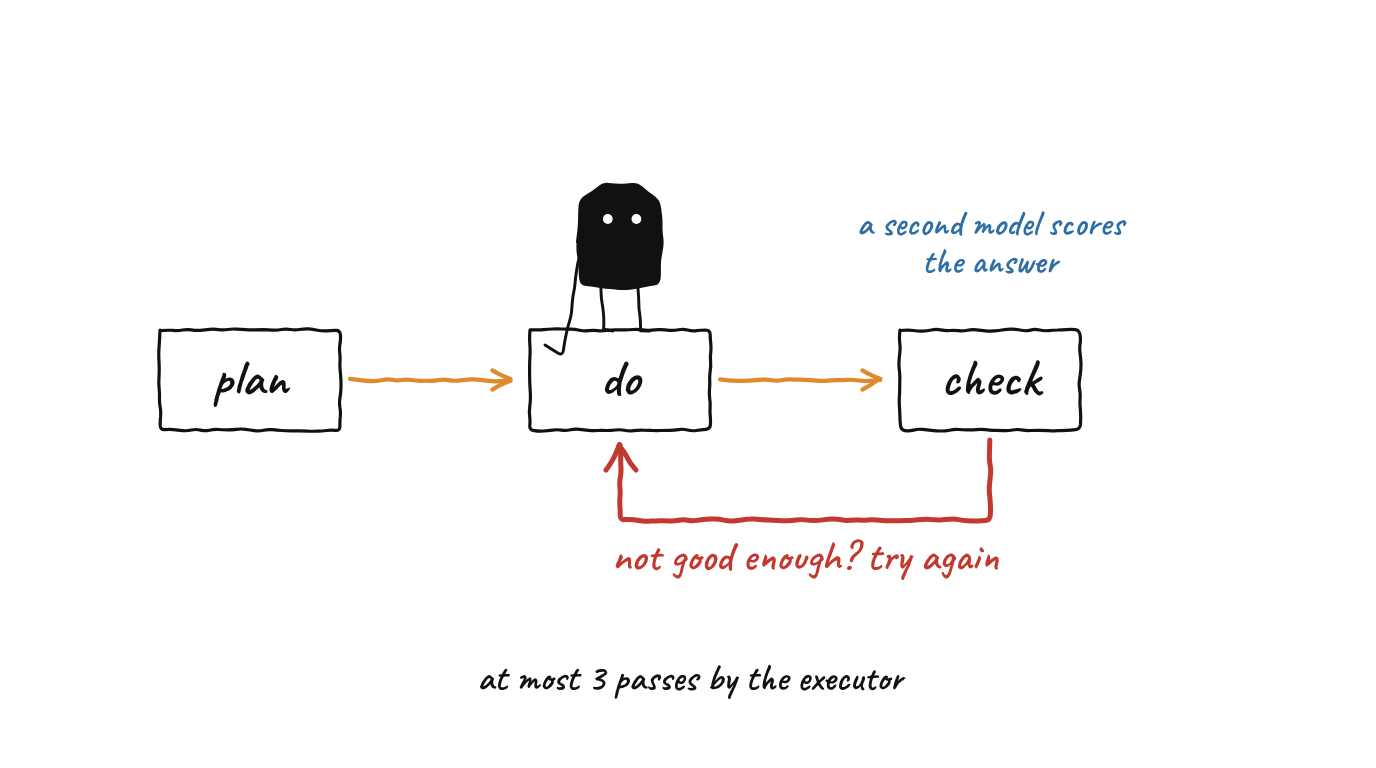
Plan, do, check, and try again. A second model scores the answer; the executor makes at most three passes.
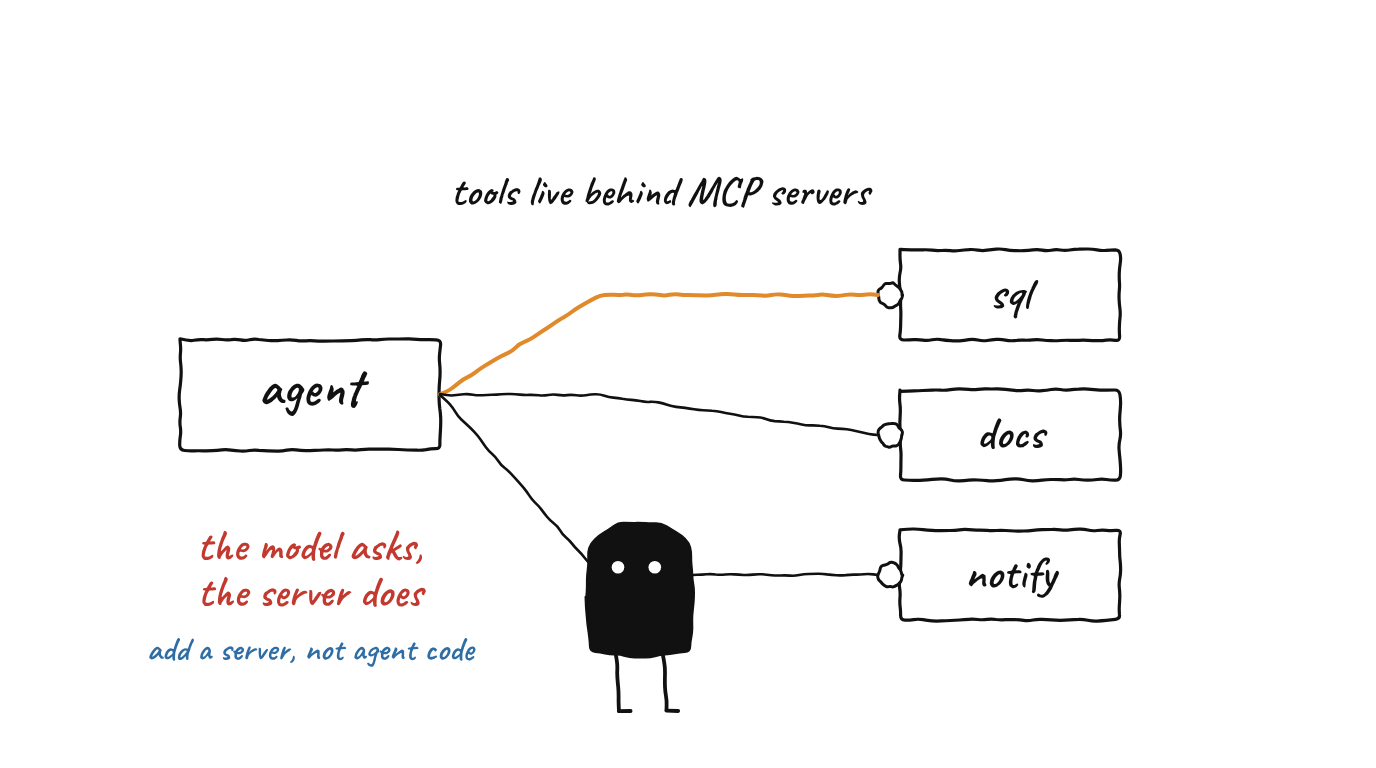
Tools live behind MCP servers. The model asks; the server does the work.
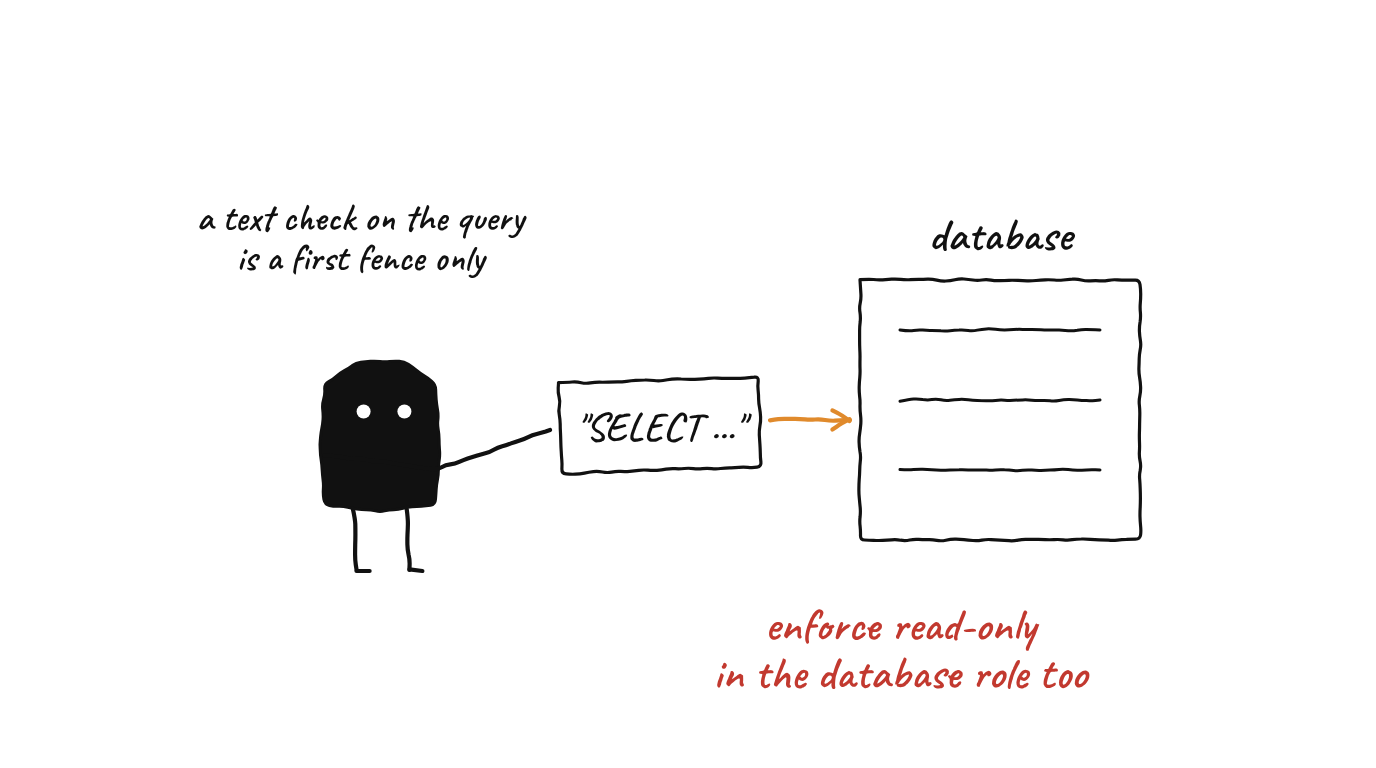
A recommendation, not current behaviour. The SQL tool checks the text of the query. Give its database user read-only rights as well.
The whole system in one picture
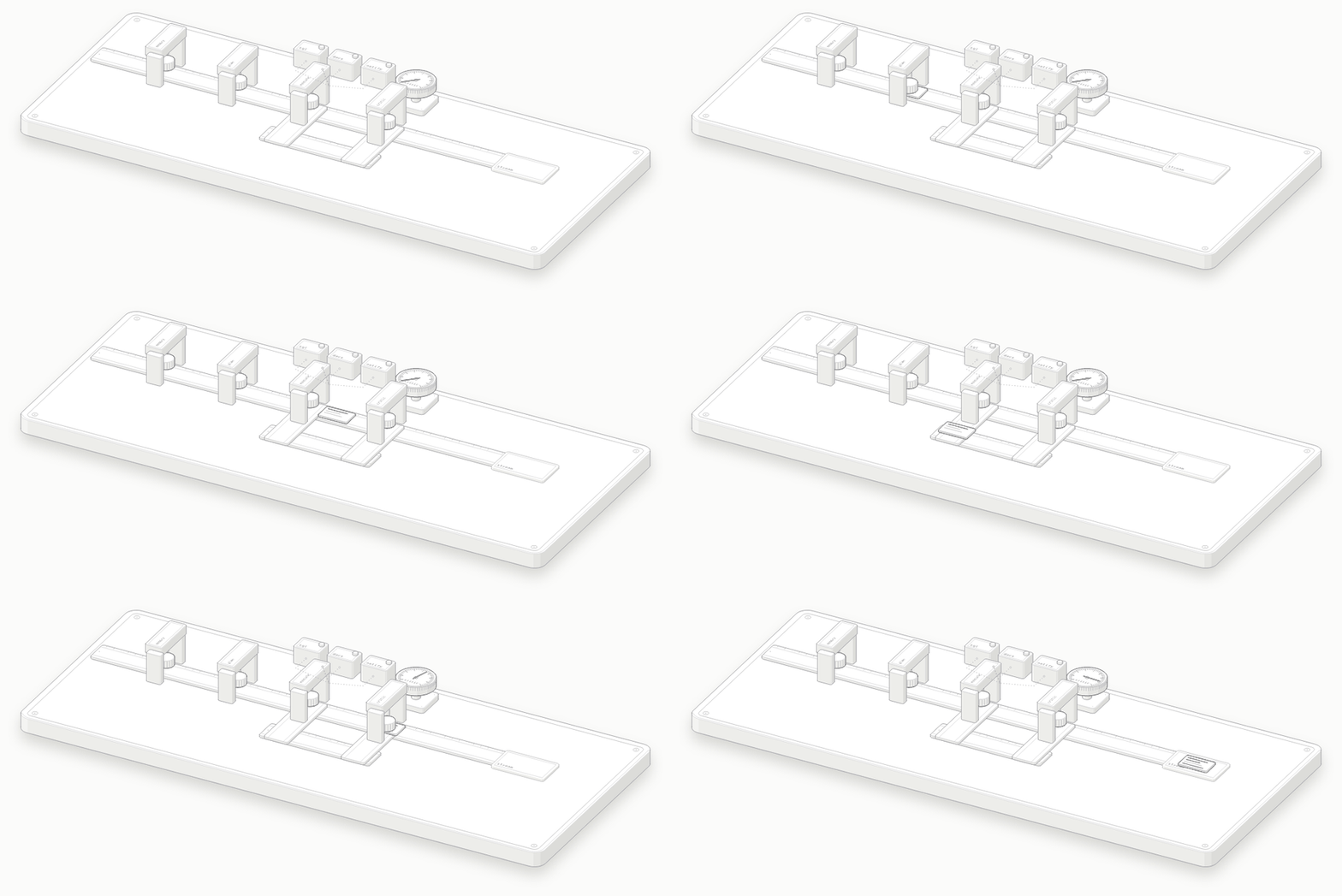
| On the bench | In the platform | Code |
|---|---|---|
| Arch "memory" | Vector search for context on the task text | backend/agents/memory.py, backend/rag/retriever.py |
| Arch "plan" | Break the task into up to six numbered steps | backend/agents/planner.py |
| Arch "execute" and the three boxes | The executor lists tools on three MCP servers, lets the model choose, calls them, then writes an answer | backend/agents/executor.py, backend/mcp_servers/ |
| Arch "critic" and its dial | The critic returns a score, a revise flag and feedback as JSON | backend/agents/critic.py |
| Return lane | should_revise sends the slip back to the executor while passes remain |
backend/agents/graph.py |
| Tray "stream" | The final answer is returned by REST or streamed node by node over a WebSocket | backend/main.py |
Open docs/anatomy/agent-loop-bench-light.html in a browser to scrub through it (details in docs/anatomy/README.md). Which tools fire, the plan and the needle positions are drawn for the picture; no real score is shown.
How it works, start to finish
Phase 1 · Ingest documents (optional)
POST /api/v1/documents/ingest takes one uploaded file (.pdf, .txt, .md or .docx) in a form field named file, splits it with LlamaIndex's SemanticSplitterNodeParser, embeds it with OpenAI text-embedding-3-large, and stores it in a Qdrant collection (enterprise_knowledge by default).
curl -X POST http://localhost:8000/api/v1/documents/ingest -F "file=@annual_report.pdf"
Phase 2 · Run a task
| Step | Node | What it really does |
|---|---|---|
| 1. Retrieve | memory_retrieval |
Vector search on the task text; keeps up to 5 chunks scoring at least 0.7. |
| 2. Plan | planner |
Asks the model for up to six numbered steps. If none can be parsed, the whole task becomes one step. An empty plan routes to handle_error. |
| 3. Execute | executor |
Connects to the three MCP servers to list their tools, lets the model choose tools for the current plan step, calls them, then makes a second model call to write an answer from all tool results so far. |
| 4. Critique | critic |
Asks the model for a JSON score (0 to 10), a revise flag and feedback. A score of 7 or more should mean no revision. An unparseable reply accepts the answer. |
| 5. Loop or finish | should_revise |
If a revision is needed and fewer than three executor passes have run, go back to step 3 with the critique; otherwise finish. |
| 6. Respond | FastAPI | POST /api/v1/agent/invoke returns the answer, confidence, citations and tool results. The WebSocket /ws/agent/{thread_id} streams a node_update message after each node. |
MCP servers
| Server | Port | Tools |
|---|---|---|
postgres_mcp |
8001 | query_database, list_tables, insert_record |
document_mcp |
8002 | extract_text_from_pdf, extract_tables_from_pdf, search_document (each takes a file path on the server) |
notification_mcp |
8003 | send_slack_message, send_webhook (to any URL), create_slack_reminder |
All three use the streamable HTTP transport.
Stack
| Layer | Technology | Status in this repository |
|---|---|---|
| Orchestration | LangGraph | Used by graph.py; no checkpointer is attached by the API |
| LLM | Claude via langchain-anthropic (model name set in config.py) |
Needs ANTHROPIC_API_KEY |
| Tools | FastMCP servers | Three servers, as above |
| RAG | LlamaIndex, Qdrant (hybrid), OpenAI embeddings | Needs OPENAI_API_KEY for embeddings |
| API | FastAPI with REST and WebSocket | No authentication |
| Frontend | Next.js 14, Zustand, React Markdown | Imports packages missing from package.json |
| Observability | LangSmith, Prometheus, Grafana | Langfuse is listed but unused |
| Infrastructure | Docker Compose (11 services), Kubernetes manifests, Terraform | Not applied or tested here; the Celery worker service has no module behind it |
Quick start
Everything here comes from the source and the Makefile and has not been run.
git clone https://github.com/designer-coderajay/enterprise-agentic-ai-platform.git
cd enterprise-agentic-ai-platform
python -m venv venv && source venv/bin/activate
pip install -r requirements.txt
cp .env.example .env     # set ANTHROPIC_API_KEY, OPENAI_API_KEY, DATABASE_URL, SECRET_KEY
make dev-full            # Docker Compose stack
Or run pieces yourself: start each MCP server with python backend/mcp_servers/<name>/server.py, then uvicorn backend.main:app --port 8000 from the repository root.
Example call:
curl -X POST http://localhost:8000/api/v1/agent/invoke \
  -H "Content-Type: application/json" \
  -d '{"task": "List the tables in the database and summarise what they hold"}'
Project structure
enterprise-agentic-ai-platform/
├── backend/
│   ├── agents/         # state, graph, planner, executor, critic, memory
│   ├── rag/            # ingestion pipeline and retriever (LlamaIndex + Qdrant)
│   ├── mcp_servers/    # postgres_mcp, document_mcp, notification_mcp
│   ├── api/            # FastAPI routes (health, agent, documents)
│   ├── observability/  # LangSmith and Prometheus setup
│   └── main.py         # FastAPI app (REST and WebSocket)
├── frontend/           # Next.js chat UI with an agent trace sidebar
├── infra/              # Dockerfiles, Kubernetes manifests, Terraform
├── tests/              # five pytest-asyncio tests with a mocked model
├── docs/
│   ├── anatomy/        # the interactive bench figure (HTML, GIF, PNG) and its build files
│   └── illustrations/  # the README illustrations and their generator
├── docker-compose.yml
└── Makefile
Limitations
- Prototype. No authentication, no checkpointer on the API path, no deploy pipeline.
- Multi-step plans are not fully executed unless the critic keeps asking for another pass (see the table above).
- The SQL tool is not safely read-only. Use a read-only database role, restrict the writable tables or remove
insert_record, and treat model-written SQL as untrusted. - The document and webhook tools take model-chosen inputs. A file path on the server and a URL to call are both supplied by the model; restrict them before exposing this to users.
- The critic is a model, not a test. It can accept a wrong answer.
- Costs. One task can make many model calls (planner, executor with tools, a synthesis call, the critic, per pass).
- Not run here. This README was checked against the source code, not by running the system; the five tests were not run either.
Skills demonstrated
Multi-agent workflow design with LangGraph · conditional routing and feedback loops · tool abstraction with MCP · RAG with LlamaIndex and Qdrant · FastAPI REST and WebSocket streaming · Docker Compose, Kubernetes and Terraform authoring
License
No licence file is included in the repository.
Reviews (0)
Sign in to leave a review.
Leave a reviewNo results found