venture-ops
Health Uyari
- License — License: MIT
- Description — Repository has a description
- Active repo — Last push 0 days ago
- Low visibility — Only 5 GitHub stars
Code Gecti
- Code scan — Scanned 12 files during light audit, no dangerous patterns found
Permissions Gecti
- Permissions — No dangerous permissions requested
Bu listing icin henuz AI raporu yok.
AI-powered fundraising ops built on Claude Code. Skill modes for investor scanning, pitch-deck refresh, accelerator applications, and follow-up cadence. Batch processing, PDF generation.
Venture-Ops
AI-powered fundraising ops built on Claude Code. Skill modes for investor scanning, pitch-deck refresh, accelerator applications, and follow-up cadence. Batch processing, PDF generation.
Inspired by santifer/career-ops — adapted for founders raising rounds.
Venture-Ops is an AI fundraising command center for founders: investor discovery, pitch-deck refresh, application drafting, pipeline tracking, and market-aware fundraising ops.
Instead of juggling old decks, scattered investor notes, and generic applications, you get one structured system that helps you:
- find investors and programs that actually fit your company
- refresh your story when the deck, website, and product drift apart
- spot what is missing before a founder call or partner meeting
- prepare cleaner outreach, applications, and follow-ups
- keep a live fundraising memory instead of starting from zero every week
Important: Venture-Ops is not an investor-spam bot. It is a sharpening system. It helps founders choose better targets, tighten the story, and prepare better materials. The founder still decides what gets sent.
30-Second Demo
GitHub strips interactive HTML from READMEs, so the live walkthrough sits in a standalone page:
It shows the actual founder flow: load startup context, scan current-fit investors, refresh the deck against the website, generate target-specific deck variants, and work from a tracker instead of loose notes.
Full Demo Walkthrough
You can also understand the whole product directly in the README:
1. Load founder context
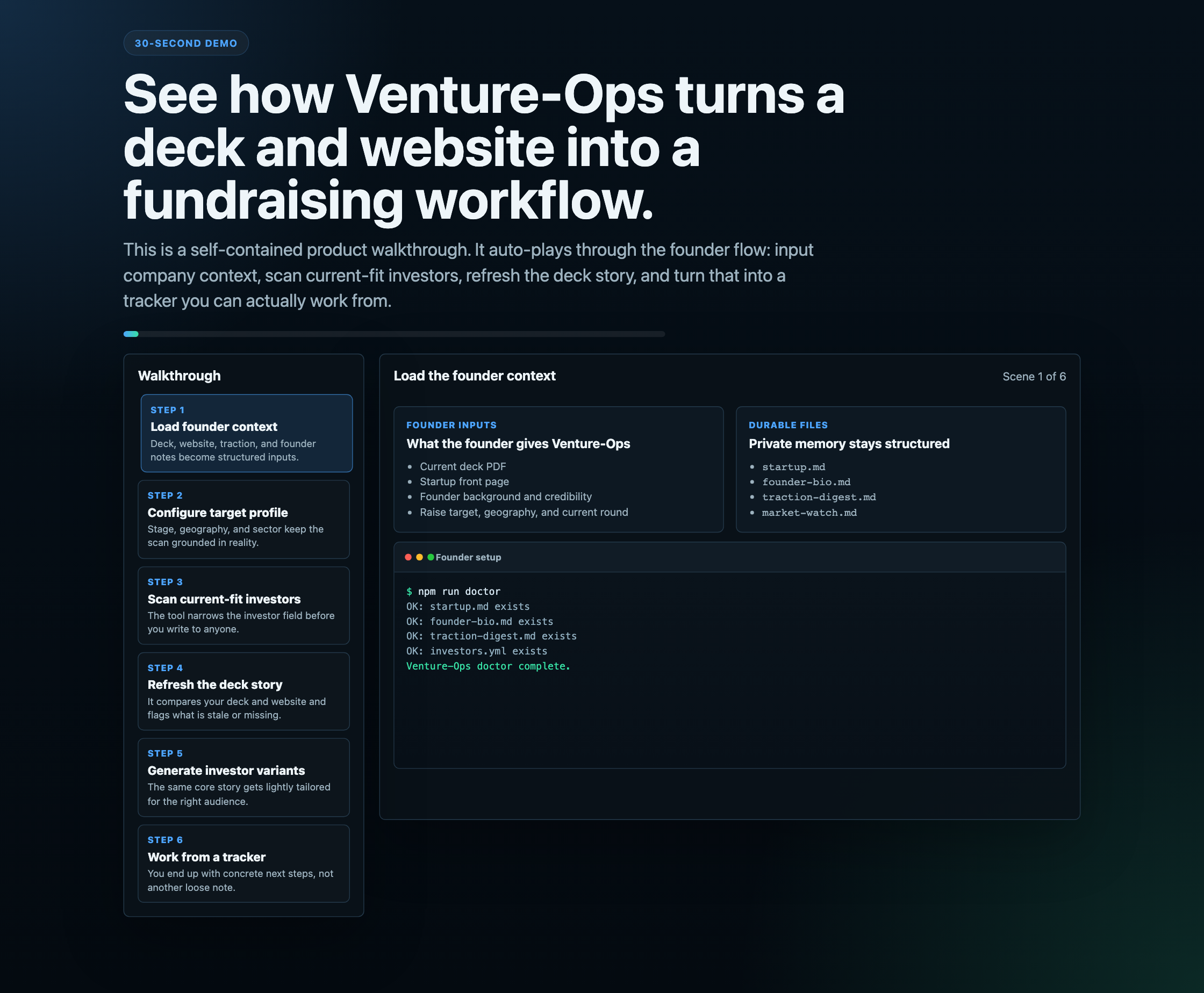
Start with the files founders already have: deck, website, founder background, traction notes, and raise profile.
2. Configure the target profile
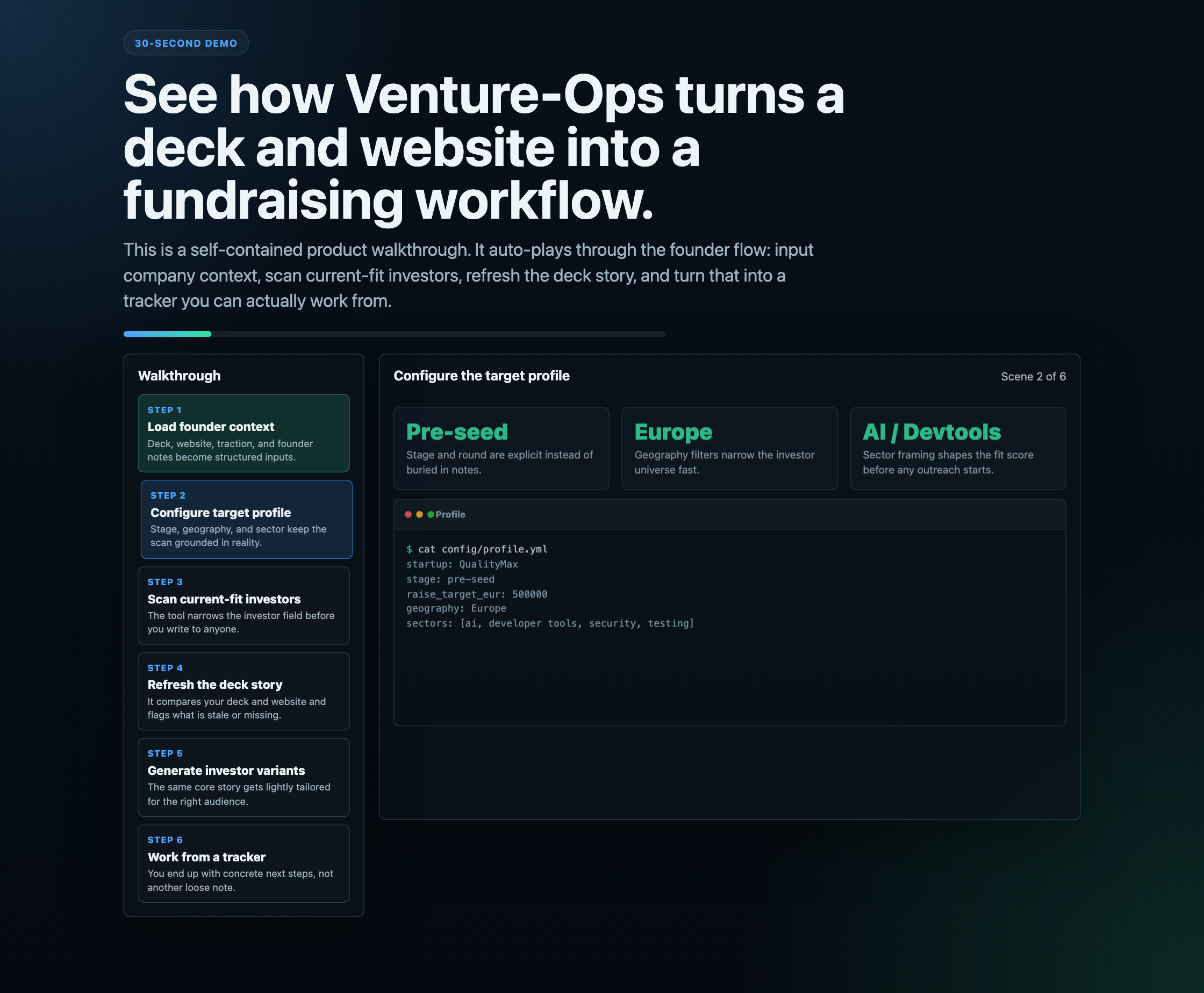
Venture-Ops turns stage, geography, and category framing into explicit filters before any outreach starts.
3. Scan current-fit investors
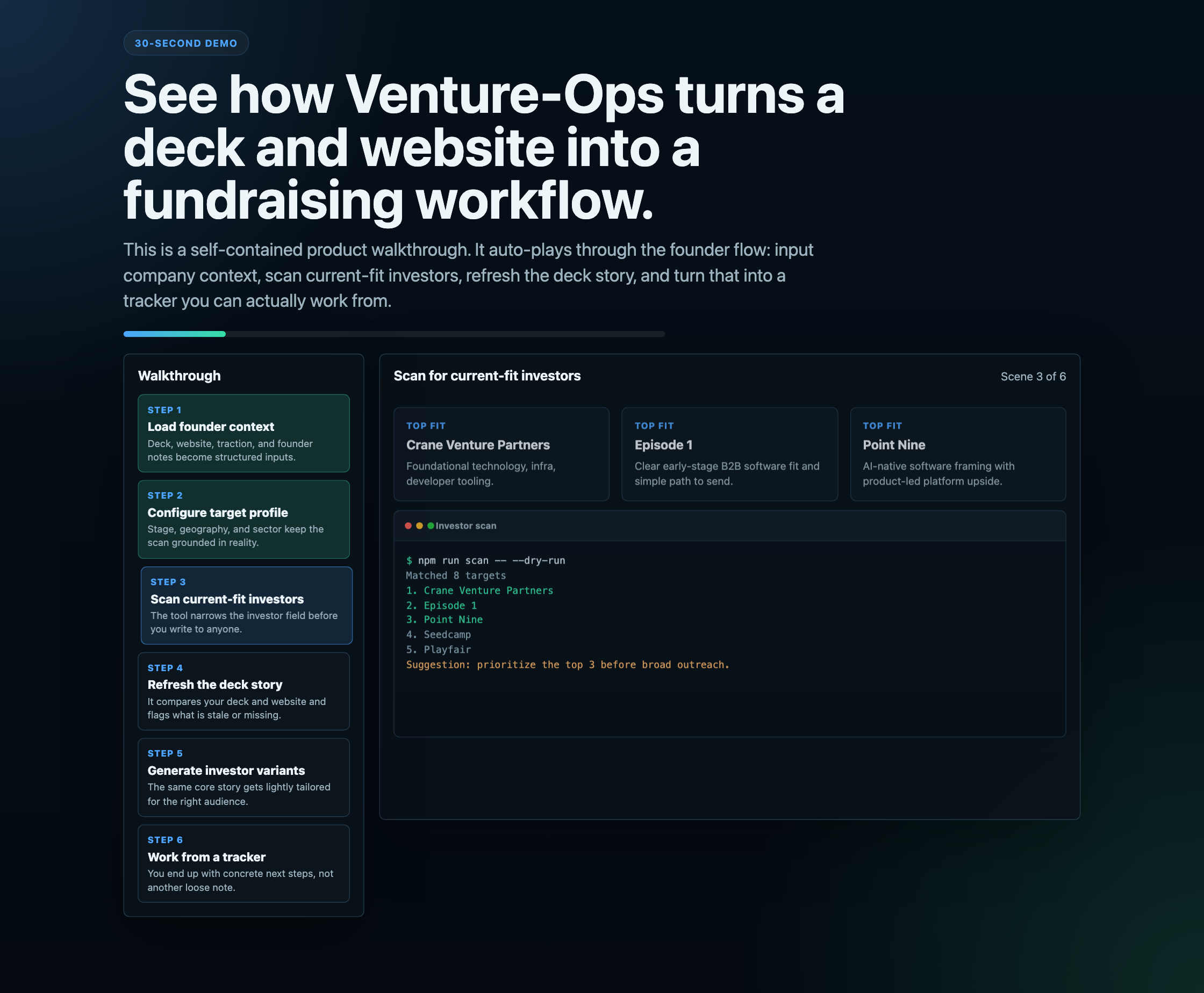
Instead of a broad list, the scanner narrows the field into a small shortlist with reasons.
4. Refresh the deck against the website
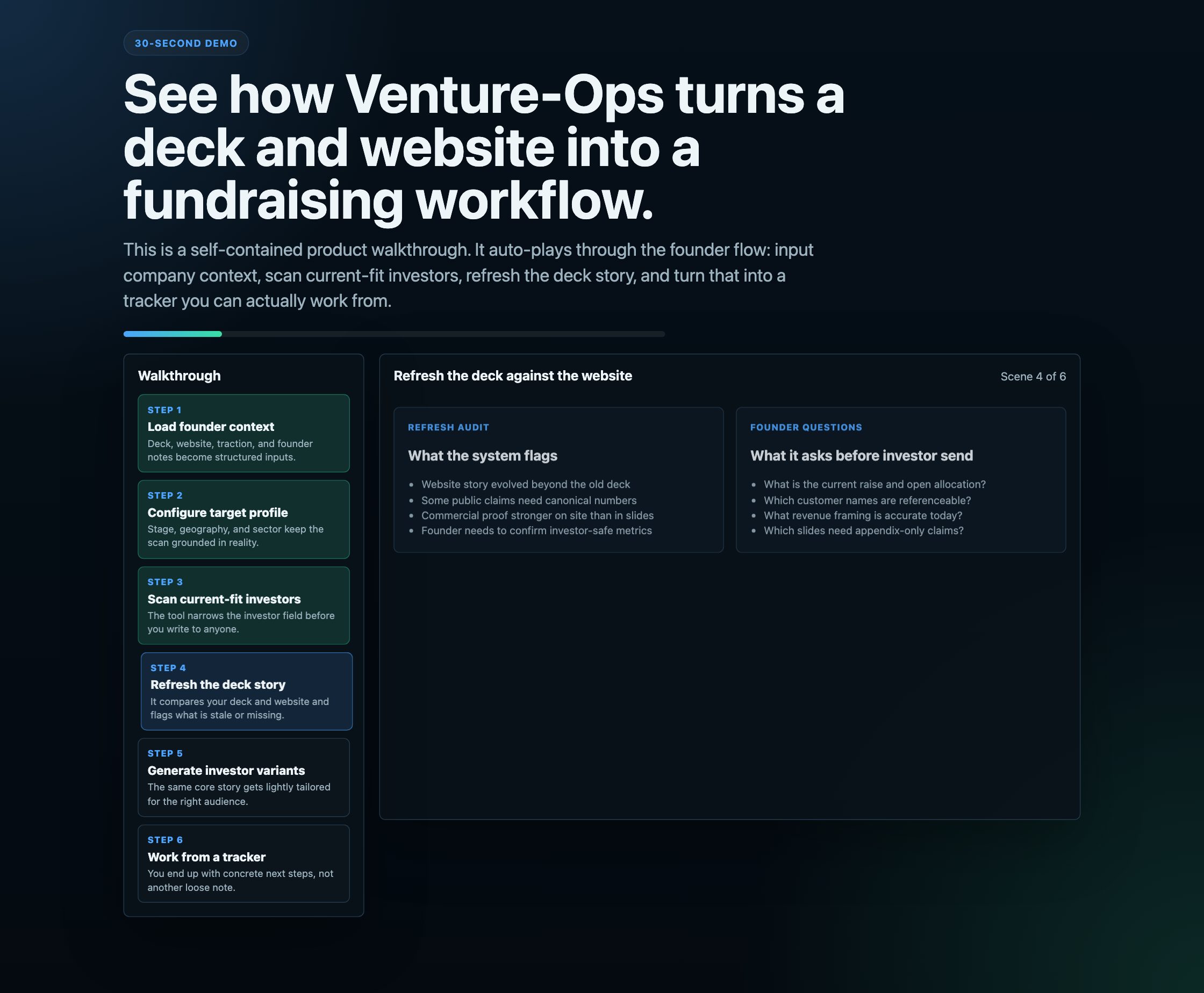
The refresh loop surfaces drift, stale claims, and the founder questions that should be answered before sending materials.
5. Generate target-specific decks
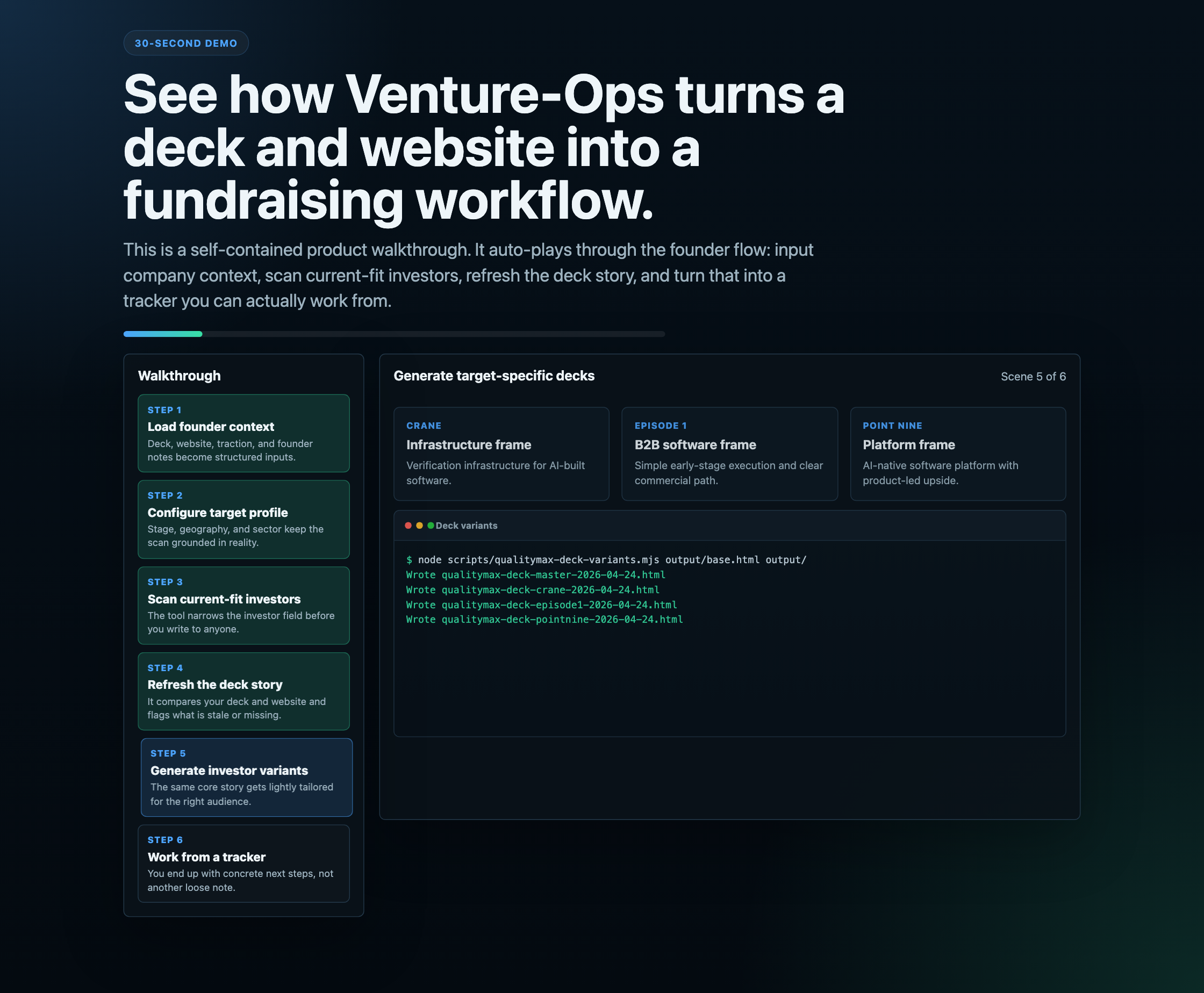
One shared company story can be lightly reframed for firms like Crane, Episode 1, and Point Nine without rebuilding the whole deck from zero.
6. Work from a tracker
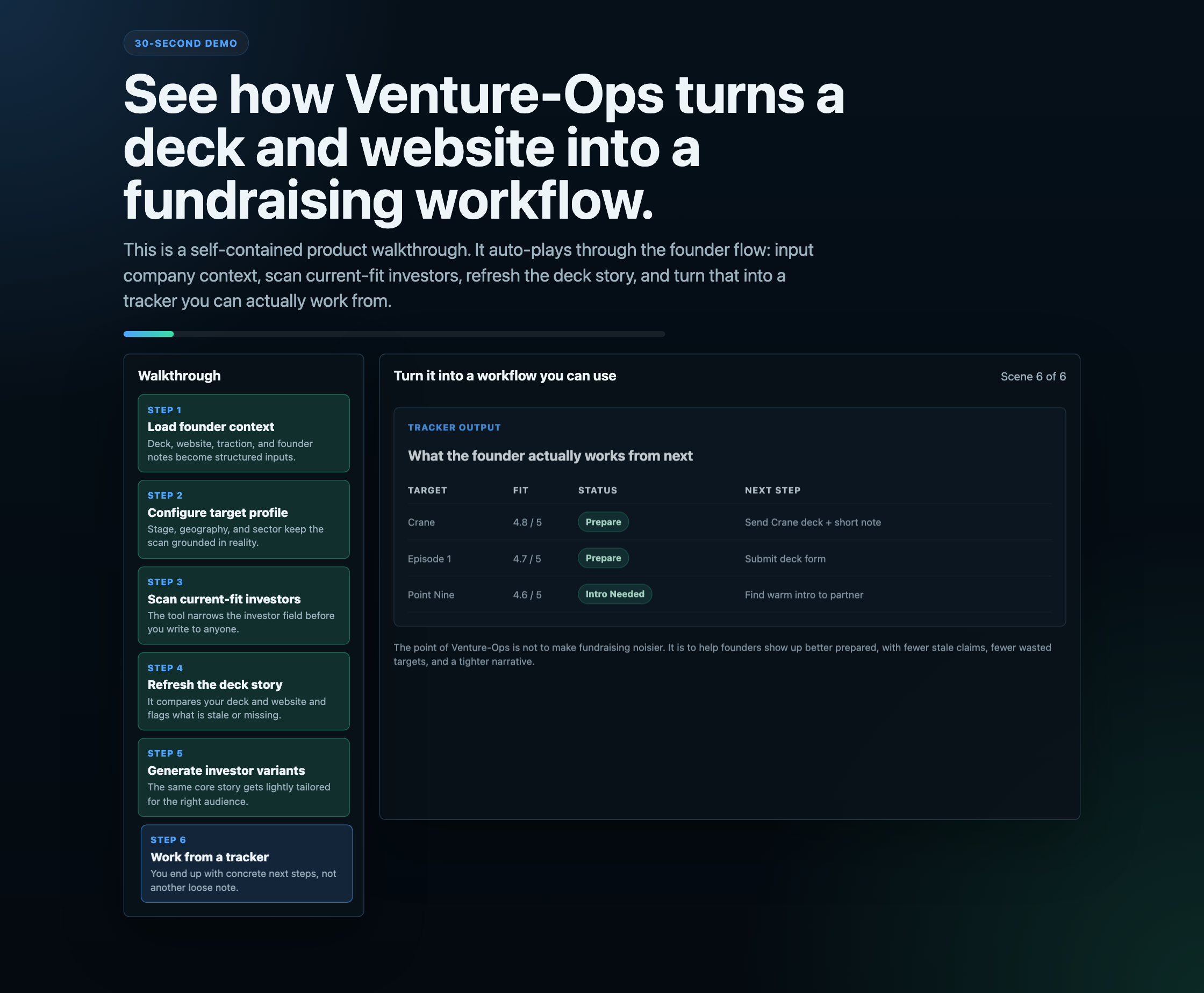
The end state is a workflow: who fits, what gets sent next, and where the round stands.
At A Glance
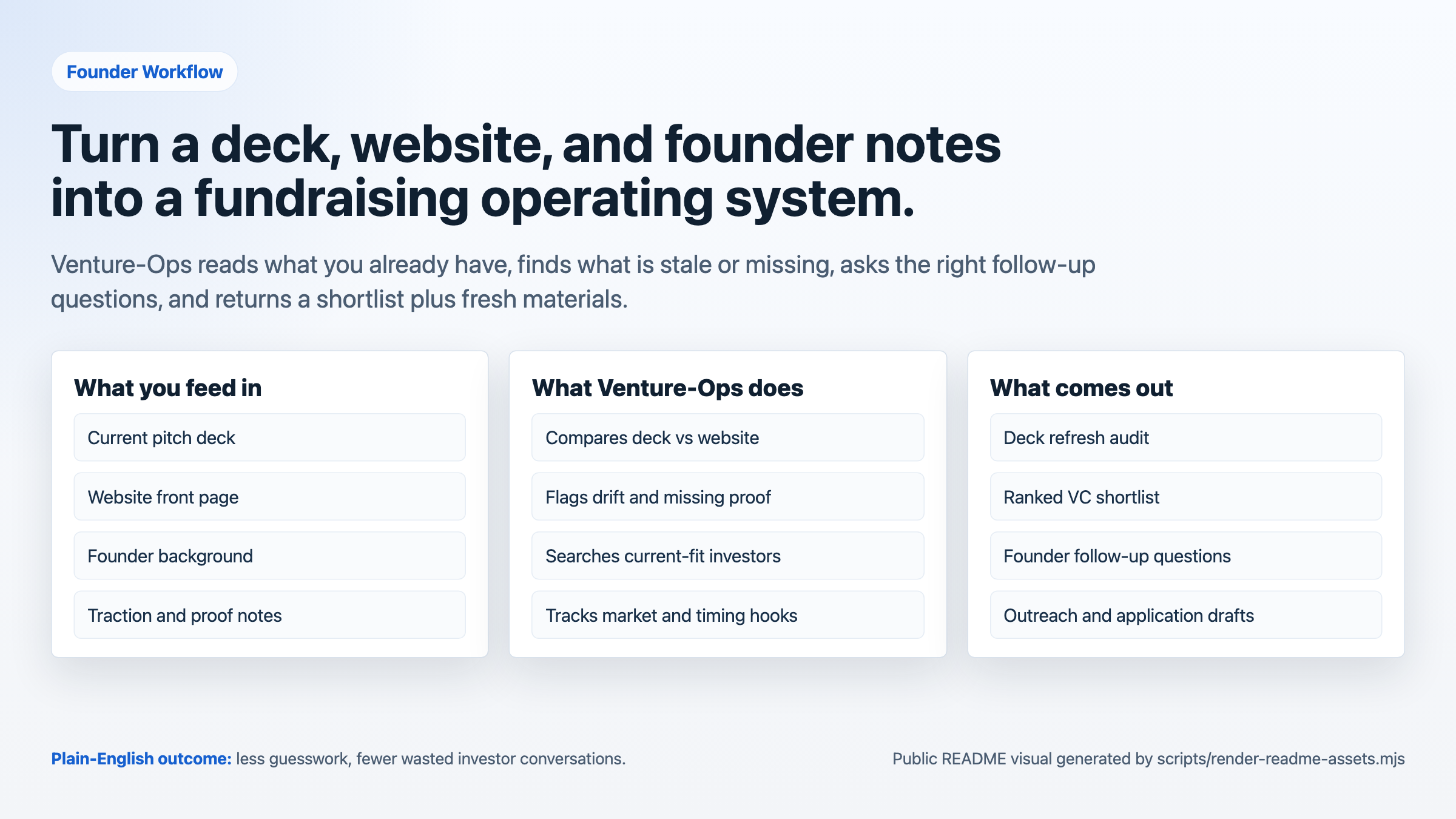
In plain English:
- You give the system your current deck, website, founder context, and goals.
- It compares those inputs, finds what is stale or missing, and checks which investors fit.
- It asks focused follow-up questions where the story is still weak.
- It gives you refreshed materials, a ranked target list, and a pipeline to work through.
What This Tool Does
Venture-Ops turns any AI coding CLI into a founder-side fundraising operating system.
It is designed for founders who need to:
- raise a pre-seed, seed, or early institutional round
- apply to accelerators, founder programs, studios, or grants
- keep a pitch deck current without rewriting it from scratch every month
- understand which VCs are a real fit and which are a waste of time
- prepare target-specific application answers and intro blurbs
- maintain a structured memory of traction, proof points, risks, and investor objections
The system is agentic: it can inspect your public startup site, compare it to your current deck, identify what is stale, suggest sharper proof, and prepare target-specific material for the next conversation.
What You Put In
Even a non-technical founder can think of Venture-Ops as a very organized analyst.
You feed it:
- your current deck
- your website
- founder background
- traction notes
- target round and geography
- a curated investor list or a few URLs to start from
What You Get Out
You get back:
- a deck refresh audit
- a ranked investor shortlist
- founder follow-up questions
- target-specific outreach/application drafts
- a tracker of who to contact and when
- a market/news memory that helps keep the story current
Sanitized Real Example
Below is a sanitized example derived from a real founder deck and public company website. Sensitive numbers, customer details, and internal claims are intentionally replaced with placeholders.
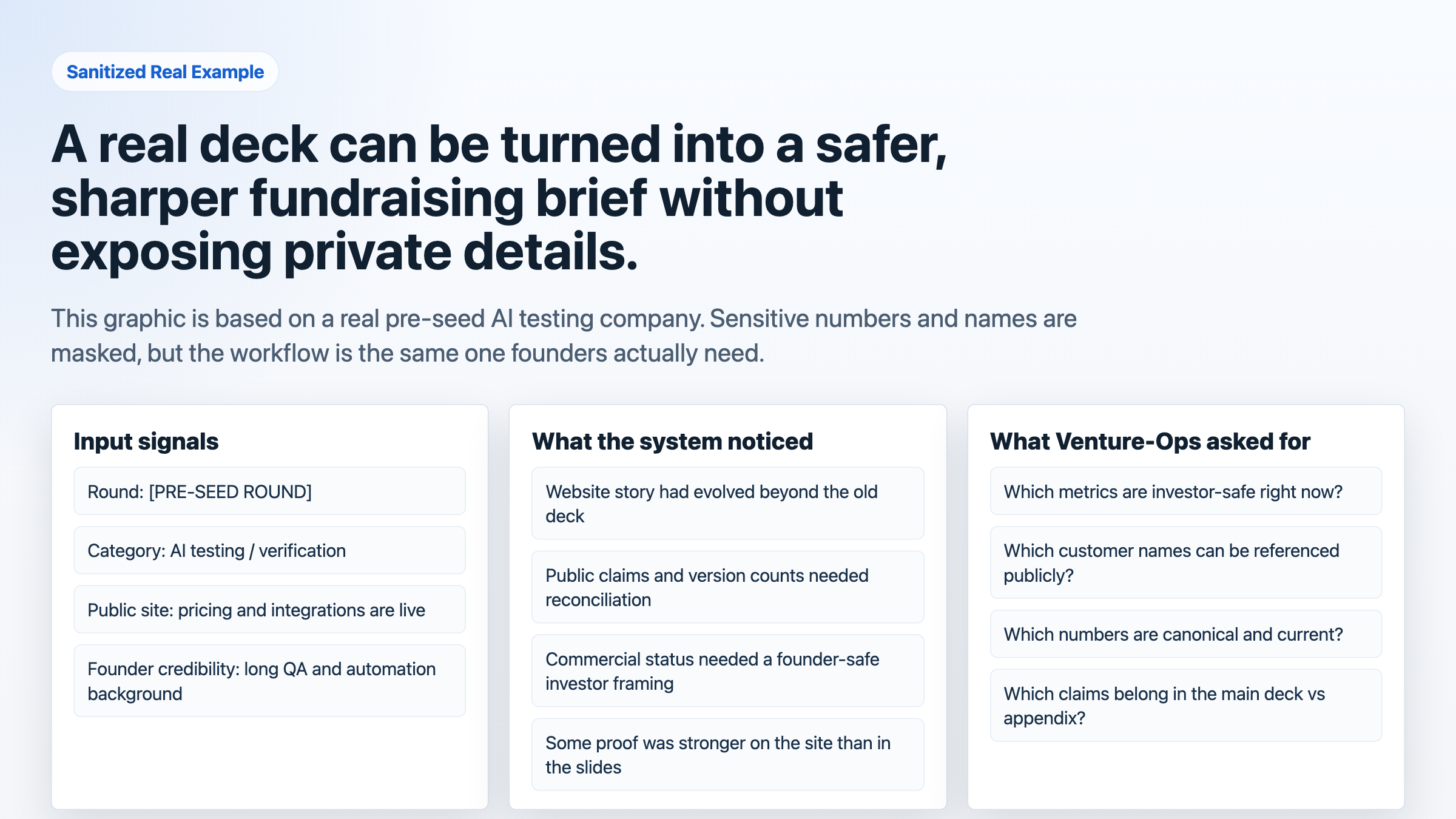
What Venture-Ops did with that real case:
- pulled the current deck into structured notes
- checked the front page and public founder profile
- found narrative drift between deck and website
- flagged diligence gaps before investor send
- produced a fresh deck draft and a target shortlist
Live VC Search Example
This is a visual snapshot from a real live search run on April 24, 2026 for a European pre-seed AI testing / developer infrastructure company.
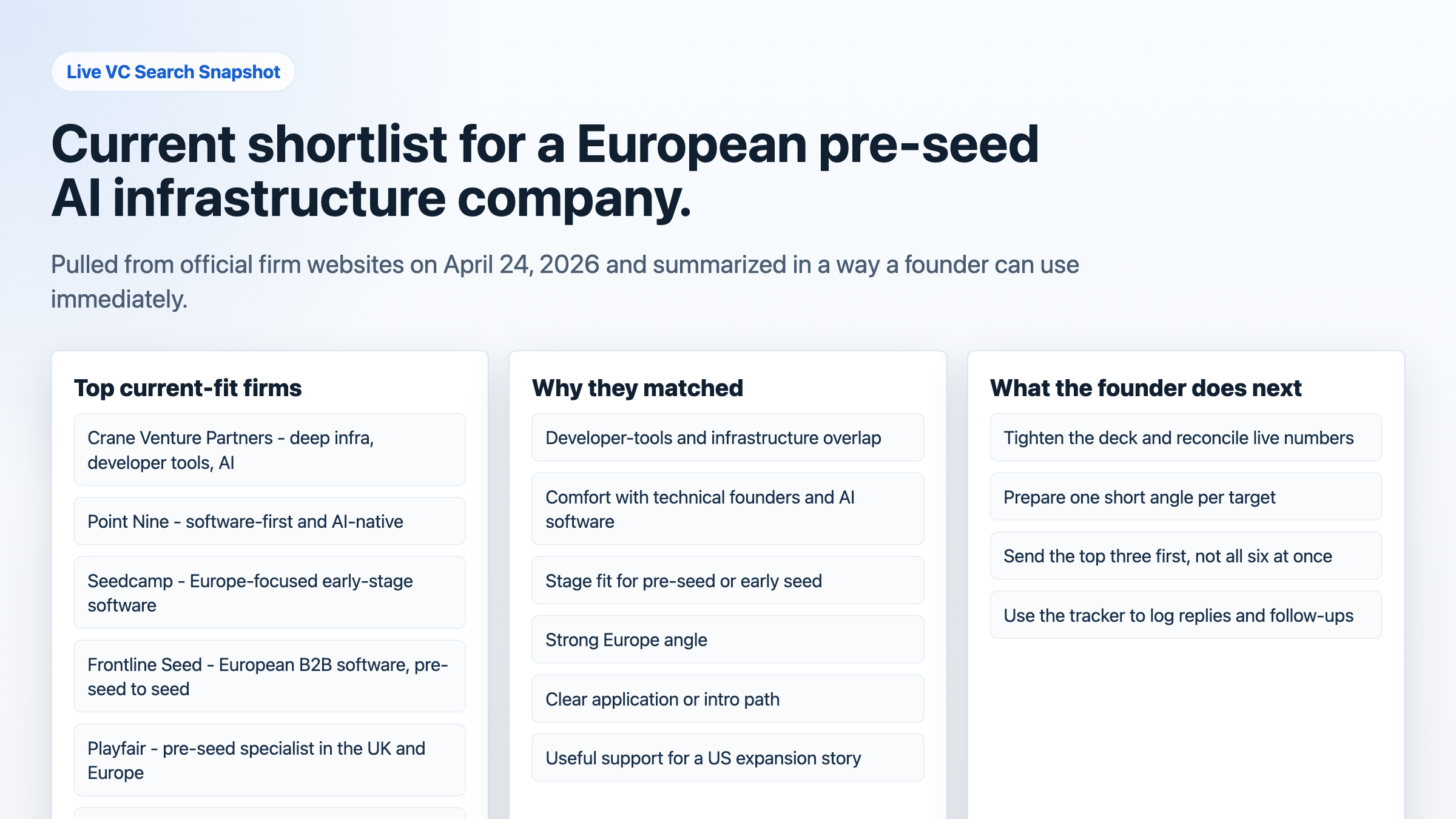
Why this matters for a non-technical founder:
- you are not starting from a blank sheet
- the tool narrows the field to a small shortlist with reasons
- it gives you the "why this firm" angle before you write to anyone
Official Site Snapshots
These are the actual official websites Venture-Ops used in that live search.
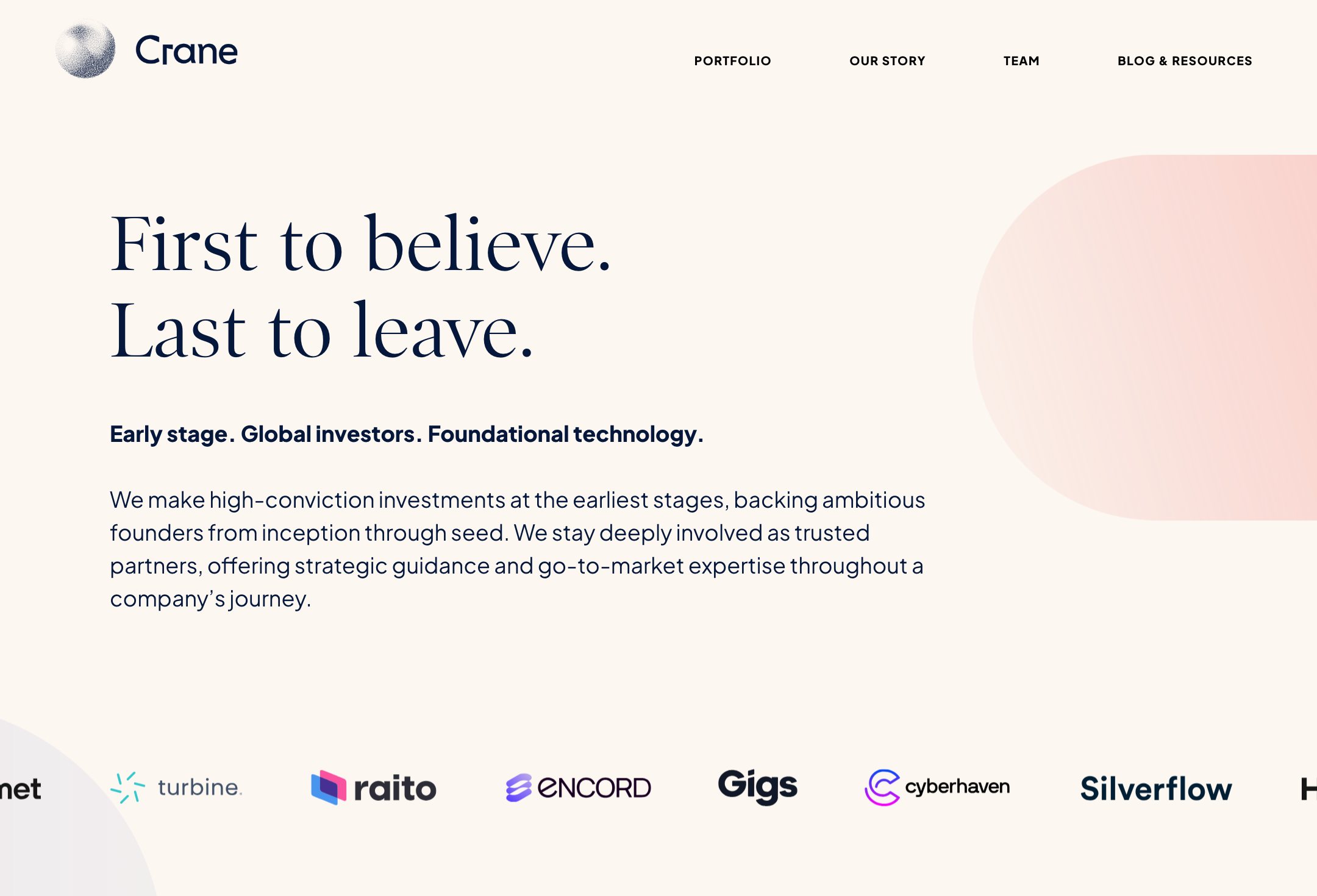 Crane Venture Partners |
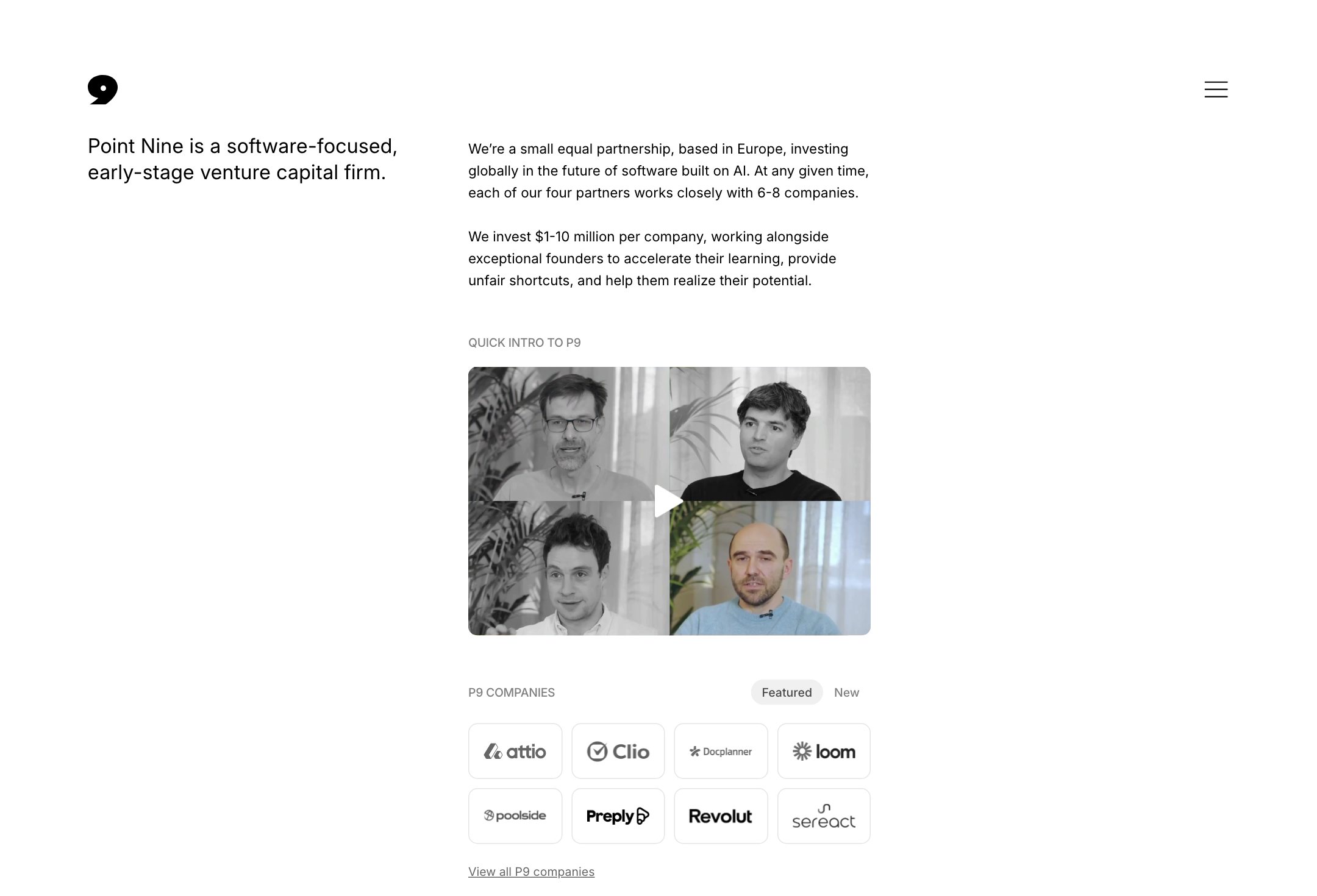 Point Nine |
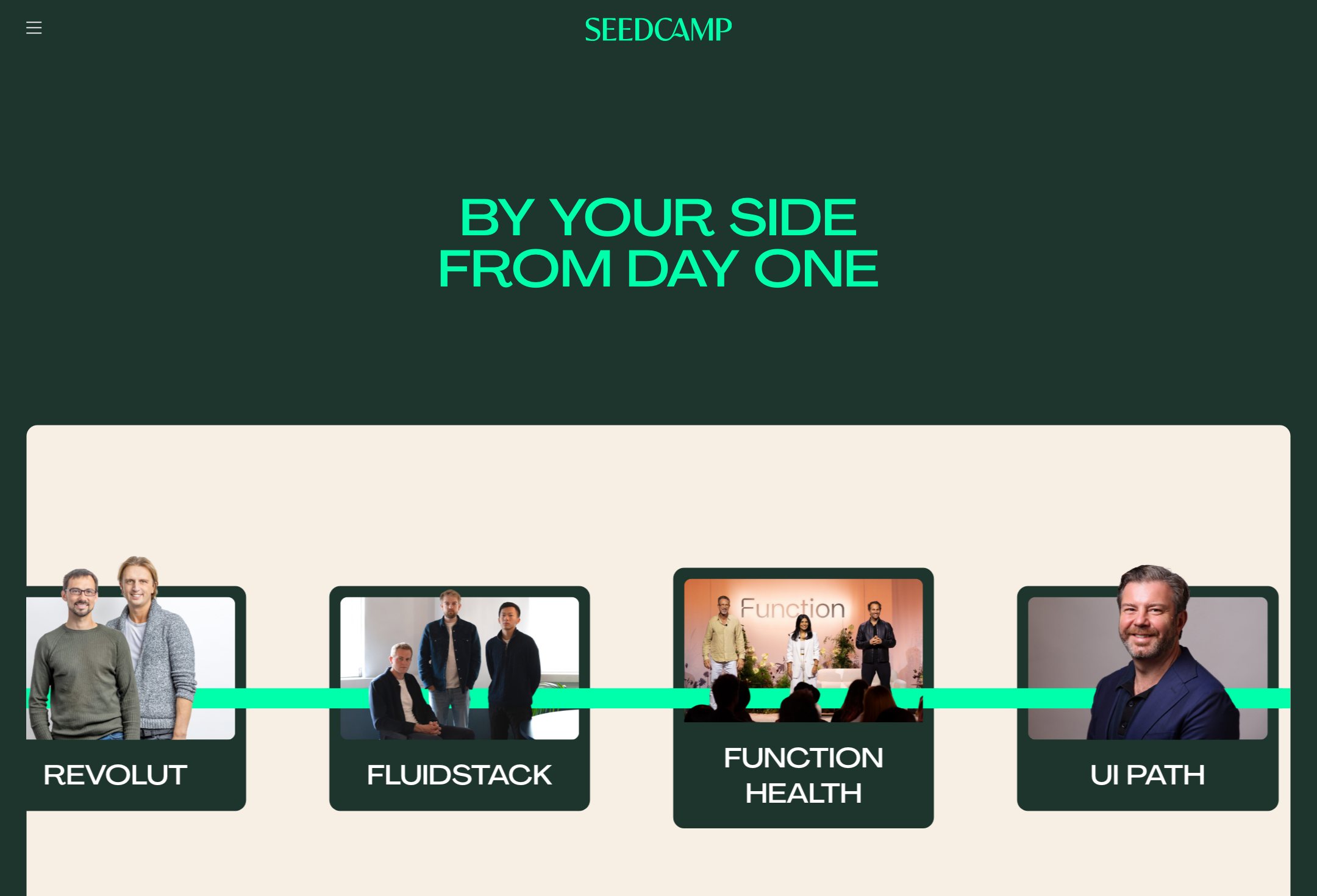 Seedcamp |
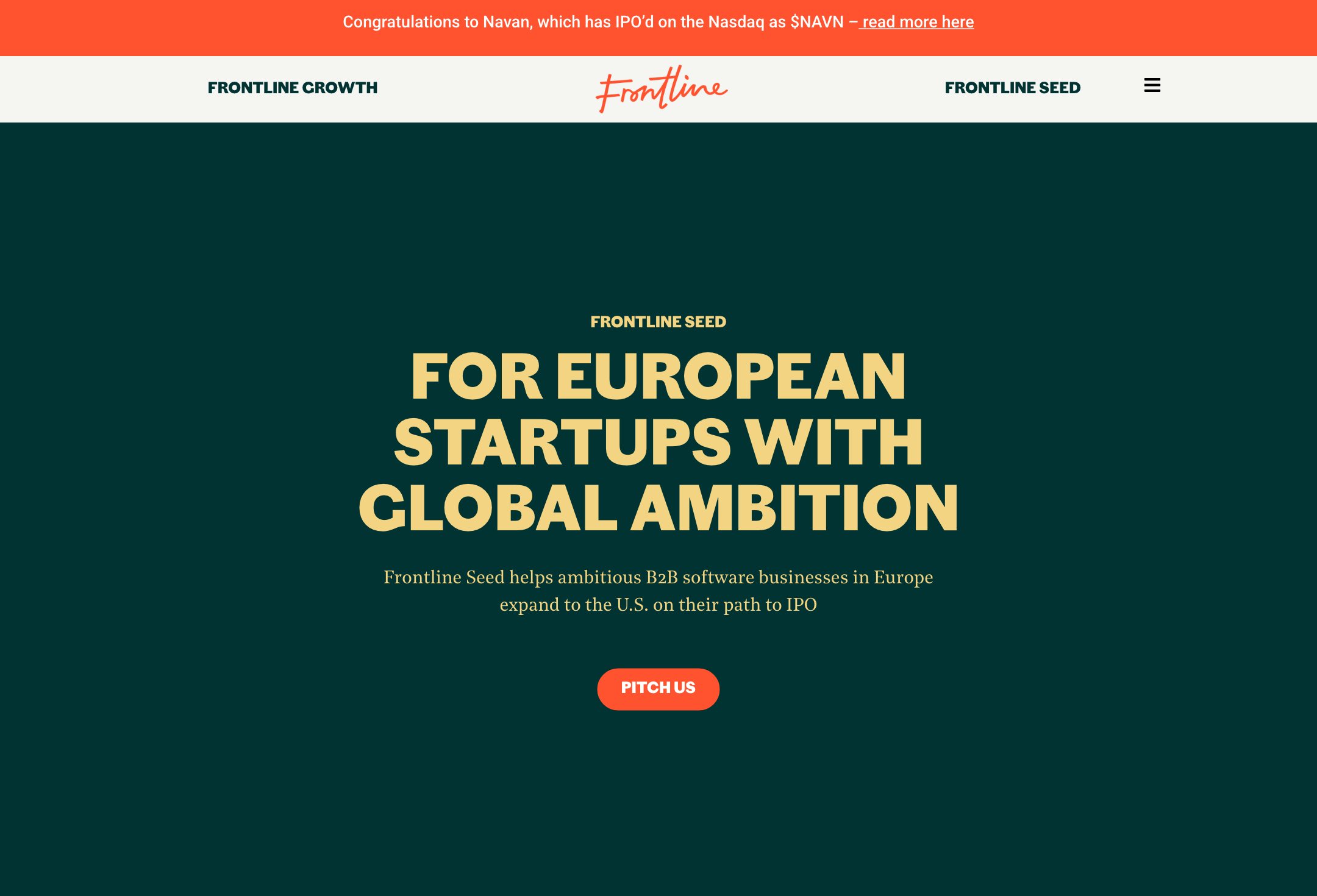 Frontline Seed |
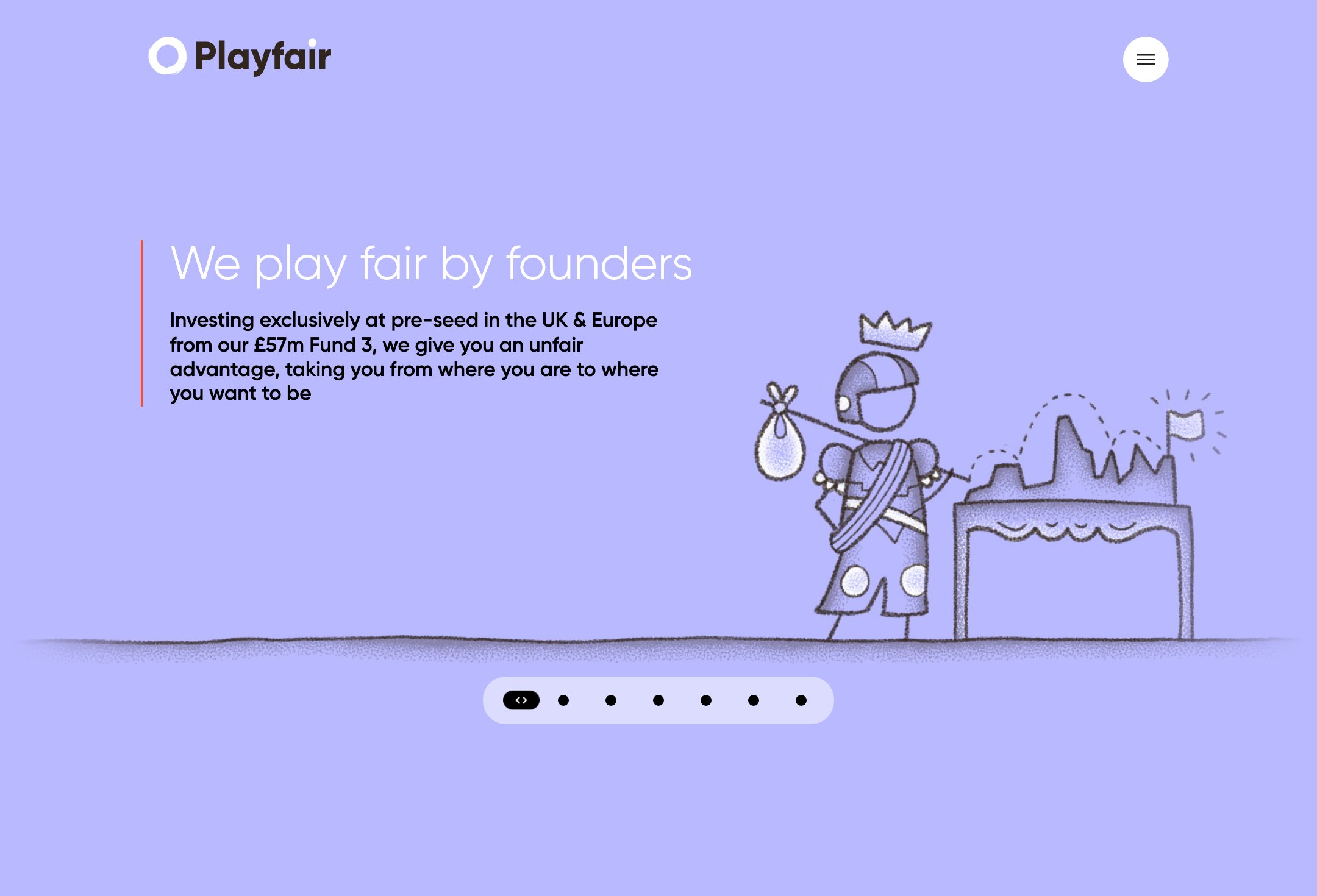 Playfair |
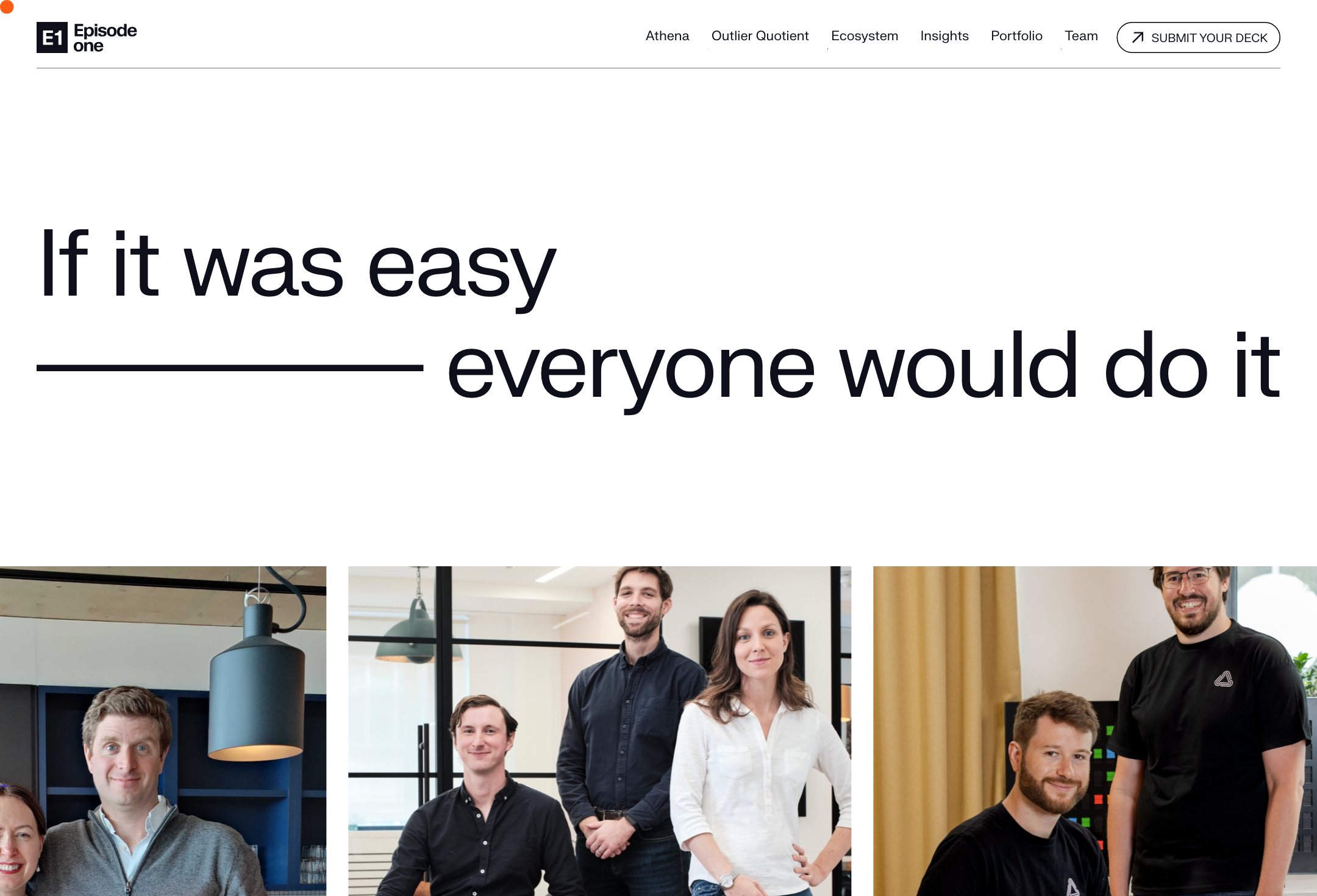 Episode 1 |
Live sources:
What A Founder Actually Does
If you are non-technical, the workflow is simple:
- Put your current story into
startup.md,founder-bio.md, andtraction-digest.md. - Add your target round and geography in
config/profile.yml. - Add investor names or URLs in
investors.yml. - Ask the agent to refresh the deck, scan investors, or compare targets.
- Review the generated shortlist and answer the follow-up questions.
- Send only the best applications and intros, not everything everywhere.
Features
| Feature | What it means in practice |
|---|---|
| Target Scanner | Finds investors, accelerators, angels, and founder programs that match your stage, sector, geography, and round |
| Fit Evaluation | Explains why a target fits or does not fit, instead of just giving you a name |
| Deck Refresh | Compares deck, website, founder inputs, and current proof to find stale claims and missing slides |
| Pitch Deck Generation | Drafts a 10-12 slide narrative and exports it to HTML/PDF |
| Founder Question Loop | Asks the highest-value questions when your story is incomplete or inconsistent |
| News / Trend Memory | Tracks market shifts, relevant incidents, and category timing hooks in market-watch.md |
| Pipeline Tracking | Keeps a single source of truth for targets, statuses, and follow-up timing |
| Human-in-the-Loop | Drafts and recommends, while the founder stays in control of submissions |
Example Use Cases
1. Refresh a stale deck before investor meetings
You have:
- a PDF deck from a few weeks ago
- a startup website that has evolved
- product updates that are not reflected in the narrative
Use Venture-Ops to:
- compare the deck against the front page
- flag missing metrics, outdated product scope, and stale screenshots
- ask targeted founder questions
- generate an updated 12-slide draft
2. Find real-fit investors instead of broad lists
You are a Berlin-based pre-seed founder building developer infrastructure.
Use Venture-Ops to:
- configure your target profile once
- scan a curated investor universe
- rank targets by fit
- identify who deserves time this week and who should be skipped
3. Apply to accelerators without generic answers
You want to apply to YC, EF, Antler, or another founder program.
Use Venture-Ops to:
- adapt the company story to each program
- generate sharper founder bios and application answers
- highlight where the deck underexplains the "why now"
4. Keep the fundraising narrative current
The market changes fast.
Use Venture-Ops to:
- monitor current trends and adjacent-company news
- update
market-watch.md - surface "this should change in the deck now" signals before the next investor call
Quick Start
git clone https://github.com/Desperado/venture-ops.git
cd venture-ops
npm install
npx playwright install chromium
npm run doctor
Then customize:
- Edit
startup.mdwith the company source of truth. - Edit
founder-bio.mdwith founder background and credibility. - Edit
traction-digest.mdwith metrics, customers, and proof. - Edit
market-watch.mdwith trends, competitor moves, and timing hooks. - Edit
config/profile.ymlfor stage, geography, round size, and investor targeting. - Edit
investors.ymlto add funds, angels, accelerators, grants, or founder programs you want to track.
If you want to refresh the public visuals:
npm run readme:assets
Usage
Local commands
npm run doctor                  # initialize and verify setup
npm run scan -- --dry-run       # preview matching targets
npm run scan                    # append matches to data/pipeline.md
npm run verify                  # validate tracker/report integrity
npm run deck -- deck.html out.pdf
npm run followup                # surface follow-up candidates from tracker
Inside an AI coding agent
/venture-ops                    -> show menu
/venture-ops scan               -> discover matching targets
/venture-ops evaluate {URL}     -> investor/accelerator fit report
/venture-ops deck {target}      -> tailored pitch deck package
/venture-ops refresh            -> audit deck + website + founder updates
/venture-ops news               -> trends/news monitoring and implications
/venture-ops apply {target}     -> application / outreach assistant
/venture-ops pipeline           -> process data/pipeline.md
/venture-ops tracker            -> status overview
/venture-ops followup           -> cadence and draft follow-ups
/venture-ops compare            -> rank multiple targets
/venture-ops deep               -> deep-dive one target
Or just paste:
- a VC URL
- an accelerator page
- your current deck
- your startup site
and ask the agent to run the relevant mode.
Example Prompts
Refresh my deck from this PDF and compare it against my website.

Find the top 10 VCs in Europe for a pre-seed developer-tools company.

Evaluate whether YC or EF is the stronger fit for us right now.

Turn this existing fundraising narrative into a tighter 12-slide deck.

Read my startup front page and tell me what an investor would still find unclear.

Update market-watch.md with the last 30 days of relevant category news.
How It Works
Deck + website + founder memory + traction notes
                   │
                   ▼
        Refresh loop + fit scoring + trend monitoring
                   │
          ┌────────┼────────┐
          ▼        ▼        ▼
      Reports    Decks    Tracker
       .md      .pdf/.html  .md
The important point: Venture-Ops is not just "write me a deck." It is a reusable operating model:
- source of truth files
- mode-based workflows
- investor scanner
- refresh loop
- narrative memory
- tracker discipline
Core Files
| File | Purpose |
|---|---|
startup.md |
Company source of truth: problem, solution, market, traction, roadmap |
founder-bio.md |
Founder narrative, credibility, founder-market fit |
traction-digest.md |
Compact proof-point memory for investor materials |
market-watch.md |
Current trends, news hooks, competitor signals |
config/profile.yml |
Raise profile, round, geography, sectors, ideal target types |
investors.yml |
Curated target universe for scanning and fit matching |
data/pipeline.md |
Pending targets to process |
data/targets.md |
Fundraising tracker |
reports/* |
Generated evaluations, deck drafts, and refresh audits |
output/* |
Generated slide HTML and PDFs |
Project Structure
venture-ops/
├── startup.md
├── founder-bio.md
├── traction-digest.md
├── market-watch.md
├── config/profile.yml
├── investors.yml
├── modes/
├── templates/
├── data/
├── reports/
├── output/
└── assets/readme/
Operating Principle
This is a filter, not a spam machine.
A small number of high-fit, high-context investor conversations beats broad cold outreach. Venture-Ops should make the founder sharper, not noisier.
It should also get better over time:
- every founder correction sharpens the profile
- every new metric improves the deck
- every missed question becomes a future checklist item
- every market change updates the narrative memory
Disclaimer
Venture-Ops is a local, open-source workflow, not a hosted fundraising platform.
By using it, you acknowledge:
- You control your data. Founder details, investor notes, traction, and fundraising materials stay on your machine unless you choose to send them to an AI provider.
- You control submissions. The system drafts and recommends, but it should not submit applications or send outreach on your behalf.
- You verify current facts. Investor partners, deadlines, check sizes, and program terms change frequently; current claims should be checked before use.
- No guarantees. Fit scores are recommendations, not truth. Investors are not deterministic systems. Use judgment.
License
MIT
Yorumlar (0)
Yorum birakmak icin giris yap.
Yorum birakSonuc bulunamadi