yes-dev
Health Warn
- License — License: MIT
- Description — Repository has a description
- Active repo — Last push 0 days ago
- Low visibility — Only 6 GitHub stars
Code Fail
- exec() — Shell command execution in tests/tray-launch.py
- exec() — Shell command execution in tests/tray-log.py
Permissions Pass
- Permissions — No dangerous permissions requested
No AI report is available for this listing yet.
Windows tray app that auto-approves Chrome's Allow remote debugging? prompt so parallel automation clients never block

A tray app that clicks Chrome's "Allow remote debugging?" prompt for you. Windows and macOS.
Chrome 144+ asks for consent every single time a client attaches to the remote
debugging endpoint. If you drive Chrome with more than one agent or automation
client, those prompts stack up and each one blocks its client until a human
clicks Allow. Yes, Dev sits in the tray and answers them.
Measured on Chrome 151: four parallel attaches went from ~35 seconds of waiting
on a human to 2.4-4.4 seconds, unattended.
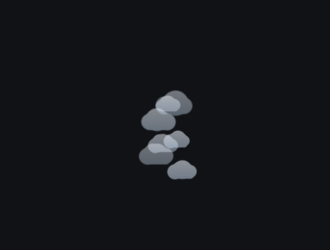
Each approval releases one cloud, which drifts away from the tray and fades.
Shown here against a plain backdrop; on a real desktop they drift over whatever
is behind them.
Field data, from the machine it was built on: 454 approvals over 8 days,
one failed click (99.8% success), no runaway pauses, and it came back by itself
after a reboot. That figure is from the Windows build, which has the mileage;
the macOS build is newer and is described honestly under
Known limitations.
Windows: update if you are running 1.0.0
The 1.0.0 engine leaked memory, and badly. It walked the UI Automation tree
four times a second whether or not a prompt was there, and those elements hold
native memory that puts no pressure on the managed heap - so .NET never
collected, and nothing was ever released. Measured at ~9 MB/min, about 13 GB a
day. It was found in the field at 51.5 GB private after ten days, with
Windows compressing 11.8 GB to cope.The same build also let the engine outlive its tray. The burst guard and the
disarm timer both live in the tray, so an orphaned engine keeps approving
prompts with nothing watching the rate - the 51.5 GB one had been running
unattended for five days.Both are fixed in 1.1.0.
If you are on 1.0.0,git pulland restart the tray. Full detail, with the
before and after measurements, is in the changelog.
Why not just turn the prompt off?
You can't, and this is not a gap waiting to be filled. There's no flag, no
policy, no "remember my choice". The RemoteDebuggingAllowed enterprise policy
only enables or disables the feature outright.
The request to persist approval,
#825, was
closed as not planned in March 2026 - so a built-in "always allow" is not
coming. #1794,
about the prompts stacking up when several clients connect at once, is still
open. Clicking the button is the only route, which is what this does.
Read this before you install it
That prompt exists to stop a malicious local program from seizing your
signed-in browser: full access to your cookies, your saved data, and the ability
to navigate anywhere as you. Auto-approving means any local process that
attaches gets in, not just the ones you started.
On a single-user dev machine that's usually a fine trade. It is still a real
reduction in protection, so Yes, Dev ships with two mitigations on by default:
- Stay on for a fixed window (15 min / 1 hour / 4 hours), then it disarms itself.
- Burst guard reacts if approvals spike past 60 in a minute, which is well
clear of normal load but far below a runaway loop. By default it asks what to
do, with a visible five-second countdown: Stop or Allow for one hour.
Letting the timer run out stops it, because that is the safe answer to a burst
you were not expecting. Set it to Stop silently instead and it pauses
without asking, re-arming a minute later. Turn the guard off entirely if your
workload makes it noise.
The 60/min default is measured, not guessed: several agents working in parallel
peaked at 15 approvals in the busiest minute of a real session. Set your own
limit from the tray if your workload is heavier.
Both mitigations live in the tray, not in the engine, so the tray dying must not
leave an engine approving prompts with nothing watching the rate. On macOS the
engine is passed --exit-with-parent and stops itself the moment it is
reparented; on both platforms the tray kills the engine on the way out.
If you only need automation against a throwaway profile, you don't need this at
all: launch Chrome with its own --user-data-dir and it never prompts. This tool
is for when you need your real, signed-in browser.
Install
Clone the repo, then follow your platform. requirements.txt covers both -
its markers install only what your platform needs, so pip install -r requirements.txt works either place.
Windows
Requires Windows and Python 3.9+.
pip install pystray pillow
pythonw yes_dev.pyw
Right-click the tray icon and tick Start at login to make it permanent (it
drops a shortcut in your Startup folder - no scheduled task, no admin rights).
macOS
Requires Python 3.9+. Use a python.org build, or a Homebrew one with Tk, since
the burst dialog is Tk. Built and verified on macOS 26 with Chrome 152; nothing
here is new API, but no older macOS has been tested.
pip install rumps pillow pyobjc-framework-Cocoa pyobjc-framework-ApplicationServices
python3 yes_dev_mac.py
Then grant Accessibility, which macOS requires before any process may drive
another app's UI. The menu's top section shows whether you have it; clicking
Accessibility: NOT granted raises the system prompt and opens
System Settings > Privacy & Security > Accessibility. Without it every attribute
read comes back empty and the app looks broken rather than unpermitted.
Run as a loose script, that grant attaches to your Python binary - fragile,
because it breaks when the interpreter path changes, and far too broad, because
everything that interpreter ever runs inherits it. A signed .app bundle is the
right home for it and is not built yet; see
Known limitations.
Getting Chrome to prompt at all
From Chrome 136, --remote-debugging-port is ignored on your default profile
unless it is paired with a non-default --user-data-dir - and a throwaway
profile never prompts, so it is not the thing to test against. To attach to your
real, signed-in browser, turn on Remote Debugging atchrome://inspect/#remote-debugging. Each attach to the browser endpoint then
raises the consent prompt, which is what this app answers. The consent gates the
CDP WebSocket handshake itself, so a blocked client sits waiting mid-handshake.
The menu
| Item | What it does |
|---|---|
| On | Master switch. Off means the engine isn't running at all. |
| Accessibility (macOS) | Whether the permission is granted; click to request it and open the settings pane. |
| Start at login | Windows: a Startup folder shortcut. macOS: a LaunchAgent. |
| Stay on for | Auto-disarm after 15 min / 1 hour / 4 hours, or stay on until you say otherwise. |
| Speed | Poll interval: 150ms / 250ms / 750ms. |
| Approve notice | How approvals are announced: floating puffs (default), a toast card, or silent. |
| Pause on burst | Trip past 30 / 60 / 120 approvals a minute, or off. Then either ask me first (5s dialog: Stop, or Allow for one hour) or stop silently and re-arm after a minute. |
| Observe only | Log the dialogs but don't click - useful for a first look. |
| Include Microsoft Edge | Watch Edge windows too. |
| Open log / Open config | The data directory for your platform (see Files). |
The icon is green when armed, amber when observing, grey when off, red when
paused, and carries a running approval count - in the tooltip on Windows, in the
menu on macOS.
How it works
Three processes on both platforms, and the seams between them are plain text,
which is why a second platform could be dropped in without touching the shared
logic:
tray            owns config, the menu, the counter and the burst guard
  |
  +-- engine    finds and clicks the dialog
  |             appends "[ACTION]" lines to yes-dev.log  <-- the tray tails this
  |
  +-- overlay   the clouds; one integer per line on stdin = show N clouds
  |
  +-- burst_dialog.py   the 5s prompt; prints its answer on stdout
The engine's entire interface to the tray is that log line, so the counter, the
clouds and the burst guard work unchanged whichever engine is running. The tray
never touches the accessibility APIs itself: it supervises the engine process,
tails its log, and writes config.json. Options the engine only reads at
startup restart it automatically.
The config file is identical on both platforms - same name, same keys, same
defaults - so settings copy across machines. Both builds read it as utf-8-sig
and write plain UTF-8, because Notepad and PowerShell add a byte-order mark that
a strict UTF-8 read would reject, silently resetting every setting to default.
Finding the dialog on Windows
watcher.ps1 first enumerates visible top-level Chrome_WidgetWin_1 windows.
It matches the consent title and browser process before it reads any UI
Automation elements. The idle path does not scan the browser's accessibility tree.
The engine invokes the matching Allow button through InvokePattern. If that
fails, it uses the native LegacyIAccessible COM interface for the same button
runtime ID inside the same dialog. Neither method moves the mouse or changes focus.
An action call is logged as an attempt. The engine writes one [ACTION] event
only after the original dialog/button disappears. A pending entry holds only
the window handle, process ID, button runtime ID and method name, not live UI
Automation objects. Repeated attempts on one prompt do not increase the tray
counter or burst rate. A new button identity can be handled immediately even if
Windows reused the window handle.
The counter measures dialog dismissal after an approval action. It cannot inspect
another client's protocol session. The isolated browser tests verify successful
CDP connections separately, and require one counter event per tested connection.
The log writer permits concurrent reading and uses bounded retries for short
file locks. A confirmation stays pending until its ACTION record is saved. A
reader that blocks log rotation does not cause the current event to be dropped;
the engine appends it and retries rotation on a later write.
Finding the dialog on macOS
Same shape of problem, different tree. Here the dialog is attached to the
browser window, as an AXSheet, wrapping an alert whose subrole is the thing
worth matching on:
AXApplication  "Chrome"
  AXWindow  "<tab title> - Google Chrome"
    AXSheet  "Allow remote debugging?"                    <-- dialog host
      AXGroup / AXSubrole=AXApplicationAlertDialog
        AXButton  "Turn off in settings" | "Cancel" | "Allow"
watcher_mac.py walks each Chrome process's windows, sheets and children,
matches by title and role, and presses the button with AXPress - again with
no mouse movement and no focus stealing.
An approval is logged only once the sheet is verified gone, and "gone" is judged
by the AX references that were pressed, never by what now sits at those
coordinates - Chrome draws the next queued prompt exactly where the last one was,
so a geometry check would call a dismissed sheet still up and miss a real
approval. Under load AXPress can report success while the sheet outlives the
check. A longer AX timeout and a re-press clears that, and there is no synthetic
click anywhere in the engine: a cursorless one was tried four ways and Chrome
ignores them all, and a pointer-moving one would break the promise above. A sheet
that outlives the retries is logged FAILED and pressed again next sweep.
Two macOS-specific traps, both found by running docs/mac/ax_probe.py against a
live prompt:
- The title alone is not enough. It also matches the Window menu's
AXMenuItemfor the dialog, and anAXHeadinginside it. Matching role as
well as title is what separates the real dialog from its echoes. - There is no
GetRuntimeId(). Chrome sets noAXIdentifieron this alert,
so deduplication keys on position and size instead. Note thatAXPosition
comes back as anAXValueand must be unwrapped withAXValueGetValue-
pyobjc has no.pointValue(), and a key that silently falls back to object
identity changes on every sweep, which defeats the dedupe entirely.
macOS also demands an Accessibility grant that has no Windows equivalent.
This is TCC, it is deliberate, and it cannot be scripted around: AppleScript and
System Events need exactly the same grant, so there is no side door.
The puffs
A toast card per approval is worse than the problem when approvals fire dozens
of times an hour, so the default notice is a small translucent cloud that drifts
away from the tray and fades out. Position, size, speed, drift, lifetime and
release delay are all jittered, so a burst scatters instead of stacking. The
windows are click-through and non-activating - they never take focus or swallow
a click. Warnings (burst guard, auto-disarm) still use a real toast, because
those carry text you need to read.
| Windows | macOS |
|---|---|
 |
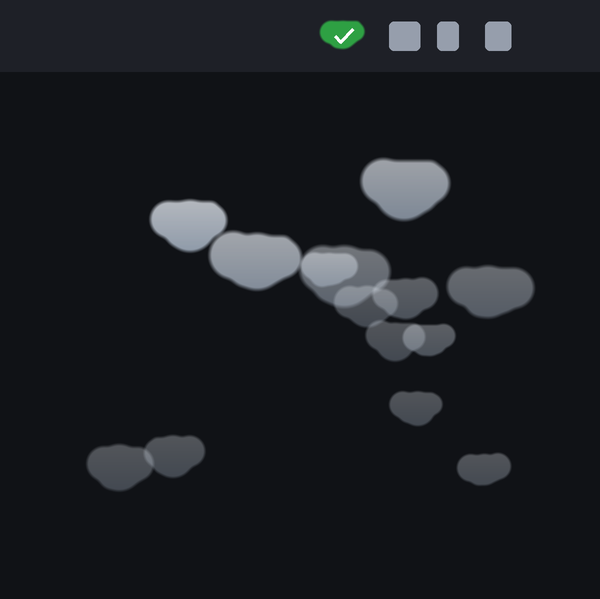 |
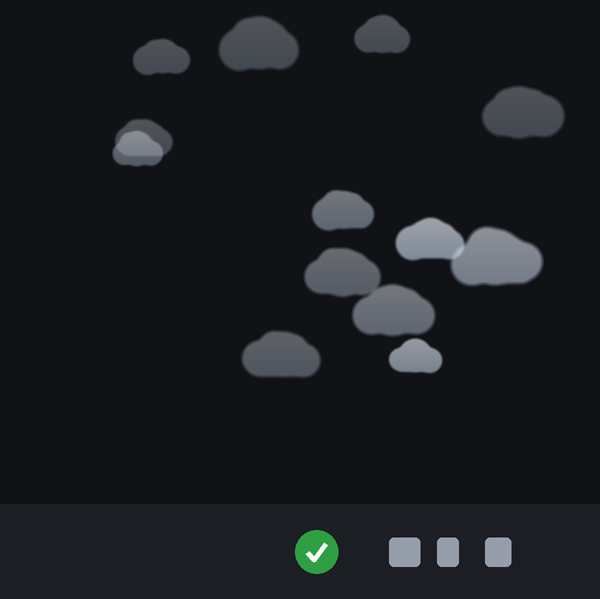
| Windows. The tray sits at the bottom of the screen, so a cloud is released there and rises away into open desktop. | macOS. The status item sits at the top, so a cloud is released just under the menu bar and falls away from it - and hangs, flipped, rather than sitting on its flat base. |
That direction is the one deliberate behavioural difference between the two
builds, and it is forced rather than chosen. Rising was tried first on macOS and
measured: released level with the status item, a cloud crossed the menu bar
within a second and spent the rest of its life off-screen, still ~40% opaque.
Every cloud is generated, never a stored asset: five jittered lobes over a flat
base, blurred for soft edges, put through a contrast curve so the silhouette
still reads as a shape, then shaded with a vertical gradient. No two are alike.
The macOS overlay flips only the alpha mask, not the whole image - flipping
the image carries the shading with it and lights the cloud from below, which
looks wrong hanging under a menu bar.
Neither picture is a mock-up or a hand-arranged row. docs/make_art.py anddocs/make_art_mac.py replay a real burst and freeze it mid-flight, taking the
shapes, spawn positions, speed, drift and fade straight from puffs.py andpuffs_mac.py, so the art cannot drift from the app. The two generators are
built the same way and to the same size, so the pair sits level and any
difference you see between them is a real difference in the app rather than an
artefact of how the picture was made.
The bar along the edge of each - taskbar below, menu bar above - is a
genericized stand-in, but the app's own icon on it is the real one, drawn from
the same code the app uses: a green circle with a check in the Windows tray, and
on macOS the cloud itself, flipped and filled, so the icon and the notification
are literally the same shape rather than two things that merely resemble each
other. The neighbouring icons are placeholders, there for scale.
Both are shown on a dark ground because the clouds are built to read over a
taskbar and would be nearly invisible on a white page. docs/clouds.png anddocs/clouds-mac.png are the same frames with transparent backgrounds and no
bar, and docs/cloud.png is a single cloud, for reuse elsewhere.
Windows: layered windows
The clouds are drawn as 32-bit bitmaps and handed to the compositor withUpdateLayeredWindow, not painted by Tk. Colour-keyed transparency can only
make one exact colour disappear, which forces hard aliased edges; per-pixel
alpha gives soft edges and a shaded underside, and one call moves and fades a
cloud together.
Three Windows quirks cost real time here and are worth knowing if you touchpuffs.py:
- Tk will not paint from a worker thread. Toplevels created off the main
thread are reported visible byIsWindowVisible, sit at the right
coordinates, and render solid black. Identical code on the main thread paints
fine. Since pystray owns the parent's main thread, the overlay runs as its own
small process (puffs.py --serve) that takes one integer per line on stdin. - Order matters around
SetWindowLongW. Applying the click-through ex-style
to a window that has not been realized yet drops its layered attributes and it
stays invisible forever. Callupdate_idletasks()first, then set the style,
then push the bitmap. - Declare argtypes, not just restype, for anything taking a handle. With only
a restype set, ctypes passes a Python int as a C int and a 64-bitHDC
overflows it -CreateDIBSectionfails with "argument 1: OverflowError: int
too long to convert", the window never gets its pixels, and a plain white
rectangle sits there instead of a cloud.
macOS: transparent NSWindows
Easier than Windows, because per-pixel alpha is native: a borderless NSWindow
with setOpaque_(False), a clear background, setIgnoresMouseEvents_(True) for
click-through, NSStatusWindowLevel so it floats above ordinary windows, andorderFrontRegardless() to show without stealing focus. setAlphaValue_ does
the fade and setFrameOrigin_ the drift. No colour key, no premultiplication,
no layered-window ordering trap - the premultiplied path in _render_cloud
exists only for UpdateLayeredWindow, and macOS wants straight alpha.
Three things to get right:
- Coordinates are flipped. The macOS origin is bottom-left. Falling is
-y
here; rising on Windows is also-y. Same sign, opposite direction. - Use
NSScreen.visibleFrame, notframe, so the menu bar and Dock are
excluded. It is the counterpart ofSPI_GETWORKAREA. - Render at
backingScaleFactorand size the image in points, or the art is
an upscaled 1x asset on a retina display.
On both platforms: never let a frame kill the animation loop. An exception
between scheduled callbacks stops the reschedule, and every cloud on screen
freezes there permanently, in the user's face. Catch per-frame, destroy what is
live, and keep the loop going.
Set YESDEV_DEBUG=1 to have the overlay log spawns and failures to puffs.log
in the data directory.
Files
| Path | Role |
|---|---|
yes_dev.pyw |
Windows tray UI, engine supervisor, config |
yes_dev_mac.py |
macOS menu-bar UI, engine supervisor, config |
watcher.ps1 |
The UI Automation engine. Runs standalone too. |
watcher_mac.py |
The Accessibility engine. Runs standalone too. |
platform_mac.py |
macOS paths, single instance, permission check, autostart |
puffs.py |
The cloud overlay and the shared artwork. Its own process. |
puffs_mac.py |
The macOS cloud overlay. Its own process. |
burst_dialog.py |
The five-second burst prompt. Also its own process. Shared. |
docs/mac/ax_probe.py |
Dumps Chrome's accessibility tree around the dialog |
docs/make_art.py, docs/make_art_mac.py |
Regenerate the cloud art from puffs.py |
Everything the app writes lives in one directory per platform:
| Windows | macOS | |
|---|---|---|
| Data directory | %LOCALAPPDATA%\YesDev\ |
~/Library/Application Support/YesDev/ |
| Settings | config.json |
config.json |
| Approvals, from the engine | yes-dev.log |
yes-dev.log |
| Tray-side events and errors | tray.log |
tray.log |
Both logs roll over at 1MB, keeping one previous generation.
Run an engine by itself if you'd rather not have a tray at all:
powershell -NoProfile -ExecutionPolicy Bypass -File watcher.ps1 -Observe
python3 watcher_mac.py --observe
Known limitations
- Windows supports English and Simplified Chinese (zh-CN) dialogs. The
dialog title and approval button must match the configured language patterns.
Other languages need custom-DialogPatternand-ApprovePatternvalues inwatcher.ps1. The Windows tray does not expose these parameters. The macOS
patterns remain unchanged by the Windows fixes. - Matched by string, so a Chrome rename breaks it. If a future Chrome
retitles the dialog, approvals silently stop. The log still records dialogs it
found but could not act on, so observe mode will tell you quickly. - Clouds anchor to one screen. On Windows they use the primary monitor in
unscaled pixels, tested on a single 1920x1080 display at 100% scale. On macOS
they anchor to the screen carrying the menu bar. Either way the approving
itself is resolution-independent and unaffected.
macOS specifically
- Not packaged or signed yet. Running as a loose script means the
Accessibility grant attaches to your Python interpreter rather than to this
app: fragile, and far broader than it should be. A signed.appis the fix
and is the main piece of work outstanding. - Toast notices degrade to log-only. Notification Center refuses
notifications from an unbundled script, soApprove notice > Toast card
writes totray.loginstead. Floating puffs, the default, are unaffected. - Autostart works but is untested across a real logout. The LaunchAgent is
written and loaded correctly; surviving an actual logout and login has not
been proven the way it was on Windows. - Less mileage. The Windows build has 454 real approvals behind it. The
macOS build has been verified end to end against live prompts - engine, tray,
overlay, teardown - but it has not yet run for days on end.
License
MIT
Reviews (0)
Sign in to leave a review.
Leave a reviewNo results found