Synapse
Health Uyari
- License — License: NOASSERTION
- Description — Repository has a description
- Active repo — Last push 0 days ago
- Low visibility — Only 7 GitHub stars
Code Uyari
- network request — Outbound network request in .agents/skills/expo-cicd-workflows/scripts/fetch.js
Permissions Gecti
- Permissions — No dangerous permissions requested
This self-hosted server acts as a shared, persistent memory and project-tracking brain for AI assistants like Claude. It allows team members to share a single knowledge graph across multiple sessions so context is never lost.
Security Assessment
The overall risk is Low. The automated code scan reviewed 12 core files and found no dangerous patterns, hardcoded secrets, or requests for excessive permissions. However, it is important to note the context of how this tool works. By design, the server handles potentially sensitive data, processing your project context, code summaries, and work logs. It requires network requests to communicate with your AI client and connect to the remote self-hosted database. Since you are expected to self-host this via Docker or Coolify, the security of your data ultimately depends on how securely you configure and expose your own deployment.
Quality Assessment
The project is very new, which is reflected in its low community visibility (only 5 GitHub stars). Despite this, it is actively maintained, with repository pushes occurring as recently as today. The repository includes a comprehensive description and detailed documentation to help users get started. One minor friction point for some developers will be the licensing; the repository lists no official license in its GitHub metadata, though the README claims an AGPL-3.0 + Commercial model. As an early-stage tool, it lacks the proven track record of community trust that larger projects have.
Verdict
Use with caution. The underlying code appears safe and free of malicious behavior, but you should evaluate your own security posture before trusting a new, low-visibility project with your proprietary project data.
Self-improving AI brain for Claude Code & Desktop — 28 MCP tools, 253 skills, collective memory, project tracking, work logs. One server, all your sessions share the same knowledge. Deploy on Coolify in 2 minutes.

The intelligence layer for AI workflows.
One MCP connection. Collective knowledge. Multi-user auth. Zero local files.
Your AI assistant forgets everything when you close the session. For your whole team, that's a productivity tax you pay every single day. Synapse fixes it — permanently, collectively, with audit trails.
55 MCP tools, 258 skills, multi-user authentication, 12-page dashboard, collaborative whiteboards, team-safe knowledge graph — served from a single self-hosted server. Claude Code, Claude Desktop, or any MCP client connects and gets the full system.












Built by Daniel De Vecchi · GitHub
2-Minute Setup
Add this to your Claude Code config (~/.claude.json → mcpServers):
"codegraph": {
  "command": "node",
  "args": ["/path/to/skillbrain/packages/codegraph/dist/cli.js", "mcp-proxy"],
  "env": {
    "SKILLBRAIN_MCP_URL": "https://your-server.com/mcp",
    "CODEGRAPH_AUTH_TOKEN": "your-personal-api-key"
  }
}
Restart Claude Code. You now have 50 tools, 258 skills, and shared team memory.
First login creates the admin user automatically. Additional team members are invited from the dashboard (Team page) and each gets their own API key for MCP access.
For Claude Desktop, add the same to ~/Library/Application Support/Claude/claude_desktop_config.json.
See It In Action
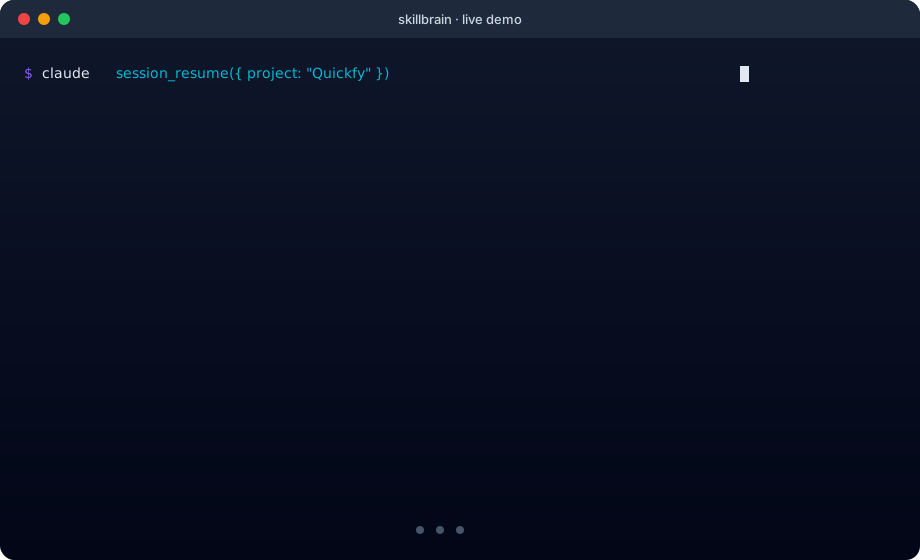
Resume a project after days away
> session_resume({ project: "Quickfy" })

## Resume Context: Quickfy

### Last Session
- Date: 2026-04-15
- Task: add stripe payments
- Status: paused
- Summary: Implemented Stripe checkout + webhook handler
- Next steps: Add subscription renewals and account page
- Branch: feat/payments
- Commits: abc123, def456

### Project Memories (3)
- [BugFix conf:3] Cookie forwarding in Server Actions needs explicit headers()
- [Pattern conf:3] Centralize Payload Local API calls in lib/payload.ts
Find the right skill for any task
> skill_route({ task: "add stripe payments" })

Recommended: payments (494 lines), churn-prevention (241), pricing-strategy (232)

> skill_read({ name: "payments" })
→ Full Stripe integration guide: checkout, webhooks, subscriptions, error handling
Share knowledge across the whole team
> memory_query({ scope: "team", type: "BugFix" })

M-bugfix-xxx [BugFix conf:3] @alice • 2026-04-20
  "Every collection in multi-tenant Payload MUST have access control functions..."

M-bugfix-yyy [BugFix conf:2] @bob • 2026-04-22
  "Coolify healthchecks fail on slow migrations — increase start_period to 90s"
A bug Alice fixed last week is now searchable from Bob's session. Personal notes stay private (scope: "personal"), project-specific knowledge scopes to the project, and team learnings are visible to everyone.
Self-service API keys
Each team member rotates their own MCP access token from the Profile page. No shared passwords, no server restart, full audit trail.
What's New — May 2026
- Whiteboards (FigJam-style, integrated with Synapse data) — full collaborative whiteboard with infinite canvas, sticky notes, frames, shapes, code blocks, free-hand pen, images, emoji stamps, and connectors. The killer feature: drag Synapse memories/skills/sessions/projects directly onto the canvas as live cards, double-click to edit them inline, and run 14 deterministic generators to auto-build boards from your data (by-tag, by-type, by-project, by-skill, by-author, recent, most-used, decisions-log, antipatterns, open-todos, session-timeline, skill-graph, project-overview, semantic-cluster). Includes async collaboration (comments + @mention email + in-app notification inbox + heartbeat presence avatars), 5 templates (Retro, Brainstorm, Kanban, OKR, Mind-map), undo/redo, snap-to-grid + alignment guides, multi-handle resize, group/ungroup, lock, dot voting, timer, color-by-author, markdown sticky, syntax-highlighted code, version snapshots auto-saved hourly, soft-delete trash, pin/favorites, tags + search, read-only public share links, full board export (PNG/JPG/PDF/JSON), MCP exposure (5 new tools), and Figma-style left vertical sidebar. Zero npm dependencies (vanilla JS, ~3000 LOC), MIT-only vendor libs (marked, Prism, html2canvas) self-hosted in
/vendor/. - Semantic search (vector embeddings) —
memory_searchnow uses hybrid retrieval:0.5 × BM25 + 0.5 × cosine similarityviaXenova/multilingual-e5-small(384-dim, CPU-only, IT+EN). Memories that share meaning surface even without keyword overlap. - Embed-on-add — every new memory is embedded in the background automatically (fire-and-forget, never blocks
memory_add). First call downloads the model (~118 MB) to the local cache. - Graceful degradation — if the model is unavailable, retrieval falls back to BM25-only. No breaking changes.
- Backfill script —
pnpm backfill:embeddingsre-embeds all existing memories in batches of 32 (idempotent, safe to re-run after deploy).
What's New — April 2026
The last wave of releases turned Synapse from a single-user tool into a team platform. Everything below ships in the current build:
- Multi-user authentication — email + password, admin bootstrap on first login, legacy
DASHBOARD_PASSWORDdeprecated. - Self-service API keys —
GET/POST/DELETE /api/me/api-keysfrom the Profile page, no admin needed for rotation. - Memory scopes —
personal/team/projecton every memory. "My memories" filter isolates what you authored. - Team-safe storage layer — ownership tracking (
created_by_user_id,updated_by_user_id) across memories, skills and components, withConcurrencyErroron stale writes. - Review system & approval queue — memories and skills can be saved as
draftand approved from the Review page. Full audit log (review_audittable) with approve/reject/rollback. - Skill version history — every upsert snapshots the skill into
skill_versionswith achange_reason(manual, import, haiku-evolution, rollback). Instant rollback to any prior version. - Design system auto-populate — scan Tailwind v4 configs, CSS variables and
tokens.jsonfiles. Cross-referenced against the component catalog. - Component catalog + token linking — bulk import component snippets, auto-detect
var(--color-*)references, link to design systems. - Project merge & dedup —
POST /api/projects-meta/mergeabsorbs duplicate projects (sessions, memories, env vars, design systems merge with conflict resolution). - MemPalace retrieval — BM25 re-ranking on FTS5 trigram candidates (partial/prefix match: "serv" → "server"), closet boost for project-context results, verbatim session chunk indexing with
session_search. - Memory persistence fix — CodeGraph uploads (
codegraph_analyze) now merge only the index tables; memories, sessions, skills and env vars are never overwritten. - ENCRYPTION_KEY rotation —
POST /api/admin/rotate-keyre-encrypts all secrets atomically; safe to run before changing the key in Coolify. - CodeGraph auto-upload — proxy auto-uploads the local analysis on connect if the server is stale or missing; Bearer auth fixed for
/api/*routes.
Before vs After
| Without Synapse | With Synapse | |
|---|---|---|
| Same bug, 3rd time | 20 min rediscovering | memory_search → 2 seconds |
| New session | Start from zero | Auto-loads context + top memories |
| Multiple sessions | Isolated silos | One shared database — instant sync |
| Resume after days | "Where was I?" | session_resume → exact state |
| "Don't do X" | Forgotten next session | AntiPattern with decay — persists |
| Stale knowledge | Old patterns pollute | Auto-decay: unused → deprecated |
| Which skill to use? | Search docs manually | skill_route → instant match |
| Team collaboration | Isolated inboxes / Slack | Shared DB, team scope, per-user ownership |
| Access control | Trust everyone | Per-user API keys + audit log |
| Knowledge curation | Everything auto-merged | draft status + approval queue |
| Brainstorm / planning meeting | Miro/FigJam disconnected from your data | Whiteboard with 14 generators that pull memories/decisions/sessions live |
| Visual project handoff | Slides + 5 stale wikis | Project overview board · share read-only link · auto-extract memories from retro |
What Is Synapse?
A self-improving AI brain deployed on your server, with multi-user authentication and team-safe storage. Thirteen integrated systems:
📚 1. Skills-as-a-Service (258 skills)
Domain knowledge served via MCP: Next.js, Stripe, SEO, CRO, Payload CMS, Docker, React Native, design systems, and more. Loaded on demand.
skill_list()         → browse all 258 skills
skill_route(task)    → find the best skills for your task
skill_read(name)     → load full skill content
skill_add(name)      → contribute a new skill (draft mode supported)
skill_update(name)   → update a skill, history kept in skill_versions
🧠 2. Memory Graph
Typed knowledge graph with 8 memory types, 5 relationship types, and 3 scopes, stored in SQLite. Retrieval uses hybrid scoring (0.5 × BM25 + 0.5 × cosine similarity) via multilingual-e5-small (384-dim, CPU-only, IT+EN) over FTS5 trigram candidates (partial/prefix match: "serv" → "server"), plus closet boost for project-context relevance. Falls back to BM25-only when the model is unavailable.
Memory types: Fact, Preference, Decision, Pattern, AntiPattern, BugFix, Goal, Todo
Edge types: RelatedTo, Updates, Contradicts, CausedBy, PartOf
Scopes: personal (private to author), team (visible to everyone), project (scoped to one project)
Every memory has confidence scoring (1–10) with automatic decay. Bad memories fade. Good ones strengthen.
🌐 3. Collective Memory
One shared SQLite database on the server. All clients — Claude Code, Claude Desktop, any MCP client — read and write through the same store. A bug fixed in session A is instantly searchable from session B.
Alice (Claude Code)  ──proxy──→ server ──→ SQLite (shared)
Bob   (Claude Desktop) ──proxy──→ server ──→ SQLite (shared)
Carol (Browser)        ──HTTPS──→ server ──→ Dashboard
👥 4. Multi-User + Teams (NEW)
Email + password authentication with bootstrap admin on first login. Admins invite team members from the Team page, assign roles, and track membership. Every write records the author.
🔑 5. Self-Service API Keys (NEW)
Each user rotates their own MCP access tokens from the Profile page (GET/POST/DELETE /api/me/api-keys). Admin never sees your key. Tokens are hashed at rest.
✅ 6. Review System & Approval Queue (NEW)
Save memories and skills as draft — they land in the Review page queue instead of going live. Admins (or whoever has the review role) approve, reject, or roll back. Every decision is logged in review_audit.
🗂 7. Skill Version History (NEW)
Every time a skill is created or updated, a snapshot goes into skill_versions with a change_reason (manual / import / haiku-evolution / rollback). One click restores any prior version.
🎨 8. Design System Registry (NEW)
Scan Tailwind v4 configs, CSS variables and tokens.json files directly — the MCP accepts the file contents inline. The design system is stored, merged, and cross-referenced with the component catalog.
🧩 9. Component Catalog (NEW)
Register reusable UI components (hero, pricing table, CTA block, etc.) with code snippet, section type, and design-token references auto-detected from var(--color-*) usage. Searchable by project, section, or token.
📁 10. Project Tracking + Work Log + Merge
Projects are auto-derived from sessions. Every session records task, status, deliverables, next steps, branch, and commits. Duplicates can be merged without losing history.
project_list()                → all projects with status
project_merge({ from, into }) → absorb a duplicate project
session_resume({ project })   → full context to continue work
📊 11. Hub Dashboard
Web dashboard served on the same port as the MCP HTTP server. Bearer-token auth shared with MCP. Twelve pages:
- Home — stats, recent memories, sessions
- Projects — all projects with status and context
- Work Log — deliverables timeline per project
- Skills — browse/search 258 skills, edit & version
- Memories — explore memories with scope / type / project / author filters
- Sessions — timeline of all sessions across the team
- Whiteboards — list, search, pin, tag, multi-select, trash + restore
- Components — component catalog with design-token linking
- Design Systems — scan, merge and inspect design tokens
- Team — invite users, assign roles, manage members
- Review — approval queue for draft memories and skills
- Profile — rotate your API keys, change password
⚡ 12. Auto-Session Tracking
The proxy auto-detects your project (from package.json or folder name), git branch, and client type (Code vs Desktop). Sessions are created, heart-beated and closed automatically.
🎨 13. Whiteboards (NEW — May 2026)
A FigJam-style infinite canvas, but wired to your Synapse data. Drag any memory / skill / session / project onto the board as a live card and edit it in place. Run 14 generators to auto-build boards from your knowledge graph (by tag, by type, by project, by skill, by author, recent, most-used, decisions log, antipatterns, open todos, session timeline, skill graph, project overview, semantic cluster via K-means + embeddings). Sticky notes with markdown, code blocks with syntax highlighting, frames, free-hand pen, shapes (rect/ellipse/triangle), images (drag-drop, base64 inline), emoji stamps, connectors with 4 kinds (related/depends-on/blocks/leads-to). Full async collaboration: comments threading, @email mentions (email + in-app inbox), heartbeat-based presence avatars, dot voting, timer, color-by-author. 5 templates (Retro, Brainstorm 3-step, Kanban, OKR, Mind-map). Auto-snapshots hourly, soft-delete trash + restore, pin/favorites, tags, search across boards, read-only public share links, export PNG/JPG/PDF/JSON. Zero JS dependencies (vanilla, ~3000 LOC); only 3 MIT vendor libs self-hosted (marked, Prism, html2canvas).
whiteboard_list({ scope, projectName, tag, pinned, search }) → boards
whiteboard_create({ name, scope, nodes, tags, description })  → new board
whiteboard_add_nodes({ id, nodes, connectors })               → append
whiteboard_read({ id })                                        → full state
whiteboard_search({ q })                                       → matches
Dashboard preview

🏠 Home |

🧠 Memory Explorer |

📚 Skills Browser |

🧩 Component Catalog |

🎨 Design Systems |

📝 Work Log |

🗂 Whiteboards list |

🎨 Whiteboard canvas |

⚡ Generators |
55 MCP Tools
Memory (8)
| Tool | Purpose |
|---|---|
memory_add |
Save a memory (auto-detects contradictions, supports scope and draft) |
memory_search |
Hybrid search (BM25 + vector cosine) across all memory fields |
memory_query |
Filter by type, project, scope, author, skill, confidence |
memory_load |
Load top-scored memories for current session |
memory_add_edge |
Create relationships between memories |
memory_stats |
Statistics, contradictions and active drafts |
memory_decay |
Apply decay cycle (reinforce / decay / deprecate) |
memory_suggest |
AI-suggested memories to promote or merge |
Skills (11)
| Tool | Purpose |
|---|---|
skill_list |
List all skills with filters |
skill_read |
Read full skill content |
skill_route |
Find best skills for a task |
skill_stats |
Skills statistics by type / category |
skill_add |
Create a new skill (draft mode supported) |
skill_update |
Update a skill (versioned automatically) |
agent_list |
List all registered agents |
agent_read |
Read agent prompt |
command_list |
List all slash commands |
command_read |
Read command content |
cortex_briefing |
5-layer working memory briefing |
Sessions (6)
| Tool | Purpose |
|---|---|
session_start |
Log session with project + task |
session_heartbeat |
Keep long-running sessions alive |
session_end |
Close with deliverables + next steps |
session_resume |
Full context to continue a project |
session_history |
Recent sessions, filter by project or author |
session_search |
Full-text search across verbatim past session content |
Projects (10)
| Tool | Purpose |
|---|---|
project_list |
All projects with status and context |
project_list_full |
Full project export including env, stack, CI/CD |
project_get |
Read a single project by slug |
project_scan |
Detect stack, CMS, deploy target from repo |
project_update |
Update project metadata |
project_merge |
Merge a duplicate project into another |
project_set_env |
Encrypt & store a single env var |
project_set_env_batch |
Encrypt & store multiple env vars |
project_get_env |
Read decrypted env vars for an authorised user |
project_generate_env_example |
Emit a redacted .env.example |
Code Intelligence (7)
| Tool | Purpose |
|---|---|
codegraph_query |
Semantic search by concept |
codegraph_context |
360-degree view of a symbol |
codegraph_impact |
Blast radius before editing |
codegraph_detect_changes |
Map git diff to affected symbols |
codegraph_rename |
Graph-aware multi-file rename |
codegraph_list_repos |
All indexed repositories |
codegraph_cypher |
Raw SQL against the graph |
Components & Design Systems (8)
| Tool | Purpose |
|---|---|
component_add |
Register a component with code snippet + tokens |
component_list |
List all components with filters |
component_get |
Get a single component |
component_search |
Full-text search across components |
component_scan |
Bulk import from file contents |
design_system_scan |
Parse Tailwind config / CSS vars / tokens.json |
design_system_get |
Read the design system for a project |
design_system_set |
Overwrite the design system manually |
Whiteboards (5) (NEW)
| Tool | Purpose |
|---|---|
whiteboard_list |
List boards with filters (scope, project, tag, pinned, search) |
whiteboard_read |
Read a board (metadata + nodes + connectors) |
whiteboard_create |
Create a new board (with optional seed nodes/tags/description) |
whiteboard_add_nodes |
Append nodes/connectors to an existing board |
whiteboard_search |
Full-text search across all boards |
Architecture
flowchart TB
    subgraph Clients["Clients"]
        CC[Claude Code]
        CD[Claude Desktop]
        AM[Any MCP Client<br/>Cursor · Windsurf · OpenCode]
    end

    Proxy["proxy.ts<br/><sub>auto-session · auto-project · auto-branch</sub>"]

    subgraph Server["your-server.com · Coolify / Docker"]
        Auth["🔐 Auth layer<br/>email+password · API keys · roles"]
        Tools["🛠 55 MCP tools<br/>memory · skills · sessions · projects · codegraph · components · whiteboards"]
        Review["📝 Review / approval queue"]
        Hub["📊 Hub Dashboard · 12 pages"]
        Whiteboards["🎨 Whiteboards<br/><sub>FigJam-style · 14 generators · share links</sub>"]
    end

    subgraph Storage["SQLite · single source of truth"]
        Skills["📚 258 skills<br/><sub>FTS5 · versioned</sub>"]
        Memory["🧠 Memory Graph<br/><sub>8 types · 5 edges · 3 scopes</sub>"]
        Projects["📁 Projects + Work Log + Merge"]
        Components["🧩 Components + Design Systems"]
        Boards["🖼 Whiteboards<br/><sub>state · snapshots · activity · presence</sub>"]
        Audit["🧾 Audit log<br/><sub>review_audit · skill_versions</sub>"]
        Migrations["⚙️ 27 migrations · 000 → 026"]
    end

    CC -- stdio --> Proxy
    CD -- stdio --> Proxy
    AM -- stdio --> Proxy
    Proxy -- "HTTPS + Bearer (per-user API key)" --> Auth
    Auth --> Tools
    Auth --> Hub
    Auth --> Whiteboards
    Tools --> Review
    Tools --> Skills
    Tools --> Memory
    Tools --> Projects
    Tools --> Components
    Tools --> Boards
    Review --> Audit
    Hub --> Skills
    Hub --> Memory
    Hub --> Projects
    Hub --> Components
    Hub --> Boards
    Hub --> Audit
    Whiteboards --> Boards
    Whiteboards --> Memory

    classDef server fill:#0f172a,stroke:#334155,color:#f1f5f9
    classDef store fill:#1e1b4b,stroke:#4338ca,color:#e0e7ff
    classDef client fill:#064e3b,stroke:#10b981,color:#d1fae5
    class Server server
    class Storage store
    class Clients client
Self-Hosted Setup
Option A: Connect to an existing server (2 minutes)
Get an API key from your admin (or generate one from your Profile page), then add the MCP config as shown in 2-Minute Setup.
Option B: Deploy your own server
1. Clone and build
git clone https://github.com/deve1993/skillbrain
cd skillbrain/packages/codegraph
npm install && npm run build
2. Import skills
node dist/cli.js import-skills ../..
3. Run locally
# Local MCP (stdio — single machine, no auth)
node dist/cli.js mcp

# HTTP server (for remote access + dashboard + multi-user)
node dist/cli.js mcp --http --port 3737
4. Bootstrap the admin user
On first HTTP start, set ADMIN_EMAIL and DASHBOARD_PASSWORD to bootstrap the admin account. After first login these become optional — the admin manages users from the dashboard.
DASHBOARD_PASSWORDis kept for backwards compatibility (migration012_deprecate_dashboard_password.sql), but the preferred auth path is per-user email + password + API keys.
5. Deploy on Coolify / Docker
docker build -t skillbrain .
docker run -p 3737:3737 \
  -v skillbrain-data:/data \
  -e [email protected] \
  -e DASHBOARD_PASSWORD=bootstrap-only-password \
  skillbrain
On Coolify: point to packages/codegraph/Dockerfile, set env vars, add persistent volume at /data.
6. Configure clients
Each team member gets their own API key from the dashboard and configures:
"codegraph": {
  "command": "node",
  "args": ["/path/to/dist/cli.js", "mcp-proxy"],
  "env": {
    "SKILLBRAIN_MCP_URL": "https://your-server.com/mcp",
    "CODEGRAPH_AUTH_TOKEN": "user-specific-api-key"
  }
}
How It Compares
| Feature | CLAUDE.md | Mem0 / Zep | Spacebot | Synapse |
|---|---|---|---|---|
| Memory | Manual text | Vector DB | Typed graph (Rust) | Typed graph (SQLite + MCP) |
| Retrieval | None | Cosine similarity | Keyword | BM25 + vector embeddings + trigram FTS5 + closet boost |
| Cross-session | No | API calls | Chat channels | Shared SQLite via proxy |
| Memory types | None | Key-value | 8 types | 8 types + 5 edge types + 3 scopes |
| Contradiction detection | No | No | No | Auto on save |
| Confidence decay | No | No | No | Automatic |
| Skills | No | No | Generic | 258 domain skills |
| Project tracking | No | No | No | Auto-derived + work log + merge |
| Code intelligence | No | No | No | AST + impact + call graph |
| Dashboard | No | Cloud UI | No | 11-page self-hosted hub |
| Multi-user | No | No | Per-workspace | Email+password + per-user API keys |
| Approval workflow | No | No | No | Draft → review queue + audit |
| Skill versioning | No | No | No | Full history + rollback |
| Setup | 0 min | API key | Cargo build | 2 min (MCP config) |
| Works with | Claude Code | Any LLM | Discord/Slack | Any MCP client |
Skill Catalog (258 total)
| Category | Count | Examples |
|---|---|---|
| Process | 109 | brainstorming, debugging, TDD, planning, review |
| Other (domain) | 34 | specialists, tooling, integrations |
| Commands | 23 | /frontend, /audit, /new-project, /clone |
| Agents | 20 | planner, builder, ux-designer, seo-specialist |
| Marketing | 15 | CRO, copywriting, pricing, launch strategy |
| SEO | 14 | audit, technical, content, schema, geo, hreflang |
| Frontend | 9 | nextjs, tailwind, shadcn, i18n, animations |
| Backend | 7 | trpc, auth, forms, database, payments |
| Lifecycle | 5 | codegraph-context, capture-learning, post-session-review |
| CMS | 3 | payload, cms, mongodb |
| Files | 3 | file-handling, pdf, csv |
| Infrastructure | 3 | ci-cd, coolify, docker |
| Legal | 3 | gdpr, iubenda, legal-templates |
| Monitoring | 2 | monitoring-nextjs, monitoring-expert |
| Performance | 2 | performance, web-vitals |
| Realtime | 2 | realtime, websocket-engineer |
| Automation · Security · System · Video | 1 each | n8n, security-headers, system-sync, video-producer |
FAQ
Q: Does this work with Cursor / Windsurf / OpenCode?
A: Yes — any tool that supports MCP over stdio, through the included HTTP proxy.
Q: Can I have multiple users with different permissions?
A: Yes. Email + password login, admin / user roles, per-user API keys, and every write records the author.
Q: Can I review memories and skills before they go live?
A: Yes. Save them as draft — they land in the Review page queue. Approvals, rejections and rollbacks are logged in review_audit.
Q: What happens to memories created by someone who leaves the team?
A: Ownership is tracked (created_by_user_id). Admins can list and re-assign.
Q: How do I migrate from v1 (shared DASHBOARD_PASSWORD) to v2 (multi-user)?
A: Set ADMIN_EMAIL before first login — the current DASHBOARD_PASSWORD bootstraps the admin account. Generate API keys per team member from the Team page. The old shared password keeps working as a fallback until you remove it.
Q: What happens offline?
A: The proxy needs internet to reach the server. For offline use, run node cli.js mcp directly — local SQLite, no server, no multi-user.
Q: How does it get smarter over time?
A: Every session captures memories (bugs, patterns, decisions). Confidence grows with validation, decays without use. Draft memories sit in the review queue until approved. Skills auto-evolve when Haiku proposes updates that an admin approves.
Q: What inspired this?
A: Spacebot.sh by Spacedrive — their typed memory system with graph edges. We adapted it for MCP + SQLite + self-hosted deployment, and extended it with multi-user auth, approval workflow and skill versioning.
Contributing
Contributions welcome:
- New domain skills (submit as
draft— admin will review) - Memory Graph integrations
- Dashboard improvements
- Multi-language support
- Migration scripts between Synapse instances
License
Synapse is dual-licensed:
- AGPL-3.0 — Free for open source use. If you run a modified version over a network (including SaaS), you must share your source code under AGPL-3.0.
- Commercial License — For proprietary/closed-source deployments. Removes all AGPL obligations.
The complete AGPL-3.0 text is in the LICENSE file.
Need a commercial license? Contact [email protected].
Built with Claude Code + Synapse collective memory
Yorumlar (0)
Yorum birakmak icin giris yap.
Yorum birakSonuc bulunamadi