engraph
Health Uyari
- License — License: MIT
- Description — Repository has a description
- Active repo — Last push 0 days ago
- Low visibility — Only 9 GitHub stars
Code Gecti
- Code scan — Scanned 3 files during light audit, no dangerous patterns found
Permissions Gecti
- Permissions — No dangerous permissions requested
Bu listing icin henuz AI raporu yok.
Local knowledge graph for AI agents. Hybrid search + MCP server for Obsidian vaults.
engraph — Vault Intelligence for AI Agents
Turn your Obsidian vault into a knowledge API. 5-lane hybrid search, MCP server, HTTP REST API, ChatGPT Actions — all local, all offline.


engraph turns your markdown vault into a searchable knowledge graph that any AI agent can query — Claude Code via MCP, ChatGPT via Actions, or any tool via REST API. It combines semantic embeddings, full-text search, wikilink graph traversal, temporal awareness, and LLM-powered reranking into a single local binary. Same model stack as qmd. No API keys, no cloud — everything runs on your machine.
Why engraph?
Plain vector search treats your notes as isolated documents. But knowledge isn't flat — your notes link to each other, share tags, reference the same people and projects. engraph understands these connections.
- 5-lane hybrid search — semantic embeddings + BM25 full-text + graph expansion + cross-encoder reranking + temporal scoring, fused via Reciprocal Rank Fusion. An LLM orchestrator classifies queries and adapts lane weights per intent. Time-aware queries like "what happened last week" or "March 2026 notes" activate the temporal lane automatically.
- MCP server for AI agents —
engraph serveexposes 22 tools (search, read, section-level editing, frontmatter mutations, vault health, context bundles, note creation, PARA migration) that Claude, Cursor, or any MCP client can call directly. - HTTP REST API —
engraph serve --httpadds an axum-based HTTP server alongside MCP with 23 REST endpoints, API key authentication, rate limiting, and CORS. Web-based agents and scripts can query your vault with simplecurlcalls. - Section-level editing — AI agents can read, replace, prepend, or append to specific sections by heading. Full note rewriting with frontmatter preservation. Granular frontmatter mutations (set/remove fields, add/remove tags and aliases).
- Vault health diagnostics — detect orphan notes, broken wikilinks, stale content, and tag hygiene issues. Available as MCP tool and CLI command.
- Obsidian CLI integration — auto-detects running Obsidian and delegates compatible operations. Circuit breaker (Closed/Degraded/Open) ensures graceful fallback.
- Real-time sync — file watcher keeps the index fresh as you edit in Obsidian. No manual re-indexing needed.
- Smart write pipeline — AI agents can create, edit, rewrite, and delete notes with automatic tag resolution, wikilink discovery, and folder placement based on semantic similarity.
- Fully local — llama.cpp inference with GGUF models (~300MB mandatory, ~1.3GB optional for intelligence). Metal GPU-accelerated on macOS (88 files indexed in 70s). No API keys, no cloud.
What problem it solves
You have hundreds of markdown notes. You want your AI coding assistant to understand what you've written — not just search keywords, but follow the connections between notes, understand context, and write new notes that fit your vault's structure.
Existing options are either cloud-dependent (Notion AI, Mem), limited to keyword search (Obsidian's built-in), or require you to copy-paste context manually. engraph gives AI agents direct, structured access to your entire vault through a standard protocol.
How it works
Your vault (markdown files)
        │
        ▼
┌─────────────────────────────────────────────┐
│              engraph index                   │
│                                             │
│  Walk → Chunk → Embed (llama.cpp) → Store   │
│                                             │
│  SQLite: files, chunks, FTS5, vectors,      │
│          edges, centroids, tags, LLM cache  │
└─────────────────────────────────────────────┘
        │
        ▼
┌─────────────────────────────────────────────┐
│              engraph serve                   │
│                                             │
│  MCP Server (stdio) + File Watcher          │
│  + HTTP REST API (--http, optional)         │
│                                             │
│  Search: Orchestrator → 4-lane retrieval    │
│          → Reranker → Two-pass RRF fusion   │
│                                             │
│  22 MCP tools + 23 REST endpoints           │
└─────────────────────────────────────────────┘
        │
        ▼
  Claude / Cursor / any MCP client / curl / web agents
- Index — walks your vault, chunks markdown by headings, embeds with a local GGUF model via llama.cpp (Metal GPU on macOS), stores everything in SQLite with FTS5 + sqlite-vec + a wikilink graph
- Search — an orchestrator classifies the query and sets lane weights, then runs up to five lanes (semantic KNN, BM25 keyword, graph expansion, cross-encoder reranking, temporal scoring), fused via RRF
- Serve — starts an MCP server that AI agents connect to, with a file watcher that re-indexes changes in real time
Quick start
Install:
# Homebrew (macOS)
brew install devwhodevs/tap/engraph

# Pre-built binaries (macOS arm64, Linux x86_64)
# → https://github.com/devwhodevs/engraph/releases

# From source (requires CMake for llama.cpp)
cargo install --git https://github.com/devwhodevs/engraph
Index your vault:
engraph index ~/path/to/vault
# Downloads embedding model on first run (~300MB)
# Incremental — only re-embeds changed files on subsequent runs
Search:
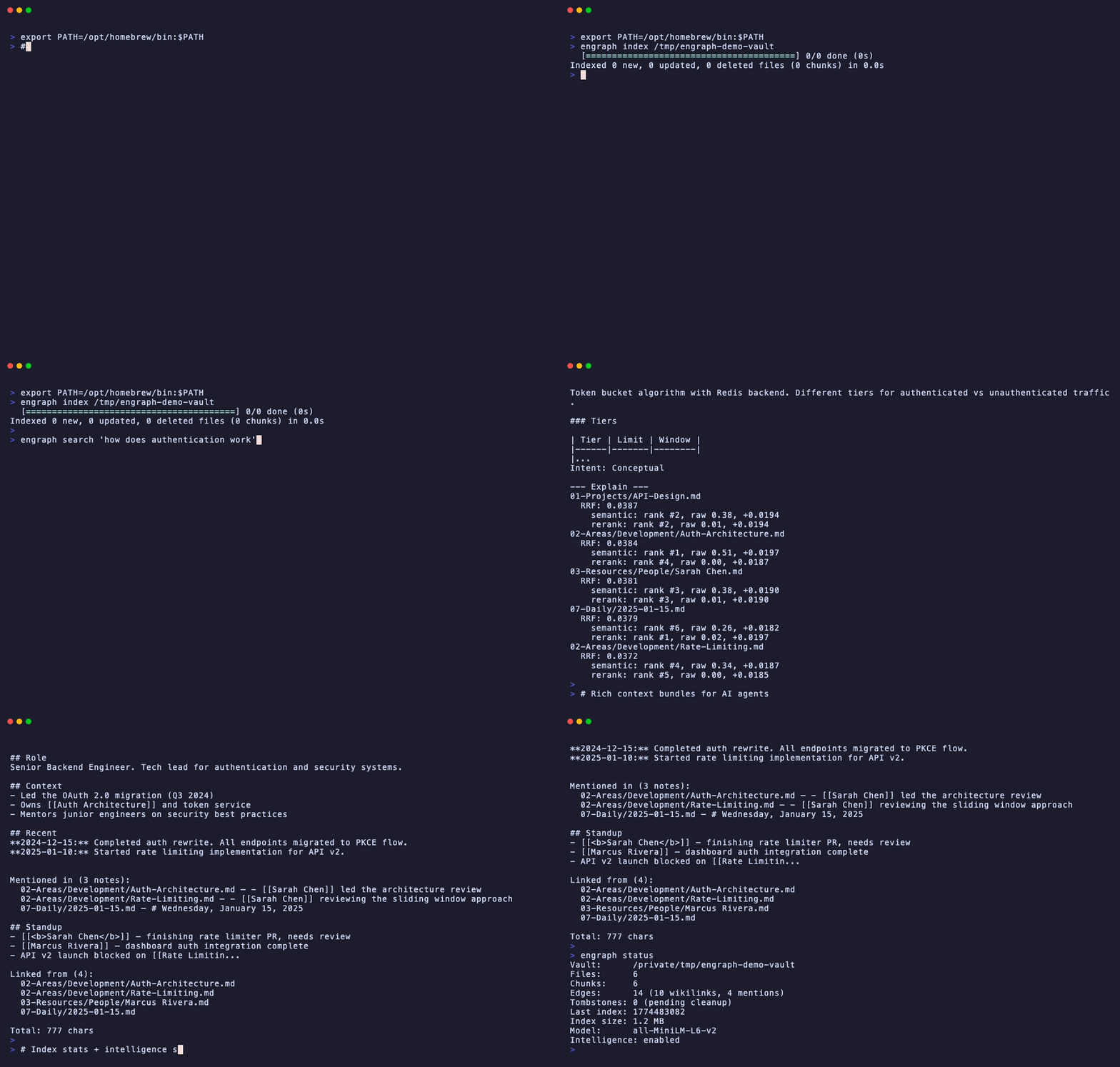
engraph search "how does the auth system work"
 1. [97%] 02-Areas/Development/Auth-Architecture.md > # Auth Architecture  #6e1b70
    OAuth 2.0 with PKCE for all client types. Session tokens stored in HTTP-only cookies...

 2. [95%] 01-Projects/API-Design.md > # API Design  #e3e350
    All endpoints require Bearer token authentication. Tokens are issued by the OAuth 2.0...

 3. [91%] 03-Resources/People/Sarah-Chen.md > # Sarah Chen  #4adb39
    Senior Backend Engineer. Tech lead for authentication and security systems...
Note how result #3 was found via graph expansion — Sarah's note doesn't mention "auth system" directly, but she's linked from the auth architecture doc via [[Sarah Chen]].
Connect to Claude Code:
# Start the MCP server
engraph serve

# Or add to Claude Code's settings (~/.claude/settings.json):
{
  "mcpServers": {
    "engraph": {
      "command": "engraph",
      "args": ["serve"]
    }
  }
}
Now Claude can search your vault, read notes, build context bundles, and create new notes — all through structured tool calls.
Enable HTTP REST API:
# Start MCP + HTTP server on port 3030
engraph serve --http

# Custom port and host
engraph serve --http --port 8080 --host 0.0.0.0

# Local development without API keys (127.0.0.1 only)
engraph serve --http --no-auth
API key management:
# Add a new API key (read or write permission)
engraph configure --add-api-key

# List existing keys
engraph configure --list-api-keys

# Revoke a key
engraph configure --revoke-api-key eg_abc123...
Enable intelligence (optional, ~1.3GB download):
engraph configure --enable-intelligence
# Downloads Qwen3-0.6B (orchestrator) + Qwen3-Reranker (cross-encoder)
# Adds LLM query expansion + 4th reranker lane to search
Example usage
4-lane search with intent classification:
engraph search "how does authentication work" --explain
 1. [97%] 01-Projects/API-Design.md > # API Design  #e3e350
    All endpoints require Bearer token authentication...

Intent: Conceptual

--- Explain ---
01-Projects/API-Design.md
  RRF: 0.0387
    semantic: rank #2, raw 0.38, +0.0194
    rerank: rank #2, raw 0.01, +0.0194
02-Areas/Development/Auth-Architecture.md
  RRF: 0.0384
    semantic: rank #1, raw 0.51, +0.0197
    rerank: rank #4, raw 0.00, +0.0187
The orchestrator classified the query as Conceptual (boosting semantic lane weight). The reranker scored each result for relevance as the 4th RRF lane.
Rich context for AI agents:
engraph context topic "authentication" --budget 8000
Returns a token-budgeted context bundle: relevant notes, connected people, related projects — ready to paste into a prompt or serve via MCP.
Person context:
engraph context who "Sarah Chen"
Returns Sarah's note, all mentions across the vault, connected notes via wikilinks, and recent activity.
Vault structure overview:
engraph context vault-map
Returns folder counts, top tags, recent files — gives an AI agent orientation before it starts searching.
Create a note via the write pipeline:
engraph write create --content "# Meeting Notes\n\nDiscussed auth timeline with Sarah." --tags meeting,auth
engraph resolves tags against the registry (fuzzy matching), discovers potential wikilinks ([[Sarah Chen]]), suggests the best folder based on semantic similarity to existing notes, and writes atomically.
Edit a specific section:
engraph write edit --file "Meeting Notes" --heading "Action Items" --mode append --content "- [ ] Follow up with Sarah"
Targets the "Action Items" section by heading, appends content without touching the rest of the note.
Rewrite a note (preserves frontmatter):
engraph write rewrite --file "Meeting Notes" --content "# Meeting Notes\n\nRevised content here."
Replaces the entire body while keeping existing frontmatter (tags, dates, metadata) intact.
Edit frontmatter:
engraph write edit-frontmatter --file "Meeting Notes" --op add_tag --value "actionable"
Granular frontmatter mutations: set, remove, add_tag, remove_tag, add_alias, remove_alias.
Delete a note:
engraph write delete --file "Old Draft" --mode soft   # moves to archive
engraph write delete --file "Old Draft" --mode hard   # permanent removal
Check vault health:
engraph context health
Returns orphan notes (no links in or out), broken wikilinks, stale notes, and tag hygiene issues.
HTTP REST API
engraph serve --http adds a full REST API alongside the MCP server, exposing the same capabilities over HTTP for web agents, scripts, and integrations.
23 endpoints:
| Method | Endpoint | Permission | Description |
|---|---|---|---|
| GET | /api/health-check |
read | Server health check |
| POST | /api/search |
read | Hybrid search (semantic + FTS5 + graph + reranker + temporal) |
| GET | /api/read/{file} |
read | Read full note content + metadata |
| GET | /api/read-section |
read | Read a specific section by heading |
| GET | /api/list |
read | List notes with optional tag/folder/created_by filters |
| GET | /api/vault-map |
read | Vault structure overview (folders, tags, recent files) |
| GET | /api/who/{name} |
read | Person context bundle |
| GET | /api/project/{name} |
read | Project context bundle |
| POST | /api/context |
read | Rich topic context with token budget |
| GET | /api/health |
read | Vault health diagnostics |
| POST | /api/create |
write | Create a new note |
| POST | /api/append |
write | Append content to existing note |
| POST | /api/edit |
write | Section-level editing (replace/prepend/append) |
| POST | /api/rewrite |
write | Full note rewrite (preserves frontmatter) |
| POST | /api/edit-frontmatter |
write | Granular frontmatter mutations |
| POST | /api/move |
write | Move note to different folder |
| POST | /api/archive |
write | Soft-delete (archive) a note |
| POST | /api/unarchive |
write | Restore archived note |
| POST | /api/update-metadata |
write | Update note metadata |
| POST | /api/delete |
write | Delete note (soft or hard) |
| POST | /api/migrate/preview |
write | Preview PARA migration (classify + suggest moves) |
| POST | /api/migrate/apply |
write | Apply PARA migration (move files) |
| POST | /api/migrate/undo |
write | Undo last PARA migration |
Authentication:
All requests require an API key via the Authorization header:
curl -H "Authorization: Bearer eg_abc123..." http://localhost:3030/api/vault-map
Keys have either read or write permission. Write keys can access all endpoints; read keys are restricted to read-only endpoints. Use --no-auth for local development without keys (127.0.0.1 only).
curl examples:
# Search
curl -X POST http://localhost:3030/api/search \
  -H "Authorization: Bearer eg_..." \
  -H "Content-Type: application/json" \
  -d '{"query": "authentication architecture", "top_n": 5}'

# Read a note
curl http://localhost:3030/api/read/01-Projects/API-Design.md \
  -H "Authorization: Bearer eg_..."

# Create a note
curl -X POST http://localhost:3030/api/create \
  -H "Authorization: Bearer eg_..." \
  -H "Content-Type: application/json" \
  -d '{"content": "# Meeting Notes\n\nDiscussed auth timeline.", "tags": ["meeting", "auth"]}'
Rate limiting: Configurable per-key token bucket (requests per minute). Defaults to 60 req/min. Returns 429 Too Many Requests when exceeded.
CORS: Configurable allowed origins in config.toml under [http]. Defaults to allow all origins for local development.
[http]
port = 3030
host = "127.0.0.1"
cors_origins = ["http://localhost:3000", "https://myapp.example.com"]
rate_limit = 60

[[http.api_keys]]
key = "eg_..."
permission = "write"
PARA Migration
engraph migrate para restructures your vault into the PARA method (Projects, Areas, Resources, Archive) using heuristic classification. The workflow is non-destructive: preview first, review the plan, then apply.
Workflow:
# 1. Preview — classify notes and generate a migration plan
engraph migrate para --preview
# Outputs: markdown summary + JSON plan saved to ~/.engraph/

# 2. Review the plan (edit if needed)
cat ~/.engraph/migration_preview.md

# 3. Apply — move files according to the plan
engraph migrate para --apply

# 4. Undo — reverse the last migration if something looks wrong
engraph migrate para --undo
Classification signals:
| Category | Detection signals |
|---|---|
| Projects | Open tasks (- [ ]), active/in-progress status in frontmatter, project tags |
| Areas | Recurring topic keywords (health, finance, career, learning), area-related tags |
| Resources | People notes (People folder, person-like content), reference material, articles, code snippets |
| Archive | Done/completed/inactive status, no incoming or outgoing wikilinks, stale content |
Notes that don't match any signal with sufficient confidence stay in place. Daily notes (YYYY-MM-DD.md) and templates are always skipped.
MCP tools: migrate_preview, migrate_apply, migrate_undo — available in engraph serve for AI-assisted migration.
HTTP endpoints: POST /api/migrate/preview, /api/migrate/apply, /api/migrate/undo — available via engraph serve --http.
ChatGPT Actions
Connect your Obsidian vault to ChatGPT as a custom GPT Action. ChatGPT can search, read, create, and edit your notes through engraph's REST API.
Prerequisites
- engraph installed and indexed (
engraph index ~/your-vault) - A tunnel tool: Cloudflare Tunnel (recommended) or ngrok
Step 1: Configure engraph
# Interactive setup — enables HTTP, creates API key, sets CORS
engraph configure --setup-chatgpt
Or configure manually in ~/.engraph/config.toml:
[http]
enabled = true
port = 3000
host = "127.0.0.1"
rate_limit = 60
cors_origins = ["https://chat.openai.com", "https://chatgpt.com"]

[[http.api_keys]]
key = "eg_your_key_here"    # generate with: engraph configure --add-api-key --key-name chatgpt --key-permissions write
name = "chatgpt"
permissions = "write"        # "read" for search-only, "write" to also create/edit notes

[http.plugin]
name = "My Vault"
description = "Search and manage my Obsidian vault"
public_url = "https://your-tunnel-url.trycloudflare.com"   # set after starting tunnel
Step 2: Start engraph + tunnel
Terminal 1 — engraph HTTP server:
engraph serve --http
Terminal 2 — Cloudflare tunnel:
cloudflared tunnel --url http://localhost:3000
# Prints a URL like: https://abc-xyz.trycloudflare.com
Or with ngrok:
ngrok http 3000
# Prints a URL like: https://abc123.ngrok-free.app
Step 3: Update config with tunnel URL
Edit ~/.engraph/config.toml and set public_url to your tunnel URL:
[http.plugin]
public_url = "https://abc-xyz.trycloudflare.com"
Then restart engraph (Ctrl+C and re-run engraph serve --http). This ensures the OpenAPI spec points to the correct public URL.
Step 4: Verify endpoints
# Both should return JSON (no auth required)
curl https://your-tunnel-url/openapi.json
curl https://your-tunnel-url/.well-known/ai-plugin.json

# Search with auth
curl -X POST -H "Authorization: Bearer eg_your_key" \
  -H "Content-Type: application/json" \
  -d '{"query": "test search"}' \
  https://your-tunnel-url/api/search
Step 5: Register in ChatGPT
- Go to ChatGPT → Explore GPTs → Create
- Give your GPT a name (e.g., "Vault Assistant")
- Add these Instructions:
You are a knowledge assistant connected to the user's Obsidian vault via engraph.

WORKFLOW:
1. Use searchVault to find relevant notes before answering questions
2. Use readNote for full content, readSection for specific headings
3. Use getWho for people context, getProject for project context
4. Use getVaultMap to orient yourself in the vault structure
5. Only create or edit notes when explicitly asked

SEARCH TIPS:
- Temporal queries ("last week", "yesterday") activate time-aware search automatically
- Results include confidence % — prefer higher confidence matches
- Fuzzy matching works: typos in names are handled

STYLE:
- Reference vault notes by name when answering
- Quote relevant snippets
- If information isn't in the vault, say so clearly
- Be concise
- Click Add Action → Import from URL
- Enter:
https://your-tunnel-url/openapi.json - Click the gear icon next to Authentication
- Select API Key, Auth Type: Bearer
- Paste your API key (the
eg_...key from Step 1) - Save and test
Conversation starters
- "What happened in my vault last week?"
- "Summarize my current work projects"
- "Find notes related to [topic]"
- "Create a note about today's meeting with [person]"
Notes
- Tunnel URLs are temporary (Cloudflare quick tunnels change on restart). For persistent URLs, set up a named Cloudflare tunnel or use ngrok with a reserved domain.
- Read-only mode: set
permissions = "read"on the API key if you don't want ChatGPT to create or modify notes. - Rate limiting: default is 60 requests/minute per key. Adjust
rate_limitin config if needed. - engraph must be running on your machine for ChatGPT to access it. If you close the terminal, the connection drops.
Use cases
AI-assisted knowledge work — Give Claude or Cursor deep access to your personal knowledge base. Instead of copy-pasting context, the agent searches, reads, and cross-references your notes directly.
Developer second brain — Index architecture docs, decision records, meeting notes, and code snippets. Search by concept across all of them.
Research and writing — Find connections between notes that you didn't explicitly link. The graph lane surfaces related content through shared wikilinks and mentions.
Team knowledge graphs — Index a shared docs vault. AI agents can answer "who knows about X?" and "what decisions were made about Y?" by traversing the note graph.
How it compares
| engraph | Basic RAG (vector-only) | Obsidian search | |
|---|---|---|---|
| Search method | 5-lane RRF (semantic + BM25 + graph + reranker + temporal) | Vector similarity only | Keyword only |
| Query understanding | LLM orchestrator classifies intent, adapts weights | None | None |
| Understands note links | Yes (wikilink graph traversal) | No | Limited (backlinks panel) |
| AI agent access | MCP server (22 tools) + HTTP REST API (23 endpoints) | Custom API needed | No |
| Write capability | Create/edit/rewrite/delete with smart filing | No | Manual |
| Vault health | Orphans, broken links, stale notes, tag hygiene | No | Limited |
| Real-time sync | File watcher, 2s debounce | Manual re-index | N/A |
| Runs locally | Yes, llama.cpp + Metal GPU | Depends | Yes |
| Setup | One binary, one command | Framework + code | Built-in |
engraph is not a replacement for Obsidian — it's the intelligence layer that sits between your vault and your AI tools.
Current capabilities
- 5-lane hybrid search (semantic + FTS5 + graph + cross-encoder reranker + temporal) with two-pass RRF fusion
- Temporal search: natural language date queries ("last week", "March 2026", "recent"), date extraction from frontmatter and filenames, smooth decay scoring
- Confidence % display: search results show normalized 0-100% confidence instead of raw RRF scores
- LLM research orchestrator: query intent classification + query expansion + adaptive lane weights
- llama.cpp inference via Rust bindings (GGUF models, Metal GPU on macOS, CUDA on Linux)
- Intelligence opt-in: heuristic fallback when disabled, LLM-powered when enabled
- MCP server with 22 tools (8 read, 10 write, 1 diagnostic, 3 migrate) via stdio
- HTTP REST API with 23 endpoints, API key auth (
eg_prefix), rate limiting, CORS — enabled viaengraph serve --http - Section-level reading and editing: target specific headings with replace/prepend/append modes
- Full note rewriting with automatic frontmatter preservation
- Granular frontmatter mutations: set/remove fields, add/remove tags and aliases
- Soft delete (archive) and hard delete (permanent) with audit logging
- Vault health diagnostics: orphan notes, broken wikilinks, stale content, tag hygiene
- Obsidian CLI integration with circuit breaker (Closed/Degraded/Open) for resilient delegation
- Real-time file watching with 2s debounce, startup reconciliation, and watcher coordination to prevent double re-indexing
- Write pipeline: tag resolution, fuzzy link discovery, semantic folder placement
- Context engine: topic bundles, person bundles, project bundles with token budgets
- Vault graph: bidirectional wikilink + mention edges with multi-hop expansion
- Placement correction learning from user file moves
- Enhanced file resolution with fuzzy Levenshtein matching fallback
- Content-based folder role detection (people, daily, archive) by content patterns
- PARA migration: AI-assisted vault restructuring into Projects/Areas/Resources/Archive with preview, apply, and undo workflow
- Configurable model overrides for multilingual support
- 426 unit tests, CI on macOS + Ubuntu
Roadmap
- Research orchestrator — query classification and adaptive lane weighting (v1.0)
- LLM reranker — optional local model for result quality (v1.0)
- MCP edit/rewrite tools — full note editing for AI agents (v1.1)
- Vault health monitor — orphan notes, broken links, stale content, tag hygiene (v1.1)
- Obsidian CLI integration — auto-detect and delegate with circuit breaker (v1.1)
- Temporal search — find notes by time period, date-aware queries (v1.2)
- HTTP/REST API — complement MCP with a standard web API (v1.3)
- PARA migration — AI-assisted vault restructuring with preview/apply/undo (v1.4)
- ChatGPT Actions — OpenAPI 3.1.0 spec + plugin manifest +
--setup-chatgpthelper (v1.5) - Multi-vault — search across multiple vaults (v1.6)
Configuration
Optional config at ~/.engraph/config.toml:
vault_path = "~/Documents/MyVault"
top_n = 10
exclude = [".obsidian/", "node_modules/", ".git/"]

# Enable LLM-powered intelligence (query expansion + reranking)
intelligence = true

# Override models for multilingual or custom use
[models]
# embed = "hf:Qwen/Qwen3-Embedding-0.6B-GGUF/qwen3-embedding-0.6b-q8_0.gguf"
# rerank = "hf:ggml-org/Qwen3-Reranker-0.6B-Q8_0-GGUF/qwen3-reranker-0.6b-q8_0.gguf"

# Obsidian CLI integration (auto-detected during init)
[obsidian]
# enabled = true
# cli_path = "/usr/local/bin/obsidian"

# Registered AI agents
[agents]
# names = ["claude-code", "cursor"]
All data stored in ~/.engraph/ — single SQLite database (~10MB typical), GGUF models, and vault profile.
Development
cargo test --lib          # 426 unit tests, no network (requires CMake for llama.cpp)
cargo clippy -- -D warnings
cargo fmt --check

# Integration tests (downloads GGUF model)
cargo test --test integration -- --ignored
Contributing
Contributions welcome. Please open an issue first to discuss what you'd like to change.
The codebase is 26 Rust modules behind a lib crate. CLAUDE.md in the repo root has detailed architecture documentation for AI-assisted development.
License
MIT
Yorumlar (0)
Yorum birakmak icin giris yap.
Yorum birakSonuc bulunamadi