power_failure_resumer
Health Warn
- License — License: MIT
- Description — Repository has a description
- Active repo — Last push 0 days ago
- Low visibility — Only 6 GitHub stars
Code Fail
- rm -rf — Recursive force deletion command in install.sh
Permissions Pass
- Permissions — No dangerous permissions requested
No AI report is available for this listing yet.
Resume your Codex/Claude Code Ghostty sessions after a power failure — crash-cluster detection, confidence-scored plans, verified reopens
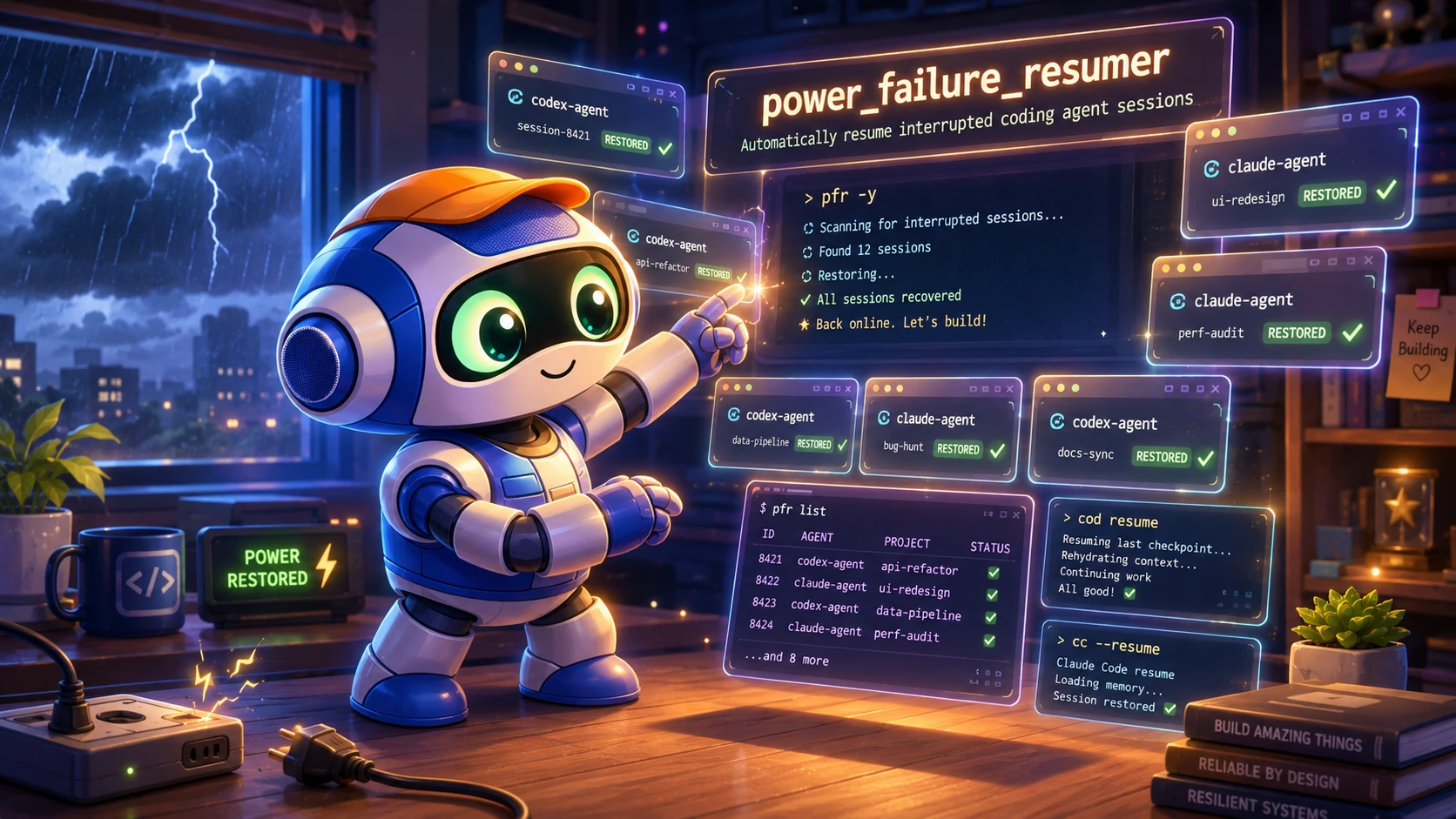
power_failure_resumer
When a power failure kills your terminal mid-swarm, get every Codex and Claude Code session back in one command.



curl -fsSL "https://raw.githubusercontent.com/Dicklesworthstone/power_failure_resumer/main/install.sh?$(date +%s)" | bash
TL;DR
The Problem
You run a fleet of local coding agents (Codex CLI and Claude Code) in Ghostty tabs. A power cut or hard reboot kills the terminal and every session in it. The transcripts survive on disk, but reconstructing which twenty sessions were live at the moment of death, in which project directories, with which resume ids, is slow manual work at exactly the wrong time.
The Solution
A power cut leaves a forensic signature: every process that was mid-write stops touching its session file at nearly the same wall-clock moment, just before the next boot time. pfr scans Codex and Claude Code session files, finds that simultaneous-death cluster, scores how likely it is to be a real crash, and reopens each victim in its own Ghostty tab. Every tab launches its resume command (cod resume <id> -m <recorded-model>) directly in an interactive login shell, so your aliases apply and each session comes back on the model it was actually using.
Why use pfr?
| Feature | What you get |
|---|---|
| Crash-cluster detection | Pre-boot mtime clustering with densest-pocket isolation; idle sessions from earlier stay out |
| Confidence scoring | high / medium / low with printed reasons; a busy afternoon's file activity never scores high |
| Already-running skip | Sessions you resumed by hand are found in ps and not opened twice |
| Plans | Discovery writes last-plan.json; inspect once, open later, repeatably |
| Post-open verification | Polls ps for resume evidence, writes last-report.json, exits non-zero on silent failures |
| Tab order | Live status-log tab, agent-mail tab, hub projects, then the rest |
| Titles + previews | Each session shows its title and first user message, so you know what you're resuming |
| Model-matched resume | Each session resumes with its recorded model and reasoning effort (-m / --model pinned), so Codex never warns about a model mismatch |
| ntm-aware | Sessions spawned by ntm tmux swarms are excluded by default, attributed via ntm's send history, swarm manifests, checkpoint session bindings, and a narrow addressed-as-a-pane phrasing check; --include-ntm overrides |
| Fast bulk open | All tabs open in one scripting call, each running its resume command directly; no typing, no per-tab settle |
| Doctor | pfr --doctor catches missing permissions and dependencies before they waste a recovery |
| Offline tests | 16 suites against generated fixtures, including an install-then-run e2e through the real installer and launcher; no Ghostty, network, or live agents needed |
Quick example
$ pfr --dry-run
› boot time:     2026-08-03 16:22:58
› cluster mode:  pre_boot
› anchor mtime:  2026-08-03 16:22:49
› matched:       4 session(s)  (from 20 recent candidates)
› confidence:    high  (mode=pre_boot, cluster_size=4, anchor_gap_to_boot=9.0s, pre_boot_tight_pocket)
› skipped:       19 ntm-spawned session(s)  (--include-ntm to include)

──── sessions to resume ────
 1. codex   16:22:49     ~/projects/frankenterm
      cod resume 019fa4a7-3665-7aa3-8633-2a47c42c1d78 -m gpt-5.6-sol -c model_reasoning_effort=ultra
      » First read ALL of the AGENTS.md file and README.md file super carefully…
 2. claude  16:22:49     ~/projects/frankensim
      cc --resume ba9de0d5-51bb-40f8-9029-8ea3bcfc3481 --model claude-fable-5
      (Review project for bugs and improvements)
      » study this project and look for bugs…
 ...
› plan saved: ~/.local/state/pfr/last-plan.json  (confidence=high, 4 sessions)
› next: pfr --last-plan -y   or   pfr --last-plan --pick

$ pfr --last-plan -y     # open the whole batch, verify against ps, write the report
Design philosophy
- mtime is the death signal. Content timestamps say what a session talked about; file mtime says when its process stopped writing. Clustering runs on mtime alone.
- Discover once, open later. Rediscovery drifts: sessions age, some get resumed by hand, new work starts. Plans freeze the decision so opening is repeatable.
- Cluster first, filter second. Already-running sessions are dropped after the crash pocket is chosen, so filtering cannot shift the cluster onto an unrelated burst of activity.
- Never claim success without evidence. Every open is checked against
ps; a tab that silently shows a bare shell is a reported failure. - Your shell, your aliases. Resume commands run in a real interactive login shell, and each one pins the model and reasoning effort recorded in the session's own transcript, so a session recorded on one model never silently resumes on another.
- Swarm sessions belong to the swarm manager. Panes spawned by ntm die and recover as a swarm; pfr leaves them out unless told otherwise, so a twenty-tab recovery does not bury your four hand-typed sessions under sixteen orphaned panes.
How it compares
| pfr | Ghostty window restore | tmux-resurrect | Manual ls -lt archaeology |
|
|---|---|---|---|---|
| Restores the agent conversation | yes (cod resume / cc --resume) |
no (empty shells) | no (empty panes) | eventually |
| Knows which sessions died in the crash | yes (pre-boot clustering) | no | no | you, by hand |
| Skips ones already brought back | yes (via ps) |
no | no | your memory |
| Judges whether it was a real crash | yes (scored, with reasons) | no | no | no |
| Survives a hard power cut | yes | partial | only if saved beforehand | yes |
Install
One-liner:
curl -fsSL "https://raw.githubusercontent.com/Dicklesworthstone/power_failure_resumer/main/install.sh?$(date +%s)" | bash
Installs to ~/.local/share/pfr and symlinks pfr into ~/.local/bin. Flags (after bash -s --):
| Flag | Purpose |
|---|---|
--easy-mode |
Add ~/.local/bin to PATH in shell rc files |
--prefix DIR |
Install root (default ~/.local/share/pfr) |
--bin-dir DIR |
Symlink dir for pfr (default ~/.local/bin) |
--ref REF |
Git ref/branch/tag/commit (default main; pin a SHA for reproducibility) |
--offline TARBALL |
Install from a local tarball |
--force |
Reinstall even if unchanged |
--verify |
Run pfr --doctor after install |
--install-skill |
Install the bundled pfr agent skill without prompting |
--no-install-skill |
Never install or ask about the agent skill |
--quiet / --no-gum |
Quieter or plain ANSI output |
The installer treats itself as a security boundary. Archives are validated before extraction (single top-level directory; no traversal, links, devices, or oversized members; macOS AppleDouble litter tolerated). It refuses to replace an install root or pfr launcher it does not own, stages the complete new tree before activating it, and keeps the previous tree until the launcher update succeeds so a failed upgrade rolls back. An unchanged tree short-circuits with "already up to date" (bytecode caches are ignored when comparing) while still repairing a missing launcher.
From a checkout:
git clone https://github.com/Dicklesworthstone/power_failure_resumer
cd power_failure_resumer
ln -sf "$PWD/power_failure_resumer.sh" ~/.local/bin/pfr
Requirements: bash 3.2+ and python3. macOS: osascript and Ghostty (Automation permission; Accessibility only if the keystroke fallback fires). Linux: the ghostty CLI. gum and fzf are optional.
Quick start
pfr --dry-run          # after a blackout: inspect first
pfr -y                 # open the crash cluster
pfr --pick             # choose a subset (fzf if installed)
pfr --last-plan -y     # open the saved plan later
pfr --doctor           # health check
Each run discovers session files (honoring $CODEX_HOME / $CLAUDE_HOME), clusters the simultaneous-death pocket and scores its confidence, skips sessions already live in ps, saves the plan, opens tabs in order, then verifies every resume against ps and writes a report.
blackout → boot → pfr --dry-run   → review list + confidence
                → pfr -y           → open + verify + report
                → pfr --last-plan  → same set later, no rediscover
From a checkout without installing: ./power_failure_resumer.sh … and ./scripts/run_tests.sh.
Post-boot notification
pfr --notify is a quiet, discovery-only post-boot check. It saves a freshlast-plan.json and sends a desktop notification only for a high confidence
cluster, or a medium confidence cluster with at least three resumeable
sessions. The notification suggests pfr --last-plan --pick; it never opens
Ghostty, even if launch flags such as -y are also present. macOS usesosascript; Linux uses notify-send when available. Seedocs/autoboot.md for a RunAtLoad LaunchAgent example.
Command reference
Discovery
| Flag | Purpose |
|---|---|
--window SECS |
Simultaneous-death window (default 180) |
--lookback-hours H |
Only sessions modified in last H hours (default 48) |
--pre-boot-lookback S |
Seconds before boot to search (default 900) |
--mode auto|pre_boot|density|recent |
Clustering strategy |
--providers LIST |
codex, claude, or both |
--projects-only |
Restrict to ~/projects/... |
--include-subagents |
Keep Codex subagent threads |
--include-ntm |
Keep sessions spawned by ntm tmux swarms (excluded by default, since ntm owns their recovery) |
--ntm-history PATH |
ntm send-history JSONL used for attribution (default ~/.local/share/ntm/history.jsonl) |
--ntm-data DIR |
ntm data dir holding manifests/ and checkpoints/ used for attribution (default ~/.local/share/ntm) |
--force-reopen |
Include sessions that already look live |
--limit N |
Cap listed/opened sessions (confidence still uses the full pocket) |
--json |
Machine-readable discovery output |
Plans
| Flag | Purpose |
|---|---|
| (default) | Write <state-dir>/last-plan.json after discovery |
--last-plan |
Load that plan; skip rediscovery |
--plan PATH |
Load a specific plan file |
--save-plan PATH |
Also write a copy to PATH |
--no-save-plan |
Do not write last-plan.json (with --save-plan PATH, only the explicit copy is written) |
--force-stale-plan |
Allow a plan from a different boot, older than 24h, or timestamped in the future |
Launch
| Flag | Purpose |
|---|---|
--dry-run / -n |
List only |
-y / --yes |
Open all matches |
--pick |
Multi-select (fzf when present, numeric prompt otherwise) |
--tabs / --windows |
Surface mode |
--driver ui|api|ghostty |
macOS default ui; Linux default ghostty |
--ui / --api |
Driver shortcuts |
--delay SECS |
Pause between surface creations (default 0.1 on macOS, 0.35 on Linux) |
--settle SECS |
Wait for the shell after a keystroke-fallback surface opens (native launches need none) |
--max N |
Safety cap on opens (default 40) |
Health & isolation
| Flag | Purpose |
|---|---|
--doctor (+ --json) |
Environment checks; exit 0 when healthy |
--codex-root PATH / --claude-root PATH |
Alternate session roots |
--fake-boot EPOCH |
Pretend boot time (or PFR_FAKE_BOOT) |
--ps-file PATH |
Canned process table instead of live ps |
--state-dir PATH |
Plans, reports, run logs (default ~/.local/state/pfr) |
Environment
| Variable | Purpose |
|---|---|
PFR_WINDOW, PFR_LOOKBACK_HOURS, PFR_PRE_BOOT_LOOKBACK, PFR_PROVIDERS |
Discovery defaults |
PFR_OPEN_MODE, PFR_DRIVER, PFR_DELAY, PFR_SETTLE, PFR_MAX_OPEN |
Launch defaults |
CODEX_HOME, CLAUDE_HOME |
Relocated agent state dirs |
PFR_NTM_HISTORY, PFR_NTM_DATA |
ntm records used for ntm-session attribution |
PFR_STATE_DIR / XDG_STATE_HOME |
Plan/report/run-log location |
PFR_CODEX_ROOT, PFR_CLAUDE_ROOT, PFR_PS_FILE, PFR_FAKE_BOOT |
Same as isolation flags |
PFR_VERIFY=0 / PFR_VERIFY_TIMEOUT |
Skip / tune verification (default 15s) |
PFR_STATUS_TAB=0 |
No live run-log tab |
PFR_AM=0 / PFR_AM_BIN |
Skip / override the agent-mail tab |
PFR_KEEP_TEMPS=1 |
Keep temp files (debug) |
PFR_DOCTOR_SIM_MISSING |
Doctor checks to force-fail (tests) |
No config file; flags and environment only.
Architecture
                 ┌──────────────────────────────────────────────────┐
                 │              power_failure_resumer.sh            │
                 │        (CLI, prompts, tab order, drivers)        │
                 └───┬──────────┬──────────┬──────────┬─────────────┘
                     │          │          │          │
             discover.py    plan.py   confidence.py  verify.py
             scan+cluster  save/load   score plan    poll ps,
             mark running  staleness   high/med/low  last-report
                     │          │
   $CODEX_HOME/sessions/**   ~/.local/state/pfr/{last-plan.json,
   $CLAUDE_HOME/projects/**   plans/, last-report.json, run-*.log}
                     │
        ┌────────────┴───────────────┐
        │ macOS: open_sessions_ui /  │   Linux: ghostty CLI,
        │ open_sessions .applescript │   one window per session
        └────────────────────────────┘
How clustering works
On a hard power cut, processes that were mid-write stop updating files at about the same wall-clock time. After reboot, many session files share mtimes within a few seconds of each other, just before the kernel's recorded boot time.
lib/discover.py:
- Collect top-level sessions modified in the last
--lookback-hours. - Drop Codex subagent threads unless
--include-subagents. - Drop ntm-spawned sessions unless
--include-ntm, using ntm's own records: send-history prompts (matched against each session's first and last user message), swarm manifest pane specs (project dir, agent type, spawn model), checkpoint session-id bindings, and a narrow addressed-as-a-pane phrasing check for swarms that left no record at all. - Dedupe by
(provider, session_id), keeping the newest file. - Mark live resumes from
ps: a realcod/codex/cc/claudeinvocation withresume/--resumefollowed by exactly one UUID. Cluster first, then drop live ones so the crash pocket does not shift. - auto mode: take sessions in
[boot − lookback, boot + slack], then the densest--windowpocket inside that set; a session idle ten minutes before the crash falls out. If the pre-boot set is empty, fall back to a global densest window.
Confidence is scored on the full pocket (including already-running members) before any --limit truncation. Only a tight pre-boot pocket of three or more sessions scores high; density-only mode never does. The rubric lives in lib/confidence.py and is locked by tests.
Titles and previews: Claude sessions prefer custom-title, then ai-title, then summary, then the first real user message; Codex sessions use nickname + project plus the first real user message. Format notes: docs/session-formats.md.
Resume commands
The same commands you would type yourself:
cod resume 019fa4a7-3665-7aa3-8633-2a47c42c1d78 -m gpt-5.6-terra -c model_reasoning_effort=high

cc --resume ba9de0d5-51bb-40f8-9029-8ea3bcfc3481 --model claude-fable-5
They run in a real interactive login shell (working directory preset per tab), so cod / cc aliases and their flags apply. The model and reasoning effort recorded in each session's transcript are pinned explicitly, so a session recorded with one model never silently resumes with another.
Ghostty open drivers
ui (macOS default). One osascript invocation opens every tab in the batch. Each session gets a dedicated tab (never the default/restored tab) whose surface runs the resume command directly in an interactive login shell ($SHELL -il -c '<resume>; exec $SHELL -il'). Nothing is typed at a prompt, so submission cannot race shell startup or die in zsh's bracketed paste, and your aliases still apply. When the agent exits the tab drops back to a fresh interactive shell. If native surface creation fails for a session: System Events fallback (⌘T / paste / Return), which needs Accessibility. Automation for Ghostty is required either way.
api (macOS). Same batch command-launch without the keystroke fallback. Automation required.
ghostty (Linux). One ghostty CLI window per session with --working-directory and an interactive shell running the resume command. --tabs becomes --windows: the CLI cannot address an existing window's tabs.
Tab order
- Status tab: tails this run's formatted log (
<state-dir>/run-*.log) so the whole resume is visible as it happens. Disable withPFR_STATUS_TAB=0. - Agent-mail:
am, if installed andPFR_AMis not0. - Hub sessions whose cwd is exactly
~/projects,/data/projects, or/dp. - Remaining sessions, newest first within each group.
Plans and reports
| Path | Contents |
|---|---|
<state-dir>/last-plan.json |
Latest discovery plan (0600; dir 0700; atomic writes) |
<state-dir>/plans/plan-*.json |
Archived plans (newest 20 kept) |
<state-dir>/last-report.json |
Post-open verification summary |
<state-dir>/run-*.log |
Per-run live logs (newest 10 kept) |
Plan load refuses a plan from a different boot, older than 24h, or timestamped more than five minutes in the future unless --force-stale-plan, and rejects any schema_version other than 1. Every session record is structurally validated (provider, exact UUID, absolute cwd, finite mtime) and the resume command is reconstructed from those validated fields; the stored resume_cmd text is never executed.
Doctor
pfr --doctor checks python3, core libs, writable state dir, session roots, and the platform's Ghostty hooks (Ghostty.app, osascript, and an Automation probe on macOS; the ghostty CLI on Linux). It also confirms the cod and cc commands resolve in a login zsh (the same kind of shell resume commands run in), notes when ntm records are present (so you know ntm-spawned sessions will be excluded), and reports optional extras (fzf, am). Exit 0 when healthy; --json for automation.
Agent skill
The repository bundles an agent skill at skills/pfr/ that teaches Claude Code and Codex the safe recovery loop: doctor first, dry-run and review the cluster, open the frozen plan with --pick, then treat any unverified entry in last-report.json as a failed recovery. Interactive installs ask whether to install it (default: no); --install-skill says yes without asking, --no-install-skill suppresses the question. Opt in any time with --install-skill (copied into ~/.claude/skills/pfr and ~/.codex/skills/pfr for agents that exist on the machine), or install it by hand:
cp -R skills/pfr ~/.claude/skills/pfr
Testing
./scripts/run_tests.sh
Regenerates mtime-bearing fixtures (git cannot store mtimes), then runs tests/test_*.sh, tests/test_*.py, and tests/e2e_*.sh in name order, writing NDJSON events and per-test output under tests/logs/ (last 50 lines dumped on failure). The default run is fully offline against fixture roots, --fake-boot, and canned --ps-file tables: no live Ghostty, no network, no writes to real session dirs.
Suites: smoke, clustering (densest-window ties, pre-boot outliers, dedupe, running-mark regression), titles/previews, ntm attribution + model pinning (all four attribution layers, the habitual-opener regression, and recorded-model resume commands), plan + confidence rubric with a golden fixture, doctor contracts (including a symlinked-launcher regression), tab order, verification, installer (offline archives, upgrade detection, collision refusal), and e2e dry-run / plan-roundtrip / skip-running / installed-CLI (stdin-piped install into an isolated HOME, then doctor, discovery, plan roundtrip, and an upgrade driven through the real pfr launcher symlink on PATH). An opt-in live suite (PFR_LIVE=1) opens a real Ghostty tab and proves the launched command lands in the process table.
Layout
power_failure_resumer/
├── power_failure_resumer.sh        # CLI: prompts, tab order, drivers
├── install.sh                      # curl|bash installer (gum + ANSI)
├── lib/
│   ├── discover.py                 # scan + cluster + running-skip → JSON
│   ├── confidence.py               # high/medium/low rubric + plan build
│   ├── plan.py                     # save/load plans, staleness, validation
│   ├── verify.py                   # post-open ps polling + last-report.json
│   ├── open_sessions_ui.applescript   # macOS ui driver (default)
│   └── open_sessions.applescript      # macOS api driver
├── scripts/run_tests.sh            # NDJSON-logging offline test runner
├── tests/                          # generated fixtures, unit + e2e suites
├── skills/pfr/                     # agent skill (safe recovery loop for Claude Code / Codex)
├── docs/session-formats.md         # Codex/Claude on-disk format notes
├── AGENTS.md
├── CHANGELOG.md
└── README.md
Troubleshooting
| Symptom | Fix |
|---|---|
| Empty cluster | --mode recent --lookback-hours 6 --window 3600, or widen --pre-boot-lookback |
| All sessions already live | Expected if you already resumed them; --force-reopen to reopen anyway |
| Too many sessions | --projects-only, --providers codex, or --pick |
low confidence warning |
The dense pocket may not be a crash; review before opening |
| Keystrokes go nowhere (macOS fallback) | Grant Accessibility; do not type while the fallback is running; larger --settle |
| Tab opens a bare shell | Native launch failed and the fallback pasted nothing; check Automation/Accessibility, then re-run |
Verify failed / not in ps |
The resume likely never executed in that tab; check the tab and re-run for that session |
| Wrong sessions excluded as ntm | --include-ntm, or point --ntm-history at the right file |
cod / cc not found in tab |
Confirm the aliases work in a normal Ghostty tab (.zshrc) |
| AppleScript errors | System Settings → Privacy → Automation: allow your terminal → Ghostty |
| Stale plan refused | Rediscover, or --force-stale-plan |
| Skip status / agent-mail tab | PFR_STATUS_TAB=0 / PFR_AM=0 |
| Skip verification | PFR_VERIFY=0 |
Limitations
- Scope is local Codex CLI + Claude Code. No remote SSH panes, tmux swarms on other machines, Cursor, or VS Code sessions.
- Already-running detection needs
resumein argv. A session originally started withoutresumecarries no UUID in its process args and cannot be skip-detected. Verification has the mirror-image blind spot: it proves the resume command ran, not that the agent is healthy. - Claude's directory encoding is lossy (every non-alphanumeric character becomes
-); pfr prefers thecwdembedded in the JSONL and only trusts a decoded path that exists. - macOS automation needs permissions. First run prompts for Automation (and Accessibility if the fallback fires);
pfr --doctorreports what is missing. - A clean shutdown does not look like a crash, and pfr scores it accordingly rather than guessing.
- ntm attribution is only as good as ntm's records. A swarm driven entirely outside
ntm send, with no manifest and no checkpoint, is caught only by the phrasing check on its prompts; a pane whose prompts never mention pane or swarm vocabulary can slip through. Theskipped:line and per-session previews make stragglers easy to spot before opening.
FAQ
Will it double-open sessions I already resumed by hand?
No. Discovery checks ps for live cod/cc invocations resuming those exact UUIDs and skips them. Override with --force-reopen.
What if I run pfr twice?
Same mechanism: the first run's sessions are now live in ps, so the second run skips them.
Will nightly reboots make pfr invent a crash?
Density pockets far from boot score low, and only a tight pre-boot pocket of three or more sessions scores high. The reasons print either way.
Why is the first tab a log tail?
That is the live run log, so you can watch the resume happen. Agent-mail is the second tab when am is installed. PFR_STATUS_TAB=0 / PFR_AM=0 to disable.
Does it work on Linux?
Yes. Discovery, plans, and verification are identical; opening uses the ghostty CLI, one window per session, since there is no AppleScript.
Where did my ntm swarm sessions go?
They are excluded on purpose: ntm owns swarm recovery, and reopening twenty panes as loose Ghostty tabs would leave you with an orphaned mob. The skipped: N ntm-spawned session(s) line reports the count; --include-ntm brings them back if you really want them.
Will resuming change which model a session uses?
No. Discovery reads the model and reasoning effort recorded in each session's transcript and pins them on the resume command (-m and -c model_reasoning_effort= for Codex, --model for Claude), so a session recorded on one model resumes on that model even when your alias defaults to another.
Why not just re-run cod resume from shell history?
For one session, do that. For a twenty-tab swarm across six projects, the cluster + plan + verify loop is one command instead of half an hour.
Where does my data go?
Nowhere. Everything is local: pfr reads session files and writes plans/reports under ~/.local/state/pfr.
About Contributions
About Contributions: Please don't take this the wrong way, but I do not accept outside contributions for any of my projects. I simply don't have the mental bandwidth to review anything, and it's my name on the thing, so I'm responsible for any problems it causes; thus, the risk-reward is highly asymmetric from my perspective. I'd also have to worry about other "stakeholders," which seems unwise for tools I mostly make for myself for free. Feel free to submit issues, and even PRs if you want to illustrate a proposed fix, but know I won't merge them directly. Instead, I'll have Claude or Codex review submissions via gh and independently decide whether and how to address them. Bug reports in particular are welcome. Sorry if this offends, but I want to avoid wasted time and hurt feelings. I understand this isn't in sync with the prevailing open-source ethos that seeks community contributions, but it's the only way I can move at this velocity and keep my sanity.
License
MIT. See LICENSE.
Reviews (0)
Sign in to leave a review.
Leave a reviewNo results found