ai-bwrap
Health Uyari
- License — License: MIT
- Description — Repository has a description
- Active repo — Last push 0 days ago
- Low visibility — Only 7 GitHub stars
Code Gecti
- Code scan — Scanned 4 files during light audit, no dangerous patterns found
Permissions Gecti
- Permissions — No dangerous permissions requested
Bu listing icin henuz AI raporu yok.
Run AI coding agents (Claude Code, opencode, Grok, ...) inside a bubblewrap sandbox — one wrapper, any agent.
ai-bwrap
Run AI coding agents inside a bubblewrap sandbox — one wrapper, any agent.


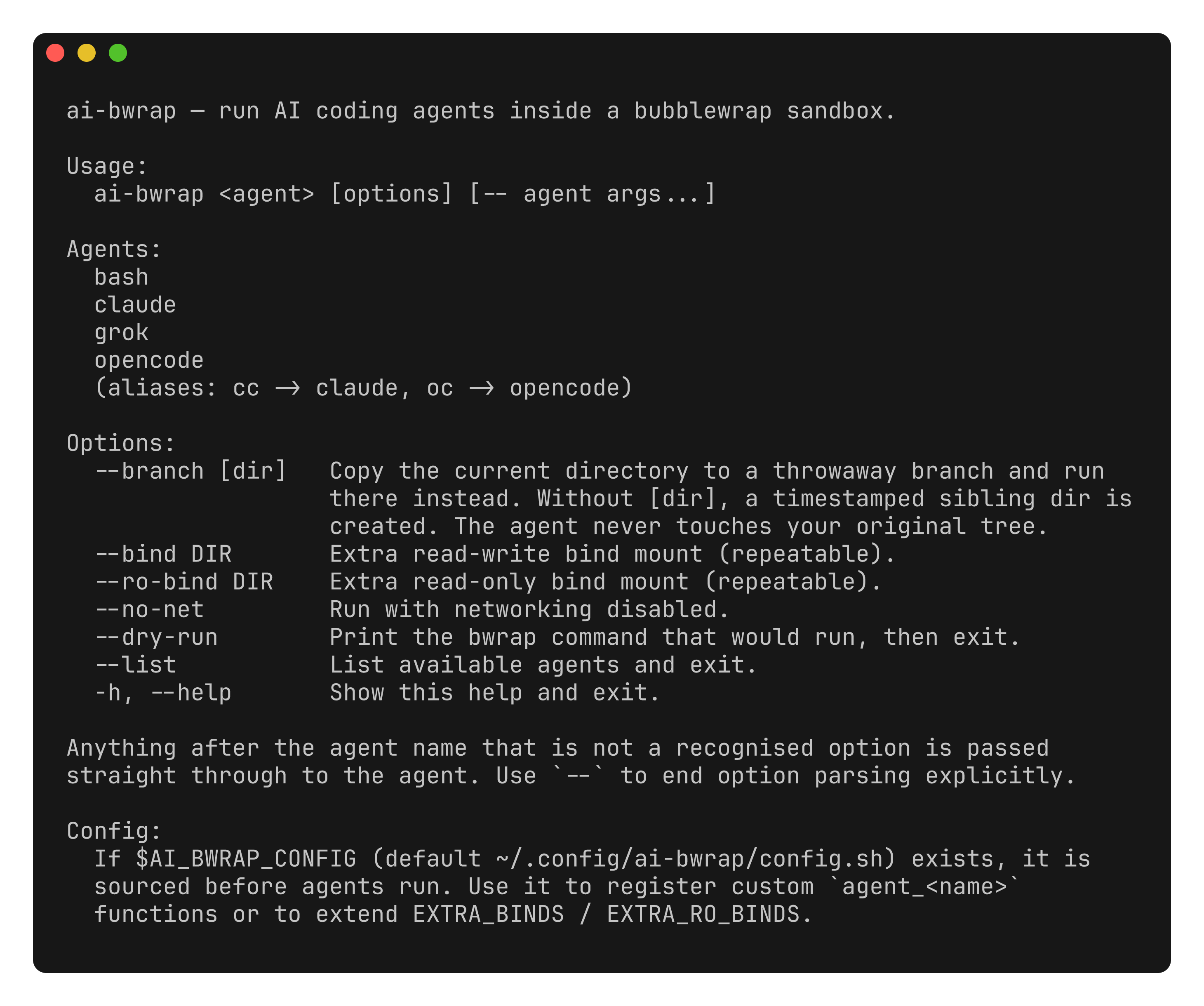
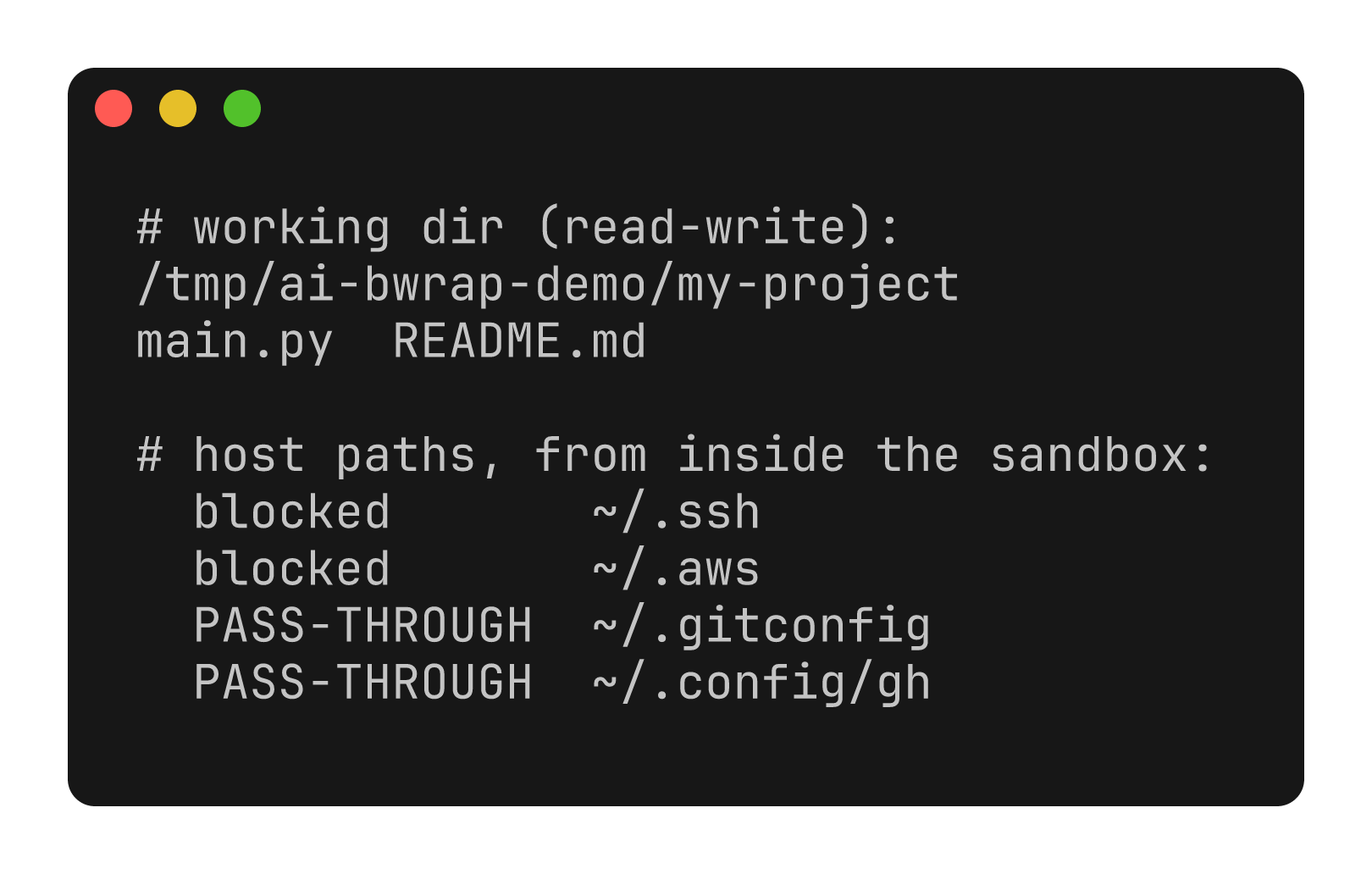
ai-bwrap launches an AI coding agent — Claude Code, opencode, Grok, or a plain shell — inside a bwrap namespace. The agent gets read-write access only to your current working directory; the rest of $HOME stays hidden. Just the config, cache, and state directories an agent actually needs are passed through.
It is the multi-agent sequel to opencode-bwrap: instead of wrapping a single tool, agents are declared as small shell functions, so the registry is extensible without touching the wrapper.
Why
AI coding agents run shell commands, edit files, and fetch from the network on your behalf. Run directly, they can read anything you can — ~/.ssh, ~/.aws, browser profiles, every other project on disk. ai-bwrap confines them to the directory you're actually working in, while still passing through the toolchains and credentials they legitimately need (git, gh, Node/NVM, Cargo, …).
Requirements
- Linux
bwrap(bubblewrap):sudo apt install bubblewrap # Debian/Ubuntu sudo pacman -S bubblewrap # Arch sudo dnf install bubblewrap # Fedora- The agent you want to run (
claude,opencode,grok, …) on your$PATH.
Installation
cp ai-bwrap ~/.local/bin/ai-bwrap
chmod +x ~/.local/bin/ai-bwrap
Usage
ai-bwrap <agent> [options] [-- agent args...]
Built-in agents: claude, opencode, grok, bash (aliases: cc → claude, oc → opencode).
cd /path/to/your/project

ai-bwrap claude                       # Claude Code, confined to this directory
ai-bwrap oc --model anthropic/claude-sonnet-4-5   # opencode, flags passed through
ai-bwrap grok                         # Grok CLI
ai-bwrap bash                         # a shell inside the sandbox, to inspect it
Anything after the agent name that ai-bwrap doesn't recognize is passed straight to the agent. Use -- to end option parsing explicitly.
Options
| Option | Description |
|---|---|
--branch [dir] |
Copy the current directory to a throwaway branch and run there instead. Without [dir], a timestamped sibling directory is created. Your original tree is never touched. |
--bind DIR |
Extra read-write bind mount (repeatable). |
--ro-bind DIR |
Extra read-only bind mount (repeatable). |
--no-net |
Run with networking disabled. |
--dry-run |
Print the bwrap command that would run, then exit. |
--list |
List available agents. |
-h, --help |
Show help. |
What the sandbox blocks
| Resource | Behavior |
|---|---|
Files outside $PWD |
Not visible (no bind) |
~/.ssh, ~/.aws, secrets, other projects |
Not mounted |
$HOME (other than passed-through dirs) |
Empty virtual dir |
Physical block devices (/dev/sda, …) |
Not present |
| Host processes (other PIDs) | Isolated PID namespace |
sudo / privilege escalation |
Blocked — no setuid in the namespace |
What is passed through
Common to every agent (read-only unless noted): $PWD (read-write), ~/.gitconfig, ~/.config/gh, $NVM_DIR, ~/.pyenv, ~/.local/bin, ~/.npm (rw), ~/.cargo (rw), /usr, /etc.
Each agent additionally passes through its own config/cache/state (e.g. ~/.claude, ~/.config/opencode, ~/.grok). See the agent functions in ai-bwrap for the exact list.
Custom agents
An agent is just a function named agent_<name> that declares its binds and the command to run. Define your own in ~/.config/ai-bwrap/config.sh (override with $AI_BWRAP_CONFIG) — no need to edit the wrapper:
# ~/.config/ai-bwrap/config.sh
agent_aider() {
    AGENT_BINDS+=( --bind-try "$HOME/.aider" "$HOME/.aider" )
    EXEC_CMD=("$(require_cmd aider)")
}

# Extend the binds shared by all agents:
EXTRA_RO_BINDS+=( "$HOME/reference-repos" )
The same file can append to EXTRA_BINDS (read-write) and EXTRA_RO_BINDS (read-only). ai-bwrap --list shows custom agents alongside the built-ins.
Security notes
bwrap uses Linux namespaces — the host kernel is shared. This is stronger isolation than running an agent directly, and lighter than a VM. For everyday development it's a practical tradeoff, but be aware:
- The host kernel is shared; a kernel-level exploit could escape the sandbox.
- Anything explicitly bind-mounted is reachable by the agent — keep the passthrough list minimal.
- The
claudeagent runs with--dangerously-skip-permissionson the rationale that the sandbox is the boundary, so in-app prompts are redundant. Override by passing your own flags after--.
See SECURITY.md for the vulnerability reporting process.
Acknowledgements
Builds on opencode-bwrap and the bubblewrap project.
Contributing
Contributions welcome — see CONTRIBUTING.md and the Code of Conduct.
License
ai-bwrap is the multi-agent successor to opencode-bwrap, the original single-tool sandbox wrapper.
Related projects
- git-dup — Snapshot a git subdirectory (committed state + untracked files) into a timestamped sibling directory
- claude-chrome-multi-instance-warn — Claude Code plugin: warns once per session when a tool payload is about to launch another browser (Chrome/Playwright/Puppeteer/CDP) or fan work…
- claude-email-leak-notice — Claude Code plugin: warns once per session when a personal email address appears in a tool payload, so it does not end up in a commit or a pushed…
- didvc — a little bit about me/vulpes.
Yorumlar (0)
Yorum birakmak icin giris yap.
Yorum birakSonuc bulunamadi