clawdbot
Health Uyari
- License — License: MIT
- Description — Repository has a description
- Active repo — Last push 0 days ago
- Low visibility — Only 5 GitHub stars
Code Basarisiz
- rm -rf — Recursive force deletion command in cleanup-task.sh
- rm -rf — Recursive force deletion command in pr-hygiene.sh
Permissions Gecti
- Permissions — No dangerous permissions requested
This agent provides shell-based orchestration for spawning, monitoring, and managing multiple AI coding agents (such as Claude Code and Codex) within isolated git worktrees. It automates workflows like PR reviews, conflict resolution, and CI fail fixes.
Security Assessment
Overall Risk: High. As an orchestration agent, it inherently executes local shell commands to manage git repositories, run terminal multiplexers (tmux), and interact with the GitHub CLI. While there are no hardcoded secrets or dangerous OAuth permissions requested, the rule-based scan failed due to "rm -rf" (recursive force deletion) commands found in cleanup-task.sh and pr-hygiene.sh. If these deletion commands are manipulated or run unexpectedly, they could result in catastrophic data loss on the host machine.
Quality Assessment
The project is under active development, with its most recent push occurring today. It benefits from clear documentation and an MIT license. However, it currently has very low community visibility and trust, holding only 5 GitHub stars. Because it relies on complex shell scripting to automate developer tools, a small community presence means potential bugs or security edge cases have not been widely peer-reviewed.
Verdict
Use with caution. The active maintenance and open license are positives, but the destructive "rm -rf" flags and low community review make this risky to deploy in critical environments without thoroughly auditing the shell scripts yourself.
AI agent swarm orchestration toolkit — spawn, monitor, and manage coding agents (Codex, Claude Code, Gemini) with automated PR review and CI fix handling
clawdbot
AI agent swarm orchestration for production codebases.
A shell-first toolkit for spawning coding agents into isolated git worktrees, tracking their progress, automating PR reviews, and driving a safe human-in-the-loop merge loop. Zero LLM cost when idle — monitoring scripts only wake the orchestrator when something needs attention.
How it works
task/prompt
   │
   ▼
spawn-agent.sh ─────────────────────────────────────┐
   │                                                 │
   ├── create worktree from integration branch       │
   ├── write prompt + inject AGENTS.md               │
   └── start agent in tmux session                   │
                                                     │
agent codes → tests → commits → pushes → opens PR   │
                                                     │
   ┌─────────────────────────────────────────────────┘
   ▼
swarm-monitor.sh (*/3 cron) ──── check-agents.sh
   │
   ├── CI failed?        → wake orchestrator to fix
   ├── PR ready?         → wake orchestrator to notify
   ├── conflict?         → wake orchestrator to rebase
   └── nothing changed?  → exit silently (zero cost)

pr-manager.sh (*/10 cron)
   │
   ├── auto-merge safe integration PRs
   ├── spawn review-fix agents for unresolved threads
   ├── spawn CI-fix agents for failing checks
   └── open integration→main sync PRs when queue drains

human reviews and merges main-targeted PRs
In Action
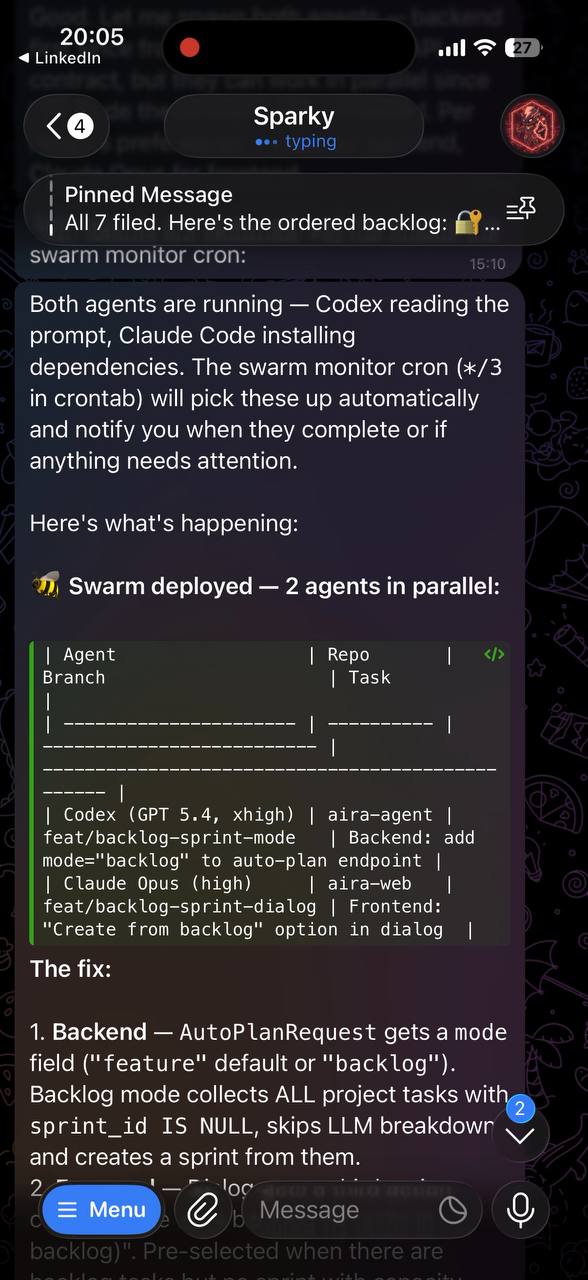
Swarm Deploy — Codex + Claude Code spawned in parallel, each in its own worktree |
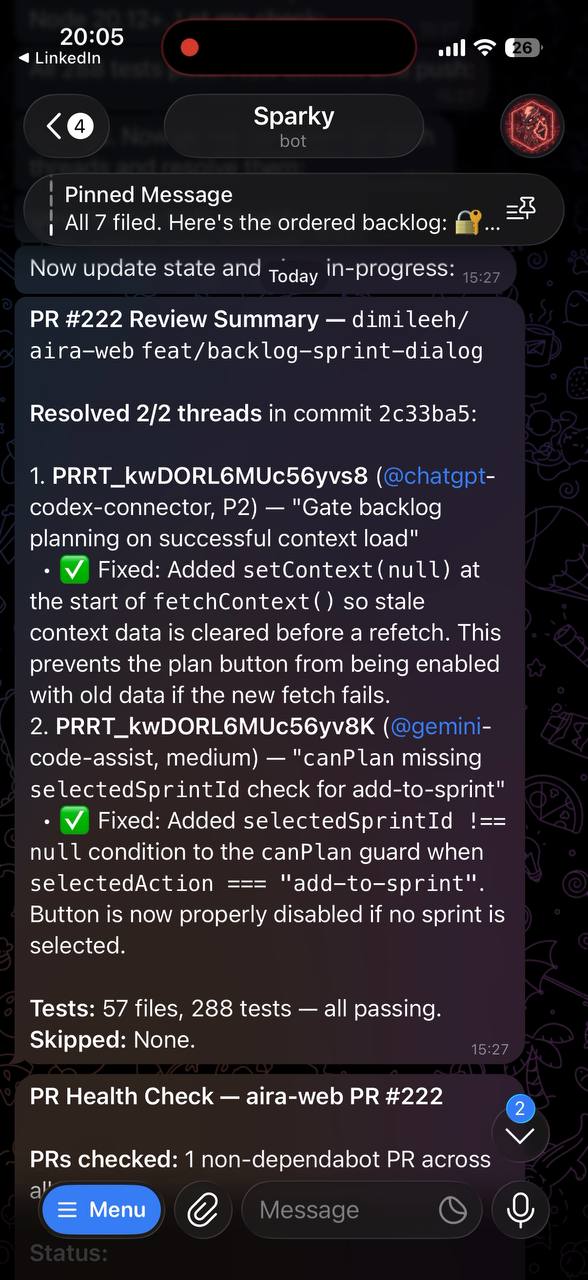
Auto Review — Bot review threads resolved with fixes, all tests passing |
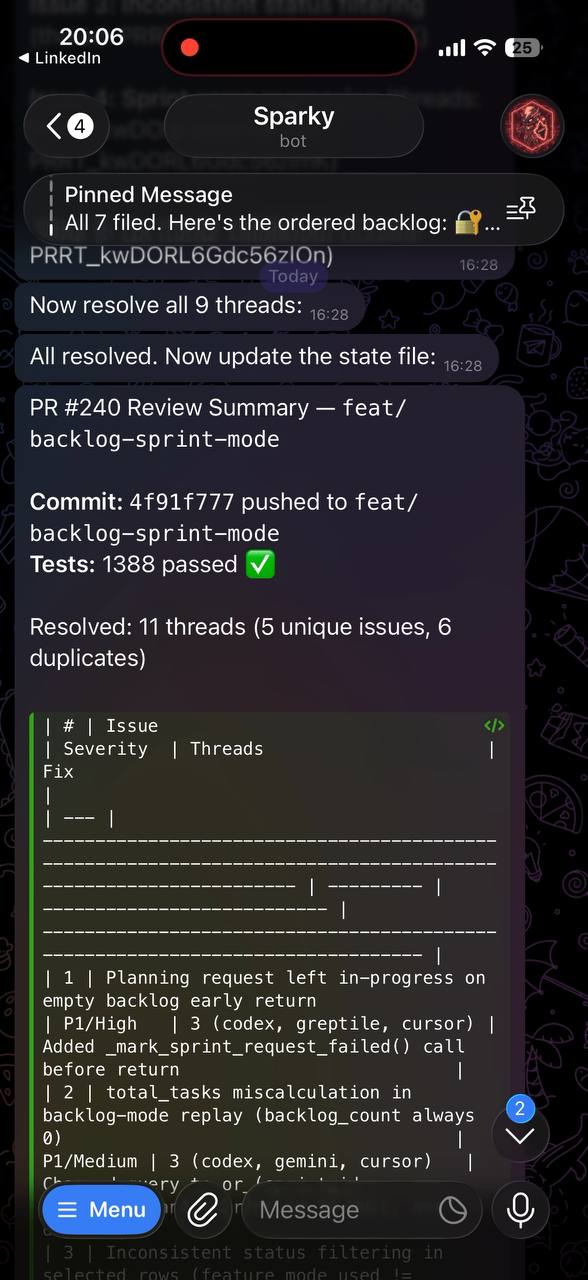
Review Resolution — 11 threads resolved across 5 real issues, 1388 tests ✅ |
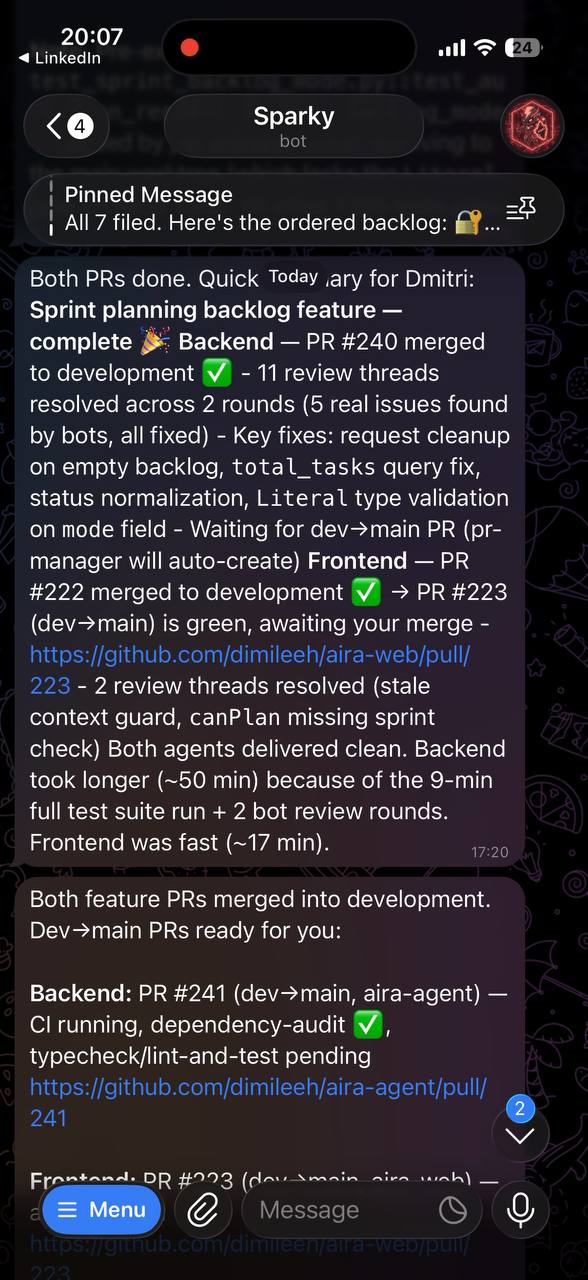
Delivery — Both agents done, dev→main PRs ready for human merge |
Prerequisites
- OpenClaw — installed and authenticated
git— version controlgh— GitHub CLI, authenticated with repo + PR permissionstmux— agent sessions run herejq— JSON processing- Node.js — managed via NVM
- At least one coding agent CLI:
Installation
Clone directly into ~/.clawdbot — the repo IS the runtime directory:
git clone [email protected]:YOUR_USER/clawdbot.git ~/.clawdbot
cd ~/.clawdbot
cp .env.example .env
# Edit .env with your repos, GitHub owner, paths, etc.
Agent Authentication
Coding agents need access to their provider's API. There are two ways to authenticate:
Option A: CLI OAuth login (recommended — no keys to manage)
Log in once on your machine, and all spawned agents inherit the session:
codex auth     # OpenAI / Codex CLI
claude login   # Anthropic / Claude Code
gemini auth    # Google / Gemini CLI
Credentials are stored in your home directory (~/.codex/, ~/.claude/, etc.). Since spawn-agent.sh runs tmux as the same user, agents pick them up automatically.
Option B: API keys (for headless servers or CI environments)
Set keys in ~/.clawdbot/.env — only the ones you use:
OPENAI_API_KEY="sk-..."          # Codex CLI
ANTHROPIC_API_KEY="sk-ant-..."   # Claude Code
GEMINI_API_KEY="AIza..."         # Gemini CLI
spawn-agent.sh sources .env before launching agents, so keys are automatically available. .env is gitignored and never committed.
You can also set keys in your shell profile (~/.bashrc) — same effect.
Create the runtime directories:
mkdir -p logs prompts runners memory
Set up crontab:
crontab -e
# Agent pre-check (validate GitHub API, repos accessible)
*/10 * * * * /home/YOU/.clawdbot/agent-precheck.sh >> /home/YOU/.clawdbot/logs/precheck.log 2>&1

# PR manager (merge, review-fix, sync PRs)
*/10 * * * * /home/YOU/.clawdbot/pr-manager.sh >> /home/YOU/.clawdbot/logs/pr-manager.log 2>&1

# Swarm monitor (zero-LLM, wakes orchestrator only on events)
*/3 * * * * /home/YOU/.clawdbot/swarm-monitor.sh
Connecting to your OpenClaw agent
clawdbot is the infrastructure — your OpenClaw agent is the brain that drives it. You need to tell your agent that ~/.clawdbot/ exists and how to use it.
1. Tell your agent about clawdbot
Add this to your workspace AGENTS.md (or HEARTBEAT.md):
## Coding Agent Swarm

~/.clawdbot/ contains the swarm orchestration toolkit.
- Spawn agents: `~/.clawdbot/spawn-agent.sh <task-id> <repo-path> <branch-name> <agent: codex|claude|gemini> <model> <thinking: low|medium|high|xhigh> "<prompt>"`
- Check status: `~/.clawdbot/check-agents.sh`
- Clean up: `~/.clawdbot/cleanup-task.sh <task-id>`
- PR status: `~/.clawdbot/pr-unified-status.sh`
2. Install the swarm skill (recommended)
The swarm skill (SKILL.md in this repo) gives your agent structured knowledge of the full spawn → monitor → review → merge lifecycle. Copy it into your OpenClaw skills directory:
mkdir -p ~/.openclaw/skills/swarm
cp ~/.clawdbot/SKILL.md ~/.openclaw/skills/swarm/SKILL.md
With the skill installed, you can just say "spawn a Codex agent to fix the auth bug in my-backend" and your agent handles the rest — worktree creation, prompt injection, tmux session, and monitoring.
3. How the pieces connect
You (chat with your OpenClaw agent)
 ↓
"Fix the auth bug and add the dashboard feature"
 ↓
OpenClaw agent reads swarm skill → calls spawn-agent.sh (×2)
 ↓
Coding agents work in isolated worktrees → push → open PRs
 ↓
swarm-monitor.sh (cron) detects CI failure / PR ready
 ↓
`openclaw cron wake` → wakes your agent
 ↓
Agent auto-fixes CI, resolves reviews, notifies you when ready
 ↓
You review and merge to main
The cron jobs (swarm-monitor.sh, pr-manager.sh) are the glue — they run pure bash with zero LLM cost, and only wake your OpenClaw agent when something actually needs attention.
4. Customize AGENTS.md
AGENTS.md is injected into every spawned agent's worktree. This is where you encode your team's standards:
- TDD requirements
- Code style and conventions
- Git commit format
- PR description template
- Which skills to load
- What NOT to do
Edit it to match your workflow. The default covers TDD, conventional commits, and clean code.
Configuration
All config lives in .env (gitignored). Copy .env.example and fill in your values:
# Required
CLAWDBOT_REPOS="owner/backend owner/frontend"    # Space-separated repos
CLAWDBOT_GITHUB_OWNER="owner"                     # GitHub org or user
CLAWDBOT_PROJECTS_ROOT="$HOME/Projects"           # Where repos are cloned

# Branch strategy
CLAWDBOT_INTEGRATION_BRANCH="development"         # Agents target this
CLAWDBOT_MAIN_BRANCH="main"                       # Humans merge here

# Paths
CLAWDBOT_HOME="$HOME/.clawdbot"                   # This directory
CLAWDBOT_NODE_PATH="$HOME/.nvm/versions/node/v24.13.0/bin"

# Notifications (via OpenClaw)
CLAWDBOT_NOTIFY_CHANNEL="telegram"
CLAWDBOT_NOTIFY_TARGET="YOUR_CHAT_ID"

# Agent defaults
CLAWDBOT_DEFAULT_AGENT="codex"
CLAWDBOT_CODEX_MODEL="gpt-5.4"
CLAWDBOT_CLAUDE_MODEL="claude-opus-4-7"
CLAWDBOT_GEMINI_MODEL="gemini-2.5-pro"

# Optional
CLAWDBOT_SKILLS_PATH="$CLAWDBOT_PROJECTS_ROOT/antigravity-awesome-skills/skills"
CLAWDBOT_DEPENDABOT_REPO="owner/frontend"         # Auto-merge dependabot PRs here
Every script sources .env on startup with safe fallbacks, so existing env vars also work.
Repo layout
~/.clawdbot/
├── .env                  # Local config (gitignored)
├── .env.example          # Template for .env
├── AGENTS.md             # Instructions injected into every agent
├── README.md
├── LICENSE
├── spawn-agent.sh        # Spawn a coding agent in a worktree
├── check-agents.sh       # Check status of all tracked tasks
├── cleanup-task.sh       # Clean up finished task worktree
├── finalize-task.sh      # Auto-called on agent exit
├── agent-precheck.sh     # Validate GitHub API + repo access
├── github-precheck.sh    # Extended GitHub health check
│
├── pr-manager.sh         # PR automation: merge, review-fix, sync
├── swarm-monitor.sh      # Zero-LLM monitor (cron, wakes on events)
├── pr-hygiene.sh         # PR health checks and cleanup
├── pr-review-collector.sh    # Collect review comments
├── pr-unified-status.sh      # Unified PR status across repos
├── check-pr-ready.sh         # Check if PR is ready to merge
├── check-pr-reviews.sh       # Check PR review status
├── check-pr-review-debt.sh   # Track review debt
├── check-cursor-risk.sh      # Cursor Bugbot risk assessment
├── auto-resolve-praise-threads.sh  # Auto-resolve "looks good" threads
│
├── logs/                 # Cron output (gitignored)
├── prompts/              # Agent prompt files (gitignored)
├── runners/              # tmux session metadata (gitignored)
├── memory/               # Agent memory files (gitignored)
└── *.json                # State files (gitignored)
Usage
Spawn an agent
~/.clawdbot/spawn-agent.sh \
  <task-id> \
  <repo-path> \
  <branch-name> \
  <agent: codex|claude|gemini> \
  <model> \
  <thinking: low|medium|high|xhigh> \
  "<prompt>"
Example:
~/.clawdbot/spawn-agent.sh \
  fix-auth-bug \
  ~/Projects/my-backend \
  fix/auth-bug \
  codex \
  gpt-5.4 \
  xhigh \
  "Fix the auth refresh token race condition. Add tests. Open a PR against development."
Check running agents
~/.clawdbot/check-agents.sh | jq .
Returns JSON with task IDs, statuses, PR numbers, CI state, and recommended actions.
PR status across repos
~/.clawdbot/pr-unified-status.sh    # Overview of all open PRs
~/.clawdbot/check-pr-ready.sh       # Which PRs are ready to merge
~/.clawdbot/check-pr-review-debt.sh # Which PRs need review attention
Clean up a finished task
~/.clawdbot/cleanup-task.sh <task-id>
Removes the worktree, deletes the branch (if merged), and removes the task from the registry.
The review loop
Two cron jobs form the core automation:
swarm-monitor.sh (every 3 min) — Pure bash, zero LLM cost. Reads check-agents.sh output and only wakes the OpenClaw orchestrator when:
- A PR's CI failed and needs a fix agent
- A PR is ready for merge/review
- A branch has merge conflicts
pr-manager.sh (every 10 min) — Handles repo-wide PR lifecycle:
- Auto-merges integration PRs when CI is green and reviews are approved
- Blocks merges if a release PR (integration→main) is already open
- Spawns isolated agents to fix unresolved review threads
- Spawns agents to fix CI failures
- Opens integration→main sync PRs when the dev queue is clear
- Notifies via OpenClaw when PRs need human attention
The result: agents code, push, get reviewed, fix review feedback, and re-push — all without human involvement until the final merge to main.
Safety rails
- Runtime
ghwrapper —spawn-agent.shgenerates aghshim in a temp dir that rejects PRs not targeting the integration branch - Worktree isolation — each task gets its own worktree; no cross-contamination
- Human-only main merges — PRs to main are never auto-merged
- State files — all automation state is in readable JSON files
- Cron announces deltas — only notifies when something changes, not on every run
- No direct pushes to main — enforced by convention and the gh wrapper
Supported agents
| Agent | CLI | Default flags |
|---|---|---|
| Codex | codex exec |
--dangerously-bypass-approvals-and-sandbox, configurable model + reasoning |
| Claude Code | claude |
--dangerously-skip-permissions, configurable model |
| Gemini | gemini |
--yolo, configurable model |
Adjust defaults in spawn-agent.sh or override via .env.
Agent skills
Coding agents perform better with domain-specific knowledge. We use Antigravity Awesome Skills — 883+ agentic skills for AI coding assistants.
git clone https://github.com/sickn33/antigravity-awesome-skills.git \
  "$CLAWDBOT_PROJECTS_ROOT/antigravity-awesome-skills"
Skills are referenced in AGENTS.md and loaded by agents at startup. Examples:
tdd-workflow— RED→GREEN→REFACTOR cycleclean-code— naming, readability, function designfastapi-pro— async Python + FastAPI patternsnextjs-best-practices— App Router conventionsdocker-expert— multi-stage builds, securitycode-reviewer— review guidelines, security scanning
Create your own skills too — it's just a SKILL.md file with instructions.
Browse the full catalog: sickn33/antigravity-awesome-skills
Updating
Since ~/.clawdbot is the repo itself:
cd ~/.clawdbot
git pull origin main
Your .env and state files are gitignored, so pulls are clean.
Inspiration
This project is inspired by @elvissun's article OpenClaw + Codex/ClaudeCode Agent Swarm: The One-Person Dev Team — the original write-up on using OpenClaw as an orchestration layer for parallel coding agents. Elvis described the architecture and workflow but didn't release the source code, so we built clawdbot as the open-source implementation.
License
MIT — see LICENSE.
Yorumlar (0)
Yorum birakmak icin giris yap.
Yorum birakSonuc bulunamadi