AgentAction
Health Uyari
- License — License: Apache-2.0
- Description — Repository has a description
- Active repo — Last push 0 days ago
- Low visibility — Only 5 GitHub stars
Code Gecti
- Code scan — Scanned 12 files during light audit, no dangerous patterns found
Permissions Gecti
- Permissions — No dangerous permissions requested
Bu listing icin henuz AI raporu yok.
Trust infrastructure for autonomous AI agents: decision assurance, action authorization, runtime controls, and verifiable lifecycle evidence.
AgentAction
Trust infrastructure for autonomous AI agents.
AgentAction is the trust layer between autonomous agents and enterprise
systems: it evaluates decisions, enforces policy, authorizes actions, and
preserves verifiable evidence across the agent lifecycle. The canonical project
site is AgentAction.dev.
AgentAction evaluates decisions, enforces policy, authorizes actions, and
preserves verifiable evidence from intent through execution and continuous
evaluation.
Intent -> decision assurance -> policy enforcement -> action authorization
       -> execution -> evidence -> continuous evaluation
The action gate is the current enforcement wedge inside that broader trust
lifecycle. Versioned agentpass.* protocol identifiers and the legacyagentpass and agentid commands remain supported for compatibility. See
Project Positioning for the canonical scope and messaging
boundaries.
Try AgentAction
| Experience | What it demonstrates |
|---|---|
| Gateway and refund control | Approval, scoped JIT authority, idempotency, audit, and provider-tool authorization in a support workflow. |
| DevOps and SRE control | Production-context checks, deployment approval, JIT grants, dry-run dispatch, canary monitoring, and rollback control. |
| Policy builder | Browser-based manifest authoring with generated YAML, starter OPA policy, and example gateway requests. |
Prefer to start without blocking an existing workflow? Run the passive MCP
observer quick start below, inspect the counterfactual policy decisions, and
enable enforcement only after the boundary matches your intent. The hosted
observability console is an operator surface protected by Cloudflare Access,
not a public demo.
Quick Start
Recommended: Observe An MCP Workflow
Run the self-contained observer from a fresh clone:
git clone https://github.com/dinpd/AgentAction.git
cd AgentAction/mcp-gateway-adapter
npm ci
npm run demo:observe
The demo puts the existing reference adapter into passive mode:
MCP client -> customer-run observer adapter -> downstream MCP server
                      |-> local policy + process-local shadow state
                      `-> privacy-safe JSON observation events
Every MCP request and response remains unchanged. The observer records which
calls would be allowed, denied, or challenged under enforcement, including
stateful findings such as duplicate side effects and tool loops. It does not
call hosted authorization, consume approval or JIT authority, filter tool
discovery, or attach provider receipts.
The command above is a self-contained onboarding test. To place the adapter in
front of representative traffic, set "mode": "observe", configure itsdownstream.url and tool mappings, then start it with:
npx tsx src/index.ts /path/to/observe-config.json
The current deployment is a customer-run Node HTTP sidecar with process-local
shadow state and JSON events written to stdout. Review the
observe-mode configuration, transition to enforcement, and limitations
before using it with a real workflow. The reference adapter is an onboarding
and integration surface, not yet a production-complete MCP gateway.
Alternative: Embed The Guard
For an application that owns the tool execution path, install the local
TypeScript guard:
npm install @dinpd/ai-agent-guard
Wrap a consequential tool call:
import { createToolGate } from "@dinpd/ai-agent-guard";

const gate = createToolGate({ policy });

const execution = await gate.run(
  {
    agentId: "support-agent",
    jobId: "case-1042",
    tool: "stripe.refund",
    action: "pay",
    resource: "payment/pi_123",
    amountUsd: 49,
    idempotencyKey: "refund-case-1042-pi_123"
  },
  () => stripe.refunds.create({ payment_intent: "pi_123", amount: 4900 })
);

if (!execution.executed) {
  return execution.decision;
}
Run the embedded-guard repository demos:
git clone https://github.com/dinpd/AgentAction.git
cd AgentAction/packages/guard
npm install
npm run demo:quickstart
npm run demo:mcp
npm run demo:circuit
npm run demo:gate
npm run demo:pii
npm test
The guard package is published as@dinpd/ai-agent-guard.
See packages/guard/ for starter policies and more examples.
How It Works
AgentAction connects six claims without collapsing them together: the declared
intent, assessment of the decision, policy authorization, provider execution,
independent evidence, and continuous outcome evaluation. Authorization is not
proof of execution, and execution is not proof that the intended outcome was
achieved within constraints.
Action Authorization
Agent proposes tool call -> AgentAction checks policy + state -> allow / deny / challenge
RBAC can say which identity may access a tool. OAuth can prove access to a
server. MCP tool schemas describe inputs. Agent frameworks can decide which
tools are visible to a model. AgentAction answers the runtime question:
Should this specific tool call, with this payload, in this job state, execute right now?
The gate runs outside model context and agent-editable memory. It keeps the
state needed to stop failures that static access control and prompt rules miss:
- Duplicate refunds, payments, emails, exports, deployments, or writes.
- Runaway loops and repeated tool calls.
- Token, cost, runtime, and tool-call budget spikes.
- PII or sensitive data moving to the wrong destination.
- Risky actions without action-scoped approval.
- Replays or payload changes after authority was granted.
Approvals bind to the proposed tool, resource, payload, amount, destination,
job, and expiry. Side-effectful actions bind an idempotency key or call
fingerprint to the recorded provider result. The gate therefore remembers what
actually executed rather than relying on what the agent thinks happened.
AgentAction separates three concepts that agent systems often blur:
Skill = workflow package
Tool = executable operation
Flow = data movement boundary
The local guard applies tool and flow checks in-process. Larger deployments use
the same model through manifests, approvals, hosted gateways, signed receipts,
provider-side verification, and durable evidence.
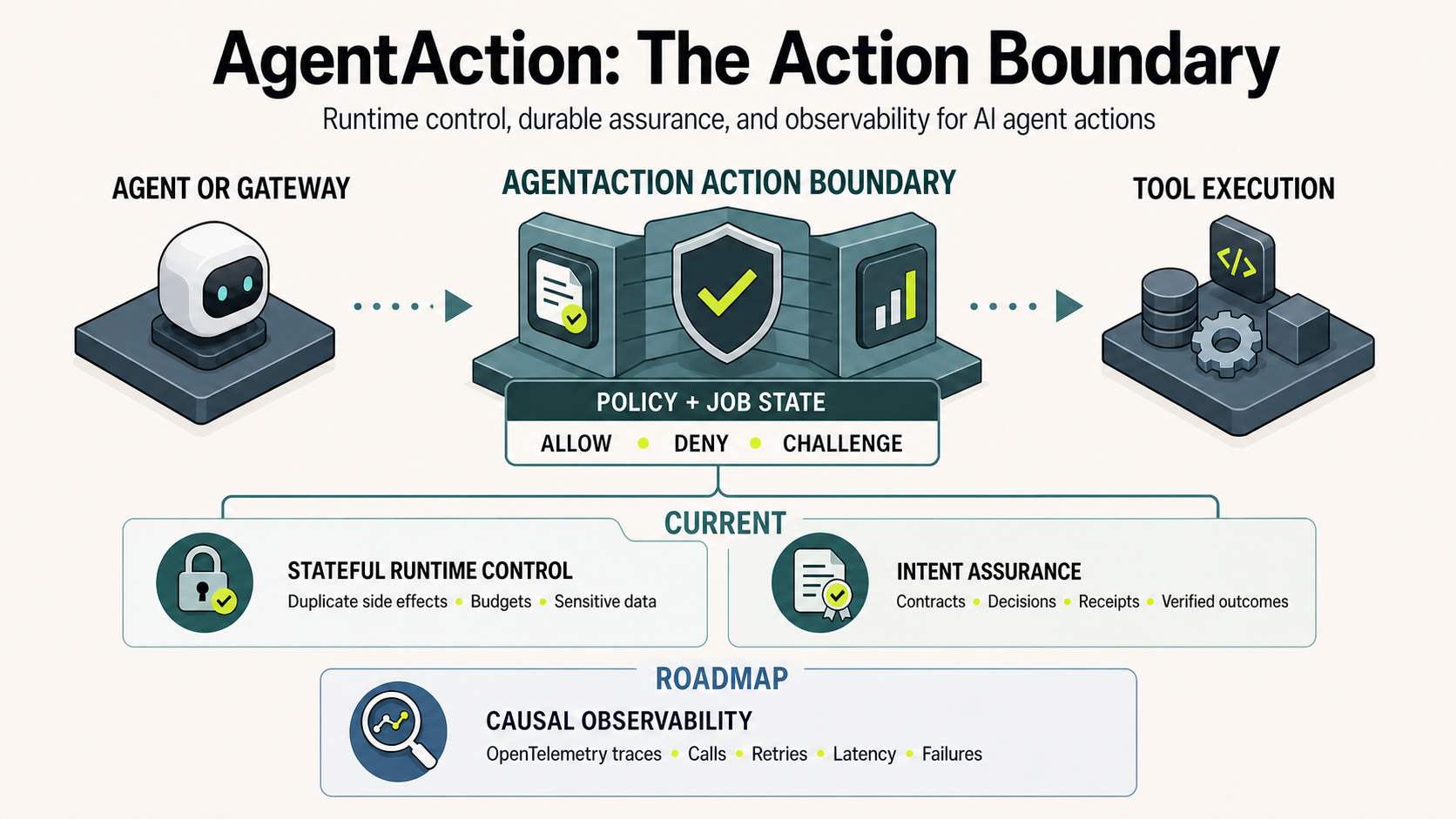
At enterprise scale, every consequential action crosses an enterprise-controlled
gateway before reaching internal, SaaS, cloud, or provider-hosted tools.
AgentAction acts as the decision service; the gateway remains the policy
enforcement point, and providers can independently verify scoped authorization
receipts.
AgentAction also fits into broader task-scoped security architectures such as
Cloudflare's Agent Access Model (AAM).
It implements the action-control and evidence layers while
integrating with external identity brokers and network enforcement rather than
replacing them.
Choose Your Path
| You are building | Start here |
|---|---|
| An existing MCP workflow or gateway | Start with the recommended passive observer quick start, then use the mcp-gateway-adapter/ integration guide |
| An agent or application | packages/guard/ and the local examples |
| An enterprise AI platform | Enterprise governance and authorization in practice |
| A SaaS, API, or MCP provider | Provider MCP authorization, Express middleware, or FastAPI helpers |
| A security or risk program | Enterprise topology, receipt profiles, and standards alignment |
| An observability or assurance implementation | Intent assurance, the operator console, and community proposals |
For the enterprise CLI and manifest workflow:
git clone https://github.com/dinpd/AgentAction.git
cd AgentAction
python -m pip install -e ".[dev]"
agentaction validate examples/provider-mcp-support-agent.yaml
agentaction risk-score examples/provider-mcp-support-agent.yaml
agentaction generate-policy examples/provider-mcp-support-agent.yaml --target opa
The Python distribution is agentaction-dev. agentaction is the primary CLI.agentpass and agentid remain compatibility aliases, and versioned schema,
environment-variable, and receipt identifiers retain their existing names.
Platform Control Surfaces
AgentAction exposes three connected control surfaces:
- Agent Evaluation: define versioned intent profiles, exercise synthetic
scenarios, and compare profile-scoped assurance signals before wider
deployment. - Decision Assurance: assess the declared basis for a consequential choice,
including policy factors, alternatives, assumptions, uncertainty, and
supporting evidence—without inspecting hidden chain-of-thought. - Action Authorization: gate the exact action against policy and prior
state, then issue action-bound authority that providers can independently
verify.
Provider verification, execution receipts, verified observations, immutable
assessments, and outcome evaluation connect the three surfaces across the trust
lifecycle. Framework wrappers, gateway adapters, and conformance suites are
delivery and interoperability mechanisms, not separate product surfaces.
Current Capabilities
- Versioned intent profiles, synthetic scenarios, immutable assessments, and
profile-scoped quality rollups provide the Agent Evaluation foundation. - Normalized decision evidence captures policy factors, alternatives,
assumptions, uncertainty, and supporting evidence without recording private
chain-of-thought. - Local TypeScript action authorization with circuit breakers, budgets,
approvals, idempotency, PII/data-flow controls, and decision audit events. - Passive observe and fail-closed enforce modes for MCP
tools/callthrough the
reference MCP gateway adapter. - Cloudflare gateway runtime with tenant manifests, OIDC checks, approval
queues, scoped JIT grants, audit timelines, and provider-result replay. - Provider authorization receipts signed as JWS with a public JWKS endpoint.
- Express and FastAPI provider-side verification middleware.
- Versioned intent contracts, execution evidence, verified outcome
observations, immutable snapshots, final evaluations, and quality rollups. - Access-protected operator console for fleet-level outcome, constraint,
confidence, execution-discipline, and data-quality review. - DevOps/SRE and OpenClaw solution packs for concrete integration paths.
See Current implementation status for planned and
adopter-facing work.
Architecture And Documentation
- Enterprise deployment and governance
- Enterprise-managed MCP authorization sequence
- Action-gate roadmap
- Intent assurance
- Decision-basis evidence
- Provider contracts and authorization
- Agentic identity standards crosswalk
- Interoperability positioning
- Explainer video
Community Specifications And Roadmap
AgentAction publishes experimental, vendor-neutral drafts for
Agent Action Boundary Evidence
and Agent Outcome Observability and Assurance Metrics.
They are discussion documents, not adopted standards; AgentAction is a
non-normative reference implementation.
Implementation work and identified gaps are tracked in the public
Intent Observability & Assurance project.
The Action Gate Roadmap tracks product layers and
adopter-facing demonstrations.
Open Source Governance
License
Apache-2.0
Yorumlar (0)
Yorum birakmak icin giris yap.
Yorum birakSonuc bulunamadi