cccat
Health Uyari
- License — License: MIT
- Description — Repository has a description
- Active repo — Last push 0 days ago
- Low visibility — Only 5 GitHub stars
Code Basarisiz
- rm -rf — Recursive force deletion command in bin/cccat.js
- fs.rmSync — Destructive file system operation in bin/cccat.js
- fs module — File system access in bin/cccat.js
- fs.rmSync — Destructive file system operation in lib/adopt.js
- fs module — File system access in lib/adopt.js
- fs module — File system access in lib/content.js
- fs.rmSync — Destructive file system operation in lib/install.js
- fs module — File system access in lib/install.js
Permissions Gecti
- Permissions — No dangerous permissions requested
Bu listing icin henuz AI raporu yok.
Claude Code Cat — turn waiting time into English micro-lessons, explained in your own language (Korean & Japanese, more welcome). Animated cat in your status line. Local-first, zero network.
(=^・ω・^=) cccat — Claude Code Cat
A spoonful of English in your status line, while Claude Code thinks.





cccat turns Claude Code's idle moments — thinking, running tools, waiting for a response — into
tiny English-learning moments for developers whose first language isn't English. An animated
kaomoji cat sits in your status line reflecting what Claude Code is doing, and next to it shows
a practical English expression from real dev work, explained in your own language.
Explanations currently ship in Korean and Japanese, and the design makes adding more
languages a matter of dropping in one overlay file — the English expressions stay shared.
| English expression + Korean explanation | English expression + Japanese explanation |
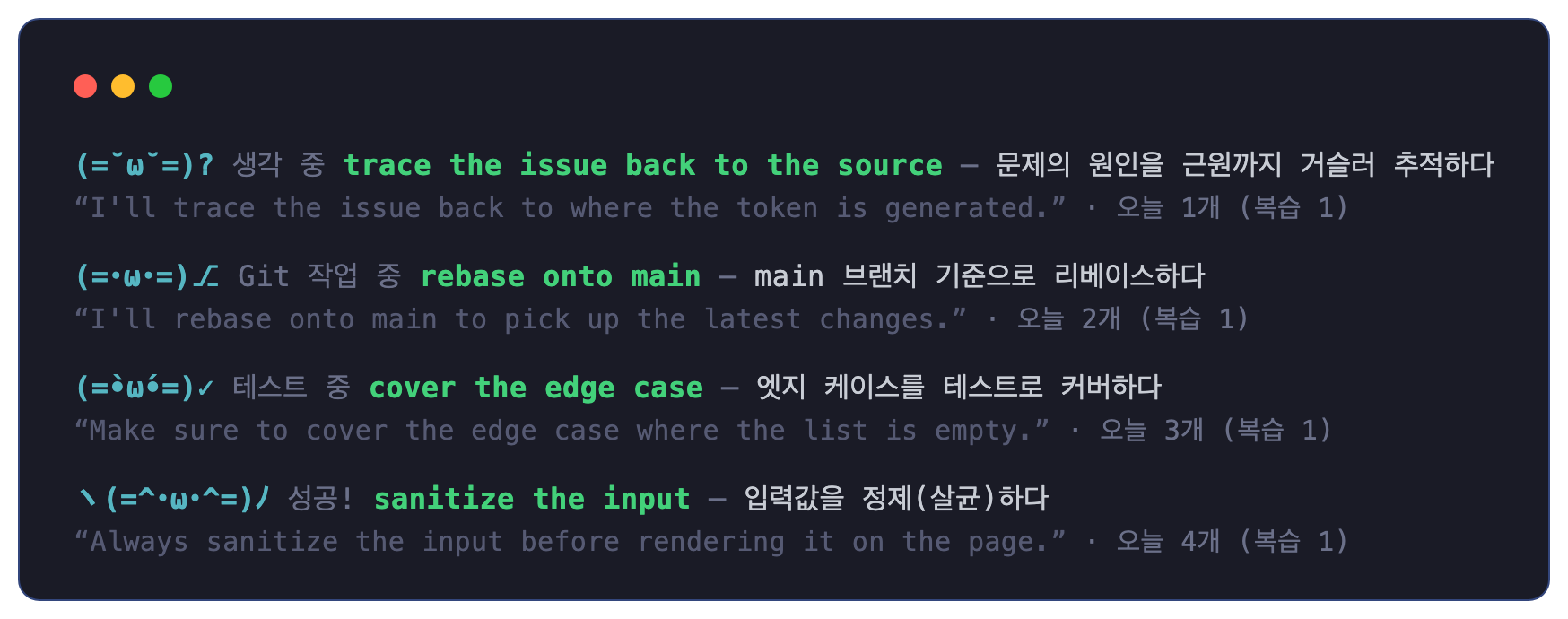 |
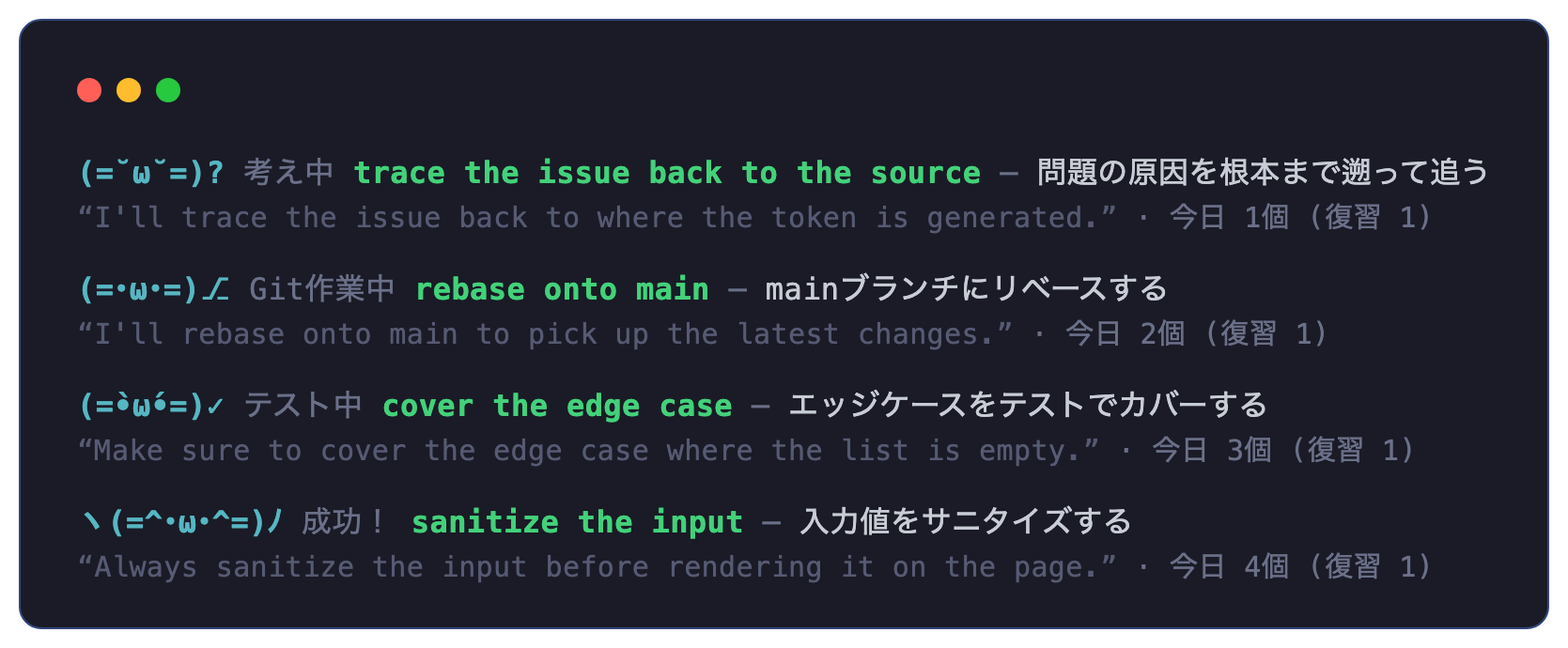 |
Rendered from the real cccat status-line engine (cccat lang ko / cccat lang ja). The cat's
face and spinner animate in real time as Claude Code's activity changes; the state label
(thinking / Git / testing / success …) and the explanation both follow your chosen language. See
docs/VERIFICATION.md for a live Claude Code TUI capture.
Table of contents
- Why
- At a glance
- Requirements
- Install
- Explanation languages
- Projects with their own status line
- Usage
- CLI reference
- Configuration
- Uninstall
- Privacy
- FAQ
- Docs
- License
Why
Using Claude Code, you spend a lot of little moments waiting for a response. The idea is to turn
those few seconds into learning real, everyday developer English — expressions likestage the changes, cover the edge case, clean build — instead of scrolling away. It runs
100% locally, makes zero network requests, and never stores your prompts or file contents.
At a glance
| 🐱 Character | An animated cat whose face changes with Claude's activity (thinking / reading / writing / testing / git / error / success …) |
| 🌐 Native-language explanations | Practical English expressions + a natural explanation in your language + example. Korean & Japanese today |
| 🎯 Context-aware | Prefers expressions related to what you're doing right now (file types, commands) |
| 🔁 Spaced review | Resurfaces older expressions at the right time via a spaced-repetition schedule |
| 🔒 Local-first | Zero network requests. Prompts and file contents are never stored |
| 🆓 Free / open source | No account, no payment, no server. MIT licensed |
Requirements
- Node.js 18+ (
npxships with Node) - Claude Code (verified on 2.1.201 / macOS — see docs/COMPATIBILITY.md)
Install
Option 1 — npx (easiest, nothing to clone)
npx github:dkdannyboy/cccat install
One line, no clone and no global install. Remove later with npx github:dkdannyboy/cccat uninstall.
Option 2 — one-line install script
curl -fsSL https://raw.githubusercontent.com/dkdannyboy/cccat/main/scripts/install.sh | sh
Clones (or updates) the repo into ~/.cccat/app and runs cccat install.
Option 3 — clone (for development / contributing)
git clone https://github.com/dkdannyboy/cccat.git
cd cccat
node bin/cccat.js install     # or: npm install -g . && cccat install
Restart Claude Code after installing and the cat appears in your status line.
What install does
- Backs up
~/.claude/settings.jsonto~/.cccat/backup/with a timestamp - Copies its own source into
~/.cccat/appso hooks reference a stable path (an npx cache path
would otherwise break once cleaned) - If you already have a status line, it is never removed — cccat wraps it so your existing
output always shows first, with the cccat lines below it (your original output is cached for 5s) - Registers 9 hook events (
UserPromptSubmit,PreToolUse,PostToolUseFailure,Stop,Notification,SubagentStart,SubagentStop,SessionStart,SessionEnd) — your existing
hooks are untouched. For performance it does not register the per-tool-callPostToolUse, and
throttlesPreToolUseto skip redundant runs within 2s - Sets a status line
refreshInterval(1s by default) so the animation keeps moving between
events. Turning animation off (config show_animation false) removes the timer entirely - Uses a launcher that resolves
nodeat run time, so upgrading Node later won't break the hooks - Reinstalling is safe (idempotent) — no duplicate lines
Explanation languages
The default explanation language is Korean; Japanese is fully supported (all 240+ expressions
translated). Switch at any time:
cccat lang ja     # Japanese explanations
cccat lang ko     # back to Korean
cccat lang        # show current + supported languages
Changes apply immediately — no reinstall. Meanings, examples and quiz hints all follow the
chosen language. Only the explanation is translated; the English expressions are shared across
all languages. Adding a language is just a content/i18n/<code>.json overlay — see
docs/CONTENT_GUIDE.md. Contributions of new
language overlays are welcome.
The optional danielclass.com note (free English study material) is
shown only to Korean-language users, at most once a day.
Projects with their own status line
Some projects define their own status line in .claude/settings.json. Since project settings
take precedence over user settings, cccat is hidden inside such a project. Run this once in
that project's directory to make them coexist:
cccat adopt      # show the project's status line + the cccat lines together
cccat unadopt    # revert
adopt only writes to the git-ignored .claude/settings.local.json and never touches the
shared .claude/settings.json. cccat doctor detects this situation and suggests the command.
Usage
After installing it just works. The status line follows what Claude Code is doing (thinking /
reading / writing / testing / git / error …), changing the cat's face and the English
expression. The expression rotates about every 30s (default), and previously seen expressions
come back later as review via a spaced-repetition schedule.
Preview without installing:
cccat demo thinking
CLI reference
| Command | Description |
|---|---|
cccat install |
Install into Claude Code (auto-backs up settings) |
cccat uninstall [--purge] |
Remove, restore prior status line/hooks. --purge also deletes learning data |
cccat doctor |
Diagnose install state, status line, hook count, content |
cccat lang [code] |
Show/change explanation language (ko, ja) |
cccat adopt |
In a project with its own status line, set up coexistence (writes .claude/settings.local.json; never touches settings.json) |
cccat unadopt |
Undo adopt and restore |
cccat on / cccat off |
Enable / disable |
cccat pause [min] / cccat resume |
Pause for N minutes (default 30) / resume now |
cccat config list |
Print all settings |
cccat config get <key> |
Read one setting |
cccat config set <key> <value> |
Change a setting |
cccat stats |
Today's count, cumulative learning/mastered/saved |
cccat today |
Full list of expressions seen today |
cccat save |
Save the currently shown expression |
cccat saved |
List saved expressions |
cccat reset [--all] |
Reset learning history (--all also resets state) |
cccat privacy |
What is/isn't collected and where it's stored |
cccat demo [state] |
Preview rendering without installing (real rotation engine) |
cccat version |
Print version |
Configuration
Change with cccat config set <key> <value>. Defaults live in lib/config.js.
| Key | Default | Description |
|---|---|---|
enabled |
true |
Master on/off |
show_character |
true |
Show the cat |
show_animation |
true |
Frame animation |
show_english |
true |
Show the English expression |
show_korean |
true |
Show the explanation (in the active language) |
show_example |
true |
Show the example line (wide terminals only) |
quiz_ratio |
0.2 |
Fraction of already-seen expressions shown as fill-in-the-blank quizzes (0–1) |
rotate_sec |
30 |
Minimum seconds between expression changes |
refresh_sec |
1 |
Animation refresh interval (seconds, 1–10). Re-run cccat install after changing |
review_ratio |
0.3 |
Probability of preferring review over a new expression (0–1) |
context_aware |
true |
Prefer expressions matching recent activity (file type / command) |
promo |
true |
Show the danielclass.com note (≤ once/day, Korean users only) |
language |
ko |
Explanation language (ko, ja). Also settable via cccat lang <code> |
compact |
false |
Force single-line mode |
difficulty_max |
3 |
Max difficulty of shown expressions (1–3) |
Uninstall
cccat uninstall           # restore status line/hooks, keep learning data
cccat uninstall --purge   # the above + delete all of ~/.cccat
Privacy
100% local, zero network requests. It stores only: tool type, file extension, command category,
keyword-matched tags, and learning history. It never stores prompt text, file contents, full
paths, environment variables, or secrets. See docs/PRIVACY.md or runcccat privacy.
FAQ
Does it slow Claude Code down?
Not noticeably. Each tool call adds ~80ms via the PreToolUse hook (mostly Node cold-start), and
consecutive calls skip even that thanks to a 2s throttle. Hooks are designed to exit quietly on
any input, so they never block Claude Code.
Does it use a lot of CPU/battery?
The status line re-runs every refresh_sec (1s default) for the animation (~0.1s CPU per call).
Reduce it with cccat config set refresh_sec 3 or remove the timer entirely withcccat config set show_animation false, then cccat install.
Where do the expressions come from? Is it generated live by AI?
240+ curated expressions ship locally, so it works with no external API. There are no live LLM
calls (hence zero network, zero cost). Add your own via a user pack (below).
I already use a status line.
Install wraps your existing status line command; its output always shows on the first line, then
the cccat lines follow. Nothing is removed.
A project defines its own status line.
Run cccat adopt once in that project directory —
see Projects with their own status line.
Can I get explanations in another language?
Korean and Japanese today. Adding a language is a single overlay file
(docs/CONTENT_GUIDE.md); PRs welcome.
Can I add my own expressions?
Drop a pack into ~/.cccat/packs/*.json and it loads alongside the core pack. Schema in
docs/CONTENT_GUIDE.md.
Docs
| Doc | Contents |
|---|---|
| ARCHITECTURE.md | Data flow, module map, design decisions |
| CONTENT_GUIDE.md | Content schema, tag vocabulary, user packs, i18n overlays |
| PRIVACY.md | What is/isn't collected, storage location, deletion |
| COMPATIBILITY.md | Supported / unsupported environments |
| KNOWN_LIMITATIONS.md | Known limitations |
| VERIFICATION.md | Real Claude Code verification log |
| FUTURE.md | Roadmap ideas |
Contributing
Bug reports and expression suggestions are welcome — open an issue or PR. Run tests withnpm test; PRs must pass CI (Node 18/20/22 × Linux/macOS). New language overlays especially
welcome.
License
MIT — LICENSE
Yorumlar (0)
Yorum birakmak icin giris yap.
Yorum birakSonuc bulunamadi