LORE
Health Uyari
- License — License: AGPL-3.0
- Description — Repository has a description
- Active repo — Last push 0 days ago
- Low visibility — Only 5 GitHub stars
Code Basarisiz
- rm -rf — Recursive force deletion command in bin/lore.py
Permissions Gecti
- Permissions — No dangerous permissions requested
Bu listing icin henuz AI raporu yok.
Shared agent memory for Claude Code, Codex and Gemini via Google Antigravity in DOXA. LORE combines Hermes-pattern memory with Honcho-inspired dialectic reasoning, evidence-linked beliefs, reviewed facts, local session recall and signed sync.







LORE — Lots Of Reconciled Engrams
Persistent memory shared by Claude Code, Codex, and DOXA. Curated facts
are hard-capped; curated proposals wait for review. Derived beliefs retain their
evidence and appear on request or through explicitly enabled context.
[!WARNING]
Beta. Commands, caps, and configuration may change between releases.
LORE indexes local transcripts; Claude review sends a scrubbed digest to
the session's Anthropic endpoint./lore:setupedits Claude settings.
Hooks and model tools stage curated changes for review; the deriver writes
beliefs directly. Sync is off until configured. Read Data & safety.
LORE keeps recall separate from authority: a belief carries citations,
and relations between beliefs do not turn them into approved facts.
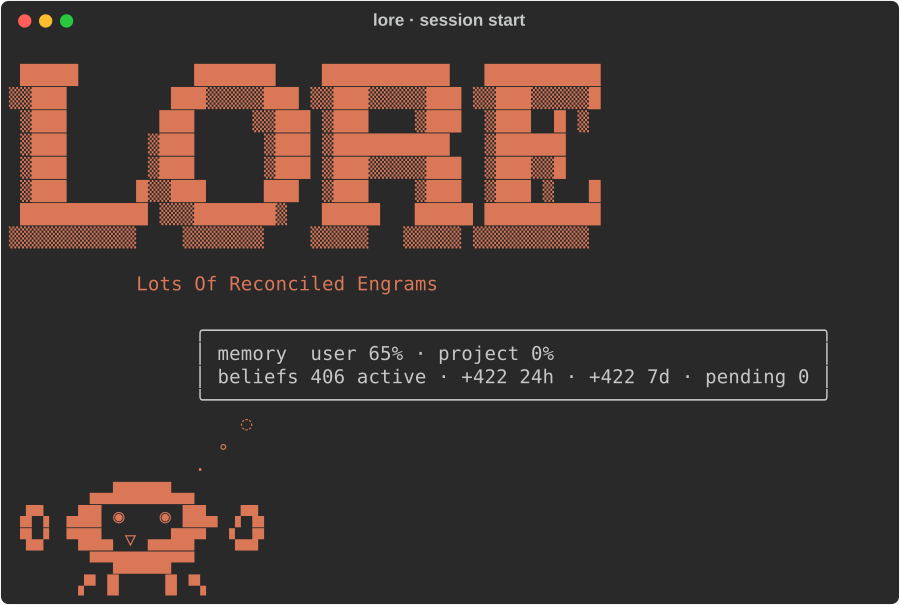
What you get
LORE 0.62.32 records
tool outcomes by default and lets reviewers link them to beliefs and learned
recipes.
LORE 0.62.31 documents
shared memory for Gemini sessions through Google Antigravity in DOXA.
LORE 0.62.30 adds
paged pending review, protected cleanup, and optional shared skill usage.
- Claude Code, Codex, and DOXA memory. Share one native store for capped
user and project facts across engines; host facts stay local. - Beliefs with evidence. Query conclusions, citations, and their graph on
demand, or enable experimental, bounded graph context. - Session search. Local FTS5 index of Claude Code, DOXA, and Codex transcripts.
- File maps. A short
path — purposeguide to important project files. - Bounded pending review. Page through large queues
while preserving human review of each complete, exact proposal. - Reviewed cleanup. Preview diagnostic retention and select orphaned
codegraph snapshots before applying a reviewed plan. - Tool evidence. LORE captures reported tool outcomes by default. Link relevant observations to beliefs and learned recipes.
- Learned skills. Recipes carry outcome history and staged updates or retirement.
- Local skill experiments. Compare exact pending coding skills
against frozen tests before human approval. The experimental subscription
coding adapter is disabled by default and requires an explicit budget for
attempted calls and independent verification. - Cross-machine sync. Signed hub, peer, or offline transfer, with optional
skill usage counters; off by default. - Agent integration. Claude Code and Codex plugins inject startup context;
interactive CLI writes apply directly, while hooks and model tools stage proposals.
Engine-origin labels add context, not authority. The manual
explains the write gates, hooks, and belief model.
Use /lore:filemap to inspect file maps; LORE_FILEMAP_CAP andLORE_MACHINE_CAP bound file maps and machine memory.
Install
/plugin marketplace add docwilde/lore
/plugin install lore
/lore:setup
The plugin uses the native Rust CLI. Install Rust with rustup
if lore-rs is not already installed; the first /lore:setup builds it once
in a private disk cache. Hooks use the installed carrier and never build during
startup. From a checkout, use ./task build or ./task install.
The carrier may use a newer patch release within the plugin’s major/minor
version; preview versions require an exact match../task install places lore-rs and lore in ~/.local/bin by default;
keep that directory on PATH. Run setup after a plugin update so hooks have
a compatible carrier before the next session starts.
Native CLI, hooks, MCP and DOXA share saved caps, stage switches, review
model preferences, context refresh and sync transport settings from${CLAUDE_CONFIG_DIR:-$HOME/.claude}/settings.json. Process environment
overrides saved values, including explicit empty values. A custom store
uses only process overrides unless it belongs to the chosen settings
directory. Store paths and identity remain process configuration. Saved credentials require a private, owned settings file.
/lore:setup walks each /lore:doctor finding behind its own confirmation: disabling Claude Code's built-in auto-memory, adding the permission allowlist, porting existing entries, priming the session index.
First run: review only looks forward, so run /lore:backfill project once to derive existing sessions into the belief store.
Windows
Native Windows is not supported yet. The bin/lore launcher and ./task
require a POSIX shell, and the Rust carrier uses Unix file and process APIs.
CI checks Linux and macOS, but not Windows.
WSL 2 is the practical
route to try on a Windows machine: install Rust and run LORE and its Claude
Code or Codex integration inside the same Linux
distribution. Keep the checkout and LORE store in the distribution's Linux
filesystem (for example, under ~/), then follow the install steps above.
This WSL 2 setup has not been verified in LORE CI; see the
platform notes before relying on it.
Antigravity in DOXA
DOXA connects to Google Antigravity on native Linux. Gemini sessions in DOXA receive LORE memory with their first prompt and contribute scrubbed transcripts to local LORE session search. Use DOXA_LORE=0 to disable memory injection and indexing for a session.
Codex
LORE supports Codex through the portable plugin.json and
its startup, prompt and tool hooks. Enable the full plugin,
then review and trust its hooks with /hooks in Codex. Once trusted, the startup
hook injects the shared user and current project snapshot at startup, resume,
clear, compaction, and fork. Codex requires a new review when a hook changes; see its
hook trust documentation.
Claude Code, Codex, and DOXA read the same store; set LORE_ROOT when using a
store other than ~/.claude/lore.
The Codex skill supports explicit recall and
memory writes. Index local Codex, Claude Code, and DOXA transcripts withlore index, search them with lore search "terms" --all, and read a match
with lore session <id>. Indexing and search stay local and use SQLite FTS5.
The Codex injection hooks read context without indexing transcripts or
scheduling review.
Interactive Codex sessions can apply CLI memory writes directly. Calls
classified as hooks or detached/model writers stage proposals; inspect them
with lore pending and resolve the exact reviewed
proposal in the native terminal or DOXA. The MCP tool lore_remember always
stages a proposal. A proposal or search result is not an approved fact.
The plugin declares its startup and prompt hooks and skills. Register the native
MCP server separately to give Codex tools for curated memory, beliefs and evidence,
graph traversal, session search, and staged memory proposals. From this checkout:
./task install
codex mcp add lore --env LORE_ENGINE=codex -- "$HOME/.local/bin/lore-rs" mcp --engine codex
Restart Codex to load the registered server.
For a skill-only local setup from this checkout:
mkdir -p "${CODEX_HOME:-$HOME/.codex}/skills"
ln -s "$(pwd)/codex/skills/lore" "${CODEX_HOME:-$HOME/.codex}/skills/lore"
The skill calls LORE's CLI against the shared store when a task needs recall.
This skill-only setup does not install the automatic SessionStart hook;
install the full Codex plugin for startup context injection.
Memory and graph context
Claude Code refreshes curated memory on prompt submission when its content
changes by default (LORE_REFRESH_ON_CHANGE=0 opts out). The bundled Codex
hook supplies startup snapshots; read back changes during a session withlore memory show or the MCP tool lore_memory_list.
Replacements and removals require a unique --match. Empty or whitespace-only
replacement text is refused; use memory remove to delete an entry:
lore memory replace --scope project --match "old wording" "replacement fact"
lore memory remove --scope project --match "obsolete fact"
An absent entry reports match_not_found; multiple matches reportmatch_ambiguous.
Graph context is experimental and off by default. Enable it in the shared
settings with lore config set LORE_GRAPH_CONTEXT 1. Its defaults are a
1,200-character budget (LORE_GRAPH_CONTEXT_CAP) and one relation hop
(LORE_GRAPH_CONTEXT_HOPS). The Claude prompt hook and bundled Codex startup
and UserPromptSubmit hooks inject the bounded block. Codex retrieves graph
context on the first prompt and subsequent prompts; retrieval failures leave
startup memory available and omit the graph block.
With graph context enabled, lore graph context --prompt "topic terms" reads
the block explicitly. lore graph stats, lore graph neighbours <id>, and the
MCP tool lore_belief_neighbours support on-demand inspection and traversal.
Graph-retrieved beliefs retain their own evidence and citation status.
Review and cleanup
Startup and refresh snapshots keep curated memory available when a pending
scan fails, reporting the pending count as unknown with a diagnostic code.lore pending falls back to a bounded page when the ordinary listing is too
large. Request pages explicitly and inspect a selected proposal with:
lore pending page --limit 50
lore pending page --limit 50 --cursor '<next_cursor>'
lore pending show PROPOSAL_ID
Follow next_cursor until has_more is false; a page can have no visible
items and still have more to scan. Changed queues or expired cursors require
a fresh first page. Full-queue operations retain their 4,096-entry bound.
Approval and rejection still require human review of the complete current
proposal, bound to its exact bytes and file identity. See the
pending page workflow.
Preview cleanup with lore trace retention-plan orlore codegraph cleanup-plan. Manual application requires human review of a
plan whose complete inventory and file proofs still match. Trace cleanup
protects recent captures and referenced evidence; codegraph cleanup removes
only the orphan snapshots explicitly selected by the owner. Automatic trace
retention is off by default; opt in withlore config set LORE_DIAGNOSTIC_RETENTION 1. See
retention and reviewed cleanup for policies and application.
Sync — one memory on every machine
Sync is off until configured. LORE records portable changes in a local
operation log; a configured transport moves signed operations between
machines. Unverified operations go to pending review; class-specific merge
rules preserve alternatives or stage conflicting content. Machine memory
stays on its own host.
- Hub: push and pull through the private
lore-hubservice, which stores operations without interpreting them. - Direct peer: exchange operations between two machines without a hub.
- Offline bundle:
lore sync exportandlore sync importtransfer signed memory, beliefs, file maps, proposals, and skills by file. Bundles exclude transcripts, session indexes, and credentials.
lore sync status                 # local state; no network call
lore sync login <token>          # hub authentication
lore sync                        # pull, then push
lore sync bootstrap              # initialize a new machine
lore sync export <new-file>      # create an offline bundle
lore sync import <file>          # verify and merge a bundle
lore sync resign --apply         # sign this machine's own backlog with the current key
lore sync seed --apply           # back-fill ops for state older than the log itself
Machines must share LORE_SYNC_HMAC_KEY to verify operations. You can choose
which data classes sync; see the manual
for setup and the protocol for the wire format.
Skill usage sync is separately off by default.
Enable it on each participating machine with lore sync classes +skill_usage,
then run lore sync seed --apply. Signed per-author uses, ok, and fail
counters merge without double counting and preserve resets. Existing totals
stay local as a baseline; later increases can sync over the network or in
offline bundles. Reasons and review evidence stay local. Shared counts help
rank recipes; skill updates and retirement still require human review of an
exact proposal.
Signed historical belief operations with missing UID references are kept in
the log as quarantined data and shown by lore sync status; they do not enter
curated memory. A fresh direct-peer pull can replay a retained signed log when
an older hub copy cannot be replaced.
Data & safety
- Search stays local. Indexing needs no embeddings or API calls.
- Claude review uses the session's Anthropic endpoint. LORE scrubs likely secrets before sending a digest.
- Derived beliefs are written without approval. The read gate limits when they can influence an agent.
- The write gate is advisory. Interactive CLI calls can write curated memory directly; hook/model callers stage proposals.
LORE_WRITE_GATE=offbypasses CLI staging and is not a security boundary. - Sync is opt-in. Configured transports can carry memory, beliefs, proposals, skills, and selected scrubbed session text; treat the destination as private storage.
- Setup changes Claude settings with confirmation.
lore teardownreverses those changes.
DOXA — the native terminal
LORE provides a canonical Rust module for
DOXA: memory, beliefs, review, context and
session search share the existing files, SQLite store and signed sync log.
See the native core guide for build commands and contracts.
Claude Code and Codex hooks, the standalone CLI, MCP, review and sync transports
use this native core. The Python lore_core
library remains a compatibility reference
and interoperability test oracle.
Reference
- Manual — commands, configuration, hooks, and store mechanics:
docs/manual.md - Maintenance — large pending queues, retention and reviewed snapshot cleanup, and optional skill usage sync
- Design rationale —
docs/user-model-channel-separation.md,docs/memory-proposal-quality.md,docs/write-gate.md - Sync — the wire contract in
docs/sync-protocol.md, the design and merge rules indocs/plans/sync.md - CHANGELOG.md — release notes, newest first
Lineage
Curated memory follows the Hermes Agent
pattern: hard caps, a reviewer that proposes but never applies, and stable
context with change-detected refresh in Claude Code and startup snapshots in
Codex. The belief layer uses Honcho's
deriver/dreamer/dialectic split, stored locally in SQLite.
The name means the accumulated knowledge of a craft — and, coincidentally, Data's brother in TNG. The logo's amber is a positronic wink at that.
License
AGPL-3.0 for everyone, including commercial use. A commercial license is available where those terms don't fit. "LORE" and its mark are reserved.
Yorumlar (0)
Yorum birakmak icin giris yap.
Yorum birakSonuc bulunamadi