invincat
Health Uyari
- No license — Repository has no license file
- Description — Repository has a description
- Active repo — Last push 0 days ago
- Community trust — 23 GitHub stars
Code Gecti
- Code scan — Scanned 12 files during light audit, no dangerous patterns found
Permissions Gecti
- Permissions — No dangerous permissions requested
This is a terminal-based AI programming assistant that helps developers with coding tasks. It can read and write files, execute terminal commands, and maintain memory across sessions using a multi-agent architecture.
Security Assessment
Overall risk: Medium. The agent has broad capabilities that include reading and writing local files, executing shell commands, and making network requests to browse the web and connect to AI models. Fortunately, the tool implements strong safety guardrails: actions are approval-gated by default, meaning the user must manually approve file edits and command executions before they happen. A light code scan of 12 files found no hardcoded secrets, dangerous patterns, or excessive permission requests. However, the tool fundamentally requires access to sensitive local systems to function, so standard caution is advised.
Quality Assessment
The project appears to be actively maintained, with its most recent code push happening today. It currently has 23 GitHub stars, indicating a small but growing level of community trust. The README is highly detailed and transparent about its architecture, runtime guardrails, and execution flow. The only notable drawback is the complete lack of an open-source license. Without a defined license, the code is technically proprietary by default, which imposes strict legal limits on how it can be modified, shared, or integrated into commercial projects.
Verdict
Use with caution — the code is actively maintained and appears safe to run, but you must manually vet its approval prompts, and the missing license makes it unsuitable for any formal or commercial adoption.
A native Python agent CLI built on DeepAgents CLI, featuring an independent memory Agent that captures learnings after each task and delivers efficient AI coding assistance through hierarchical memory management.
Invincat CLI
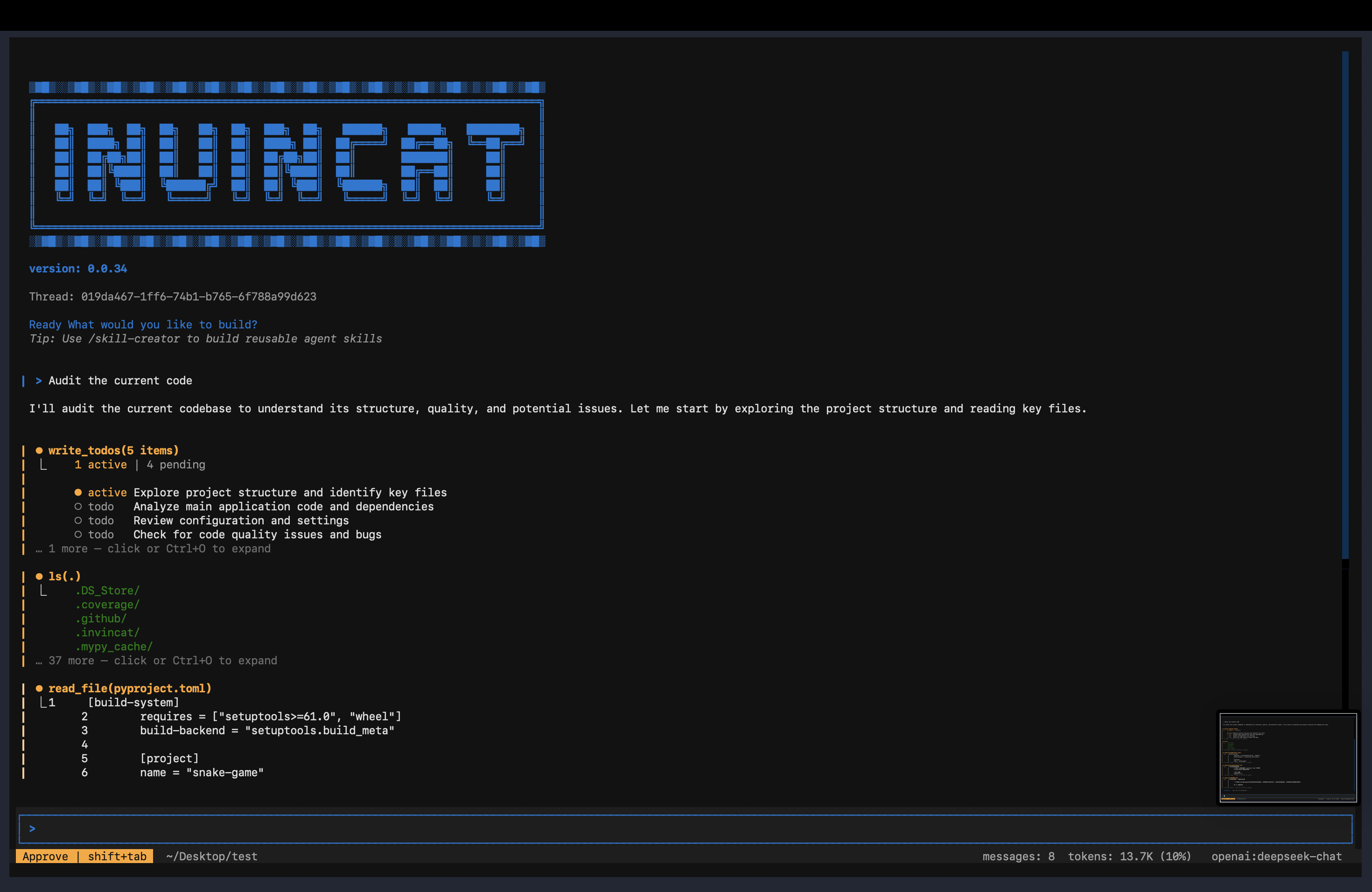
A Python-based terminal AI programming assistant — collaborate with AI directly in your project directory: read/write files, execute commands, browse the web, and maintain memory across sessions.
Why Invincat
Invincat is designed for real engineering work in local repositories, not demo-only chat.
- Terminal-native workflow: stay in your project directory and use AI without switching IDEs or browser tabs.
- Execution with guardrails: shell/file/network actions are approval-gated by default, with optional auto-approve for trusted flows.
- Plan-first delivery mode:
/planlets teams review and approve checklists before execution, reducing risky one-shot edits. - Long-context durability: micro compression + offload keep long sessions usable without losing operational history.
- Practical memory model: user/project memory stores persist conventions across sessions and are inspectable via
/memory. - Extensible architecture: MCP tools, skills, and subagents allow adapting the assistant to team-specific workflows.
Agent Architecture
Invincat uses a multi-agent runtime with clear role boundaries.
Execution Flow
User Inputenters the session router.- If
/planmode is active, input is routed to thePlanner Agent; otherwise to theMain Agent. Main Agentexecutes tools (file/shell/web/MCP) under approval and middleware guardrails.- After a non-trivial turn completes,
Memory Agentruns asynchronously to extract durable user/project memory updates. - When needed,
Main Agentdelegates bounded subtasks to local or async subagents.
Agent Roles and Responsibilities
| Agent | Primary Responsibility | Allowed/Expected Behavior | Hard Boundary |
|---|---|---|---|
| Main Agent | Execute user tasks end-to-end | Read/write files, run commands, use MCP/tools, coordinate subtasks | Must not directly read/write memory_user.json or memory_project.json |
Planner Agent (/plan) |
Produce and refine executable plans | Read-only context gathering, write_todos, approve_plan, optional clarification via ask_user |
No implementation actions (no file edits, no command execution) |
| Memory Agent | Curate durable memory after each completed turn | Score and apply memory ops (create/update/rescore/retier/archive/delete/noop) to user/project stores |
Conservative extraction; skips low-confidence or ephemeral facts |
| Local Subagents | Parallelize bounded in-process subtasks | Handle scoped tasks delegated by main agent with explicit instructions | Operate only within delegated scope; main agent remains final integrator |
| Async Subagents | Offload long/remote tasks | Launch/update/cancel remote subagent jobs via async tools | Treated as delegated workers, not primary conversation owner |
Runtime Guardrails
- Planner mode uses both visible-tool filtering and runtime allow-list enforcement.
- Memory store files are protected by middleware and updated only through the memory pipeline.
- Memory extraction runs in post-turn async middleware (
aafter_agent) so it does not block user-visible responses.
Documentation
- Chinese guide: doc/README_CN.md
- Memory design (Chinese): doc/MEMORY_DESIGN.md
- Memory design (English): doc/MEMORY_DESIGN_EN.md
Installation
Requirements: Python 3.11+
# Install from PyPI
pip install invincat-cli
Or install from source:
git clone https://github.com/dog-qiuqiu/invincat.git
cd invincat
pip install -e .
Quick Start
# Start in your project directory
cd ~/my-project
invincat-cli
After the first launch, run /model to configure the model and API Key, then you can start the conversation directly.
Model Configuration
Configure via Interface
Run /model command to open the model management interface:
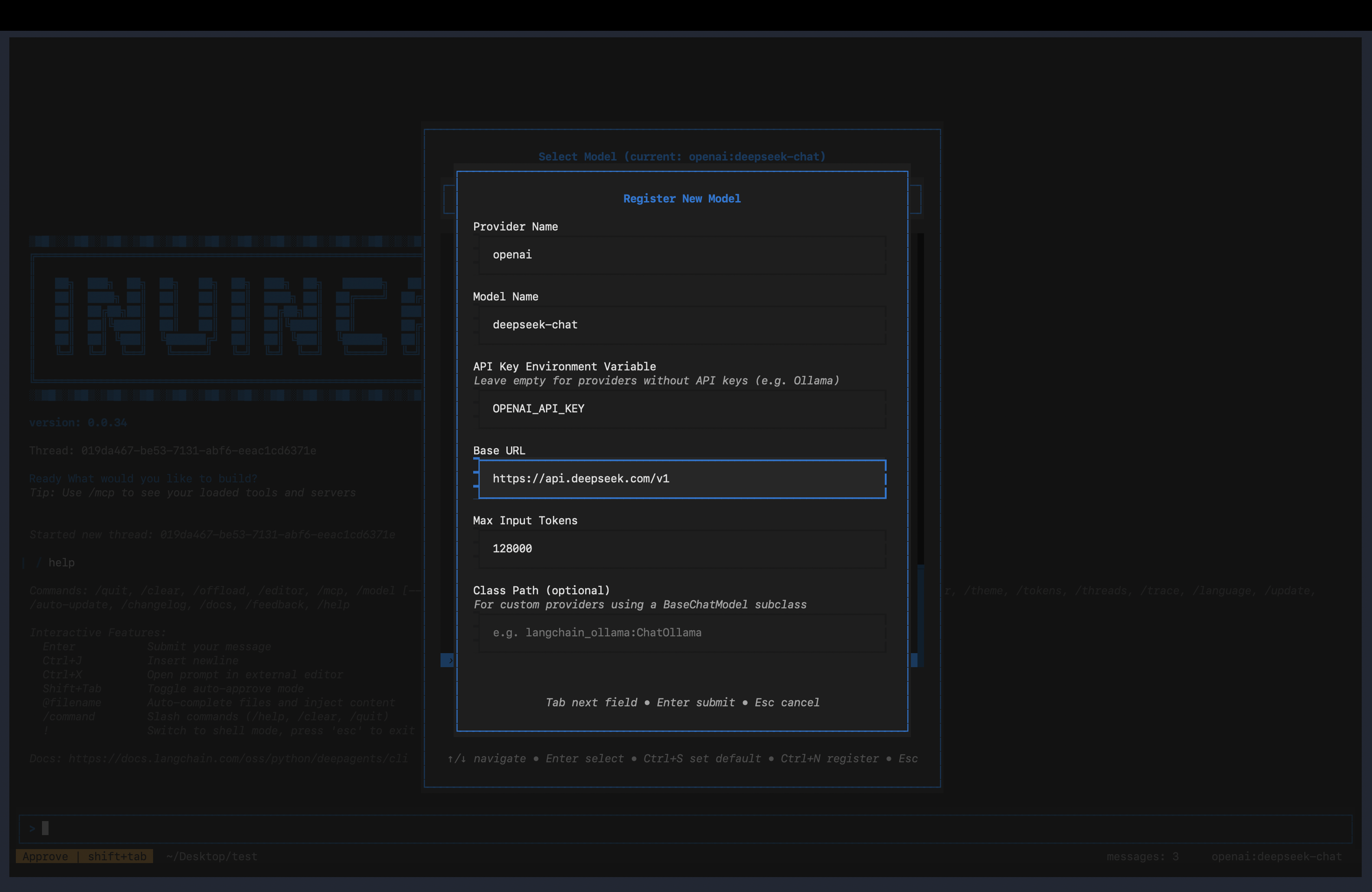
- Press
Ctrl+Nto register a new model - Fill in the provider, model name, and API Key
- Select from the list and press
Enterto activate
Supported Providers
| Provider | Example Models |
|---|---|
anthropic |
claude-sonnet-4-6, claude-opus-4-7 |
openai |
gpt-4o, o3 |
google_genai |
gemini-2.0-flash, gemini-2.5-pro |
openrouter |
Supports all models on OpenRouter |
For OpenAI-compatible interfaces (DeepSeek, Zhipu, local Ollama, etc.), simply set the base_url to connect.
Environment Variables
| Variable | Description |
|---|---|
ANTHROPIC_API_KEY |
Anthropic API Key |
OPENAI_API_KEY |
OpenAI API Key |
GOOGLE_API_KEY |
Google API Key |
OPENROUTER_API_KEY |
OpenRouter API Key |
TAVILY_API_KEY |
Tavily web search Key (optional) |
Basic Usage
Type your question or task directly in the input box and press Enter to send. AI will automatically select the appropriate tools to complete the task:
Search for the latest usage of LangGraph interrupt
Command Mode (/ prefix)
/clear
/threads
/model
... ...
Press Tab to autocomplete available commands. See Slash Commands for the complete list.
Plan Mode
Use planner mode when you want to discuss and approve a plan before execution:
/plan
Then describe your task in chat. The planner agent will:
- analyze requirements with read-only tools
- write a todo list (
write_todos) - ask for explicit approval (
approve_plan)
After approval, planner mode exits and keeps the approved checklist visible.
The approved checklist is then handed to the main agent for execution.
If you reject the plan, the planner stays in planning mode so you can refine
requirements and regenerate the checklist.
Exit planner mode anytime:
/exit-plan
/exit-plan also cancels an in-flight planner turn and drops queued planner handoff actions, so no stale plan execution will continue after exit.
File References
Use @ in your message to reference files, and AI will read and understand their content:
@src/main.py Are there any potential performance issues in this file?
Tool Approval
When AI performs operations like file writing, shell commands, or network requests, it will pause by default for confirmation:
Auto-approve Mode: Press Shift+Tab to toggle. When enabled, all tool calls are automatically approved, suitable for trusted task scenarios. The status bar will display an AUTO indicator.
⚠️ It's recommended to enable auto-approve only after you're familiar with the task content.
Input Line Breaks
Press Ctrl+J in the input box to insert a line break, suitable for entering longer code or paragraphs.
Context Management
Micro Compression
A lightweight compression that runs automatically before each model call, no LLM involved, taking <1ms.
How it works: Groups conversation messages by "tool call groups", keeps a dynamic recent window intact, and compresses older large tool outputs in two levels:
cleared-light: richer placeholder near the cutoff (keeps head/tail signals)cleared-heavy: stronger placeholder for older groups (keeps concise summary)
Compressible Tool Outputs:
| Tool | Compression Effect |
|---|---|
read_file |
file content → light/heavy placeholder |
edit_file |
diff output → light/heavy placeholder |
write_file |
write result → light/heavy placeholder |
execute |
shell output → light/heavy placeholder |
grep/glob/ls |
search/list output → light/heavy placeholder |
web_search/fetch_url |
web content → light/heavy placeholder |
Not Compressed: agent/subagent results, ask_user responses, MCP tool outputs, compact_conversation results.
Tune micro compression with environment variables:
INVINCAT_MICRO_COMPACT_KEEP_RECENT_GROUPS=3
INVINCAT_MICRO_COMPACT_DYNAMIC_GROUP_FACTOR=12
INVINCAT_MICRO_COMPACT_MAX_KEEP_RECENT_GROUPS=8
INVINCAT_MICRO_COMPACT_LIGHT_NEAR_CUTOFF_GROUPS=2
INVINCAT_MICRO_COMPACT_MIN_COMPRESS_CHARS=240
💡 Micro compression only affects the context sent to the model, does not modify persisted state, and complete history is still saved in checkpoints.
Auto Compression
When context window usage exceeds 80%, the system automatically compresses older messages into summaries to free up space, requiring no manual operation. The status bar token count turns orange above 70% and red above 90% as warnings.
Manual Compression
/offload
Or equivalently /compact. After execution, it shows how many messages were compressed and how many tokens were freed.
Memory System
AI can remember your preferences, project conventions, and important information across sessions.
Memory Architecture Highlights
- JSON single source of truth: runtime memory uses
memory_user.jsonandmemory_project.jsononly, which keeps reads/writes auditable and deterministic. - Dual-scope isolation: separates cross-project personal preferences (
user) from repository conventions (project) to avoid memory pollution. - Read/write pipeline decoupling:
RefreshableMemoryMiddlewareis responsible only for loading/rendering/injecting memory.MemoryAgentMiddlewareis responsible only for post-turn extraction and structured writes.
- Async post-turn extraction: memory updates run after main responses, so memory persistence does not block interactive latency.
- Incremental extraction with recovery: consumes only delta messages after last successful cursor, with full-history fallback when history is rewritten.
- Evidence-aware project memory: project scope favors durable conventions backed by tool evidence and avoids transient session noise.
- Deterministic invalid-fact cleanup: stale or contradicted active memories can be removed by rule-based validation, reducing long-lived wrong memory.
- Strong write safety: schema validation, dedup/conflict guards, path whitelist, and atomic write (
tmp + os.replace) prevent corruption. - Transparent and operable:
/memoryprovides full-screen live inspection and management for both scopes.
Memory Governance Innovation
This project treats memory as a governed subsystem, not just a longer chat history.
- Decision/write split: the memory agent decides operations, while runtime validators and guards decide what is actually persisted.
- Typed lifecycle model: memory evolves through explicit operations (
create/update/rescore/retier/archive/delete/noop) instead of opaque free-form rewrites. - Built-in drift control: invalid-fact cleanup, scoring/tiering, and archive/delete semantics prevent memory from becoming stale or bloated.
- Evidence-gated project memory: project conventions require durable signals and tool evidence, reducing accidental writes from transient noise.
- Operator-friendly governance: memory stores are inspectable JSON, and
/memoryprovides live visibility for review and correction.
Memory Runtime Architecture
flowchart LR
    A[Conversation Turn] --> B[Main Agent Response]
    B --> C[MemoryAgentMiddleware aafter_agent]
    C --> D{Non-trivial + completed + throttle passed?}
    D -- No --> E[Skip extraction]
    D -- Yes --> F[Incremental slice by cursor + anchor]
    F --> G[Collect tool evidence]
    G --> H[Structured ops JSON]
    H --> I[Validate + guardrails]
    I --> J[Atomic write memory_user.json / memory_project.json]
    J --> K[Next turn RefreshableMemoryMiddleware injects active memory]
Memory Files
| Type | Path | Scope |
|---|---|---|
| Global Memory Store | ~/.invincat/{assistant_id}/memory_user.json (default: ~/.invincat/agent/memory_user.json) |
Universal for all projects (coding style, personal preferences) |
| Project Memory Store | {project root}/.invincat/memory_project.json (fallback: {cwd}/.invincat/memory_project.json when project root is not detected) |
Current project context (repository conventions, architecture, stack); falls back to current working directory when no project root is detected |
AGENTS.md is deprecated for runtime memory injection. The runtime memory pipeline now uses memory_*.json as the single source of truth.
Auto Memory Update
Memory updates are triggered after non-trivial completed turns, with:
- incremental extraction: consume only messages added since the previous
memory extraction in the same thread - cursor invalidation fallback: if history is rewritten (for example,
compaction/checkpoint replay), fallback to one full-history pass - turn-interval throttling
- keyword-based early triggers (preferences/rules/conventions)
- time/file cooldown guards
Tune behavior via environment variables:
INVINCAT_MEMORY_CONTEXT_MESSAGES=0
INVINCAT_MEMORY_MIN_TURN_INTERVAL=1
INVINCAT_MEMORY_MIN_SECONDS_BETWEEN_RUNS=0
INVINCAT_MEMORY_FILE_COOLDOWN_SECONDS=0
INVINCAT_MEMORY_CONTEXT_MESSAGES=0 means no cap on the incremental delta
since the last memory extraction. Set a positive integer to cap the delta
to recent N messages.
By default the memory agent runs after every non-trivial turn
(MIN_TURN_INTERVAL=1, no wall-clock or file cooldown) so memory stays
in sync with the latest signal. Raise the values to re-enable throttling
if the extraction cost becomes a concern.
For production tuning (cost-sensitive setups), a practical starting point is:
INVINCAT_MEMORY_MIN_TURN_INTERVAL=2
INVINCAT_MEMORY_MIN_SECONDS_BETWEEN_RUNS=8
INVINCAT_MEMORY_FILE_COOLDOWN_SECONDS=5
Troubleshooting Project Memory Not Updating
If project memory updates appear rare, check in this order:
- Is the turn non-trivial and completed? Very short confirmations (
ok,thanks,继续) are skipped. - Did evidence come from supported tools? Project evidence extraction prioritizes
read_file,edit_file,write_file,execute,bash,shell. - Is evidence durable and convention-like? Temporary logs or one-off statuses are intentionally ignored.
- Is throttling active?
MIN_TURN_INTERVAL, wall-clock cooldown, or file cooldown can suppress runs. - Was history rewritten? Cursor mismatch triggers fallback behavior; check whether compaction/replay happened.
- Did writes fail guardrails? Invalid/conflicting operations are dropped by schema and safety validation.
Quick verification path:
- Run one concrete, non-trivial turn that states a stable project rule.
- Ensure at least one supporting read/execute tool result exists in that turn.
- Open
/memoryand check theprojecttab for new or updated active items.
Memory Design Docs
Memory Manager UI
/memory
Open the full-screen memory manager for live inspection of memory stores:
- separate pages for
userandprojectscope (1/2, orTabto switch) - highlights key fields (
status,id,section,content) for each item - supports
r(refresh),a(show/hide archived),Esc(close)
Skill System
Skills are predefined workflow templates for reusing complex task steps.
Using Skills
/skill:web-research Search for LangGraph best practices
/skill:code-review Check code quality in src/ directory
Skill Locations
| Location | Path | Description |
|---|---|---|
| Built-in Skills | Installed with package | skill-creator |
| Global Custom | ~/.invincat/agent/skills/ |
Available across projects |
| Project-level | .invincat/skills/ |
Only available in current project |
Creating Custom Skills
/skill-creator
Starts an interactive wizard that guides you through creating and saving new skills.
Session Management
View and Switch Sessions
/threads
Opens the session browser, displaying all historical conversations (time, message count, branch, etc.).
Start New Conversation
/clear
Clears the current conversation and starts a new session (old sessions are still saved and can be retrieved via /threads).
Slash Commands
Type / in the input box and press Tab to view and autocomplete all commands.
Session
| Command | Description |
|---|---|
/clear |
Clear current conversation, start new session |
/threads |
Browse and restore historical sessions |
/plan |
Enter planner mode; approved checklist is handed to the main agent |
/exit-plan |
Exit planner mode, cancel running planner turn and queued handoff |
/quit / /q |
Exit program |
Model & Interface
| Command | Description |
|---|---|
/model |
Switch or manage model configurations |
/theme |
Switch color theme |
/language |
Switch interface language (Chinese / English) |
/tokens |
View token usage details |
Context & Memory
| Command | Description |
|---|---|
/offload / /compact |
Manually compress context, free tokens |
/memory |
Open full-screen memory manager (live user/project view) |
Tools & Extensions
| Command | Description |
|---|---|
/mcp |
View connected MCP servers and tools |
/editor |
Edit current input in external editor |
/skill-creator |
Interactive wizard for creating new skills |
/changelog |
Open release notes/changelog |
/feedback |
Show feedback channel information |
/docs |
Open project documentation entry |
Others
| Command | Description |
|---|---|
/help |
Display help information |
/version |
Display version number |
/reload |
Reload configuration files |
/trace |
Open current conversation in LangSmith (requires configuration) |
FAQ
Q: No response on first launch?
You need to configure the model first. Run /model → Press Ctrl+N to register a model → Fill in the API Key.
Q: How to interrupt a running task?
Press Esc to interrupt the current AI response; if AI is waiting for tool approval, Esc acts as a rejection.
Q: Context too long causing slow response?
Run /offload to manually compress history, or wait for automatic compression (triggers when usage exceeds 80%).
Q: How to make AI remember my coding preferences?
Just tell AI directly, for example "Remember: my project uses 4-space indentation, no semicolons", and AI will automatically save it to memory files at the appropriate time.
Q: How to share skills across different projects?
Place skill files in the ~/.invincat/agent/skills/ directory for global availability; place in .invincat/skills/ for current project only.
Yorumlar (0)
Yorum birakmak icin giris yap.
Yorum birakSonuc bulunamadi