headroom
Health Uyari
- License — License: MIT
- Description — Repository has a description
- Active repo — Last push 0 days ago
- Low visibility — Only 5 GitHub stars
Code Gecti
- Code scan — Scanned 12 files during light audit, no dangerous patterns found
Permissions Gecti
- Permissions — No dangerous permissions requested
Bu listing icin henuz AI raporu yok.
Track and rotate your Claude & Codex usage across accounts from one live dashboard — read live, never spending a token.
headroom
Never hit a Claude or Codex usage limit mid-flight again.
headroom tracks the remaining capacity of every Claude and ChatGPT/Codex
subscription you own — without spending a single token — puts it on a live
dashboard you'll actually want to look at, and rotates your tools to the next
account with headroom the moment one hits a limit.
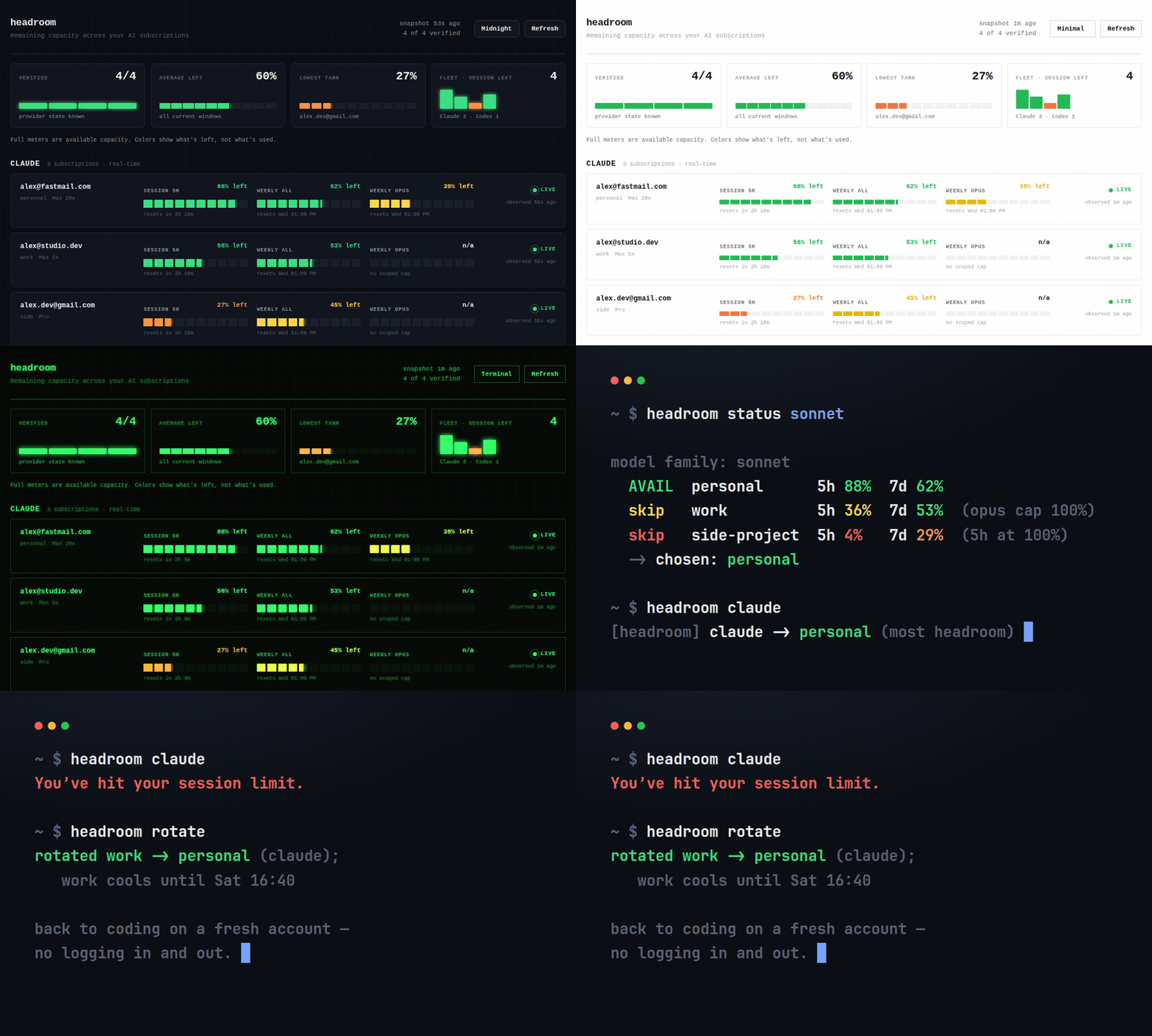
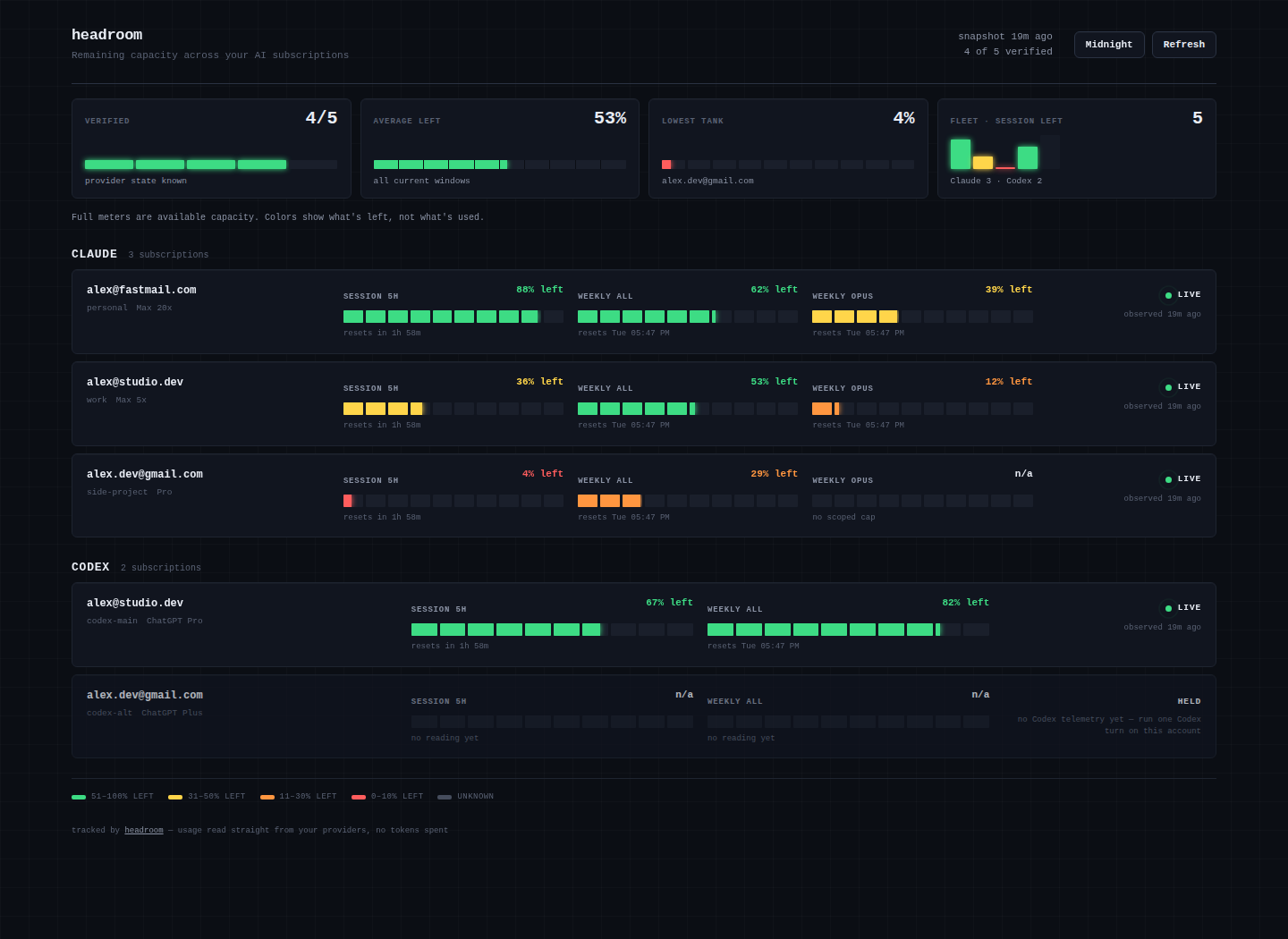
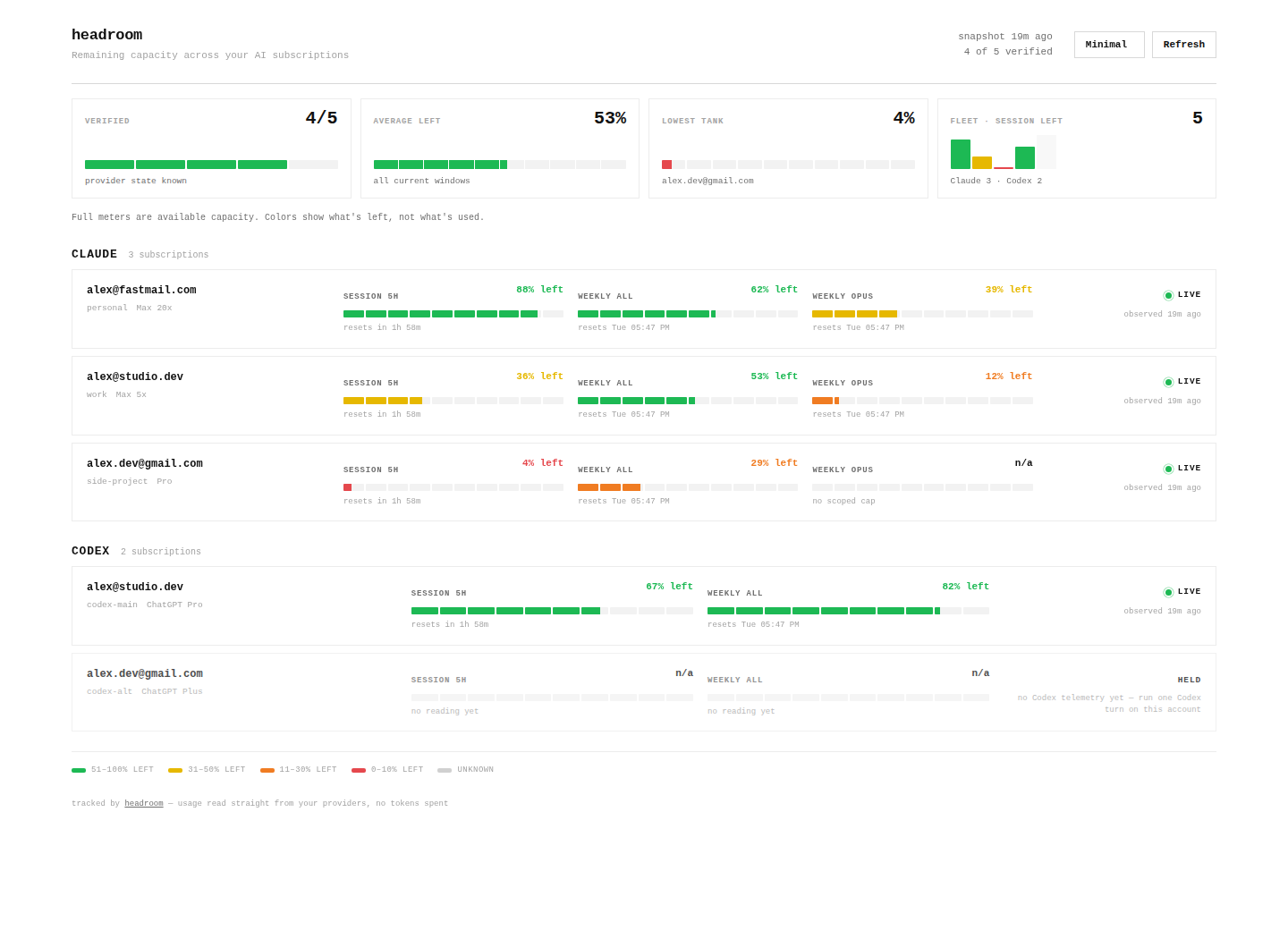
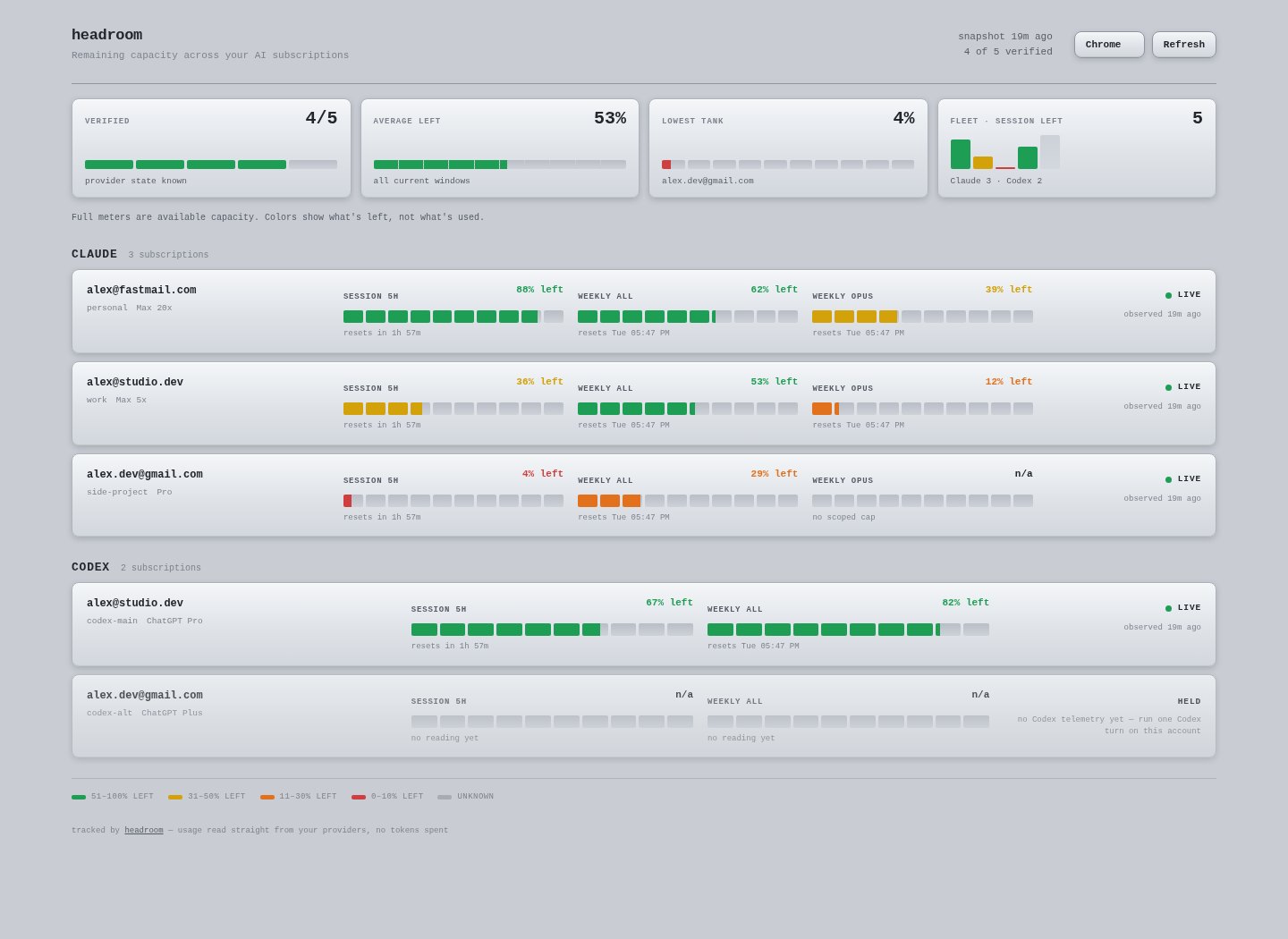
Five built-in themes (Midnight, Minimal, Chrome, Paper, Terminal), switchable
live from the dashboard. The setup wizard asks how you want it to look.
| Midnight | Minimal |
|---|---|
 |
 |
| Chrome | Terminal |
|---|---|
 |
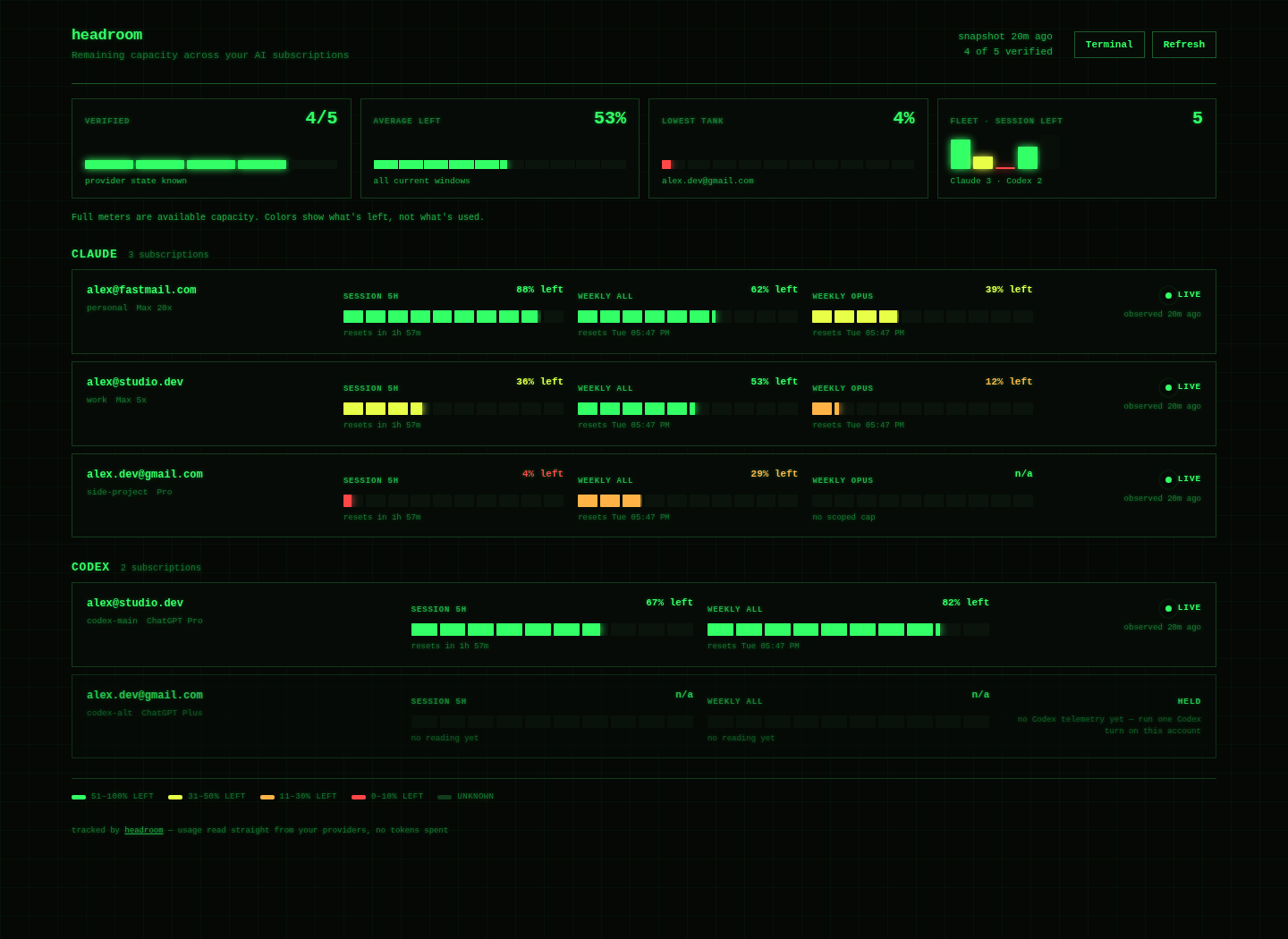 |
Why this exists
If you run more than one Claude or ChatGPT subscription (work + personal +
team), you know the drill: a session dies with "you've hit your limit", you
have no idea how much is left on the other accounts, and you burn ten minutes
logging in and out to find out.
headroom fixes all three problems:
- See — every account's 5-hour, weekly, and model-scoped windows on one
page, color-coded by what's left, not what's used. - Read for free — usage comes live from the same reads your CLIs already
use (Anthropic's OAuth usage API; the Codex app-server's rate-limits read).
Checking your limits never consumes them. - Rotate —
headroom claudelaunches on the first account in your
preference order with proven headroom. When a limit hits,headroom rotate(or the/rotatorskill inside Claude Code) cools that
login down until its window resets and hands you the next one.
Quickstart
Requirements: Python 3.9+ (stdlib only — no pip installs), macOS or Linux,
and the claude and/or codex CLIs you already use. (On macOS, connect
Claude accounts with a fresh headroom connect login rather than adopting the
Keychain-backed default — see docs/KNOWN-LIMITS.md.)
git clone https://github.com/domanski-ai/headroom
cd headroom
./install.sh              # symlinks bin/headroom onto your PATH
headroom serve --demo     # OPTIONAL: preview it now with sample data, no setup
headroom setup            # the wizard: connects accounts, styles your dashboard
Want to see it before connecting anything? headroom serve --demo opens the
dashboard on bundled sample data — it's exactly what the screenshots show.
The wizard finds logins already on your machine (~/.claude, ~/.codex) and
adopts them in place — credentials are never moved, copied, or read beyond
what's needed to verify who's logged in. Extra accounts get their own isolated
config home and log in through the provider's own flow.
Then:
headroom serve --open      # live dashboard at http://127.0.0.1:8377
headroom status sonnet     # who has capacity right now, and why not
headroom claude            # launch Claude Code on the best account
headroom rotate            # limit hit? cool this login, switch to the next
The commands
| command | what it does |
|---|---|
headroom setup |
first-run wizard: accounts + dashboard style quiz |
headroom connect |
add another account (guided login, clobber-proof) |
headroom collect |
refresh usage for every account (no tokens spent) |
headroom status [model] |
table: every account, its windows, and exactly why any is skipped |
headroom pick <model> |
print the best account name (exit 2 if none) — script-friendly |
headroom env <model> |
print the export CLAUDE_CONFIG_DIR=... line for the best account |
headroom claude / codex [args] |
launch the CLI on the best account |
headroom run <model> -- <cmd> |
headless run with automatic rotation on limit-hit |
headroom rotate [model] |
cool the current account, hand you the next |
headroom serve [--open] |
local live dashboard (auto-refreshes stale data) |
headroom serve --demo |
preview the dashboard with bundled sample data — no accounts needed |
headroom statusline |
color-coded capacity for your Claude Code status line |
headroom doctor |
environment + config health check (handy for bug reports) |
How the reads work (and why they're safe)
- Claude — real-time. Your login token already has access to
api.anthropic.com/api/oauth/usage, the endpoint the Claude apps themselves
use to draw their usage UI. headroom calls it read-only and verifies the
organization the response belongs to matches the login bound to that slot —
a swapped or clobbered login can never report another account's headroom.
Claude usage is always live. - Codex — real-time. headroom reads Codex usage live from the Codex
app-server (codex app-server→account/rateLimits/read+account/read), bound to each account's own config home. That's a live,
identity-verified read of the same rate-limit data ChatGPT/Codex uses — not
a scrape of stale session logs — so Codex usage is as current as Claude's,
and Codex accounts are routed and rotated just like Claude ones.
(On an older Codex CLI without the app-server, headroom falls back to a
best-effort session-log read and the router holds those accounts until a
fresh reading appears.)
Every account is optional — run only Claude, only Codex, or both. Both
providers are read live, identity-bound, and fully routed.
- Snapshots are written atomically. The dashboard gets a sanitized projection
(optionally with emails redacted) — raw identity material stays in the
private state directory with0600permissions.
Fail-closed by design
headroom never guesses. An account with a stale reading, an unverifiable
identity, an out-of-range percentage, or an active cooldown is held — shown
on the dashboard as held, skipped by the router, with the reason spelled out
in headroom status. If no account has proven capacity, pick says so with a
non-zero exit instead of pointing you at a login that will die mid-task.
Connecting accounts is protected the same way: a fresh login that turns out to
be an account you already connected is rolled back and refused, because two
slots silently sharing one login is how you eat a week's quota by accident.
Claude Code integration
See integrations/claude-code — a status line
showing live capacity at the bottom of every session, and a /rotator skill
so Claude can rotate accounts for you when a limit hits.
Hosting the dashboard somewhere else
headroom dashboard builds two static files (index.html + usage.json)
in ~/.headroom/state/public/. Put them behind any static host or reverse
proxy; add a cron for headroom collect to keep the JSON fresh. Turn onredact_emails in setup if the page might be visible to others.
Security posture
The engine was adversarially reviewed cross-model (GPT-5.6 at x-high
reasoning effort) before first release; every fixable finding is patched and
the deliberate tradeoffs are documented in
docs/KNOWN-LIMITS.md. Highlights: auth-override
environment variables are scrubbed from every provider subprocess, usage
snapshots are atomic with a sanitized public projection (emails redacted by
default), authenticated requests never follow redirects, corrupt protective
state holds routing instead of clearing it, and stale data is always shown
as held — never promoted to live.
A note on multiple accounts
headroom manages accounts you legitimately hold — a personal plan, a work
plan, a team seat. It doesn't create accounts, share credentials, or bypass
provider controls; it just routes your own tools at your own logins and tells
you what's left. Check your providers' terms if you're unsure what applies
to your setup.
License
MIT — see LICENSE.
Yorumlar (0)
Yorum birakmak icin giris yap.
Yorum birakSonuc bulunamadi