pattern-mcp
Health Warn
- License — License: MIT
- Description — Repository has a description
- Active repo — Last push 0 days ago
- Low visibility — Only 6 GitHub stars
Code Warn
- process.env — Environment variable access in scripts/budget-diff.mjs
- process.env — Environment variable access in scripts/category-eval-bundled-only.mjs
- process.env — Environment variable access in scripts/coop-rewards-1_5-validation.mjs
- process.env — Environment variable access in scripts/diagnose-variance.mjs
- network request — Outbound network request in scripts/diagnose-variance.mjs
Permissions Pass
- Permissions — No dangerous permissions requested
No AI report is available for this listing yet.
Pattern MCP helps coding agents make better UI decisions before they start building. It checks component libraries against product requirements, helping agents avoid missing important needs or adding unnecessary complexity. If nothing fits, Pattern finds real references from Mobbin and Figma, so agents can build from something concrete, not guess.
Pattern




Pattern solves a simple problem: agents don't always follow your design
guidance. Instead of relying on the agent to interpret and follow
instructions, Pattern turns that guidance into a checkable process. It
evaluates UI components from external libraries or your own design
system against a requirements checklist, then tells the agent whether to
use an existing component or build one from scratch using a concrete
design reference.
Website · npm · Report an issue
Contents (click to expand)- Install · What Pattern Does · How it works · Quick Start · Try it · Validation examples
- Make the judgment call:
recommend_component·extract_requirements - Track cost and outcome:
record_component_decision·read_ledger·report_build_cost·report_outcome_proxy· Feature cost attribution · Outcome proxies · Per-project judgment ledger - Verify and export old decisions:
check_ledger_liveness·sweep_ledger_liveness·export_ledger_provenance·backfill_ledger_snapshot_ref·post_ledger_provenance_to_github· Ledger integrity and decision provenance (design overview — start here for how the five fit together) - Per-project decision memory · Security and privacy · Telemetry
- Cost: The
_metafield · Prompt caching · Measured cache and fetch behavior · Search limits · Ensemble cost · Session call cap - Local call log · Known limitations
Install
npm install pattern-mcp
See Quick Start below to add your Anthropic API key and connect
Pattern to your MCP client.
What Pattern Does
Instead of returning a list of search results, Pattern looks at what you
need, checks real components against that need, and tells the agent
whether to:
- Use an existing component from shadcn/ui, 21st.dev, or ReUI
- Build a custom component, using a real product reference from
Mobbin and/or Figma Community
Pattern is designed for agents to use while they are building.
It exposes eleven tools, in three groups:
Make the judgment call.
recommend_component— evaluates a UI component need and returns a
structured recommendation.extract_requirements— runs just the requirement-extraction step on
its own, so you can inspect or hand-edit the checklist beforerecommend_componentspends its search+score budget on it.
Track what it cost and what actually happened.
record_component_decision— records what the agent actually did so
future recommendations in the same project can take that decision into
account.read_ledger— lists pastrecommend_componentjudgments for aproject_id, including any that were served from the ledger cache (see
Per-project judgment ledger); passfeature_idinstead of browsing by keyword to get a full cost rollup for
one feature (see Tool:report_build_cost).report_build_cost— self-reports the end-to-end build cost for one
feature, so cost incurred after Pattern's own verdict (the actual
scaffold/install/build) is still attributable back to it.report_outcome_proxy— self-reports a value signal (rework, time to
merge, kept-vs-replaced) for one feature, deliberately independent of
Pattern's own verdict -- see Outcome
proxies.
Verify old decisions still hold up, and export a record of them. See
Ledger integrity and decision
provenance for how these five
fit together.
check_ledger_liveness— checks whether a ledger entry's recordedfile_pathstill exists and still references itschosen_candidate.sweep_ledger_liveness— batch version ofcheck_ledger_liveness
across a whole project (or every project in the ledger), plus
dangling-cluster detection. Meant to be invoked by your own cron/CI, not
something Pattern schedules itself.export_ledger_provenance— formats one ledger entry as a stable
markdown block (checklist, candidates, verdict,snapshot_ref) you can
paste into a PR or issue by hand.backfill_ledger_snapshot_ref— best-effortsnapshot_ref
reconstruction for entries written before that field existed.post_ledger_provenance_to_github— posts anexport_ledger_provenance
artifact as a real comment on a GitHub PR/issue, idempotently. The one
tool here with a real, visible side effect outside your own machine;
confirm with the user before calling it.
How it works
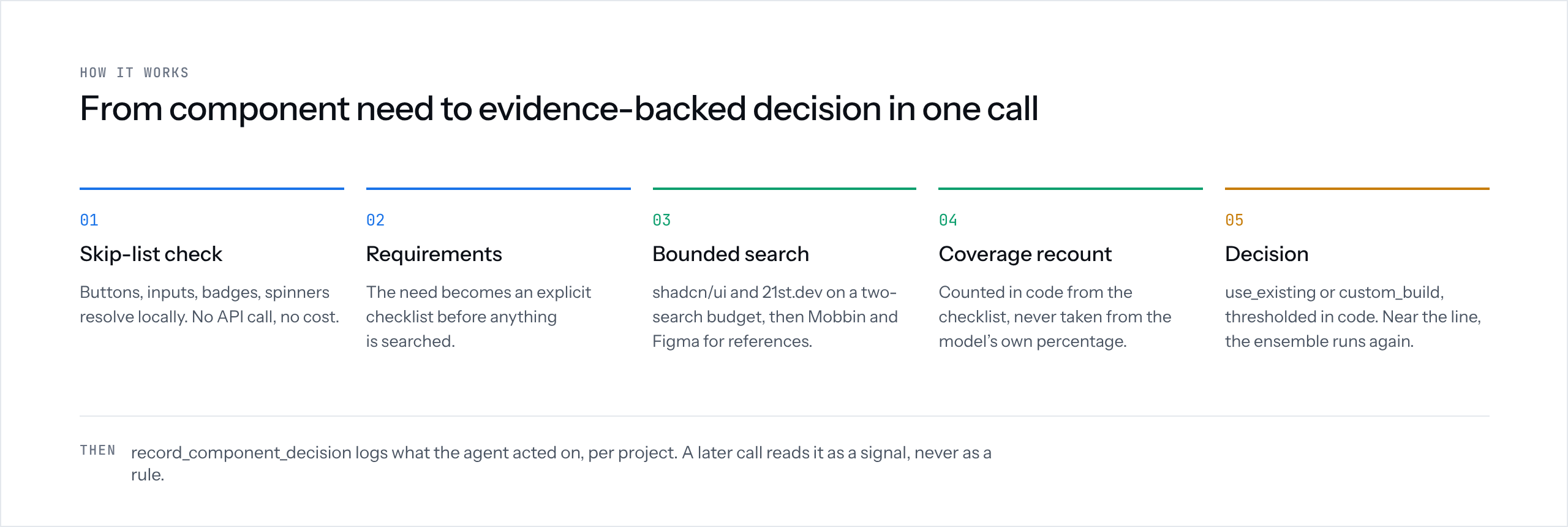
For each recommend_component call, Pattern:
- Checks whether the need is a simple primitive that doesn't require a
search. - Turns the request into a set of specific requirements, unless a
checklist was already supplied (seechecklist). - Searches for matching shadcn/ui, 21st.dev, and ReUI components.
- Checks each candidate against the requirements using evidence from the
actual component. - Calculates how much of the requirement is covered.
- Decides whether to use an existing component or build a custom one.
- If a custom build is needed, searches Mobbin and Figma Community for
real product examples. - Returns the result as structured JSON the calling agent can act on.
Coverage is calculated by the server from the individual requirements it
checked. It does not simply trust the percentage returned by the model.
A result can also be:
use_existingcustom_buildno_candidates_foundskip_listledger_cache_hit— served from a recent, matching prior judgment
instead of a fresh search+score (see
Per-project judgment ledger).
no_candidates_found is kept separate from a low-coverage result. Not
finding a candidate is different from finding candidates that don't cover
the requirements.
If project_id is supplied, Pattern also checks for past confirmed
decisions on that project and factors them in as a consistency signal —
never a rule that overrides a genuinely better match found in the current
search. Separately, project_id also enables the judgment ledger: a
high-confidence prior judgment matching this exact
component_need/domain/framework/existing_stack, recorded recently enough,
can be served directly (ledger_cache_hit) instead of running a fresh
search+score. This is the one deliberate exception to "every recommendation
searches and scores again" — see
Per-project judgment ledger for the exact
rules and why it's safe.
Every result includes computed_at, because coverage is a snapshot of the
search at that point in time, not a permanent fact. Every result also
includes _meta — the timing and token cost of that specific call (see
Cost).
Boundary-risk checks
The same evidence can sometimes be judged slightly differently between
model runs. When a result is close enough to a decision threshold that it
could change the verdict, Pattern automatically runs the judgment two more
times and uses the majority result.
If the three runs disagree, Pattern returns:
{
  "confidence": "low",
  "ensemble": {
    "triggered": true,
    "runs": ["use_existing", "custom_build", "use_existing"],
    "agreement": "2/3"
  }
}
Results that are clearly inside a threshold don't trigger extra runs — see
Cost below for the measured impact.
Simple primitives
These are handled locally without an API call:
| Primitive | Use it for |
|---|---|
button |
A clickable action trigger |
input |
A single-line text entry field |
checkbox |
A binary on/off toggle |
label |
A caption for a field or control |
badge |
A small status or count indicator |
spinner |
An indeterminate loading indicator |
tooltip |
A contextual hover/focus hint |
avatar |
A user or entity image, or initials |
icon |
A single glyph or symbol |
This keeps trivial requests fast and avoids unnecessary API usage.
What powers the search
Pattern does not scrape shadcn/ui, 21st.dev, ReUI, Mobbin, or Figma Community
itself.
Each tool call makes one or more requests to the Anthropic Messages API,
using claude-sonnet-5 by default. The server enables Anthropic'sweb_search tool and provides a system prompt that defines the full
decision process.
That process includes:
- Skip-list checks
- Requirement extraction
- Component search
- Evidence-based coverage scoring
- Decision thresholds
- Mobbin and Figma Community reference searches when a custom build is
needed
Figma Community does not require a Figma API key. Pattern uses the same
web search mechanism for Figma Community as it does for the other sources.
The model returns structured JSON. Pattern then applies important checks
itself, including recalculating coverage and applying the decision
threshold.
Quick Start
1. Install
npm install pattern-mcp
This installs the pattern-mcp command via npx (or your project's
local node_modules/.bin), used in the client configs below.
git clone <this repo>
cd pattern-mcp
npm install
npm run build
Use node /absolute/path/to/pattern-mcp/dist/index.js as the server
command in place of npx pattern-mcp in the examples below.
2. Add your Anthropic API key
Pattern requires:
ANTHROPIC_API_KEY
The API account associated with this key pays for the requests Pattern
makes (see Cost below).
You get the key from the Anthropic Console under Settings → API Keys.
API billing is separate from Claude.ai or Claude Code subscriptions. A
Claude Pro or Max subscription does not include API usage.
Connect Pattern to your MCP client
Pattern is a standard MCP server, so it works with MCP-compatible
clients.
The server command is:
npx pattern-mcp
Claude Code
You can add Pattern to your project's .mcp.json or register it with the
CLI.
For the current project:
claude mcp add pattern \
  -e ANTHROPIC_API_KEY=sk-ant-... \
  -- npx pattern-mcp
This uses the default local scope, so the server is available to the
current project.
To make Pattern available across your projects:
claude mcp add pattern \
  -e ANTHROPIC_API_KEY=sk-ant-... \
  --scope user \
  -- npx pattern-mcp
Important: put -e/--env and --scope before the --. Everything
after -- is treated as the command and its arguments.
Check the connection with:
claude mcp list
You should see Pattern with a ✔ Connected status.
claude mcp add stores the configuration in ~/.claude.json. Avoidclaude mcp get pattern when possible because it can print your API key
in plaintext.
Cursor
Add Pattern to:
.cursor/mcp.json
Codex CLI
Pattern can be configured globally in:
~/.codex/config.toml
or at the project level in:
.codex/config.json
Use the MCP configuration format supported by your Codex CLI version.
Claude Desktop
Add Pattern through Claude Desktop's MCP settings.
The configuration looks like:
{
  "mcpServers": {
    "pattern": {
      "command": "npx",
      "args": ["pattern-mcp"],
      "env": {
        "ANTHROPIC_API_KEY": "sk-ant-..."
      }
    }
  }
}
Restart your MCP client after adding Pattern.
Then ask your agent to list its available MCP tools and look for:
recommend_component
Try it
Give your agent a specific UI need, for example:
Use recommend_component to find me a UI component for a price breakdown
showing nightly rate, cleaning fee, service fee, and taxes. I'm building
an Airbnb-style booking checkout in React with Tailwind.
The agent should use the result to make the next decision:
- Install or use the recommended component, or
- Start a custom build using the returned requirements and product
references.
Pattern returns useful descriptions for both paths.
- For an existing component,
component_descriptionexplains what the
component does and looks like before the agent installs it. - For a custom build,
reference_descriptionexplains what each Mobbin
or Figma Community reference actually shows.
These descriptions are grounded in what Pattern found during the search
rather than generic descriptions.
Validation examples
Pattern's validation suite uses five UI needs from an Airbnb-style rental
marketplace:
- Price breakdown with fees and taxes
- Cancellation policy display
- Host earnings dashboard
- Property image gallery
- Host-guest messaging inbox
Together, these cover different outcomes, including clear matches,
false-positive-prone searches, no candidates, and decisions close to the
threshold.
Tool: recommend_component
Input
{
  "component_need": "price breakdown with fees and taxes",
  "domain": "Airbnb-style rental marketplace",
  "framework": "React + Tailwind",
  "existing_stack": "already using shadcn/ui",
  "project_id": "my-booking-app"
}
component_need should describe the actual UI you need, not just a
category.
Good: price breakdown with fees and taxes
Too vague: pricing
Vague requests can produce misleading matches. For example, a generic
SaaS pricing table may look like a match for "pricing" even though it
doesn't work for a booking checkout.
project_id
project_id is optional.
When provided, Pattern can use decisions previously recorded for the
same project (see Per-project decision memory)
as a consistency signal.
A previous decision can help the model stay consistent with similar UI
decisions, but it cannot override a better match found in the current
search.
Pattern still searches and scores every request from scratch. Past
decisions never cause a search to be skipped.
If you leave out project_id, Pattern does not use project memory.
checklist
checklist is optional -- an array of requirement strings.
When provided, recommend_component skips its own internal requirement
extraction entirely and scores coverage against exactly the items you
passed, instead of extracting its own checklist. Search and scoring still
run fresh every call; only the extraction step is skipped.
This is meant to be used together with extract_requirements:
call extract_requirements first, inspect (or hand-edit) the checklist it
returns, then pass that checklist here. That gives you a chance to catch a
misread requirement before Pattern spends its search+score budget.
Leave checklist out to keep today's default behavior: recommend_component
extracts its own checklist internally, exactly as before this option
existed.
feature_id
feature_id is optional -- a stable identifier for the feature this
component need belongs to (e.g. a ticket id or branch name). Its only use
is joining this call's cost with a laterreport_build_cost call for the same feature.
Omit it to have one derived deterministically from project_id +component_need; only meaningful together with project_id. See
Feature cost attribution.
file_path
file_path is optional -- path (relative to PROJECT_ROOT) where this
component decision is expected to be implemented, if already known.
Usually not known yet at call time, since the decision typically precedes
the file existing. When provided, it's stored on the resulting ledger
entry and check_ledger_liveness can later
confirm the file still exists and still references chosen_candidate. It
cannot currently be attached to an entry after the fact -- see Ledger
integrity and decision provenance.
Is the checklist actually skipped, not just re-derived? Checked, not
assumed. breakdown_ms.extract for a checklist-provided call is smaller
than the default path's, but not near-zero -- which raised the question of
whether the model is still doing some of the extraction work in that
window rather than treating the checklist as fixed input. Reading the
model's actual reasoning (via thinking with display: "summarized",
5 runs: 3 with checklist provided, 2 default) answered it: thechecklist-provided runs' pre-search reasoning was a short, generic
"search shadcn/ui and 21st.dev" thought with no mention of the checklist's
content, e.g. "I should look for existing image gallery component options
on shadcn/ui and 21st.dev" -- consistently ~3-4 seconds. The default
runs' reasoning, by contrast, explicitly enumerated and derived the
checklist items ("...mapping out the checklist: a photo grid with hero
and thumbnails... a full-screen lightbox with next/prev navigation,
keyboard support...") and took roughly 2x longer (~7-8 seconds). The
remaining time in the checklist-provided path is baseline model latency
before it decides to search, not re-extraction -- it doesn't scale with or
reference the checklist's content.
Output
{
  "verdict": "use_existing | custom_build",
  "confidence": "high | medium | low",
  "reason": "scored | no_candidates_found | skip_list",
  "computed_at": "2026-08-23",
  "requirements_checked": [
    {
      "requirement": "...",
      "met": true,
      "evidence": "..."
    }
  ],
  "coverage": "5/7 (71%)",
  "recommendation": {
    "source": "21st.dev | shadcn | reui | null",
    "install_command": "string | null",
    "component_description": "string | null",
    "reference": {
      "source": "Mobbin | Figma Community",
      "url": "...",
      "flow_name": "...",
      "file_name": "...",
      "reference_description": "...",
      "url_type": "deep_link | entry_point"
    }
  },
  "ensemble": {
    "triggered": false
  },
  "checklist_source": "extracted | provided",
  "_meta": {
    "total_ms": 41516,
    "breakdown_ms": { "extract": 5006, "search": 3114, "score": 33396 },
    "tokens_used": { "input": 8400, "output": 620 },
    "estimated_cost_usd": 0.14
  }
}
The past_decision_signal field is included only when there is a
relevant previous decision for the supplied project_id.
checklist_source is always present: "extracted" when Pattern derived
the checklist itself (the default, unchanged behavior), "provided" when
you passed one in via checklist.
_meta is always present. See Cost for what each field means,
how breakdown_ms is measured, and what it means when the ensemble
triggers.
Reference links
When Pattern recommends a custom build, it may return references from
Mobbin, Figma Community, or both.
The reference field can be:
- An array when both sources returned useful results.
- A single object when only one source returned a useful result.
nullwhen neither source produced a grounded reference.
Deep links vs. entry points
Pattern tells you whether a reference URL points directly to the
identified screen or flow.
"url_type": "deep_link" means Pattern verified that the URL points to
the specific reference.
"url_type": "entry_point" means the URL is a search or browse page. The
agent may need to find the specific screen or flow from there.
For Mobbin, Pattern fetches the search result page and looks for a more
specific link to the screen or flow it identified.
For Figma Community, URLs containing /community/file/ are already
specific to a file and are treated as deep links. Other Figma URLs are
checked like Mobbin URLs.
Pattern never invents a URL. If it cannot verify a specific link, it
keeps the real search result URL and clearly identifies it as an entry
point.
Installation commands are not trusted
The install_command comes from search results. It is not verified
against a package registry, and Pattern does not execute it.
The calling agent should:
- Show the command to the user.
- Get confirmation.
- Run it only after confirmation.
See SECURITY.md for more details.
Tool: register_design_system
Points recommend_component at this project's own design system instead
of shadcn/ui, 21st.dev, and ReUI -- for a solo dev with their own component
library or design spec who wants Pattern's coverage scoring against
candidates they'll actually use, not external libraries they won't. This is
the Solo Dev architecture from pattern-solo-design-system-architecture.md:
local, per-project, one-or-the-other -- registering a design system for aproject_id replaces external-library scoring for that project
entirely, it does not add to it. There's no shared/remote ledger, no
multi-user attribution, and no team auth in this scope -- those are
deliberately deferred to a team phase, only if this use case proves out.
Input
Exactly one of manifest_path or directory_path is required, both
relative to the project root (PATTERN_PROJECT_ROOT, defaults to this
server's working directory) -- never an absolute path.
{
  "project_id": "my-booking-app",
  "directory_path": "src/components"
}
manifest_path-- a components manifest. Two recognized shapes:- A hand-authored JSON array of
{name, props, description, usage_example}objects, optionally wrapped in{"components": [...]}. - A Storybook-exported
stories.json/index.jsonfile (an object with a
top-levelentriesorstoriesmap). Component names only in this
case -- Storybook's basic export doesn't carry prop data, so candidates
from this path start with an emptypropslist.
- A hand-authored JSON array of
directory_path-- a directory of real component source files,
scanned recursively for.jsx/.tsx/.js/.tsfiles (excludingnode_modules/dist/build/.gitand.test./.spec./.stories.
files). Each exported, uppercase-named function or const component found
becomes a candidate, with props read in priority order from a<Name>Propsinterface/type, a.propTypesblock, or (last resort) the
component's own destructured parameters. This is a heuristic scan, not a
full parser -- a sparse or partial props list for some components is
expected, not a bug, especially on plain JS with no prop typing at all.
Output
{
  "status": "registered",
  "registration": {
    "project_id": "my-booking-app",
    "source_kind": "directory_scan",
    "source_path": "src/components",
    "registered_at": "2026-09-03T18:04:11.201Z",
    "candidate_count": 29,
    "candidates": [
      { "name": "ReferralBanner", "props": ["code", "bonusAmount"], "description": null, "usage_example": null, "file_path": "rewards/ReferralBanner.jsx" }
    ]
  }
}
Registering overwrites (does not merge with) any prior registration for the
same project_id. Once registered, recommend_component scores ONLY
against these candidates for calls with this project_id -- no separate
flag needed, it's automatic based on project_id alone, and step 3's live
web search is skipped entirely (web_search is still available, but
reserved for a custom_build verdict's Mobbin/Figma Community reference
grounding, same as the external-library path). A use_existing verdict
scored this way always carries "source": "design_system" on the
resulting ledger entry, set server-side regardless of what the model wrote,
so read_ledger and export_ledger_provenance can match on it reliably.
This only writes local config to ~/.pattern/design_systems.json (override
with PATTERN_DESIGN_SYSTEMS_PATH) -- it never calls the Anthropic API.
Registration is a point-in-time snapshot, not a live link: re-run this
whenever the design system's own components change meaningfully.
A safety net for a missed match
The model can occasionally say custom_build/no_candidates_found
against a registered design system even when a real match is sitting
right there in its own prompt -- a reading-comprehension miss over its own
known-complete candidate list, not evidence the list was actually empty.
When this happens, recommend_component's response may carry adesign_system_recall_check field: a deterministic, zero-cost, local
keyword-overlap check (component name, props, description/usage_example
vs. component_need/domain) run automatically whenever reason isno_candidates_found in this mode.
{
  "verdict": "custom_build",
  "reason": "no_candidates_found",
  "design_system_recall_check": {
    "possible_missed_candidates": [
      { "name": "ReferralBanner", "shared_keywords": ["referral", "bonus"] }
    ],
    "note": "These registered design-system candidates share keywords with this component_need but were not selected as a match -- the verdict may have missed a real one. This is a weak, keyword-only signal, not proof of an actual match: double-check these candidates yourself (or re-run this call) before trusting custom_build here."
  }
}
This never overrides the verdict -- a shared keyword is weak evidence, not
proof of a real match -- it only surfaces the risk so you (or the calling
agent) know to double-check before accepting a custom_build verdict at
face value. Absent entirely when there's no overlap, or outside
design-system mode.
Tool: extract_requirements
Runs only the requirement-extraction step recommend_component normally
does internally, and returns just the checklist -- no search, no scoring,
no verdict.
This is an opt-in, two-call pattern for agents that support tool search or
code-mode style tool use: call extract_requirements first, inspect (or
hand-edit) the checklist it returns, then pass that checklist torecommend_component's optional checklist input to score against it
directly, skipping recommend_component's own internal extraction.
The single-call default -- just calling recommend_component with nochecklist -- is unchanged and is still the recommended path for most
callers. Reach for extract_requirements when you specifically want to
catch a misread requirement before Pattern spends its search+score budget,
not as a routine first step.
Input
{
  "component_need": "image gallery for a property listing",
  "domain": "Airbnb-style rental marketplace"
}
Same fields, same meaning, as recommend_component's component_need anddomain. There is no framework input here -- extraction is grounded in
the domain, not the framework, so framework doesn't affect the checklist
in recommend_component either.
Output
{
  "checklist": ["...", "...", "..."],
  "extraction_confidence": "high | medium | low",
  "_meta": {
    "total_ms": 6798,
    "breakdown_ms": { "extract": 6798, "search": 0, "score": 0 },
    "tokens_used": { "input": 275, "output": 302 },
    "estimated_cost_usd": 0.0036
  }
}
Typical latency is a few seconds -- one small API call with no tools
declared, versus recommend_component's full search+score pipeline.
extraction_confidence is a placeholder heuristic, not a validated
signal. It's currently derived from how specific component_need is
(word count) -- the same "vague category name" problem the rest of this
README warns about elsewhere. It is not based on any measured correlation
with actual extraction quality. Treat "low" as a prompt to reread yourcomponent_need, not as a calibrated confidence score. This is flagged
here as a known gap, to revisit once there's real usage data to base a
better signal on.
Trivial primitives (see Simple primitives) return an
empty checklist with extraction_confidence: "high" and no API call, the
same local skip-list short-circuit recommend_component uses.
Tool: record_component_decision
Use this tool after the agent has actually acted on a component
decision.
For example, call it after:
- Installing an existing component
- Completing a custom build
Do not call it for every recommendation.
The tool only saves the decision. It does not run a judgment or make an
Anthropic API call.
Input
{
  "project_id": "my-booking-app",
  "component_need": "price breakdown with fees and taxes",
  "domain": "Airbnb-style rental marketplace",
  "action": "custom_built",
  "source": "custom",
  "timestamp": "2026-08-25T14:32:00.000Z",
  "time_saved_minutes": 25
}
project_idis required and should be stable. A project directory
path or project name works well.actionmust be"installed"or"custom_built".sourcecan be"shadcn","21st.dev","reui", or"custom".timestampis optional. If omitted, Pattern uses the current time.time_saved_minutesis optional -- the calling agent's own estimate,
in minutes, of how much time this decision saved by having Pattern's
verdict instead of researching candidates and judging fit from scratch.
This is entirely self-reported. Pattern has no way to measure a
counterfactual ("how long would this have taken without Pattern?"), so
unlike_meta(Pattern's own real cost/latency for the call that
produced the verdict), this number is never computed or verified --
it's just recorded as-given. Omit it rather than guess a number to fill
the field.
Output
{
  "status": "recorded",
  "project_id": "my-booking-app",
  "entry": { "..." }
}
Tool: read_ledger
Lists past recommend_component judgments for a project_id -- every
call that reached the API and produced a verdict, not just ones explicitly
confirmed via record_component_decision. Useful for auditing what
Pattern has already judged for a project, or for understanding why a call
came back with served_from_ledger: true.
Input
{
  "project_id": "my-booking-app",
  "component_need": "cancellation",
  "limit": 10
}
project_idis required.component_needis optional -- a simple keyword filter (substring
match, no embeddings) against stored entries'component_need. Omit to
list everything for the project.limitis optional, defaults to 20. Most recent entries first.feature_idis optional. When provided,component_needandlimit
are ignored and the response is a full cost rollup for that one feature
instead of a keyword listing -- see Feature cost
attribution.
Output
{
  "project_id": "my-booking-app",
  "entries": [
    {
      "id": "a1b2c3d4-...",
      "timestamp": "2026-08-29T19:50:47.073Z",
      "project_id": "my-booking-app",
      "feature_id": "3f9a21c0",
      "component_need": "cancellation policy display with refund tiers by date",
      "domain": "Airbnb-style rental marketplace",
      "framework": "React + Tailwind",
      "checklist": ["...", "..."],
      "checklist_source": "extracted",
      "candidates_evaluated": [
        { "source": "ReUI (reui.io)", "name": "Timeline", "url": "https://reui.io/components/timeline", "coverage_pct": 62.5 }
      ],
      "verdict": "use_existing",
      "chosen_candidate": "Timeline",
      "confidence": "low",
      "reason": "scored",
      "coverage": "5/8 (62.5%)",
      "cost_usd": 0.087,
      "cache_hit": false,
      "project_conventions_snapshot": "9f3a1c7e2b0d4f5a",
      "file_path": null,
      "snapshot_ref": "a1b2c3d4e5f6...",
      "last_verified_live": null,
      "live_status": "unknown",
      "reconstructed_snapshot_ref": null
    }
  ]
}
file_path/snapshot_ref/last_verified_live/live_status/reconstructed_snapshot_ref are the ledger integrity + decision
provenance fields -- see Ledger integrity and
decision provenance and Tool:check_ledger_liveness. Entries written
before this feature shipped read back with file_path/snapshot_ref/last_verified_live as null and live_status as "unknown" rather
than missing keys.
Passing feature_id instead returns:
{
  "project_id": "my-booking-app",
  "feature_id": "3f9a21c0",
  "verdict_entries": [ "...same shape as above, filtered to this feature_id..." ],
  "build_records": [
    { "id": "...", "timestamp": "...", "project_id": "my-booking-app", "feature_id": "3f9a21c0", "tokens_used": 9000, "cost_usd": 1.25, "outcome": "shipped" }
  ],
  "total_cost_usd": 1.34,
  "outcome_proxy": { "time_to_merge_hours": 3.5, "reworked": true, "days_to_rework": 12, "status_at_30d": "kept" },
  "outcome_proxy_history": [ "...every raw report_outcome_proxy record for this feature_id, oldest first..." ]
}
outcome_proxy is null (and outcome_proxy_history an empty array)
when no report_outcome_proxy calls have been made for this feature yet
-- see Outcome proxies.
Each entry holds only distilled fields -- candidates_evaluated never
contains raw HTML, full prop tables, or the per-requirement evidence textrecommend_component itself returns. See
Data minimization below.
Tool: report_build_cost
Self-reports the end-to-end build cost for one feature. Pattern only ever
sees the cost of judging what to use (recommend_component's own_meta.estimated_cost_usd); everything past that -- the actual scaffold,
install, or custom build -- happens outside Pattern entirely and Pattern
has no way to observe it. Call this once, after the calling agent's build
for a feature is actually complete (shipped, abandoned, or replaced), not
on every verdict.
Input
{
  "feature_id": "3f9a21c0",
  "project_id": "my-booking-app",
  "tokens_used": 9000,
  "cost_usd": 1.25,
  "outcome": "shipped"
}
feature_idis required -- either a value you explicitly passed to an
earlierrecommend_componentcall for this feature, or (if you didn't)
the same valuerecommend_componentderives on its own:sha256(project_id + "::" + component_need, lowercased/trimmed)
truncated to 8 hex characters. When in doubt, callread_ledgerwith
justproject_idand copy thefeature_idoff the relevant entry
rather than re-deriving it by hand.project_idis optional but recommended -- without it, this record
still joins to arecommend_componententry byfeature_idalone, butread_ledger's rollup can't scope it to one project.tokens_usedis optional.cost_usdis required -- your own real number, not Pattern's.outcomeis required:"shipped","abandoned", or"replaced_with_existing".
Output
{
  "status": "recorded",
  "record": {
    "id": "c5706b47-...",
    "timestamp": "2026-09-02T01:25:29.653Z",
    "project_id": "my-booking-app",
    "feature_id": "3f9a21c0",
    "tokens_used": 9000,
    "cost_usd": 1.25,
    "outcome": "shipped"
  }
}
This only appends a local record to ~/.pattern/build_ledger.jsonl
(override with PATTERN_BUILD_LEDGER_PATH) -- it never re-runs any
judgment and never calls the Anthropic API.
Tool: report_outcome_proxy
Self-reports a value signal for one feature, deliberately independent of
Pattern's own verdict -- the whole point is a signal that could
contradict the verdict, so nothing on this path ever readscoverage_pct, confidence, or any other Pattern-produced field. Computereworked/days_to_rework and time_to_merge_hours from your own repo's
real git history (e.g. git log --follow against the files this
feature's build touched) rather than relying on Pattern -- rework rate and
time-to-merge need real git history, a materially bigger surface than
the one narrow, read-only exception described in Ledger integrity and
decision provenance below.
Report status_at_30d only once a real ~30-day-post-merge horizon has
actually passed.
Safe to call more than once for the same feature_id as more signal
becomes available over time -- e.g. time_to_merge_hours right after
merge, reworked on a later re-check, status_at_30d at the 30-day mark.read_ledger's feature_id rollup merges every report into one
latest-value-per-field view (a later report only overwrites the specific
fields it includes, never the others).
Input
{
  "feature_id": "3f9a21c0",
  "project_id": "my-booking-app",
  "reworked": true,
  "days_to_rework": 12
}
feature_idis required.project_idis optional but recommended, same reasoning asreport_build_cost.reworked,days_to_rework,time_to_merge_hours,status_at_30dare
all individually optional, but at least one is required -- an empty
report is rejected rather than silently recording nothing.
Output
{
  "status": "recorded",
  "record": {
    "id": "8a2f1e0c-...",
    "timestamp": "2026-09-16T18:04:12.881Z",
    "project_id": "my-booking-app",
    "feature_id": "3f9a21c0",
    "reworked": true,
    "days_to_rework": 12
  }
}
This only appends a local record to ~/.pattern/outcome_proxies.jsonl
(override with PATTERN_OUTCOME_PROXY_PATH) -- it never calls the
Anthropic API.
Tool: check_ledger_liveness
Checks whether ledger entries for a project_id are still live --
does the file_path recorded on the entry (if any, seefile_path) still exist, and does it still
mention chosen_candidate. See Ledger integrity and decision
provenance for the full design
and its deliberate limits.
This is the one exception to Pattern otherwise having no filesystem
access to your repo (see Outcome proxies above) --
scoped narrowly to read-only fs.existsSync/file-read calls againstPROJECT_ROOT (defaults to this server's own working directory; override
with PATTERN_PROJECT_ROOT). It never writes to your repo and never runs
an arbitrary shell command.
Input
{
  "project_id": "my-booking-app",
  "ledger_entry_id": "a1b2c3d4-..."
}
project_idis required.ledger_entry_idis optional -- check just that one entry instead of
every entry forproject_idthat has afile_pathset.
Output
{
  "project_id": "my-booking-app",
  "checked": 1,
  "total_entries": 2,
  "results": [
    {
      "ledger_entry_id": "a1b2c3d4-...",
      "component_need": "cancellation policy display with refund tiers by date",
      "file_path": "src/components/CancellationPolicy.tsx",
      "live_status": "live",
      "checked_at": "2026-09-02T20:11:03.442Z",
      "note": null
    },
    {
      "ledger_entry_id": "e5f6a7b8-...",
      "component_need": "gallery",
      "file_path": null,
      "live_status": "unknown",
      "checked_at": null,
      "note": "no file_path recorded on this entry -- nothing to check"
    }
  ]
}
live_status is one of "live", "orphaned", "unknown", or"dangling" (only ever produced bysweep_ledger_liveness's cluster
detection, never by a single-entry check_ledger_liveness call -- see
Ledger integrity and decision
provenance).
Entries with no file_path are listed but never checked or written toledger_liveness.jsonl -- their status is permanently "unknown" since
there's nothing to check. Results here are also layered ontoread_ledger's live_status/last_verified_live fields for the same
entries afterward -- check_ledger_liveness is the only thing that
advances those fields past their write-time defaults.
Tool: sweep_ledger_liveness
Batch version of check_ledger_liveness:
updates live_status for every file_path-bearing entry across an
entire project, or -- when project_id is omitted -- every project_id
present in the ledger. This is the "on a schedule (project open or cron)"
half of the referential-integrity design that check_ledger_liveness's
on-demand, single-project call doesn't cover.
Pattern has no daemon or scheduler of its own. Each server invocation
is transient, tied to its MCP host's lifecycle -- there is nowhere inside
this server for a cron job to live. This tool is meant to be invoked by
whatever external scheduler you already have (a cron job, a CI step
running nightly), not something Pattern triggers automatically or ever
will on its own.
Input
{
  "project_id": "my-booking-app"
}
project_id is optional -- omit it to sweep every project_id present
in the ledger in one call.
Output
{
  "projects_swept": 2,
  "total_entries_checked": 14,
  "dangling_clusters": [
    { "project_id": "my-booking-app", "feature_id": "3f9a21c0", "entry_ids": ["...", "..."] }
  ],
  "per_project": [
    { "project_id": "my-booking-app", "checked": 9, "total_entries": 12, "dangling_clusters": 1 },
    { "project_id": "other-project", "checked": 5, "total_entries": 5, "dangling_clusters": 0 }
  ]
}
Dangling clusters, and how "cluster" maps onto what the ledger actually stores
The ledger has no explicit entry-to-entry reference field -- each line is
an independent judgment record. feature_id (see Feature cost
attribution) is the one real grouping
construct that already exists, so a "cluster" here means every entry
sharing one feature_id, and "no live anchor" means none of them
resolved to live_status: "live". A single-entry group is just an
ordinary orphaned/unknown entry, not a cluster phenomenon, so groups of
one are never flagged.
Every entry in a qualifying cluster gets live_status: "dangling" --
overriding whatever "orphaned"/"unknown" value it had -- visible on
its next read_ledger/check_ledger_liveness read via the sameledger_liveness.jsonl overlay check_ledger_liveness already writes to
(see Referential integrity).
Tested against the exact repro shape reported by a user: 13 entries, 12
sharing a feature_id with no live anchor among them, 1 separate and
live -- all 12 flag dangling, the 13th doesn't. Also tested at 200 and
1,000 synthetic entries without reintroducing search+score-class latency
(both complete in well under a second -- this is fs.existsSync calls
and in-memory grouping, not API calls).
Tool: export_ledger_provenance
Formats one ledger entry -- requirements checklist, candidates compared,
verdict, confidence, snapshot_ref -- as a single markdown block: a
stable, portable record of that decision you can paste into a PR
description or issue by hand. See Ledger integrity and decision
provenance for the full
design and its deliberate limits.
Pure and deterministic: the same entry always produces byte-identical
markdown, since the function reads nothing but its input (no live system
time, no disk state). This only formats and returns text -- it does not
post anything anywhere; seepost_ledger_provenance_to_github
below for that.
Input
{
  "project_id": "my-booking-app",
  "ledger_entry_id": "a1b2c3d4-..."
}
Both fields are required -- unlike check_ledger_liveness, there's no
"every entry for this project" mode, since a provenance artifact is
inherently about one specific decision.
Output
{
  "ledger_entry_id": "a1b2c3d4-...",
  "markdown": "## Pattern decision: cancellation policy display with refund tiers by date\n\n- **Verdict:** use_existing (confidence: high)\n- **Reason:** scored\n- **Coverage:** 5/8 (62.5%)\n- **Domain:** Airbnb-style rental marketplace\n- **Framework:** React + Tailwind\n- **Snapshot:** `9f3a1c7e2b0d4f5a6b7c8d9e0f1a2b3c4d5e6f70`\n- **Judged at:** 2026-08-29T19:50:47.073Z\n\n### Requirements checked\n- ...\n\n### Candidates compared\n| Source | Name | Coverage | Chosen |\n| --- | --- | --- | --- |\n| ReUI (reui.io) | Timeline | 62.5 | ✓ |\n\n_Generated by Pattern (`export_ledger_provenance`) from ledger entry `a1b2c3d4-...`._"
}
Errors (as isError: true, not a thrown exception) when ledger_entry_id
doesn't match any entry for that project_id -- including when the id is
real but belongs to a different project, since entries are always scoped
per project_id.
For a custom_build verdict, the candidates section explains that gap in
prose instead of an empty table -- Pattern doesn't persist the
custom-build reference (Mobbin/Figma) to the ledger (seedistillCandidate), so it can't reproduce it here.
A null snapshot_ref (project root wasn't a git repository at judgment
time) renders as prose too, not the literal word null.
Tool: backfill_ledger_snapshot_ref
Best-effort reconstruction of snapshot_ref for ledger entries written
before that field existed (or written outside a git repository): finds
the commit that was HEAD at or just before each entry's own timestamp
(git log --before=<timestamp> -1 --format=%H). Entries that already
have a real snapshot_ref are reported but never touched -- backfill
only ever fills a gap, never second-guesses a captured value.
Input
{
  "project_id": "my-booking-app",
  "ledger_entry_id": "a1b2c3d4-..."
}
ledger_entry_id is optional -- omit it to backfill every entry in the
project missing snapshot_ref.
Output
{
  "project_id": "my-booking-app",
  "attempted": 3,
  "reconstructed": 2,
  "results": [
    { "ledger_entry_id": "a1b2c3d4-...", "already_had_snapshot_ref": false, "reconstructed_snapshot_ref": "9f3a1c7e2b0d4f5a6b7c8d9e0f1a2b3c4d5e6f70" },
    { "ledger_entry_id": "e5f6a7b8-...", "already_had_snapshot_ref": false, "reconstructed_snapshot_ref": null }
  ]
}
A reconstructed value is always labeled, never presented as real
Necessarily an approximation, not a guarantee: a rebase, force-push, or
history rewrite since that timestamp can make "the commit HEAD pointed
to then" no longer resolve to what the codebase actually looked like at
judgment time. Every attempt is persisted (including failures -- a
project whose git history doesn't reach back that far, or that isn't a
git repository at all) to ~/.pattern/snapshot_backfill.jsonl (override
with PATTERN_SNAPSHOT_BACKFILL_PATH), and surfaces on later reads asreconstructed_snapshot_ref -- a field kept fully separate fromsnapshot_ref itself, never overwriting or being confused with it.export_ledger_provenance andpost_ledger_provenance_to_github
both render a reconstructed value with an explicit "(reconstructed via
backfill -- best-effort approximation, not the original captured
snapshot)" label, never silently as if it were equivalent to a value
captured live.
Tested against a real throwaway git repo with known commit history (an
entry timestamped between two real commits reconstructs to exactly the
first one), a 200-entry synthetic ledger outside any git repo (every
attempt fails fast and reports null rather than throwing), and a
read-only run against this project's own real coop-commerce ledger
entries, per the spec's own test plan.
Tool: post_ledger_provenance_to_github
Posts one ledger entry's provenance artifact (the same contentexport_ledger_provenance produces) as a real comment on a GitHub PR or
issue. This is the one tool in this server with a real, visible side
effect on a third-party service -- every other tool here only ever
touches local files. Confirm with the user before calling it, the same
way you're expected to confirm before running a suggestedinstall_command (see Installation commands are not
trusted and SECURITY.md).
GitHub treats a PR and an issue identically for comments (both use the
same /issues/{number}/comments endpoint), so there's one input shape
for both -- no separate "is this a PR" flag.
Auth: GITHUB_TOKEN, not a GitHub App
This resolves the open question left in Ledger integrity and decision
provenance's earlier writeup
in favor of a personal access token, read from the GITHUB_TOKEN
environment variable -- the same convention every GitHub Action and thegh CLI itself already use. Needs repo scope. A GitHub App was the
alternative on the table, but it needs a hosted installation flow and a
webhook receiver, which contradicts this project's entire distribution
model (a local npm package, no hosted infrastructure -- see Ledger
integrity and decision provenance
and the Pattern Primer's build-order principle). Pattern manages no
GitHub credential of its own, the same way it manages no git credential
for snapshot_ref -- it just reads what's already in your environment.
Input
{
  "project_id": "my-booking-app",
  "ledger_entry_id": "a1b2c3d4-...",
  "repo": "my-org/my-booking-app",
  "issue_number": 42
}
All four fields are required.
Output
{
  "posted": true,
  "comment_url": "https://github.com/my-org/my-booking-app/pull/42#issuecomment-...",
  "comment_id": 123456789
}
Idempotent by construction
Every posted comment is prefixed with a hidden HTML marker keyed to the
ledger entry's id (<!-- pattern-ledger-provenance:<id> -->). A call
first checks the thread's existing comments (most recent 100 -- full
pagination isn't handled yet) for that marker; if found, it returns{ "posted": false, "reason": "already_posted", "comment_url": "..." }
pointing at the existing comment instead of creating a duplicate. A
repeat call is always safe to make.
Errors (isError: true) clearly on: no GITHUB_TOKEN set, a malformedrepo (not owner/repo), an unknown ledger_entry_id, or a GitHub API
error (bad credentials, repo/issue not found, rate limit) -- the error
message includes the real HTTP status and GitHub's own error text.
Feature cost attribution
Every recommend_component call that writes to the ledger -- a fresh
judgment or a $0 ledger cache hit -- now
carries a feature_id, plus its own cost_usd and cache_hit. Pair that
with report_build_cost's build-time record and read_ledger'sfeature_id rollup, and total spend on a feature (judgment + build,
across however many calls) is queryable end to end, not just the cost of
one verdict call.
feature_id defaults to a deterministic derivation --sha256(project_id + "::" + component_need) truncated to 8 hex chars --
so repeat calls for the same feature land under the same id automatically,
with no coordination needed between recommend_component andreport_build_cost calls. Pass your own feature_id explicitly (e.g. a
ticket id or branch name) if you'd rather key on something stable on your
own side.
Outcome proxies
Cost data alone (feature cost attribution above) can't answer whether a
cheaper build was actually worth it -- comparing it against Pattern's
own verdict/coverage_pct would be circular, since that's the very thing
being evaluated. report_outcome_proxy attaches a cheap, non-circular
value signal per feature_id instead:
reworked/days_to_rework(primary proxy) -- was any file this
feature's build touched modified again after the original merge, and if
so, how soon? Computed from real git history, not Pattern's own data.time_to_merge_hours(secondary proxy) -- how long the feature
took from first commit to merge.status_at_30d(tertiary, longer-horizon proxy) -- at a ~30-day
horizon, does the component Pattern recommended still exist in the
codebase, unchanged in kind ("kept"), was it swapped for a different
approach ("replaced"), or removed entirely ("removed")?
read_ledger's feature_id rollup returns both outcome_proxy (the
merged latest-value-per-field view) and outcome_proxy_history (every
raw report, in case the timeline itself matters) alongside the cost
figures from Feature cost attribution above
-- so "what did this feature cost end to end, and did it hold up?" is
answerable from one read_ledger call.
Per-project judgment ledger
Distinct from per-project decision memory
below -- that file only gains an entry when record_component_decision is
explicitly called. The ledger instead gains one entry automatically for
every recommend_component call with a project_id that lands on
reason "scored" or "no_candidates_found" -- whether that's a fresh
call that reached the API, or a $0 ledger cache
hit served without one (cache_hit: true,cost_usd: 0), so a feature's total cost still rolls up correctly even
once most of its later calls are free. See Feature cost
attribution.
Pattern stores it locally in:
~/.pattern/ledger.jsonl
Change the location with PATTERN_LEDGER_PATH. One JSON object per line
(append-only, JSONL).
The cache-hit exception
Every other part of Pattern scores fresh every time (see
No caching, by design). The ledger is the one
deliberate exception: a later recommend_component call with a matchingproject_id can be served directly from a prior entry, skipping
search+score entirely, when all of the following hold:
component_needmatches exactly (case-insensitive).domainandframeworkmatch exactly.existing_stackhashes to the same value as the stored entry's
(both omitted counts as a match).- The stored entry's
confidenceis"high". - The stored entry's
reasonis"scored"or"no_candidates_found". - The stored entry is no older than
PATTERN_LEDGER_TTL_DAYS(default
30 days, configurable).
When served this way, the response has reason: "ledger_cache_hit",served_from_ledger: true, ledger_entry_id, andoriginal_verdict_timestamp -- so nothing is ever silently passed off as
freshly verified. _meta.estimated_cost_usd and tokens_used are
genuinely 0: no API call happened. requirements_checked is null on
this path -- the ledger never stores per-requirement evidence text (see
Data minimization), so a cache hit can only replay
the verdict/confidence/coverage/chosen-candidate, not the original
per-requirement reasoning.
Any mismatch on the criteria above -- a different domain, a changedexisting_stack, an entry that's gone stale, or one that wasn't
high-confidence -- falls through to a normal, fresh search+score call.
Turning the cache-hit exception off
Set PATTERN_NO_LEDGER_CACHE_HIT (any truthy value) to restore
"every recommend_component call always scores fresh" without removing
any ledger code. This disables only the cache-hit short-circuit --
entries are still written to ledger.jsonl and read_ledger still works
either way, so the audit trail keeps growing even with the switch on.
Unset the variable to re-enable cache hits again at any time.
Data minimization
Nothing written to the ledger ever contains raw search/fetch content.
Every candidate is reduced to exactly four fields before it's written --source, name, url, coverage_pct -- enforced at the type level
(assertDistilledCandidateShape in src/index.ts), not just by
convention: a raw or extended object throws rather than silently
persisting. Run node scripts/verify-ledger-boundary.mjs (afternpm run build) to check this boundary directly.
Ledger integrity and decision provenance
Two gaps in the ledger, surfaced from user feedback: it tracks that a
decision was made, but not whether the thing it decided about is still
live in your codebase, and it stores the checklist/verdict but not a
version pin or an exportable artifact you can attach to a PR or issue.
Both are now fully addressed, across five tools:check_ledger_liveness andsweep_ledger_liveness close the first gap;export_ledger_provenance,backfill_ledger_snapshot_ref, andpost_ledger_provenance_to_github
close the second. See pattern-ledger-integrity-and-provenance-spec.md
for the original phased plan this was built against.
This required the one deliberate exception to Pattern otherwise having
no filesystem/git access to your repo at
all (the principle report_build_cost/report_outcome_proxy are built
around). Still narrow, still all read-only, and still nothing here ever
writes to your repo or runs an arbitrary git/shell command:
git rev-parse HEAD, on every ledger write, to capturesnapshot_ref.git log --before=<timestamp> -1 --format=%H, only insidebackfill_ledger_snapshot_ref, to reconstruct a best-effortsnapshot_reffor an entry that predates it.fs.existsSyncplus a plain-text read of one file, only for afile_pathyou explicitly passed torecommend_component, only insidePROJECT_ROOT(see below) -- whatcheck_ledger_liveness/sweep_ledger_liveness
check.post_ledger_provenance_to_githubadditionally makes a real,
visible network call to the GitHub API -- see that tool's own docs,
it's a materially different kind of exception (a third-party service,
not your local machine) from the four above.
PROJECT_ROOT
Defaults to process.cwd() -- for a locally-run stdio MCP server, that's
normally the consuming repo's root, since MCP hosts typically launch the
server with the project directory as its working directory. Override withPATTERN_PROJECT_ROOT if that assumption doesn't hold for your setup.
A file_path that's absolute or escapes PROJECT_ROOT via ../ resolves
to live_status: "unknown" rather than being read -- belt-and-suspenders,
since the calling agent already has real filesystem access to its own
machine regardless.
Decision provenance: snapshot_ref
Every ledger entry -- fresh judgment or ledger cache
hit -- now carries snapshot_ref: the commit
SHA of PROJECT_ROOT at the moment that line was written, or null whenPROJECT_ROOT isn't a git repo (or git isn't installed, or the call
times out) -- this never fails the underlying recommend_component call.
Entries written before this shipped read back with snapshot_ref: null.
A cache-hit entry's snapshot_ref reflects the codebase state when that
cache-hit line was written, not the original judgment's -- to see the
original judgment's snapshot, look up the entry named in itsledger_entry_id/original_verdict_timestamp fields instead.
export_ledger_provenance packages one
entry's full record -- checklist, candidates, verdict, snapshot_ref --
into a markdown block you can paste into a PR or issue by hand.post_ledger_provenance_to_github
posts that same artifact automatically, idempotently, using a personalGITHUB_TOKEN rather than a GitHub App (see that tool's docs for why).backfill_ledger_snapshot_ref
reconstructs a best-effort snapshot_ref for entries that predate the
field, always clearly labeled as reconstructed wherever it's rendered.
Referential integrity: file_path / live_status
recommend_component optionally accepts file_path (see Tool:recommend_component) -- usually not known at
call time, since the decision typically precedes the file existing. When
set, check_ledger_liveness can later
check whether that file still exists and still mentionschosen_candidate:
live-- the file exists and mentionschosen_candidate.orphaned--file_pathis set but the file no longer exists.unknown-- nofile_pathwas ever recorded, the path escapesPROJECT_ROOT, or the file exists butchosen_candidatecan't be
confirmed in it. Deliberately the default outcome for anything
ambiguous: a false"orphaned"is worse than a lingering"unknown".dangling-- only ever produced bysweep_ledger_liveness, never bycheck_ledger_livenesson its own: a cluster of 2+ entries sharing afeature_idwhere none of them resolved to"live". Graph-level
analysis across a project's whole entry set, not a single-entry check
-- see that tool's docs for whyfeature_idis the grouping used.
check_ledger_liveness remains on-demand and single-project;sweep_ledger_liveness is the
scheduled/batch counterpart -- meant to be invoked by your own cron/CI,
since Pattern has no scheduler of its own. live_status/last_verified_live
start "unknown"/null on every entry at write time and only ever
advance via a check_ledger_liveness/sweep_ledger_liveness call;
results are stored append-only in ~/.pattern/ledger_liveness.jsonl
(override with PATTERN_LEDGER_LIVENESS_PATH, same "append, never mutate
the source line, most recent record wins at read time" convention asoutcome_proxies.jsonl, see Outcome proxies) and
layered onto ledger.jsonl's own entries at read time -- the ledger line
itself is never rewritten.
Per-project decision memory
Pattern stores confirmed decisions locally in:
~/.pattern/memory.json
You can change the location with:
PATTERN_MEMORY_PATH
The file is organized by project:
{
  "my-booking-app": [
    {
      "component_need": "price breakdown with fees and taxes",
      "domain": "Airbnb-style rental marketplace",
      "action": "custom_built",
      "source": "custom",
      "timestamp": "2026-08-25T14:32:00.000Z",
      "time_saved_minutes": 25
    }
  ]
}
time_saved_minutes is omitted from an entry entirely when the calling
agent didn't provide one -- it's never backfilled or estimated by Pattern.
Each project keeps its 50 most recent decisions. Older entries are
removed as new ones are added.
Only decisions explicitly recorded through record_component_decision
are saved. Pattern does not automatically save recommendations.
If an agent ignores or changes a recommendation, nothing is recorded
unless the agent explicitly calls record_component_decision with what
it actually did.
The memory file is local plaintext. Pattern does not send it anywhere.
component_need and domain are stored in this file, so avoid putting
sensitive information in them. See SECURITY.md.
A failure to write the decision file is returned as an error fromrecord_component_decision.
No caching, by design. Project memory (this file, memory.json) does
not cache recommendations. A previous decision is only additional context
for a new judgment. This is unrelated to the
judgment ledger's bounded cache-hit
exception, which lives in a separate file (ledger.jsonl) and is always
flagged (served_from_ledger: true) when it happens — see
Known limitations for more.
Security and privacy
Pattern uses the Anthropic API and web search to make its
recommendations.
Local project memory and the local call log are stored on the machine
running Pattern. They are not sent anywhere by Pattern itself.
The one exception is telemetry, on by default -- see
Telemetry below for exactly what it sends and how to turn
it off.
Review SECURITY.md before putting sensitive information
into fields such as component_need, domain, or project IDs.
Telemetry
On by default, as of v0.9.0. To turn it off:
PATTERN_TELEMETRY=0
(false and no also work, case-insensitively. Before v0.9.0 this was
opt-in -- PATTERN_TELEMETRY=1 to turn on. In practice that meant almost
no signal: installs happened, but almost nobody set the env var. This
release flips the default and adds a second, standard event stream, both
described below, while keeping the same "never sent" guarantees.)
The one-time notice. The first time you run this version of Pattern
-- whether it's a brand-new install or an upgrade from an older version
-- it prints a short notice to stderr explaining all of this and how to
opt out. It prints exactly once, ever (tracked by a marker file at~/.pattern/telemetry_notice_shown), then never again, regardless of
whether you act on it. There's no interactive y/n prompt: Pattern's stdin
is the MCP JSON-RPC channel the client uses to talk to it, so blocking on
stdin for a keypress would fight the protocol handshake instead of
showing a dialog -- a stderr notice is the safe equivalent for a stdio
MCP server.
Why it exists. Three things about real usage can't be answered from
this repo alone: whether people actually come back and use Pattern on a
second or third project on their own; how often a BYO Anthropic key
actually hits a rate limit or runs out of credit in real sessions, not
just the one time that happened during manual testing (see
Known limitations); and, previously, whetherrecommend_component gets called at all after install -- opt-in
telemetry couldn't answer that last one because the people who'd opt in
are a biased, tiny sample of everyone who installs.
What gets sent, when on -- two event streams, same distinct ID:
- Pattern's own events, sent directly to PostHog:
- An anonymous, randomly generated install ID -- a UUID created once
and stored at~/.pattern/install_id(overridable viaPATTERN_INSTALL_ID_PATH), never derived from your machine,
username, or any other identifying information. This is the distinct
ID both event streams use, so an install counts as the same "user"
in either. - A one-way SHA-256 hash of
project_id, truncated to 16 hex characters
-- never the rawproject_idstring. The hash lets Pattern count how
many distinct projects one install has used, without ever seeing what
those projects are named. - On every
recommend_componentcall that reaches the API or the ledger
cache-hit shortcut:verdict,confidence,reason,ensemble_triggered,estimated_cost_usd, andserved_from_ledger--
the same distilled shape already written to the
local call log, not new information. - On a failed Anthropic API call specifically: the HTTP status code and a
coarse classification (rate_limit,insufficient_credit, orother)
-- never the request or response body.
- An anonymous, randomly generated install ID -- a UUID created once
- Standard MCP tool-call analytics, via
@posthog/mcp: which tool
was called, call duration, and success/failure, so unique installs and
call counts per tool (includingrecommend_component) are visible the
same way any other MCP server's usage would be. This SDK's defaults
would otherwise also capture full tool call arguments, full response
text, and the raw thrown error message on a failure -- Pattern
explicitly strips all of that ($mcp_parameters,$mcp_response,$mcp_intent,$mcp_error_message) before anything leaves the process,
via itsbeforeSendhook. What's left is the same shape as stream 1
above: counts, timing, and coarse success/failure, never content.
What never gets sent, telemetry on or off: component_need,domain, framework, existing_stack, requirements_checked evidence,
the raw project_id, a failed API call's request or response body, or
your Anthropic API key. This is a claim about both event streams above,
not just the first one.
Where it goes. Both streams go to Pattern's PostHog project via its
public, write-only project key (safe to ship in source -- it can send
events, it cannot read data back). Set PATTERN_POSTHOG_KEY /PATTERN_POSTHOG_HOST to point at a different project, e.g. for
self-hosting.
Turning it off: PATTERN_TELEMETRY=0 disables both streams entirely
-- when it's off, instrument() (stream 2) is never even called, and
stream 1's capture() calls are no-ops.
Cost
Pattern uses the Anthropic API, so recommend_component has a cost.
A typical single pass costs about $0.06–$0.10 with Sonnet 5 at current
pricing. Skip-listed primitives cost $0 because they're handled locally
and never reach the API. A ledger cache hit
also costs $0, for the same reason -- no API call happens.
The _meta field
Every recommend_component and extract_requirements response includes
an internal _meta block reporting what that call actually spent. This
is not shown to the user automatically -- the calling agent has to
surface it, the same way it's separately instructed to showinstall_command before running it (see
above). Both tool descriptions
say so explicitly: surface _meta.estimated_cost_usd after the call,
since it's real spend against the user's own API key, not internal
bookkeeping.
{
  "total_ms": 41516,
  "breakdown_ms": { "extract": 5006, "search": 3114, "score": 33396 },
  "tokens_used": { "input": 8400, "output": 620 },
  "estimated_cost_usd": 0.14,
  "scoring_fetch": { "attempted": true, "succeeded": true, "url": "https://ui.shadcn.com/docs/components/..." }
}
total_ms-- wall-clock time for the call.tokens_used-- total input tokens (fresh + cache write + cache read,
summed) and output tokens, read directly from the API response's own
usage data.estimated_cost_usd-- computed fromtokens_usedat Pattern's
configured model's current per-token rate (checked against Anthropic's
pricing, not assumed). This is an estimate: it doesn't account for
pricing changes Pattern hasn't been updated for, or any account-specific
discounts.breakdown_ms-- howtotal_mssplits acrossrecommend_component's
three internal phases.scoring_fetch-- whether step 4's single candidate-verification fetch
(see Fetch-grounded scoring
below) actually happened for this response.urlisnullwhenattemptedisfalse(no real candidate to verify, e.g.reason: "no_candidates_found"or"skip_list"). This is a diagnostic only --
Pattern never uses it to auto-correctrequirements_checkedafter the
fact, since there's no safe fallback value for an unverified met/not-met
call the way there is for a reference URL.
How breakdown_ms is measured, and its one real caveat. The bundled
call runs extraction, search, and scoring inside a single model turn
(search/fetch happen server-side, not as separate requests this code
makes), so there's no natural place for three separate stopwatches.
Pattern gets a real per-phase split by streaming the response and timing
content-block boundaries instead: extract ends the moment the first
search call starts, and search ends when that first wave of search
calls and results finishes. This was checked against real traces (not
assumed) across both use_existing and custom_build cases before
shipping, and both boundaries land cleanly and consistently.
The one place this needs a caveat: for a custom_build verdict, step 6's
Mobbin/Figma reference search and its deep-link verification fetch happen
after the coverage-scoring reasoning that decided custom_build in the
first place -- so breakdown_ms.score, for those cases, covers coverage
scoring and reference-finding and the final write-up, not just
"scoring" in the narrow step-4 sense. It's still a real, measured number;
it's just a wider bucket for custom_build than for use_existing. This
is disclosed here rather than presented as a narrower number than it is.
When the ensemble triggers (see below), _meta reports the sum
across all reruns that actually happened -- total tokens and cost spent,
not the wall-clock time you waited. The three ensemble passes run with the
2nd and 3rd concurrent, so perceived latency is closer to ~2x one pass,
not the ~3x total_ms will show. Cost and token spend are genuinely
additive across reruns, which is what _meta is reporting there.scoring_fetch is the one exception -- it isn't summed (a fetch either
happened for the specific pass whose evidence became the returnedrequirements_checked, or it didn't), so it reports that winning pass's
own value, not an aggregate across all three.
Three things help keep the cost down without changing the decision process.
Prompt caching
Pattern caches its system instructions using cache_control: ephemeral.
The instructions are the same across calls, so repeated requests don't
pay the full input cost for that block.
Measured cache and fetch behavior
_meta.tokens_used.input_breakdown splits input tokens into fresh,cache_write, and cache_read (see The _meta
field) -- added specifically to check assumptions
about caching against real numbers rather than guessing. Two real
findings so far:
- A single, non-repeat call is not "all fresh." The working
assumption had been that only exact-repeat calls (the ledger cache
hit) benefit from caching at all. A live
test disproved that: a fresh, non-repeat toast-component call came back
with roughly half its input tokens served fromcache_read. A
follow-up 4-case sample (2026-09-02, spanning a cleanuse_existing
call, acustom_buildcall, and two historically boundary/inconsistent
cases) confirmed this wasn't a fluke --cache_readshare stayed in a
46-63% band across all four, regardless of call shape. fresh(fully-priced, never-cached) tokens are driven by whether the
call reaches step 6's Mobbin/Figma reference search, not by general
complexity or the boundary-risk ensemble firing. In that same
4-case sample, the twouse_existingcalls had negligiblefresh
tokens (0.2%); bothcustom_buildcalls (which searched Mobbin/Figma)
had 24-27.5%fresh-- even though, in both of those cases, the actual
Mobbin fetch failed (url_not_accessible, 0 bytes returned). That
rules out fetched-page content size as the driver for this cost --
it's the extra Mobbin/Figma-restricted search calls themselves. This
is whyPATTERN_FETCH_MAX_CONTENT_TOKENS
was trimmed (a fetch-content cap can't fix a search-call cost) rather
than split per-step as originally considered, and why reducing
Mobbin/Figma search overhead is tracked as its own, differently-scoped
future item rather than folded into that change.
Search limits
Pattern limits candidate discovery to 3 web searches -- one per source.
If a custom build is needed, it reserves 2 additional searches for
references:
- 1 for Mobbin
- 1 for Figma Community
shadcn/ui, 21st.dev, and ReUI are searched in the same turn rather than
sequentially, which reduces how much conversation context needs to be
sent repeatedly.
Fetch-grounded scoring and reference verification
Pattern allows up to 3 web_fetch calls per pass: 1 reserved for scoring,
2 reserved for reference verification (1 for Mobbin, 1 for Figma
Community).
Before finalizing coverage, Pattern fetches the best-fitting candidate's
own real docs/source page once and re-checks the checklist against that
page, not just the search-result snippet it started with. This exists
because search-result descriptions can both overstate a component's real
capabilities and miss real ones it actually has -- both were observed in
testing on the same case (an invented feature claim and a missed real
one). If the fetch fails, or there's no confirmed URL to fetch, Pattern
falls back to search-only evidence and says so in the affected items.
Each result's _meta.scoring_fetch reports whether this fetch actually
happened for that response ({ attempted, succeeded, url }) -- it's a
diagnostic, not something Pattern uses to auto-correct individual
requirement judgments. Unlike a reference URL (which has a safe fallback:
the category page), there's no safe fallback for an unverified met/not-met
call, so nothing is silently corrected -- scoring_fetch just tells you
whether the grounding actually ran.
A fetch can read up to PATTERN_FETCH_MAX_CONTENT_TOKENS content tokens
(default 12,000 -- trimmed from 15,000 after a real instrumentation
sample showed the largest actual fetched page was ~10.7k tokens, see
Measured cache and fetch behavior
above). web_fetch has no separate per-call fee; the cost comes from the
content added to the model's context.
Choosing a cheaper model
You can change the model with:
PATTERN_MODEL
It defaults to:
claude-sonnet-5
You could use a cheaper model such as Haiku 4.5 without changing the code.
Before using a cheaper model in production, run the five validation cases
and compare its results with Sonnet's:
- Price breakdown
- Cancellation policy
- Earnings dashboard
- Image gallery
- Messaging inbox
The cheaper model hasn't been validated yet, so these results should be
treated as an open question rather than an established performance claim.
Ensemble cost (boundary-risk cases only)
Pattern uses extra model calls only when a result is close enough to a
decision threshold that a small change in judgment could change the
verdict.
The requirement checklist has eight items, so coverage can only land on
these values:
0%
12.5%
25%
37.5%
50%
62.5%
75%
87.5%
100%
The decision thresholds are 40% and 80%.
That means results at 37.5%, 50%, 75%, and 87.5% are the cases where
changing the judgment on one requirement can flip the verdict.
For those cases, Pattern runs the full judgment three times and takes
the majority result.
For example:
{
  "ensemble": {
    "triggered": true,
    "runs": ["use_existing", "custom_build", "use_existing"],
    "agreement": "2/3"
  }
}
If all three runs agree, the majority verdict is returned normally.
If they split 2/3, Pattern sets confidence to "low". The disagreement
is surfaced rather than hidden.
Results at 0, 12.5, 25, 62.5, and 100% stay single-pass because one
changed requirement can't move them across either threshold.
Measured ensemble cost
The ensemble doesn't mean every call costs 3x.
In the latest five-case validation, Pattern made 15 outer calls:
- 8 stayed single-pass
- 7 triggered the ensemble
- 21 model passes were used for those 7 ensemble calls
- 29 total model calls across the test
That works out to about a 1.9x average multiplier across that test set.
The worst case is still 3x for an individual call when the ensemble is
triggered.
What the ensemble can and cannot solve
The ensemble reduces the chance that one unlucky model judgment
determines the result. It doesn't eliminate uncertainty.
If the underlying evidence is genuinely ambiguous, three runs can still
disagree.
For example, the image-gallery validation case continued to flip between
outer runs. When that happened, the ensemble consistently reported a 2/3
split with confidence: "low".
That's expected behavior: the tool is exposing uncertainty instead of
presenting an ambiguous result as certain.
Session call cap
Pattern limits the number of API calls to 40 per server process by
default.
You can change this with:
PATTERN_SESSION_CAP
The cap protects against runaway agents, such as an agent stuck in a
retry loop or repeatedly asking for the same recommendation.
The 40-call default is based on the project's validation work. A
realistic project with roughly 25 components would use about 25 calls
for a full pass, leaving room for iteration.
Skip-listed primitives don't count because they never reach the API.
The counter lives in memory and resets when the server restarts.
If 40 calls is too low for your project, increase PATTERN_SESSION_CAP
rather than repeatedly restarting the server.
Local call log
Every API call is recorded in a local log.
By default:
~/.pattern/calls.log
You can change the location with:
PATTERN_LOG_PATH
The log is local. Pattern does not send it anywhere.
Each API call adds one JSON line, for example:
{
  "timestamp": "2026-08-24T21:12:43.882Z",
  "component_need": "cancellation policy display",
  "domain": "Airbnb-style rental marketplace",
  "framework": "React + Tailwind",
  "verdict": "custom_build",
  "confidence": "high",
  "reason": "scored",
  "coverage": "2/8 (25%)",
  "ensemble_triggered": false,
  "reference_sources_grounded": ["Mobbin", "Figma Community"],
  "checklist_source": "extracted",
  "total_ms": 44834,
  "estimated_cost_usd": 0.15
}
Additional fields appear when relevant:
ensemble_agreementappears when the ensemble runs.reference_sources_groundedappears forcustom_buildresults and
lists only sources that produced a grounded reference.
checklist_source, total_ms, and estimated_cost_usd mirror the
call's _meta block (see Cost) -- total_ms andestimated_cost_usd are the same aggregated-across-reruns numbers when
the ensemble triggers, not per-pass figures.
The log deliberately does not contain:
- The full
requirements_checkedevidence - Your Anthropic API key
It does contain component_need and domain, so avoid putting sensitive
information in those fields. See SECURITY.md.
The log directory is created automatically.
If Pattern cannot write to the log because of permissions, a read-only
filesystem, or a full disk, it reports the problem to stderr but does not
fail the tool call.
Review a log
You can summarize a log with:
node summarize-log.js [path]
If no path is provided, it uses the same default location as the server.
The summary includes:
- Verdict and confidence breakdown
- Reason breakdown
- Ensemble trigger and agreement rates
- Reference-source grounding rates for custom builds
- Component needs that were requested more than once
Repeated component needs can be useful to investigate alongside the
session call cap.
Known limitations
Model judgment can vary
Pattern's search results can stay the same while the model's
interpretation of those results changes between runs.
Validation found cases where two runs found the same named components
using the same search queries but judged the same evidence differently.
For example, the model interpreted an Export action as present in one
run and absent in another.
This is a limitation of model-based evidence judgment, not necessarily a
search or code problem.
The boundary-risk ensemble exists to detect and surface this uncertainty.
A missed match in your own design system isn't automatically re-checked
In design-system mode, the model can saycustom_build/no_candidates_found even when a real, relevant candidate
is sitting right in its own prompt -- a reading-comprehension miss over a
fully-known candidate list, not a live-search gap. The boundary-risk
ensemble above doesn't catch this: it only re-checks a "scored" result
near the 40%/80% threshold, never a "no_candidates_found" verdict.
The keyword-overlap safety net flags
this risk (design_system_recall_check on the response) but does not fix
it -- it's a detection layer, not a re-check. The actual fix (re-running
the model on a suspicious no_candidates_found verdict, the same way a
close "scored" call already gets re-checked) is scoped but not built.custom_build ledger entries in this mode also record zero candidates
(candidates_evaluated: []), same as the external-library path, so a
genuine miss and a correct "nothing here" still look identical inread_ledger afterward unless the recall check happened to catch it.
A staged pipeline was evaluated and not adopted
To address the variance above, an alternative architecture was built and
tested: splitting the single bundled judgment call into separate stages
(extract requirements, search evidence, score coverage), on the theory
that isolating each step would make results more consistent and easier
to diagnose.
A pilot comparison (5 cases, 3 repeated runs per case, per
architecture) found no consistent benefit. The staged pipeline improved
consistency on one boundary-risk case but was less consistent than the
bundled pipeline on another, including one run that failed outright.
Net accuracy against hand-graded gold answers was statistically
indistinguishable between the two architectures, and the staged
pipeline cost roughly 2x the bundled pipeline's call volume across
the board, not only on the boundary-risk cases it was expected to help
most.
Pattern ships the bundled pipeline. The staged implementation remains
in the repo (src/staged/) as an evaluated, unshipped experiment, not
a supported alternative.
extract_requirements is not a revival of this. It's a standalone
tool for inspecting the extraction step's output before an agent commits
to recommend_component's search+score budget -- an opt-in visibility
tool, not an internal re-architecture. recommend_component's own
pipeline is still fully bundled; nothing about this evaluation changed.
No caching, by design
Every recommendation searches and scores again -- with one bounded
exception (see below).
This means a recommendation can change as component libraries change.
For example, a later shadcn/ui release can introduce a component that
changes a previous custom_build result.
Do not build a second, unbounded cache of recommendations at the
calling-agent layer on top of Pattern's own. If you add caching there,
keep it session-scoped.
Project decision memory does not change
this. It provides context from previous decisions, but everyrecommend_component call still performs a fresh search and scoring
pass.
The one deliberate exception is the
judgment ledger's cache-hit path: a later
call matching an exact, recent, high-confidence prior judgment can be
served without a fresh search+score. It's bounded (exact
component_need/domain/framework/conventions match, a staleness TTL) and
always self-identifies via served_from_ledger: true andreason: "ledger_cache_hit" -- so a calling agent that wants a guaranteed
fresh check on every call should look for that flag and treat it the same
as any other verdict it wants to double-check.
The skip-list is still evolving
The primitive skip-list is a starting point and has not yet been
validated against broad real-world usage.
Watch for two failure modes:
- Agents calling Pattern for things that should have been skipped.
- Agents building generic UI for something that should have been on the
skip-list.
The local call log can help identify both patterns.
Pattern needs internet access
Pattern requires outbound access to:
api.anthropic.com
It also depends on whatever external sites the model's web_search tool
can reach.
It will not work in an environment that blocks general outbound internet
access.
Requirements and coverage are judgment calls
Requirement extraction and evidence scoring are performed by the model.
Pattern adds safeguards such as:
- Structured requirements
- Server-side coverage recalculation
- Decision thresholds
- Boundary-risk ensembling
- Grounding checks for reference URLs
But the underlying interpretation of whether evidence satisfies a
requirement is still model judgment.
When introducing Pattern into a new workflow, spot-check early results
against the actual components before relying on it unattended.
Reviews (0)
Sign in to leave a review.
Leave a reviewNo results found