mnemic
Health Gecti
- License — License: MIT
- Description — Repository has a description
- Active repo — Last push 0 days ago
- Community trust — 10 GitHub stars
Code Uyari
- network request — Outbound network request in docker-compose.agent-memory.yml
Permissions Gecti
- Permissions — No dangerous permissions requested
Bu listing icin henuz AI raporu yok.
Local-first memory kernel for coding agents: MCP-native, temporal, auditable, source-keyed, and benchmarked.
Mnemic
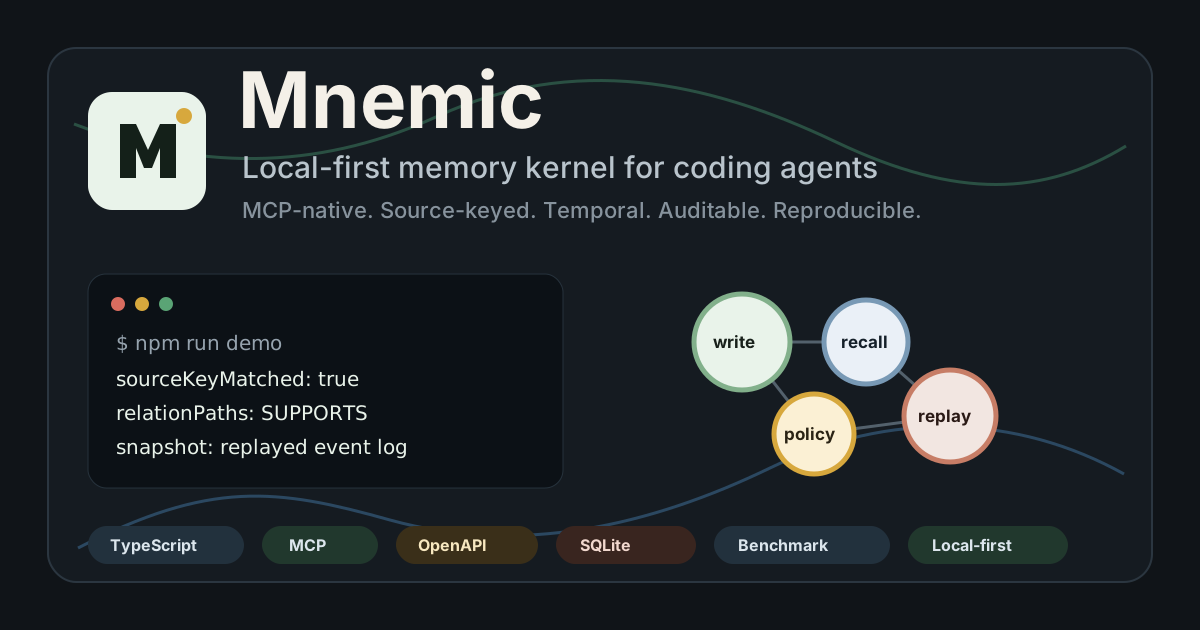
Mnemic is a local-first memory kernel for coding agents and LLM applications.
It gives Codex, Claude Code, Cursor, Copilot-style agents, and custom MCP clients one shared, auditable, graph-backed long-term memory layer. Agents write source-keyed memories, preview changes before they become durable, recall facts as of a point in time, explain why recall selected a record, and turn the memory graph into prompt-ready context packs and session briefings.
The repo is TypeScript-first, MCP-native, and shaped for the 2026 agent-memory stack: durable memory outside the context window, inspectable provenance, local defaults, governance before writes, and reproducible evals.
Why Mnemic
Mnemic is not a vector-store wrapper or a hidden chat-summary cache. It is a repo-scoped memory plane that agents can inspect, replay, and govern.
Modern agent platforms already treat memory as infrastructure: MCP standardizes tool and data connections, agent SDKs expose session state, and long-term memory benchmarks increasingly test temporal recall, workflow knowledge, and stale facts. Mnemic focuses on the missing developer layer between those pieces.
| Hot-path problem | Mnemic answer |
|---|---|
| Every coding agent relearns the same project facts | Shared MCP, CLI, SDK, and HTTP memory surface |
| Memory writes drift or duplicate across sessions | Source-keyed idempotent writes plus preview before save |
| "Why did the agent remember this?" is hard to debug | Recall explanations with matched fields, score parts, and relation paths |
| Old facts keep beating corrected facts | validFrom / validTo plus asOf temporal recall |
| Audit and handoff need more than final state | Append-only events, first-class diffs, JSONL export/import, rollback preview |
| Launch claims need proof | demo, benchmark, doctor, openapi:check, package:check, and launch:check |
Five-Minute Demo
npm install
npm run demo
The demo starts an isolated backend on a random local port, writes a small coding-agent memory graph, previews an idempotent update, explains recall, builds a context pack, prints a session briefing, audits memory hygiene, shows the append-only timeline, replays an event-log snapshot, and writes a launch report.
The same replay path is available from the CLI as mnemic snapshot, from MCP as mnemic_snapshot, and from HTTP as GET /api/agent-memory/snapshot.
Expected landmarks:
Mnemic Memory Write Preview
sourceKeyMatched: true
changedFields: confidence, content, importance, updatedAt

Mnemic Recall Explanation
matchedFields: content, sourceKey, tags, title
relationPaths: ...

Mnemic Memory Audit
blocks: 0
warnings: 0

Mnemic Memory Snapshot
eventsReplayed: 5
relations: 2
Demo artifacts are written to target/mnemic-launch-demo/, including mnemic-launch-report.md. Demo details live in examples/coding-agent-memory.
Quickstart
Initialize local config for a clone:
npm run init
This generates .env.mnemic, .mnemic/policy.json, .mcp.json, and AGENTS.mnemic.md without overwriting existing files. Use node mnemic-cli/dist/index.js init --force to refresh generated files.
Run the readiness doctor:
npm run doctor
Validate the OpenAPI contract:
npm run openapi:check
Run the deterministic benchmark:
npm run benchmark
It writes target/mnemic-benchmark/mnemic-eval-report.md and currently checks recall@5, mean hit rank, stale false positives, relation-path coverage, and latency without requiring a model provider. See docs/benchmark-baseline.md and docs/benchmark-landscape.md.
Docker
docker compose -f docker-compose.agent-memory.yml up -d --build mnemic-memory-backend
curl -fsS http://127.0.0.1:8088/actuator/health
See docs/docker-quickstart.md for SQLite mode, stop commands, optional Neo4j profile, and Docker readiness checks.
What Ships Today
| Surface | Current capability |
|---|---|
| HTTP API | remember, preview, temporal recall, explain, context pack, briefing, stats, policy, audit, timeline, JSONL export/import, rollback |
| API contract | OpenAPI 3.1 contract plus a local/CI drift check for route and schema coverage |
| SDK | shared TypeScript contracts plus MnemicClient for every backend endpoint |
| CLI | mnemic remember, preview, link, explain, context, briefing, audit, snapshot, eval, rollback |
| MCP | mnemic_* tools for agent clients, including write preview, recall explanation, policy, audit, and JSONL handoff |
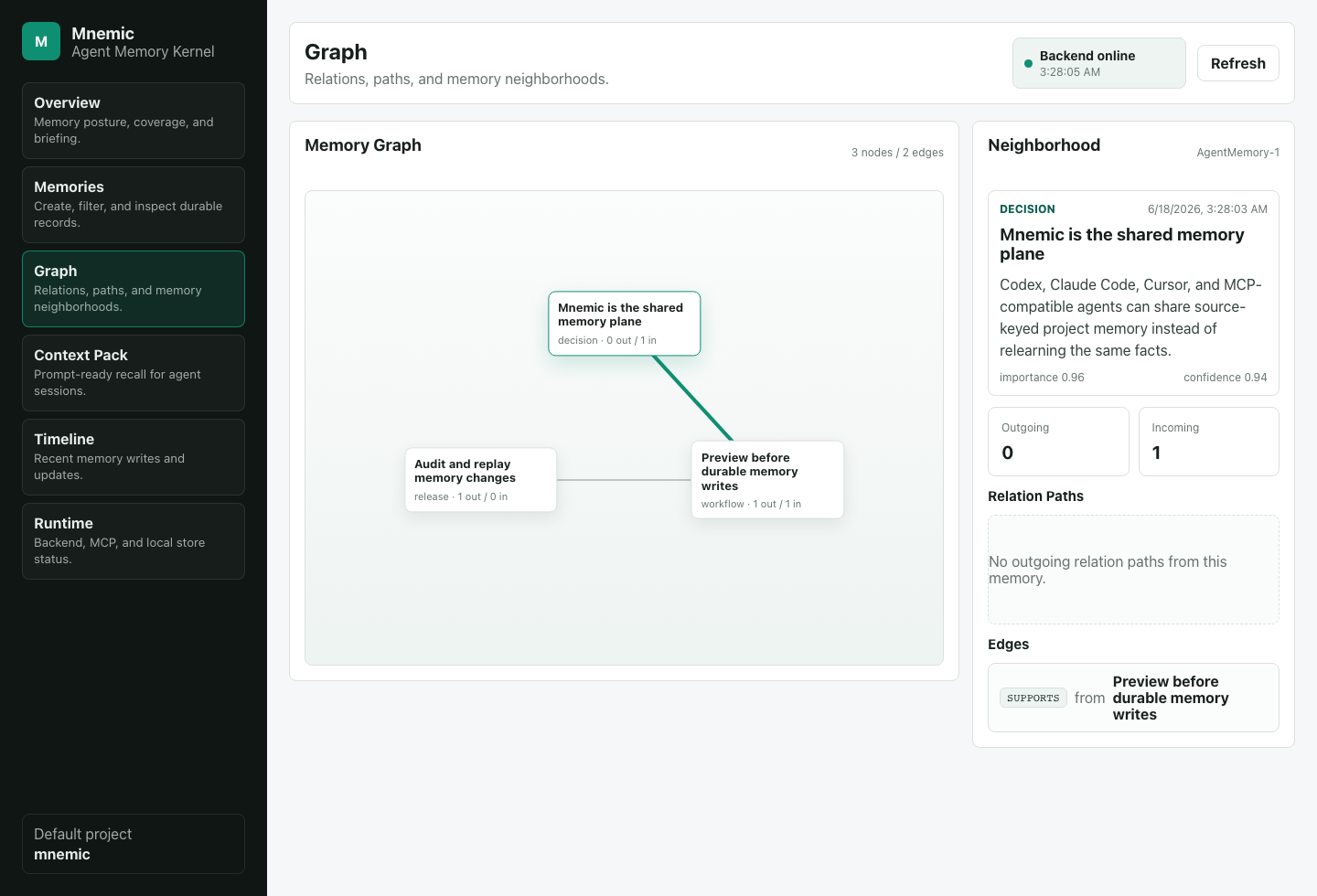
| Studio | React workbench for memories, graph neighborhoods, write diffs, recall explanations, runtime policy, audit, and timelines |
| Storage | zero-setup JSON store plus local SQLite mode with normalized memory, tag, relation, and event tables |
| Governance | secret blocking, source-key requirements for high-impact memory, confidence/staleness warnings, configurable policy file |
| Benchmark | deterministic coding-agent eval with terminal, JSON, and Markdown report output |
| Doctor | local readiness checks for source workspace, build artifacts, MCP config, policy, audit, and backend health |
| Package check | npm pack dry-run verification for SDK, CLI, server, and MCP packages |
| CI | workspace tests, production build, package readiness, MCP live smoke, model-free eval, policy checks, audit checks, and release-script checks |
Launch Gates
npm run launch:check
npm run docs:check
npm run rewrite:check
npm run completion:check
npm run fresh:check
npm run github:launch:check
npm run docker:check
npm run repository:check
npm run public:check
npm run supply:check
npm run community:check
npm run security:check
npm run benchmark:landscape:check
npm run market:check
npm run release:notes
npm run release:check
npm run package:check
npm run ci:smoke
npm run completion:check verifies the completion audit that maps the original rename, TypeScript rewrite, and 2026 agent-memory direction to current source evidence and remaining release blockers.
npm run repository:check verifies package metadata and launch docs point at the final Mnemic repository target instead of the old project identity. Use strict mode after the GitHub repository is renamed.
npm run public:check summarizes public-launch state: target origin, clean worktree, remote repository reachability, GitHub About metadata, hosted CI/CodeQL proof, and npm publication blockers. Use strict mode after the repository is renamed and pushed.
npm run supply:check verifies lockfile shape, npm audit at the high threshold, package-manager pinning, npm token boundaries, trusted-publishing docs, and private package status.
npm run community:check verifies GitHub community-health files such as support policy, code of conduct, Dependabot config, and release checklist coverage.
npm run security:check verifies CodeQL workflow configuration, security docs, Dependabot coverage, and security hardening release gates.
npm run launch:check verifies the GitHub-facing path: README visual card, Studio preview image, demo, benchmark/readiness commands, temporal snapshot messaging, release checklist coverage, Docker link, and package discovery keywords.
npm run docs:check verifies README Docs Map coverage and local Markdown links/images across the public documentation surface.
Refresh the Studio preview asset after meaningful UI changes:
npm run studio:capture
Connect An Agent
Run a local backend:
cp .env.mnemic.example .env.mnemic
scripts/start-agent-memory-stack.sh
Install the Codex MCP entry:
scripts/install-codex-mcp.sh
Generic MCP client snippets are in docs/mcp-client-configs.md. Detailed API, CLI, MCP, governance, SDK, and storage usage lives in docs/usage.md.
Docs Map
- docs/usage.md: API, CLI, MCP tools, SDK examples, governance, storage.
- docs/agent-memory-architecture.md: runtime shape and memory model.
- docs/mnemic-2026-roadmap.md: product thesis and roadmap.
- docs/benchmark-landscape.md: public benchmark positioning and adapter plan.
- docs/local-readiness.md: doctor checks and local troubleshooting.
- docs/docker-quickstart.md: fresh-clone Docker setup.
- docs/github-actions.md: CI, eval, policy, and PR memory-review workflows.
- docs/github-launch.md: GitHub About text, topics, launch copy, and benchmark claim guardrails.
- docs/security-hardening.md: CodeQL, Dependabot, sensitive-data, and security-release boundaries.
- docs/supply-chain.md: lockfile, audit, package provenance, and npm trusted-publishing boundaries.
- docs/repository-migration.md: GitHub repository rename plan and package metadata target.
- docs/completion-audit.md: original-goal completion evidence and remaining release blockers.
- docs/release-checklist.md: release and package-readiness checks.
- docs/npm-publishing.md: guarded npm publishing strategy.
- docs/releases/v0.1.0.md: current launch-candidate release notes.
- docs/openapi.json: machine-readable HTTP API contract.
Workspace
mnemic-sdk/contains the shared TypeScript contracts and HTTP client.mnemic-cli/contains the command-line workflow entrypoint.mnemic-server/is the TypeScript backend.mcp-server/exposes Mnemic memory through MCP tools.studio/is the React workbench.legacy/java/documents the retired pre-Mnemic Java implementation.
The active product path is the TypeScript workspace. Archived legacy docs live under docs/legacy/; they are provenance for the old graph engine, not the current product direction.
Open Source
- License: MIT
- Contributions: CONTRIBUTING.md
- Code of conduct: CODE_OF_CONDUCT.md
- Security: SECURITY.md
- Support: SUPPORT.md
- Changelog: CHANGELOG.md
Yorumlar (0)
Yorum birakmak icin giris yap.
Yorum birakSonuc bulunamadi