c0
Health Pass
- License — License: MIT
- Description — Repository has a description
- Active repo — Last push 0 days ago
- Community trust — 12 GitHub stars
Code Pass
- Code scan — Scanned 5 files during light audit, no dangerous patterns found
Permissions Pass
- Permissions — No dangerous permissions requested
No AI report is available for this listing yet.
An external memory for LLMs: a bi-temporal knowledge graph with hybrid (keyword + vector) retrieval and a self-improving reflection loop.
c0
An external memory for LLMs — a bi-temporal knowledge graph with hybrid (keyword + vector) retrieval and a self-improving reflection loop.
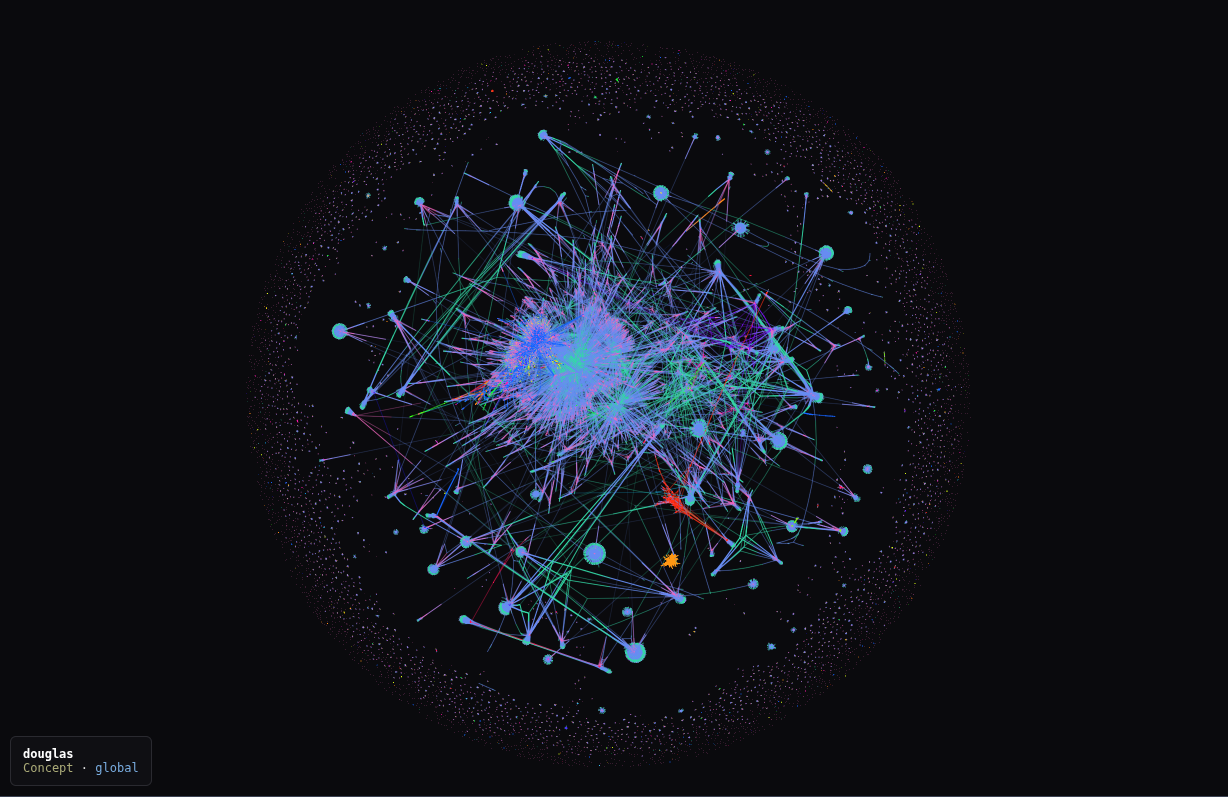


Why
Language models are stateless between sessions and their training data goes stale. The usual fix — stuffing documents into a vector store — retrieves blobs of prose and has no notion of how knowledge changes over time.
c0 takes a different approach. It stores knowledge as a graph of concepts and the relationships between them, retrieves the relevant subgraph on demand, and tracks how each fact evolves. The result is a persistent, correctable memory layer you can query in natural language and grow as you work.
How it works
query ──▶ ❶ exact match ─▶ ❷ keyword (BM25) ─▶ ❸ hybrid (BM25 + vector, fused by RRF)
                                                          │
                                                          ▼
                                          resolve to a concept node in Neo4j
                                                          │
                                                          ▼
                                     traverse the graph for related context  ──▶  answer
                                                          │
                                              (no match) ▼
                                          reflection loop: learn from the miss
- Graph storage (Neo4j). Knowledge lives as
Conceptnodes and typed relationships, not as text chunks — so retrieval can traverse from one idea to related ones. - Hybrid retrieval. A tiered cascade: exact match → keyword (Lucene/BM25) → hybrid, which runs keyword and vector search and merges them with Reciprocal Rank Fusion (RRF). Keyword nails exact names and identifiers; vectors catch synonyms and paraphrase; fusion gets the best of both without normalizing incompatible score scales.
- Bi-temporal. Every concept carries two independent timestamps — when it was recorded (transaction time) and when it is true (valid time) — so you can run point-in-time ("as-of") queries, supersede a concept when it evolves, or invalidate it with a causal audit trail. Nothing is deleted; it's time-bounded.
- Self-improving reflection loop. When a lookup finds nothing, the dead end is queued, and an LLM classifies it: commit a genuinely new, reusable concept, discard noise, or queue the uncertain ones for human review.
Requirements
- Rust (2024 edition — 1.85+)
- Neo4j 5 — a
docker-compose.ymlis included - Ollama for local embeddings (default model:
nomic-embed-text) - (optional) an Anthropic API key — used by the reflection classifier and concept extraction; c0 runs without it (those features degrade gracefully)
Quickstart
# 1. Start Neo4j (binds to localhost only)
docker compose up -d

# 2. Pull the embedding model
ollama pull nomic-embed-text

# 3. Build & install
cargo install --path .

# 4. Point c0 at Neo4j (defaults shown; the bundled compose uses no auth)
export NEO4J_URI="bolt://localhost:7687"
export NEO4J_USER=""        # empty for the bundled docker-compose
export NEO4J_PASSWORD=""
# export ANTHROPIC_API_KEY="sk-..."   # optional, for the reflector/extraction

# 5. Create indexes (vector + fulltext), then a namespace
c0 migrate
c0 init --namespace my-project

# 6. Add knowledge and recall it
c0 add concept "reciprocal rank fusion" -d "Rank-based fusion of multiple result lists; score = weight/(k+rank)."
c0 add concept "hybrid search" -d "Keyword (BM25) + vector retrieval, fused by RRF." --force
c0 relate "reciprocal rank fusion" USED_BY "hybrid search"   # both endpoints must exist
c0 walk "reciprocal rank fusion"                             # traverses outgoing edges -> "hybrid search"
--forceon the second concept skips the similar-concept guard: closely related ideas
often score as near-duplicates, andrelaterequires both endpoints to already exist.
Core commands
| Command | What it does |
|---|---|
c0 walk <topic> |
Recall: resolve a concept (exact → keyword → hybrid) and traverse for context |
c0 walk <topic> --as-of <date> |
Point-in-time recall (bi-temporal) |
c0 search <query> |
Hybrid search without traversal (--vector-only / --keyword-only) |
c0 add concept <name> -d "<desc>" |
Add a concept (embedded on write) |
c0 add patch <name> --content "<text>" |
Add a knowledge patch that corrects/augments a concept |
c0 relate <a> <TYPE> <b> |
Create a typed relationship |
c0 supersede <old> --with <new> |
Mark a concept evolved into a newer one |
c0 invalidate concept <name> --reason "<why>" |
Retract a concept with a causal trail |
c0 describe <concept> "<new desc>" |
Update a description (and re-embed) |
c0 reflector ... |
Inspect/process the dead-end → learn loop |
c0 health --fix |
Check Neo4j / Ollama / indexes |
c0 export · c0 audit · c0 move |
Maintenance utilities |
Run c0 --help for the full set.
Configuration
c0 reads connection details from the environment, with a per-namespace .c0/config.toml for local settings:
| Variable | Default | Purpose |
|---|---|---|
NEO4J_URI |
bolt://localhost:7687 |
Neo4j connection |
NEO4J_USER / NEO4J_PASSWORD |
empty | Neo4j auth |
ANTHROPIC_API_KEY |
— | Optional; reflector classification & extraction |
Embedding host/model (Ollama) default to http://localhost:11434 and nomic-embed-text, and are configurable.
Using c0 with Claude Code
c0 pays off most when you treat the graph as where knowledge lives and keep your CLAUDE.md for protocol — the instruction to consult c0, plus your own house rules. Project facts, API shapes, and architecture decisions go stale fast and bloat every prompt when hard-coded into CLAUDE.md; put them in the graph instead and let the model pull the relevant subgraph on demand, then correct it over time with patches and supersessions.
The one thing CLAUDE.md does need is an instruction to actually reach for c0. A minimal version:
## Memory

Before answering questions about this project's stack, architecture, or APIs,
run `c0 walk "<topic>"` first and use what it returns — it patches stale
training knowledge. As you learn durable facts, write them back with
`c0 add concept` / `c0 relate` so the next session inherits them.
Keep your preferences and conventions in CLAUDE.md as usual — just stop hand-maintaining knowledge there. For hands-off recall, wire c0 walk into a Claude Code hook so the lookup happens automatically on matching prompts.
This is a workflow suggestion, not a setup requirement — c0 is a plain CLI and works with any assistant (or none). Adopt as much of the pattern as suits you.
Optional: Claude Code session indexing
If you use Claude Code, an optional feature indexes your session transcripts into the graph so you can semantically search past conversations and jump back into the right one. It's off by default (it couples to Claude Code's transcript format); enable it explicitly:
cargo install --path . --features sessions
This is the reference example of c0's source-adapter pattern — the same shape any "fill the graph from " integration would take.
Architecture notes
The retrieval core lives in src/graph.rs (Cypher queries, the BM25/vector/RRF functions, temporal filters) and src/embeddings.rs (Ollama client + cosine similarity). The reflection loop is in src/reflector.rs. Hybrid search defaults — alpha = 0.4 (keyword vs. vector weight), k = 60 (the canonical RRF constant), a 0.3 vector threshold — are defined in HybridSearchConfig.
Contributing
Issues and PRs welcome. The codebase forbids unsafe and lints with Clippy pedantic; please keep new code warning-clean and run cargo build --features sessions as well as the default build.
License
Reviews (0)
Sign in to leave a review.
Leave a reviewNo results found