claude-lights-out
Health Uyari
- License — License: MIT
- Description — Repository has a description
- Active repo — Last push 0 days ago
- Low visibility — Only 5 GitHub stars
Code Basarisiz
- rm -rf — Recursive force deletion command in install.sh
Permissions Gecti
- Permissions — No dangerous permissions requested
Bu listing icin henuz AI raporu yok.
Claude Code dynamic workflow for autonomous software engineering. Zero human intervention. Spec-driven, doc-as-ground-truth pipeline that persists across sessions. Agents understand the full project — won't fix local and break global.
claude-lights-out
Structured engineering loops, not one-shot vibes.

A fully automated development pipeline for Claude Code. Agents write, review, test, and fix in loops — delivering working code with persistent documentation that survives across sessions.
Why
Vibe coding with AI agents has four unsolved problems:
| Problem | What happens | How lights-out solves it |
|---|---|---|
| No control | Agent skips testing, ignores edge cases, cuts corners | Fixed 9-phase pipeline — every phase runs, no shortcuts |
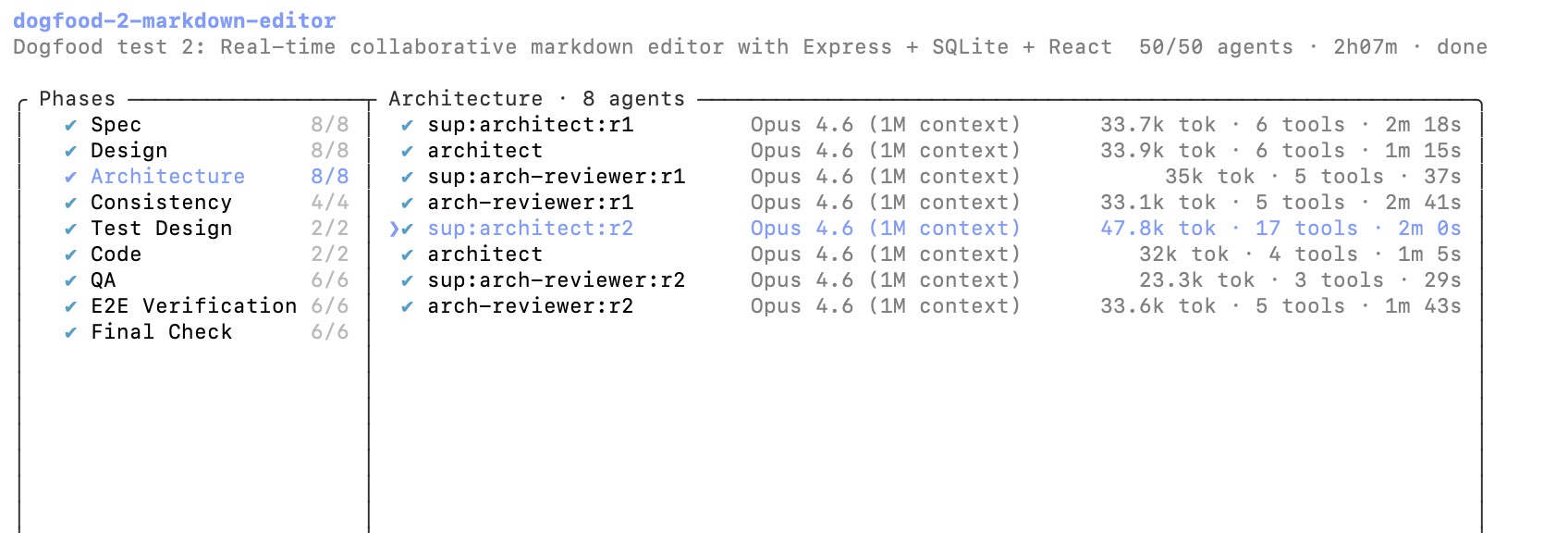
| Black box | Agent runs for 20 minutes, you have no idea what's happening | Claude workflow board shows real-time phase progress |
| Too much babysitting | You test → find bug → report → agent fixes → repeat | Agent does full design + test + QA loop before delivery |
| Context amnesia | New session or compaction = agent forgets everything | Forced doc maintenance (spec + design + arch) survives across sessions |
Plus: adversarial quality — every artifact goes through independent write → review → fix cycles. A single agent won't find its own mistakes.
Install
curl -fsSL https://raw.githubusercontent.com/DreamChaserEric/claude-lights-out/main/install.sh | bash
Requires: Claude Code CLI with workflow support.
Usage
/lightsout Build a CLI that converts CSV to JSON with streaming support
/lightsout Add rate limiting to the existing API endpoints
/lightsout Fix: search returns stale results after cache invalidation
Simple requests launch immediately. Ambiguous requests get a quick brainstorm (3-5 questions max).
How It Works
graph TD
    A["/lightsout your request"] --> B{Complex?}
    B -->|Simple| C[Launch pipeline]
    B -->|Ambiguous| D[Quick brainstorm] --> C

    C --> S1[Spec Writer ↔ Reviewer]
    S1 --> S2[UX Designer ↔ Reviewer]
    S2 --> S3[Architect ↔ Reviewer]
    S3 --> S4[Consistency Check]
    S4 --> S5[Test Case Design]
    S5 --> S6[Code Orchestrator]
    S6 --> S7[QA ↔ Bug Fixer]
    S7 --> S8[E2E Verification]
    S8 --> S9[Final Check ↔ Fixer]
    S9 --> R[Done: code + docs + commits]

    style S1 fill:#e1f5fe
    style S2 fill:#e1f5fe
    style S3 fill:#e1f5fe
    style S6 fill:#e8f5e9
    style S7 fill:#fff3e0
    style S8 fill:#fff3e0
    style S9 fill:#fff3e0
Every phase runs. Agents self-calibrate depth — a bug fix breezes through docs, a greenfield project gets full treatment. The code orchestrator autonomously decides whether to implement solo or spawn parallel sub-agents based on project complexity.
Architecture
Three-layer separation:
| Layer | Responsibility | Where |
|---|---|---|
| Orchestration | Phase order, loop control, state accumulation | lightsout-workflow.js |
| Role | Agent identity, capabilities, behavior rules | prompts/*.md |
| Context | Situation-aware briefing for each agent | Supervisor agent |
The supervisor reads full pipeline state + the worker's role definition, then generates a focused context brief. Workers see: role instructions + supervisor brief + original user input.
Design Principles
- Writer ≠ Reviewer — independent agents catch what the author can't see
- Docs are ground truth —
spec.md,design.md,architecture.mdpersist across sessions - Clear ownership — spec owns behaviors, design owns interactions, arch owns technical structure
- Information never lost — templates are guides not constraints; agents preserve all relevant input
- Priority chain — original input > architecture > spec > domain knowledge
- Test before code — test cases designed before implementation, driving TDD
What You Get
After a pipeline run, your project contains:
docs/
  spec.md           # Product specification (capabilities, scenarios, errors)
  design.md         # Interaction design (UX flows, states, feedback)
  architecture.md   # Technical architecture (ADRs, structure, contracts)
  test-cases.md     # Test plan designed before implementation
src/                # Working, tested implementation
tests/              # Full test suite (written before code)
These docs are the project's memory. Next session, any agent can read them and continue without re-explanation.
Customization
Edit any prompt in ~/.claude/lights-out/prompts/:
supervisor.md          # Context synthesis rules
spec-writer.md         # Product specification
ux-designer.md         # Interaction design
architect.md           # Technical architecture
code-agent.md          # Orchestrator + TDD implementation
test-case-designer.md  # Test design principles
qa-engineer.md         # Quality verification
visual-qa.md           # E2E verification
+ reviewer/fixer prompts
Limitations
- Requires Claude Code with workflow support
- Each run uses 30-50 agent calls depending on project complexity
- Best suited for small-to-medium greenfield projects and well-scoped features
- Not a replacement for human code review on production systems
License
MIT
Yorumlar (0)
Yorum birakmak icin giris yap.
Yorum birakSonuc bulunamadi