DruOPC
Health Warn
- License — License: MIT
- Description — Repository has a description
- Active repo — Last push 0 days ago
- Low visibility — Only 5 GitHub stars
Code Pass
- Code scan — Scanned 12 files during light audit, no dangerous patterns found
Permissions Pass
- Permissions — No dangerous permissions requested
No AI report is available for this listing yet.
DruOPC: an OPC UA toolkit. PLC simulator + web browser (Blazor). Watch, write, alarms, history, and more.
DruOPC



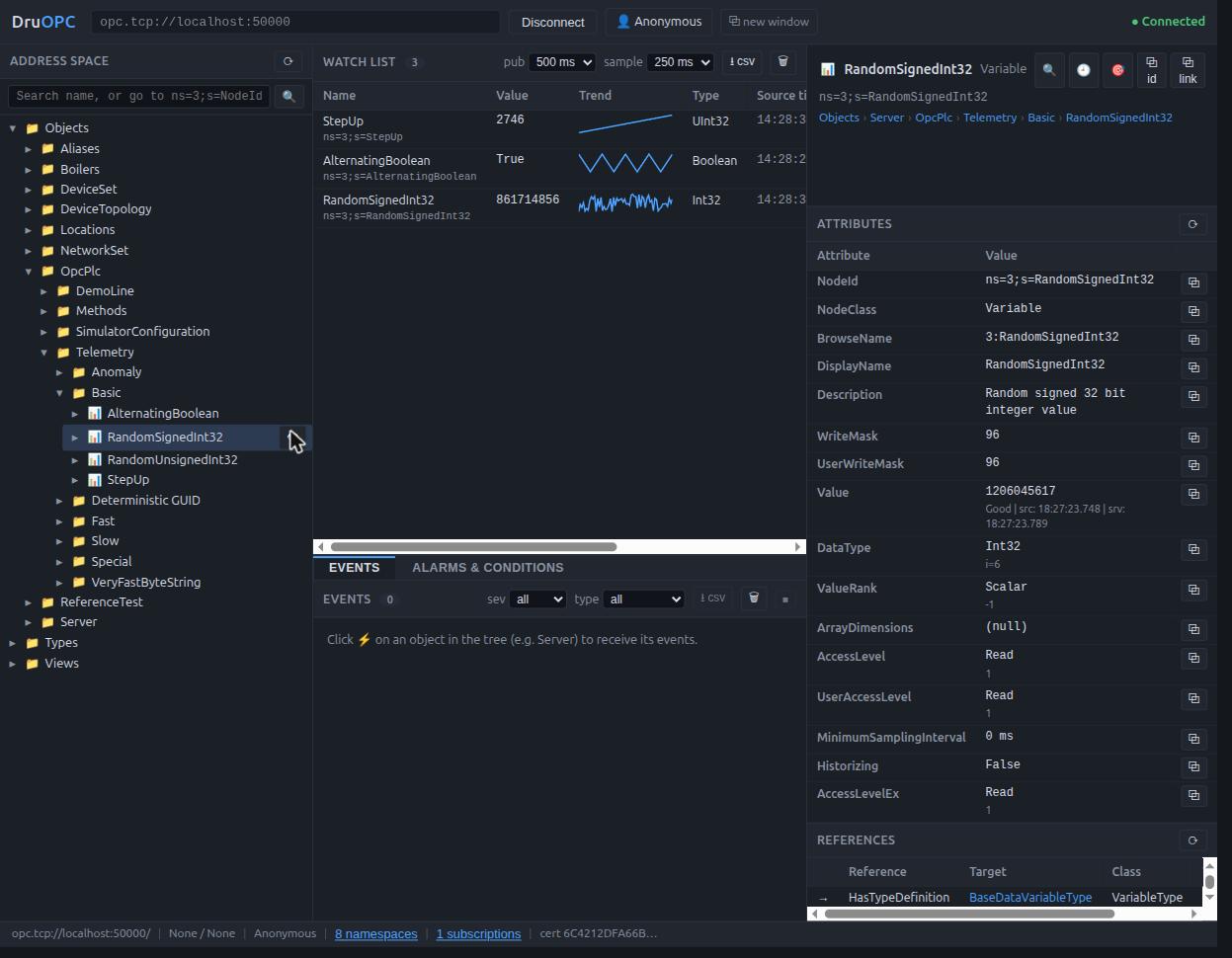
DruOPC is a two-piece toolkit for learning, testing and demonstrating
OPC UA:
- DruOPC Simulator (
src/) — an OPC UA server that behaves like a PLC:
changing values, anomalies, boilers, events, alarms, methods, and your own
nodes from a JSON file. Everything is configured throughappsettings.json—
no command-line flags. - DruOPC Browser (
browser/) — a web-based OPC UA client for browsing and
inspecting any OPC UA server: live watch lists, writes, methods, events,
alarms with acknowledge, history, UDT decoding, shareable deep links.
They work great together (the browser connects to the simulator out of the box)
and separately (point the browser at a real PLC; point any OPC UA client at the
simulator).
Want to help? See CONTRIBUTING.md — bug reports, docs
fixes and pull requests are all welcome. If DruOPC saves you a license dongle
hunt, you can buy me a coffee. ☕
This is a fork of
Azure-Samples/iot-edge-opc-plc
with breaking changes: the command-line interface was replaced byappsettings.jsonconfiguration, the host was rebuilt on the .NET generic
host, and DruOPC was added. The upstream Docker images on MCR do not
match this fork.
Quick start
Docker
git clone https://github.com/drusteeby/DruOPC.git
cd DruOPC
docker compose up
Open http://localhost:5080 and connect to opc.tcp://simulator:50000.
From source
Prerequisite: .NET SDK 10 or later.
git clone https://github.com/drusteeby/DruOPC.git
cd DruOPC

# terminal 1 — the simulated PLC (OPC UA server on opc.tcp://localhost:50000)
dotnet run --project src

# terminal 2 — DruOPC (web client on http://localhost:5080)
dotnet run --project browser
Open http://localhost:5080, click Connect, trust the certificate — you are
browsing live data.
New to OPC UA? The getting started guide walks
through all of this step by step, explains the OPC UA concepts as you go, and ends
with you writing values and acknowledging alarms.
Documentation
| Document | What it covers |
|---|---|
| Getting started | Zero to a live connection in 15 minutes; OPC UA primer; connecting to real PLCs |
| DruOPC user manual | Every DruOPC feature, troubleshooting table, OPC UA glossary |
| Configuration reference | Every simulator setting (below) |
| Deterministic alarms | Scripted alarm sequences for repeatable client testing |
DruOPC in brief
- Endpoint discovery, security-mode selection, anonymous / username / X509 login
- Per-certificate trust dialog (trust once / permanently); auto-accept off by default
- Address-space tree with search, NodeId jump, breadcrumbs and reveal-in-tree
- Full attribute + reference inspection with copy buttons
- Live watch list: subscriptions, sparkline trends, inline typed writes, CSV export
- Events with server-side severity/type filters; CSV export
- Alarms & conditions: live retained-condition list, ConditionRefresh, acknowledge
- Raw history read with chart, table and CSV (browser-timezone aware)
- Method calls with typed argument forms
- Value inspector: full values, structures/UDTs as expandable JSON trees
- Namespace table and subscription inspector
- Shareable deep links (
?endpoint=…&node=…); per-browser-tab isolated sessions
See the user manual for how to use each of these.
Simulator features
The address space contains, by default:
- An alternating boolean, random signed/unsigned 32-bit integers
- Sine waves with spike and dip anomalies, positive and negative trends
- Values cycling good/bad/uncertain status (slow: 10 s, fast: 1 s)
- Configurable slow (10 s) and fast (1 s) changing nodes of several types
- Boiler #1: a complex-type (UDT) boiler status with heater on/off methods
- Boiler #2: a Device Information (DI) companion-spec boiler with
DeviceHealth states and maintenance/overheat events - A GUID-identified node set, long strings (10–200 kB), special characters in
names, opaque and long NodeIds, and the OPC Foundation reference test nodes - A working-set memory node under
OpcPlc/Telemetry/Special/WorkingSetMB
Enabled through configuration (see reference):
- Simple events (
Simulation:AddSimpleEventsSimulation) — the OPC Foundation
SimpleEvents quickstart model, emitting aSystemCycleStartedEventTypeevery 3 s - Alarms & conditions (
Simulation:AddAlarmSimulation) — the OPC Foundation
AlarmCondition quickstart: areas (Green/Yellow…) with motor/tank sources raising
Trip, Deviation, Level and Dialog conditions on a deterministic heartbeat, with
working Acknowledge/Confirm/Comment - Deterministic alarms (
Simulation:DeterministicAlarmSimulationFile) —
script-driven alarm sequences (details) - Event bursts (
Simulation:EventInstanceCount/EventInstanceRate) - User-defined nodes from a JSON file (below)
- NodeSet2 / uanodes model files (
NodeSet2Files,UaNodesFiles) - Chaos mode (
RunInChaosMode) — randomly injects errors, closes sessions
and subscriptions; use it to test client resiliency - Tag writer (
TagWriter) — replays a station-data handshake against the
nodes from the bundlednodesfile.json(demo of externally-driven values)
OPC UA methods
Method (under OpcPlc/Methods) |
Description |
|---|---|
| ResetTrend | Reset trend values to their baseline |
| ResetStepUp / StopStepUp / StartStepUp | Control the StepUp counter |
| StopUpdateSlowNodes / StartUpdateSlowNodes | Pause/resume slow node updates |
| StopUpdateFastNodes / StartUpdateFastNodes | Pause/resume fast node updates |
| HeaterOn / HeaterOff | Boiler #1 heater control |
You can call all of these from DruOPC's method dialog.
Update limits
To freeze or limit simulation updates at runtime, write to theSlowNumberOfUpdates / FastNumberOfUpdates nodes inOpcPlc/SimulatorConfiguration: < 0 = update forever (default), 0 = stop,> 0 = update that many more times.
Configuration
All simulator settings live in src/appsettings.json
under the OpcPlc section. Edit the file, or override any setting without
touching it:
Environment variables — replace
:with__(double underscore):# Linux/macOS OpcPlc__Simulation__AddAlarmSimulation=true OpcPlc__OpcUa__ServerPort=51000 dotnet run --project src # Windows PowerShell (the variable persists for the terminal session; # unset with: $env:OpcPlc__Simulation__AddAlarmSimulation=$null) $env:OpcPlc__Simulation__AddAlarmSimulation="true"; dotnet run --project srcAn
appsettings.Production.json(or anyASPNETCORE_ENVIRONMENT) file
layered over the defaults — standard .NET configuration behavior.
Invalid values (for example a zero node rate) are rejected at startup with a
clear message rather than misbehaving silently.
Setting reference
Keys are relative to the OpcPlc section, so OpcUa:ServerPort meansOpcPlc:OpcUa:ServerPort (env var OpcPlc__OpcUa__ServerPort).
Server basics
| Key | Default | Meaning |
|---|---|---|
OpcUa:ServerPort |
50000 |
OPC UA endpoint port (opc.tcp://<host>:<port>) |
OpcUa:ServerPath |
"" |
Optional URL path suffix for the endpoint |
OpcUa:Hostname |
machine name (shipped config sets localhost) |
Hostname used in the endpoint and certificate |
OpcUa:EnableUnsecureTransport |
true |
Also offer a SecurityMode=None endpoint (handy for dev; disable in production) |
OpcUa:MaxSessionCount / MaxSubscriptionCount / MaxQueuedRequestCount |
100 / 100 / 2000 |
Server limits |
OpcUa:MaxSessionTimeout |
3600000 |
Session idle timeout (ms) |
OpcUa:OpcMaxStringLength |
1048576 |
Max transferable string length |
OpcUa:LdsRegistrationInterval |
0 |
Registration interval in ms with an OPC UA Local Discovery Server, if you run one (0 = off) |
WebServerPort |
8080 |
HTTP port serving the pn.json file (a ready-made node list for Microsoft's OPC Publisher edge module; ignore if you don't use it) |
ShowPublisherConfigJsonIp / ShowPublisherConfigJsonPh |
true / false |
Write/log pn.json using IP / hostname as EndpointUrl |
PnJson |
pn.json |
Name of the OPC Publisher file |
LogLevelCli |
info |
Log level (critical…trace) |
RunInChaosMode |
false |
Randomly inject errors/close sessions to test clients |
Security & authentication
| Key | Default | Meaning |
|---|---|---|
OpcUa:AutoAcceptCerts |
true |
Trust any client certificate (dev convenience — turn off for real use) |
OpcUa:TrustMyself |
true |
Put the server's own cert into its trusted store |
OpcUa:OpcOwnCertStoreType |
Directory |
Directory, X509Store (Windows cert store) or FlatDirectory (Kubernetes-style flat PKI folder) |
OpcUa:OpcOwnCertStorePath / OpcTrustedCertStorePath / OpcRejectedCertStorePath / OpcIssuerCertStorePath |
pki/... |
Certificate store locations |
OpcUa:DnsNames |
[] |
Extra DNS names/IPs added to the server certificate |
OpcUa:DontRejectUnknownRevocationStatus |
true |
Accept CA certs whose CRL/OCSP is unreachable |
DisableAnonymousAuth |
false |
Require a login |
DisableUsernamePasswordAuth |
false |
Disallow username/password logins |
DisableCertAuth |
false |
Disallow X509 user-certificate logins |
AdminUser / AdminPassword |
sysadmin / demo |
Admin login (change these!) |
DefaultUser / DefaultPassword |
user1 / password |
Standard login (change these!) |
Trusted user certificates and issuer chains can be provisioned viaOpcUa:TrustedUserCertificateFileNames / ...Base64Strings and the
corresponding UserIssuer keys, or by dropping .der/.crt files intopki/trusted-user/certs.
Simulation
| Key | Default | Meaning |
|---|---|---|
Simulation:SimulationCycleCount / SimulationCycleLength |
50 / 100 |
Cycles per phase / cycle length in ms |
Simulation:AddAlarmSimulation |
false |
Alarms & conditions model |
Simulation:AddSimpleEventsSimulation |
false |
SimpleEvents model |
Simulation:AddReferenceTestSimulation |
true |
OPC Foundation reference test nodes |
Simulation:DeterministicAlarmSimulationFile |
null |
Path to a deterministic alarm script |
Simulation:EventInstanceCount / EventInstanceRate |
0 / 1000 |
Burst events: count per cycle / rate in ms |
DataGeneration:NoDataValues / NoDips / NoSpikes / NoPosTrend / NoNegTrend |
false |
Disable individual data simulations |
SlowNodes:NodeCount / NodeRate / NodeType |
1 / 10 (s) / UInt |
Slow-changing nodes (UInt, Double, Bool, UIntArray) |
SlowNodes:NodeMinValue / NodeMaxValue / NodeStepSize / NodeRandomization |
type min/max, 1, false |
Value shaping |
FastNodes:* |
count 1, rate 1 s |
Same options as SlowNodes, faster |
VeryFastByteStringNodes:NodeCount / NodeSize / NodeRate |
1 / 1024 B / 1000 ms |
Large ByteString churn |
GuidNodes:NodeCount |
1 |
Nodes with deterministic GUID ids |
Boiler2:TemperatureSpeed / BaseTemperature / TargetTemperature / MaintenanceInterval / OverheatInterval |
1, 10, 80, 300 s, 120 s |
Boiler #2 behavior |
NodesFile |
nodesfile.json |
User-defined nodes file (below) |
UaNodesFiles / NodeSet2Files |
[] |
Compiled .uanodes / NodeSet2.xml model files to load |
TagWriter:Enabled |
true |
Station-data handshake demo against the bundled nodes file |
Slow/fast node data types: UInt counts up by 1, Double by 0.1, Bool
alternates, UIntArray is 32 counting values.
User-defined nodes (NodesFile)
Set OpcPlc:NodesFile to a JSON file describing your own nodes. They appear
under the OpcPlc folder, are readable/writable by any client, and are not
simulated — they hold whatever a client last wrote (unless the
TagWriter drives them).
{
  "Folder": "MyTelemetry",
  "FolderList": [
    { "Folder": "Line1", "NodeList": [ { "NodeId": "ChildNode" } ] }
  ],
  "NodeList": [
    { "NodeId": 1023, "Name": "ActualSpeed", "Description": "Rotational speed" },
    {
      "NodeId": "DKW",
      "DataType": "Float",
      "ValueRank": -1,
      "AccessLevel": "CurrentReadOrWrite",
      "Description": "Diagnostic characteristic value"
    }
  ]
}
NodeId(required): numeric, string or GUID identifier.Name,Description(optional): default to the NodeId.DataType: any OPC UA built-in type name; defaults toInt32.ValueRank:-1scalar (default),1one-dimensional array.AccessLevel: e.g.CurrentRead,CurrentReadOrWrite(default).NamespaceIndexorNamespace(optional): place the node in a specific
namespace.FolderListnests folders recursively.
The bundled src/nodesfile.json models a four-station
demo line (DemoLine/Station10 … Station40); the TagWriter service animates
Station10's handshake tags.
Running in Docker
Every release publishes container images to GitHub Container Registry. The
easiest way to run the whole toolkit:
curl -O https://raw.githubusercontent.com/drusteeby/DruOPC/main/compose.yaml
docker compose up
Then open http://localhost:5080 and connect to opc.tcp://simulator:50000
(the simulator's name on the compose network).
Or run the pieces individually:
# The simulator (OPC UA on 50000)
docker run --rm -it -p 50000:50000 -p 8080:8080 \
  -e OpcPlc__Simulation__AddAlarmSimulation=true \
  -v druopc-pki:/app/pki \
  ghcr.io/drusteeby/druopc-simulator:latest

# The browser (web UI on http://localhost:5080)
docker run --rm -it -p 5080:8080 ghcr.io/drusteeby/druopc-browser:latest
Any OpcPlc__* environment variable from the
configuration reference works with -e; mounting /app/pki
keeps the server certificate stable across restarts. To build an image locally
instead of pulling, the SDK does it without a Dockerfile:dotnet publish src -c Release /t:PublishContainer.
Deploying to a cloud
All cloud deploys pull the public container images from GHCR.
Azure — one click, runs both apps in a Container Instances group and
outputs the OPC UA endpoint and browser URL:
AWS — CloudFormation template running both apps on a single EC2 instance:
download tools/templates/aws-druopc.cfn.yaml,
then in the CloudFormation console choose Create stack → Upload a template
file. Tighten the AllowedCidr parameter to your own IP.
Google Cloud — Cloud Run only serves HTTP, so it fits the browser but not
the simulator's raw opc.tcp port:
gcloud run deploy druopc-browser --image ghcr.io/drusteeby/druopc-browser:latest \
  --port 8080 --allow-unauthenticated --region us-central1
For the simulator on GCP, use a Compute Engine VM with the
compose file, same as any other Linux host.
Public demo instance — deploy/demo/compose.yaml
is a hardened variant (non-default passwords required, resource limits, alarms
enabled) for hosting a shared "try it live" instance on any Docker host.
Installing from package managers
- Snap (Linux):
sudo snap install druopc, thendruopc.simulatoranddruopc.browser. - NuGet: the
DruOPC.Simulatorpackage lets you embed the simulator in
your own test projects (see Testing). - Windows and macOS: download the self-contained archives from the
releases page — no .NET
install required.
Testing
dotnet test tests
The integration suite (74 tests) starts a real server on an ephemeral port per
fixture and exercises it with a real OPC UA client — including alarm
acknowledge round-trips.
For your own projects, the build produces a NuGet package so you can embed the
simulator in unit tests; see tests/PlcSimulatorFixture.cs for how to host the simulator inside your own test project.
Repository layout
| Path | Contents |
|---|---|
src/ |
The OPC PLC simulator (ASP.NET Core generic host) |
browser/ |
DruOPC, the web OPC UA client (Blazor Server) |
tests/ |
Integration tests |
docs/ |
Getting started, user manual |
Disclaimer
The simulator is a development and test tool. It ships with well-known default
passwords and permissive certificate handling; do not expose it to untrusted
networks in that state. DruOPC performs live writes and method calls on
whatever server it is pointed at — use appropriate care on production systems.
Resources
Reviews (0)
Sign in to leave a review.
Leave a reviewNo results found