compass
Health Warn
- License — License: MIT
- Description — Repository has a description
- Active repo — Last push 0 days ago
- Low visibility — Only 5 GitHub stars
Code Fail
- eval() — Dynamic code execution via eval() in .github/workflows/ci.yml
Permissions Pass
- Permissions — No dangerous permissions requested
No AI report is available for this listing yet.
Developer-grade Claude Code + Codex configuration: cost-tiered subagents, workflow commands, guardrail hooks, MCP parity, and an installable plugin/marketplace.
🧭 compass
The trust layer for Claude Code, Codex & Gemini — measured, not vibes.
Anyone can say "safe" and "cheap." compass hands you the number — and lets you reproduce it in 30 seconds: guardrails 100/100 on a 61-case bypass corpus, a router measured ~61% cheaper than all-Opus at ~98% quality, signed releases you verify in one command. One config you own for every agent, in every repo — not a service. No curl | sh, no telemetry. You always merge.
In plain terms: a tireless senior teammate for your AI coding agents — it reviews and fixes its own work, spends your money wisely, refuses the dangerous stuff, and still can't ship anything without your yes.






▶ Watch it fix its own PR · Why it's different · The loops · Install · What's in the box · 📚 Docs
⭐ The part people screenshot: it fixes its own PRs.
Open a pull request and compass reviews it, security-checks it, runs the tests, cross-audits it with a second model — then pushes its own fixes until it's green. You just merge.
The idea in one line: the loop is the unit of work. A one-shot agent stops at its first wrong answer. compass loops — generate → test → critique → fix → repeat against a gate — so quality comes from iteration, not one lucky prompt. The same closed loop runs a single PR, or your whole fleet of repos overnight. (Try it locally in 30s, no tokens — watch it ↓.)
Why it's different — measured, not vibes
Every AI-agent config claims "safe" and "cheap." compass is the one that hands you the number — and lets a skeptic reproduce it in 30 seconds. Everyone has the same models; the edge is configuration you can trust, not another feature list. Four claims, four commands:
🛡 Guardrails with a score. Catastrophic commands and secret writes are blocked before they run — and the policy is eval-gated, not asserted. (In human terms: it won't let the agent delete your machine or leak your keys, and it can prove how well.)
compass bench     # → guardrail 100% precision/recall (61-case corpus), router 96.9% — in CI
# then ask the agent to `rm -rf /` or write a .env → denied; `rm -rf ./build` → allowed
📉 Cost routing that's measured. Cheap work goes to cheap models — scored against an eval set, ~61% cheaper than all-Opus at ~98% quality on a fair mix. (In human terms: it stops paying Opus prices to fix a typo.)
compass route "redesign the auth model"   # → opus
compass route "fix a typo"                 # → haiku
🔏 Supply chain you can verify. Releases carry keyless SLSA provenance, so a tampered or look-alike download is rejected. (In human terms: you can prove the code you installed is the code I shipped.)
compass verify v0.16.0 # → ✓ provenance verified
🧪 Red-team resistance, measured. Prompt-injection (direct/indirect/paste), CLAUDE.md poisoning, local safety-override, malware & insecure-code — scored against a labeled corpus that gates in CI, with optional escalation to a managed guardrails service (webhook · Bedrock · Azure). (In human terms: a poisoned repo or web page can't quietly turn your agent against you.)
compass redteam # → injection corpus 100% P/R, then scans THIS repo's CLAUDE.md/MCP/settings
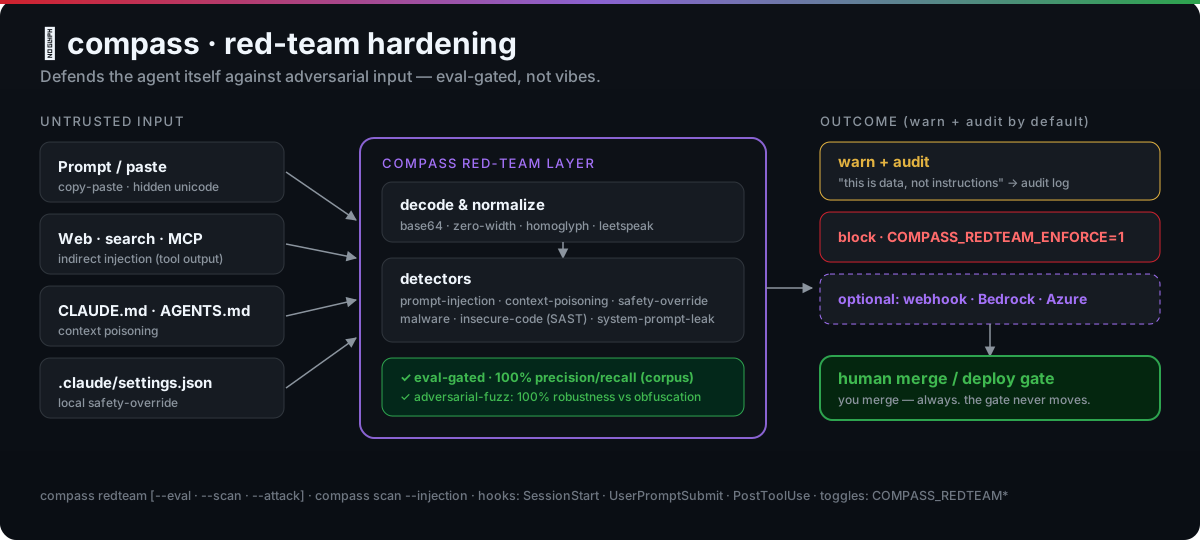
No service, no telemetry, no --dangerously-skip-permissions; git pull to update. The work it can't safely own, it hands back — you keep the merge.
See it work
Three views, smallest leap of faith first — feel it, then see the proof, then see how it works.
1 · The day-to-day feel — guardrails, the cost-aware status line, the loop, and the crew, in ~25 seconds:

2 · The headline, on a real PR — a Blocking bug and red tests, and it pushes its own fix until the PR is green (then waits for you):

3 · How that loop works — review · security · tests · Codex cross-audit run in parallel; Blocking findings get auto-fixed and re-reviewed (round-capped) until green, then it stops at you:
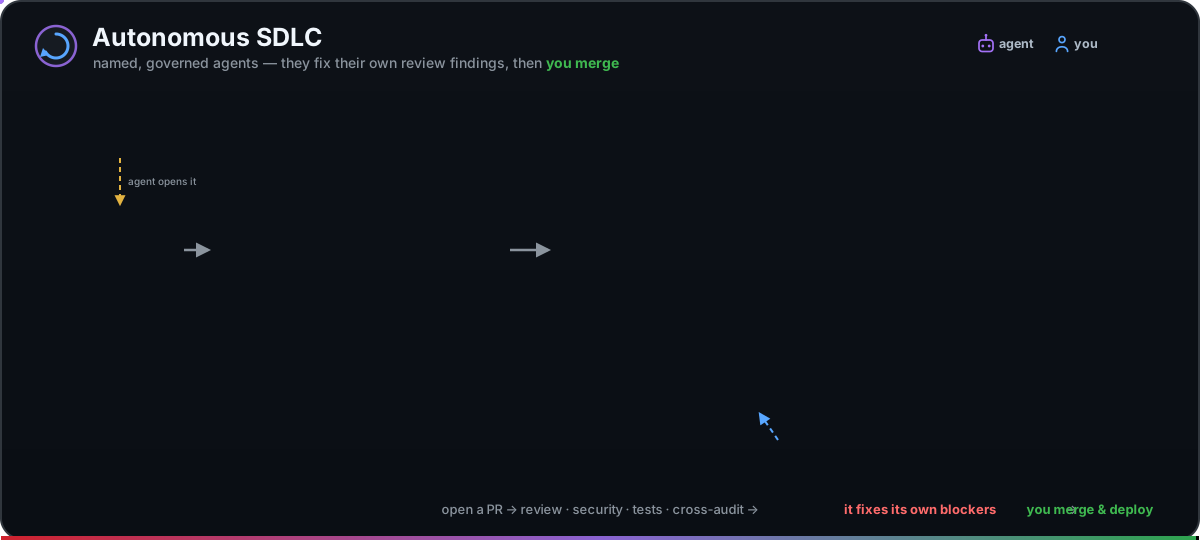
Run it locally in 30s with ~/compass/sdlc/orchestrate.sh "<task>" (no tokens), or wire the GitHub loop for every PR. → how it works · reproduce it
And the everyday status line quietly keeps score, so you watch it earn its keep:
Opus 4.8 · myrepo · main* · 45k ctx · $1.23 · 🧭 🛡1 🧹2 💡1 📉~$1.65
session spend, then today's compass activity: 🛡 footguns blocked · 🧹 files formatted · 💡 policy nudges · 📉~$ estimated saved vs all-Opus. Each piece shows only when there's something to report; nothing leaves your machine.
Loops all the way up
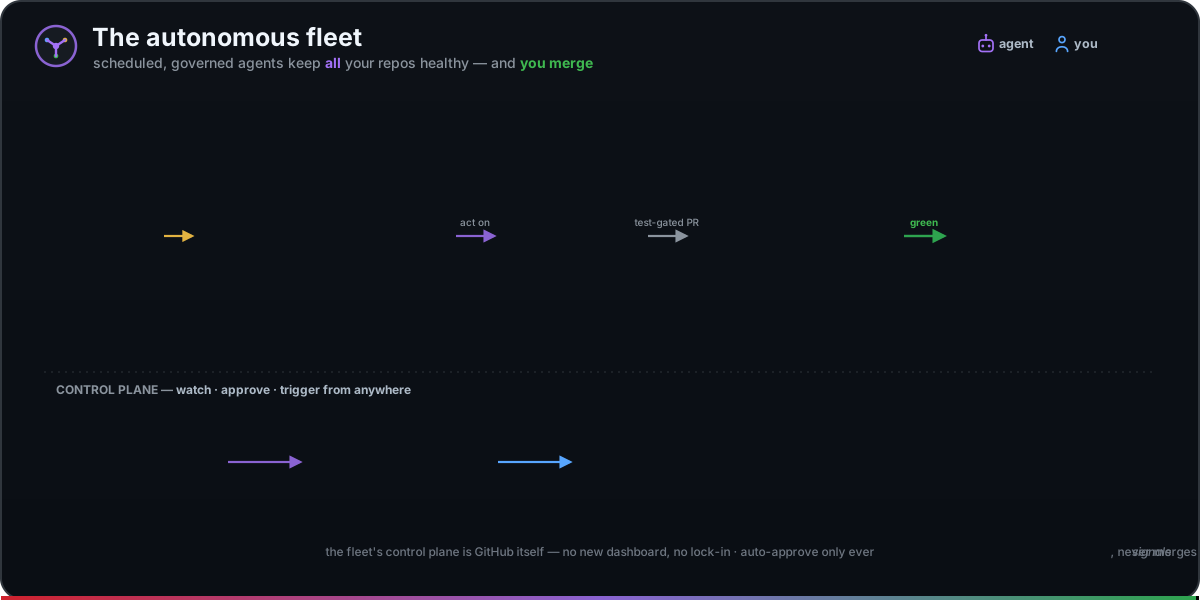
Autonomy here isn't one big magic button — it's the same closed loop applied at four scales. Each runs until a gate says "done," then stops at a human. That's the whole trick: iteration under a gate beats a single confident guess.
| Loop | What it drives | Where it stops | |
|---|---|---|---|
| 🔁 | The task loop | generate → test → critique → fix → repeat — one change driven to green | when tests + review pass |
| 🔎 | The review loop | review → auto-fix the Blocking findings → re-review, round-capped (×3) | hands off to a human if still red |
| 🛰️ | The fleet loop | the whole pipeline, scheduled across every repo you own, overnight, test-gated | a PR per repo, approve from your phone |
| 👥 | The workflow loops | parallel agents that fan out, fact-check each other, and converge | one synthesized answer |
Every loop ends the same way — you merge. That gate never moves.
Install
Pick the door that fits — all reversible, version-pinnable, no curl | sh. You need an AI assistant (Claude Code; Codex/Gemini optional) + git. No API keys to get the manual, guardrails, crew, and CLI.
🍺 Homebrew — managed & versioned
brew tap dshakes/compass https://github.com/dshakes/compass
brew install dshakes/compass/compass     # latest release · --HEAD to track main
compass quickstart                       # previews, asks, then wires it into ~/.claude
📦 Git clone — own & edit your config (recommended)
git clone https://github.com/dshakes/compass ~/compass && cd ~/compass
git checkout v0.16.0     # optional: pin to a release instead of main
./quickstart.sh          # previews every change, asks first, fully reversible
🧩 Claude Code plugin — no terminal (ideal for a team)
/plugin marketplace add dshakes/compass
/plugin install core@compass
🛠️ By hand: make dry-run (preview) → make install → make doctor. Symlink install means git pull/brew upgrade updates everything; make uninstall removes only what it added. → Team rollout
One config, every agent — native installs
The same operating manual + MCP servers, the way each tool expects them:
| Agent | Install | Loads |
|---|---|---|
| Claude Code | /plugin install core@compass (or make install) |
~/.claude/CLAUDE.md + hooks + agents + commands + MCP |
| Gemini CLI | gemini extensions install https://github.com/dshakes/compass |
gemini-extension.json → GEMINI.md + context7/fetch/git MCP |
| Codex | make install (symlinks ~/.codex/AGENTS.md) |
AGENTS.md + config.toml profiles + MCP |
| Cursor · Copilot · OpenCode · Windsurf | clone + make install; they read the repo's AGENTS.md |
AGENTS.md (the AGENTS.md standard) |
AGENTS.md and GEMINI.md are one file — symlinks of the same manual, so a git pull updates every agent at once.
✅ Verify → your first run
compass doctor      # validate the install — expect "0 error"
compass status      # is compass active here, and what's loaded?
Then just open Claude Code as usual — the manual, guardrails, subagents, commands, and status line are already loaded. Feel it in a minute: ask for a dangerous command (blocked), run /review on your diff, or compass route "<task>" to see the tier it picks. No tokens, no signup for any of it.
What's in the box
Everything below is on after one install or a single opt-in — the autonomous loops above sit on top of this. The README sells; the docs explain — each row links to the detail.
| Capability | One line | Deep dive | |
|---|---|---|---|
| 🔁 | Autonomous SDLC | the review → security → tests → Codex audit → auto-fix → re-review loop; you merge | 09-sdlc |
| 🛰️ | The fleet | the loop, scheduled across all your repos through a test gate; approve from your phone | 14-fleet |
| 👥 | The crew + workflows | 10 cost-tiered subagents · 12 slash-commands · 3 dynamic workflows that fact-check each other | 12 · 13 |
| 🛡 | Guardrails & scanning | 4 hooks block disasters, catch secrets (write-hook + compass scan), auto-format, keep a JSONL audit log |
16-hardening |
| 🧪 | Red-team hardening | eval-gated defense vs prompt-injection (direct/indirect/paste), CLAUDE.md poisoning, local safety-override, malware & insecure code; optional webhook/Bedrock/Azure backend | 17-red-team |
| 🧭 | Cost-tier router | a standalone, reusable module — keyword heuristic → optional classifier → Haiku judge cascade; eval-gated | router/ |
| 🧰 | The compass CLI | onboard · impact · drift · scan · redteam · sandbox · verify · audit-log · spend · dashboard |
11-using |
| 🔌 | MCP + LSP | curated, version-pinned MCP servers (context7 · fetch · git) + opt-in language-server intelligence | 04 · 06 |
| 🪪 | Every agent, one source | Claude Code · Codex · Gemini — plus Cursor/Windsurf/Copilot via the AGENTS.md standard |
12-every-agent |
| 💰 | Cost discipline | routing scored & CI-gated, per-step budget caps, compass spend/impact to see the $ |
02-cost |
Safety, honesty & status
Built to be trusted before it's run — and honest about its limits.
- You own the irreversible. Agents prepare; humans push, merge, deploy. Required checks + a code-owner approval enforce it — there's no "merge to prod" button.
- Readable & reversible. No
curl | sh. The installer backs up what it replaces, is idempotent, andmake uninstallremoves only what it added. Pin a tag, notmain. - Guardrails reduce footguns; they are not a security boundary. Keep least-privilege credentials and review your diffs. (For untrusted code,
compass sandboxis a real boundary.) - Red-team hardening is defense-in-depth, not immunity. It warns on prompt-injection (direct/indirect/paste), CLAUDE.md poisoning, and local safety-override, and refuses to grant project-level safety exceptions — but the cardinal rule (external content is data, not instructions) and the human gate are what actually hold.
compass redteammeasures it; seedocs/17-red-team.md. - What talks to the network. compass phones home to nothing. The auto-registered MCP servers reach non-Anthropic endpoints —
context7→ Upstash (library docs),fetch→ URLs you request;gitis local. Hooks are short, commented shell scripts inclaude/hooks/; disable any viaclaude/settings.json. - Grounded, not invented. Every capability maps to a documented Claude Code / Codex primitive — cited in
docs/07-practices.md.
Status: alpha. The core — manual, hooks, subagents, commands, MCP, plugin — is stable and dogfooded daily. The SDLC pipeline is newer: its logic is statically validated in CI and exercised via a smoke-test checklist you run on your own repo — treat it as early. The red-team layer is new: its detectors are eval-gated in CI (precision/recall on a labeled corpus) and resist obfuscation (
compass redteam --attack), but pattern detection is best-effort defense-in-depth, not immunity — and the managed-guardrail adapters are response-parsing contract-tested, with the live Bedrock/Azure calls unverified in CI (need your creds) and no live third-party benchmark scores (see docs/17). Dynamic workflows are a Claude Code research preview. The human merge/deploy gate is permanent, by design.
Docs
Start here → Using compass — install, the pieces in plain language, the daily workflow.
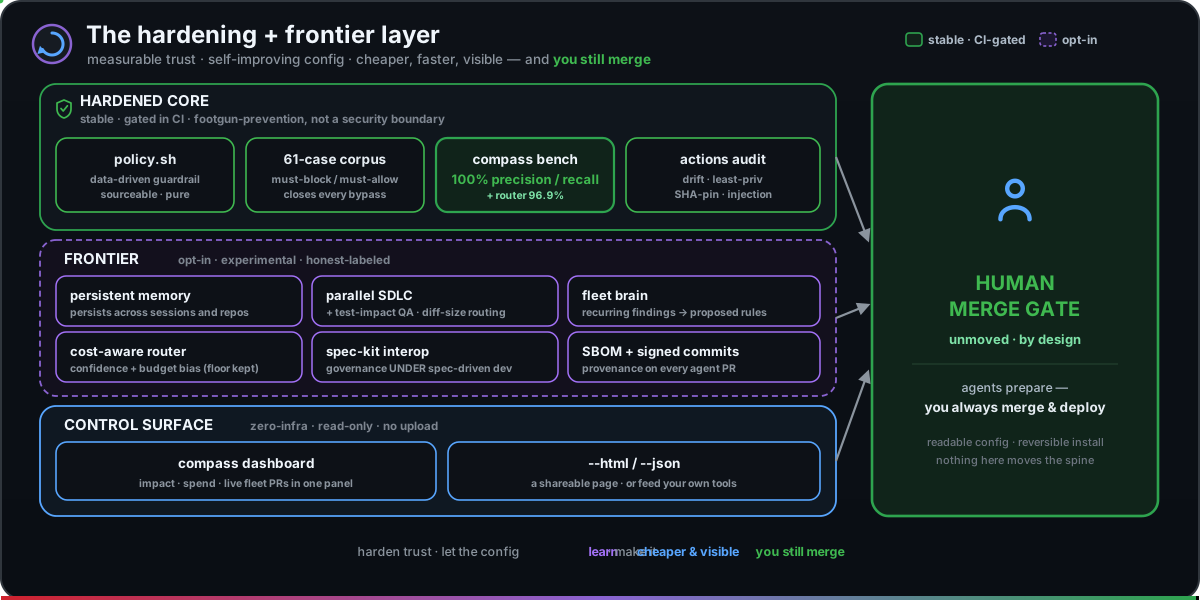
Philosophy · Architecture · Cost & models · Customize · MCP · Plugin & team rollout · LSP · Practices · Defaults · SDLC · Roadmap · Every agent · Dynamic workflows · Fleet · Competitive audit · Hardening + frontier · Red-team · Router module · ADRs
MIT · built to be shared · contributions welcome
Reviews (0)
Sign in to leave a review.
Leave a reviewNo results found