skills
Health Uyari
- License — License: NOASSERTION
- Description — Repository has a description
- Active repo — Last push 0 days ago
- Low visibility — Only 6 GitHub stars
Code Gecti
- Code scan — Scanned 3 files during light audit, no dangerous patterns found
Permissions Gecti
- Permissions — No dangerous permissions requested
Bu listing icin henuz AI raporu yok.
An incisive, source-available brand-distillation skill for Claude, Codex & any SKILL.md tool. Finds the kernel hiding in your product's name, then builds a full brand kit to hand to the coding agent of your choice. You can't be Don (or afford him). But Ron's available.
Ron Draper — a brand-distillation skill for Claude
You can't be Don. Be Ron.
You have a product. You know it cold. But the story — the one line that makes people get it
instantly — is still buried in your head. This skill digs it out.
Ron Draper is an Agent Skill that does late-stage
branding the way a certain fictional adman did it: it doesn't invent your product, it gets very close
to something real and finds the simple, human truth you're too close to see. The goal is the
pitch-room moment — you hear the line and say "oh… yeah, that's exactly it."
It runs a repeatable method: interrogate → find the kernel hiding in the name/story → decide with
conviction (and show the bench) → swatches → mockup → kit → developer handoff, confirming with you
at each gate. It works in Claude Code, the Claude apps, and — because Skills are an open standard —
any tool that reads SKILL.md, including Codex.
The magic, in two real before/afters
Recognition over invention. The best brand idea is almost always already in the material — the
name, the model number, the origin story. The skill's job is to surface it so it feels inevitable.
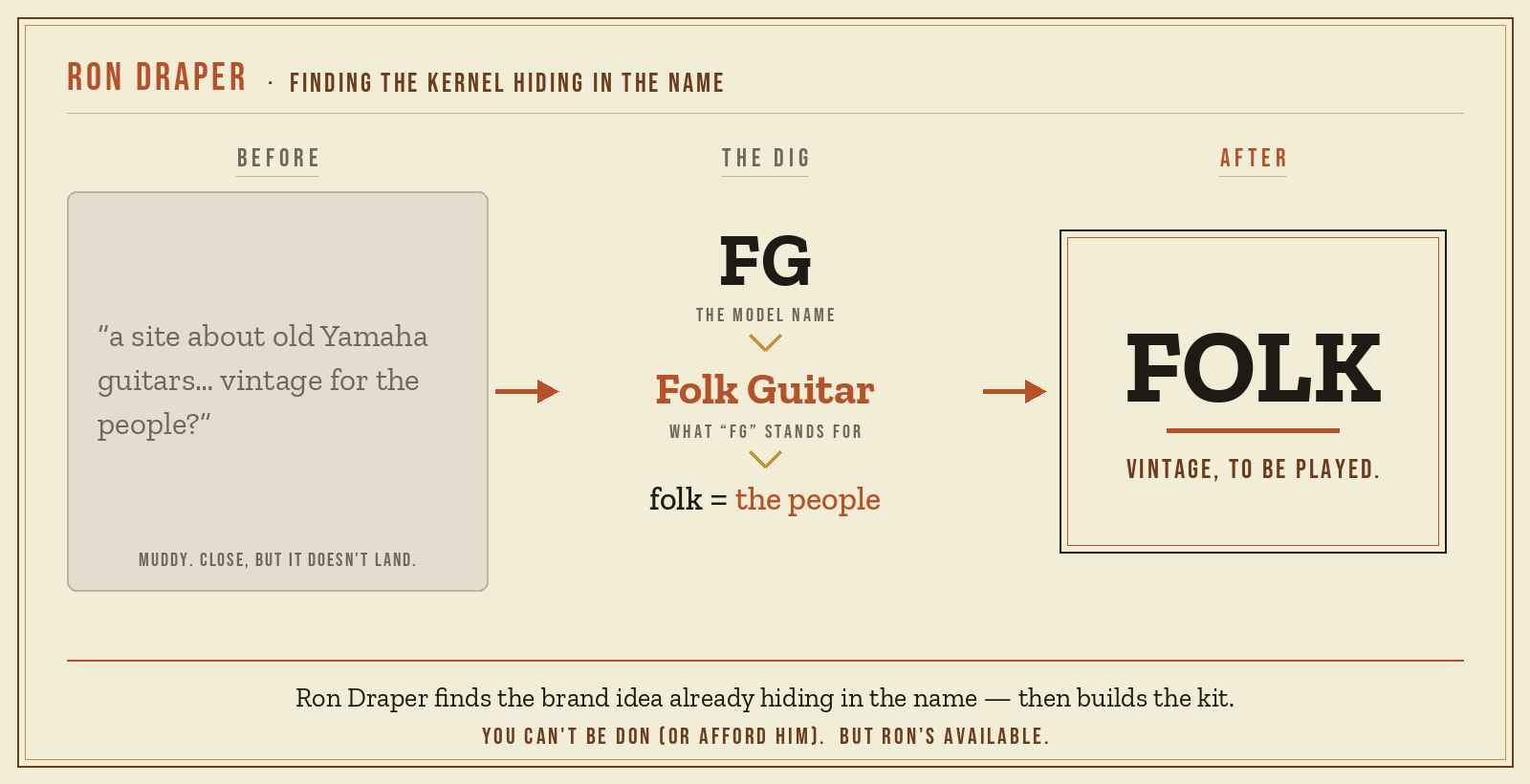
1. A vintage-guitar reference site
- Before: "It's a site about old Yamaha guitars, kind of… vintage for the people? I can't make it
land." - The dig: the guitars are Yamaha FG models. FG stands for Folk Guitar. Folk means
the people. The whole thesis was one word away the entire time. - After: the brand became FOLK — "vintage, to be played." The name stopped being a
description and became the idea.
2. A real-estate estimate auditor
- Before: a tool that checks whether your Zillow "Zestimate" is wrong, with a name ending in
"…maxxing" and a double X — and no clear identity. - The dig: an X is what you strike a wrong number with. The double-X was already a redline /
audit stamp. The logo was hiding in the name. - After: an "audit the black box" identity — forensic, evidence-first, the mark built from the X.
Neither was clever invention. Both were excavation. That's the whole skill.
When to use it
- Pre-launch — the product is built or nearly built, well thought-through, about to ship, and
needs its incisive name/identity/story. (The sweet spot.) - Rebranding — a real product, maybe with users, that just isn't explained in a way people grasp
in a second. Good product, muddy story.
It needs deep product knowledge and real stakes from you — you've lived the problem. Users are
not required.
Not for blank-canvas, pre-product ideas. The skill extracts a kernel that already exists; it
can't manufacture one from a category and a hunch. If you're there: build the thing first, then come
back.
Install
In Claude Code, add this repo as a plugin marketplace, then install the plugin:
/plugin marketplace add DTM-repo/skills
/plugin install ron-draper@draper-skills
Then just describe a branding task — the skill is model-invoked and triggers itself when relevant. To
verify it loaded, run /plugin validate . from the repo root.
Prefer not to use a marketplace? The plugins/ron-draper/skills/ron-draper/ folder is a standalone
skill — drop it in ~/.claude/skills/ and it works.
What's inside
plugins/ron-draper/skills/ron-draper/
  SKILL.md                       the method (start here)
  references/method.md           the kernel diagnostic, naming, the honest-caveat doctrine
  references/visual-craft.md     read-behind-the-feel, type voices, render-and-check
  references/kit-and-handoff.md  file-kit structure + handoff conventions
  scripts/trace_silhouette.py    trace a real reference into a correct-proportioned SVG (no network)
  assets/BRAND.template.md, tokens.template.css   skeletons to fill
Transparency: the one script only traces a local image you point it at and writes files locally —
no network calls, nothing hidden. Read it before you run it; that's the right habit with any skill.
License
Source-available, not open source — see LICENSE. You're free to use it (including in your own
commercial work), read it, modify it for your own use, and share unmodified copies for free. You may
not resell it or repackage it into a paid product without permission. Use it to make cooler
products; just don't sell the skill itself out from under its author.
Customizing / making it yours
- The method is universal. There's a clearly-marked "David's defaults" layer in
references/kit-and-handoff.md(a particular file-kit shape, agent-OS conventions, Claude
Code/Codex handoff habits). Keep it, edit it, or delete it — the craft doesn't depend on it. - Bump
versioninplugins/ron-draper/.claude-plugin/plugin.jsonwhenever you change the skill, so
installed users actually receive the update.
Yorumlar (0)
Yorum birakmak icin giris yap.
Yorum birakSonuc bulunamadi