atelier
Health Warn
- License — License: NOASSERTION
- Description — Repository has a description
- Active repo — Last push 0 days ago
- Low visibility — Only 5 GitHub stars
Code Pass
- Code scan — Scanned 12 files during light audit, no dangerous patterns found
Permissions Pass
- Permissions — No dangerous permissions requested
No AI report is available for this listing yet.
A software factory where AI agents propose and deterministic code disposes. A Python ADW engine runs coding agents in bounded phases; a Next.js cockpit observes and controls them. Both halves meet at one SQLite trace - the single source of truth.
Atelier
A workshop where agents propose and deterministic code disposes. It bolts the
Super-Simple Software Factory's ADW engine onto an operator
cockpit borrowed from FounderOS's "Monolith Signal"
design system. Agents work inside bounded phases, Python decides sequencing and
acceptance, and every event streams to a UI you can watch.
The whole thing rests on one seam: both halves treat SQLite as the single source
of truth. The engine writes the live trace; the cockpit reads it back.
┌──────────┐   writes    ┌─────────────────────────────┐   reads (readonly, WAL)   ┌──────────┐
│  engine  │ ──────────▶ │  engine/adws/adw_data/sssf.db │ ◀──────────────────────── │ cockpit  │
│ (Python) │             │   9 tables · the contract     │                           │ (Next.js)│
└──────────┘             └─────────────────────────────┘                           └──────────┘
Layout
| Path | What it is |
|---|---|
engine/ |
SSSF stamped in via its install.py. Runs ADWs, writes sssf.db. |
cockpit/ |
Fresh Next.js 14 app. Reads sssf.db through a Zod-validated repo layer. |
docs/ |
The build plan (atelier-plan.html) and usage guide. |
Note on git:
engine/shares this repo's single git root (no nested.git).
SSSF anchors on the git root.pi's-epaths, the write-boundary diff, and
commit phases all resolve there, so every engine config path isengine/-prefixed
and ADWs are run from the repo root.repo_root()is therefore the atelier root:
the factory self-hosts (it can build Atelier itself), guarded byprotected_files.
The seam contract
cockpit/lib/types.ts is the frozen TypeScript mirror of the engine's schema
(engine/adws/adw_modules/tracer.py), and cockpit/lib/schemas.ts is the Zod
enforcement of it. Python↔TS drift is the architecture's #1 risk, so it's made
machine-checkable:
cd cockpit && pnpm check:contract # asserts every expected column exists in the live db
Running it
Engine: kick a run (writes to the shared db). Run from the repo root:
just demo                      # two cheap read-only runs, end to end
# or a single one:
uv run engine/adws/adw_prompt.py --config engine/adws/adw_sssf_config/sssf.config.yaml \
  --agent scout "reply with a one-line summary of this repo"
Cockpit: watch runs land (reads the shared db):
cd cockpit
pnpm install
pnpm dev                       # http://127.0.0.1:4200
The cockpit finds the db via SSSF_DB in cockpit/.env.local (an absolute path toengine/adws/adw_data/sssf.db).
Stamping into another repo
Atelier can stamp its engine into any git repo. After that, the repo runs its own
ADWs and keeps its own trace. The payload is generated live from engine/adws/
(no committed templates to drift) at the native adws/ layout, no engine/ prefix.
First stamp. Run from your Atelier checkout:
uv run engine/adws/install.py /path/to/target-repo # add --init to create + git-init a target that isn't a repo yet
What lands, and why the buckets matter for updates:
| Bucket | What | On update |
|---|---|---|
| MANAGED | engine code Atelier owns: adws/adw_modules/*.py, adws/adw_*.py, and the /atelier operator skill (.claude/skills/atelier/**) |
kept current (hashed in .atelier/manifest.json) |
| USER | adws/adw_sssf_config/sssf.config.yaml, prompts, the justfile, .env.sample, your own ADWs/skills |
stamped once, never touched again |
| RUNTIME | adws/adw_data/sessions/, sssf.db* |
gitignored, never stamped |
Install is idempotent by refusal: if .atelier/manifest.json already exists it
stops and points you at update.py, so a re-run can never clobber your roster.
Run an ADW from the stamped repo (native layout, no engine/ prefix):
cd /path/to/target-repo
uv run adws/adw_scout.py --config adws/adw_sssf_config/sssf.config.yaml "one-line summary of this repo"
just sessions                  # the justfile is stamped in; the trace lands in the repo's own sssf.db
Before running build/test ADWs, edit the stamped sssf.config.yaml's quality: /verify: block to match the target's own test/lint commands.
The /atelier operator skill. Every stamp also lands a Claude Code skill at.claude/skills/atelier/: the operator manual for driving the factory in that repo
(run / create / update ADWs, tune the roster, observe runs), with cookbooks and references
written for the native adws/ layout. Its single source is engine/skills/atelier/
(symlinked into this checkout as .claude/skills/atelier, so /atelier works here too; the
skill is layout-aware and translates adws/ → engine/adws/ when it detects the source repo).
It is MANAGED, so update.py keeps its docs in lockstep with engine behavior; a cookbook
you hand-edit is parked as <file>.atelier-new, never clobbered. Claude Code autoloads it;
other agent harnesses (codex, cursor, pi) don't scan .claude/skills/, so point their own
rules file at .claude/skills/atelier/SKILL.md rather than copying it (a copy drifts, and a
pointer in AGENTS.md/CLAUDE.md would leak into the ADW coding agents via guidance injection).
Pull later engine improvements. Reconciled per file by content hash; your edits are
never clobbered (a conflict is written beside the file as <file>.atelier-new):
uv run engine/adws/update.py /path/to/target-repo
Front many stamped repos from one cockpit. Register each incockpit/atelier.projects.json (gitignored; copy atelier.projects.example.json).root may be absolute or relative to cockpit/; adwsSubdir is adws for a stamped
repo (engine/adws for Atelier self-hosting):
[
  { "id": "my-app", "name": "My App", "root": "/abs/path/to/target-repo", "adwsSubdir": "adws" }
]
The cockpit then routes each project under /<id>/… with a switcher. A supervisor
keeps one worker draining each project's queue:
uv run engine/adws/adw_worker.py --supervise # reads the registry; the ONLY thing that spawns workers
Start/stop a project's worker from the cockpit sidebar footer: it writes aworkerDesired flag the supervisor disposes; the cockpit itself never spawns a process.
Three coding-agent backends
The engine picks a backend per agent via coding_agent: in the config (D1 in the plan):
| Backend | coding_agent |
Drives | Auth |
|---|---|---|---|
| pi | pi |
GPT-5.6 (Sol/Terra/Luna), etc | pi's own (~/.pi/agent) |
| Claude SDK | claude_code |
Claude (Haiku/Sonnet/Opus) | Claude Code's own login (claude) |
| Cursor CLI | cursor |
Cursor's models (cursor/*: Anthropic/OpenAI/Grok/Kimi/Composer) |
Cursor login (cursor-agent login) |
agent_cc.py (Claude SDK) and agent_cursor.py (Cursor CLI) each mirror agent_pi.run's
contract exactly (streamed tool events, envelope text, usage, session resume) soagents.execute() treats all three identically. The Cursor backend reports no dollar cost
(subscription billing) and has an inert context-window valve (cooperative handoff only).
Current roster: scout → anthropic/claude-haiku-4-5 (Claude SDK); builder →openai-codex/gpt-5.6-sol (pi); planner → anthropic/claude-fable-5.
⚠️ pi no longer supports Anthropic. So
agents.py::load_configforcescoding_agent: claude_codefor anyanthropic/*model, regardless of the roster.
Claude always goes through the SDK (theclaudeCLI's own login, no API key), and pi
only ever runs non-Anthropic models. A straycoding_agent: pion ananthropic/*
agent is corrected at load, so no roster can mis-route it. Also:pi0.81.1 has no~/.pi/agent/models.json, soengine/.envpointsPI_MODELS_PATHat a local stub
(andcontext_window()degrades to unknown when even that is absent, e.g. a stamped repo).
Build status
- Phase 0: Foundations & the seam ✅ Monorepo up; engine runs; schema frozen +
contract-checked; design system lifted; cockpit renders real runs from the shared db. - Phase 1: Observe (next). The three views on real data: Runs log · live Process
Map · Run detail (phases + envelope + gates). - Phases 2–5: control plane · observability/cost · authoring · real-time. See
docs/atelier-plan.html.
The cockpit
Every view reads live from the shared sssf.db, in FounderOS's "Monolith Signal" terminal aesthetic.
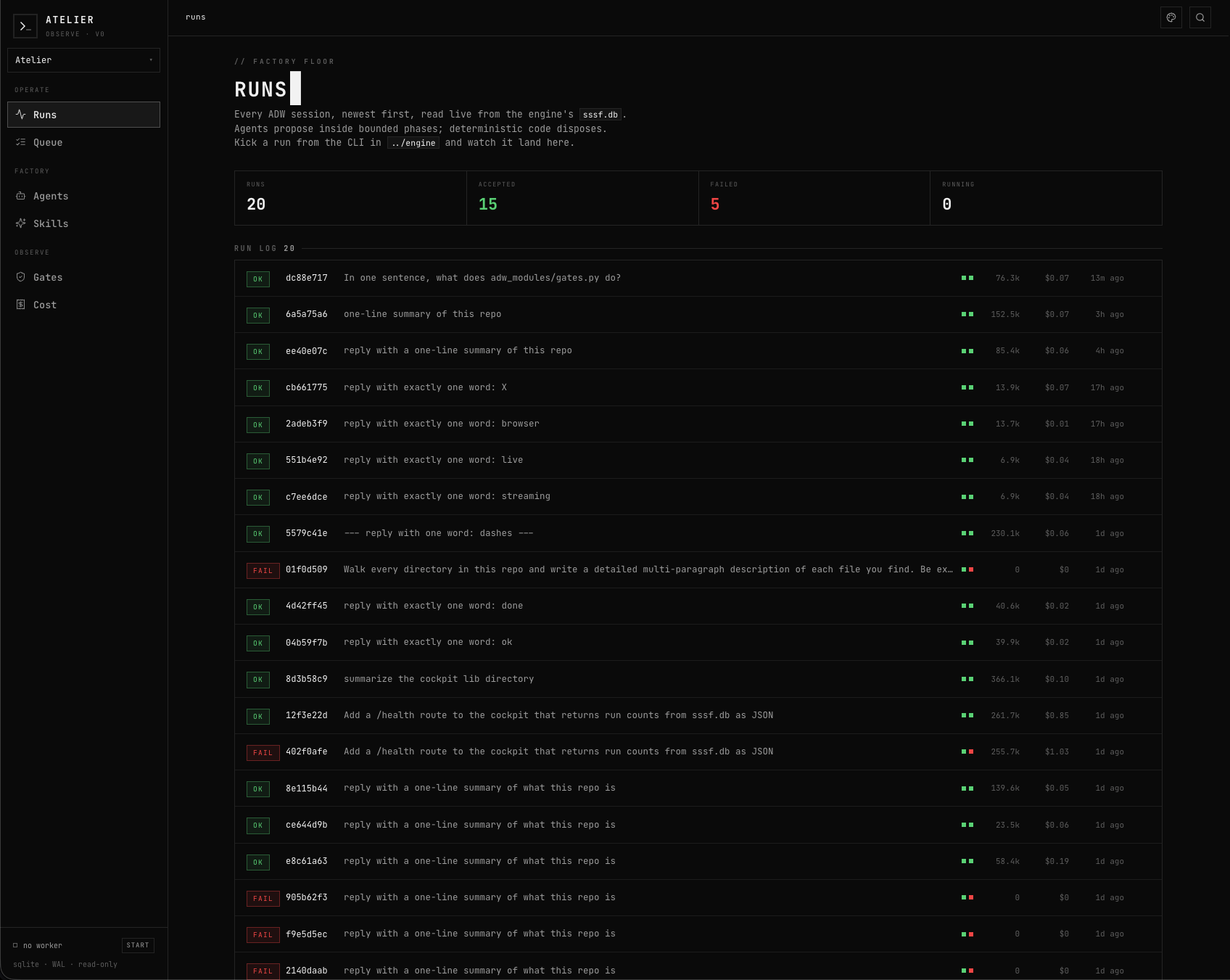
Runs: the factory floor. Every ADW session newest-first, with acceptance, tokens, cost, and phase-progress dots per row.
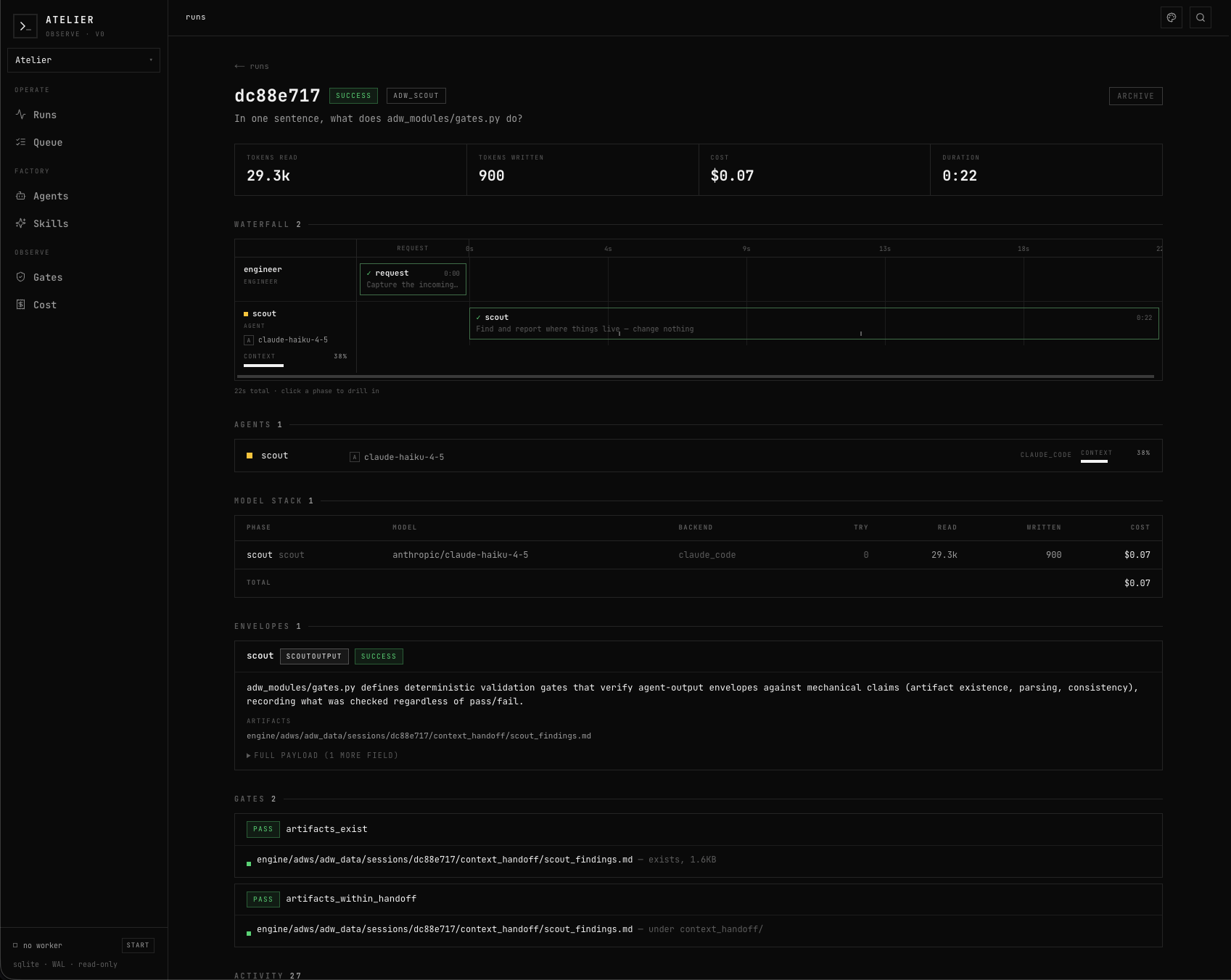
Run detail. Drill into one run: the phase waterfall, the agent + model stack, the typed envelope, and the deterministic gates that accepted it (here the read-only scout passing artifacts_exist and artifacts_within_handoff).
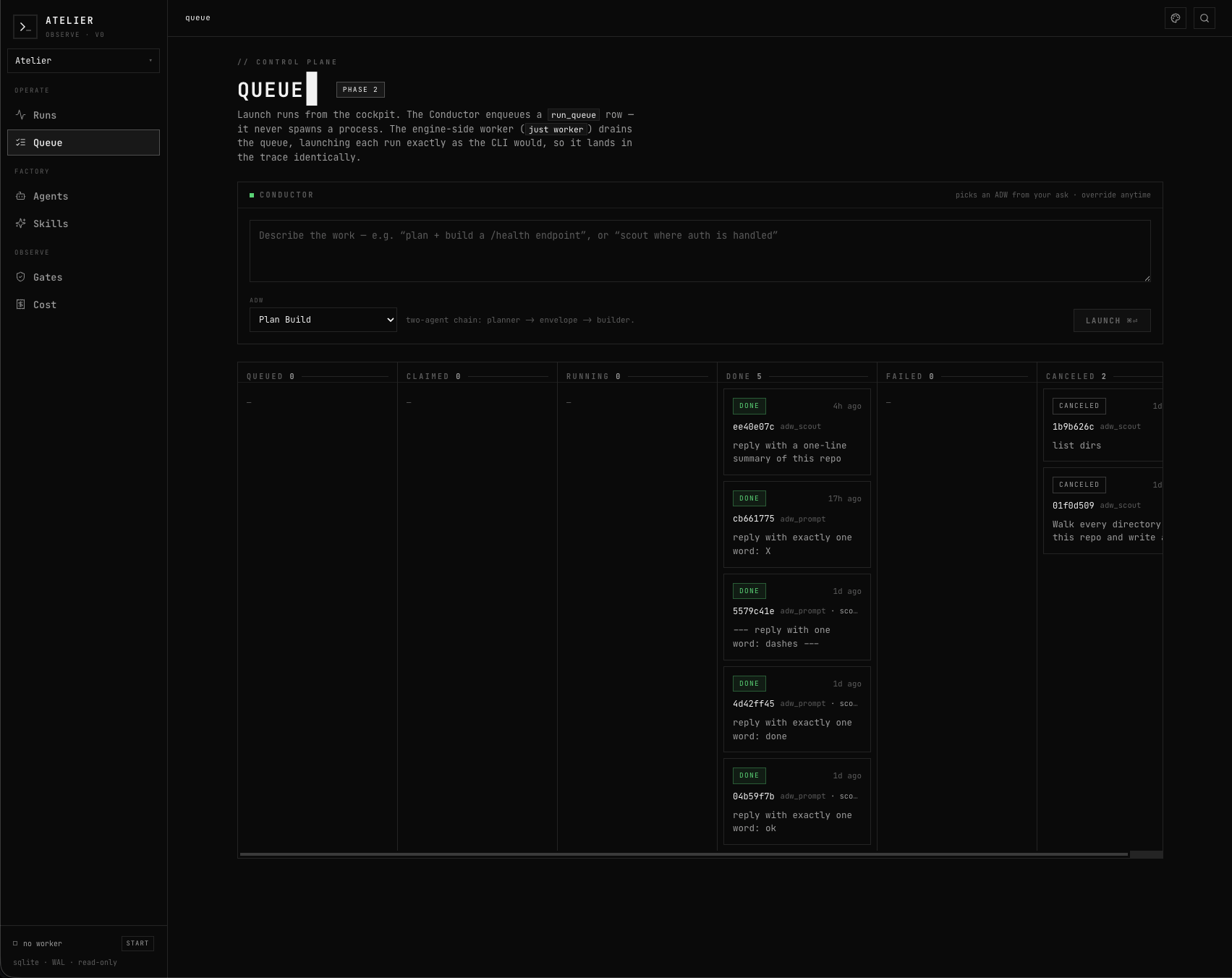
Queue: the control plane. Describe work to the Conductor, which enqueues a run_queue row; the engine-side worker drains it, launching each run exactly as the CLI would. The cockpit never spawns a process.
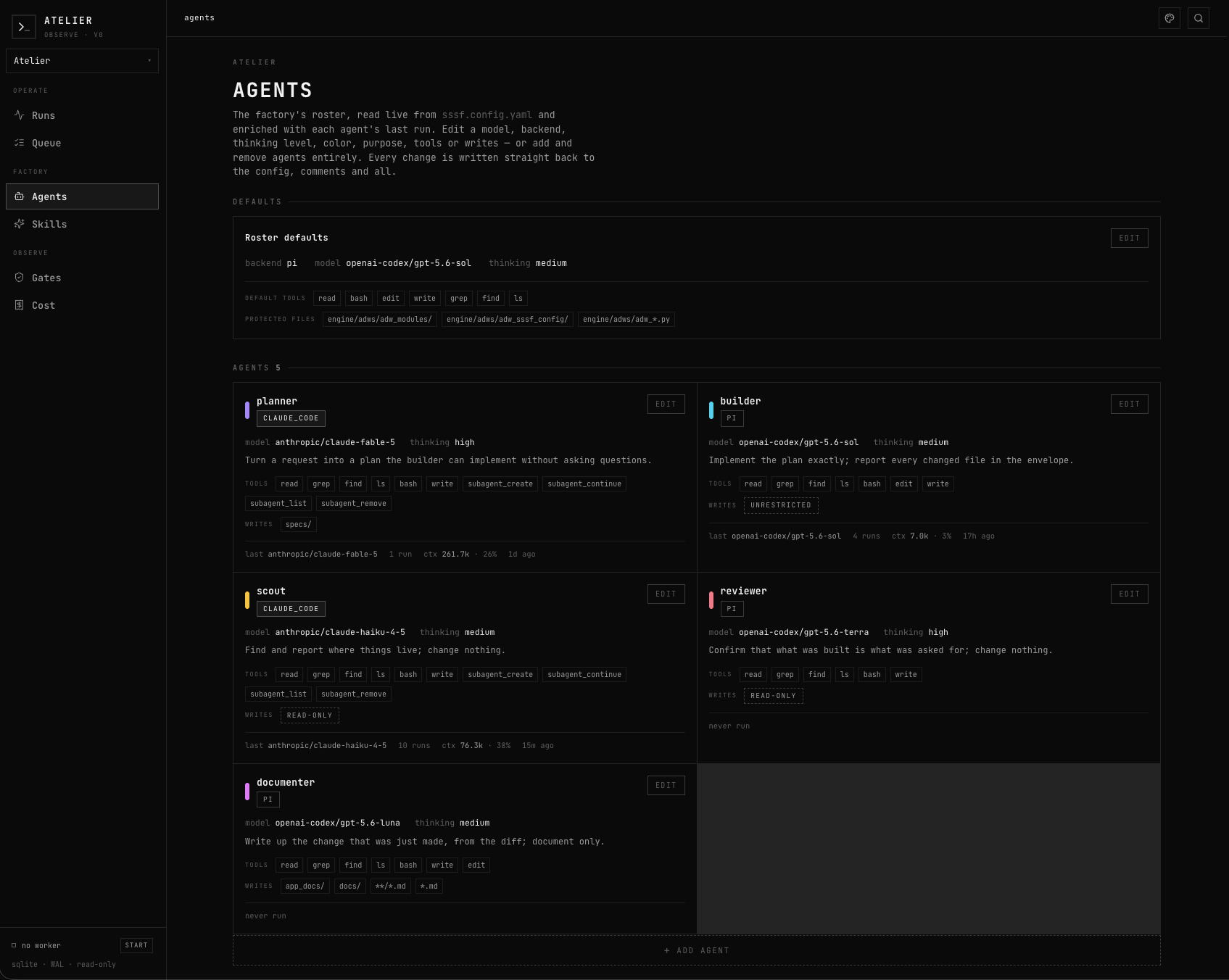
Agents: the roster. Each agent's model, backend, thinking level, tools, and write boundary, read live from sssf.config.yaml and editable straight back into it, comments and all.
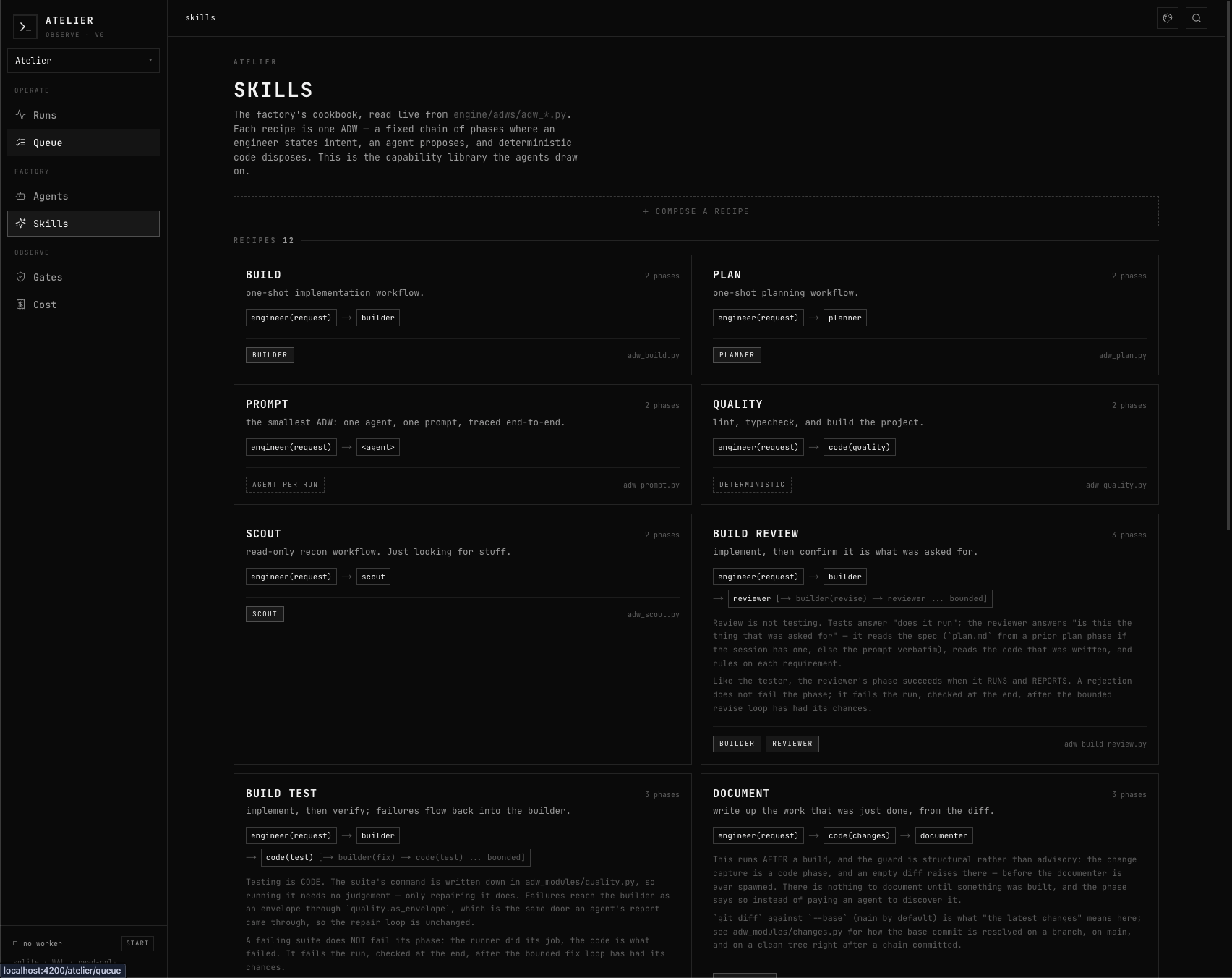
Skills: the recipe catalog. One card per ADW, showing its phase chain, parsed live from the adw_*.py docstrings.
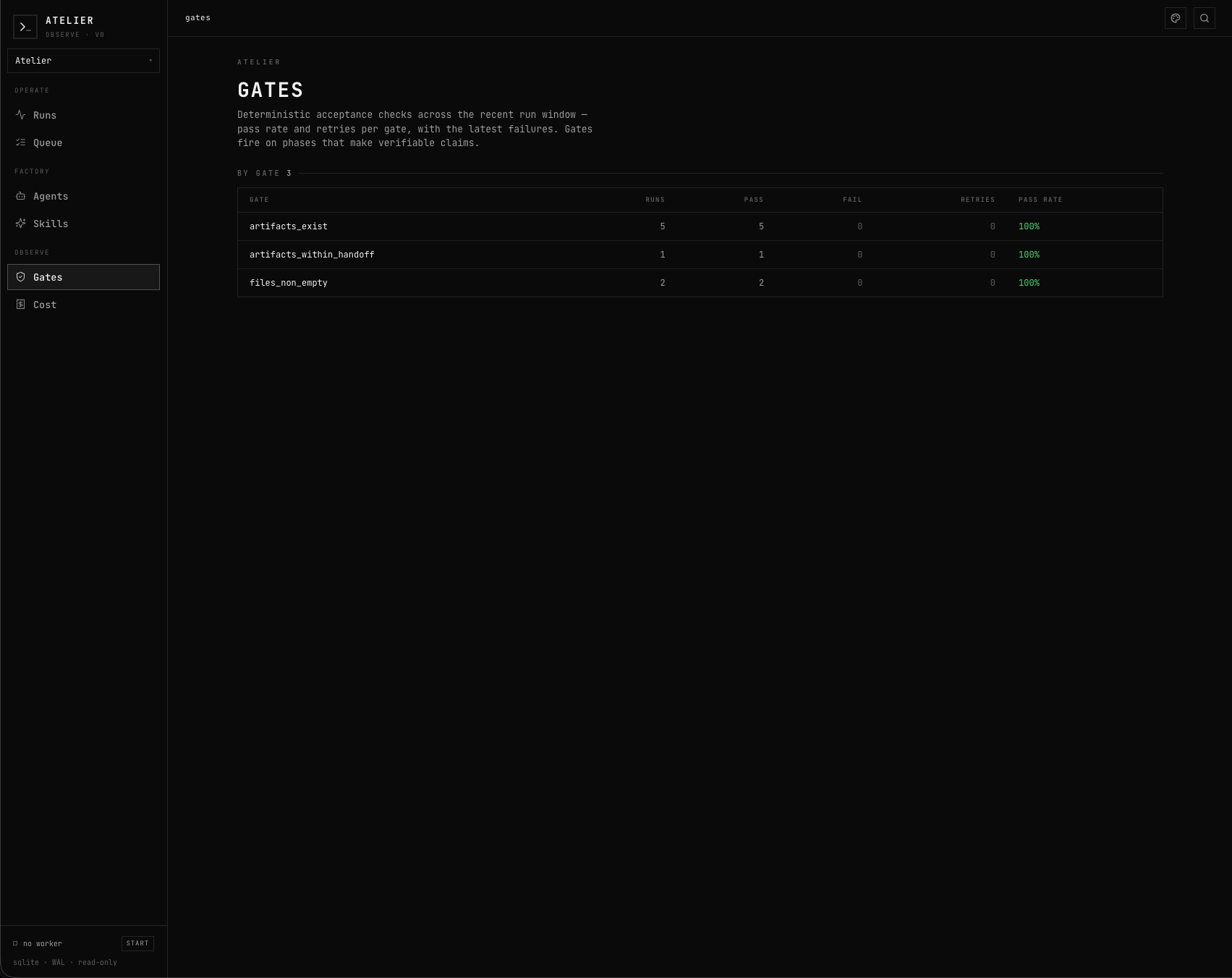
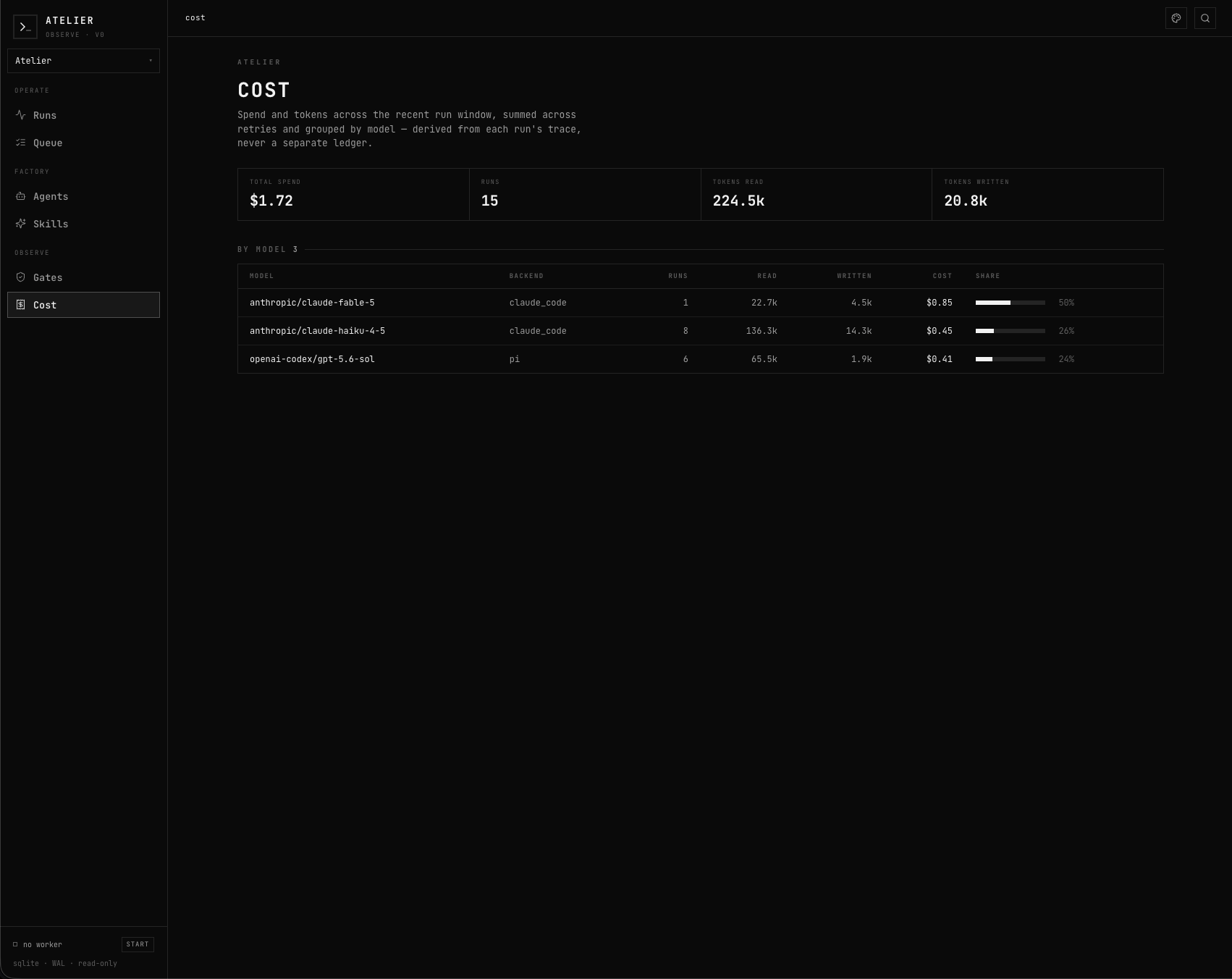
Gates & Cost: the rollups. Per-gate pass/fail/retry health, and spend + tokens grouped by model, both derived from each run's trace, never a separate ledger.
License
Atelier is released under the MIT License.
It builds on two MIT-licensed projects, retained under their own MIT terms:
- Super-Simple Software Factory (SSSF) — the ADW engine
- FounderOS — the "Monolith Signal" cockpit design system
Reviews (0)
Sign in to leave a review.
Leave a reviewNo results found