LIVA
Health Pass
- License — License: NOASSERTION
- Description — Repository has a description
- Active repo — Last push 0 days ago
- Community trust — 11 GitHub stars
Code Pass
- Code scan — Scanned 12 files during light audit, no dangerous patterns found
Permissions Pass
- Permissions — No dangerous permissions requested
No AI report is available for this listing yet.
Advanced Agentic AI Assistant & Desktop Cognitive Architecture (5-tier memory, SQLite-Vec, 91 MCP tools, Llama.cpp)
LIVA — Local Intelligent Virtual Assistant 🧠
A Privacy-Centric, Local-First Cognitive Desktop Operating System









Executive Summary
LIVA (Local Intelligent Virtual Assistant) is a JARVIS-like, desktop-native cognitive operating system engineered for Windows 10/11 x64 workstations. Built from the ground up in modern Rust with a high-performance Tauri v2 desktop shell and a Vue 3 / Three.js 3D avatar interface, LIVA delivers an autonomous personal AI assistant that operates 100% offline and local-first.
Core Tenets
- Zero Telemetry & Absolute Privacy: All conversational reasoning, document indexing, multimodal vision grounding, voice synthesis, and desktop automation execute directly on local CPU/GPU hardware. No prompts, audio chunks, or embeddings leave the machine.
- Unified Native Rust Architecture: All legacy Node.js/Python server processes, Docker daemons, and internal loopback TCP/WebSocket proxies have been completely eliminated. The entire runtime is consolidated into a cohesive 7-crate Rust workspace.
- Actor-Based Concurrency: Dedicated, non-blocking MPSC actors for LLM inference (with 3-tier priority scheduling and preemption) and transactional SQLite mutations (single-writer micro-batching pinned to an isolated OS thread).
- Multi-Tier Hierarchical Memory: Ultra-fast active recall via in-memory Radix Trie (< 0.1 ms), persistent SQLite WAL storage, statically compiled
sqlite-vecvector embeddings, and lock-free HippoRAG knowledge graph traversal. - Strict Hardware Guardrails: Operates within a guaranteed RAM ceiling of $\le 4.0\text{ GB}$ (typical working set $\sim 2.27\text{ GB}$) and a VRAM ceiling of $\le 5.1\text{ GB}$, actively governed to avoid interfering with foreground workstation tasks.
System Architecture
LIVA is organized as a unified, high-performance Rust Workspace containing exactly 7 member crates, cleanly separating domain contracts, persistence, inference, tooling, automation, orchestration, and desktop presentation.
                           ┌────────────────────────────────────────────────────────┐
                           │                 LIVA DESKTOP SHELL                     │
                           │                    (liva-desktop)                      │
                           │    Tauri v2 Shell · Multi-Window · WH_MOUSE_LL Hook    │
                           └───────────────────────────┬────────────────────────────┘
                                                       │ Native Tauri v2 IPC Channels
                                                       │ (Zero TCP/WebSocket Loopback)
                                                       ▼
┌───────────────────────────────────────────────────────────────────────────────────────────────────┐
│                             LIVA NATIVE ORCHESTRATION FACADE                                      │
│                                    (liva-native-core)                                             │
│       AppState Coordinator · Agent StateGraph · WebRTC Voice Pipeline · Qwen3-VL Vision · MCP     │
├──────────────────────┬───────────────────────┬─────────────────────┬──────────────────────────────┤
│                      │                       │                     │                              │
│       crates/        │        crates/        │       crates/       │           crates/            │
│   liva-core-types    │      liva-storage     │      liva-llm       │           liva-cua           │
│                      │                       │                     │                              │
│  - Pure Domain Types │  - SQLite Pool (WAL)  │  - Priority LlmActor│  - Native Computer-Use Agent │
│  - Errors (thiserror)│  - Pinned DbActor     │    (High/Norm/Low)  │  - Win32 Synthetic Input     │
│  - Auth & Permissions│  - Radix FactTrie     │  - Thread-Safe ONNX │  - Multi-Monitor DPI Aware   │
│  - IPC Schema Models │  - Static sqlite-vec  │    EmbeddingEngine  │  - UIPI & Security Governor  │
│  - Specta TS Export  │  - Lock-Free HippoRAG │  - SHA-256 Trust    │  - Hardware Kill Switch      │
│  - Zero Heavy Deps   │    (ArcSwap<CsrGraph>)│    Model Cache      │    (VK_ESCAPE Daemon)        │
└──────────────────────┴───────────────────────┴─────────────────────┴──────────────────────────────┘
                                                       ▲
                                                       │ Diagnostic Probes & Benchmarks
                               ┌───────────────────────┴───────────────────────┐
                               │                 crates/liva-tools             │
                               │        Consolidated CLI & Diagnostic Suite    │
                               │      (probe · bench · doctor · eval commands) │
                               └───────────────────────────────────────────────┘
The 7 Rust Workspace Members
| Member | Path | Edition | Description & Core Responsibilities |
|---|---|---|---|
| 1. Desktop Shell | liva-desktop/src-tauri |
2021 | Tauri v2 desktop application shell. Hosts transparent overlay widgets, dashboard, and setup windows. Handles system tray, Windows low-level mouse hooks (WH_MOUSE_LL for click-through Ghost Mode), Stronghold encrypted secret store, and in-process IPC channel routing. |
| 2. Native Core | liva-native-core |
2021 | Top-level orchestration facade and runtime engine. Houses the unified AppState context, agent StateGraph scheduling, full-duplex WebRTC audio pipeline (Silero VAD, Smart Turn v3.2, Parakeet STT, VieNeu/Piper TTS), Qwen3-VL vision processing, native MCP server, and hardware governors (VisualGovernor, NVML monitor). |
| 3. Core Types | crates/liva-core-types |
2021 | Pure domain models and contract definitions with zero heavy external dependencies. Defines thiserror error hierarchies, role-based authorization (CommandPrincipal), IPC request/response types, and Specta bindings for frontend TypeScript type safety. |
| 4. Storage Engine | crates/liva-storage |
2024 | Calibrated persistent storage. Implements calibrated SQLite WAL connection pools, single-writer DbActor transactional micro-batching, in-memory Radix Trie active recall, statically compiled sqlite-vec C-FFI, and lock-free ArcSwap<CsrGraph> for HippoRAG graph traversal. |
| 5. LLM Engine | crates/liva-llm |
2024 | Actor-based local LLM runtime. Features a bounded Tokio MPSC LlmActor with a 3-tier priority queue (High, Normal, Low) and atomic preemption. Decouples thread-safe ONNX EmbeddingEngine sessions (&self), dynamic prompt budgeting, and SHA-256 model trust verification. |
| 6. Diagnostic Tools | crates/liva-tools |
2021 | Consolidated CLI diagnostic suite replacing 26 individual diagnostic binaries. Exposes unified commands: probe (DB, ONNX, wakeword, GTCRN, STT, TTS, router, OS), bench (latency & throughput), doctor (preflight health verification), and eval (task & recall evaluation). |
| 7. Computer-Use Agent | crates/liva-cua |
2021 | Native desktop automation engine. Provides Win32 synthetic mouse/keyboard input injection, monitor DPI coordinate mapping, screen ROI capture, UIPI (User Interface Privilege Isolation) security guards, dedicated emergency kill switch (VK_ESCAPE hotkey polling thread), and SQLite action audit logging. |
Architecture Clarification: Audio and speech processing (Silero VAD, Smart Turn v3.2, Sonora AEC3, GTCRN speech denoiser, Parakeet STT, VieNeu/Piper TTS) is implemented directly within
liva-native-core/src/webrtc,src/stt,src/tts, andsrc/wake.rs. There is no separatecrates/liva-voicecrate.
Concurrency, Runtime & Memory Architecture
1. Actor-Based Concurrency & Preemption
- Prioritized
LlmActor: LLM generation runs inside a bounded Tokio MPSC actor. Requests are categorized into three priority bands:Priority::High: Health checks, parameter inspection, and cancellation signals.Priority::Normal: Interactive user conversational turns and live streaming responses.Priority::Low: Background memory consolidation, document indexing, and maintenance tasks.
- Instant Preemption: The actor eagerly drains commands from its queue. Long-running token generation executed on dedicated OS blocking threads (
tokio::task::spawn_blocking) continuously monitors atomic cancellation tokens. An incomingHigh-priority command or shutdown signal preempts ongoing generation in $< 5\text{ ms}$, eliminating head-of-line blocking and interface freezes. - Dedicated Single-Writer
DbActor: Database write operations are serialized through an MPSC channel to a dedicated background OS thread. Write commands are coalesced into transactional micro-batches (BEGIN IMMEDIATE...COMMIT) flushed either upon reaching 50 operations or an elapsed 5ms window. This boosts write throughput to 1,500–3,000 ops/s and completely preventsSQLITE_BUSYdatabase lock contention.
2. Multi-Tier Memory Subsystem
┌────────────────────────────────────────────────────────────────────────┐
│                      LIVA Multi-Tier Memory Engine                     │
├────────────────────────────────────────────────────────────────────────┤
│ Tier 0: In-Memory Radix Trie (crates/liva-storage)                     │
│   - FactTrie & ActiveRecallManager                                     │
│   - Substring sliding-window keyword matching in < 0.1 ms (0 tokens)   │
├────────────────────────────────────────────────────────────────────────┤
│ Tier 1: Persistent SQLite WAL (crates/liva-storage & liva-native-core) │
│   - Calibrated PRAGMAs: page_size=4096, cache_size=-2000 (~2MB),       │
│     mmap_size=256MB, synchronous=NORMAL, journal_size_limit=64MB       │
│   - Micro-batched single-writer DbActor; readers pool for concurrency  │
├────────────────────────────────────────────────────────────────────────┤
│ Tier 2: Hybrid Vector Index (crates/liva-storage)                      │
│   - sqlite-vec: Static C-FFI (vec_idx USING vec0(embedding int8[384])) │
│   - Decoupled EmbeddingEngine: multilingual-e5-small via ONNX Runtime  │
│   - FTS5 full-text search integrated with Ebbinghaus memory decay      │
├────────────────────────────────────────────────────────────────────────┤
│ Tier 3: Associative Knowledge Graph (crates/liva-storage)              │
│   - GraphRAG: l3_nodes and l3_edges tables                             │
│   - In-memory lock-free ArcSwap<CsrGraph> snapshot                     │
│   - HippoRAG: 3-round SpMV Personalized PageRank (PPR) in ~1.12 ms     │
└────────────────────────────────────────────────────────────────────────┘
3. Native Tauri v2 IPC Protocol
- Zero Loopback WebSockets/TCP: Completely eliminates internal loopback network ports (no port 8002, no
tokio-tungstenite). - Direct In-Process Channels: Text tokens, phonemes, viseme blendshapes, and binary audio buffers stream directly over native
tauri::ipc::Channelinstances and window events (window.emit). - End-to-End Safety: Eliminates Windows Firewall alerts, eliminates double JSON serialization overhead, and guarantees compile-time schema synchronization between Rust and Vue 3 via Specta.
4. Hardware Resource Limits & Load Governors
- RAM Ceiling ($\le 4.0\text{ GB}$):
- Peak internal working set: $\sim 2.27\text{ GB}$ (Core + Tokio 120MB, Storage/CSR 150MB, Embeddings 80MB, Voice DSP 60MB, STT 180MB, LLM 280MB, KV Cache 250MB, VLM 150MB, TTS 250MB, UI/Three.js 350MB).
- Steady-state operating memory: $\sim 3.0\text{ GB}$ including OS buffers.
- VRAM Ceiling ($\le 5.1\text{ GB}$):
- Physical GPU memory budget strictly reserved for Windows DWM compositor (1.0 GB) and dual CUDA contexts (350 MB).
VisualGovernor: Enforces mutual exclusion for the 750 MB Qwen3-VL vision model. When not in active visual reasoning, the VLM is kept dormant. Upon a vision capture event, the visual slot is claimed and kept warm for a 15-second cooldown window before release.Governor(NVML): Monitors external GPU and CPU utilization in real-time. If foreground applications (such as 3D games or video editing suites) exceed 80% utilization, LIVA automatically throttles background tasks and drops OS thread priorities toBELOW_NORMAL.
Dataflow & IPC Architecture
sequenceDiagram
    autonumber
    actor User as User (Voice / UI / Input)
    participant UI as Vue 3 / OffscreenCanvas (liva-ui)
    participant Shell as Tauri v2 Shell (liva-desktop)
    participant Core as Orchestration Facade (liva-native-core)
    participant LlmActor as LlmActor (crates/liva-llm)
    participant Storage as DbActor & Memory (crates/liva-storage)
    participant Cua as Win32 CUA Engine (crates/liva-cua)

    User->>UI: Conversational Turn / Action
    UI->>Shell: invoke("native_ipc_call_stream", payload)
    Shell->>Core: handle_command_as(CommandPrincipal, command)

    rect rgb(240, 245, 255)
        Note over Core,Storage: Step 1: Sub-millisecond Active Recall
        Core->>Storage: try_intercept_turn(text) [Radix FactTrie]
        alt Exact Fact Match Found (< 0.1ms)
            Storage-->>Core: Intercept turn (0 LLM tokens consumed)
        else Fact Miss
            Core->>Storage: Hybrid Retrieval (sqlite-vec + FTS5 + HippoRAG PPR)
            Storage-->>Core: Contextual Knowledge Snippets
        end
    end

    rect rgb(255, 245, 240)
        Note over Core,LlmActor: Step 2: Prioritized LLM Generation
        Core->>LlmActor: generate_text_stream(prompt, Priority::Normal)
        loop Token Stream Generation
            LlmActor-->>Core: Token Chunk
            Core-->>Shell: Forward token
            Shell-->>UI: window.emit("ipc-stream:req_id", token)
        end
    end

    opt Action Requires Desktop Automation
        Core->>Cua: execute_action(action, SecurityGovernor)
        Cua->>User: Win32 Synthetic Mouse/Keyboard Event
        Cua->>Storage: Audit Log Transaction (DbActor)
    end

    Core->>Storage: Async Memory Consolidation (Priority::Low)
Prerequisites & Installation
System Requirements
- Operating System: Windows 10/11 x64 (64-bit required).
- Rust Toolchain: Rust 1.85+ (supporting Rust 2024 edition) with
x86_64-pc-windows-msvctarget. - Node.js: v20 or newer (npm v10+ with npm workspaces support).
- C++ Build Tools: Visual Studio 2022 C++ x64 Build Tools with the LLVM (
lld-link) linker component. - CMake & LLVM: CMake $\ge 3.24$ and LLVM/Clang. Ensure
LIBCLANG_PATHenvironment variable points to your LLVMbindirectory. - Hardware: Minimum 16 GB system RAM. NVIDIA GPU (CUDA 12.x) with 6 GB+ VRAM recommended for hardware acceleration; full CPU fallback inference is supported.
Step-by-Step Setup
# 1. Clone the repository
git clone https://github.com/DuongNAD/LIVA.git
cd LIVA

# 2. Install frontend and toolchain dependencies
npm ci

# 3. Fetch and verify required model weights (GGUF & ONNX)
npm run setup:models

# 4. Verify system environment, model hashes, and toolchain health
cargo run -p liva-tools -- doctor
Environment Configuration (PowerShell)
💡 Notice: LIVA's native core does not parse
.envfiles at runtime for security and determinism. Configure parameters directly in your PowerShell session or Windows environment:
# GPU layer offload (set to 0 for CPU-only inference, 99 for maximum GPU offload)
$env:LIVA_LLM_N_GPU_LAYERS = "99"

# Context window token budget (default: 4096)
$env:LIVA_LLM_N_CTX = "4096"

# Voice wake mode: "asr_prefix" (default) or "wakeword"
$env:LIVA_WAKE_MODE = "asr_prefix"

# Optional: Number of SQLite read connections in the pool (default: 4)
$env:LIVA_DB_READERS = "4"
For complete environment variable documentation, refer to Environment Variables & Configuration.
Build, Test & Development
All build and test executions on developer machines MUST adhere to strict resource-bounding flags to prevent compiler thread explosion and protect workstation stability.
Sequential Development Commands
# 1. Workspace compilation check (strictly bounded to 2 threads)
cargo check --workspace -j 2

# 2. Workspace code formatting verification
cargo fmt --all -- --check

# 3. Workspace clippy linter (zero-warning compliance)
cargo clippy --workspace -j 2 -- -D warnings

# 4. Run full workspace test suite (bounded compiler and test threads)
cargo test --workspace -j 2 -- --test-threads 2

# 5. Targeted crate tests
cargo test -p liva-storage -j 2 -- --test-threads 2       # SQLite, Trie & static sqlite-vec
cargo test -p liva-llm -j 2 -- --test-threads 2           # LlmActor priority & cancellation
cargo test -p liva-cua -j 2 -- --test-threads 2           # Win32 desktop automation & killswitch
cargo test -p liva-native-core -j 2 -- --test-threads 2   # Orchestration harness & state graphs
cargo test -p liva-tools -j 2 -- --test-threads 2         # Diagnostic probe & bench suite
cargo test -p liva-desktop -j 2 -- --test-threads 2       # Tauri shell & Stronghold vault

# 6. Run diagnostic CLI tools
cargo run -p liva-tools -- probe db                       # Verify SQLite WAL & schema integrity
cargo run -p liva-tools -- doctor                         # Verify models and environment health
Running the Desktop Application
# Launch the desktop app in development mode (spawns Vue 3 Vite server + Tauri v2 shell)
cd liva-desktop
npx tauri dev
Alternatively, run npm run dev from the repository root.
Packaging Production Binaries
# Build standard release installer (NSIS / Windows x64 executable)
cd liva-desktop
npx tauri build

# Build GPU-accelerated installer with CUDA support
cd liva-desktop
npx tauri build -- --features cuda
Quantitative Architectural Benchmarks
Forensic audit comparison between LIVA's legacy monolithic prototype and the modern Multi-Crate Workspace architecture:
| Metric | Legacy Monolith | Multi-Crate Architecture | Measured Improvement |
|---|---|---|---|
Local target/ Build Cache |
94.34 GB (9,772 artifacts) | $< 12.0\text{ GB}$ | 87.3% disk reduction |
| Executable Binaries Linked | 106 binaries (78 tests + 26 bins) | 2 binaries (1 harness + 1 tools CLI) | 98.1% fewer link targets |
| Incremental Link Time | 20–60s (MSVC link.exe) |
$< 3\text{ s}$ (MSVC lld-link + single harness) |
10x–20x faster linking |
| CI/CD Pipeline Turnaround | $> 60\text{ min}$ (sequential Windows VM) | $\sim 5.5\text{ min}$ (4-Job Parallel DAG) | 91% CI turnaround cut |
| SQLite Page Cache RAM Footprint | 312.5 MB (uncalibrated pool) | $\sim 11.7\text{ MB}$ (calibrated PRAGMAs) | 96.2% RAM reduction (~300MB saved) |
| Active Recall Retrieval Latency | 50–250ms (full-table scan + AES) | $< 0.1\text{ ms}$ (in-memory Radix Trie) | 500x lower latency |
| Database Write Throughput | 20–50 tx/s (unbatched disk sync) | 1,500–3,000 ops/s (5ms micro-batching) | 50x write throughput boost |
| Health Check Latency During LLM | 3,000–15,000ms (locked Mutex) | $< 5\text{ ms}$ (Priority::High actor channel) | Zero UI freeze / HoL blocking |
| 3D Avatar Rendering Framerate | 20–35 FPS (UI thread starvation) | Locked 60 FPS (OffscreenCanvas Worker) | Fluid visual rendering |
| Windows Installer Package Size | 291.2 MB (unoptimized) | $< 85.0\text{ MB}$ (ThinLTO + symbol stripping) | 70.8% smaller installer |
Documentation Hub
LIVA maintains comprehensive, living documentation organized into clean functional tiers:
| Tier | Directory / File | Description |
|---|---|---|
| 📑 Master Index | docs/README.md |
Central entry point and navigation directory for all technical documentation. |
| 🏛️ Architecture & Principles | docs/01-kien-truc/ |
High-level system architecture, cognitive design, memory, and communication. |
| ↳ System Overview & Vision | docs/01-kien-truc/01-tong-quan-va-tam-nhin.md |
Vision, local-first philosophy, and multi-crate workspace structure. |
| ↳ Cognitive Actor Principles | docs/01-kien-truc/02-nguyen-ly-cognitive-actor.md |
Native Actor Concurrency, Perception $\to$ Policy $\to$ Action cycle, and HITL safety. |
| ↳ Multi-Tier Memory Architecture | docs/01-kien-truc/03-kien-truc-bo-nho-da-tang.md |
Deep dive into Radix Trie, calibrated SQLite WAL, static sqlite-vec, and HippoRAG. |
| ↳ Tauri v2 IPC Protocol | docs/01-kien-truc/04-giao-thuc-ipc-tauri-v2.md |
In-process streaming channels, binary payload transfer, and Specta type synchronization. |
| 📦 Workspace Member Crates | docs/02-crates/ |
In-depth engineering specifications for each workspace crate. |
| ↳ liva-native-core | docs/02-crates/01-liva-native-core.md |
Orchestration facade, AppState, agent graphs, voice/vision engines, and MCP server. |
| ↳ liva-storage | docs/02-crates/02-liva-storage.md |
Persistence mechanics, PRAGMA calibration, DbActor micro-batching, and static FFI. |
| ↳ liva-llm | docs/02-crates/03-liva-llm.md |
Actor inference, 3-tier priority scheduling, ONNX embeddings, and SHA-256 trust cache. |
| ↳ liva-core-types | docs/02-crates/04-liva-core-types.md |
Pure domain entities, error taxonomies, permission models, and IPC schemas. |
| ↳ liva-cua | docs/02-crates/05-liva-cua.md |
Computer-Use Agent automation, Win32 input, emergency kill switch, and UIPI safety. |
| ↳ liva-tools | docs/02-crates/06-liva-tools.md |
Consolidated diagnostic CLI: probe commands, benchmarks, doctor, and eval suites. |
| ↳ liva-desktop (src-tauri) | docs/02-crates/07-liva-desktop-src-tauri.md |
Tauri v2 shell, window lifecycle, system tray, WH_MOUSE_LL hooks, and IPC bridges. |
| ⚙️ Operations & Development | docs/03-phat-trien-van-hanh/ |
Operational guides, environment variables, testing, and troubleshooting. |
| ↳ Environment & Variables | docs/03-phat-trien-van-hanh/01-cau-hinh-va-bien-moi-truong.md |
Complete reference of $env:LIVA_* configuration flags and resource tunables. |
| ↳ AI Models & Resources | docs/03-phat-trien-van-hanh/02-mo-hinh-ai-va-tai-nguyen.md |
Model weight management, quantization, setup script, and SHA-256 verification. |
| ↳ Development & Debugging | docs/03-phat-trien-van-hanh/03-huong-dan-phat-trien-va-debug.md |
Windows toolchain setup, tracing subscriber configuration, and debug procedures. |
| ↳ Testing & CI/CD Pipeline | docs/03-phat-trien-van-hanh/04-kiem-thu-va-ci.md |
Single test harness architecture, resource bounding flags, and 4-job parallel DAG. |
| ↳ Backup & Recovery | docs/03-phat-trien-van-hanh/05-sao-luu-va-xu-ly-su-co.md |
Online SQLite WAL backup runbook, manifest checksum verification, and crash recovery. |
| 🗄️ Historical Archive | docs/99-luu-tru/README.md |
Quarantined legacy Node.js/Python architecture documents and completed milestones. |
| 🧠 Obsidian Vault | teamwork_projects/obsidian_llm_wiki/vault/ |
Single Source of Truth for system architectures, memory designs, and agent rules. |
Visual Showcase & Demo
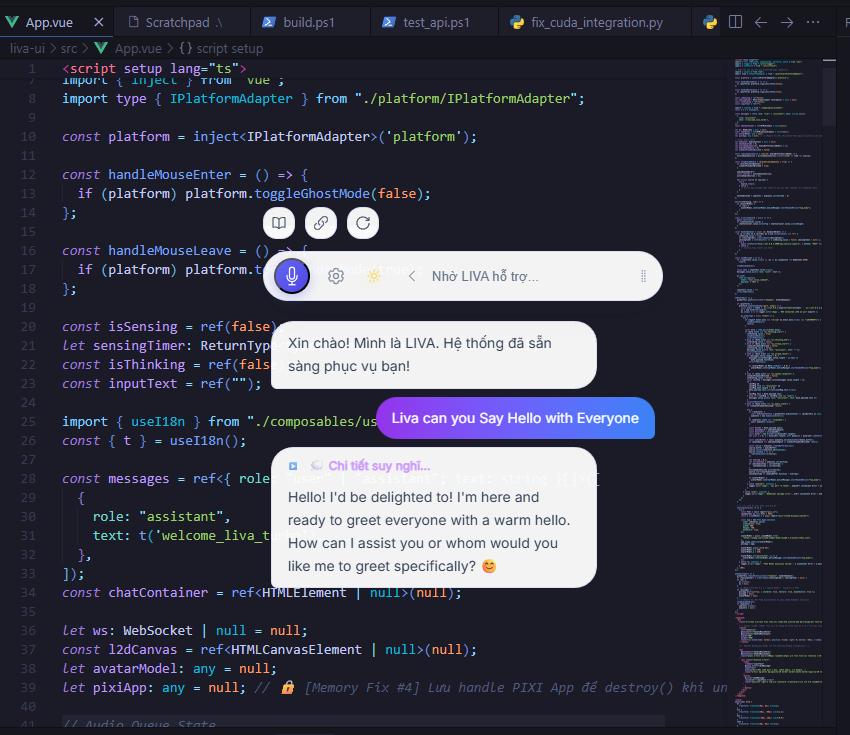

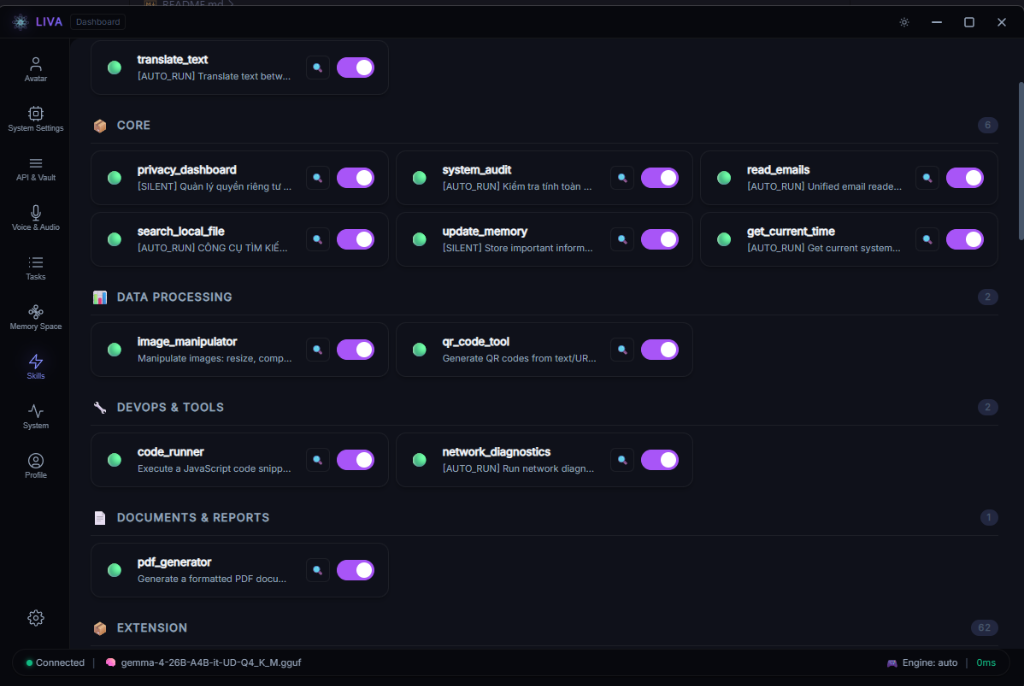
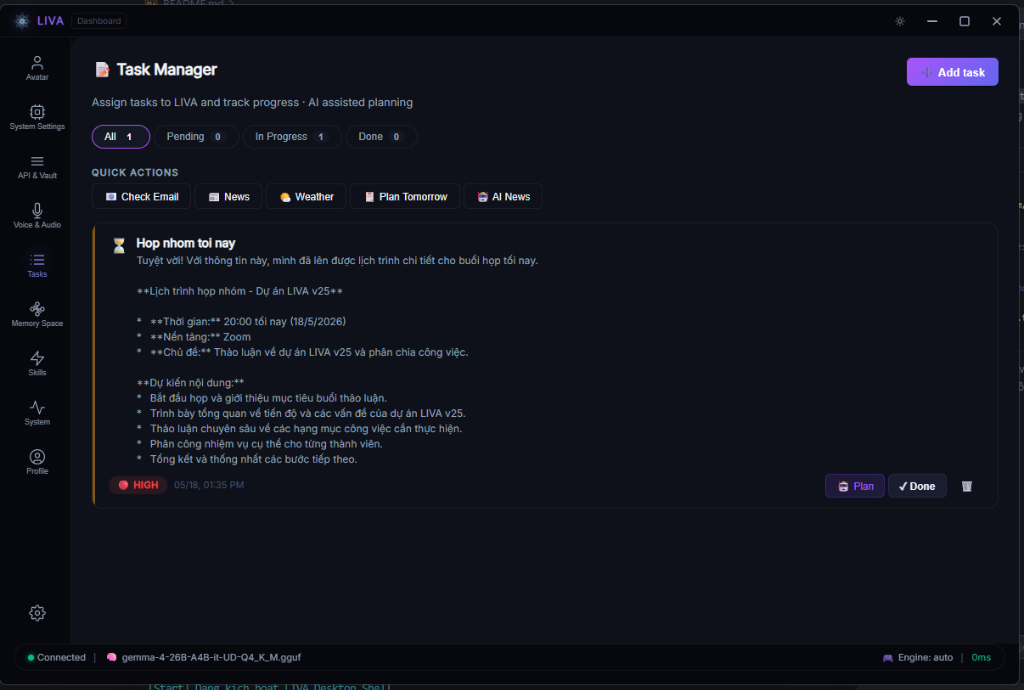
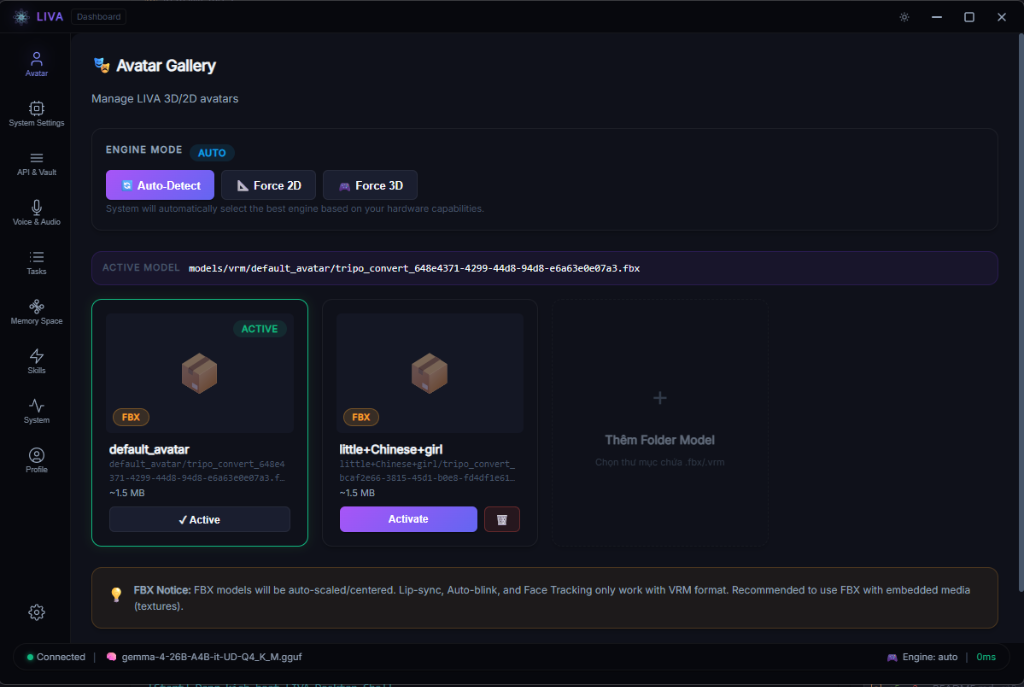
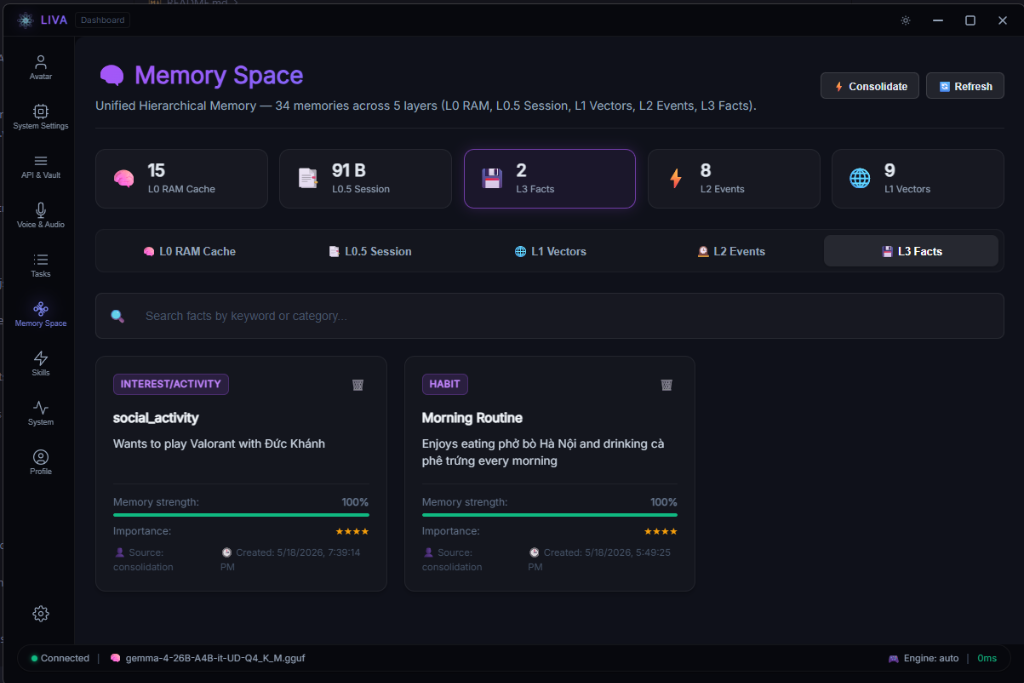
Continuous Session Video Demonstration
▶ Watch or download the unedited desktop session recording (MP4, 7.9 MB)
Author & Project Governance
Nguyen Anh Duong
Software Engineering Student, FPT University Hanoi
Lead Architect & Developer of LIVA
Licensing & Usage Terms
- Workspace Crates: The core architectural library crates (
crates/liva-core-types,crates/liva-storage,crates/liva-llm,crates/liva-tools,crates/liva-cua) are licensed under either the Apache License, Version 2.0 or the MIT License at your option. - Application Distribution: The compiled desktop application binary and user interface are protected under the Personal & Internal Use License. You are permitted to download, build, and use LIVA for personal and internal research. Commercial SaaS hosting, public redistribution, and unlicensed resale are strictly prohibited. Refer to
LICENSEfor complete legal terms.
Acknowledgments
LIVA stands upon the innovations of the global open-source community:
- llama.cpp & llama-cpp-2 for high-efficiency local LLM inference.
- Tauri & Vue.js for the lightweight desktop presentation and reactive UI shell.
- SQLite & sqlite-vec for reliable embedded transactional persistence and vector indexing.
- NVIDIA, Silero, and Piper for embedded neural speech and acoustic processing.
- Qwen Team (Alibaba Cloud) for state-of-the-art vision-language model architectures.
Reviews (0)
Sign in to leave a review.
Leave a reviewNo results found