Plumbline
Health Uyari
- License — License: NOASSERTION
- Description — Repository has a description
- Active repo — Last push 0 days ago
- Low visibility — Only 6 GitHub stars
Code Basarisiz
- rm -rf — Recursive force deletion command in build-explorer.sh
- rm -rf — Recursive force deletion command in config/claude/hooks/plumbline-enforce.sh
Permissions Gecti
- Permissions — No dangerous permissions requested
Bu listing icin henuz AI raporu yok.
Plumbline — a self-learning, customer-value-governed agile AI agent team for Claude Code. 87 subagents + skills, TDD defense-in-depth gates, Kaizen retros, a four-body adversarial council, and an empirically benchmarked QA harness. Does it hang true?
Plumbline
Does it hang true?
A defense-in-depth agent framework for Claude Code — built around one obsession: proving that work is actually done, not that it merely looks done.
86 subagents · 16 vendored skills · /agileteam v3 orchestrator · /concilium four-body council · Reality-Ledger QA · empirically benchmarked
An agile AI agent framework for Claude Code: a self-learning, customer-value-governed agentic team that builds software with TDD gates, Kaizen retrospectives, and a defense-in-depth quality pipeline.
#ClaudeCode #ClaudeSkills #AgentFramework #AIAgents #AgenticAI #AgileAIAgents #AIAgile #AIAgenticAgileTeam #KaizenAgentic #SelfLearningAgileTeam #MultiAgentSystems #AgentEngineering #TDD #AutonomousCoding #DefenseInDepth #LLMOps
We benchmarked our own agent framework — and discovered our cleverest idea didn't work.
Then we shipped the honest result anyway. That is Plumbline.
▶ Live demo · explore all 86 agents in your browser, nothing to install

⚡ Quickstart — install · update · which model
Install — Claude Code is the runtime; you also need git, bash, python3, jq:
git clone https://github.com/DYAI2025/Plumbline plumbline
cd plumbline
./config/claude/install.sh     # installs the MCP-free agents + commands/skills/hooks into ~/.claude
                               # --copy on Windows · --with-flow-agents to also add the claude-flow agents
Lean by default: a plain install mounts only the MCP-free governance agents (the
/agileteampipeline,/concilium, the core roles). The vendored claude-flow / flow-nexus agents — whose distinctive function is an external MCP server — are omitted unless you pass--with-flow-agents, so installing Plumbline never pulls you toward the token-heavy claude-flow MCP stack. The repo still ships all of them; this is an install-time choice, not a removal. (DEPENDENCIES.md)
Then, in any project inside Claude Code:
/agileteam "add OAuth2 login with refresh-token rotation"
Update from the terminal — plumbline update fetches the latest published GitHub release and applies it with verified-or-revert (it auto-reverts if the post-update check fails):
plumbline update --check     # is a newer release out? (compares your version to the latest release)
plumbline update             # fetch + apply the latest release
plumbline doctor             # self-check: version · $PATH discoverability · the update slug
plumbline: command not found? The CLI dir isn't on$PATHyet — run~/.claude/bin/plumbline …, or addexport PATH="$HOME/.claude/bin:$PATH"to your shell rc (the installer prints this hint). Inside a Claude Code session, the/plumbline-updateslash command does the same. Updating a fork from upstream:plumbline update --repo DYAI2025/Plumbline.
Which model to use — measured, not a preference. Plumbline defaults every role to your current session model (/model). But the reach-the-real-boundary safety net on the checking gates (review · security · validation · judgment) is only guaranteed on Opus — on Sonnet and Haiku that exact "green-but-broken" bug class escaped 3/3 in our benchmark (below).
- Best quality → run on Opus (or reply
gates on opusat run start to put just the five checking gates on Opus). This costs noticeably more tokens — and buys the truth-checking judgment a cheaper model cannot give you. - Lower cost → Sonnet / Haiku is fine for routine work, on the explicit understanding that the Opus-only safety net is not guaranteed. Plumbline discloses this once per run and never silently up- or down-grades.
Higher model → higher token cost → higher quality of the truth-checking. That trade-off is the point of the benchmark below. More detail: the Model policy section below · the no-plugin / no-MCP-server install boundary in
DEPENDENCIES.md· portability & web bootstrap inSETUP.md.
Installation model (honest boundary): install is via install.sh only — Plumbline is not a Claude Code plugin (/plugin install does not apply) and ships no MCP server; some vendored agents reference external MCP tools you would install separately (inert without them). See DEPENDENCIES.md.
Why "Plumbline"?
A plumb line is the oldest tool humanity has for checking whether something is truly straight — not whether it looks straight. You hang a weight on a string, and gravity gives you one honest reference that never lies.
That is exactly what this framework is for. It was born from a real failure: a feature whose tests were all green, yet the actual integration was a no-op — "tests pass" had been mistaken for "it works." Plumbline exists to hold every piece of agent-produced work against one honest reference: does it hang true?
In carpentry, "true" means both correct and perfectly plumb. That double meaning is the whole philosophy in one word.
Plumbline identity (True-Line Governance)
Plumbline is an end-to-end product-building team framework. Its core invariant is staying true to confirmed human customer value across every quality gate. It does not treat green tests, completed tasks, or agent consensus as enough. Every gate must re-check whether the work remains real, useful, usable, production-grounded, and aligned with the user's confirmed Product Vision. In one line: Plumbline does not optimize for finishing. Plumbline optimizes for staying true to confirmed human customer value; finishing is valid only when the line remains true.
What makes this different from "yet another agent list"
Most agent collections are prompt libraries. Plumbline is a prompt library plus a measured, falsifiable claim about agent quality — and we did the experiments to back it.
The core finding (empirically benchmarked, not asserted)
We suspected a clever QA prompt ("always check you reached the real boundary, not a fake") would make agents catch the "green-but-broken" class of bug. So we built mutation-oracle benchmarks: give two agent variants the same task, let them write tests, then secretly sabotage the code and count which tests turn red (caught) vs. stay green (escaped). Deterministic. No vibes.
Across four independently-designed oracle corpora (metrics/corpus/), the honest result surprised us:
| What we measured | Result |
|---|---|
| QA prompt-discipline at the test-planning stage | 5× recall at equal precision — real, kept |
| Same discipline at the build-and-test stage | outcome-neutral — the act of building already forces the agent to look |
| The decisive "provided-fake" trap (mirrors the original incident) | only Opus catches it (0/3 escaped); Sonnet and Haiku escape it 3/3 |
The lesson: whether an agent's tests reach reality is governed by model capability, not prompt cleverness. A stronger prompt cannot give a weaker model that judgment. This is documented end-to-end — including the bugs the instrument caught in itself — in metrics/SUMMARY-2026-05-30-dna-investigation.md.
That intellectual honesty — measuring our own framework instead of marketing it — is the spirit of Plumbline.
v0.10 — the discipline, measured end-to-end (n=6 full-pipeline slice)
The oracle above tests one agent in isolation. In v0.10 we measured the whole pipeline: a buried-gap build (tester → coder → reviewer → production-validator) run under two arms — the frozen-v3 agents vs. the evolved Reality-Ledger DNA — across a weak model (Haiku) and a strong one (Opus), scored by a blind judge. Two signals stood out:
We measured both halves of the ledger — catch-rate on planted gaps and false-positive ("cry-wolf") rate on pure-logic controls — and the honest answer is not "strictly better":
- ✅ On Opus — a clean win. Both arms catch every gap, but the frozen pipeline cries wolf on 67% of pure-logic features (demanding boundary tests a discount calculator doesn't need); the DNA's "fires only on genuine boundary features, never on pure logic" reflex cuts that to 17%. Same catch, ~4× less crying wolf.
- ⚖️ On a sub-Opus model — a trade-off, not a free lunch. On Haiku the DNA halves the boundary-defect escape rate (67% → 33%) — but it also raises the false-positive rate (0% → 33%). The catch-gain on the weak model is partly bought with over-sensitivity. We say so plainly.
The scope is the point — this is Plumbline:
n=6per cell · 2 gap tasks + 2 control tasks · ~24M tokens across two runs · 240 coordinated agents · judge-scored. "The DNA is strictly better" would be a lie; "net-positive on Opus, a trade-off on sub-Opus" is the measured truth. Full ledger + setup → the transparent deep-dive →.
Built on that finding
- Reality Ledger — every requirement carries an evidence class (
unit-fake → integration-fake → real-boundary-smoke → production-verified). Anything touching I/O, a remote, an external API or UI that stays*-fakeis RED regardless of green tests, and that RED cannot be silently downgraded. - Wired-in-prod check — a feature with a real implementation but no test through the production composition root is not satisfiable. The two costliest real-world misses ("exists in tests, never composed in prod") die here.
- "Kritische semantische Glättung" — a cheap, gated 3-beat QA reflex (thesis → counter-thesis → the one test that kills it) that fires only on genuine boundary features, never crying wolf on pure logic.
Plumbline even ships its own honesty as commands: /honest-status (separate looks done from is done, including what's unverified) and /bench-oracle (measure a change with a deterministic mutation oracle instead of asserting it works). The framework holds itself to its own plumb line.
Features
- 🧭 Customer-value governance ("True Line") — a Product Canvas gate, a confirmed Product Vision, and an independent Plumbline Watcher keep every decision tied to real human value, not just green tests.
- 🤖
/agileteam— an autonomous, self-organizing agile AI team — requirements → TDD → independent review → security → validation → product judgment → human sign-off, end to end. - ♻️ Kaizen / self-learning loop — a guarded retrospective turns recurring failures into persistent, evidence-checked process improvements (no blind self-modification).
- ⚖️
/concilium— a four-body adversarial council (Market · Tech · Skeptic · Distribution) that stress-tests a product idea and the team setup before you build. - 🪜 Defense-in-depth quality gates — many diverse, uncorrelated checks (Gates A–E) so a defect must survive several independent reviewers, not one.
- 🔬 Reality Ledger — every requirement carries an evidence class; anything that stays fake/mock is RED regardless of green tests, and can't be silently downgraded.
- 📊 Empirically benchmarked — a deterministic mutation-oracle harness measures the agents themselves; we published the honest negative result, not just the wins.
- 🧩 86 Claude Code subagents + 16 vendored skills across 21 categories. Honest split: a small Plumbline-engineered core (~16 — the
/agileteampipeline, the/conciliumcouncil, the core TDD/governance roles) does the differentiating work; the majority (~70) are vendored from the claude-flow agent base and shipped as a tested-workload dependency — prompts only, not individually benchmarked, not "team members". (Count derived from the explorer extractor and drift-guarded; seeconfig/claude/tests/test_readme_honesty.sh.) - 🖥️ Live Agent Explorer — a zero-install web UI to search, filter, and inspect every agent (live demo).
- 🛠️ Portable & self-contained — vendored skills + commands install with one script; works locally and in Claude Code on the web.
What's inside
| Area | Count | Purpose |
|---|---|---|
core/ |
5 | Base roles: coder, planner, researcher, reviewer, tester |
agileteam/ |
6 | /agileteam v3 workflow roles: requirements, spec-audit, PO, security, retro, context |
github/ |
13 | PR / issue / release / repo / workflow / multi-repo automation |
flow-nexus/ |
9 | Platform agents: sandbox, swarm, workflow, auth, payments, neural, … |
templates/ |
9 | Reusable agent templates and scaffolds |
consensus/ |
7 | Distributed-systems patterns: Byzantine, Raft, Gossip, CRDT, Quorum, … |
hive-mind/ |
5 | Queen / worker / scout / memory collective-intelligence patterns |
optimization/ |
5 | Performance, topology, resources, load-balancing, benchmarking |
sparc/ |
4 | SPARC phases: specification, pseudocode, architecture, refinement |
swarm/ |
3 | Swarm topologies: adaptive, hierarchical, mesh |
goal/, reasoning/, testing/ |
6 | GOAP planners, reasoning variants, TDD-London + production validation |
| domain specialists | 8 | analysis, architecture, ML, backend, CI/CD, API-docs, neural, mobile |
concilium/ |
4 | Four-body idea+team council: market-realist · tech-arbiter · skeptic · distribution-realist |
config/claude/skills/ |
16 | Vendored skills so workflows stay portable without external packs |
config/claude/commands/ |
7 | /agileteam, /agileteam-bench, /concilium, /honest-status, /bench-oracle, /reflect, /reflect-skills |
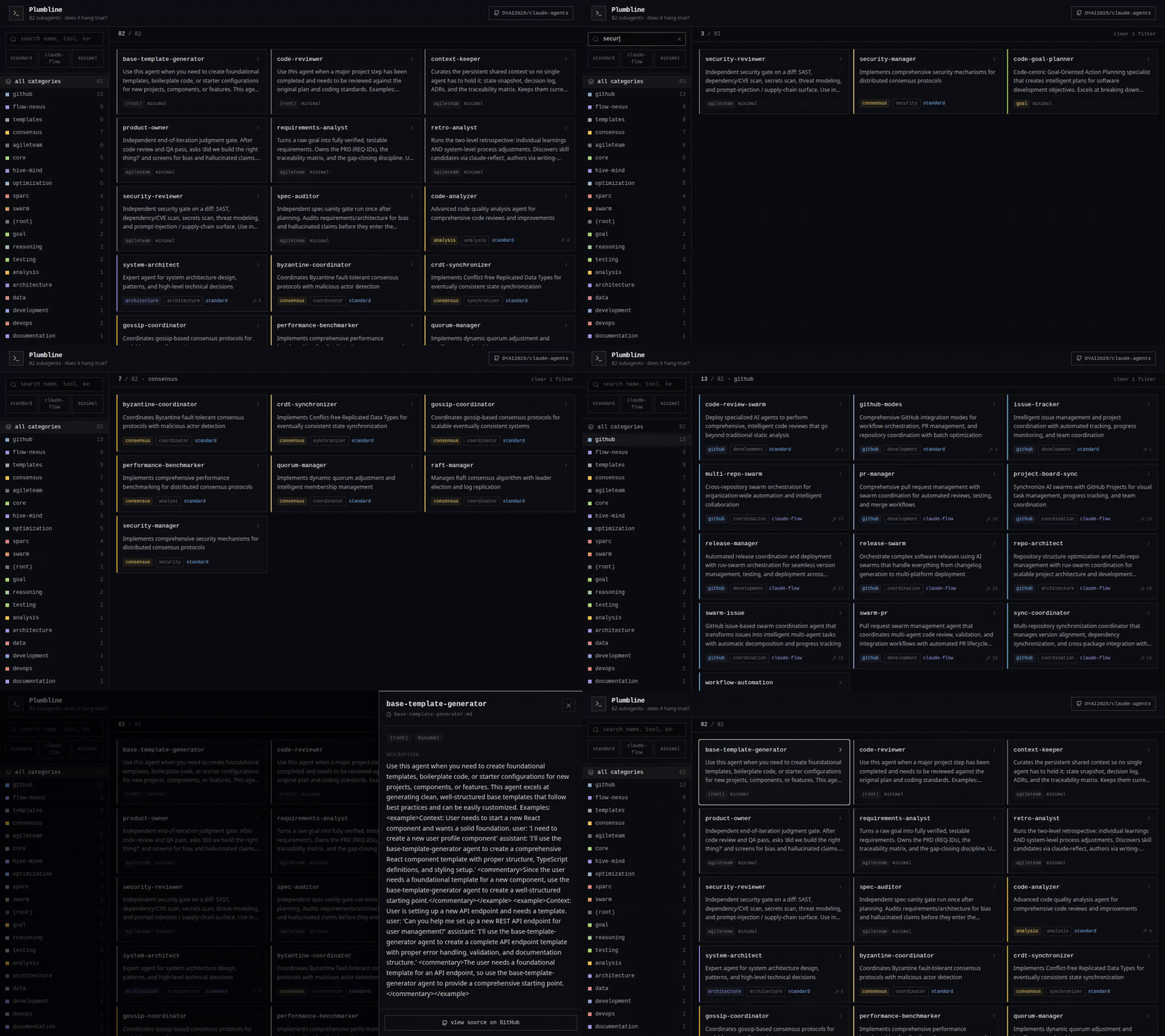
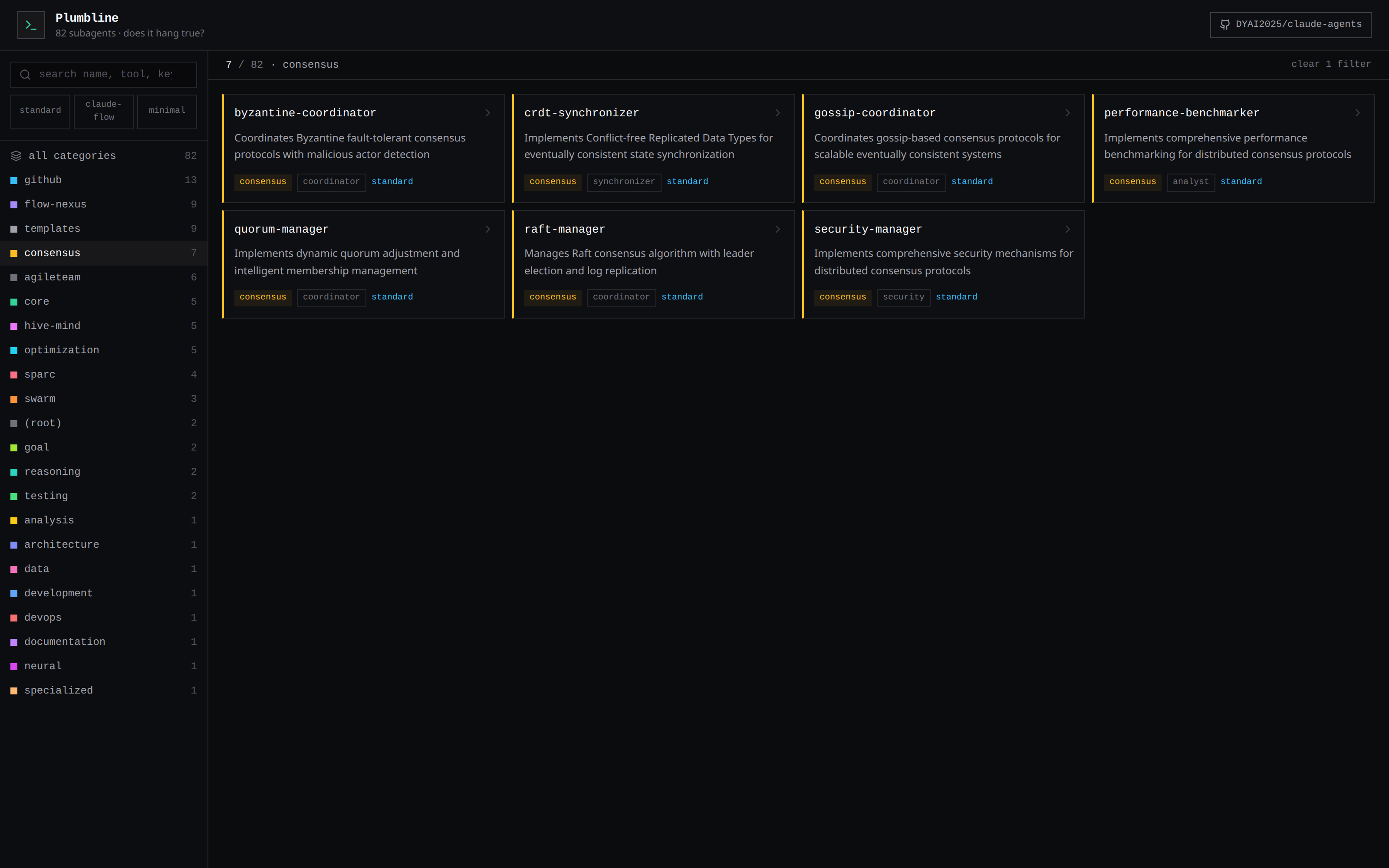
Browse them all visually in the Agent Explorer (see below).
 |
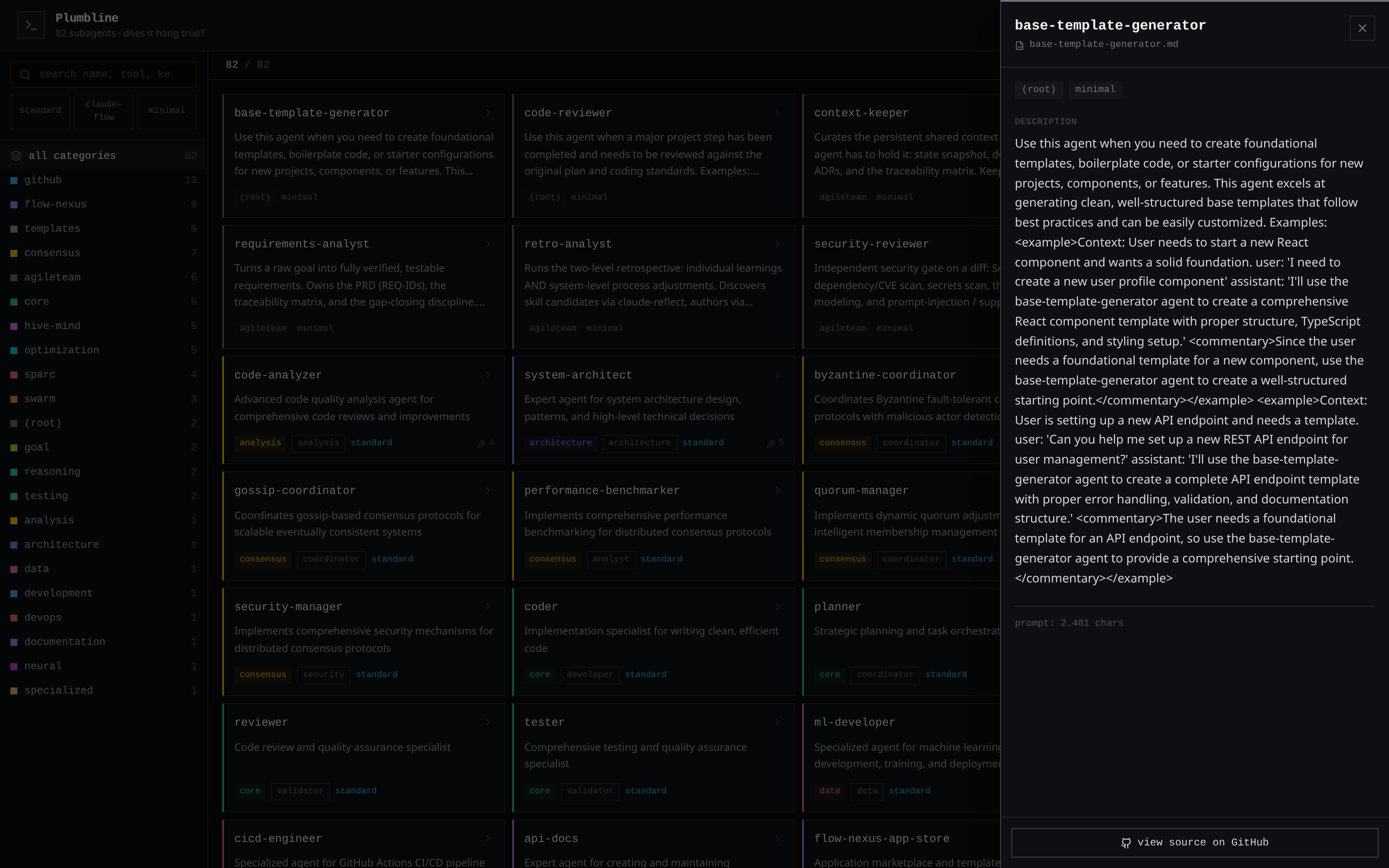 |
| Colour-coded categories, instant filtering | Per-agent detail: tools, triggers, source link |
The Agent Explorer
agent-explorer.html is a self-contained, dependency-free snapshot of the whole
collection — a dark terminal-style UI with colour-coded categories, full-text search
over names/tools/keywords, schema filters, and a per-agent detail drawer that links
straight to the source on GitHub. Try the live demo →
or open agent-explorer.html in any browser; nothing to install.
Regenerate it after editing agents:
./build-explorer.sh # re-extracts frontmatter → rebuilds the bundle + docs/index.html (the live demo)
/agileteam v3 — an autonomous TDD team with real gates
/agileteam <feature> orchestrates a full delivery pipeline of independent agents.
The governing stance: there is no "100% safe" (Rice's theorem) — so chain many
diverse, independent checks, such that a defect would have to survive several
uncorrelated gates.
- Product Canvas — a mandatory upstream value-alignment gate: problem, target user, value proposition, success signal, core use case, non-goals, risks, evidence needed — saved to
docs/canvas/<feature>.canvas.mdand explicitly user-confirmed before the PRD is finalized or development starts (no agent may self-confirm it) - Requirements — PRD, REQ-IDs, acceptance criteria, traceability matrix
- Spec sanity — ultrathink + konfabulation audit (claim-provenance check)
- Planning — architecture, atomic tasks, sequence
- TDD loop — coder writes the failing test first, then minimal impl
- Independent review — reviewer sees diff + spec, never the coder's reasoning
- Security review — SAST / deps / secrets / threat + injection surface
- Validation — per-REQ pass/fail against the matrix, with evidence
- Judgment gate — product-owner: did we build the right thing?
- Human acceptance — sign-off stays explicitly human
- Retro / learning loop — process improvements, persisted only under guardrails
Independence invariant: whoever writes code does not review it; whoever derives
tests does not implement them.
In active development: an expanded autonomous, customer-value-governed pipeline
(token-bounded council challenge gate, Vision-GO → hands-off run, per-increment
Code-reviewer→QA→Watcher value checks, liveN/Miteration progress) is reviewed on a
feature branch but not yet merged — seedev-plan.mdfor the honest
roadmap and validation status.
Model policy (measured, not guessed)
Per the benchmark above, the reach-the-real-boundary judgment lives in model
capability. The orchestrator therefore defaults all roles to your session model
(/model), discloses once at run start that the GBrain-class safety net on the
checking gates is only guaranteed on Opus, and — only if you opt in — dispatches just
those five gates on Opus. No silent up- or down-grading. (We also verified that
per-agent model: frontmatter is not applied by the current Claude Code runtime;
only an explicit dispatch parameter takes effect — so control lives in the
orchestrator, transparently.)
CORE vs FULL
| Mode | Goal | Self-modification |
|---|---|---|
core (default) |
Safe, runnable baseline | None — learnings stay human-gated |
full |
Autonomous evolution (canary + auto-revert) | Only once a metrics/runs.jsonl baseline exists |
Quality assurance
# validate every agent's frontmatter (parse errors / missing description / duplicate names)
bash config/claude/tests/run_all.sh
The CI suite checks frontmatter, metrics scripts, settings JSON, the stop-hook, the
web bootstrap, and (if installed) shell scripts via shellcheck.
Repository layout
.
├── core/                      # coder, planner, researcher, reviewer, tester
├── agileteam/                 # /agileteam workflow roles
├── github/ swarm/ hive-mind/  # automation + coordination agents
├── consensus/ sparc/ …        # distributed-systems + methodology agents
├── config/claude/commands/    # slash commands  (/agileteam, /reflect, …)
├── config/claude/skills/      # 16 vendored fallback skills
├── config/claude/hooks/       # SessionStart + learning-loop Stop hook
├── metrics/                   # the benchmark corpora + the honest write-ups
├── explorer/                  # source for agent-explorer.html
├── docs/                      # /agileteam spec v3 + governance
│   ├── canvas/                # docs/canvas — user-confirmed Product Canvas artifacts
│   └── templates/             # docs/templates — Product Canvas + workflow templates
├── README.md  SETUP.md  CLAUDE.md
Design principles
- Evidence over vibes — claims must be backed by code, tests, logs, or an explicit assumption; missing tooling is marked
MISSING, never fantasised as passing. - Roles stay sharp — a good agent has one crisp job, not a generic "do everything" identity.
- Independence matters — review, test, security and product judgment must not just echo the coder's perspective.
- Human gates stay — especially for requirements, product decisions, and persistent self-improvement.
- Version prompts like code — every agent change gets a diff, review, and validation.
Support / sponsor the benchmarks
Plumbline's central claims are measured, not asserted — and measuring them costs real model tokens. Every oracle corpus run re-executes agent variants, secretly sabotages the code, and counts which tests turn red (caught) vs. stay green (escaped), across Haiku, Sonnet and Opus. Sponsorship goes straight into that compute, so the empirical instrument stays honest, reproducible, and able to grow new corpora.
| Tier | What your contribution funds |
|---|---|
| Haiku Supporter · 5 €/mo | The daily smoke tests — keeps the repo's CORE oracle checks green every day. |
| Opus Validator · 25 €/mo | A compute-heavy FULL-mode deep evaluation run — including the provided-fake trap that only Opus catches (0/3 escaped) while Sonnet and Haiku escape it 3/3. |
| Enterprise Governance Patron · 100 €/mo | For teams running Plumbline in production — sustained benchmarking plus a seat at the table for governance / Reality-Ledger priorities. |
Sponsorship is best-effort support for an open-source project — not a paid product, SLA, or feature guarantee. Thank you for helping keep the line true.
License & attribution
MIT © 2026 DYAI2025.
The agent base is derived in part from Claude Flow by ruvnet (MIT, © ruvnet) — the repo path ruvnet/claude-flow now points to ruvnet/ruflo. Keep this attribution and the MIT notice when redistributing forks or major rewrites.
Plumbline — if you only need a single prompt, this is overkill. If you want to build, inspect, and evolve auditable agent systems that prove they hang true: welcome to the machine room.
#AIEngineering #AgentOrchestration #PromptEngineering #AutonomousAgents #CollectiveIntelligence #AgenticWorkflow #ClaudeAgents #FutureOfSoftwareDevelopment
Yorumlar (0)
Yorum birakmak icin giris yap.
Yorum birakSonuc bulunamadi