StructSmith
Health Uyari
- License — License: MIT
- Description — Repository has a description
- Active repo — Last push 0 days ago
- Low visibility — Only 6 GitHub stars
Code Gecti
- Code scan — Scanned 12 files during light audit, no dangerous patterns found
Permissions Gecti
- Permissions — No dangerous permissions requested
Bu listing icin henuz AI raporu yok.
Local-first, MCP-native tool for modelling software architecture. C4-style semantic model, React Flow editor, SQLite, single container — a self-hosted Structurizr alternative your AI client can edit over MCP.

StructSmith
Model, document and share software architecture — locally, and with your AI client.




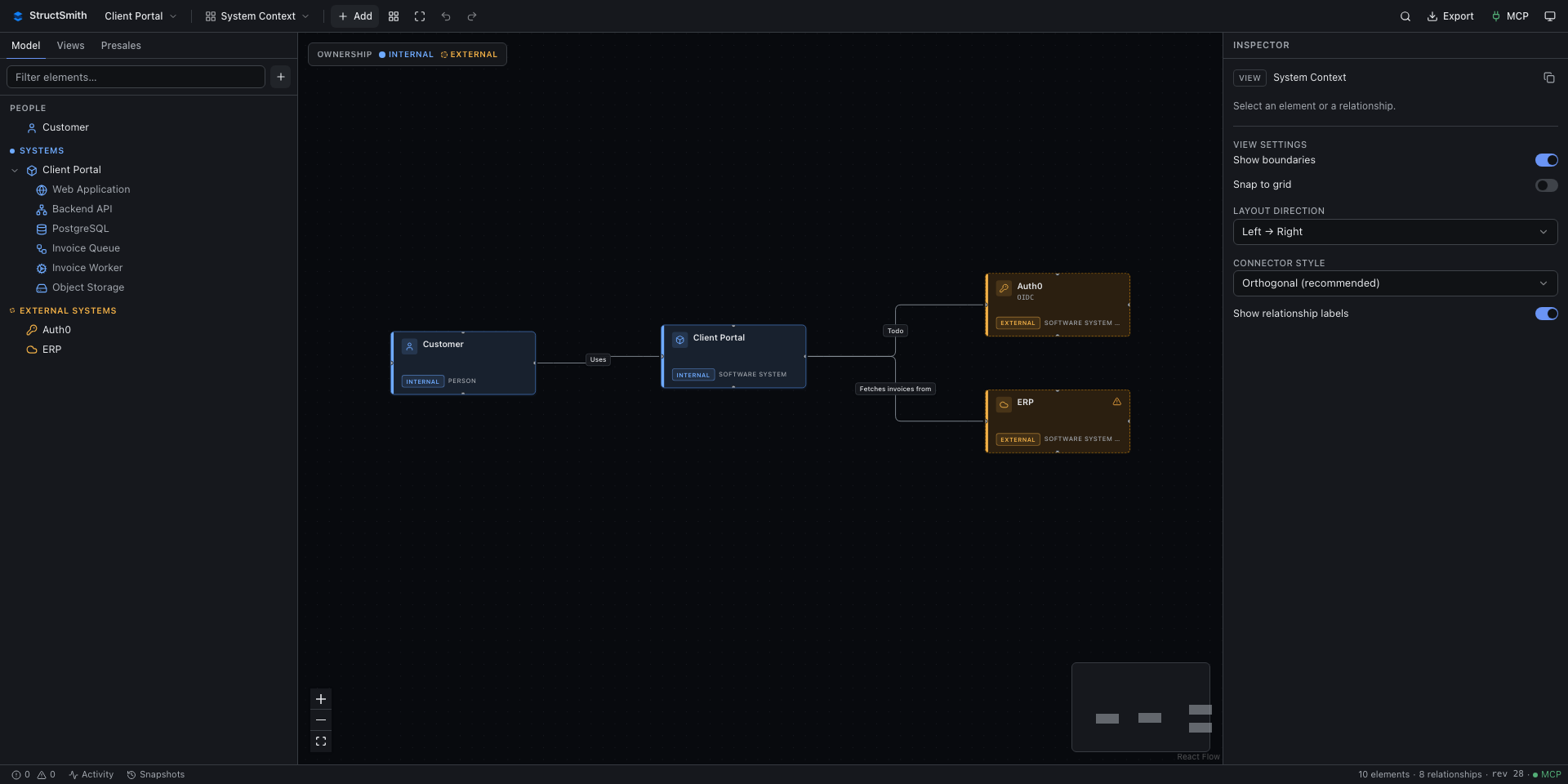
Dark-theme desktop view with consistent ownership colours across the canvas and model tree.
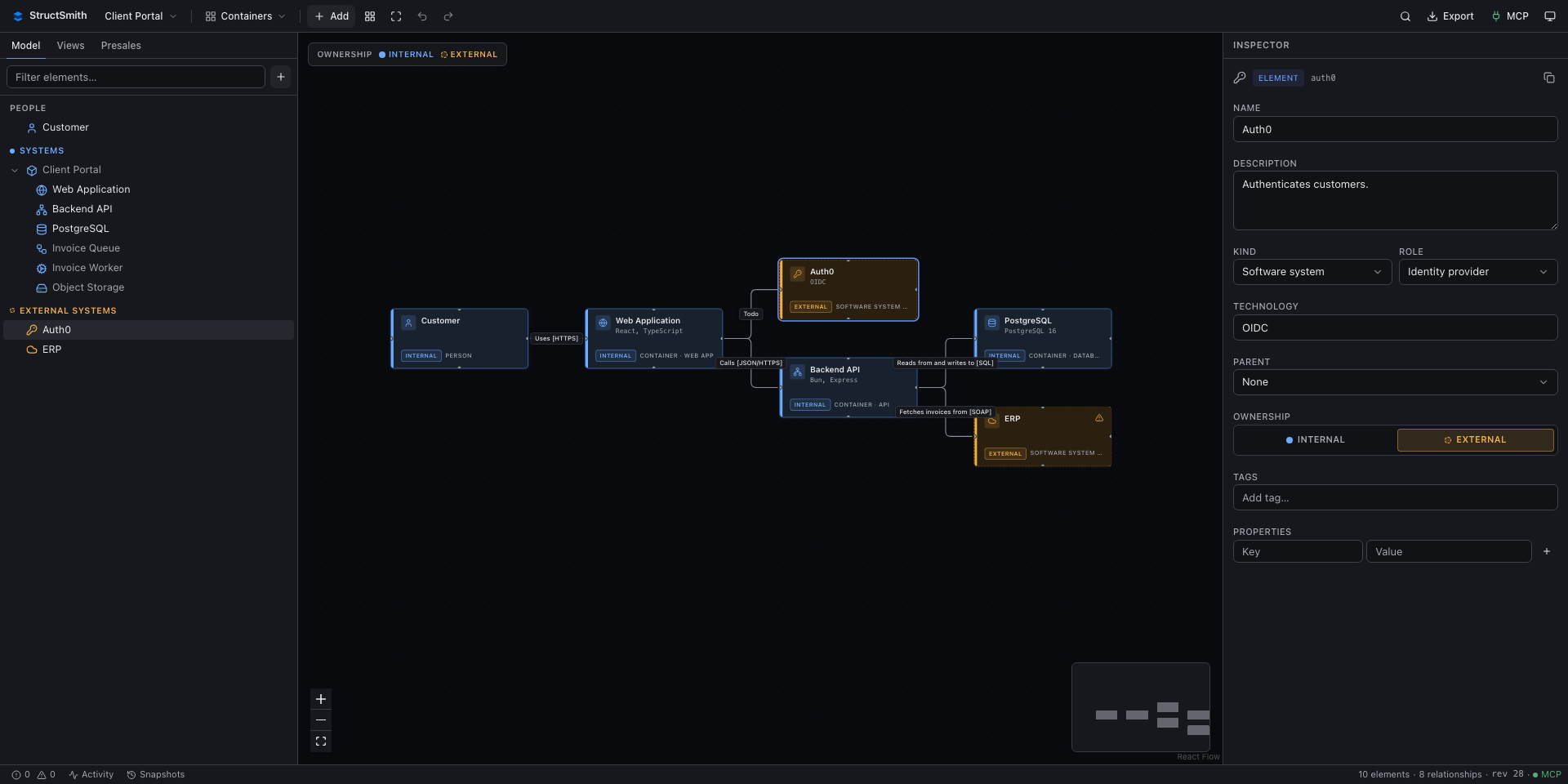
Container view: the canvas, model tree and ownership inspector use the same visual language.
A local-first, open-source tool for modelling software architecture — a self-hosted
alternative to Structurizr with a modern React Flow editor and MCP built in, so your
AI client works on exactly the same model you do.
The diagram is not the source of truth. The semantic architecture model is.
React Flow only visualises and lays out that model.
Useful for software architecture, the C4 model, presales, solution architecture,
architecture workshops, documenting systems, designing integrations — and for working on
architecture together with an AI assistant.
- MIT licensed, no account, no cloud, no telemetry — it works fully offline
- One container, one SQLite file
- REST API, MCP and the UI all sit on the same domain layer
Quick start
Stable releases and automatically generated release notes are available under
GitHub Releases. After the first
automated release, latest tracks the latest published release; use :vX.Y.Z
instead of :latest to pin a specific published version.
Run the public image
With Docker installed, run:
docker run -d --name structsmith \
  -p 127.0.0.1:8090:8080 \
  -v structsmith-data:/data \
  --restart unless-stopped \
  ghcr.io/dziksu/structsmith:latest
Then open http://localhost:8090. No repository clone or local build is needed.
Your workspaces persist in the structsmith-data Docker volume.
Build from source with Docker Compose
git clone https://github.com/dziksu/StructSmith.git structsmith
cd structsmith
docker compose up -d --build
Then open http://localhost:8090.
Local development
git clone https://github.com/dziksu/StructSmith.git structsmith
cd structsmith
bun install --frozen-lockfile
bun run dev
bun run dev starts both processes: the Bun/Express API on :3000 and the Vite dev server
on http://localhost:5173, which proxies /api and /mcp to the backend. The SQLite
database is created and migrated automatically — no Docker, Postgres, Redis, Java or Python
required for development.
The static project website lives in apps/site. Run it separately on
http://localhost:4174 with:
bun run dev:site
bun run build:site creates the GitHub Pages artifact in apps/site/dist. Changes to the
site, shared public assets, or its workflow are published automatically from main by theGitHub Pages action. Before the first deployment, select GitHub Actions as the source in
the repository's Settings → Pages; later pushes need no manual publishing step. The build
prerenders the complete page with React's server renderer and inlines its CSS into index.html;
the published page has no client-side React runtime or JavaScript bundle.
Endpoints
| URL | Purpose |
|---|---|
http://localhost:8090/ |
Web UI |
http://localhost:8090/api/... |
REST API |
http://localhost:8090/mcp |
MCP (Streamable HTTP) |
http://localhost:8090/health |
Health check |
In development the same endpoints live on http://localhost:3000 (and :5173 for the UI).
Connecting an AI client (MCP)
MCP is a core feature, not an add-on: it starts with the backend and is served from the same
process. The transport is Streamable HTTP (the deprecated SSE transport is not
implemented).
Quick install by client
Start StructSmith first, then use the command for your client. The examples assume the public
Docker image is available at http://localhost:8090.
Codex CLI, Codex Desktop and the Codex IDE extension share the same MCP configuration:
codex mcp add structsmith --url http://localhost:8090/mcp
In Codex Desktop you can instead open Settings → MCP servers → Add server, choose
Streamable HTTP, and paste the endpoint. Restart the current session after changing MCP
configuration.
Claude Code:
claude mcp add --transport http structsmith http://localhost:8090/mcp
GitHub Copilot CLI:
copilot mcp add --transport http structsmith http://localhost:8090/mcp
VS Code with GitHub Copilot — add .vscode/mcp.json to the project where you want to use
StructSmith:
{
  "servers": {
    "structsmith": {
      "type": "http",
      "url": "http://localhost:8090/mcp"
    }
  }
}
Then run MCP: List Servers and start structsmith; use Copilot Chat in Agent mode.
Claude Desktop needs a local STDIO bridge to reach a StructSmith instance on localhost.
See the AI client installation guide for a copy-ready
configuration. A public HTTPS deployment can instead be added under
Customize → Connectors → Add custom connector, but Claude connects to it from Anthropic's
cloud — localhost will not work there.
For Cursor, Windsurf, JetBrains IDEs and other MCP clients, point a native Streamable HTTP
connection at the endpoint or use this common configuration shape:
{
  "mcpServers": {
    "structsmith": {
      "type": "http",
      "url": "http://localhost:8090/mcp"
    }
  }
}
For full client-specific instructions, token authentication, local-development ports and
troubleshooting, see Install StructSmith in AI clients. The MCP page in
StructSmith also generates copy-ready snippets using the live URL, including custom ports.
Manual Codex configuration
Codex can also load StructSmith automatically from a trusted project's .codex/config.toml:
[mcp_servers.structsmith]
url = "http://localhost:8090/mcp"
default_tools_approval_mode = "writes"
tool_timeout_sec = 120
For clients that only speak stdio:
bun run mcp:stdio
The UI shows the live endpoint, the tool list and the read-only state under MCP in the
top bar.
What the AI can do
Tools cover workspaces, the model, elements, relationships, views, presales records,
snapshots and export. The preferred way to make a larger change is a single call tomodel_apply_operations, which is atomic, revision-guarded and takes an automatic snapshot
first:
- Start with
workspace_list, thenworkspace_inspectfor one complete, validated context packet. - Call
modeling_guidefor allowed values, C4 rules, relationship lifting and the recommended
workflow instead of reading StructSmith source code. - Run
model_preview_operationsbefore a large batch. It uses the real operation engine and
validator, then rolls the transaction back. - Apply the accepted batch with
model_apply_operationsand finish withmodel_validate. - References copied from the UI are one-line
StructSmithRefJSON payloads. Pass theirworkspaceId,typeandtargetIdtoreference_resolveto fetch the exact object and context.
{
  "workspaceId": "example-client-portal",
  "label": "Add asynchronous invoice processing",
  "operations": [
    { "op": "createElement", "ref": "queue",
      "data": { "kind": "container", "role": "queue", "name": "Invoice Queue", "technology": "SQS" } },
    { "op": "createElement", "ref": "worker",
      "data": { "kind": "container", "role": "worker", "name": "Invoice Worker" } },
    { "op": "createRelationship",
      "data": { "sourceElementId": "backend-api", "targetElementId": "@queue",
                "description": "Publishes invoice jobs to", "interactionStyle": "async" } },
    { "op": "createRelationship",
      "data": { "sourceElementId": "@queue", "targetElementId": "@worker",
                "description": "Delivers jobs to", "interactionStyle": "async" } },
    { "op": "setViewElements", "viewId": "containers-view-id", "elementIds": ["@queue", "@worker"] },
    { "op": "autoLayoutView", "viewId": "containers-view-id", "direction": "LR" }
  ]
}
ref gives a new entity a local alias; later operations reference it as @alias. The whole
batch runs in one SQLite transaction — it either lands completely or not at all.
Resources expose the model in an AI-friendly shape (no React internals, no CSS, no viewport
data):
architecture://guide
architecture://workspaces
architecture://workspace/{workspaceId}
architecture://workspace/{workspaceId}/inspection
architecture://workspace/{workspaceId}/model
architecture://workspace/{workspaceId}/views
architecture://workspace/{workspaceId}/view/{viewId}
architecture://workspace/{workspaceId}/records
Prompt templates: review_architecture, create_presales_architecture,identify_architecture_risks, identify_unknowns, review_security, review_scalability.
When an AI changes the model, the browser is notified over SSE (GET /api/events) and the
diagram updates on its own — no refresh needed.
The model
Workspace
 ├── Elements          person · softwareSystem · container · component ·
 │                     deploymentNode · infrastructureNode · custom
 ├── Relationships     sync · async · event · data · dependency · custom
 ├── Views             landscape · systemContext · container · component ·
 │                     deployment · custom
 ├── Records           assumption · risk · unknown · requirement · decision · note
 └── Snapshots
StructSmith models itself — this diagram is the container view of the example
self-model, exported straight from the tool with export_mermaid:
flowchart LR
  architect(["Architect"])
  ai_client["AI Client<br/><small>Claude, Cursor, any MCP client</small>"]
  subgraph structsmith["StructSmith"]
    direction LR
    web_ui["Web UI<br/><small>React, Vite, React Flow</small>"]
    rest_api["REST API<br/><small>Bun, Express</small>"]
    mcp_server["MCP Server<br/><small>MCP SDK, Streamable HTTP</small>"]
    domain["Domain Services<br/><small>no Express, no SQL</small>"]
    event_bus["Event Bus<br/><small>in-process, SSE</small>"]
    repositories["Repositories<br/><small>Drizzle ORM</small>"]
    sqlite["SQLite<br/><small>WAL, bun:sqlite</small>"]
  end
  architect -->|"Models architecture in"| web_ui
  ai_client -->|"Reads and changes the model through"| mcp_server
  web_ui -->|"Calls"| rest_api
  rest_api -->|"Delegates to"| domain
  mcp_server -->|"Delegates to the same layer as REST"| domain
  domain -->|"Reads and writes through"| repositories
  repositories -->|"Persists to"| sqlite
  domain -.->|"Publishes model changes to"| event_bus
  event_bus -.->|"Notifies the SSE stream in"| rest_api
  rest_api -.->|"Pushes workspace.updated to"| web_ui
Three rules the implementation is built around:
- Positions belong to views, not to elements. One element can appear on five diagrams
without five copies of the data; moving a node never changes the architecture. - Roles are not C4 levels.
kind = container,role = database,technology = PostgreSQL— roles drive icons, styling and filtering only. - Views show implied relationships. If a view shows a system but not its containers,
traffic to those containers is lifted to the system, the way Structurizr does it.
Every workspace has a revision. Mutating REST and MCP calls may pass expectedRevision;
a mismatch returns 409 Conflict, so a user and an AI editing at the same time cannot
silently overwrite each other.
REST API
GET    /api/workspaces                      POST   /api/workspaces
GET    /api/workspaces/:id                  PATCH  /api/workspaces/:id
DELETE /api/workspaces/:id                  POST   /api/workspaces/import

GET    /api/workspaces/:id/model            GET    /api/workspaces/:id/document
GET    /api/workspaces/:id/validate         GET    /api/workspaces/:id/activity
GET    /api/workspaces/:id/export/mermaid
POST   /api/workspaces/:id/commands         # atomic batch of operations

POST   /api/workspaces/:id/elements         PATCH/DELETE /api/elements/:id
POST   /api/workspaces/:id/relationships    PATCH/DELETE /api/relationships/:id
GET/POST /api/workspaces/:id/views          GET/PATCH/DELETE /api/views/:id
PATCH  /api/views/:id/layout                # batched, debounced layout write
POST   /api/views/:id/elements              POST /api/views/:id/auto-layout
GET/POST /api/workspaces/:id/records        PATCH/DELETE /api/records/:id
GET/POST /api/workspaces/:id/snapshots      POST /api/snapshots/:id/restore

GET    /api/events                          # SSE: workspace.updated
GET    /api/mcp-info                        GET  /api/presets   GET /api/settings
Errors always use the same envelope:
{ "error": { "code": "WORKSPACE_NOT_FOUND", "message": "...", "details": {} } }
Editor
- Desktop-first three-pane layout: explorer, canvas, inspector — all resizable
- Custom React Flow nodes with icon, name, technology and a kind/role badge; external
elements are visually distinct - Boundaries drawn around a parent whose children are on the view
- Manual layout (debounced batch save) and automatic layout with dagre (
LR/TB) - Views: the same element on many diagrams, each with its own layout
- Presales records linked to elements, with a subtle risk indicator on the canvas
- Deterministic validator with error / warning / info levels
- Export: semantic JSON, Mermaid, PNG, SVG. Import: native JSON
- Snapshots with restore; undo/redo (
⌘Z/⌘⇧Z) rides on them - Command palette (
⌘K),Fto fit the view,Delete,Escape - Light / dark / system themes, English and Polish UI
Adding a language
The UI is fully translated through i18next. Drop a JSON file next toapps/web/src/i18n/locales/en.json, register it in apps/web/src/i18n/index.ts and add it
to supportedLanguages. No copy is hard-coded in components.
Configuration
| Variable | Default | Meaning |
|---|---|---|
PORT |
3000 (8080 in Docker) |
HTTP port |
HOST |
0.0.0.0 |
Bind address |
DATABASE_PATH |
./data/architecture.db |
SQLite file |
MIGRATIONS_DIR |
./migrations |
Migration folder |
AUTH_MODE |
none |
none or token |
APP_TOKEN |
– | Bearer token required when AUTH_MODE=token |
MCP_READ_ONLY |
false |
When true, MCP exposes no mutating tools |
SEED_EXAMPLE |
true |
Seed the example workspace on first boot |
APP_NAME |
StructSmith |
Product name shown in the UI |
In token mode, /api and /mcp require Authorization: Bearer <APP_TOKEN>; /health
stays public. There is no user system — this is a local/self-hosted tool.
[!WARNING]
The defaults (AUTH_MODE=none,HOST=0.0.0.0) are meant forlocalhost. As shipped,
anyone who can reach the port can read and modify every workspace. Before exposing
StructSmith beyond your own machine, setAUTH_MODE=token, put TLS in front of it, and
publish the container port as127.0.0.1:8090:8080. See SECURITY.md.
Project layout
apps/
  web/        React + Vite UI          (React Flow, TanStack Router/Query, Zustand, shadcn-style UI)
  server/     Bun + Express            (REST, MCP transport, SSE, static UI)
docs/         Client setup and operating guides
packages/
  contracts/  Zod schemas and DTOs shared by frontend, backend and MCP
  domain/     Pure domain: rules, validation, operations, services (no Express, no SQLite)
  database/   Drizzle + bun:sqlite repositories implementing the domain ports
  mcp/        MCP server: tools, resources, prompts, Streamable HTTP handler
migrations/   Plain SQL, applied in order at startup
tests/        bun:test suite over the real domain and a real (in-memory) database
REST and MCP call the same services; only the database package knows SQL:
        REST ──┐
               ├──► Application / Domain services ──► Repositories ──► SQLite
        MCP ───┘
Scripts
bun run dev         # API + UI, one command
bun run build       # production build of the UI
bun run start       # run the server with the built UI
bun run test        # domain + persistence tests
bun run typecheck   # strict TypeScript across the whole monorepo
bun run db:generate # generate a migration with drizzle-kit
bun run db:migrate  # apply migrations
bun run db:seed     # (re)create the example workspace
bun run mcp:stdio   # MCP over stdio
Roadmap
Not in this MVP, but the model is designed for it: Structurizr DSL import/export,
architecture diff between snapshots, AI change preview before apply, optional vendor icon
packs, and importers for OpenAPI / Terraform / Kubernetes.
Contributing
Pull requests are welcome. CONTRIBUTING.md covers the local setup, the
four commands CI runs, and the five architecture invariants a change has to respect.
Participation is governed by the Code of Conduct, and security
issues go through SECURITY.md rather than public issues.
License
MIT — see LICENSE. React Flow is used strictly within its open-source scope; the
attribution is intentionally left in place.
Yorumlar (0)
Yorum birakmak icin giris yap.
Yorum birakSonuc bulunamadi