Echo
Health Uyari
- No license — Repository has no license file
- Description — Repository has a description
- Active repo — Last push 0 days ago
- Community trust — 24 GitHub stars
Code Uyari
- network request — Outbound network request in src/feeds/twitter.ts
- process.env — Environment variable access in src/lib/config.ts
Permissions Gecti
- Permissions — No dangerous permissions requested
This tool is a Crypto Twitter monitoring agent for Solana that analyzes social media sentiment, ranks narrative durability, and surfaces potential trading signals. It operates by fetching tweets, aggregating the data, and using an AI agent to score the persistence and credibility of market narratives.
Security Assessment
The overall risk is rated as Low. The tool makes outbound network requests to fetch social media feeds and accesses environment variables to manage configuration, which is standard and expected behavior for this type of software. There are no hardcoded secrets detected, and the scanner confirmed that no dangerous system permissions or shell executions are requested. As a basic precaution, users should ensure they do not expose sensitive system credentials in their environment variables when running the agent.
Quality Assessment
The project is actively maintained, with its most recent code push happening today. It features a highly detailed README that clearly explains its purpose and operational workflow. The primary concern is a missing explicit license file in the repository (despite an MIT badge in the documentation), which technically means default copyright restrictions apply and could be a blocker for commercial integration. Community trust is currently low but organic, sitting at 24 GitHub stars.
Verdict
Use with caution—while the code itself appears safe, you should verify the actual license terms with the author before integrating this into any commercial or production workflows.
CT sentiment - scans Crypto Twitter, scores narratives, surfaces trading signals.
Echo
Crypto Twitter narrative durability engine for Solana.
Ranks claims by persistence, credibility, and contradiction instead of raw hype.




Crypto Twitter is useful only when you can separate a durable market narrative from a one-hour engagement spike. A token can trend hard on CT and still fail if the claim came from weak accounts, died after one refresh cycle, or immediately attracted a credible opposing cluster.
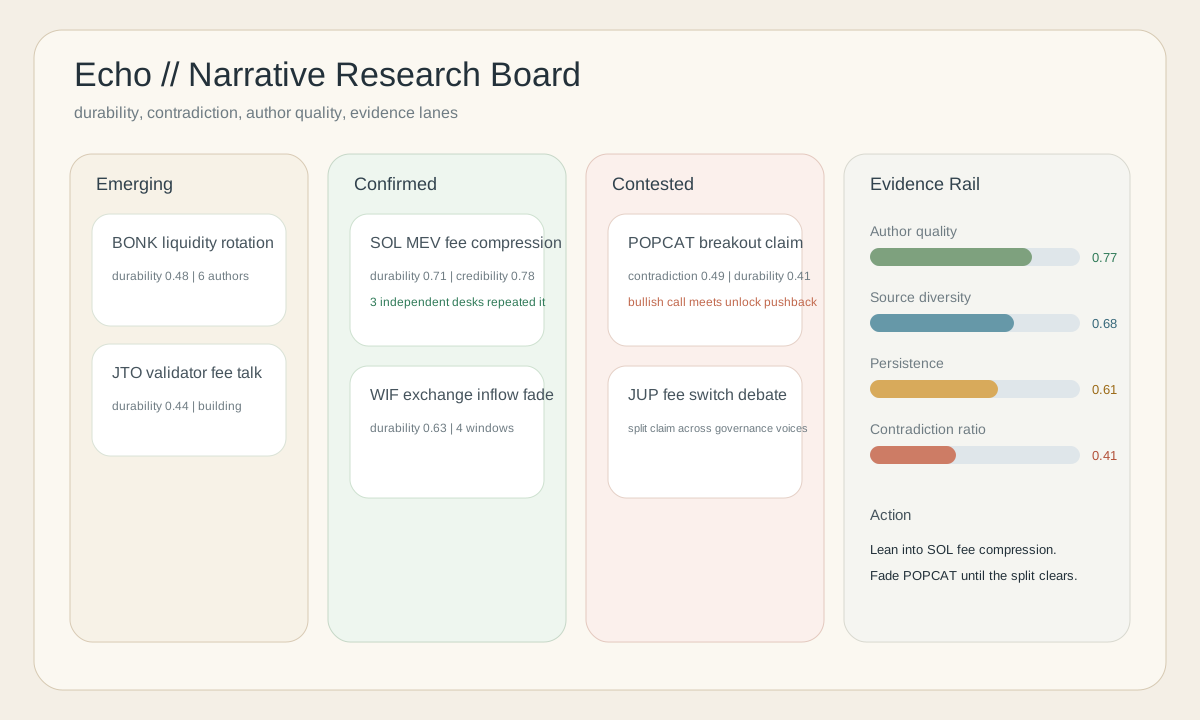
Echo fetches recent tweets for tracked Solana symbols, models author credibility and source diversity, and then asks a Claude agent to decide whether each narrative is durable, contested, or fading. The output is a ranked board of narrative signals with action hints and explicit durability context.
It is intentionally skeptical of narratives that look large only because the same claim is being echoed in one cluster.
FETCH -> AGGREGATE -> SCORE DURABILITY -> FLAG CONTESTED -> RANK
Research Board • Terminal Output • At a Glance • Operating Surfaces • How It Works • Example Output • Technical Spec • Risk Controls • Quick Start
At a Glance
Use case: Solana narrative ranking across Crypto Twitter windowsPrimary input: credibility, source diversity, persistence, contradictionPrimary failure mode: mistaking hype loops for durable narrativesBest for: operators who want to know which stories last beyond the first engagement spike
Research Board
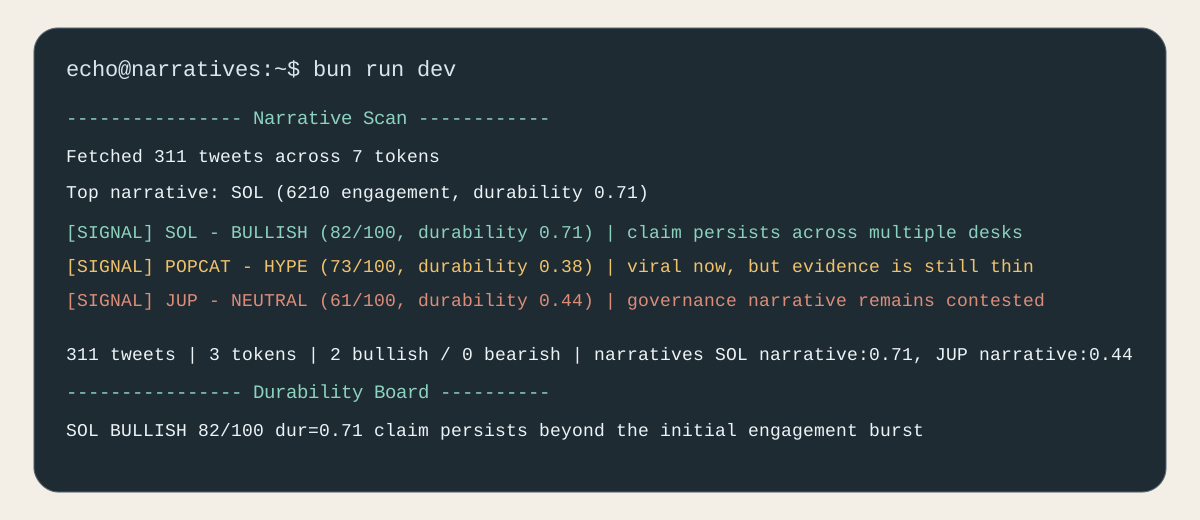
Terminal Output
Operating Surfaces
Research Board: shows which narratives are emerging, confirmed, contested, or decayingDurability Model: scores the claim instead of just the engagementContradiction Lens: makes opposing evidence visible before a narrative gets promotedTerminal Output: prints the actual story state with action context
Why Echo Exists
The problem with narrative tracking is that engagement is easy to see and hard to interpret. A claim can look huge on CT and still be completely fragile once you inspect who is repeating it and whether any credible counter-argument is growing at the same time.
Echo is built to make those hidden differences explicit. It is less interested in who is shouting loudest and more interested in whether the same claim survives across time, sources, and pushback.
How It Works
Echo uses a disciplined narrative loop:
- fetch fresh mentions for the tracked Solana tokens
- cluster similar claims into one narrative lane
- score the lane on credibility, diversity, persistence, and contradiction
- downgrade claims that are viral but narrow, repetitive, or heavily contested
- rank the remaining narratives into a board the operator can act on
The point is to identify what lasts, not what spikes for one refresh cycle.
What A Durable Narrative Looks Like
- repeated by more than one quality source cluster
- still alive across multiple windows
- not immediately met by a strong contradictory lane
- supported by evidence instead of only mood
That usually matters more than raw engagement totals.
Example Output
ECHO // NARRATIVE BOARD

lead narrative     SOL fee compression
durability         0.71
credibility        0.78
source diversity   0.68
contradiction      low
state              confirmed

operator note: claim is persisting across multiple desks without strong pushback
Technical Spec
Echo does not equate engagement with quality. Each token narrative is scored on four dimensions:
Durability = 0.35 * credibility + 0.30 * source_diversity + 0.20 * persistence - 0.15 * contradiction_ratio
Where:
credibilityblends author reach with observed engagement qualitysource_diversityrewards narratives repeated across different accounts and reply chainspersistenceincreases when the same claim survives multiple windows instead of one spikecontradiction_ratiorises when bearish and bullish evidence clusters stay active together
Operational rules:
- viral posts with weak persistence stay in
hype, notbullish - narratives above the contradiction threshold are marked
contested - score ordering is durability-adjusted, not raw engagement-only
- action hints should cite whether the edge comes from persistence, credibility, or a decaying claim
Risk Controls
credibility weighting: prevents weak accounts from overpowering the board through raw volumecontradiction penalty: stops contested narratives from being ranked like clean onespersistence requirement: downgrades stories that only live for one short windowcluster skepticism: filters cases where one social pocket keeps repeating itself
Echo is designed to be skeptical because hype is abundant and durable narratives are rare.
Architecture
Twitter fetch
  -> mention aggregation
  -> durability + contradiction scoring
  -> Claude narrative review
  -> ranked signal board
Quick Start
git clone https://github.com/EchoSentiment/Echo
cd Echo && bun install
cp .env.example .env
bun run dev
Configuration
ANTHROPIC_API_KEY=sk-ant-...
TWITTER_BEARER_TOKEN=...
AUTHOR_CREDIBILITY_WEIGHT=0.35
SOURCE_DIVERSITY_WEIGHT=0.30
PERSISTENCE_WEIGHT=0.20
CONTRADICTION_PENALTY_WEIGHT=0.15
NARRATIVE_HALF_LIFE_MINUTES=180
Legitimacy Notes
- Planned commit sequence:
docs/commit-sequence.md - Draft engineering issues:
docs/issue-drafts.md
Support Docs
License
MIT
read what lasts, not what trends for ten minutes.
Yorumlar (0)
Yorum birakmak icin giris yap.
Yorum birakSonuc bulunamadi