lifeos
Health Warn
- License — License: MIT
- Description — Repository has a description
- Active repo — Last push 0 days ago
- Low visibility — Only 5 GitHub stars
Code Warn
- fs module — File system access in _post.js
- fs module — File system access in _transform.js
- process.env — Environment variable access in mcp/src/client.js
Permissions Pass
- Permissions — No dangerous permissions requested
No AI report is available for this listing yet.
Self-hosted life OS: habits, goals, Kanban, finance and focus, with an MCP server for AI.
Edi Life OS
One self-hosted home for your focus, habits, goals, money and projects — with an MCP server so your AI assistant can work alongside you.





Quick start · Tour · AI / MCP · Deploy · API
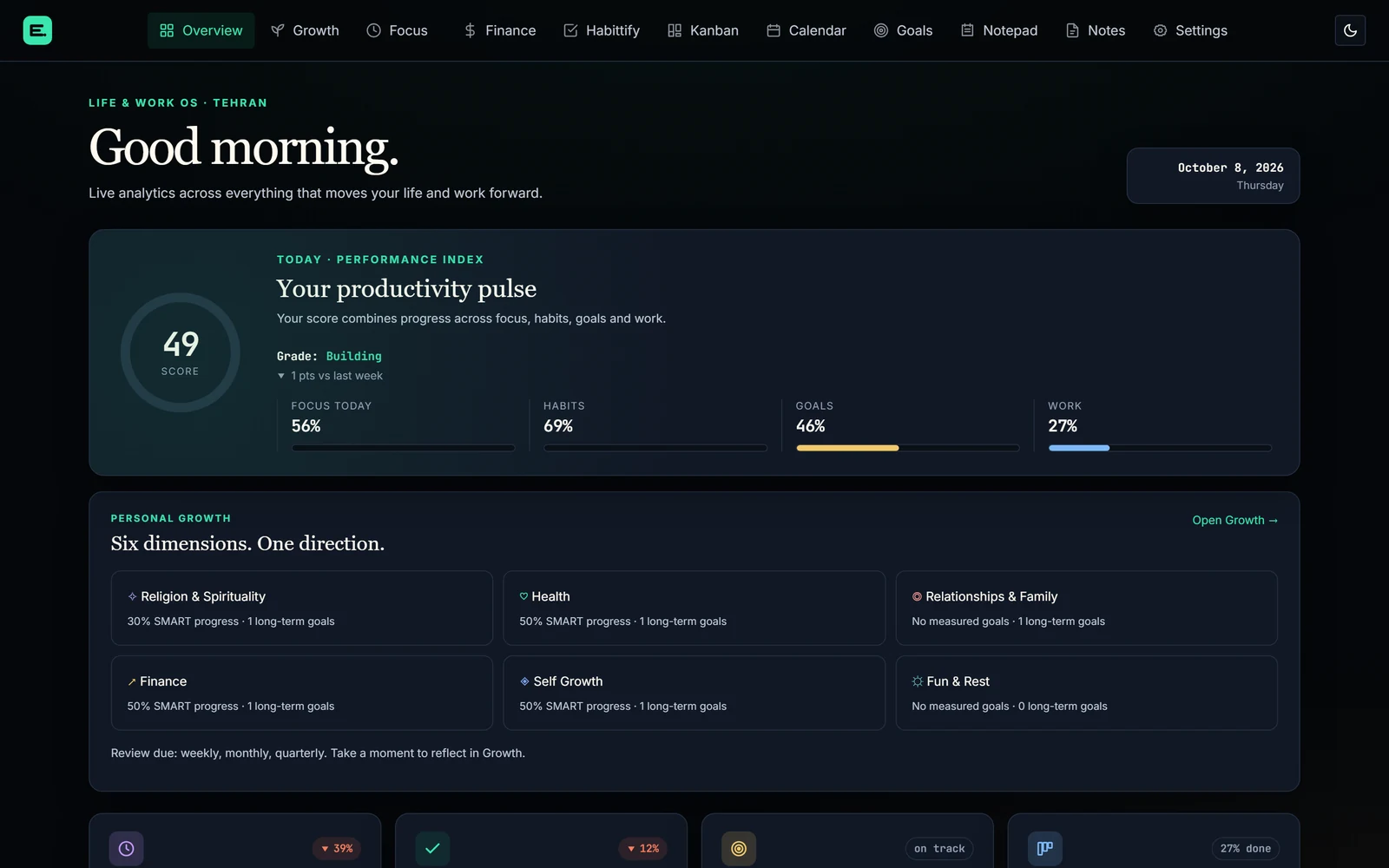
Most of us run our lives across a to-do app, a habit tracker, a budgeting spreadsheet, a Pomodoro timer and a notes app — and none of them know about each other. Edi Life OS puts all of it in one calm, private dashboard and connects the small things you do today to the direction you want your life to take.
- Everything in one place. Ten workspaces share one design, one sign-in and one database.
- Connected, not just collected. Habits drive goal progress, Kanban cards show up in the calendar, and the Overview turns it all into one daily score.
- Yours. Runs on any PHP + MySQL host, even cheap shared hosting. No subscription, no tracking, no vendor lock-in.
- AI-ready. A built-in MCP server lets Claude and other assistants read your dashboard, plan goals, log habits and track expenses for you.
A quick tour
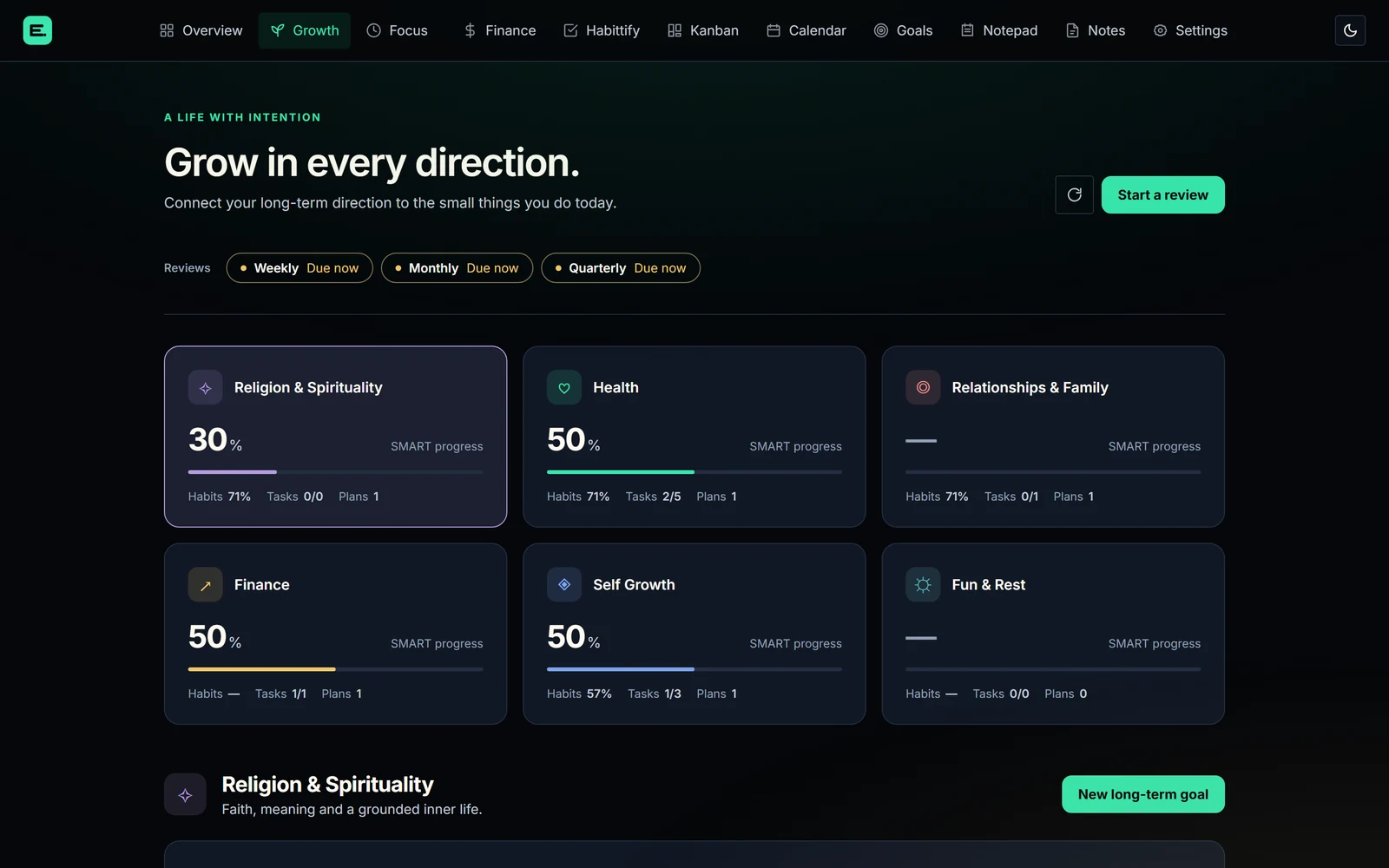
Growth — Six life dimensions, each linked to long-term goals, SMART goals, habits and tasks. Guided weekly, monthly and quarterly reviews. |
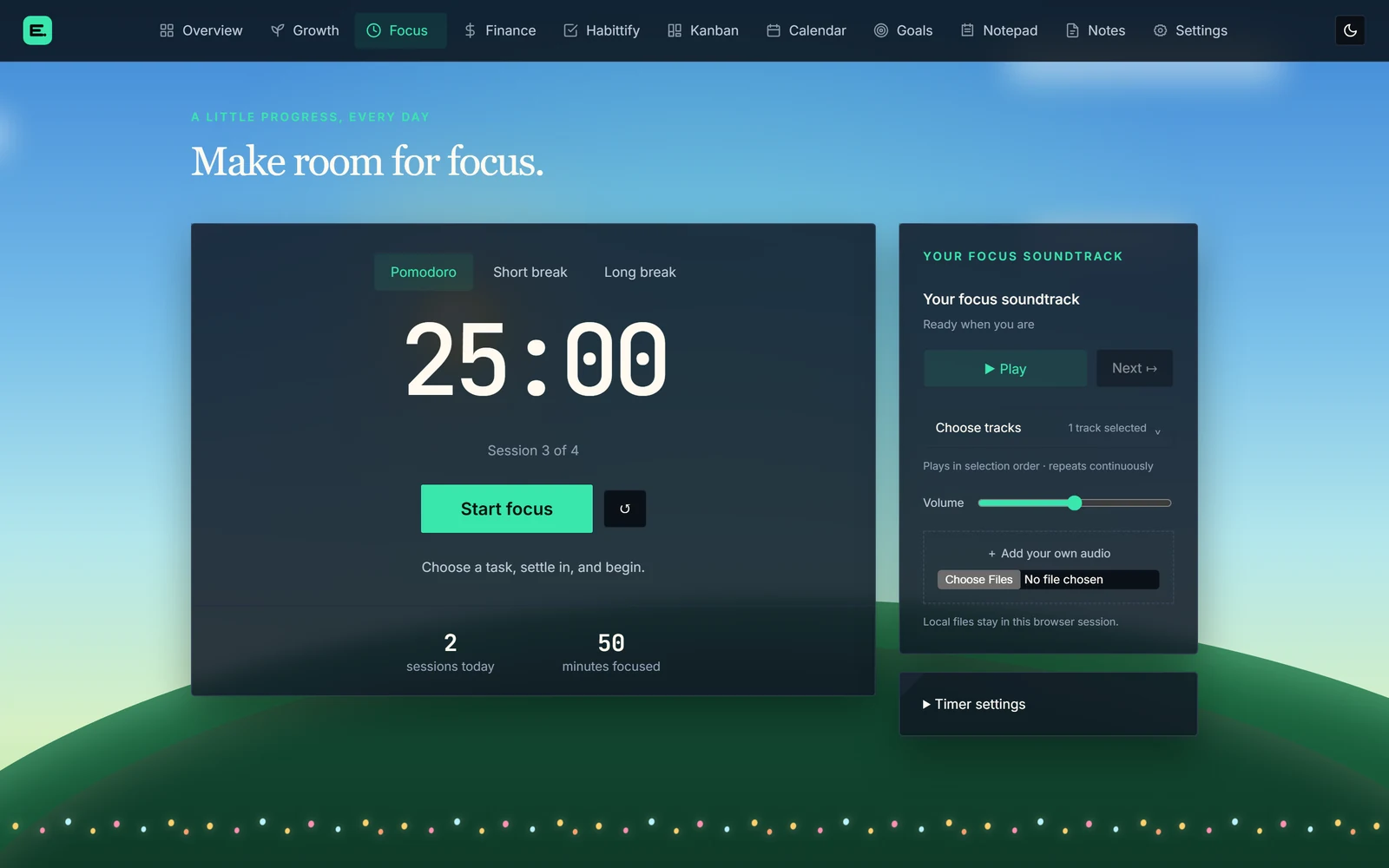
Focus — Pomodoro sessions with breaks, a built-in focus soundtrack and a landscape that follows the time of day. |
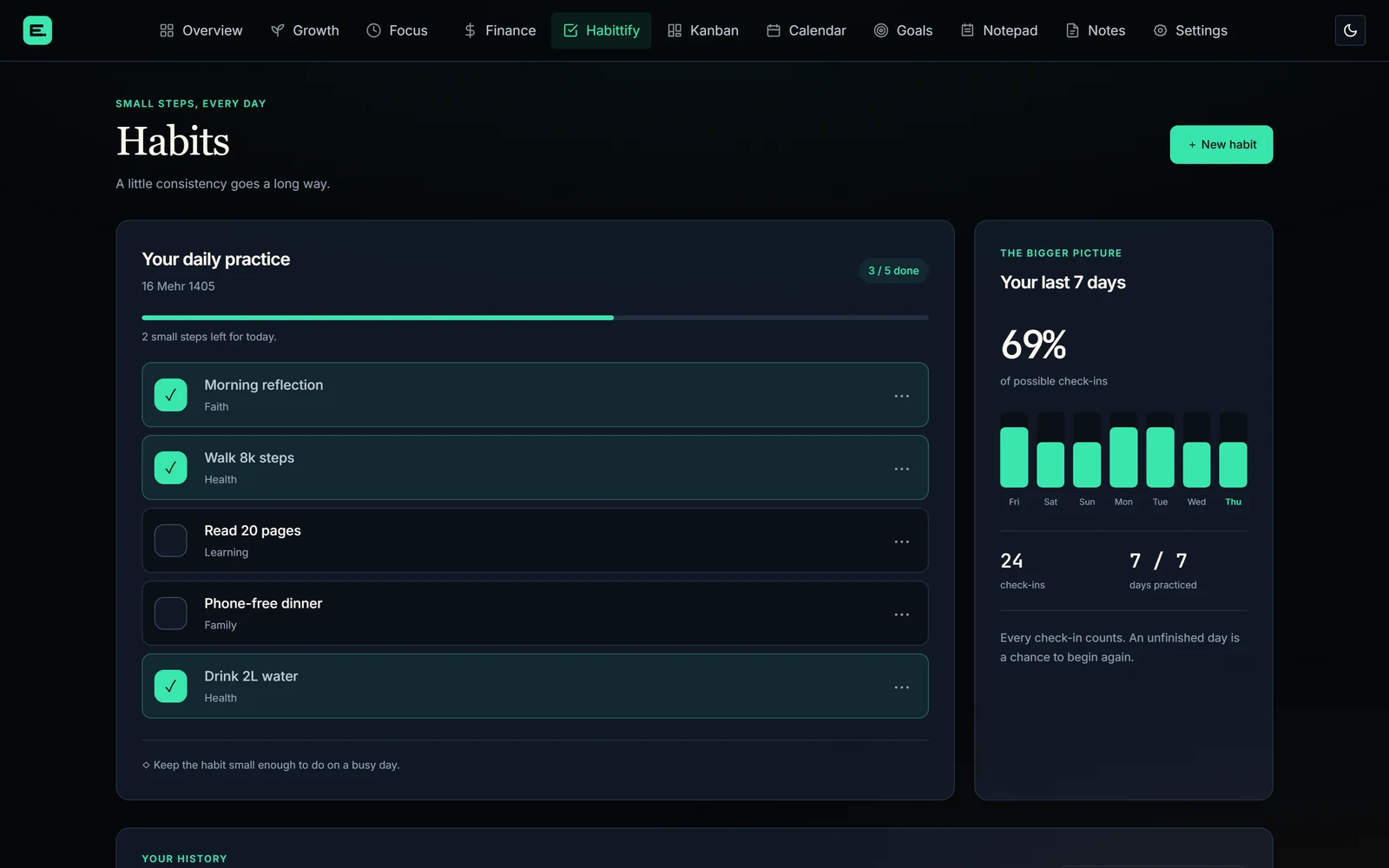
Habittify — Small daily habits, streaks and a seven-day picture of your consistency. |
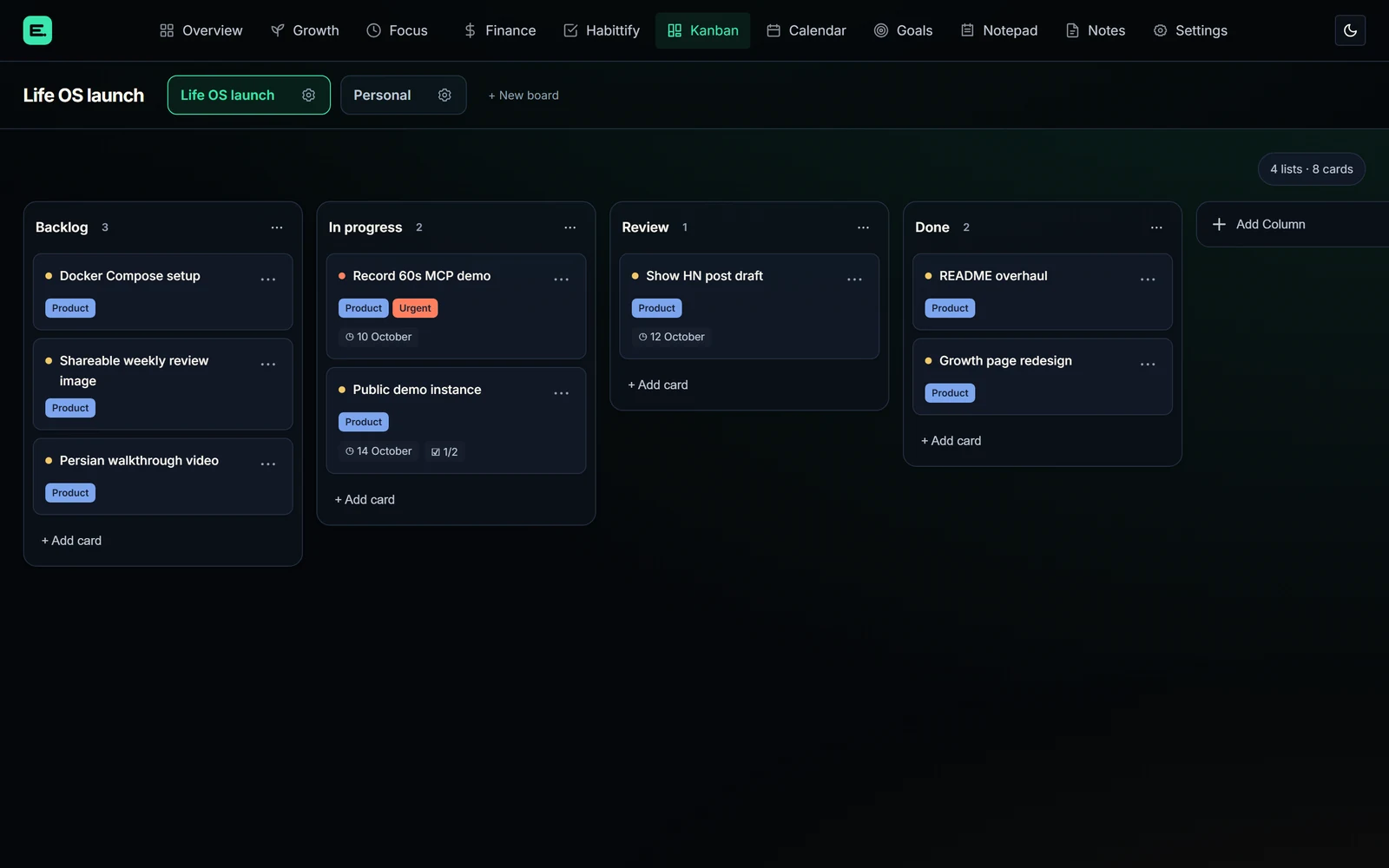
Kanban — Boards with labels, priorities, due dates, checklists, comments and attachments. |
| Workspace | What you can do |
|---|---|
| Overview | A live productivity score, focus and habit trends, goals, finances and a seven-day weather forecast. |
| Growth | Connect six life dimensions to long-term goals, SMART goals, habits and tasks. Run weekly, monthly or quarterly reviews. Guide |
| Focus | Timed sessions with short and long breaks, session history and a focus soundtrack. |
| Finance | Expenses, income and budgets in Toman. Debts you owe and credits owed to you, one-time or recurring, recorded straight into the ledger. Guide |
| Habittify | Daily habits with completion, streaks and monthly progress. |
| Kanban | Draggable cards and lists with priorities, labels, dates, checklists, comments and file attachments. |
| Calendar | Due cards and financial dues across all boards in Month or Schedule view. |
| Goals | SMART goals with measures, deadlines, priorities, checklists — or progress driven by a habit. |
| Notepad | Markdown notes with preview and export. |
| Notes | Sticky notes with colors, fonts and connections. |
Dates follow Asia/Tehran. The weather card shows Qeshm Island via Open-Meteo; its tide figure is a modeled estimate, not for navigation.
Talk to your Life OS with AI
Edi Life OS ships with an optional MCP server that exposes 26 tools across your dashboard, goals, tasks, habits, finances and notes. Connect it to Claude Desktop, Claude Code or any MCP client and ask in plain language:
"Show me my LifeOS dashboard."
"Create a SMART goal called Build a home studio, due in three months, and add Buy acoustic panels as a task."
"Mark Reading complete for today."
"Log a 450,000 Toman food expense and show my balance."
The MCP server talks to your app only through its token-protected HTTP API. It never touches your database or credentials. Setup takes a minute — see MCP server below.
Quick start
With Docker (recommended)
git clone https://github.com/edrisranjbar/lifeos.git && cd lifeos
cp .env.example .env    # set your sign-in and passwords
docker compose up -d
Open localhost:8080 and sign in. MySQL, the app and your attachments each live in their own volume, so docker compose up -d --build after a git pull upgrades without losing data.
On shared hosting
Download lifeos-<version>.zip from the latest release and extract it into your hosting home directory, so public_html/ becomes your web root and the backend sits safely above it. Copy config.example.php to config.php, fill in your MySQL details, and open your site. See the deployment guide for details.
With PHP locally
You need PHP 8.1+ (with pdo_mysql and mbstring) and MySQL 8+ (or MariaDB 10.4+).
git clone https://github.com/edrisranjbar/lifeos.git
cd lifeos
cp config.example.php config.php   # PowerShell: Copy-Item config.example.php config.php
Edit config.php with your database connection and the username and password you want to sign in with, then start the server:
php -S localhost:8000 -t public_html server.php
Open localhost:8000 and sign in. The database and tables are created on first use. You can change your sign-in later in Settings.
[!IMPORTANT]
config.phpand.envhold real credentials and are gitignored. Never commit them.
Requirements
| Component | Requirement |
|---|---|
| PHP | 8.1+ with pdo_mysql and mbstring |
| Database | MySQL 8+; also tested with MariaDB 10.4 |
| Web server | PHP's built-in server locally; Apache with rewrites for hosting |
| Weather | PHP curl and outbound HTTPS |
| MCP server | Optional: Node.js 22.9+ |
| API tests | Optional: pdo_sqlite |
API and integrations
HTTP API
A private /api/v1 API covers the dashboard, goals, tasks, habits, finances and sticky notes. It uses its own bearer token, separate from your browser sign-in.
php -r "echo bin2hex(random_bytes(32));"
Set the result as api_token in config.php (or the LIFEOS_API_TOKEN environment variable), then:
curl -H "Authorization: Bearer $LIFEOS_API_TOKEN" https://your-host/api/v1/dashboard
See the API reference for endpoints, payloads and errors.
MCP server
cd mcp
npm ci
cp .env.example .env   # set LIFEOS_BASE_URL and LIFEOS_API_TOKEN
npm start
The server runs over stdio; there is no hosted MCP endpoint. The MCP guide lists every tool and shows client configuration for Claude and Codex.
Your data stays yours
- Everything lives in your MySQL database. Habits use dedicated tables; other workspaces store JSON documents in
app_state. - Saves use revision checks, so a stale tab can't silently overwrite newer changes. API writes use transactions and row locks.
- Data from older browser-only versions is imported once; conflicting copies are archived as
legacy_backup_*records. - Back up the database, attachment files and your configuration together.
Moving from the old Habittify SQLite database? See migrating Habittify.
Security
Edi Life OS is built for a single owner.
- The API token grants read and write access to every supported domain. Token scopes and app-level rate limiting are not implemented, so set request limits at the hosting layer.
- Use HTTPS anywhere other than localhost, and keep tokens out of URLs, frontend code, screenshots and logs.
- Secret notes are hidden from API reads by default. The secret flag controls visibility; it is not separate encryption.
Project structure
public_html/          Browser workspaces, shared assets and Apache entry points
lib/                  API domains, response helpers and state transactions
mcp/                  Optional Node.js stdio MCP server
tests/                Timer, API, MySQL and integration checks
docs/                 Guides, plus README screenshots in docs/media
config.example.php    Configuration template (no real credentials)
server.php            Development router and application routing
api.php               HTTP API entry point
Built with PHP, MySQL and vanilla JavaScript — no frontend build step, no framework.
Dockerfile, docker-compose.yml and docker/config.php run the app with configuration from environment variables.
Documentation
- API reference — authentication, routes, data formats and concurrency
- MCP guide — tools, environment settings and client setup
- Deployment guide — Apache, shared hosting, backups and migration
- Development guide — local checks and disposable integration fixtures
- Growth workspace · Debts and credits
License
MIT © 2026 Edris Ranjbar. Use it, fork it and build on it.
Contributing
Ideas, bug reports and pull requests are welcome. Open an issue to start a conversation, and see the development guide to run the checks locally.
If Edi Life OS helps you run your days, consider giving it a ⭐ — it helps others find it.
Reviews (0)
Sign in to leave a review.
Leave a reviewNo results found