open-poly
Health Gecti
- License — License: GPL-3.0
- Description — Repository has a description
- Active repo — Last push 0 days ago
- Community trust — 32 GitHub stars
Code Uyari
- network request — Outbound network request in functions/api/report.ts
Permissions Gecti
- Permissions — No dangerous permissions requested
Bu listing icin henuz AI raporu yok.
An open source web based CAD tool
Open Poly
An open-source, in-browser CAD application that keeps your work on your own machine.
Try it → openpoly.dev — no sign-up, no upload, nothing to install.
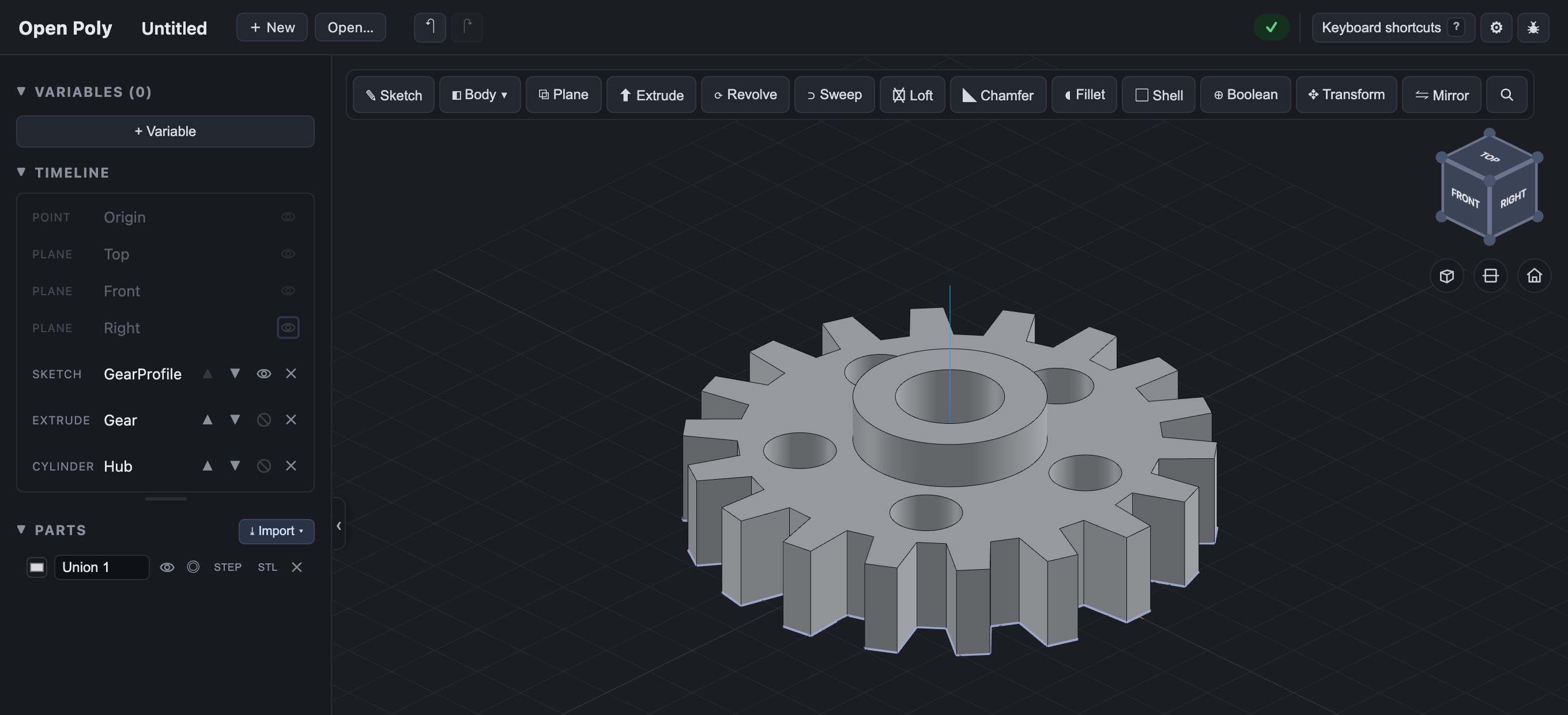
Open Poly runs entirely in your browser — modeling is powered by the OpenCASCADE geometry kernel (via replicad) compiled to WebAssembly, rendered with three.js, with parametric sketch constraints handled by planegcs. Documents autosave to your browser's IndexedDB — nothing leaves your machine.
The public deployment at https://openpoly.dev collects basic anonymous page analytics (no cookies, no personal data, nothing about your documents). Local and self-hosted builds send nothing.
Requirements
- Node.js 20.19+ or 22.12+ (required by Vite 8)
- npm (ships with Node.js)
Run
npm install
npm run dev
Vite prints a local URL (default http://localhost:5173) — open it in your browser.
Create models using your favorite agent
Open Poly comes with a built-in MCP server, so it can be driven by a local LLM agent while you watch it build geometries live in the browser.
Claude Code (already wired):
- Run the app:
npm run dev, then open the printed URL and leave the tab open. - In a Claude Code session for this repo, run
/mcpto connectopen-poly(project servers prompt on first use). - The app's top bar shows ● Agent connected. Now ask it to model something:
Using the open-poly tools, read the modeling guide, then make a 40×40×10 plate with an 8 mm hole through the middle, and fillet the top edges 2 mm.
Other clients (Claude Desktop, Cursor, Cline, …): point them at the same command — npx -y tsx <absolute-path>/mcp-server/src/index.ts. See mcp-server/README.md for per-client config, the full tool list, and troubleshooting.
Everything stays local: the agent talks to your browser tab over 127.0.0.1, and every action routes through undo, so you can revert anything it does. Because that is the only address the bridge ever dials, it is inert on the hosted build — https://openpoly.dev never attempts to reach an agent.
Contributing
See CONTRIBUTING.md for the codebase layout, dev
workflow, and PR process. Design and architecture notes, the gotchas, and what
is not built yet live in docs/PLAN.md.
License
GPL-3.0-or-later — see LICENSE. Third-party license notes
(including the LGPL constraint solver and the OCCT geometry kernel) are inNOTICE.md.
The exhaustive per-package list, with each license verbatim, is generated at
build time into dist/third-party-licenses.txt — served at
https://openpoly.dev/third-party-licenses.txt and linked from the
app's Settings dialog.
Yorumlar (0)
Yorum birakmak icin giris yap.
Yorum birakSonuc bulunamadi