claudikins-kernel
Health Gecti
- License — License: MIT
- Description — Repository has a description
- Active repo — Last push 0 days ago
- Community trust — 116 GitHub stars
Code Basarisiz
- rm -rf — Recursive force deletion command in hooks/cleanup-task-worktree.sh
- rm -rf — Recursive force deletion command in hooks/create-task-branch.sh
Permissions Gecti
- Permissions — No dangerous permissions requested
This tool is a disciplined workflow engine plugin for Claude Code. It applies SRE (Site Reliability Engineering) principles to AI coding workflows by enforcing a strict 4-stage pipeline: outline, execute, verify, and ship.
Security Assessment
The tool operates as an agent executing Shell commands. No hardcoded secrets were found, and it does not request inherently dangerous elevated permissions. However, the automated rule-based scan flagged `rm -rf` (recursive force deletion) commands inside two hook scripts (`cleanup-task-worktree.sh` and `create-task-branch.sh`). While this is a common pattern for cleaning up temporary git worktrees and branches, any automated destructive file deletion requires careful human review to ensure variables are properly sanitized and cannot be accidentally exploited. Overall risk is rated as Medium.
Quality Assessment
The project demonstrates strong community trust with 116 GitHub stars and appears to be highly maintained, featuring a push from today. It is legally safe to use, distributed under the standard and permissive MIT License. The documentation is clear, transparent about its processes, and provides straightforward setup instructions.
Verdict
Use with caution. The underlying code is actively maintained, but developers should manually review the shell scripts to ensure safe variable handling before integrating this into their daily workflow.
SRE thinking applied to Claude Code, based on Boris Cherny's Q&A.
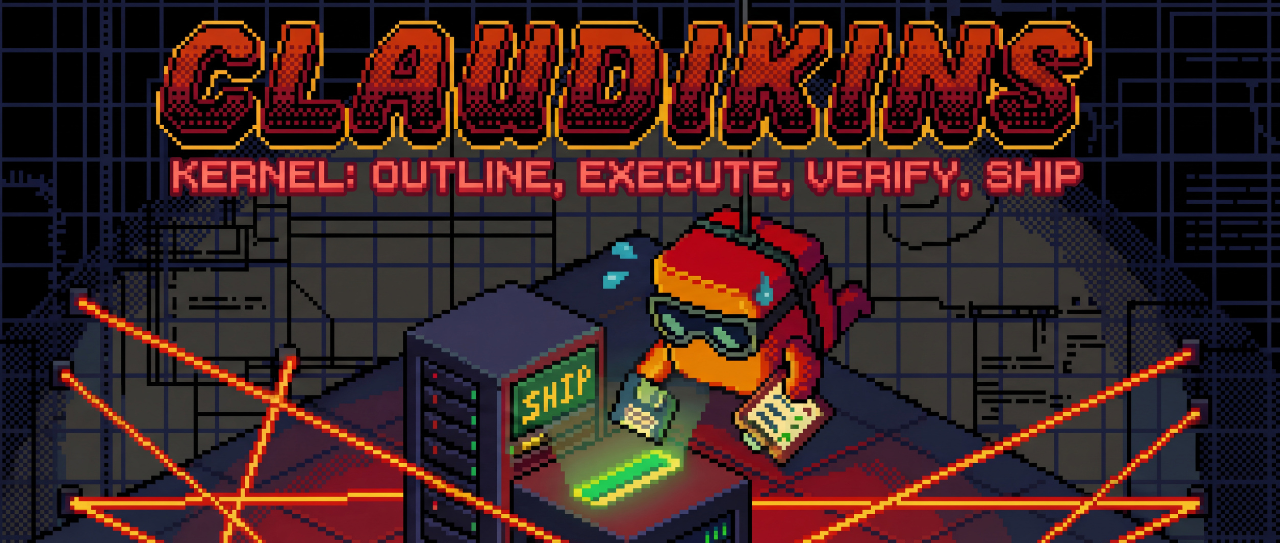



Claudikins Kernel
We call it Claudikins because "Draconian-AI-Supervisor" was taken.
A disciplined workflow engine run by a team of neurotic AI agents.
Why?
You asked Claude for a bug fix. He refactored half your codebase.
You asked Claude for a feature. He placed a bunch of stubs that look a little bit real.
You asked Claude if you should drink that coffee you forgot about, now you're feeling sick and threw up on your keyboard, which cost too much just to hear nice click clack noises whilst you code,
which actually isn't that great because it wakes your dog up at night, then you have to take him out in the cold to poop whilst you're still sick and well...okay, maybe that one was just me, but the point still stands!
claudikins-kernel applies SRE discipline to AI workflows. It enforces a strict 4-stage pipeline with gates between each step. You literally cannot skip verification. You cannot ship without the Cynic's approval.
Constraint is freedom. By preventing shortcuts, you get code that actually works.
The Workflow
┌──────────┐     ┌──────────┐     ┌──────────┐     ┌──────────┐
│ /outline │────▶│ /execute │────▶│ /verify  │────▶│  /ship   │
└──────────┘     └──────────┘     └──────────┘     └──────────┘
      │                │                │                │
      ▼                ▼                ▼                ▼
  taxonomy-        babyclaude      catastrophiser   git-perfectionist
  extremist        spec-reviewer       cynic
                   code-reviewer
Each arrow is a gate. Try to /ship without /verify passing? Blocked. Try to /execute without a plan? Blocked. The system enforces this - not guidelines, guardrails.
Quick Start
# Prerequisites: jq (JSON processor)
# Windows: winget install jqlang.jq
# Ubuntu/Debian: sudo apt install jq
# macOS: brew install jq

# Add the Claudikins marketplace
/marketplace add elb-pr/claudikins-marketplace

# Install the plugin
/plugin install claudikins-kernel
Restart Claude Code. Then:
# Start your first disciplined session
/claudikins-kernel:outline "Add user authentication to the app"
Meet the Team
These aren't generic "agents". They're your synthetic staff - each with a job and a personality.
| Agent | Role | Personality |
|---|---|---|
| taxonomy-extremist | Researcher | The librarian. Categorises everything. Reads your codebase, external docs, the web - returns structured findings. |
| babyclaude | Implementer | The eager junior. Does exactly what you specify. One task, one branch, fresh context. No scope creep. |
| spec-reviewer | Compliance | The auditor. Did you do what you said you'd do? Mechanical check against acceptance criteria. |
| code-reviewer | Quality | The critic. Is it actually any good? Error handling? Edge cases? Naming? |
| catastrophiser | Verification | The QA lead who assumes everything will break. Runs your code, takes screenshots, curls your endpoints. Sees it working, doesn't trust tests alone. |
| cynic | Simplification | The senior engineer who hates complexity. If it can be done in 5 lines, won't let you use 10. |
| conflict-resolver | Merge Handler | The diplomat. When branches collide, proposes resolutions. |
| git-perfectionist | Documentation | The pedant. README not updated? Changelog wrong? Blocked until it's right. |
The Four Commands
/outline - "Let's figure out what we're building"
Iterative brainstorming until you have a solid plan.
- Brain-jam - Back and forth with Claude. Pick from options, don't type essays.
- Research - taxonomy-extremist agents dig through your codebase in parallel.
- Approaches - 2-3 ways to solve it. Pros, cons, recommendation. You pick.
- Draft - Plan written section by section. You approve each one.
Output: plan.md with a task table that /execute can parse.
/execute - "Let's build it"
Execute the plan task by task with fresh agents and code review.
- Batch checkpoint - "Batch 1/3: [task-1, task-2]. Ready?" You decide.
- Per task - Creates branch, spawns fresh babyclaude, implements, commits.
- Two-stage review - spec-reviewer checks compliance, code-reviewer checks quality.
- Merge decision - You choose: merge all, merge some, or keep branches.
Key feature: Each babyclaude gets fresh context. No pollution between tasks.
/verify - "Does it actually work?"
Claude must see the code working. Not trust. Verify.
- Automated checks - Tests, lint, type check.
- Output verification - catastrophiser runs your code:
- Web app? Starts server, takes screenshots.
- API? Curls endpoints, checks responses.
- CLI? Runs commands, verifies output.
- Polish pass - cynic looks for unnecessary complexity. Changes one thing at a time, tests after each.
- Human checkpoint - Comprehensive report. You decide: ready to ship?
Output: verify-state.json with unlock_ship: true if approved. Plus file hashes so /ship can detect tampering.
/ship - "Send it"
Merge to main with proper docs and PR.
- Gate check - Won't run unless verify passed AND code hasn't changed.
- Commit strategy - Squash or preserve? Message drafted, you approve.
- Documentation - git-perfectionist updates README, CHANGELOG, version. Section by section.
- PR creation - Draft, approve, create via
ghCLI. - Merge - Wait for CI if you want. Merge. Cleanup branches.
Output: Code on main. PR merged. Done properly.
The Safety Net
| Protection | What it does |
|---|---|
| Cross-command gates | Can't skip steps. Execute needs plan. Ship needs verify. |
| State files | Each command writes to .claude/. Resume if context dies. |
| File locking | flock prevents race conditions on state writes. |
| Code integrity | SHA256 hashes ensure shipped code = verified code. |
| Session management | Stale session (4+ hours)? Warns you research might be outdated. |
| Human checkpoints | Nothing auto-proceeds. You approve every phase. |
Architecture
Industrial-grade patterns adapted for AI workflows.
| Distributed Systems Pattern | Claude Code Adaptation |
|---|---|
| Circuit breakers | Stuck agent detection |
| Distributed tracing | Execution spans |
| Load shedding | Batch size limits |
| Coordinated checkpoints | Batch-boundary saves |
| Deadline propagation | Task time budgets |
| Exponential backoff | Retry with jitter |
Same principles, different scale. Reliability through structure - not speed through parallelism.
Requirements
System
- jq - Used by hook scripts for JSON processing
# Ubuntu/Debian
sudo apt install jq

# macOS
brew install jq

# Windows
winget install jqlang.jq
Recommended Plugins
| Plugin | Purpose |
|---|---|
claudikins-tool-executor |
MCP access for research and verification |
claudikins-automatic-context-manager |
Context monitoring at 60% |
Optional Plugins
| Plugin | Purpose |
|---|---|
claudikins-klaus |
Escalation when truly stuck |
Status
v1.2.0 - Full Release - Regularly Maintained.
View the marketplace | Changelog
License
MIT
We call it Claudikins because "Draconian-AI-Supervisor" was taken.
Yorumlar (0)
Yorum birakmak icin giris yap.
Yorum birakSonuc bulunamadi