fleet
Health Uyari
- License — License: MIT
- Description — Repository has a description
- Active repo — Last push 0 days ago
- Low visibility — Only 5 GitHub stars
Code Gecti
- Code scan — Scanned 12 files during light audit, no dangerous patterns found
Permissions Gecti
- Permissions — No dangerous permissions requested
Bu listing icin henuz AI raporu yok.
A general-purpose agent fleet you run yourself — any model, in a sandbox, on a budget, connected to your data.
fleet


A general-purpose agent fleet you run yourself — any model, in a
sandbox, on a budget, connected to your data.
fleet is how a whole department adopts AI agents without losing sleep: every
tool call sandboxed, every turn metered against a budget, every credential held
server-side, and every working setup versioned so it runs again tomorrow — for
the next person, on a schedule. MIT-licensed, on your infrastructure: your
compute, your data, your know-how. You own the means of production.
See it in action
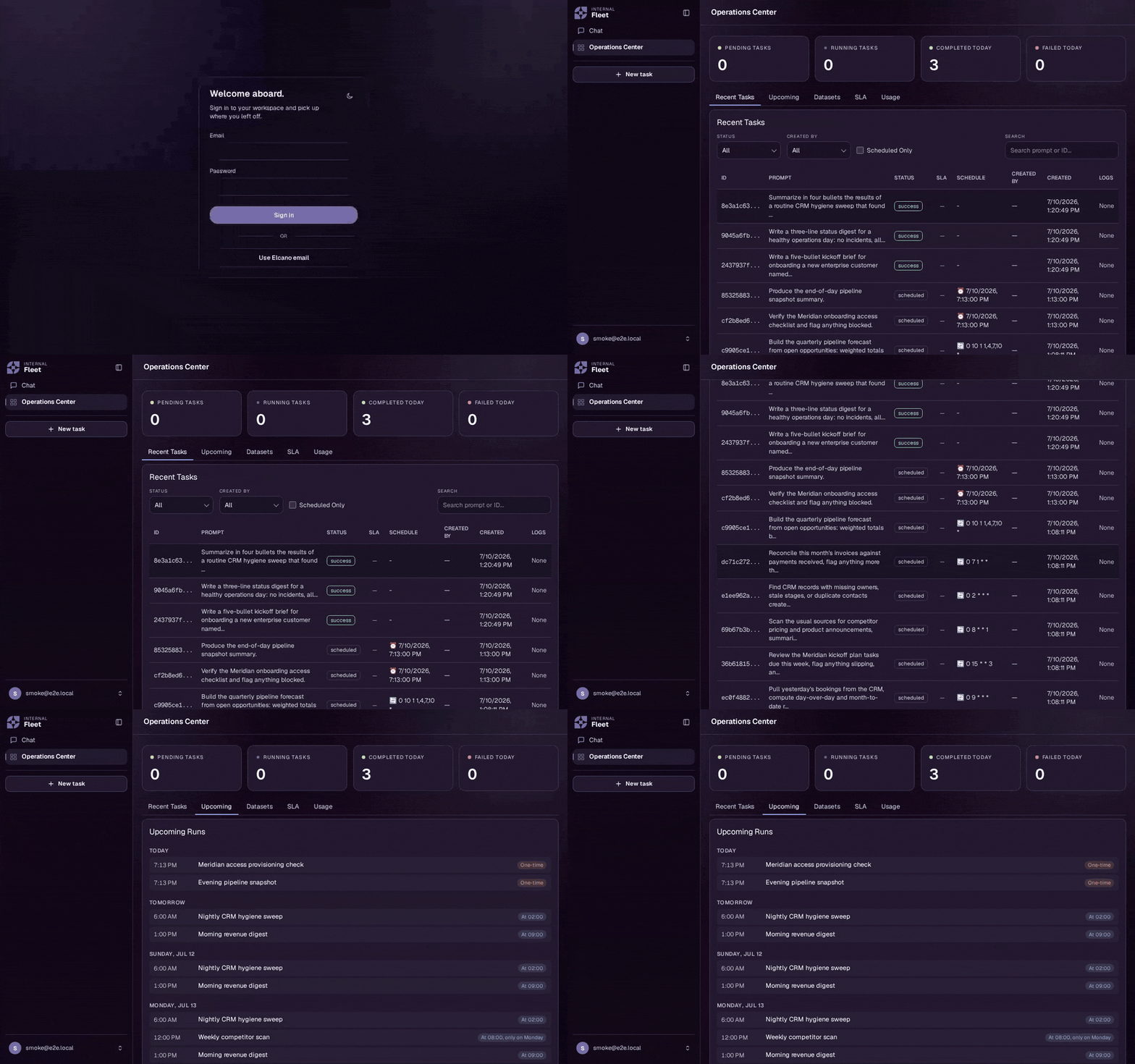
One story, three surfaces: plan the work in chat, automate the
follow-through, ride along from anywhere. The web demos are real recordings —
real model, real sandbox, real scheduler
(how they're made).
Chat — plan the kickoff, live (real model + sandbox)

Operations Center — the follow-through, automated (real scheduler)
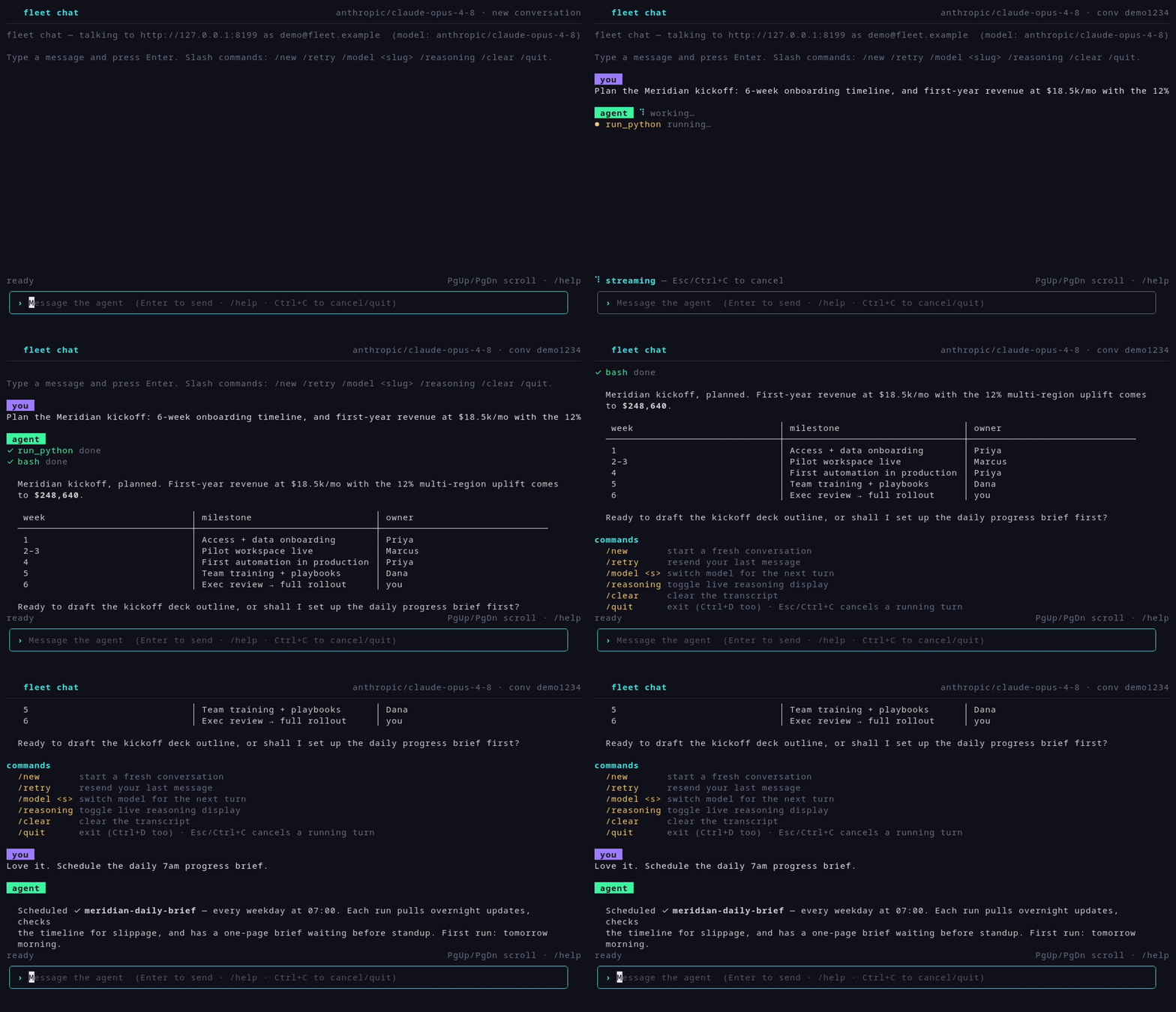
Terminal chat (fleet chat) — the same fleet, from your shell
More: screenshots of every surface.
Contents
- See it in action · Why fleet · Batteries included · Built for trust · Architecture at a glance · Standards
- Repository layout · The client-config bundle · No lock-in · Development
- Deploy · Operating fleet · Documentation
- Built by Elcano · Contributing · License
Why fleet
If your team keeps reaching for the same agent recipes — the same prompts, the
same connected tools, the same guardrails — fleet is the place to standardize
them.
Any model. fleet runs its own native agent loop and lets you choose the
best model for each task rather than hard-wiring one vendor. You decide,
at the model layer, who sees your data — task by task, and you can
change your mind tomorrow.Sandboxed by default. Model-authored local execution — bash, Python, and
file I/O — runs in an ephemeral rootless-Podman container with no fast path
around it. MCP calls are a documented host-side broker exception so their
credentials never enter the sandbox or model context. Bundle MCP and inline
HTTP-tool execution is owned by a dedicated broker subprocess; the main
agent process retains only public catalog metadata and the call transport.
Per-user remote MCP token acquisition and calls use the same child-owned
scoped boundary (ADR-0040).Two isolation tiers, one config line. Set
sandbox.runtime: kata(orlibkrun) and every sandbox container becomes a dedicated KVM microVM
(one per turn / scheduled run / persistent-REPL conversation) — escape now
takes a hypervisor CVE, not a container break-out; fail-closed preflight at
boot.docs/SANDBOX-RUNTIMES.md.Cost-controlled. Per-turn cost and token ceilings, an iteration cap,
and a timeout — enforced, not advisory. A runaway loop costs a capped turn,
not an open-ended invoice.A real scheduler. Priority queues with anti-starvation, opt-in retries
with backoff for transient failures only (deterministic ones never retry),
bounded log retention with optional encrypted archival, and per-key priority
ceilings. Every knob and default:docs/FEATURE-NOTES.md.Connected to your data. fleet speaks MCP: a per-deployment
connector catalog with multi-account credentials brokered host-side, per-task
tool selection, and per-user hosted-MCP connections.Your setups, packaged. Personas, playbooks, skills, connectors, branding,
and model defaults live in a versioned client-config bundle (see below) —
standardize once, reuse everywhere.MIT-licensed and observable. Structured observer events for every turn —
each tool call, result, token count, and cost — so you always know what an
agent did and what it cost.
Batteries included
fleet ships usable on day one — the platform pieces you'd otherwise assemble
yourself are already in the box, tested, and governed by the same core:
- An MCP connector library, two trust classes deep. Your bundle's own
connectors run as fixed host-side broker operations (not model-authored
sandbox code), and a
curated directory of hundreds of verified vendor-hosted MCP servers
(GitHub, Google, Notion, Slack, Stripe, X, OpenRouter, Hugging Face, AWS, …)
is one OAuth click away — each explicitly badged Bundled vs Third-party
so users know what they're opting into (docs/MCP-CATALOG.md).
Inlinehttp_toolscover the "just call this REST endpoint" cases without an
MCP subprocess. - A real scheduler, not a cron wrapper. Priority queues with
anti-starvation, transient-only retries with backoff, SLA tracking, dead-letter- replay, per-task sandbox limits, structured JSON output (
output_schema),
live SSE run streams, batch/import/export, and an Upcoming-runs view.
- replay, per-task sandbox limits, structured JSON output (
- Automation surface for your own ecosystem. Typed API keys + an
OpenAPI-specified HTTP API to enqueue and consume governed agent jobs from CI,
cron, bots, or other tasks (docs/BUILDING-ON-FLEET.md);
inbound HMAC webhooks and email triggers to spawn work; outbound
signed-webhook/email/browser-push notifications when it finishes. - Memory that can be trusted. Typed, provenanced user memory with
approval-gated writes, pin/retire lifecycle, human-confirmed supersession,
and a derived temporal knowledge graph with as-of queries
(docs/MEMORY.md). - Team surfaces. Projects/spaces with shared instructions + curated
connectors + shared memory, team RBAC, read-only share links, conversation
branching, conversation labels, and a dataset/table agent for row-by-row
background work with human-approved write-backs. - Quality gates for your agents. A self-hosted eval & regression harness
(fleet eval) that replays golden prompts through the real loop and gates
model/bundle changes (docs/EVALS.md); per-run error
analysis; optional PII redaction. - Three clients out of the box. The web chat UI, the Operations Center,
and a full terminal client (fleet chat) — all thin views over the same
governed API.
Built for trust: governed, auditable delegation
The hard part of agent adoption isn't technical anymore — the real barriers
are human: does it work, can I trust it, and am I willing to hand over
control? fleet earns each yes with engineering, not promises: sandboxes,
budgets, approvals, and receipts.
Can it do the job — reproducibly? The whole agent setup — prompts,
personas, playbooks, skills, connectors, model defaults — is a versioned
bundle (a plain git repo), so the setup that worked runs again next time, for
the next person, on a schedule. Every turn streams structured observer
events (each tool call, result, tokens, cost), so you judge work from its
trace, not just its final answer.
Should I trust it with this task? Limits that actually fire — cost ceiling,
token ceiling, iteration cap, timeout — and a persisted per-turn audit trail.
fleet owns execution end to end: there is no self-executing agent it can only
observe, so the log records what actually ran.
Am I comfortable handing over control? The agent has no direct power: every
model-authored local tool call goes through the sandbox under host policy
(optionally a KVM microVM), credentials stay host-side, sensitive actions raise a
default-deny allow/deny card with no "approve all", and unattended scheduled
work is fail-closed — network-sealed by default with an end-of-run verifier
(docs/AGENT-RUNTIME.md). The out-of-process MCP
address-space boundary is active for bundle MCP servers, inline HTTP tools, and
per-run hosted MCP clients. Explicit remote-MCP OAuth/connectors HTTP endpoints
remain parent-side control-plane code
(ADR-0040). One caveat to respect: the
bundle's own host-side MCP servers do receive brokered credentials by design,
so treat bundle write access as production access
(SECURITY.md).
Architecture at a glance
A single fleet process runs, on one box:
- Interactive real-time chat sessions (streamed over SSE), and
- A scheduling engine that runs recurring background agent tasks,
both executing their tool calls inside the same rootless-Podman sandbox, and
both driven by one unified agent runtime (internal/agentcore).
Standards
fleet is built on open protocols. We list only what is actually implemented and
tested in this repository:
- MCP — Model Context Protocol. A merged Go client (stdio + HTTP) drives the
deployment's connector catalog, and each user can OAuth into hosted MCP
servers from the GUI (OAuth 2.1 + PKCE, dynamic registration, tokens encrypted
at rest, host-side). ADR-0009. - Agent Skills. The bundle's
skills/dir holds capabilities in the open
Agent Skills format, loaded with
progressive disclosure (name + description in the prompt; the agent readsSKILL.mdand runs bundled scripts on demand, in the sandbox). Invoke
explicitly with/skill-namein chat.
The orchestrator HTTP API is published as an OpenAPI 3.1 contract atdocs/openapi.yaml; a CI test
(cmd/fleet/openapi_drift_test.go) keeps its routes + auth schemes in lockstep
with the shipped router, and gates the body schemas of every named component
schema bound to a Go model (property existence, required integrity,
type-kind). Inline operation schemas, schemas without a reflectable Go type,
and status codes remain documentary.
Repository layout
Abridged — the load-bearing directories, not every package. internal/ alone
holds roughly forty packages; cmd/ also carries the test/bench helpers
(fake-llm, fleet-bench), and scripts/ and .github/ hold the operator
scripts and the CI definition.
cmd/
  fleet/          the one unified binary — server (`fleet serve`: chat HTTP/SSE + orchestrator HTTP + scheduler + worker pool) AND operator CLI (every other verb)
  fleet-admin/    transitional deprecation shim — forwards to `fleet`; removed after one release
  sandbox-probe/  deploy-time sandbox smoke test
internal/
  agentcore/      the one unified run loop + shared agent primitives (cost ceilings, policy)
  agent/          input sources, observers, policies, finalize (interactive + scheduled)
  runner/         in-process capped worker pool (the old "gig", folded in)
  creds/          MCP credential-account store (host-side credential broker)
  clientconfig/   loads the pluggable CLIENT BUNDLE (branding, MCP catalog, prompts, skills, ...)
  mcp/            merged Go MCP client (stdio + HTTP)
  mcpbroker/      out-of-process bundle MCP broker transport + scoped sessions
  sandbox/        the single execution backend (ephemeral container over a persistent workspace)
  tools/          native agent tools (bash, python, ...)
  store/          interactive (chat) Postgres layer + migrations
  sched/          orchestrator/scheduler (was moc) + its migrations
  httpapi/        chat HTTP/SSE/auth layer
  config/         unified configuration (env loading; the MCP catalog comes from the bundle)
  ...             (~30 more: agentcore's neighbours, netguard, mcpoauth, observability, ...)
scripts/          bootstrap / update / doctor, the sandbox image build, and the CI policy checks
.github/          workflows (the CI + SAST gates), CODEOWNERS, dependabot, the CodeQL gate filter
web/              one Next.js app: /chat and /orchestrator
config/default/   the GENERIC client bundle baked into the repo (runs bare),
                  including config/default/sandbox/Containerfile — the sandbox
                  image is a per-client bundle artifact (build-on-box default)
docs/             architecture & operator docs; docs/adr/ records the load-bearing
                  Architecture Decision Records behind the invariants
Naming note (v1 glossary):
chat,moc,gig, andcutlass— which
appear in code comments, env-var prefixes (CUTLASS_*), docs, and the
CHANGELOG — are the names of the internal predecessor stack that fleet
consolidates and replaces. They are historical aliases inside this repo, not
separate public projects.
The client-config bundle
fleet ships no client-specific content. It loads a client-config bundle
from FLEET_CLIENT_CONFIG_DIR: manifest.yaml supplies branding, model
defaults, the connector catalog, and tool policy; system_prompts/,personas/, protocols/, skills/, and mcp/ supply the content. Contract:config/default/README.md.
Three ways in: run bare (the in-repo generic bundle — good for a first
look), fork the public template
(ElcanoTek/example-config for
the single-box podman install,ElcanoTek/example-kubernetes-config
for the Kubernetes one — they are peers, not parent and child), or
point at your own private repo (the box needs a read-only fine-grained PAT
to clone it). bootstrap --client-config <git-url[#sha-or-tag]|path> sets it
up; pin the ref in production — the bundle runs host-side under the service
identity (SECURITY.md), so a bundle change should be a
deliberate operator action, not a silent pull.
No lock-in: your agent IP is portable
Everything that defines how your agents behave lives in the client-config
bundle — a plain git repo or directory you own (FLEET_CLIENT_CONFIG_DIR), not
inside fleet's database or binary:
system_prompts/— base prompts for chat and taskspersonas/— reusable agent profilesprotocols/— playbooks your agents followskills/— packaged Agent Skills (SKILL.md+ bundled scripts)plugins/— Agent Plugins (plugin.json+skills/+mcp.json), the portable package format other agent clients also
load; see docs/AGENT-PLUGINS.mdmcp/— your MCP connectors (+requirements.txt)manifest.yaml— MCP catalog, tool policy, model defaults, sandbox blocksandbox/Containerfile— the exact image your tool calls run in
These files encode how your business actually works — your prompts, playbooks,
and connectors carry real competitive knowledge. Safety here means owning them
outright, rather than trusting a vendor's roadmap to stay clear of your market.
Versioned, under your control, over an open protocol (MCP): your
agent setup travels with you — fork it per team, share it across orgs, or point
it at another MCP-capable platform. Moving off fleet doesn't mean starting
over, which keeps adoption low-risk. The public templates show the full
layout — example-config for a
single box, example-kubernetes-config
for a cluster.
Development
make build      # go build ./...
make test       # go test ./...
make lint       # golangci-lint run
For the full build/test workflow (including the Postgres-backed Go suites, the
web app, and the Playwright e2e suites), seeCONTRIBUTING.md.
Running one task locally (fleet task run)
fleet task run executes a single task YAML to completion locally — no
server, no database — through the same governed runtime the production
scheduler uses (sandbox and credential brokering included). A debug
entrypoint, not a second execution path. (Formerly the separate cutlass
binary; its deprecation shim has been removed.)
fleet task run --log out.json path/to/task.yaml               # run one task through the governed runtime
scripts/run_workflow_live.sh docs/examples/local-task.yaml    # or: build the sandbox image, isolate a workspace, tail a log
See docs/examples/local-task.yaml for the
task schema (a thin mirror of the scheduled-task create shape).
Deploy
fleet runs as one fleet process on a single, vertically-scaled host: the
browser talks only to the Next.js web app, which proxies server-side over
loopback to the two Go backends the process boots (chat + orchestrator); Caddy
fronts it with TLS and routes the public /v1 API (plus /api-info, the A2A
agent card, /triggers/* and /webhooks/*) straight to those backends. Single-host is by design — crash recovery uses single-owner
DB leases and the worker cap is a per-process semaphore, so fleet scales by
moving to a bigger box, not more replicas.
git clone https://github.com/ElcanoTek/fleet.git /opt/fleet/src
sudo bash /opt/fleet/src/scripts/bootstrap.sh --postgres=local --enable-service \
  --client-config https://github.com/ElcanoTek/example-config.git
# then add your OPENROUTER_API_KEY to the env file and: fleet restart
→ Full deployment guide — host sizing, the one-command web + Caddy/TLS stack,
the env file, and every option: docs/DEPLOYMENT.md.
Kubernetes shop? fleet also ships a first-class cluster path
(ADR-0049): a Helm
chart (deploy/helm/fleet) for the single-replica control plane, with agent
sandboxes running as ephemeral pods viaFLEET_SANDBOX_BACKEND=kubernetes — same loop, same security model, one
backend switch. Seedocs/DEPLOYMENT-KUBERNETES.md.
Operating fleet
The operator lifecycle is bootstrap → update → status, one box. The server
runs via fleet serve; every other verb is the idempotent operator CLI (each ascripts/ shell script wrapped by a fleet subcommand). Each service
self-migrates on start.
| Verb | What it does |
|---|---|
fleet bootstrap |
provision a box (Postgres, build, install, systemd, optional web + TLS) |
fleet update |
git pull + rebuild + reinstall the binaries in place |
scripts/fleet-upgrade.sh |
drain, swap, health-gate, and auto-roll-back on failure |
fleet status / fleet diagnose |
quick health report / redacted support bundle |
fleet doctor |
diagnose and repair box-level drift (packages, podman prereqs, unit drift; also surfaced read-only in Settings → Admin → Doctor) |
fleet restart · stop · logs |
service lifecycle |
fleet chat [--email you@org] |
terminal TUI for the agent (token auto-read on-box) |
fleet backup / fleet restore |
disaster recovery (docs/BACKUP_RESTORE.md) |
fleet timers install |
install + enable the daily backup/maintenance systemd timers on an existing box (docs/TIMERS.md) |
→ Full operator runbook — the env file, the client-config checkout, every
verb in detail, process logs, and backup/restore:docs/OPERATORS.md.
Documentation
Deep references live in docs/ so this README stays an orientation, not a manual:
| Doc | What it covers |
|---|---|
docs/DEPLOYMENT.md |
Full deployment guide — host sizing, the one-command web + Caddy/TLS stack, options |
docs/DEPLOYMENT-KUBERNETES.md |
Kubernetes as a first-class path — the Helm chart, the kubernetes sandbox backend (agent sandboxes as ephemeral pods), kind walkthrough + production checklist |
docs/OPERATORS.md |
Operator runbook — the env file, the client-config checkout, every lifecycle verb |
docs/AGENT-RUNTIME.md |
Agent runtime mechanics — per-turn sandbox, ceilings, compaction, verifier, artifacts |
docs/SANDBOX-RUNTIMES.md |
Sandbox OCI runtimes — runc / Kata / libkrun isolation tiers |
docs/CONFIG-RELOAD.md |
Which settings hot-reload without a restart, and how |
docs/SERVER-STATS.md |
Admin Server tab — lightweight CPU, memory, disk, network, and uptime status |
docs/BACKUP_RESTORE.md |
Disaster recovery — backup + restore of both databases |
docs/WEBHOOK-SIGNING.md · docs/TESTING.md |
Webhook HMAC signing · the test suite + fake-LLM seam |
docs/SCANNING.md |
The scanning stack — which of golangci-lint / ruff / govulncheck / Grype / gitleaks / npm audit / CodeQL / Semgrep owns what, what actually blocks a merge, and the known gaps |
docs/CODEQL.md |
CodeQL specifics — advanced setup, the four-language matrix, the High-band gate + accepted-findings register, and why a PR-event run certifies a diff rather than a tree |
docs/BUILDING-ON-FLEET.md |
The HTTP API as an automation substrate — keys, kicking off jobs, consuming structured output |
docs/API-CLIENTS.md |
Reaching the API from another machine — what the TLS front routes, the key store the service reads, X-API-Key, the free connection test |
docs/MCP-CATALOG.md |
The connector catalog — bundled vs third-party trust classes |
docs/adr/ |
Architecture Decision Records — the why behind the non-negotiable invariants |
SECURITY.md · CONTRIBUTING.md |
Reporting a vulnerability · contributor workflow + CI gates |
Built by Elcano (commercial support)
fleet is built by ElcanoTek. Everything in this repository is the complete,
MIT-licensed platform — there is no held-back enterprise edition. What an
Elcano engagement adds is the team that built it, working inside your stack:

- Forward-deployed engineering. Elcano engineers embed with your team, take
the workflows your people already run in chat, and make them
production-ready: scheduled, monitored, budgeted, and verified. - Custom MCP connectors & data integrations. Bespoke connectors into the
systems your work actually lives in — built, credential-brokered, and
maintained for your deployment. - Add-on capabilities. Agents and services Elcano builds and operates
beyond this repo — email-native agents, monitoring and analysis tools, and
other domain-specific pieces, packaged into your client-config bundle. - Deployment, support & operations. fleets stood up on your infrastructure
and kept healthy — upgrades, sandbox images, and model changes gated by evals
before they ship.
Engagements don't shrink the repo: client-specific work lives in each client's
config bundle, and platform improvements land here, in the open.
elcanotek.com ·
[email protected]
Contributing
Contributions are welcome — see CONTRIBUTING.md for the
build/test workflow, branch/PR conventions, and CI gates. Please also read theCODE_OF_CONDUCT.md. To report a security issue privately,
see SECURITY.md.
Acknowledgements
fleet stands on the shoulders of excellent open-source projects and open
standards. Our thanks to the teams and communities behind them:
- Podman — rootless, daemonless
containers. Every agent tool call's model-authored local execution (bash,run_python, file I/O) executes inside a rootless-Podman sandbox; there is no
trusted fast path that skips it. MCP is the documented host-side broker
exception (see above). - Kata Containers and
libkrun — the OCI runtimes behind
fleet's optional hypervisor-isolation tier: setsandbox.runtimeand every
sandbox container becomes a dedicated KVM microVM with its own guest kernel,
plugging into the same Podman invocation unchanged. - Fedora —
fedora-minimalis the base image
for the default sandbox, and we think it's the safest base in the game for
this job: a deliberately small image (less surface to attack), backed by one
of the fastest CVE-response pipelines in any distribution, with the entire
Python data stack installed as signed Fedora RPMs instead ofpipat
runtime — one audited supply chain, not a thousand PyPI tarballs. fleet
deliberately tracks the rolling tag so every on-box rebuild picks up the
current patches, and Grype scans keep the claim honest — on every main-targeting
PR that is not docs-only, plus a weekly scheduled re-scan of the existing image
(PRs intodevget no image scan; it runs at the dev→main promotion). - Model Context Protocol and its SDKs —
the open standard fleet speaks (stdio + HTTP) to reach tools and data through a
credential-brokered MCP catalog. - Agent Skills — the open skill
format fleet loads from the client-config bundle (SKILL.md+ bundled scripts,
with progressive disclosure). - Charmbracelet — fleet leans on the
charm stack end to end: Fantasy
is the Go framework underneath the multi-provider agent run loop, and thefleet chatterminal client is built on
Bubble Tea,
Bubbles,
Lip Gloss, and
Glamour — with
vhs recording the README's TUI
demo and freeze rendering its
static screenshots. - OpenRouter — unified, provider-agnostic model
routing that backs fleet's "any model, the right one per task" design.
License
fleet is released under the MIT License.
Yorumlar (0)
Yorum birakmak icin giris yap.
Yorum birakSonuc bulunamadi