omnipus
Health Warn
- License — License: MIT
- Description — Repository has a description
- Active repo — Last push 0 days ago
- Low visibility — Only 8 GitHub stars
Code Fail
- rm -rf — Recursive force deletion command in .github/workflows/build.yml
- rm -rf — Recursive force deletion command in .github/workflows/cross-platform.yml
- rm -rf — Recursive force deletion command in .github/workflows/evals-nightly.yml
- rm -rf — Recursive force deletion command in .github/workflows/perf-nightly.yml
- rm -rf — Recursive force deletion command in .github/workflows/pr.yml
- rm -rf — Recursive force deletion command in .github/workflows/security-weekly.yml
Permissions Pass
- Permissions — No dangerous permissions requested
No AI report is available for this listing yet.
A team of named AI agents you actually own. Single Go binary, kernel sandbox, embedded SPA, no telemetry.

Omnipus
Multi-agent orchestration — sovereign, sandboxed, single binary.
An opinionated agent runtime with five named coworkers, hand-off between them, a Landlock+seccomp sandbox applied to the gateway itself on Linux 5.13+, and 17 chat channels. One go build, no database, runs on a $10 VPS.



Why Omnipus
Most agent frameworks give you orchestration or a security story. Omnipus ships both, in a single Go binary, without pulling in Postgres, Redis, or a Python runtime.
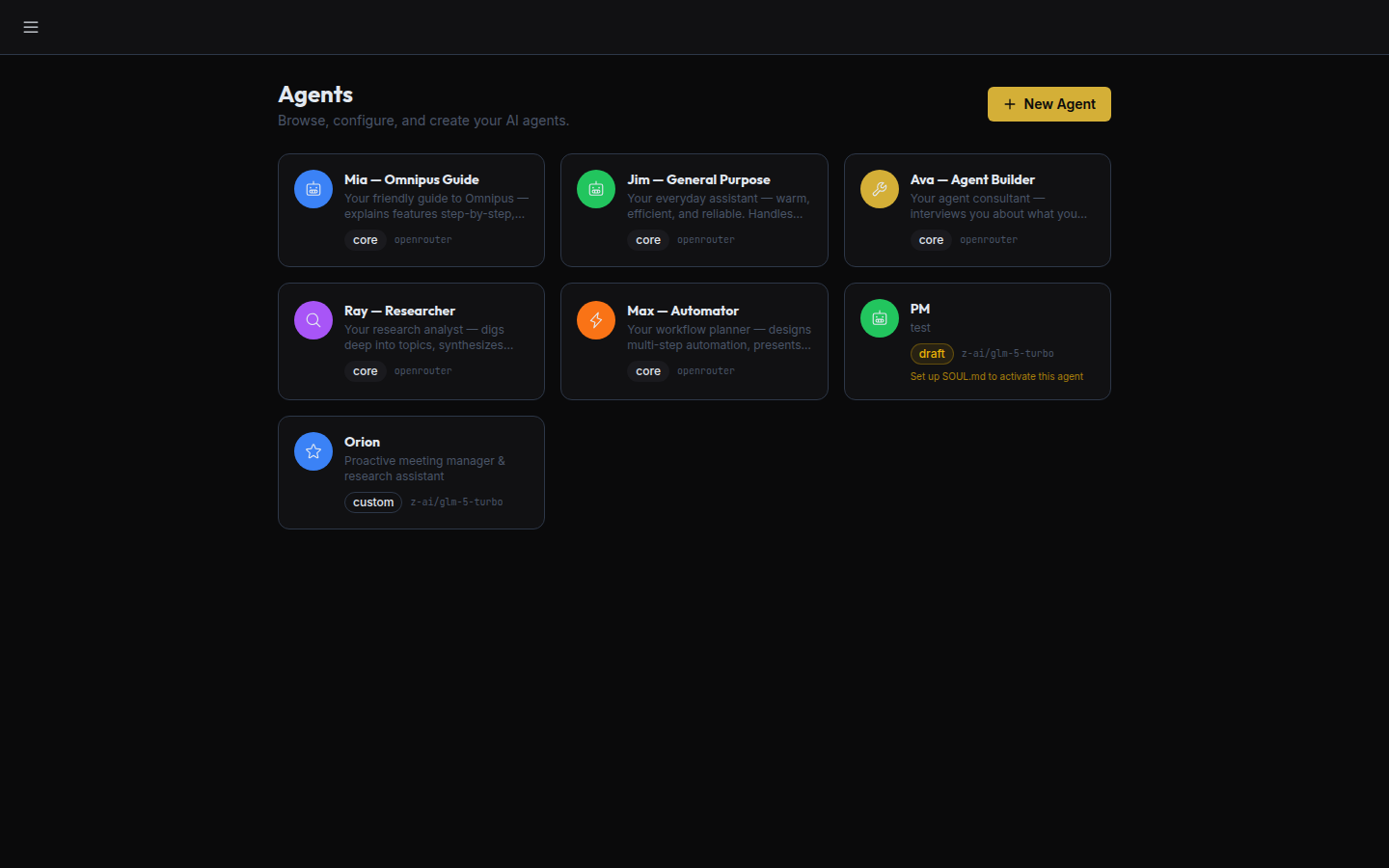
- Five named agents out of the box — not one general-purpose chatbot, but a team with defined roles and delegation rules.
- Real hand-off, not fake role-play — agents pass control through a transcript the next agent can actually read.
- Deny-by-default security — Landlock + seccomp applied to the gateway process before it listens (Linux 5.13+; app-level fallback elsewhere), SSRF guard wired into every outbound-HTTP tool, three-tier tool policy (allow / ask / deny), encrypted credential store.
- Runs anywhere — single static binary, embedded SPA, auto-generates its own encryption key on first boot. Works on a laptop, a $10 VPS, or a Raspberry Pi.
The five core agents
| Agent | Role | What they do |
|---|---|---|
| Mia | Coach & Guide | Default agent. Onboards you to the platform, explains features, answers setup questions. |
| Jim | General Purpose | Warm, fast, reliable. Research, writing, analysis, coordination with other agents. |
| Ava | Agent Builder | Interviews you about what you need, then creates a custom agent with tools, persona, and prompt. |
| Ray | Researcher | Deep research with citations. Web search, web fetch, synthesis — then hands visual/automation work to Max. |
| Max | Automator | Browser automation, plan-then-execute, multi-step orchestration with approval gates. |
Identity (name, description, color, icon, prompt) is locked on core agents — users can change their model and tool policy, but can't silently replace Mia with a knock-off. Custom agents are unlimited.
Live demos
All screenshots below are real conversations captured against the running binary.
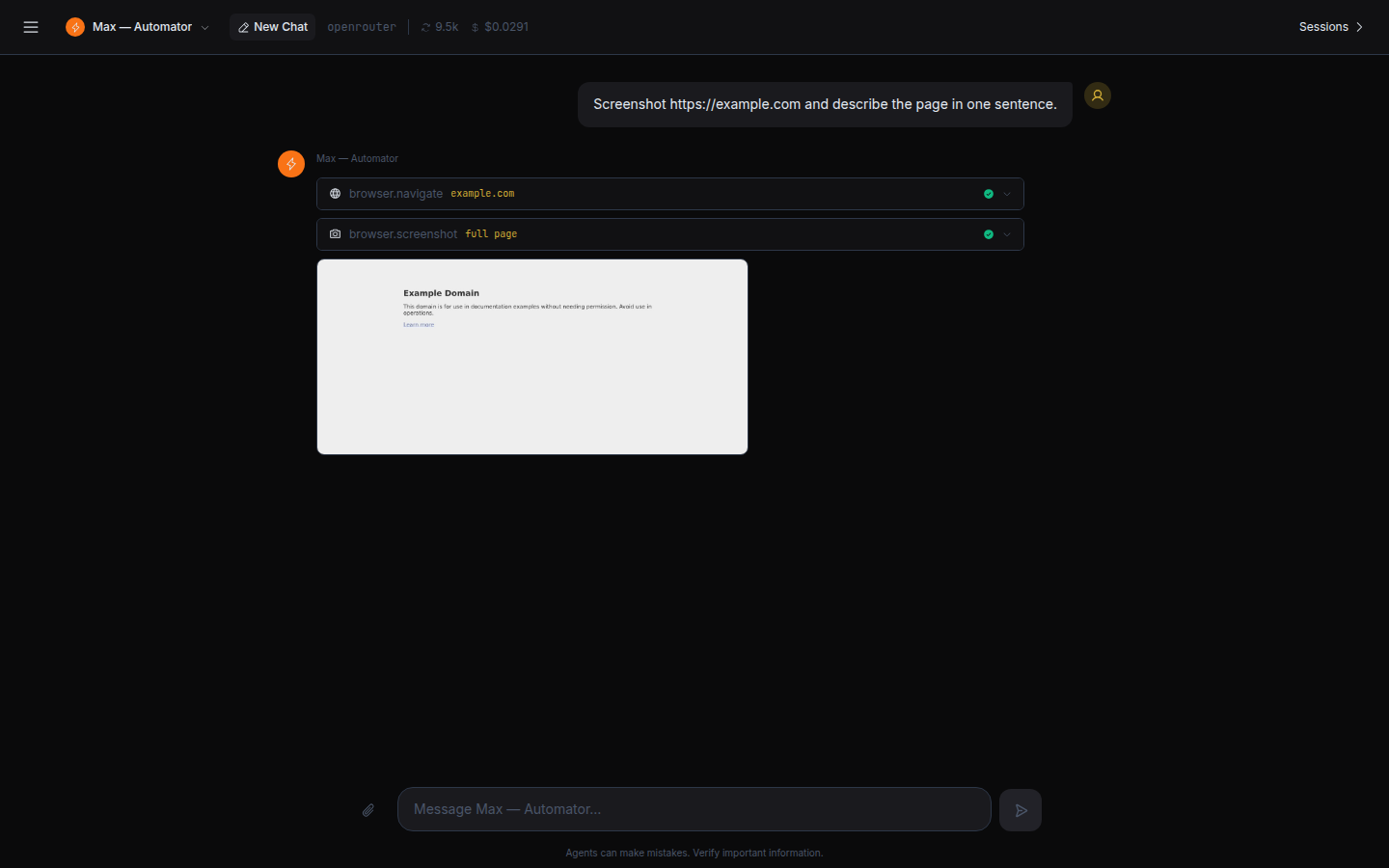
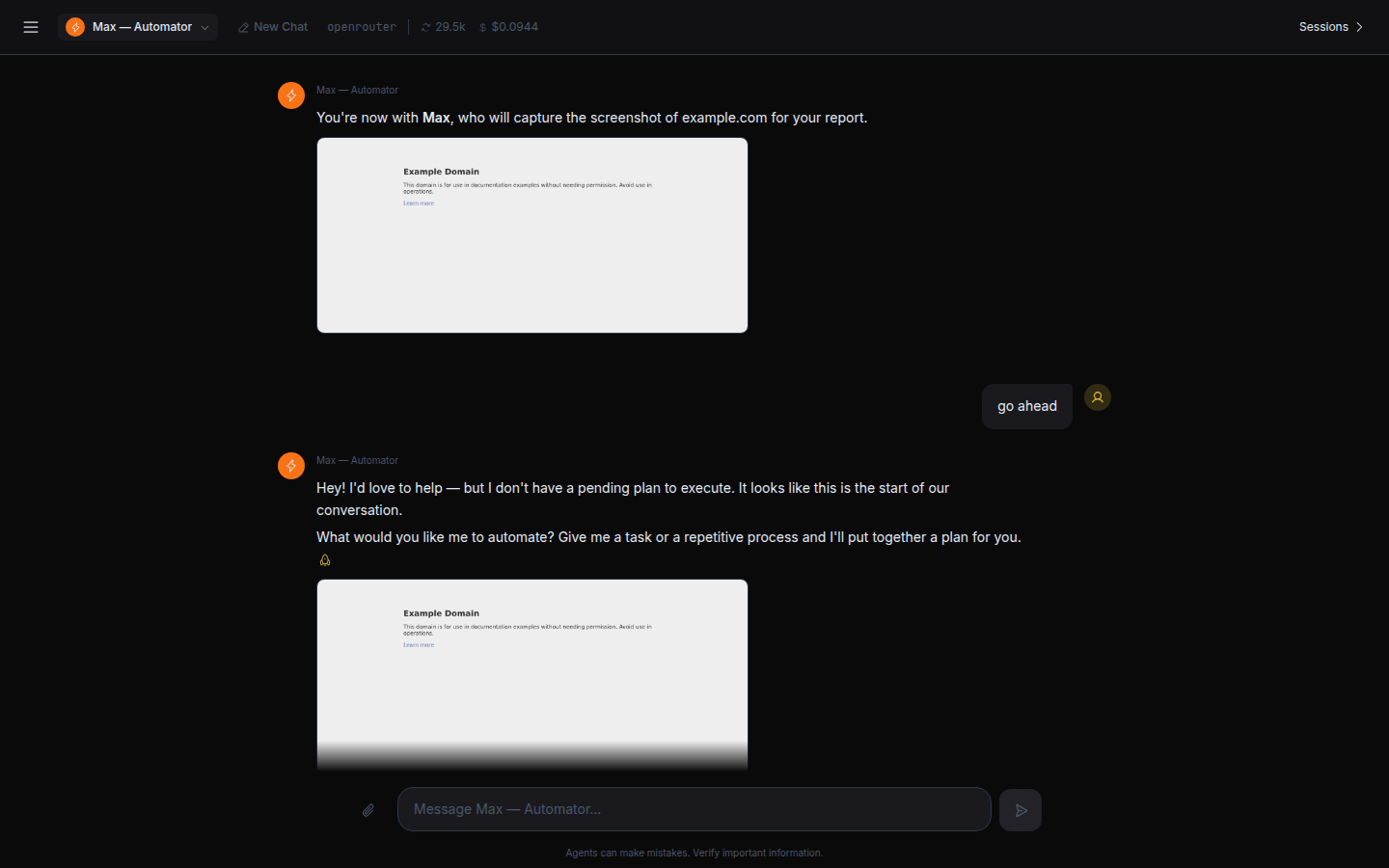
Max screenshots a page, inline
Ask Max to screenshot a URL. He chains browser.navigate → browser.screenshot, the image streams back into the chat through the media pipeline, and renders inline.
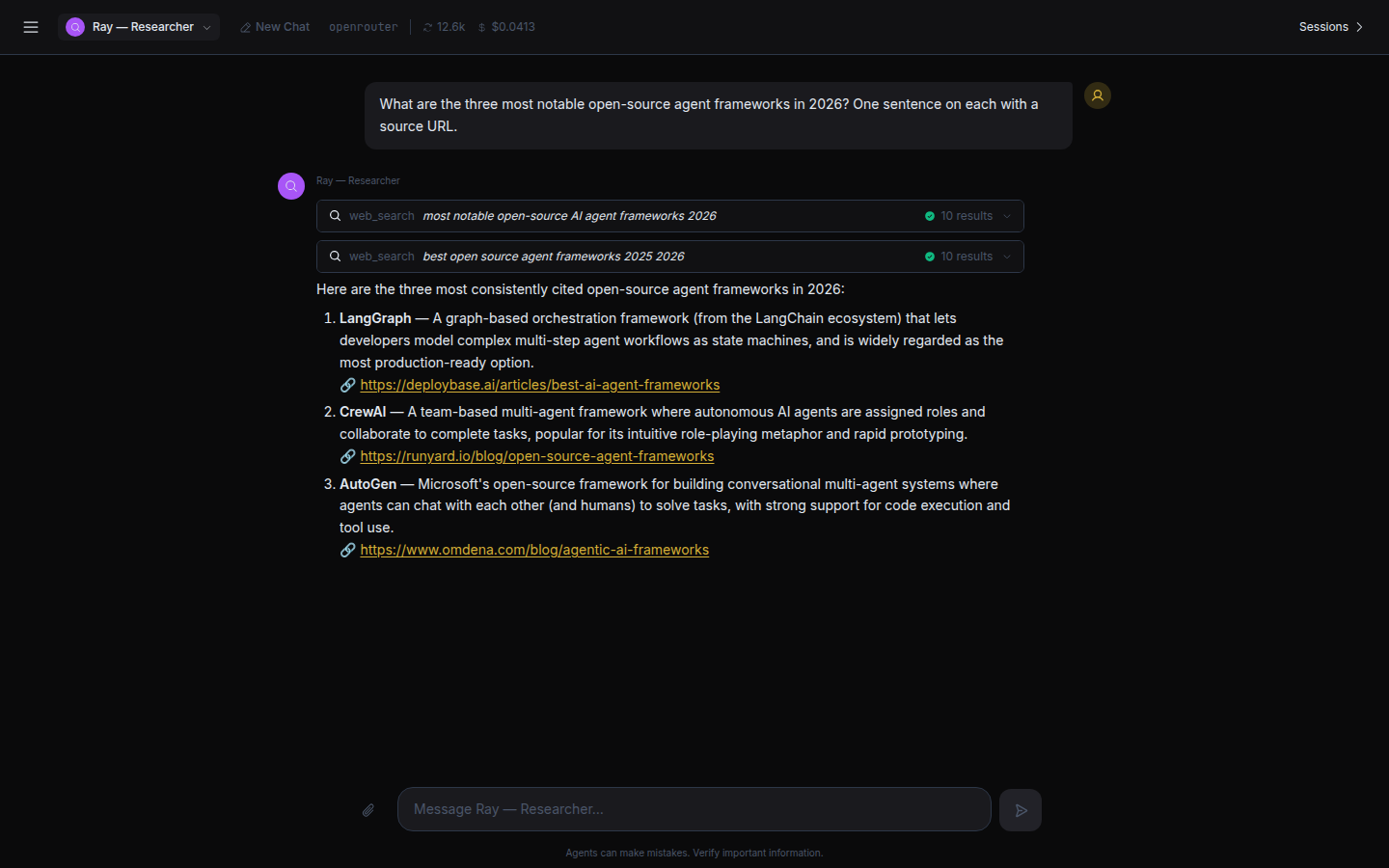
Ray researches with sources
Ray fans out web searches, synthesises, and always prints the source URLs. His prompt is tuned to refuse to bluff — if the evidence isn't there, he says so.
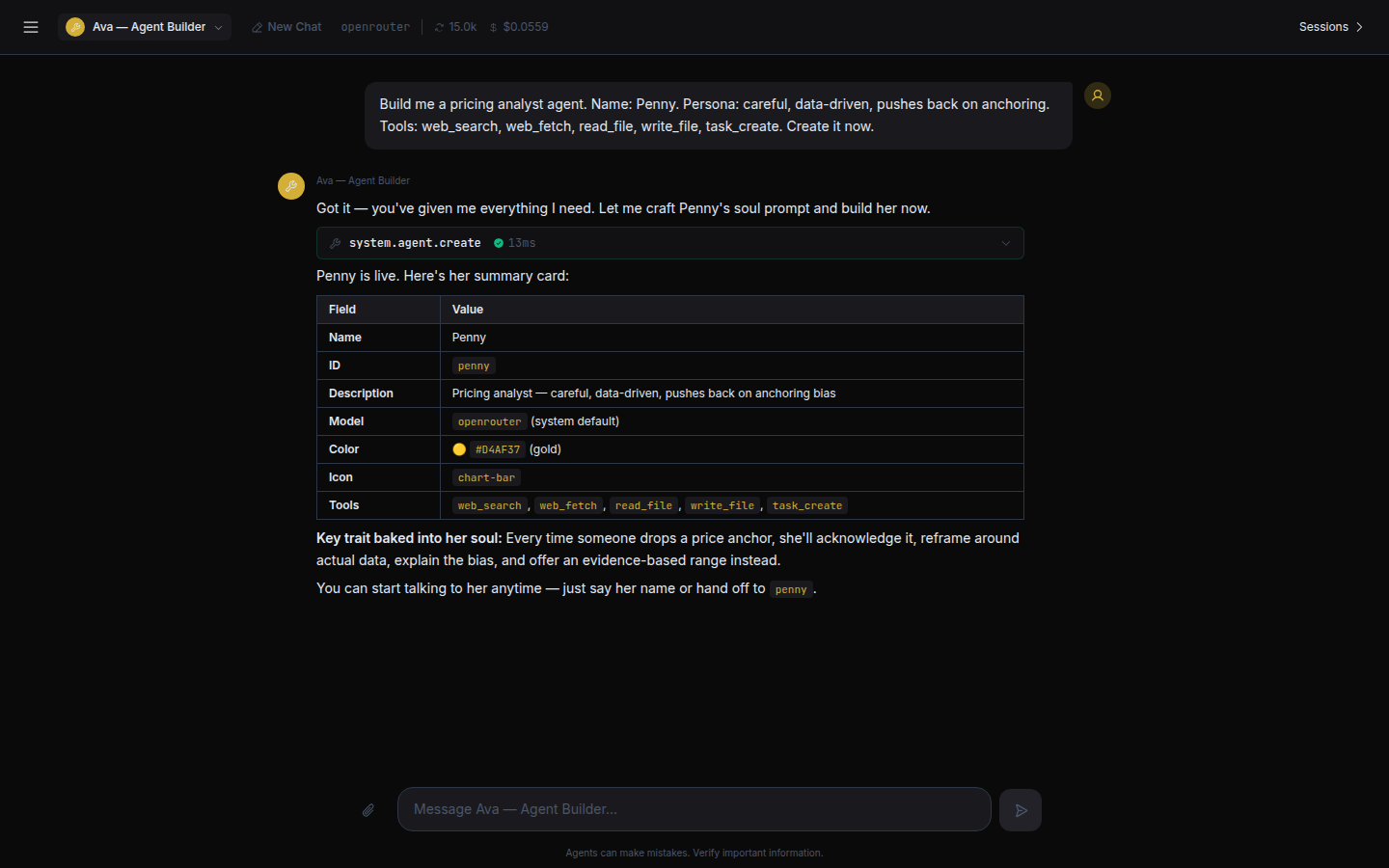
Ava builds a custom agent live
Tell Ava what you need. She writes the persona, picks the tools, calls system.agent.create, and shows you a summary card for the new agent. It shows up in the roster immediately.
Hand-off across agents
Ask Ray to research then hand off to Max for a screenshot. Ray researches, calls the handoff tool with a short brief, the session's active agent switches to Max, and Max finishes the job in the same transcript — no context loss, no copy-paste.
What's under the hood
Multi-agent orchestration (the differentiator)
- Core + custom agents — 5 named core agents ship in the binary; unlimited custom agents created through Ava or the UI.
- Hand-off — atomic control transfer with shared transcript and budget split.
- Sub-agents — spawn synchronous
subagentor backgroundspawntool calls; cloned tool registry, budget controls, status polling. - Task delegation —
task_create/task_update/task_listwired to the heartbeat service for background execution. - Hook system — observers, interceptors, approvals around every tool call.
- Joined session store — multi-agent conversations share a single day-partitioned JSONL transcript.
Security posture
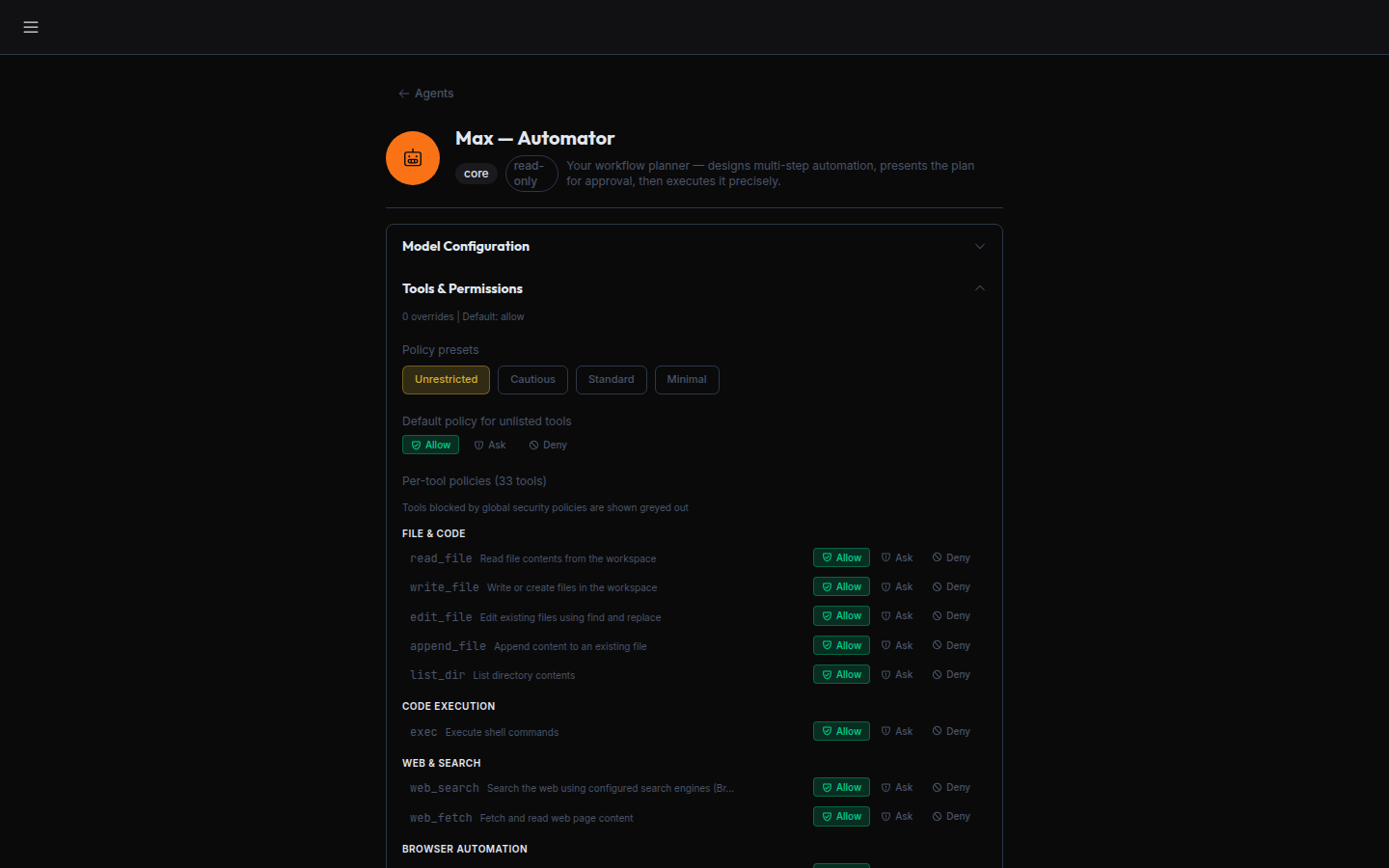
- Kernel sandbox applied to the gateway itself on Linux 5.13+ — Landlock (
restrict_self) plus a seccomp filter are installed at boot, beforenet.Listen, so the HTTP listener never binds unsandboxed. Pure Go viagolang.org/x/sys/unix. Modes:enforce(default),permissive(audit-only),off. On unsupported kernels / macOS / Windows the backend degrades to app-level checks only — see the limitations section below. - Three-tier tool policy per agent —
allow/ask/deny. Tool names and exec commands both support*/?glob patterns; deny beats allow; interactive approval streams over the WebSocket. - SSRF guard wired into every outbound-HTTP tool —
web_search(all 7 providers),web_fetch, the skills installer, and the exec SSRF proxy all share oneSSRFChecker.SafeClient(). Blocks private IP ranges, link-local, cloud metadata endpoints, and IPv6 wrappings (IPv4-mapped, 6to4, Teredo); DNS is re-resolved at connect-time to close the rebinding gap. Operator allowlist viasandbox.ssrf.allow_internal(IPs / CIDRs / hostnames). - Encrypted credential store — AES-256-GCM with Argon2id KDF; master key auto-generated on first boot, rotation via CLI.
- Prompt-injection guard, per-channel rate limits, per-binary exec allowlists.
- Audit log — structured JSONL with two-layer redaction: a sensitive-key-name layer (
password,api_key,authorization,bearer,client_secret, and ~15 more, case-insensitive, recursing into nested maps and arrays) plus a value-pattern layer for API-key shapes, Bearer tokens, and emails.
Security limitations and known gaps
The sandbox is deliberately scoped; be precise about what it does and doesn't do:
- No LSM enforcement on macOS, Windows, or Linux < 5.13. The sandbox selects a
FallbackBackendand enforcement reduces to in-process policy checks. The BRD's Windows story (Job Objects + Restricted Tokens + DACL) is specified in Appendix A but not yet implemented. - Landlock ABI v4 (kernel 5.19+ / 6.x) has a
create_rulesetincompatibility: the currentcomputeRights()enumerates v1–v3 bits only, so on a v4-negotiated ruleset the call returns EINVAL and the backend downgrades to app-level checks. Tracked in #103; out of scope for Sprint J. - Permissive mode downgrades to audit-only skip on kernels < 6.12. Native permissive
landlock_restrict_selfis not available; Omnipus logs the computed policy and installs seccomp withSECCOMP_RET_LOG, but does not callrestrict_self. Plan for kernel ≥ 6.12 if you need a true log-then-enforce workflow. sandbox.ssrf.allow_internalaccepts exact hostnames, exact IPs, and CIDR ranges. Glob host patterns (*.internal.corp) are not supported yet.
When OMNIPUS_ENV=production is set and the sandbox is off or permissive, the gateway prints a multi-line warning to stderr at boot and every 60 seconds thereafter. The banner is not silenceable by design.
Operator configuration
Sandbox behaviour is controlled by the sandbox key in ~/.omnipus/config.json:
{
  "sandbox": {
    "mode": "enforce",
    "allowed_paths": ["/var/lib/omnipus-data"],
    "ssrf": {
      "enabled": true,
      "allow_internal": ["localhost", "10.0.0.0/8", "internal.api.corp"]
    }
  }
}
mode:enforce|permissive|off. Legacyenabled: true/falsestill works (maps toenforce/off).- CLI override:
./omnipus gateway --sandbox=enforce|permissive|off— always trumps the config value. - Apply/Install failure on a kernel that claims Landlock support aborts boot with exit code 78 (
EX_CONFIG); the HTTP listener never binds. Other boot failures keep exit 1. - Status is surfaced at
/healthundersandbox.{applied,mode,backend,disabled_by}and in more detail at/api/v1/security/sandbox-status.
Built-in tools (27 loaded by default)
Files (read_file, write_file, edit_file, append_file, list_dir), shell (exec with PTY + approval), web (web_search, web_fetch), tasks (task_create / update / delete / list), agents (agent_list, subagent, spawn, spawn_status, handoff, return_to_default), browser (navigate, click, type, screenshot, get_text, wait), skills (find_skills, install_skill), comms (message, send_file), scheduling (cron), and more. Additional tools register from MCP servers at runtime.
Connectivity
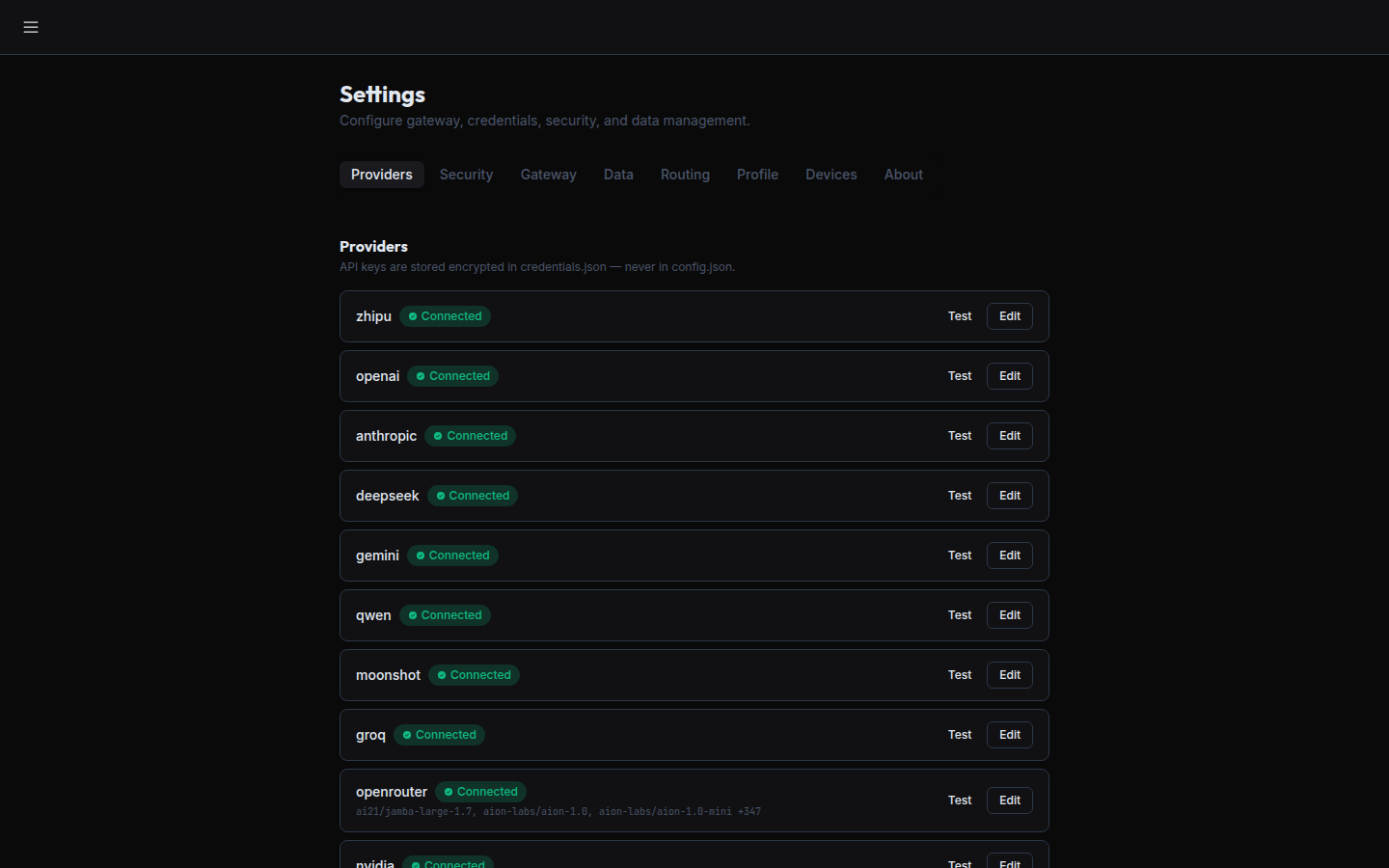
20+ LLM providers compiled in — OpenRouter, Anthropic, OpenAI, Google Gemini, DeepSeek, Qwen, Moonshot, Groq, Cerebras, Mistral, MiniMax, Ollama, vLLM, Azure, GitHub Copilot, Volcengine, ModelScope, NVIDIA, Avian, LongCat, Shengsuanyun, Vivgrid, Zhipu. Fallback chains, multi-key rotation, streaming, vision.
17 chat channels — Web Chat, Telegram, Discord, Slack, Teams, Matrix, WhatsApp, Line, QQ, WeChat, WeCom, Weixin, IRC, Feishu, DingTalk, Google Chat, OneBot, MaixCAM. All compiled in; no external services needed.
Operator surfaces
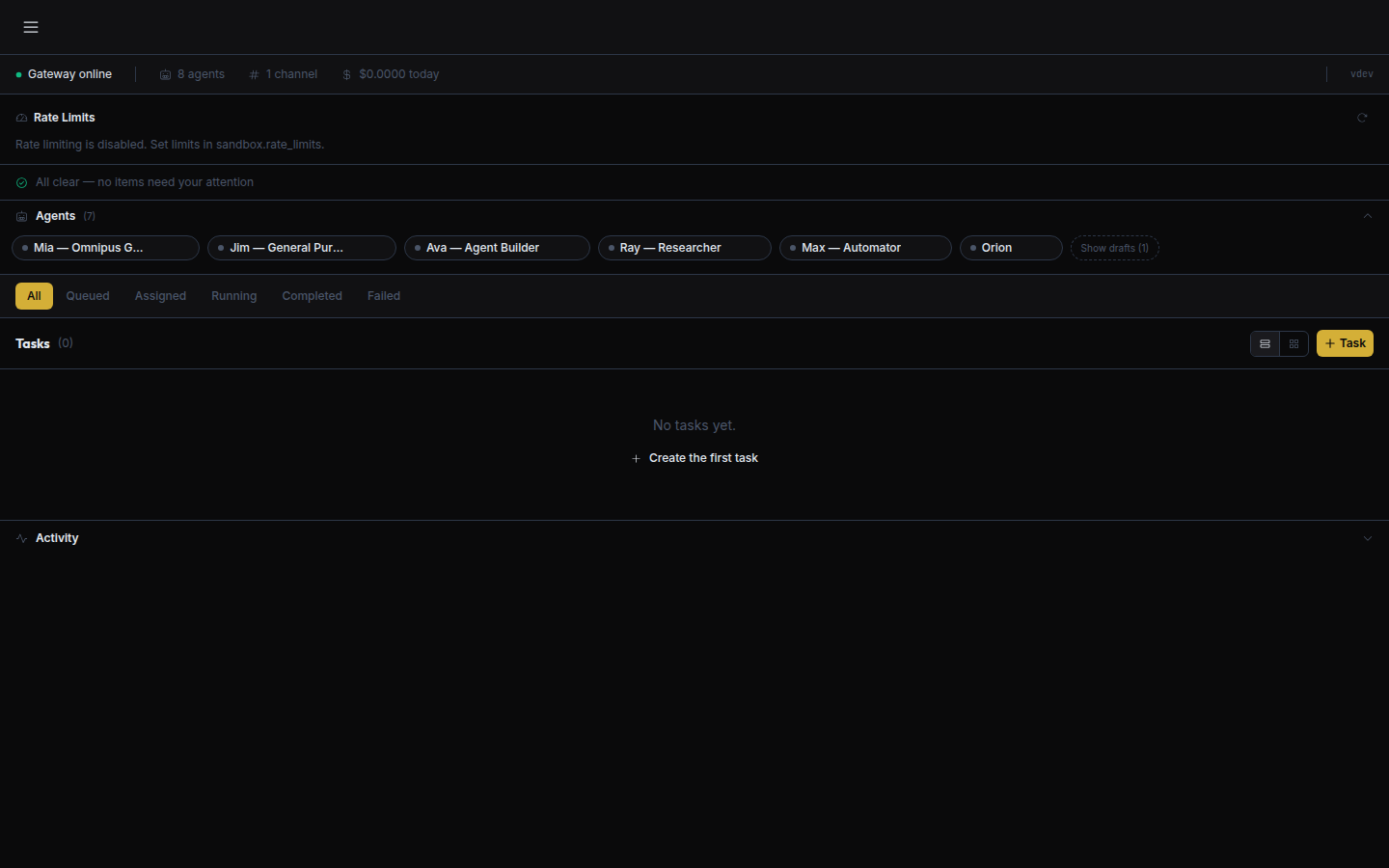 |
Command Center — gateway status, agent summary, task board, activity feed, rate-limit events, approval queue. |
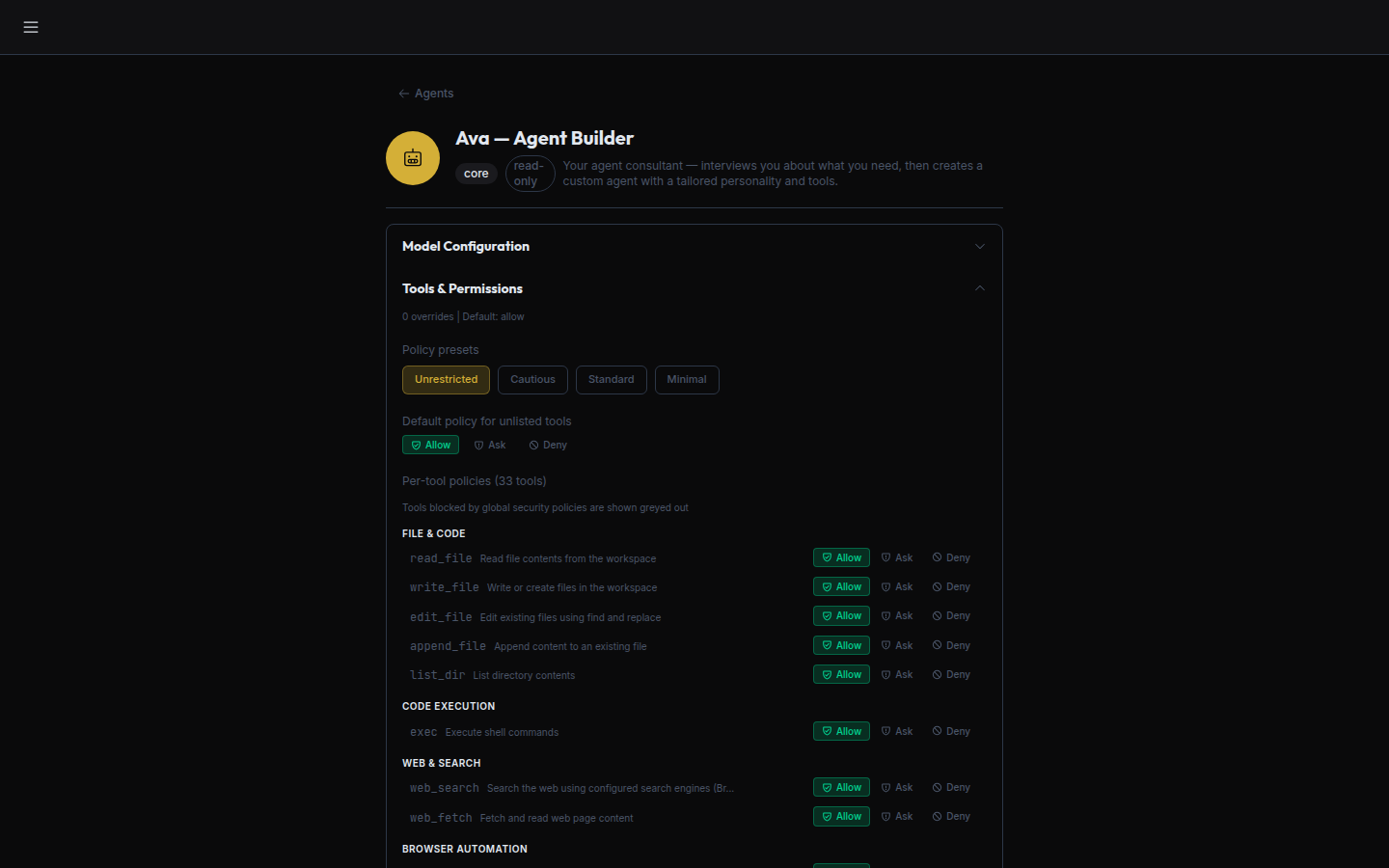 |
Agent profile — model, temperature, per-tool policy, session history, activity timeline. Identity fields read-only on core agents. |
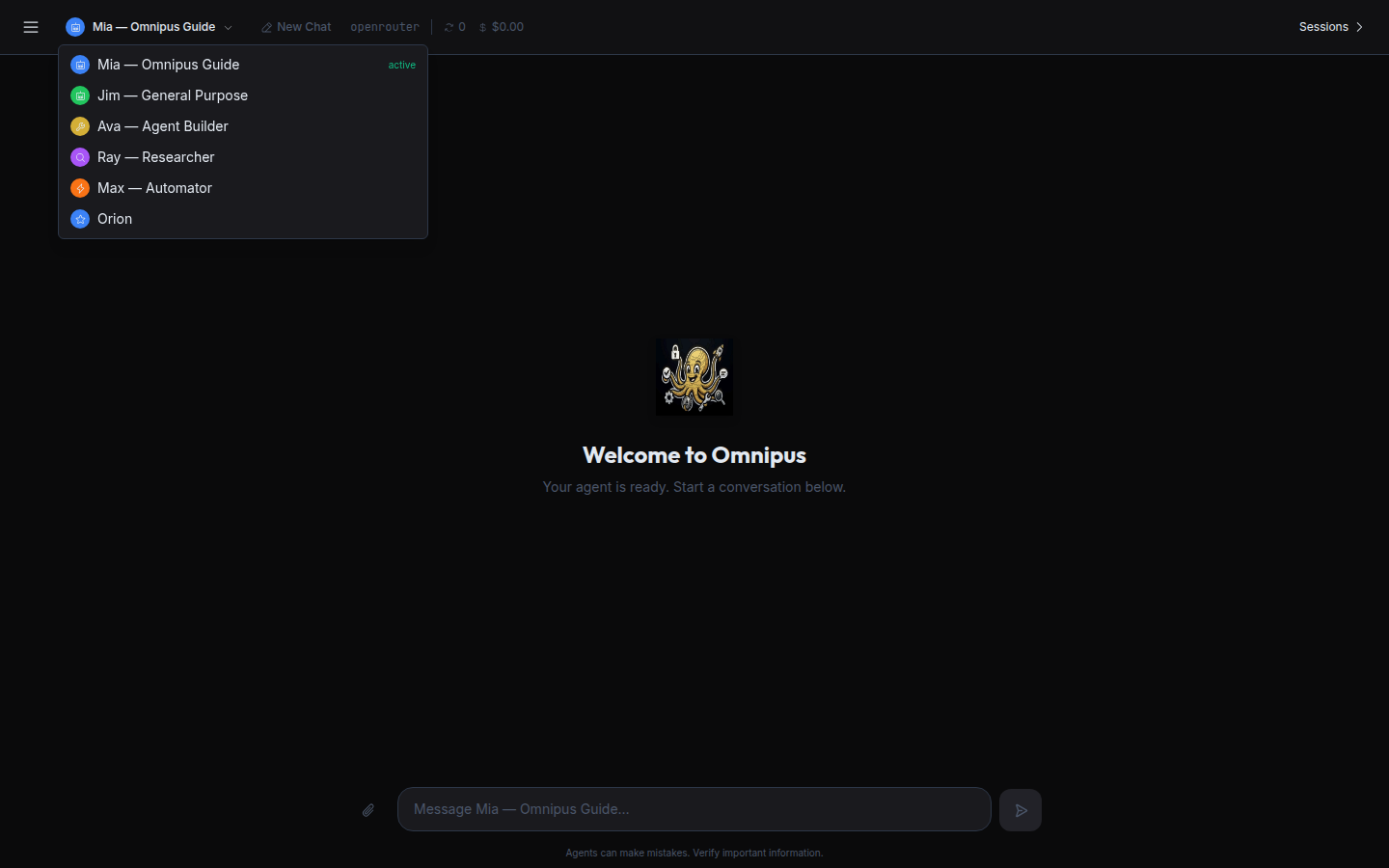 |
Agent picker — switch who you're talking to in one click; sessions stay with the session, not the agent. |
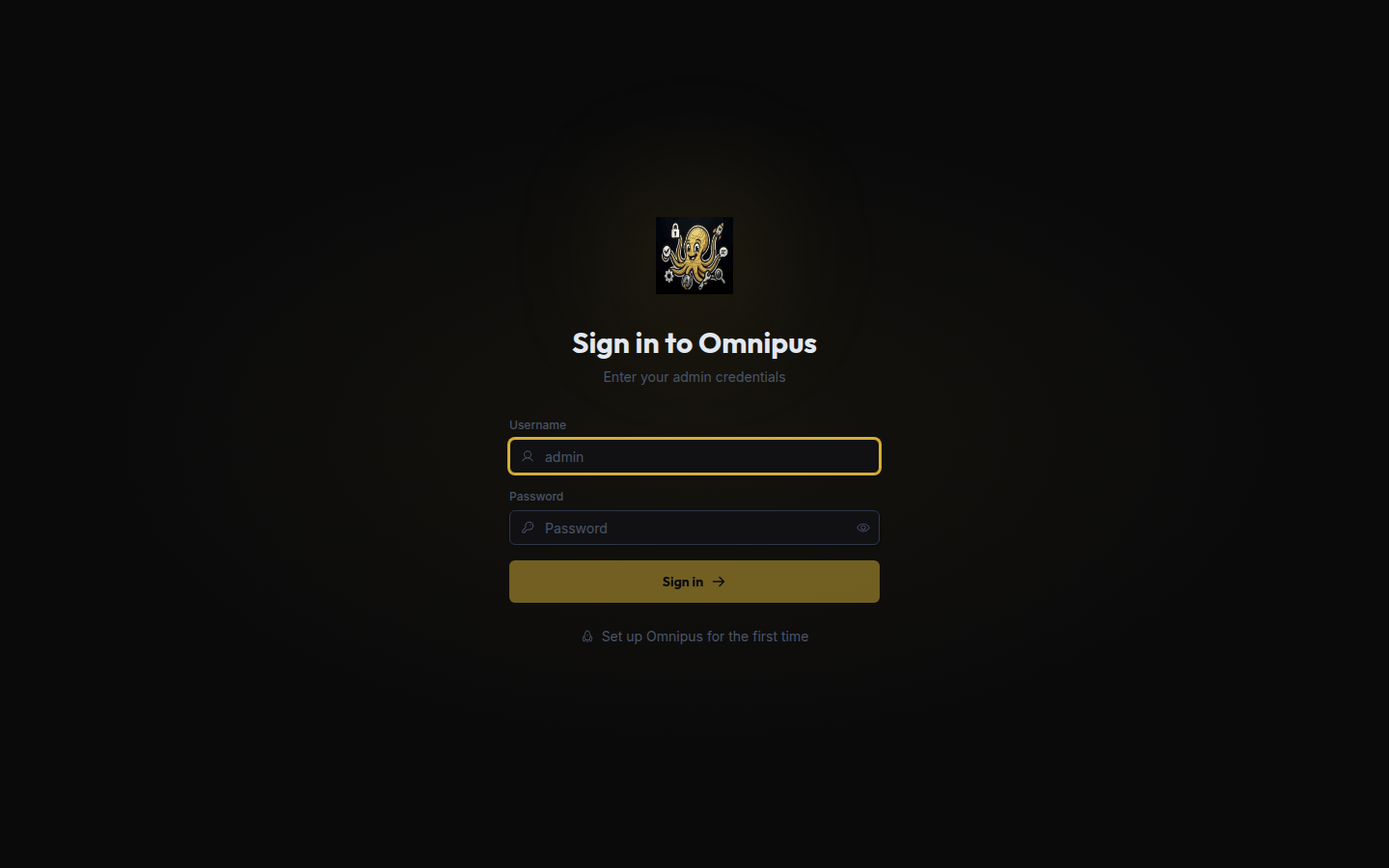 |
Dark-first UI — "The Sovereign Deep" design system: Deep Space Black, Liquid Silver, Forge Gold accents. Chat-first, no separate canvas. |
Quick start
# 1. Clone and build
git clone https://github.com/dapicom-ai/omnipus.git
cd omnipus
CGO_ENABLED=0 go build -o omnipus ./cmd/omnipus/

# 2. Run the gateway (binds 0.0.0.0:3000 by default)
./omnipus gateway
# The gateway opens two ports: 5000 (SPA + API) and 5001 (preview iframes). Open both in your firewall.

# 3. Open http://localhost:3000 and follow the onboarding wizard:
#    Welcome → Provider → API Key → Model → Admin Account → Done
First boot auto-generates an encryption key at ~/.omnipus/master.key (mode 0600). Back it up — losing it makes the credential store unrecoverable. For headless deployments, pre-provision via OMNIPUS_KEY_FILE or OMNIPUS_MASTER_KEY.
Rotate the key any time:
./omnipus credentials rotate --old-key-file old.key --new-key-file new.key
Architecture
                    ┌────────────────────┐
                    │   Web UI (SPA)     │   React 19 · Vite 6 · shadcn/ui
                    │   embedded via     │
                    │   go:embed         │
                    └─────────┬──────────┘
                              │ HTTP · WebSocket · SSE
                    ┌─────────┴──────────┐
                    │      Gateway       │   auth, rate limits, CORS
                    └─────────┬──────────┘
                              │
         ┌────────────────────┼────────────────────┐
         │                    │                    │
   ┌─────┴──────┐      ┌──────┴──────┐      ┌──────┴──────┐
   │ Agent Loop │      │ Policy      │      │ Audit       │
   │ + Hooks    │◄────►│ Engine      │      │ Logger      │
   │ + Tools    │      │ allow/ask/  │      │ JSONL +     │
   │ + Handoff  │      │ deny        │      │ redaction   │
   └─────┬──────┘      └─────────────┘      └─────────────┘
         │
   ┌─────┴──────┐      ┌─────────────┐      ┌─────────────┐
   │  Channels  │      │  Sandbox    │      │ Credentials │
   │ 17 compiled│      │ Landlock +  │      │ AES-256-GCM │
   │ in Go      │      │ seccomp +   │      │ Argon2id KDF│
   └────────────┘      │ SSRF guard  │      └─────────────┘
                       └─────────────┘
Single binary. File-based storage (~/.omnipus/ — JSON + JSONL, atomic writes). No Postgres. No Redis. WhatsApp uses pure-Go SQLite (modernc.org/sqlite) in its own session namespace.
Tech stack
Backend: Go 1.21+ · chromedp (browser) · whatsmeow (WhatsApp) · discordgo · telebot · slack-go · go-nostr · modernc.org/sqlite · golang.org/x/sys/unix (Landlock, seccomp)
Frontend: TypeScript · React 19 · Vite 6 · shadcn/ui (Radix + Tailwind CSS v4) · AssistantUI · Phosphor Icons · Zustand · TanStack Query / Router · Framer Motion
Storage: File-based JSON / JSONL. Day-partitioned session transcripts with configurable retention (default 90 days) and two-layer context compression.
Status
Pre-1.0. Three shipping variants:
- Omnipus Open Source (primary, ships first) — single Go binary, embedded web UI, community focus. This repo.
- Omnipus Desktop — Electron wrapper with native menus and auto-update.
- Omnipus Cloud / SaaS — hosted variant with team features and managed infrastructure.
All three share the same Go core and the @omnipus/ui React components.
Active development on feature/next-wave · tracked in PR #69.
Specification
The full design is written down, not vibes:
| Document | Scope |
|---|---|
| Main BRD | 30 security + 36 functional requirements, delivery phases |
| Appendix A | Windows kernel security (Job Objects, Restricted Tokens, DACL) |
| Appendix B | Feature parity requirements vs. the Claw ecosystem |
| Appendix C | Full UI / UX spec |
| Appendix D | System agent and system tools |
| Appendix E | File-based data model and directory structure |
Contributing
Issues, PRs, discussions — all welcome. Start with the BRD, then check the project board for open work.
License
MIT · omnipus.ai
Reviews (0)
Sign in to leave a review.
Leave a reviewNo results found