claude-skills-founder
Health Gecti
- License — License: MIT
- Description — Repository has a description
- Active repo — Last push 0 days ago
- Community trust — 254 GitHub stars
Code Gecti
- Code scan — Scanned 2 files during light audit, no dangerous patterns found
Permissions Gecti
- Permissions — No dangerous permissions requested
Bu listing icin henuz AI raporu yok.
Claude Code skills for startup founders — product briefs, competitor analysis, pricing strategy, pitch decks, and GTM plans from your terminal
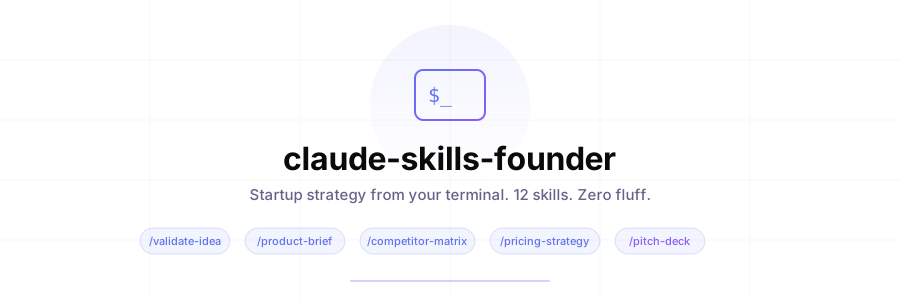
Startup strategy from your terminal. Not another dev tool.
Skills ·
Install ·
Usage ·
Examples ·
Philosophy ·
Contributing


[!NOTE]
Most Claude Code skill packs are developer tools: code review, git workflows, security audits. This one is for the founder sitting in a repo at 2am, trying to figure out if their idea is worth building.
We built these at Emotix while running our own startup. They encode the frameworks, questions, and patterns we wish we had on day one.
Skills
Validation and research
|
Strategy and growth
|
||||||||||||||||||||||||
Fundraising and metrics
|
Every skill takes plain-language input and returns scorecards, tables, and checklists you can act on.
Skills that build on each other
Each skill saves its output to a founder/ folder in your project and reads what earlier skills saved. Run /founder:competitor-matrix once, and /founder:pricing-strategy and /founder:pitch-deck reuse its sourced competitor prices instead of starting over.
founder/
├── facts.md               # what you told the skills: stage, metrics, team, the raise
├── validate-idea.md
├── competitor-matrix.md
├── pricing-strategy.md
└── ...
Commit the folder to keep a history of how your thinking changed, or add it to .gitignore to keep it private.
Facts about the outside world, such as competitor prices, funding rounds, market sizes, and benchmarks, come with a source link. When a skill can't find one, it says "Estimate" or "Not found" instead of guessing. Your own metrics, customer quotes, and testimonials are never invented: missing ones show up as [placeholders] for you to fill in.
Install
Option 1: plugin (recommended)Inside Claude Code:
/plugin marketplace add emotixco/claude-skills-founder
/plugin install founder@emotix
Skills become available as /founder:validate-idea, /founder:pricing-strategy, and so on. Update later with /plugin marketplace update emotix. The skill descriptions add about 1,100 tokens to each session. A skill's full instructions load only when you run it.
git clone https://github.com/emotixco/claude-skills-founder.git ~/.claude/skills/founder
Claude Code loads the folder as a plugin on the next session, with the same /founder: names. To update:
git -C ~/.claude/skills/founder pull
v1 installed flat files into .claude/commands/founder/. Delete that folder (or the symlink, if you used the v1 symlink option) before installing v2, or you will see every skill twice. It is either ~/.claude/commands/founder or .claude/commands/founder inside the project where you installed it.
Usage
Open Claude Code and type any skill with your context:
> /founder:validate-idea An AI tool that analyzes pitch decks and gives investor-perspective feedback
> /founder:competitor-matrix Project management tools for solo founders (not teams)
> /founder:pricing-strategy B2B SaaS for restaurant inventory, targeting independent restaurants with 1-3 locations
> /founder:pitch-deck Pre-seed raise, $500K, AI competitor analysis for founders, 200 beta users, $2K MRR
Run a skill with no input and it asks for what it needs.
[!TIP]
Be as specific as possible. Include your stage, metrics, constraints, and what you've already tried. Facts you give once are saved tofounder/facts.md, so you don't have to repeat them.
Examples
examples/restaurant-inventory/ has unedited output from three skills run in sequence on one idea, including the founder/ files they wrote. Read it before installing to see what you get.
What each skill produces
/validate-idea · the first skill you should runScores your idea on 7 dimensions (problem severity, market size, willingness to pay, competition gap, distribution, timing, founder fit) and gives a verdict: build, pivot, or kill.
Includes 3 specific validation experiments you can run in under 2 weeks for under $200.
/product-brief · from idea to structured documentTurns a one-sentence idea into a structured brief: problem statement, target audience with personas, value proposition, MVP features (exactly 5-7), success metrics with 90-day targets, risk assessment, and GTM snapshot.
/competitor-matrix · know your marketResearches 5-8 competitors on the web and builds a feature comparison table, with a source link for every price and funding round. Finds positioning gaps no one is filling, ranks threats, and recommends a niche to own.
/persona-gen · real people, not demographicsCreates 3 distinct personas with a day in the life, pain points written the way they would say them, current workarounds, and buying behavior. Includes a priority matrix showing which persona to build for first. Personas are marked as hypotheses until interviews confirm them.
/mvp-scope · cut ruthlesslyTakes your feature wishlist and triages into Must Have / Should Have / Won't Have. Defines the critical user flow (signup to value in under 5 steps), recommends a tech stack, and estimates build time for a solo developer.
/pricing-strategy · beyond "just charge more"Evaluates 6 pricing models, designs 3 tiers with specific prices and features, checks unit economics, and anchors against competitor prices linked to their pricing pages. Includes anchoring, decoy, and annual framing, plus launch vs. scale pricing and grandfathering.
/go-to-market · week-by-week launch planPre-launch audience building, launch day platform strategy (Product Hunt, HN, Reddit, Twitter/X, LinkedIn), and 90-day post-launch growth with channel prioritization. Budget allocation for $0-$500/month.
/pitch-deck · investor-ready structure12-slide outline. Every slide gets a headline that states the takeaway, the content, a visual, and speaker notes. Missing numbers become placeholders, collected in a "numbers to find" list at the end. Plus appendix slides for Q&A.
/fundraise-prep · are you actually ready?Readiness scorecard, round sizing with recommended instrument (SAFE, note, or priced round), investor targeting with a 50-investor pipeline framework, materials checklist, and a 12-week fundraising timeline.
/landing-page · copy that convertsCopy for every section: hero, problem, solution, how it works, social proof, pricing preview, FAQ, and final call to action, plus SEO metadata. Testimonials are left as placeholders that say what a strong quote would cover, because invented ones are false advertising.
/user-interviews · ask the right questionsInterview script that follows The Mom Test: no leading questions, no hypotheticals. Includes screening criteria, problem exploration, solution exploration, and a reaction phase. Analysis framework for synthesizing 5-8 interviews.
/metrics-dashboard · five metrics, not fiftyDefines exactly 5 metrics tailored to your stage (not 15 vanity metrics). Each has a definition, target, and specific action if below target. Weekly review template + investor-ready benchmarks.
/email-sequence · ready to send5-7 emails for onboarding or re-engagement. Complete copy: subject line with an A/B variant, preview text, a body under 150 words, and one call to action. Timing, segmentation, and targets from published benchmarks included.
Philosophy
|
Specific "Post a Show HN on Tuesday at 9am ET", not "post on social media" |
Opinionated "Kill this feature", not "consider deprioritizing" |
Sourced Every competitor price and market number links to where it came from |
Brief Every skill has a word limit. Brevity forces clarity. |
Structured Scorecards, matrices, checklists. No walls of text. |
Contributing
Have a skill idea? Open an issue or submit a PR.
To add a new skill:
- Create
skills/<name>/SKILL.md - Add frontmatter with
name,description,argument-hint, andallowed-tools - Add the "Before you start" block every skill uses: which
founder/files it reads, what it needs, and where it saves - Keep the expected output under 2000 words
- Test it with 3 different inputs:
claude --plugin-dir . - Run
claude plugin validate .before opening the PR
Rules that apply to every skill, such as sourcing and writing style, live in shared/conventions.md. Change them there, not in each skill.
[!IMPORTANT]
We're looking for skills that fill genuine gaps in the founder workflow, not developer tools repackaged with startup vocabulary.
License
MIT. Use these however you want.
Yorumlar (0)
Yorum birakmak icin giris yap.
Yorum birakSonuc bulunamadi