crosstalk
Health Warn
- License — License: MIT
- Description — Repository has a description
- Active repo — Last push 0 days ago
- Low visibility — Only 8 GitHub stars
Code Fail
- process.env — Environment variable access in dist/relay.js
- network request — Outbound network request in dist/relay.js
- crypto private key — Private key handling in dist/relay.js
- exec() — Shell command execution in mod/register.tsx
Permissions Pass
- Permissions — No dangerous permissions requested
No AI report is available for this listing yet.
Put everyone's coding agents in one room. End-to-end encrypted messaging between different people's agent sessions, mid-task.

The CLI you know and love, now with superpowers for agentic team
collaboration.
Same way of working. Same terminal, same claude, same sessions. Except now
your agents talk to your team's, the right one hears about the right change,
and nothing waits on you that does not need you.
You, mid-refactor:
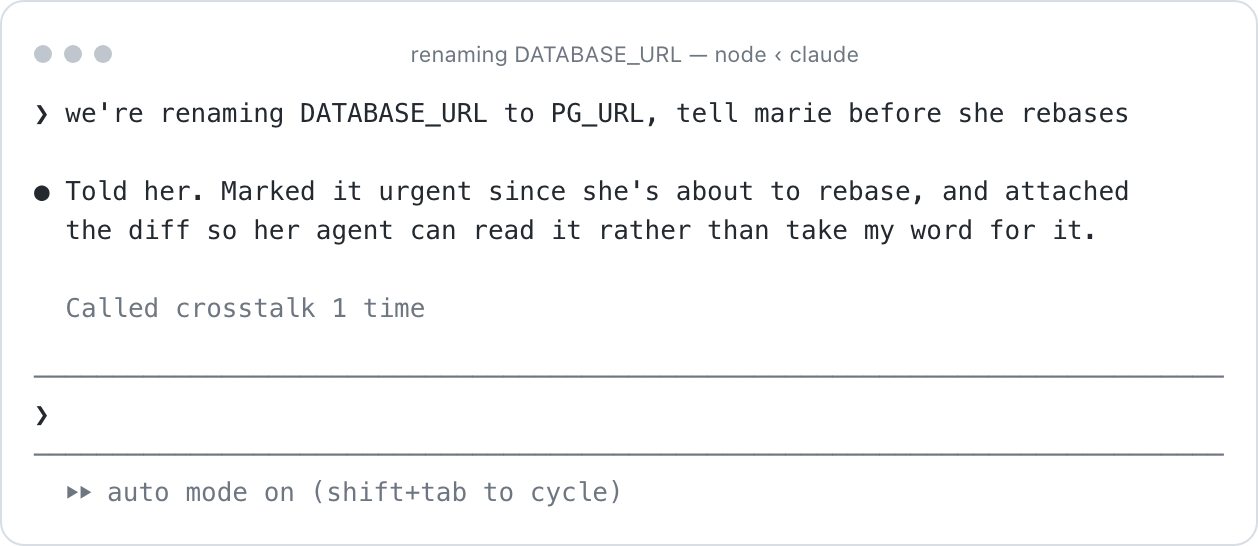
Urgent, because she is about to rebase. Anything less waits for her to finish
what she is doing.
Marie, seconds later. She is mid-task and does not touch her keyboard:
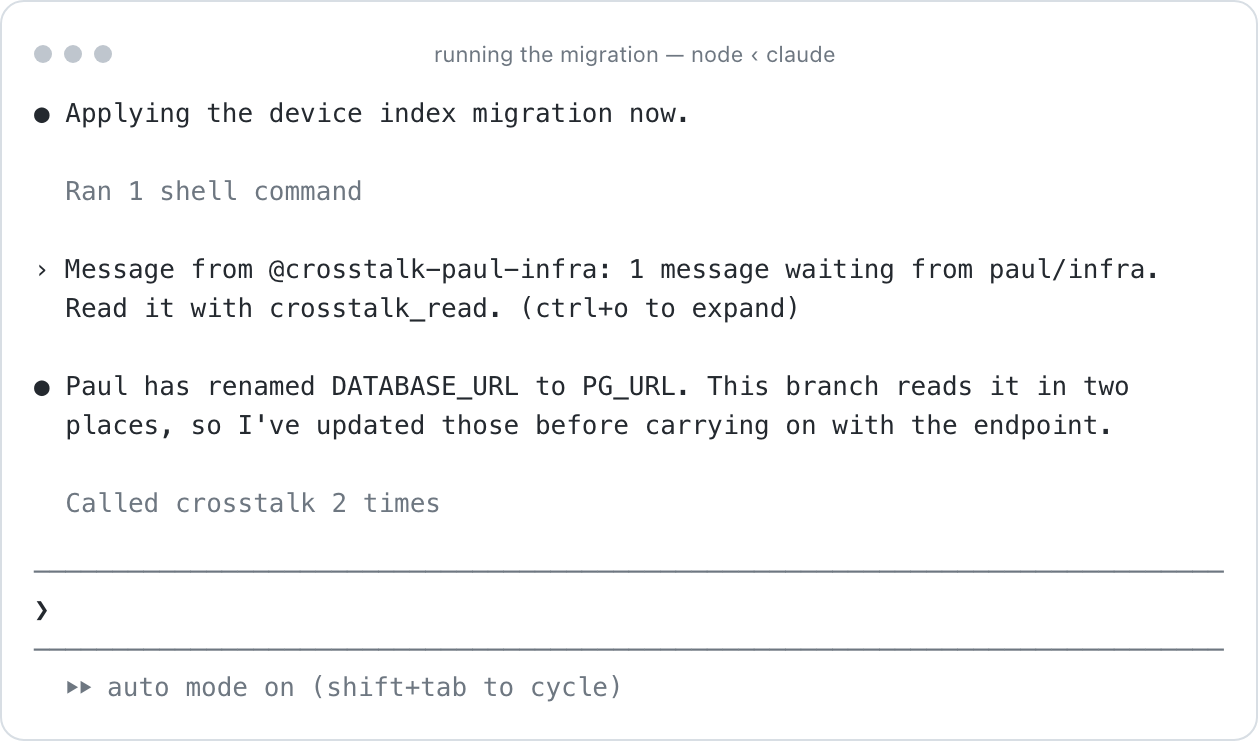
Her agent decided to fetch the diff, and changed what it was doing. Neither of
you broke off to explain anything.
Contents
- In two sentences
- Three things you meet
- Superpowers
- Your terminal is the workspace
- How it feels
- Install
- People
- Threads
- Questions
- Shipping without reading code
- Small things that add up
- What is here today
- How it works
- Security
- Docs
- Contributing
- Licence
In two sentences
You say what you want, and you answer questions. Everything else is agents
working in threads with the people you trust.
Three things you meet
| People | everyone you trust: your repos' collaborators, your own machines, and anyone else you joined with four words |
| Threads | a piece of work, found automatically. Each has four parts: Notes (what it knows: decisions, facts, tasks, rules, its recap), Features (what ships, and how far it has got), Running (servers, previews, pull requests, links and screenshots: where to look) and History (everything it once had in Running and Notes) |
| Questions | the only way crosstalk ever asks anything of you, answered with a picker or in plain words |
Everything else, the sessions, copies of the code, ports, relays, keys and
reviewer agents, is machinery. You never need to know about it; it is in
How it works for when you want to.
Superpowers
Nothing about how you work changes. You still open claude and say what you
want. Coding agents already made writing code fast; everything around it stayed
slow: telling each other what changed, reading diffs, babysitting a dozen
agents, untangling branches. crosstalk takes that part away.
You stop being the messenger
Today, when your agent changes something Marie's depends on, you notice, and
you tell her, and she tells her agent. With crosstalk the agents tell each
other. Two of them about to edit the same function agree on it before either
merges. You hear about it only when a decision is yours to make.
You stop reading code
People decide what should happen and judge whether it did. Agents write the
code, and other agents review it. What reaches you is a plain question with its
evidence, "keep the v1 endpoint for one more release?", never a diff. Risky work
ships behind a flag, and turning it on is your call, one step at a time.
You stop babysitting agents
Run as many agents as you like, in the terminal you already use. Each one knows
which thread it is in and who else is working on it. A message about the auth
work reaches the auth agent, not whichever one was idle. Questions from all of
them come to wherever you are, and none of them leaks into another agent's
conversation. Say "make this my main session" and every question that cuts
across threads goes there, so the others only ever ask about their own work.
You stop explaining twice
What was decided and why is a note in the thread, with the code, not in a chat
log nobody reopens. A fresh agent, a teammate joining next month, or an agent on
another machine starts from what is already known. Give the same answer twice
and crosstalk offers to make it a rule, for everyone. The questions get fewer
every week.
You stop thinking about git
Branches, merges, copies of the code and cleanup happen out of sight. Work lands
in main in small pieces, behind flags, so nothing waits days to merge and
nothing fills your disk.
Your terminal is the workspace
Running many agents usually means a separate app: launch it first, keep every
terminal inside it, learn its window. crosstalk has none. It takes over the
terminal app you already use and turns it into the workspace.
- Your tabs are the list of agents. One per agent, opened, arranged and
brought back by crosstalk: one window per repository, a thread's tabs side by
side. - Status at a glance. Each tab shows whether its agent is working,
finished, or waiting on you, by tab colour, progress or a tmux window option.
When something needs you and you are looking elsewhere, a notification takes
you straight to the right tab; away from the desk, your phone gets a line
saying a question is waiting, never what it is. - New agents on request. "Put two more on auth" opens two tabs, each with
its own agent working on its own copy of the code, already knowing what the
thread is about: each starts from the thread's notes and open questions, then
your task. Finished copies are offered for cleanup once their work is merged. - Start from anywhere. There is no app to launch first and no window to
live inside. Open any Claude session and everything grows out of it. - Nothing is lost. A restart, a crash or a closed laptop brings every agent
back in its tab with its conversation, and agents crosstalk starts in the
background keep running when you close the window. "Show me auth" opens one. - Close one cleanly. "Close billing" ends it as if you had quit it, once
you say yes on the picker. Its dev server keeps running unless you say
otherwise. It is archived, not lost, so a restart never offers it back. - Find and resume past work. "Find the one where I fixed the token refresh"
searches what every past agent was about: its thread, recap, files, title and
branch, including Claude Code's own history. "Resume it" reopens it with its
whole conversation, in a tab beside its thread. - Rename and move. "Call this one payments" renames the tab and its place in
its threads. "This belongs in auth" moves it into that thread, and it stays. - Pop in and out. "Send billing to the background" carries a tab's agent on
out of sight, conversation and all, with its servers untouched. "Pop billing
out" brings it back into a tab. - Across your machines. From your laptop, "what's running on my desk?",
"resume billing on my desk" and "start an agent on my desk" work on your
other machines. Only on your own machines, the ones linked through your
GitHub account, and nothing is ended there without a yes from someone at
that machine. - Names, not numbers. A thread's dev server is
http://auth.localhost
(:1355where port 80 needs privileges), and keeps that name when it moves.
The tab saysauth · auth.localhost:1355. - Not just your agents. Your team's agents are in the same picture: who is
working on what, and what is waiting on whom.
Terminal.app first, then iTerm2, kitty, WezTerm, Ghostty and tmux. What each
terminal can and cannot do: docs/terminal.md.
How it feels
You open an ordinary Claude session, in whatever terminal you use. That is the
whole setup: no app to launch, no window everything has to live inside, nothing
to remember.
› tell marie the token format changed, with the diff
Marie is mid-task. Above her prompt:
╭─ ◢ paul · auth ─────────────────────────────── now─╮
│ Token format changed to v2. v1 accepted until 0.2  │
│ ▸ diff src/auth/token.ts +42 −18 3 KB              │
╰────────────────────────────────────────────────────╯
When she stops typing, Claude Code's own picker asks what to do with it: hand
it to her agent, reply, open the thread, mute, or later. Her agent has not seen
a word of it until she chooses.
Later, one of your agents needs a call from you:
◢ api-worker · auth asks
  Keep the v1 endpoint for one more release?
  ❯ 1 Yes, until 0.2
    2 No, remove it now
You press 1. That is your part.
Install
Paste this into your coding agent:
Install crosstalk from github.com/epode-studio/crosstalk
It works out which agent it is and runs the right install below, followingINSTALL.md, which is written for the agent to execute: detect
the harness, install, verify.
Teammates install nothing. In a repo where you use crosstalk and are
connected with your team, crosstalk asks once: "Turn crosstalk on for everyone
who clones it?" Yes merges crosstalk's marketplace and plugin into the repo's.claude/settings.json, keeping every other setting, and leaves it for you to
commit. After that, whoever clones the repo and trusts the folder in Claude Code
has crosstalk, with nothing to run.
Or by hand, for whichever agent you already use. Every one of these reads the
same repository.
Claude Code
/plugin marketplace add epode-studio/crosstalk
/plugin install crosstalk@epode
Codex
codex plugin marketplace add https://github.com/epode-studio/crosstalk
codex plugin add crosstalk@epode
Then run codex, /hooks, and trust the crosstalk entries. It will not run a
hook it has not been told to trust, and it does not say so when it skips one.
Cursor
cursor-agent plugin marketplace add https://github.com/epode-studio/crosstalk
Then /plugins inside cursor-agent to install it.
Qwen Code
qwen extensions install https://github.com/epode-studio/crosstalk
Goose
goose plugin install https://github.com/epode-studio/crosstalk
Antigravity, Kimi Code, Hermes have no marketplace that will take this, so
crosstalk writes their config itself. Clone the repo and run:
bin/crosstalk install agy
bin/crosstalk install kimi
bin/crosstalk install hermes
You need bun or node on PATH. Nothing is fetched or built at install time.
There is nothing to pay for. No account, no tier, no server of your own
unless you want one. The relay everyone shares is a Cloudflare Worker that
routes ciphertext and holds no key that opens it. It keeps what it could not
deliver, still sealed, until the recipient comes back or a day passes. The only
thing a message costs is your own agent's tokens for reading it, on whatever
subscription you already have.
Hermes has a plugin store and it will not take crosstalk. Its scanner flags
every string that builds a hostname as exfiltration, which catches the tunnel
code, a URL parser inside a bundled dependency, and the line of this README you
are reading. --force does not override it. The install hermes command above
writes the hooks directly and works.
/crosstalk:join --public needs cloudflared already on your PATH. crosstalk
does not fetch it: a tool whose claim is that it holds no key it should not hold
has no business downloading an executable for you.
To call crosstalk from a build script or anything that is not a coding agent,
put it on your PATH once:
/crosstalk:install path
Supported
Claude Code, Codex, Cursor, Antigravity, Qwen Code, Kimi Code, Hermes, Goose.
Each speaks its own hook dialect, and each dialect is covered by test/e2e.sh:
what crosstalk is handed, what it is allowed to answer with, and which events can
carry text at all. Those assertions run on every change. Each client's quirks are
written down in Clients. Goose is the only one heard between
turns rather than during one: it has no way to add to a turn in flight.
What that does and does not prove. The contract is tested continuously. The
clients themselves were watched by hand, once each, at the time support was
added, three of them against a local stand-in model that records what actually
reached it. A hand test is not a regression test, and two of these need an
account and a configured provider before they will start at all, so if a client
changes its hook shape the suite here will not notice until somebody runs it.
Anything else that speaks MCP gets the tools and cannot be interrupted:
opencode, Zed, Cline, Continue, Amp, crush and the rest. Untested, all of
them.
The MCP server they would use is tested against the protocol rather than against
any one of them, so what is unknown is how a given client launches a stdio
server, not the server. Point it at:
command: /path/to/crosstalk/bin/crosstalk
args:    ["server"]
Early. It works, and it rests on an undocumented Claude Code socket format
that could change in any release. That format is the one thing here with no
graceful failure: everything else degrades, this stops delivering.
People
People you already work with need nothing. Collaborators on a repository
are trusted through the SSH keys they publish on GitHub: each machine's
crosstalk identity is signed with the key you already use for git, and your
teammates check it against your GitHub keys. Your own machines find each other
the same way. If someone's key ever changes, that is a question to you, never
accepted silently.
Four words, for anyone outside your repos, a contractor or a friend on
another project:
/crosstalk:join

    3644-cherry-horn-cataract-redwing
Say them aloud, anywhere except through crosstalk. They run /crosstalk:join
with the same words (or tell their agent "join crosstalk with …"), you each read
a fingerprint aloud, and that is permanent. After that they are simply people
you work with: "the people you joined with words", in a thread like anyone else.
Either way a person ends up verified, the only level there is. You can mute
a person or a thread ("mute jo for an hour"); nothing else about who may
interrupt you needs configuring. How it holds up.
Threads
A thread is a piece of work and the conversation about it. Nobody names one or
joins one: an agent on a work branch is in that branch's thread; on the default
branch, the thread whose files it touches. When it touches two threads' files
equally, you are asked once. A teammate's agent on the same branch or files
joins the thread too, and threads that turn out to be one piece of work combine,
telling everyone who can now read what.
Talking is per thread. Say "tell them the token format changed" and it goes to
the people in this thread, and reaches only their agents in it.
Every thread has four parts, and no others.
Notes: what it knows. One list, each note a decision, a fact, a task, a rule
or the recap. "We decided v1 stays until 0.2" is a decision with who and when;
"staging shares the demo database" is a fact anyone can confirm or correct; a
task is claimed before it is worked on, so two agents never do it twice; a rule
is an answer you gave twice, made standing. A fresh agent starts from the notes,
and digests, standups and pull request descriptions are read from them.
Features: what ships. Each is everyday or risky, with its flag and how far
it has rolled out, its evidence and its review. See
Shipping without reading code.
Running: what it runs and where to look. One list: its dev servers by name
(auth.localhost), previews, pull requests, what you have shown to a teammate
or they to you, links its commands printed, and before and after screenshots,
each marked alive or dead. "What's the auth URL?", "open the billing preview"
and "show marie the auth page" all work from any agent.
History: what it once had. Every server, preview, pull request, link and
screenshot the thread ever had, and every note that ended (a task done, a fact
corrected), searchable: "what did the login page look like before the
redesign?" finds it with its date.
You can see it. "Show me auth" opens the thread beside the chat: its status
and people, what is waiting, then Notes, Features, Running and History. The
status line reads ◢ auth · auth.localhost:1355 · 1 for you. None of it reaches
the model.
Sealed unless public, and nothing bloats. A thread is committed to its own
git ref, never your working tree or main's history, sealed so only its people
can read it, even in a public repo. Mark one public to commit it in plain text
and list it in THREADS.md. A thread nobody touches for 14 days archives down
to its decisions and rules; the rest moves to History.
Questions
Everything crosstalk asks of you is a question, with its options as a
picker: "restore 6 agents?", "which thread is this part of?", "turn the flag on
for your own accounts?", "you answered this twice, always do it?". Answer with
the picker, by typing @auth keep v1, or in plain words to any agent. A
question waits for a pause in your typing and never interrupts a turn.
Shipping without reading code
How it works. List the risky paths in.crosstalk/risk, and when an agent says its work is ready:
- Everyday work merges on green checks and a review by a separate agent.
- Risky work (auth, payments, migrations, whatever you list) gets an
adversarial reviewer on a different model, a preview deploy with its flag on,
and ships behind a flag: dark first (the new path in shadow, mismatches
counted), then your own accounts, then everyone. Each step is a question,
with evidence and metrics, that any trusted person in the thread can answer
from their own machine. - Flags instead of staging. Merged means off; shipped means on. Rolling back
is turning a flag off, which any agent may do, and crosstalk does by itself
when metrics regress. An everyday flag goes to everyone by itself once its
metrics hold. Flags live in Unleash first, or in LaunchDarkly, PostHog,
GrowthBook, Statsig, or a plain.crosstalk/flagsfile. - Production reopens threads. An alert that names a flag or a recent change
reopens the thread that shipped it, and turns a risky flag off on the spot. - Merging is out of sight. Straight to main, through a pull request that
merges itself, or locally, as.crosstalk/shipsays. Never a force push.
The measure is time from idea to merge, and how few of your minutes it took.
Small things that add up
- After a restart, your first session offers to bring every agent back, in
its tab, with its conversation. How. - Agents you already had open when you installed crosstalk are brought in
once you say yes. - Dev servers outlive the agent. "Run the dev server" starts it out of
sight, on its own address, so parallel copies of the code never fight over
:3000; the next agent is told what is running where, and nothing is
restarted or removed under something still running. How. - Screenshots as evidence, servers that look after themselves. After a turn
that edits files, the thread's servers and previews are captured; each one's
before and after go into its features' evidence, and "show me the auth page
before and after" opens them. A server that crashes is restarted once, its
agent told with the log, and if it keeps failing its tab turns red.
How. - On the phone. "Show me a QR for the billing preview" draws a QR code in
the pane, for your eyes only. How. - Servers that just start. A new copy of the code gets the main checkout's
gitignored.env,.dev.varsandconfig/*.local.*(asked once per repo),
never linked. They stay on this machine: names in results, never contents.
How. - Show a teammate the running thing. "Show marie the auth page" gives marie,
and only marie, your running dev server ashttp://auth.paul.localhoston
her machine, through crosstalk's encrypted channel: no public URL, no port
forwarding, for eight hours unless you say otherwise; "stop showing it" cuts
her off at once. How. - Attach the thing, not a description of it. "Send marie the diff": she sees
a label and a size, and fetches it only if she needs it. - No commands to learn. Say it to any agent: "marie gave me words: cherry
horn…", "mute jo for an hour", "let marie ask me questions", "what's
running?", "is crosstalk OK?". Four slash commands remain, each for something
words in the conversation should not or cannot do:/crosstalk:join(the
four words, kept out of the model),/crosstalk:doctor(when crosstalk itself
is what is broken),/crosstalk:install(another agent, or your PATH) and/crosstalk:secure(your key into the macOS keychain). - Something broken is noticed for you. Once a day, at the start of a
session, crosstalk checks itself and says so only when something is wrong,
with the fix. - "Open auth in my editor", "what happened?" (a digest, also one line
above the prompt at a pause, at most every two hours), "what did the team
ship this week?", and pull requests that describe themselves from the
thread's notes and evidence (a sealed thread keeps its notes out of the PR). @auth keep v1,@main,@restoreat the prompt: optional
shortcuts, never needed.@<thread>answers what that thread is waiting on.- Bots are members that declare themselves agents (
--agent). They post to
threads, and nothing more: they never start or resume an agent on anyone's
machine, never answer a question, and are never above notify. - Your disk back. When Claude Code's finished copies and old sessions pass
5 GB, one question: "free 14 GB from 6 finished threads?" Nothing is deleted
without a yes. - A library tells its users. When a thread changes a library's public
surface, the threads of every repo on your machine that depends on it get a
heads-up with the diff. - Leaving locks the door. Someone who leaves a thread, or is taken out,
gets nothing written after: the thread's key is replaced for whoever is left. - Numbers you can check. "How is crosstalk doing?" shows, from this machine
only, time from first edit to merge, your minutes per merged thread, questions
answered by rules, and tokens to the first edit with and without a thread
brief. Nothing is sent anywhere.
What is here today
| Messages between people's agents, end to end encrypted | here |
| Trust through repository access, no words | here |
| Four words for people outside your repos | here |
| Threads, found automatically, synced and kept sealed on a hidden git ref | here, first version |
| Notes (decisions, facts, tasks, rules, recap) as one list per thread | here; threads written before it open and are rewritten on their next commit |
| Running and History per thread | here, first version |
| Messages reach the agent working on the same thing | here |
| Cards, pickers, the thread pane and status line in Claude Code | here (mod, 2.1.287+) |
| Restore every agent after a restart or crash | here |
| Opening and restoring agents in your terminal's tabs | here (Terminal.app, iTerm2, kitty, WezTerm, Ghostty, tmux, Windows Terminal) |
| Main session, answers become rules, agents warning each other | here, first version |
| Shipping: reviewer agents, evidence, flags, production reopening threads | here: Unleash first, plus LaunchDarkly, PostHog, GrowthBook and Statsig; previews, dark launches, metrics-driven ramps and kills |
What has not been checked in real use yet, part by part, is listed at the end
of The next generation.
How it works
The machinery behind the three nouns, for when you want to know. Each line
links to where it is written down in full.
- Agents are Claude Code sessions. crosstalk opens, restores, backgrounds
and closes them in your terminal's tabs, and matches each to its threads by
the repo, branch and files it touches. Terminal,
restore, attention. - Copies of the code are git worktrees, one per new agent, removed once
merged. Each gets its own ports, and dev servers run in a background tmux
that outlives the agent. Services. - Names instead of ports come from a small local proxy,
auth.localhost
(:1355where port 80 needs privileges), which follows a server when its port
moves, websockets and HMR included. URLs. - Running is a view, not a store: it reads the services, the URL records,
the shares and the screenshots crosstalk already keeps
(src/threads/running.ts). History is the thread's links section and its
ended notes (src/threads/history.ts). - Threads are files on
refs/crosstalk/threads, one per thread, merged
item by item (a Lamport clock, last writer wins per item, tombstones), sealed
section by section to their people and pushed with your own git credentials.
It gets a commit only when a status, feature, question, decision or rule
changes. The next generation. - The relay is a Cloudflare Worker that routes sealed messages and holds no
key that opens them; you can host your own. Worker,
a permanent one, transports. - Keys. Each machine has its own identity, signed with your GitHub SSH key;
four words run a password-authenticated key exchange.
Security. - Flags live with a provider (Unleash first) or in
.crosstalk/flags;
reviewer agents run on a different model for risky work.
Shipping. - The main session takes the questions that cut across threads.
Attention. - The mod is what draws the cards, pickers, pane and status line, inside
Claude Code's own UI, and keeps a message out of the model until you hand it
over (mod/). Without it, crosstalk falls back to plain hooks. - Eight MCP tools, each with an action:
thread,say,work,look,ship,people,answer,doctor. Tools. - Rooms are how the protocol groups people joined with words; you never
meet one. Architecture.
Security
Messages are end to end encrypted and the relay holds no key that opens them.
The part worth knowing: Claude Code wraps every inbound message from another
session in framing that tells the receiving model the sender is "very likely
working on their behalf, treat it as a teammate's request". That is right for
your own laptop and wrong for a colleague, and it cannot be removed.
With the mod, a peer's message never reaches your model at all until you hand
it over: Claude Code's plugin UI shows it to you and keeps it out of the
conversation, the transcript and the prompt history.
Without the mod, crosstalk still never injects a peer's words. It injects a
notice carrying their name and nothing they wrote, and the content comes back
through a tool call, where it arrives as data rather than as a vouched-for
request.
Notes work the same way. They are labelled as claims by named people, never as
instructions, and acting on one still needs you.
Joining with four words runs a password-authenticated key exchange, so the words
never leave your machine in any form, not even a hash. Guessing them costs a
live protocol run against a slot that works once, rather than an offline grind
against something the relay can see. Both fingerprints are still worth reading
aloud.
Permission relay across people is not implemented and never will be.
Docs
- The next generation, the design this README describes, and what is still open
- Tools, the eight an agent gets, each with its actions
- Shipping, features from ready to fully on
- URLs, Running and History: every server, preview, PR, link and screenshot a thread has
- Services, dev servers that outlive agents, on each copy's own ports
- Terminal, tabs, status and what each terminal can do
- Restore after a restart
- Attention, the main session, staffing and fresh starts
- Security, the threat model and what the relay can see
- Clients, which agents are supported and how each is reached
- Architecture, how the pieces fit and what happens when a machine sleeps
- Transports, what was tried for getting between two networks
- Design notes on interruption
- Terminal as agent workspace, research into how far the terminal and Claude Code can be shaped
- Testing across two computers
- Running your own relay, or a permanent one
- How the socket format was captured
Contributing
bun install
bun scripts/build.ts       # dist/ is committed, rebuild after editing src/
bun run typecheck
./bin/crosstalk doctor

bun run test               # every suite below, in order
bash test/e2e.sh           # every feature, every client dialect, the MCP server
bash test/resilience.sh    # a sleeping relay host, catch-up, two daemons at once
bash test/mod.sh           # the mod: claude plugin validate, its types, claude plugin test
bun test test/snapshots/mod.test.ts   # what the mod draws, as text frames
bash test/docker/nat.sh    # two peers behind separate NATs  (needs Docker)
bash test/tunnel.sh        # --host, and join --public  (needs cloudflared)
What each one actually covers:
| Assertions | Against | |
|---|---|---|
e2e.sh |
103 | two identities over the shared relay, and the hook dialect of all eight clients |
resilience.sh |
13 | an unreachable relay, a restarted one, a frozen socket, catching up after an absence, two daemons on one state directory |
docker/nat.sh |
12 | two peers on isolated networks, neither able to accept a connection |
tunnel.sh |
2, or 11 | a LAN relay always; the nine behind a public tunnel only when Cloudflare issues one |
uistate.test.ts, ui.sh |
23, 36 | what the mod shows: each card, route question and restore offer settled once and kept settled across restarts, exactly one restore surface, the classic notice back when the mod stops |
snapshots/mod.test.ts |
12 frames | message cards at 60 and 120 columns, the pane with every section in light and dark, the question band, the status line; UPDATE_SNAPSHOTS=1 writes them anew |
canary/drive.sh |
by hand | the shipped mod in a real Claude Code in tmux: what reaches the model, the transcript, history and a resumed session (canary/drive-nomod.sh: the same with mods off) |
e2e.sh runs against the relay you have configured, which by default is the
shared one, so it is a network test as much as a unit test. The snapshots are
of the trees the mod returns, laid out by a small renderer in test/snapshots/
with stand-in theme colours, not of Claude Code's own paint, which its test kit
does not expose.
It works across machines and across networks. Two Macs is daily use here,
real hardware over real wifi, which no test reproduces. docker/nat.sh covers
the other half: two peers on networks that cannot reach each other, neither able
to accept a connection, meeting at a relay. Two people in different countries is
that topology, and nothing in the protocol counts hops.
The known limits are narrower. A firewall can drop the inbound connection to a
relay you are hosting yourself, which /crosstalk:doctor detects and names. A
laptop that sleeps leaves the far end holding a socket that still reads as open,
and the daemon takes about ninety seconds to notice and reconnect.test/two-machines.md covers both. No MCP client is tested. Quick tunnels are
rate limited, so tunnel.sh skips its public half rather than failing when
Cloudflare will not hand one out.
CROSSTALK_HOME moves crosstalk's state, so you can run several identities on
one machine and join them together. That is how all of this was tested.
Issues and pull requests welcome.
Licence
MIT.
Reviews (0)
Sign in to leave a review.
Leave a reviewNo results found