epure
Health Gecti
- License — License: AGPL-3.0
- Description — Repository has a description
- Active repo — Last push 0 days ago
- Community trust — 12 GitHub stars
Code Gecti
- Code scan — Scanned 12 files during light audit, no dangerous patterns found
Permissions Gecti
- Permissions — No dangerous permissions requested
Bu listing icin henuz AI raporu yok.
Calm error tracking for SaaS built by one or two developers. Keep your Sentry SDK, change the DSN. Self-host free (AGPL-3.0) in two containers.






Epure
Calm error tracking for SaaS built by one or two developers. Each new bug shows once, alerts fire only on a new issue, a regression or a spike, and the bill is flat.
- Keep your Sentry SDK. Change the DSN to Epure and set
tracesSampleRate: 0. To roll back, restore the old DSN. - Your coding agent reads the issue.
claude mcp add epure -- npx -y @epure-sh/mcp, or the hosted server athttps://app.epure.sh/mcp. - Pricing. Self-hosting is free. Cloud Pro is $29 a month, Scale $89, monthly, unlimited seats, no automatic overage: epure.sh/pricing.
- Licence. Engine AGPL-3.0. The
@epure-sh/cliand@epure-sh/mcpclients are Apache-2.0.
| Two containers | One flood, one issue | Errors only |
|---|---|---|
| Epure plus Postgres 16. Idle about 5 MiB plus 48 MiB, measured 23 Sep 2026. | Spike valve. 100 stored per minute per identical error, 150 per throw site, every repeat counted. | No tracing, replay or profiling. Keep those sample rates at 0 in the SDK. |
From clone to Issues
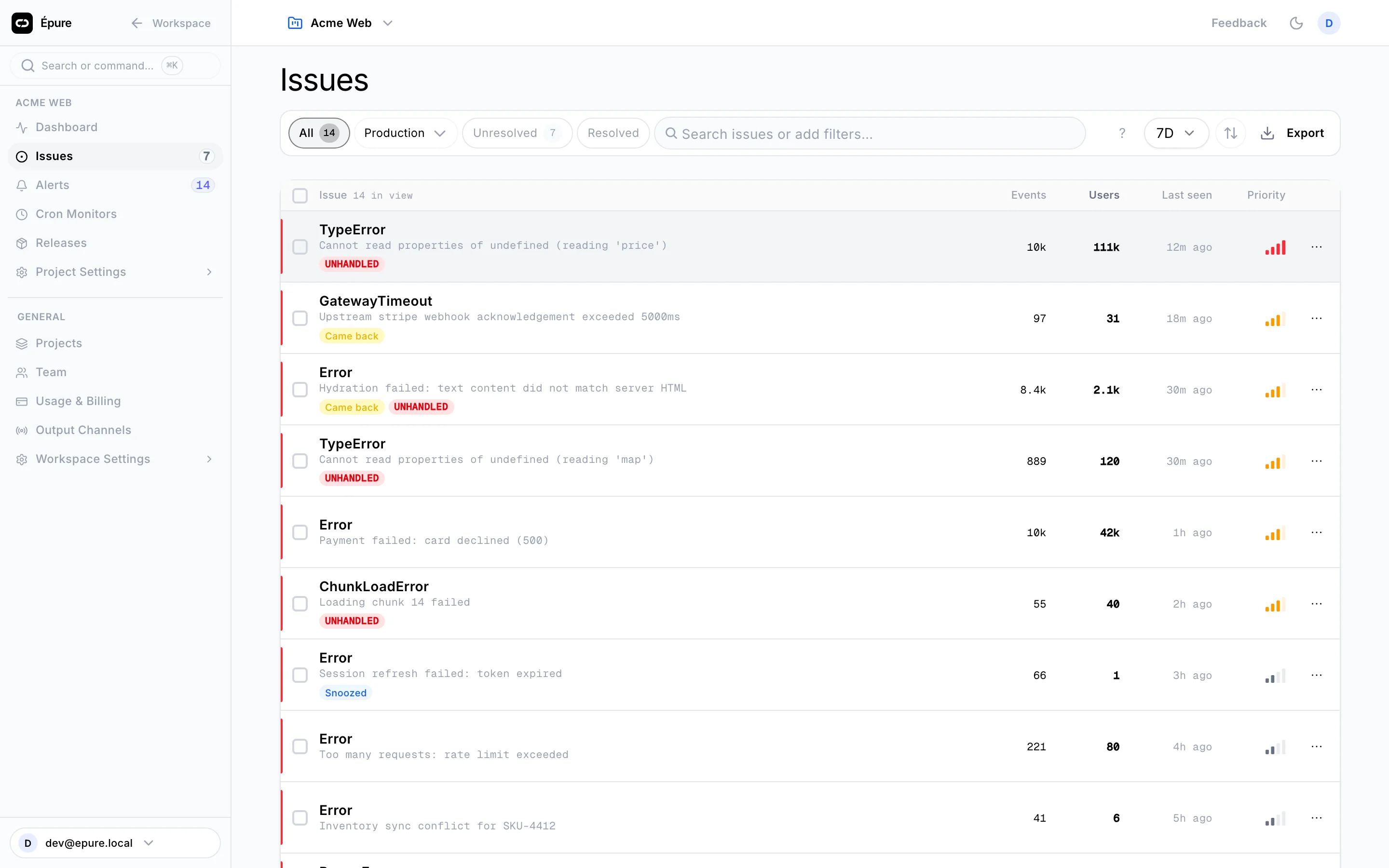
Docs: architecture, deploy, and DSN migration.
Quickstart
1. Start it
git clone https://github.com/epure-sh/epure.git
cd epure
docker compose up -d
2. Copy the DSN
Open http://localhost:8080. Register, create a project, copy the DSN.
3. Throw one error
Keep the official Sentry SDK. Paste the Epure DSN. Set tracing, replay, and profiling sample rates to 0 (Epure does not store those payloads).
import * as Sentry from "@sentry/node";

Sentry.init({
  dsn: process.env.SENTRY_DSN, // DSN from step 2
  sendDefaultPii: false,
  tracesSampleRate: 0,
  replaysSessionSampleRate: 0,
  replaysOnErrorSampleRate: 0,
  profilesSampleRate: 0,
});

Sentry.captureException(new Error("Epure test event"));
4. Open Issues
Epure test event is on the page. Grouped, with the stack.
Other languages, same DSN: Pick your SDK. It also lives under Settings → SDK connection, and the in-app Setup wizard shows it.
Deploy
On a VPS
./configure --prod
docker compose -f docker-compose.yml -f deploy/docker-compose.prod.yml --profile tls up -d
Run ./configure --prod before the first up, or after docker compose … down -v. If Postgres data already exists, the script reuses secrets from .env or applies new ones into the database — it does not overwrite .env with fresh random passwords while leaving the volume on the old ones. To rotate secrets intentionally: ./configure --prod-rotate-secrets. ./configure --prod asks for a public HTTPS hostname (not a raw IP). --profile tls starts Caddy on ports 80 and 443. Open https://your-hostname/login and repeat steps 2 to 4.
http://YOUR_SERVER:8080 will not keep you signed in. /health can still return ok. The browser drops the Secure session cookie and sends you back to the login form with no error. Drop --profile tls only when you already terminate HTTPS yourself.
After that account exists, set EPURE_REGISTRATION=false and recreate the container. Sign-in stays available. New workspaces cannot be created from the public URL. Invitation links still work.
What this binary stores, and what it refuses to store, is in docs/privacy.md. The sign-in page links to /privacy.
Pin EPURE_IMAGE to the current release tag once the URL is public (Releases · Installation).
On a platform
| Platform | Start here |
|---|---|
| Render | Blueprint render.yaml. |
| Railway | Drag deploy/railway/docker-compose.yml onto the project. Notes. |
| Coolify | Compose, base directory deploy/templates/coolify. |
| Dokploy | Compose file deploy/templates/dokploy/docker-compose.yml. |
Then the same steps: register, copy the DSN, throw once, open Issues. Longer list: Installation · deploy/.
Architecture
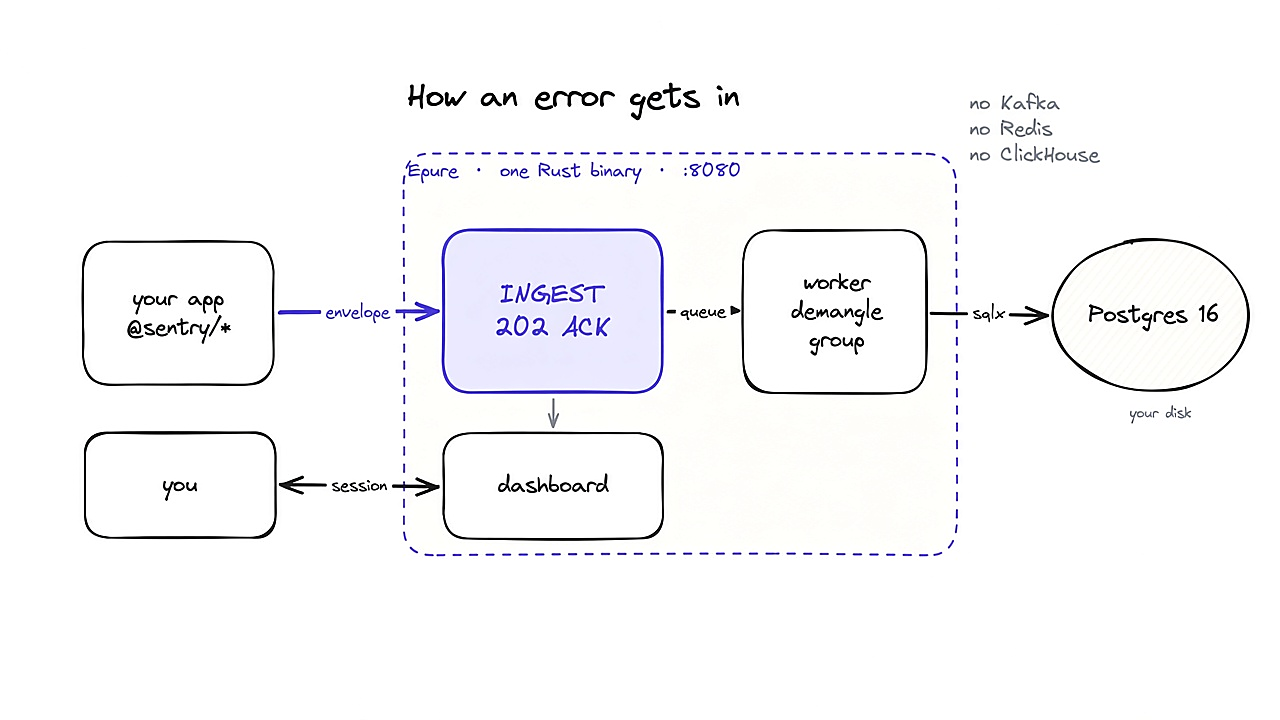
Two containers. The SDK talks to ingest; ingest returns 202 and a worker writes Postgres. The dashboard is the same binary.
Details
- Grouped issues and readable stack traces
- JS/TS sourcemaps
- Releases and regressions
- Alerts and webhooks
- Multi-project orgs and DSN rotation
- RBAC and PostgreSQL RLS
- Keyboard triage
- Spike protection
Epure does not store distributed traces, session replay, continuous profiling, generic logs, or infrastructure metrics. It does not symbolicate iOS/Android. Keep those sample rates at 0 in the SDK.
| Epure | Bugsink | Sentry self-hosted | GlitchTip | |
|---|---|---|---|---|
| Primary focus | Error tracking | Self-hosted error tracking | Errors plus tracing, replay, profiling | Errors and performance |
| Deployment | Two-container Compose | Single-container docker run |
Large multi-service cluster | Multiple options |
| License | AGPL-3.0 engine, Apache-2.0 CLI/MCP. No ee/ folder |
PolyForm Shield 1.0.0 | Check current Sentry license | MIT |
| Database | PostgreSQL 16 | See their docs | Multiple datastores | PostgreSQL |
Project Status: Beta. Epure Cloud runs this engine in production; open release gates (published capacity results, grouping quality measurement) are tracked in docs/ingester-audit.md. Two-container Compose, PostgreSQL 16 with RLS, Spike Valve flood protection, and official Sentry SDK wire compatibility. Changelog.
License: the engine (Rust crates and web UI) is GNU AGPL-3.0. The client packages @epure-sh/cli and @epure-sh/mcp stay Apache-2.0, so installing them never affects your code. Releases up to v0.1.7 were Apache-2.0. No separate closed-source core.
Yorumlar (0)
Yorum birakmak icin giris yap.
Yorum birakSonuc bulunamadi