claude-maintenance-skills
Health Warn
- License — License: MIT
- Description — Repository has a description
- Active repo — Last push 0 days ago
- Low visibility — Only 5 GitHub stars
Code Warn
- Code scan incomplete — No supported source files were scanned during light audit
Permissions Pass
- Permissions — No dangerous permissions requested
No AI report is available for this listing yet.
Three Claude Code skills for keeping a project's knowledge and your setup healthy: project-status (cold-start orientation), split-claude-md (CLAUDE.md maintenance), and salvage-session-archives (recover context from old session transcripts).
Claude Code maintenance skills
Three Claude Code skills for keeping a project's knowledge and your Claude Code setup healthy over time: orient yourself when you come back to a project, keep its CLAUDE.md from bloating, and recover anything useful left behind in old session transcripts.
Each skill is a self-contained directory (a SKILL.md). Claude can invoke one when its description matches what you are doing, or you can ask for it by name.
When each one runs
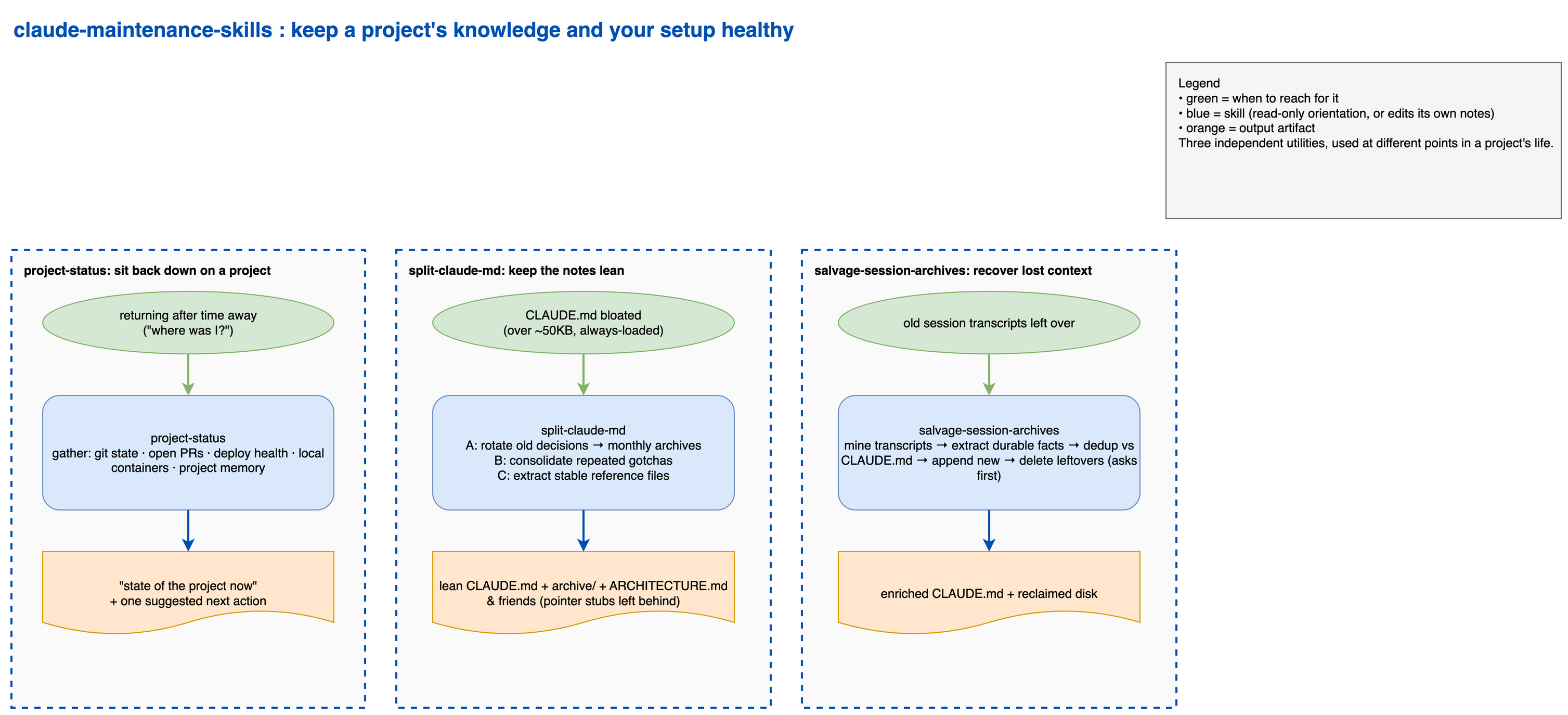
Source: docs/maintenance-flow.drawio (editable in draw.io).
The skills
project-status— cold-start orientation for a project. Gathers git state, open PRs, deploy health, local container status, OpenSpec change progress, unresolved spec-review blockers, and pending items from project memory, then synthesizes a "what is the state of this project right now" report and suggests one next action. Read-only; it never mutates git, the deploy, or your files. Use it when you sit back down on a project after time away.split-claude-md— four-phaseCLAUDE.mdmaintenance. Phase A rotates old dated decision-log entries into monthly archive files and builds an index with a grep-pattern navigation header. Phase B consolidates recurring failure patterns (two or more instances) into a single "Known Patterns & Gotchas" section with instance counts. Phase C extracts stable reference sections (architecture, file maps, data layouts) into standalone files (ARCHITECTURE.md,DEVELOPMENT.md, and so on) with one-line pointer stubs left inCLAUDE.md. Phase D is for the sections Phase C must never touch: a rule moved out of an always-loaded file stops being read, so the file gets smaller while the behaviour it governed quietly stops happening. Phase D cuts within such a section instead of between sections, leaving the rule and moving only its evidence. The goal is to keep the always-loadedCLAUDE.mdlean. Each phase is skippable; the default runs all four.salvage-session-archives— mine the Claude Code session-transcript leftover folders for a project, extract durable facts, decisions, and gotchas that never made it into the project'sCLAUDE.md, cross-check them against what is already documented (duplicates and contradictions), append the genuinely new items under a "Salvaged from session archives" section, then delete the leftover folders. Recovers lost context and cleans up disk in one pass. It asks before deleting anything.
Install
Each subdirectory here is a self-contained skill. Copy or symlink the skill directories into your ~/.claude/skills/ so Claude Code picks them up:
cp -R claude-maintenance-skills/project-status \
      claude-maintenance-skills/split-claude-md \
      claude-maintenance-skills/salvage-session-archives \
      ~/.claude/skills/
Assumptions
These skills assume the standard Claude Code layout: a per-project data directory at ~/.claude/projects/<X>/ holding an optional CLAUDE.md and a memory/ folder, and the dash-encoded transcript "leftover folders" Claude Code creates under ~/.claude/projects/. All paths derive from $HOME, so the skills work on any machine without editing. project-status also reads a repo-root CLAUDE.md when one exists.
Optional integrations (not bundled)
project-status checks several things when the tool or file is present and skips them silently otherwise. None are required:
gitand the GitHub CLI (gh) for branch state and open PRs.- A deploy host (for example Render) and local Docker, for deploy and container health.
- OpenSpec for change-progress tracking; it is a separately installed tool (
npm install -g @fission-ai/openspec) andproject-statuswill suggest/opsx:applyonly when an OpenSpec change with open tasks exists. - A
COMMENTS.mdspec-review file, read for unresolved blockers when one is present.
The session-lifecycle skills that pair naturally with these (save-context, close-session, todo, new-session) live in the separate multi-phase-skills-framework pack, so they are not duplicated here.
Conventions
project-statusandsalvage-session-archives(before its final confirmed deletion) are read-only orientation passes.split-claude-mdrestructuresCLAUDE.mdlocally and does not commit or push.- Writing follows plain-prose conventions: no em dashes, no marketing adjectives, no Unicode box-drawing characters in tables.
License
MIT. See LICENSE.
Model routing
The skills in this pack pin a Claude Code model alias in their frontmatter, so each artifact runs on the tier its work needs:
model: fable: planning and judgment-heavy reviewmodel: opus: execution and content workmodel: sonnet: routine or mechanical steps
If a pinned model is not available on your plan, or you prefer different routing, edit the model: line in the artifact's frontmatter, or delete it to inherit your session model.
Reviews (0)
Sign in to leave a review.
Leave a reviewNo results found