claude-release-workflow
Health Warn
- License — License: MIT
- Description — Repository has a description
- Active repo — Last push 0 days ago
- Low visibility — Only 5 GitHub stars
Code Fail
- rm -rf — Recursive force deletion command in _shared/security-scan.sh
Permissions Pass
- Permissions — No dangerous permissions requested
No AI report is available for this listing yet.
Two-verb ship-to-production workflow for Claude Code: /pr-checkpoint to iterate on a PR + local Docker, /release as the atomic ship gate (merge, docs, push, verify deploy), /production-smoke for read-only post-deploy checks, plus a push-to-main guard hook.
Claude Release Workflow
A set of Claude Code skills and hooks for shipping code safely. It splits "ship it" into an iterate stage and a release stage, codifies the pre-release review loop, and puts a hook in front of git push so a release always goes through the skill instead of an ad-hoc push.
The idea is a small, repeatable path from a feature branch to a verified production deploy:
- pr-checkpoint: snapshot in-progress work as a GitHub PR and rebuild your local Docker container so you can test the feature branch on localhost. Does not merge, does not touch prod. Optionally runs the review loop as advisory reports.
- review-round: the codified three-reviewer loop. Author per-agent adversarial prompts aimed at the riskiest spots, launch the review agents in parallel, reproduce every finding by execution before fixing, prove each fix with a non-vacuous regression test, and post the PR verdict comment that
releasereads. - release: the single ship-it verb. Auto-detects PR mode (merge open PRs targeting main) or trunk mode (commit straight to main), updates the README and project notes, pushes to every remote, verifies the auto-deploy landed on the right commit, and rebuilds local Docker so localhost matches prod. Refuses to merge a PR whose review-round verdict at the current head is CRITICALS-OPEN.
A block-git-push-main.sh PreToolUse hook backs this up: it deterministically blocks any raw git push to main / master and points you at /release. It is the safety net for when the model forgets the workflow.
The flow
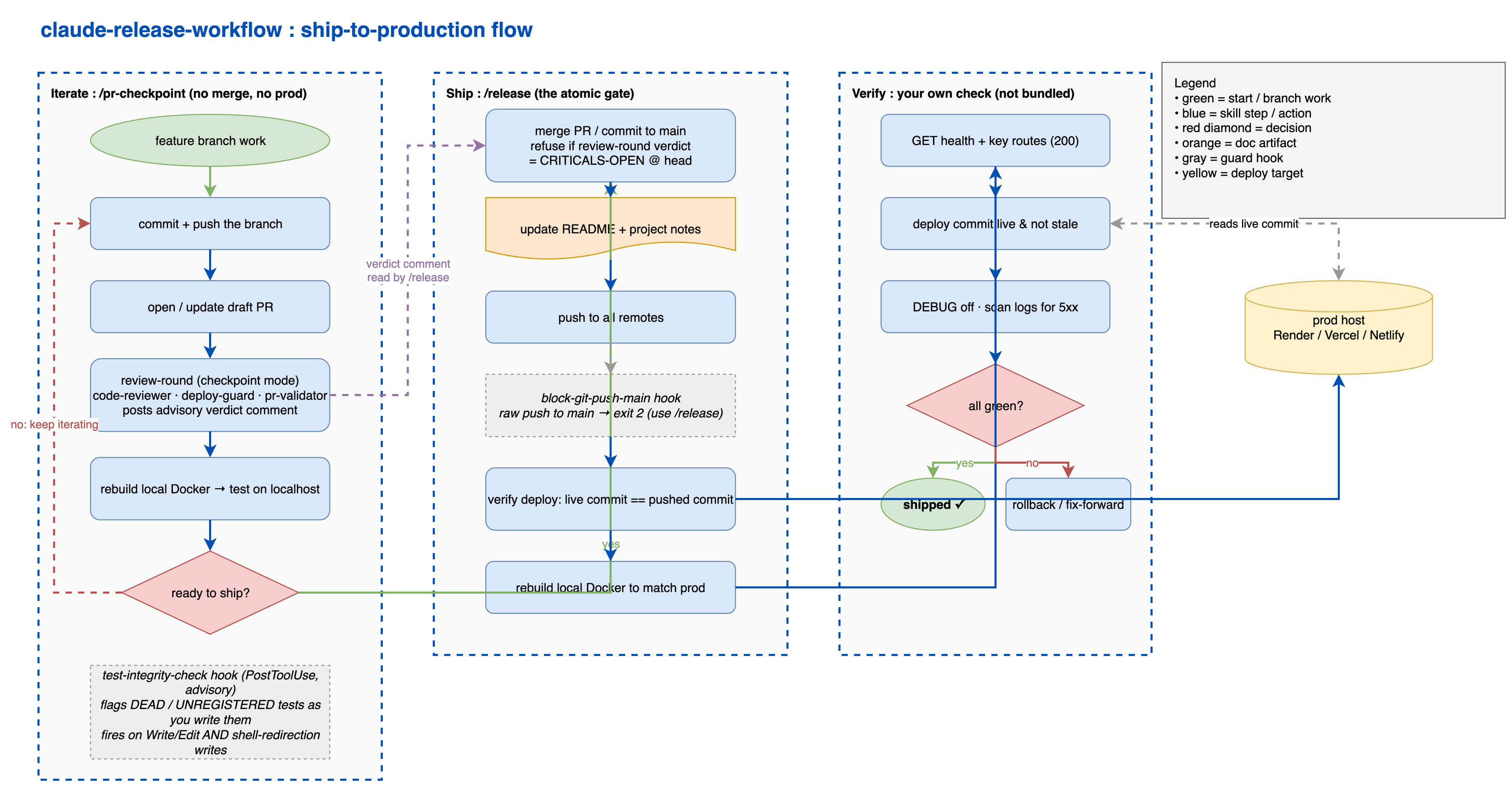
Source: docs/release-flow.drawio (editable in draw.io).
Why two verbs
/pr-checkpoint is the iterate stage. You run it as many times as you like while building a feature: it opens or updates a PR and gives you a running local container to test against, but it never merges or deploys, and does not touch your release docs (that would be premature).
/release is the hard gate. It is the one place that merges, updates docs, pushes, and deploys, all as one atomic action. Because the docs update and the deploy verification are part of the same step, you cannot ship code and forget to write down what changed.
The skills
pr-checkpoint: commit staged work, push the feature branch, open a draft PR with a structured body, optionally run the advisory review loop, and rebuild local Docker. Refuses to push to main or commit secrets, and (via the shared preflight) refuses to push AI-assistant harness files to a repo you do not own.review-round: the pre-release review loop (also the engine behind thepr-checkpointstep-6 review, in advisory checkpoint mode). Scopes the diff, authors adversarial per-agent prompts, launches the review agents in parallel, reproduces findings by execution, verifies suggested fixes against the authoritative gate, proves each fix with a mutation- or contrast-checked regression test, and posts aReview-round verdict: <CLEAN|CRITICALS-OPEN> @ <sha>comment.releasereads that marker and refuses a CRITICALS-OPEN head.release: detects the release shape (PR / trunk / nothing to do), merges or commits, runs an optional project pre-push gate, updates README + project notes, pushes to all remotes, verifies the deploy landed on the correct commit, and rebuilds local Docker. Refuses to merge a PR whose review-round verdict at the current head is CRITICALS-OPEN (a missing or stale-SHA verdict is not a blocker).
Shared protocols the skills reference (in _shared/):
release-docs.md: how the README and project notes get updated at ship time, plus the secrets / staging guardrails.local-docker-rebuild.md: detect and rebuild the repo's local container; skips silently when the project does not use Docker.harness-files-protection.md: a preflight that keeps AI-assistant working files (CLAUDE.md,MEMORY.md,.claude/, and so on) out of any repo you do not own personally.
The hooks (in hooks/):
block-git-push-main.sh: PreToolUse hook on the Bash tool that blocksgit pushto main / master, with two documented bypasses for the rare direct-push case. It is a thin delegator toblock-git-push-main.py, which decides from a quote-aware parse of the command (_bash_command_parse.py) rather than from a substring match. The parse matters in both directions: a substring match blocks a quoted grep pattern, a heredoc that writes a script containing a push line, and prose that ends one word after "push", while it letsbash -c "git push origin main"andgit push origin HEAD:refs/heads/mainstraight through.test-integrity-check.py: PostToolUse hook (advisory) that catches DEAD tests (defined after a customif __name__ == "__main__"runner, so they never bind) and UNREGISTERED tests (missing from a hand-maintained call list). Both read as green from the outside; this hook flags them deterministically via AST. It also runs standalone astest-integrity-check.py --file <path>for a one-shot audit._bash_write_targets.pyis its helper: it lets the Bash matcher see files written by shell redirection ortee, which normal Write/Edit hooks miss.
Install
Copy the skill directories, the shared protocols, and the hook into your Claude Code config.
# 1. Skills + shared protocols -> ~/.claude/skills/
for d in pr-checkpoint review-round release; do
  cp -R "$d" ~/.claude/skills/
done
mkdir -p ~/.claude/skills/_shared
cp _shared/*.md _shared/security-scan.sh ~/.claude/skills/_shared/
chmod +x ~/.claude/skills/_shared/security-scan.sh ~/.claude/skills/release/sync-remotes.sh

# 2. Hooks -> ~/.claude/hooks/
mkdir -p ~/.claude/hooks
cp hooks/block-git-push-main.sh hooks/block-git-push-main.py hooks/_bash_command_parse.py \
   hooks/test-integrity-check.py hooks/_bash_write_targets.py ~/.claude/hooks/
chmod +x ~/.claude/hooks/block-git-push-main.sh ~/.claude/hooks/test-integrity-check.py
The skills reference the shared files by their installed path (~/.claude/skills/_shared/...), so keep _shared/ next to the skills.
Mirror remotes
/release copies origin's default branch to your mirror remotes with release/sync-remotes.sh. A remote is a mirror only when you name it, once per repo:
git -C <repo> config --add release.mirror <remote-name>
Any other remote (an upstream, a fork, an archive) is listed in the output and never pushed.
Wire the hooks
Add both hooks to ~/.claude/settings.json: the push guard as a PreToolUse hook on Bash, and the test-integrity check as a PostToolUse hook on the write tools plus Bash (the Bash matcher catches shell-redirection writes that Write/Edit miss).
{
  "hooks": {
    "PreToolUse": [
      {
        "matcher": "Bash",
        "hooks": [
          { "type": "command", "command": "$HOME/.claude/hooks/block-git-push-main.sh" }
        ]
      }
    ],
    "PostToolUse": [
      {
        "matcher": "Write|Edit|MultiEdit",
        "hooks": [
          { "type": "command", "command": "python3 $HOME/.claude/hooks/test-integrity-check.py" }
        ]
      },
      {
        "matcher": "Bash",
        "hooks": [
          { "type": "command", "command": "python3 $HOME/.claude/hooks/test-integrity-check.py" }
        ]
      }
    ]
  }
}
The push guard needs jq on your PATH; the test-integrity hook needs python3 (3.9+) and is advisory (it never blocks a tool call, only emits a warning). Two bypasses exist for the genuine direct-push case: set CLAUDE_ALLOW_PUSH_MAIN=1 in the environment, or append #allow-push-main as a comment in the bash command itself (unquoted, after the push args). Use them sparingly.
Configure your personal GitHub owners
The harness-file preflight needs to know which remotes are "yours". Open ~/.claude/skills/_shared/harness-files-protection.md and set the PERSONAL_OWNERS list to your own GitHub username(s) and org(s). Everything else is treated as a client / shared repo where assistant notes must not be pushed.
Companions (not bundled)
- Review agents. The
review-roundskill (and thepr-checkpointstep-6 review it powers) drives a separate set of agents published at claude-review-agents (a code reviewer, a pre-ship deploy guard, and a test-runner / PR validator). Install those for the review loop to do something, or plug in your own. Without them, the checkpoint just skips the review. - Security scan step (optional).
/releaseruns_shared/security-scan.shon the diff it is about to ship. It needssemgrepandosv-scanneron yourPATH, and the rule files from the secure-dev-guardrails pack: copy itsstandards/folder to~/.claude/skills/_shared/security-standards/, or pointSECURITY_SCAN_BASELINEat itsbaseline.yml. When a tool is missing the scan says it could not run (exit 2) rather than reporting a clean result. - A project notes file. The
releaseskill reads and writes a project working-notes file for context (schema changes, service IDs, gotchas). For Claude Code that is usually aCLAUDE.md; adapt to whatever your project keeps. If your project has none, the docs step still updates the README and skips the notes.
Host support
The deploy-verification step is written host-agnostic with Render, Vercel, and Netlify as worked examples. The core check is the same everywhere: after a push to main, confirm the live deploy is serving the exact commit you pushed, not a stale one. A live-but-stale deploy is a failure, not a pass. If your host has no deploy API, the skill says so explicitly rather than reporting a false green.
Conventions baked in
- Two verbs, one gate: iterating is cheap and repeatable (
/pr-checkpoint); shipping is a single atomic action (/release) that always updates docs and verifies the deploy. - Secrets and assistant harness files never leave your own repos, enforced by a preflight on every push.
- Writing follows plain-prose conventions: no em dashes, no marketing adjectives, no Unicode box-drawing characters in tables.
License
MIT. See LICENSE and NOTICE. Everything here is original to this project.
Model routing
The skills in this pack pin a Claude Code model alias in their frontmatter, so each artifact runs on the tier its work needs:
model: inherit: planning and judgment-heavy review. These run on your session model, so start a planning or review session on your strongest model (switch with/model).model: opus: execution and content workmodel: sonnet: routine or mechanical steps
If a pinned model is not available on your plan, or you prefer different routing, edit the model: line in the artifact's frontmatter, or delete it to inherit your session model.
Reviews (0)
Sign in to leave a review.
Leave a reviewNo results found