ludra
Health Warn
- License — License: MIT
- Description — Repository has a description
- Active repo — Last push 0 days ago
- Low visibility — Only 7 GitHub stars
Code Pass
- Code scan — Scanned 12 files during light audit, no dangerous patterns found
Permissions Pass
- Permissions — No dangerous permissions requested
No AI report is available for this listing yet.
The game engine built for AI agents. Games are JSON, errors come with fixes, and agents play-test their own games headlessly.
Ludra



The game engine built for AI agents.
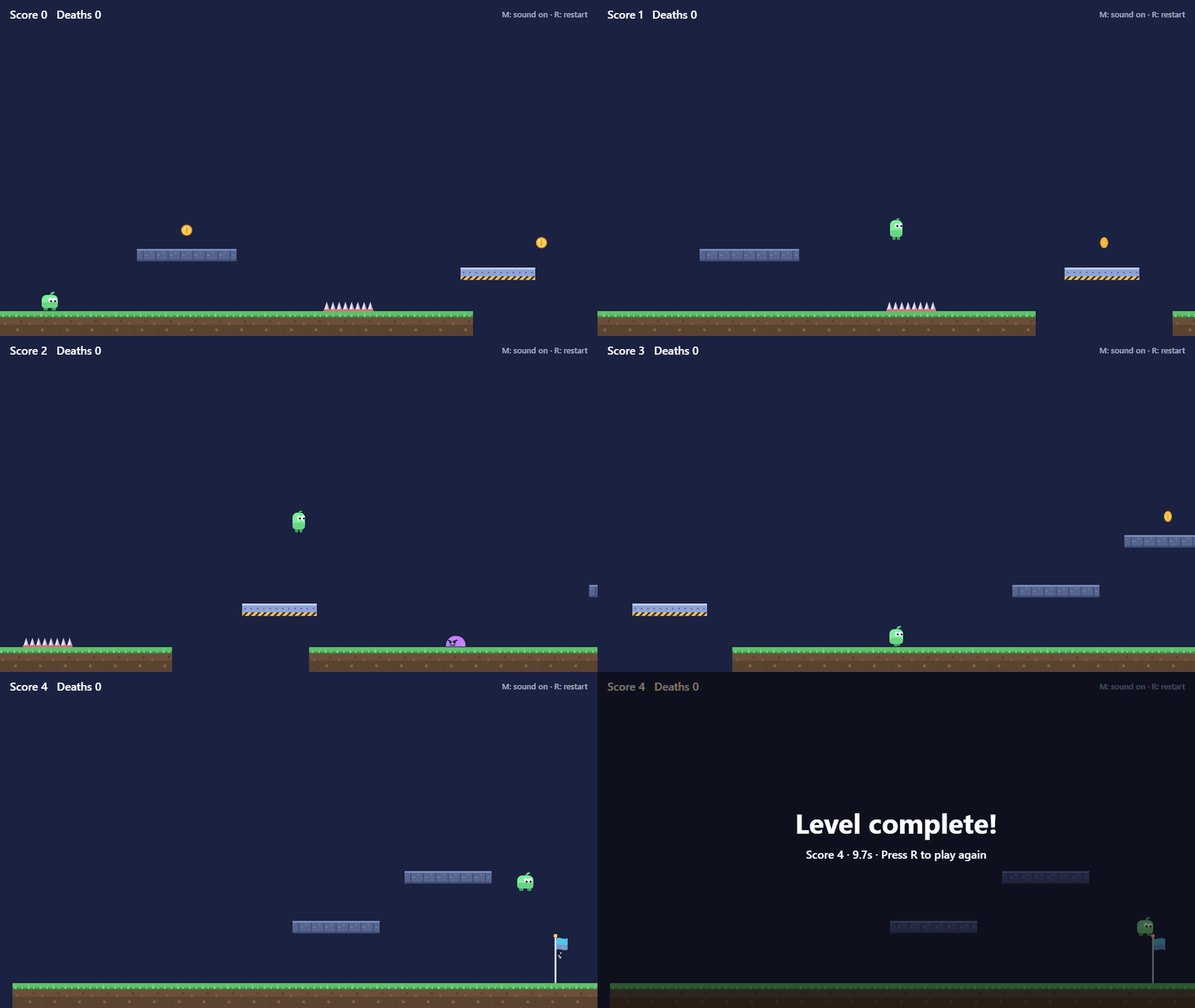
The platformer template, replayed from its own test script: won == true, deaths == 0.
Unity, Unreal and Godot are designed for humans clicking around an editor. Ludra is designed for an agent like Claude: games are plain JSON, every problem comes with a machine-readable fix, and the agent can play its own game headlessly to prove it works before a human ever touches it.
You describe the game. The agent builds it with Ludra, checks it, plays it, tests it and hands it to you.
you    > make me a platformer with spikes, a moving platform over a pit and an enemy to stomp
claude > ludra new slime-valley
         ludra check     ✓ 15 entities, no problems
         ludra play --inputs "right:0.3s, right+jump:0.45s, ..." --watch player,lift,slime
         ludra test      ✓ 6 passed, 0 failed (won == true, deaths == 0)
         Done. Run `ludra dev` to play it.
Status: early (v0.9). 2D games in several genres (platformers, top-down adventures, breakout, physics games) on arcade or real Rapier physics, with tilemaps, camera zones, tweens, multiple levels, lives, checkpoints and prefabs,
ludra reviewto catch unfinished work, art drawn in code with lighting, custom interfaces and GLSL post-processing, a library of ready-made gameplay blocks, custom TypeScript scripts, enemies, hazards, moving platforms, goals, animated SVG sprites, particles, each game's own synthesized sounds and music, plus the full agent toolchain including real rendered screenshots, work today. 3D is on the roadmap.
The idea
Unity-level games, made by AI, that are actually good. Ludra rests on two promises:
- No ceiling on creativity. The agent gets raw power, not a menu of presets: the full Canvas 2D API, GLSL shaders, any font, TypeScript for any mechanic, any genre. The engine never says "that's all you can do".
- No slop. Power alone produces games that look generated: generic, untested, silent, flat. So Ludra gives the agent eyes (simulation, screenshots), proof (deterministic tests), taste (a design guide) and a reviewer that flags unfinished work. The few hard rules guard correctness, never creativity: the simulation is deterministic, drawing can't change the game, and a game isn't done until
check,testandrevieware clean.
Why an engine for agents?
When an AI writes a game with a normal engine, it is coding blind. It cannot see the screen, cannot press keys, and does not find out that the player falls through the floor until a human tries it. Ludra closes that loop:
| What an agent needs | What Ludra gives it |
|---|---|
| A format it can read and write reliably | Scenes are JSON: entities made of components. No binary files, no editor. |
| To know what is wrong and how to fix it | ludra check: every diagnostic has a JSON path and a concrete fix: |
| To see what happens | ludra play: deterministic headless simulation with a timeline, events and an ASCII map of the frame |
| To see what players see | ludra play --screenshot 1s,end: real rendered frames as PNGs that a multimodal agent can look at |
| To prove a feature works | ludra test: scripted inputs plus assertions like "score == 3" or "player.grounded == true at 1s" |
| To know when it's finished | ludra review: flags what makes a game feel like slop, from untested mechanics to the default HUD |
| To know the API without guessing | ludra components: a reference generated from the engine itself |
| To hand off to a human | ludra dev: the same simulation in the browser with keyboard controls and live reload |
The simulation is fixed-step and deterministic, so the game a test verifies is exactly the game a player gets.
Quick start
Requires Node.js 22.18 or newer.
With Claude Code (recommended)
Install the plugin by running these two commands inside Claude Code:
/plugin marketplace add ersingvn/ludra
/plugin install ludra@ludra
Then just ask, in any folder:
make me a platformer with spikes, a moving platform and an enemy to stomp
The plugin's make-2d-platformer-games skill teaches Claude the whole loop: create the game, check after every edit, play it headlessly, prove it with test, add art and effects, and hand it to you with ludra dev. Every project created with ludra new also has a CLAUDE.md with the same loop, so other agents know how to work in it too.
To update later, run /plugin marketplace update ludra.
From npm
npx @ludra/cli new my-game
npx @ludra/cli play my-game --inputs "right:1s, jump:0.4s" --ascii
npx @ludra/cli dev my-game
Or install it once with npm install -g @ludra/cli and run ludra new my-game. The packages are @ludra/cli and @ludra/core.
From source
git clone https://github.com/ersingvn/ludra.git && cd ludra
npm install
npm run ludra -- new my-game
npm run ludra -- play my-game --inputs "right:1s, jump:0.4s" --ascii
npm run ludra -- dev my-game
A tour
A scene
{
  "id": "player",
  "components": {
    "transform": { "x": 80, "y": 482 },
    "body": { "type": "dynamic", "width": 28, "height": 36 },
    "sprite": { "color": "#7cf29c", "layer": 2 },
    "platformer": { "speed": 240, "jumpSpeed": 680 }
  }
}
ludra check: errors that explain themselves
✗ error E_UNKNOWN_COMPONENT scenes/main.scene.json → entities[0].components.platfromer
  Unknown component "platfromer" on entity "player".
  fix: Did you mean "platformer"? Run `ludra components` to list every component.
ludra play: the agent's eyes
▶ coin-climb: simulated 4.30s (258 frames)  inputs: right:0.55s, right+jump:0.45s, ...

Events
  0.57s   jump     player
  1.08s   land     player
  1.08s   collect  player → coin-1 (+1)
  ...
Final: score 3 · 7 entities

t=4.30s  frame 258  score 3  (1 char = 12x24px)
+--------------------------------------------------------------------------------+
|                                                                     @@@        |
|                                                                     @@@        |
|                                                               ######@@@#####   |
|                                           ##############                       |
|                       ##############                                           |
|################################################################################|
+--------------------------------------------------------------------------------+
Add --json to any command for machine-readable output.
ludra play --screenshot: real frames, not guesses
ASCII shows the layout. To check the art, an agent asks for real frames of the same deterministic run:
$ ludra play --inputs "right:0.3s, right+jump:0.45s, ..." --screenshot 0.85s,3.7s

Screenshots (open these PNGs to see the frames)
  0.85s   screenshots/t-0.85s.png
  3.70s   screenshots/t-3.70s.png
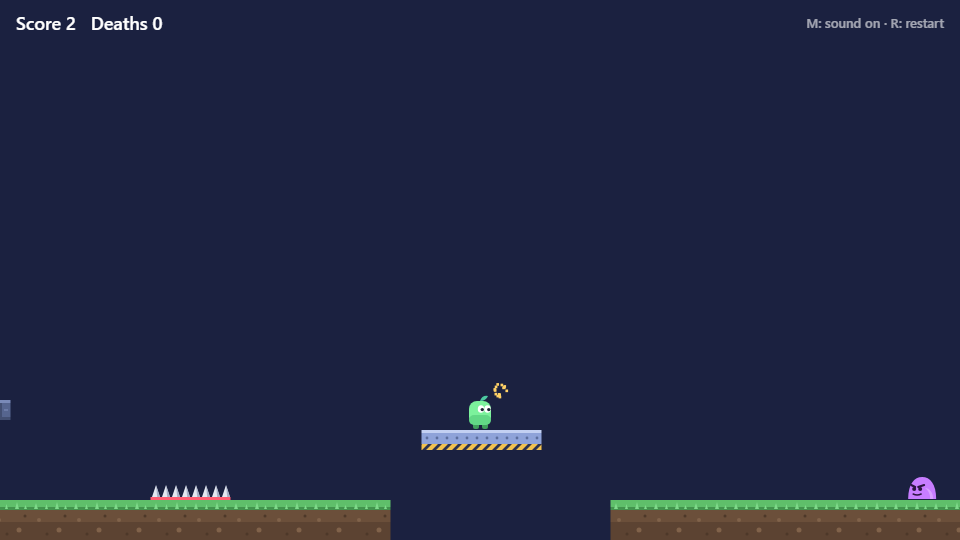
Frames come from the same renderer players use, with sprites, animation and particles, driven by Chrome, Edge or Chromium already on the machine in headless mode. Ludra adds no dependencies for this, and three frames take about a second.
ludra test: proof, not vibes
{
  "name": "the level can be completed without dying",
  "inputs": "right:0.3s, right+jump:0.45s, right:0.85s, ..., right:1.5s",
  "assert": ["won == true", "deaths == 0", "score == 4", "events.stomp == 1"]
}
gameplay.test.json
  ✓ player rests on the ground
  ✓ player runs right
  ✓ jumping leaves the ground and lands again
  ✓ spikes kill the player, who respawns at the start
  ✓ the lift carries the player over the pit
  ✓ the level can be completed without dying

6 passed, 0 failed
Assertions can check score, deaths, won, event counts (events.jump, events.stomp, ...) and any entity's x, y, vx, vy, grounded or exists, at the end or at 1.5s.
ludra review: is it finished, or just working?
check asks "is it valid?", test asks "does it work?". review asks "would anyone mistake this for a finished game?" It plays every test and reads the scenes and scripts, then flags the signs of slop:
$ ludra review
Proof: is it shown to work?
  ✗ [scenes/main.scene.json] scripts/chase.ts (on chaser) has no test that checks what it does.
    → Add a test that isolates it and asserts its effect: "chaser.state.<key> == ..."
Feel: does every moment answer the player?
  ✗ [scenes/main.scene.json] These events happen in play but nothing answers them: collect, die.
Looks: does it have a style of its own?
  ✗ [scenes/main.scene.json] It uses the engine's default HUD and end screens.
  ✗ [scenes/main.scene.json] Behind the game there is only a flat background color.
  ○ [scenes/main.scene.json] No post-processing.

4 issue(s), 1 idea(s). Fix the issues before calling the game done.
The skill treats issues like failing tests, and every template reviews clean (--strict makes issues fail CI).
Lives, checkpoints, prefabs and levels
"world": { "lives": 3 },
"entities": [
  { "id": "slime-2", "prefab": "slime", "components": { "transform": { "x": 1290, "y": 487 }, "patrol": { "speed": 90 } } },
  { "id": "lantern", "components": { "transform": { "x": 760, "y": 468 }, "body": { "type": "static", "width": 24, "height": 64, "sensor": true }, "checkpoint": {} } },
  { "id": "flag", "components": { "goal": { "next": "scenes/level-2.scene.json" }, "...": "..." } }
]
slime comes from prefabs/slime.prefab.json, shared by every scene: the entity lists only what differs. Losing every life ends the game (lost, gameover); a checkpoint moves the respawn point; a goal's next (or world.goto from a script, e.g. a title screen) moves on to another scene, carrying score and lives. Every scene is checked, and each test can pick its scene. The platformer template is two levels built this way.
Real physics, when the game is physics
Arcade physics (boxes that never rotate) stays the default: it is what precise platformers want. A scene that is about physics switches to Rapier with one line, "world": { "physics": "rapier" }, and gets rotation, circles, capsules, polygons and curved ground, friction and mass, hinges, sliders, welds, ropes, springs and motors:
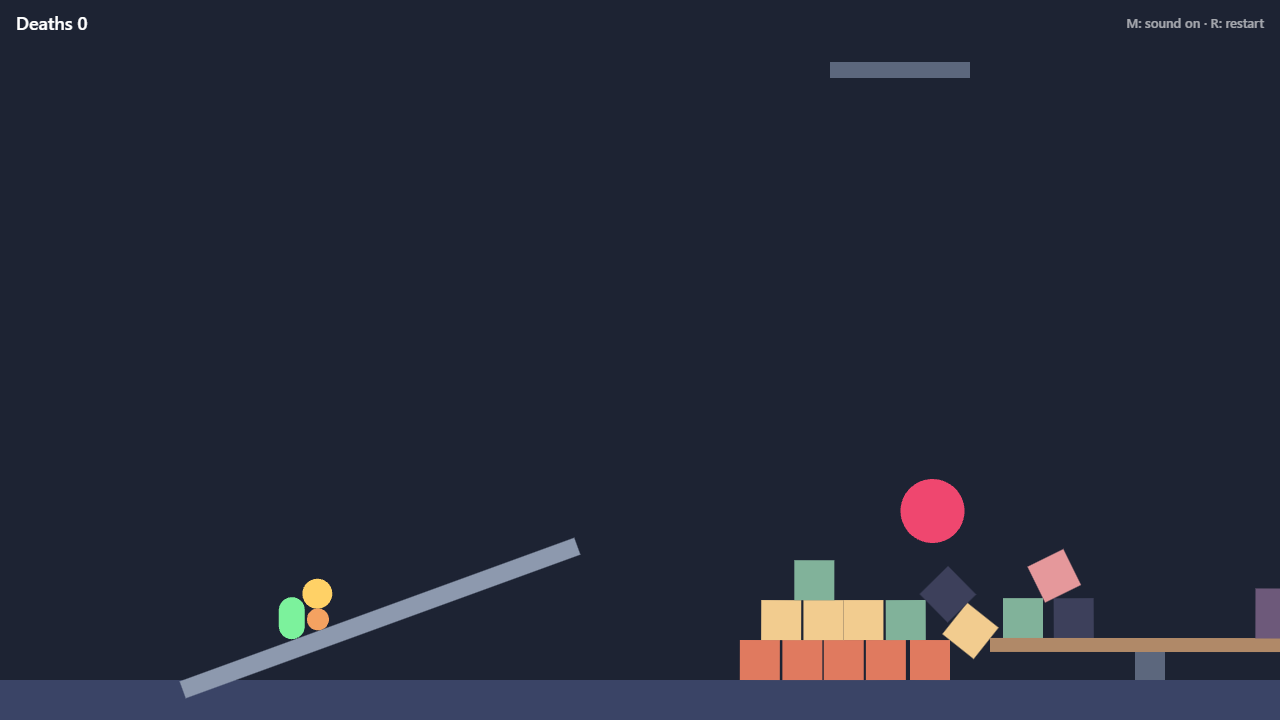
{ "id": "wrecking-ball",
  "components": {
    "body": { "type": "dynamic", "width": 64, "height": 64, "shape": "circle", "density": 12 },
    "joint": { "type": "revolute", "anchor": { "x": 260, "y": -320 } } } }
- Deterministic everywhere. Ludra uses Rapier's deterministic build: the same scene simulates bit-for-bit the same frames on Linux, macOS, Windows, every Node version and in the browser. A golden-hash test checks this on every CI machine, so tests still prove what players get.
- Players feel right. A character controller walks up slopes and slides off steep ones, steps onto ledges, pushes crates and rides platforms, and jumps exactly as high as under arcade.
- Scripts get the rest.
applyImpulse,applyForce,world.raycast, andworld.physics.raw: Rapier itself, for anything the components don't cover. - Agents can see it.
ludra play --screenshot 1s --debugdraws every collider in its true shape, every joint and every id over the frame.
Rapier is its own package, @ludra/physics, loaded only by scenes that ask for it.
Blocks: tested pieces, combined with taste
Like a video agent assembling scenes from a library of transitions and titles, a Ludra agent starts from blocks: ready-made, tested pieces of gameplay, each with its scripts, SVG art and effects.
$ ludra blocks
chasing-enemy     An enemy that waits, then runs at the player once they come close.
falling-platform  A cracked platform that shakes when stood on, falls, then comes back.
key-and-door      A key and the locked door it opens.
teleporter        Two linked pads. Stepping on one moves the player to the other.
turret            A turret that fires deadly bullets at a steady rhythm.
...

$ ludra add key-and-door --at 400,500
✓ Added "key-and-door" to scenes/main.scene.json
  entity  key-and-door-key       at (400, 460)
  entity  key-and-door-door      at (600, 440)
  file    scripts/key.ts         added
  ...
- Blocks link their parts by id, so you can add several, and never overwrite files you changed.
- Every block ships a demo that CI plays on each commit, so the library stays working.
- The agent then makes them its own: tuning
params, restyling art, and combining blocks into new mechanics.
The skill also teaches taste: a design guide on level design (teach, test, twist), fairness checks it can run (timing windows of at least 0.2 s, no blind jumps), game feel, palettes and SVG art direction, and a finishing checklist.
Art without limits
Sprites are where looks start, not where they stop. Any script can paint with the real Canvas 2D context, replace the HUD, load Google Fonts and run a GLSL shader over every frame. That's the whole toolbox a human artist-programmer would use, and agents are very good at writing code. Both of these are the templates, untouched:
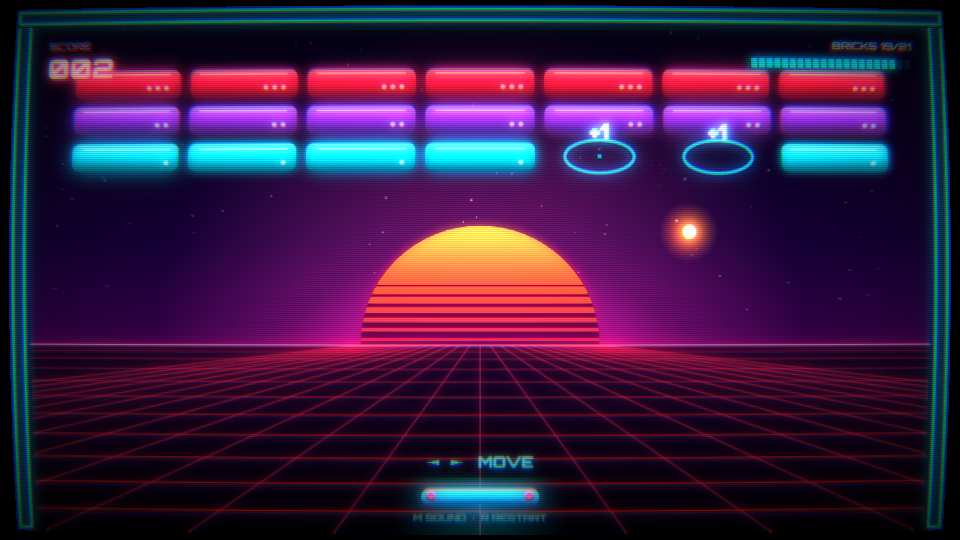
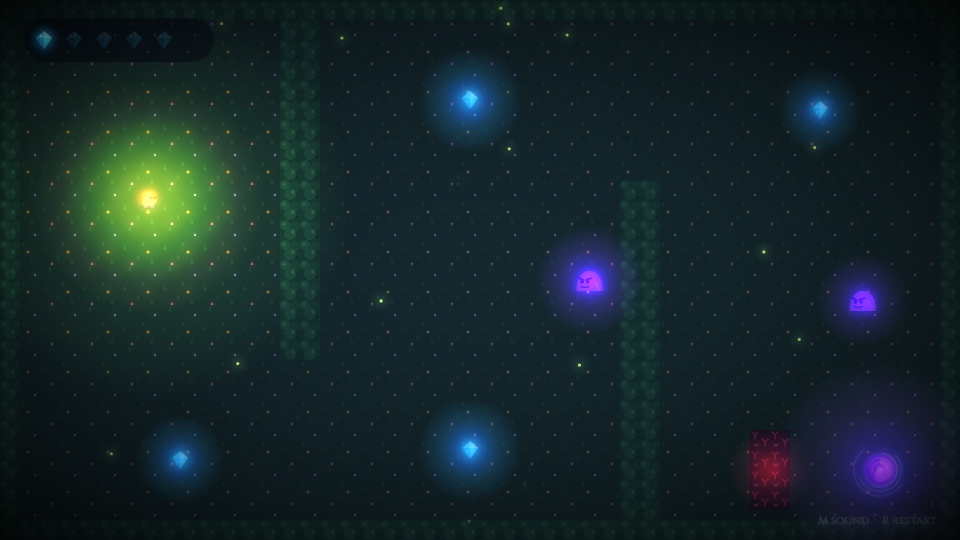
// scripts/ball.ts: game logic and looks side by side
export default {
  update({ self, params }) { /* keep the speed constant... */ },
  draw({ g, self, local }) {
    g.globalCompositeOperation = "lighter";           // additive light
    g.shadowColor = "#ffd60a";
    g.shadowBlur = 18;                                 // glow
    g.beginPath();
    g.arc(self.x, self.y, 7, 0, Math.PI * 2);
    g.fill();
  },
} satisfies Script;
"fonts": { "Orbitron": "google" },
"postfx": { "shader": "shaders/neon.frag", "uniforms": { "bloom": 1.6, "scanlines": 0.5 } }
Draw hooks can read the game but not change it (that throws), so the browser never drifts from what the tests verified. ludra check runs them against a mock canvas to catch errors early, and ludra play --screenshot renders the real thing, shader included, for the agent to look at.
Genres
Start from the template closest to your idea and reshape it:
npx @ludra/cli new my-game                       # platformer: run, jump, stomp
npx @ludra/cli new my-game --template topdown    # seen from above: gems, hedges, slimes
npx @ludra/cli new my-game --template breakout   # paddle, bouncing ball, bricks
npx @ludra/cli new my-game --template physics    # real physics: a crate to push, a rope bridge, a pendulum
Each template ships with tests that prove it can be won without dying, and its own look: the platformer in SVG sprites, the breakout drawn entirely in code, the grove lit by code over SVG sprites, Crate & Chasm on Rapier with joints you can see in --debug. The breakout route is 28 seconds long, so the skill teaches agents to write a small autopilot that plays the level and prints the input, instead of guessing.
Scripts: any game logic, still testable
Built-in components cover the basics. For everything else (enemies that chase, keys and locked doors, timers, shooting, boss phases) the agent writes a short TypeScript script, the way Unity developers write C# behaviours:
// scripts/locked-door.ts
import type { Script } from "@ludra/core";

export default {
  update({ self, world }) {
    const player = world.player();
    if (player?.state.hasKey && self.touches(player)) {
      world.emit("door-open");
      world.destroy(self);
    }
  },
} satisfies Script;
"script": { "src": "scripts/locked-door.ts" }
Unlike in other engines, the agent can prove the script works, because scripts run in the same deterministic simulation as everything else:
"assert": ["events.door-open == 1", "player.state.hasKey == true", "chaser.state.chasing == true"]
- Hooks:
start,updateandtouch. Scripts get the entity (self), theworld(get,all,player,spawn,destroy,kill,win,emit, a seededrandom) andinput. - No build step: Node and the dev server strip types on the fly.
- Errors:
ludra checkloads every script and reports syntax errors with the line and a caret. Runtime errors name the file, entity, hook and frame. - Reference: run
ludra components scriptfor the API, or seeexamples/key-questfor a jump pad, a key, a locked door, a chasing enemy and a time limit, all with tests.
Art, effects and sound, all as text
Agents can't use a paint program, so Ludra's art pipeline is text too. Sprites are SVG files the agent writes itself: spritesheets with idle, run, jump and fall animations that switch automatically, and tiles for ground and platforms. Game events trigger particles, synthesized sounds and screen shake from a few lines of JSON:
"effects": {
  "collect": { "sound": "coin", "particles": { "count": 14, "color": "#ffd166", "speed": 140 } },
  "die": { "sound": "explosion", "shake": 10, "particles": { "count": 30, "color": "#ff5d73" } }
}
No audio files are needed, and sound has no ceiling. A scene designs its own "sounds" from tone and noise layers (with vary, so repeats never sound copied) and writes its "music" as tracks of notes:
"sounds": {
  "boot-on-wood": { "tones": [{ "wave": "sine", "from": 140, "to": 70, "duration": 0.09 }], "noise": [{ "filter": "bandpass", "from": 420, "duration": 0.07 }], "vary": 0.12 }
},
"music": {
  "tempo": 100,
  "tracks": [
    { "wave": "triangle", "notes": "D4 F4 A4 ~ G4 F4 E4 C4 | D4 ~ A3 ~ C4 D4 ~ -" },
    { "wave": "sine", "notes": "D2 ~ - D2 A2 ~ - A2 | C2 ~ - C2 G2 ~ - G2" },
    { "wave": "noise", "filter": 110, "notes": "X - - - x - x -" }
  ]
}
For everything else, a script's sound hook gets the real Web Audio API, the way draw hooks get the real canvas: Crate & Chasm's wind grows as you climb, the spiked ball hisses as fast as it swings and the bridge creaks under your feet. Every template ships with its own sounds and music, and ludra review flags stock beeps and silent games. Presentation never touches the simulation, so polishing a game can't break its tests, and ludra check reports any missing image or audio file along with the files that do exist.
Components (v0.9)
| Component | What it does |
|---|---|
transform |
Position (entity center, +y is down) |
body |
Collider: static, dynamic (gravity and collisions) or kinematic; sensor for triggers; bounce for balls that rebound. Under rapier: shape (box, circle, capsule, polygon, polyline), friction, density, fixedRotation, bullet |
sprite |
A colored shape, or an image: animated spritesheets (idle/run/jump/fall), tiles and mirroring |
platformer |
Run and jump controls with coyote time, jump buffering and variable jump height |
topdown |
Movement seen from above: 8 directions, 4 directions, or a single axis for paddles |
collectible |
Picked up by the player and adds to the score |
patrol |
Moves a kinematic body back and forth: moving platforms (they carry the player) and walking enemies |
hazard |
Kills the player on touch, who respawns at the start. stompable enemies die when landed on |
goal |
Completes the level, optionally only after reaching requireScore; next moves on to another scene |
checkpoint |
Touching it moves the player's respawn point there |
joint |
Rapier: hinges, sliders, welds, ropes and springs, with limits and motors; one or a list |
emitter |
Streams particles continuously: sparkles, fire, smoke |
script |
Custom behavior in TypeScript: start, update and touch hooks with params |
camera |
The browser camera follows this entity through worlds wider than the window |
cameraZone |
An area that takes over the camera: a room the view stays inside, a fixed shot, a zoom; changes ease smoothly |
tilemap |
A level drawn as rows of characters: tiles merge into big colliders, letters place prefabs |
tween |
Eases x, y, rotation, scale or opacity: lifts that pause at each floor, gates that open on an event, bobbing coins |
Falling out of the bottom of the world also counts as a death. Scene-level effects add particles, sound and shake to game events. Run ludra components effects for every option.
Run ludra components for every field, its type and its default.
Repository layout
packages/core     Engine: scene format, validation, deterministic world, input scripts,
                  assertions, ASCII renderer, browser runtime (zero dependencies)
packages/cli      The `ludra` command, project templates and the block library (blocks/)
plugins/ludra     Claude Code plugin: the skill that teaches agents the workflow
.claude-plugin    Marketplace manifest, so the repo installs with /plugin
examples/         Games built with Ludra
docs/             Architecture and design notes
See docs/ARCHITECTURE.md for how it fits together.
Roadmap
- v0.2: more game. Enemies and patrol paths, hazards, goals, moving platforms that carry the player. Done.
- v0.3: looks. Image sprites and spritesheets, particles, screen shake, sound. Done.
- v0.4: real screenshots.
ludra play --screenshotrenders actual frames headlessly so multimodal agents can see the game. Done. - v0.5: scripting. Custom game logic in TypeScript, deterministic and testable. Done.
- v0.6: blocks and taste.
ludra blocks/ludra add, a library of tested gameplay blocks, and a design guide in the skill. Done. - v0.7: genres. A top-down controller, bounce physics, and templates for top-down adventures and breakout-style games. Done.
- v0.8: game structure and quality.
ludra review, multiple scenes and level transitions, prefabs, lives and checkpoints. Done. - v0.9: physics, sound and worlds. Rapier as one physics engine for 2D now and 3D later, a game's own synthesized sounds and music with the full Web Audio API in scripts, tilemaps, camera zones, tweened animation. See
examples/clockwork-keep. Done. - v0.10: 3D foundations. 3D transforms and bodies, a Three.js renderer with lights and shadows, cameras, a character controller, and a first 3D template, all through the same check/play/test/review loop and real screenshots.
- v0.11: 3D content. glTF models, free (CC0) model packs as blocks, skeletal animation, procedural geometry and terrain.
- v0.12: shipping. A single-file web build ready for itch.io, touch and gamepad controls, performance budgets in
review. - v1.0. 2D and 3D templates side by side, a
make-gamesskill, complete docs: an engine where an AI makes games people want to play.
Contributing
Ludra is MIT licensed and contributions are very welcome. New components are the easiest place to start. See CONTRIBUTING.md. Maintainers: releases are described in RELEASING.md.
License
Reviews (0)
Sign in to leave a review.
Leave a reviewNo results found