deepseek-reasonix
Health Pass
- License — License: MIT
- Description — Repository has a description
- Active repo — Last push 0 days ago
- Community trust — 379 GitHub stars
Code Fail
- eval() — Dynamic code execution via eval() in benchmarks/harvest/report.ts
- process.env — Environment variable access in benchmarks/spike-mcp-reconnect/runner.ts
- spawnSync — Synchronous process spawning in benchmarks/spike-tdd-kernel/bench-latency.mjs
- process.env — Environment variable access in benchmarks/spike-tdd-kernel/cost.mjs
- network request — Outbound network request in benchmarks/spike-tdd-kernel/cost.mjs
Permissions Pass
- Permissions — No dangerous permissions requested
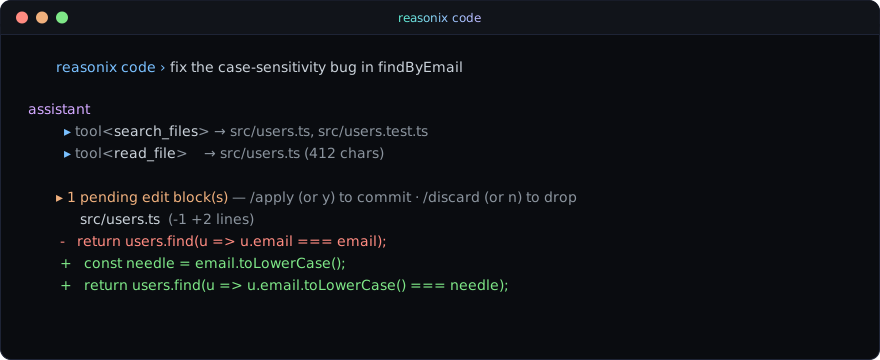
This is a DeepSeek-native AI coding agent designed to run in your terminal. It is specifically engineered for long sessions using a stable prefix-cache mechanic to keep token costs low.
Security Assessment
Overall Risk: Medium. The tool requires a DeepSeek API key to function, which it persists locally. The automated security scan flagged several code issues, most notably dynamic code execution via `eval()` and synchronous process spawning (`spawnSync`). However, these issues are isolated entirely within the project's `benchmarks` folder, meaning they are used for internal testing and do not impact the main agent runtime. The core application does not request any inherently dangerous system permissions. Outbound network requests and environment variable access are limited to expected operations, such as reading the API key from your environment and connecting to the DeepSeek service. No hardcoded secrets were detected.
Quality Assessment
This project demonstrates strong health and maintenance signals. It uses the highly permissive MIT license and is actively maintained, with its most recent code push happening today. It has earned nearly 400 GitHub stars, indicating a solid and growing level of community trust. Additionally, it offers broad compatibility with popular developer environments and CLIs like Cursor, Windsurf, and Claude Code.
Verdict
Safe to use, as the flagged security issues are safely isolated in testing scripts rather than the core agent.
DeepSeek-native AI coding agent for your terminal. Engineered around prefix-cache stability — leave it running.

English · 简体中文 · Website · Architecture · Benchmarks


A DeepSeek-native AI coding agent for your terminal.
Engineered around prefix-cache stability — so token costs stay low across long sessions, and you can leave it running.
[!TIP]
Cache stability isn't a feature you turn on; it's an invariant the loop is designed around. That's the whole reason Reasonix is DeepSeek-only — every layer is tuned to the byte-stable prefix-cache mechanic.
Install
cd my-project
npx reasonix code   # paste a DeepSeek API key on first run; persists after
Requires Node ≥ 22. Tested on macOS · Linux · Windows (PowerShell · Git Bash · Windows Terminal). Get a DeepSeek API key → · reasonix code --help for flags.
What makes Reasonix different
The loop is organized around four pillars. Each one solves a problem generic agent frameworks don't even see — because they were designed for a different cache mechanic.
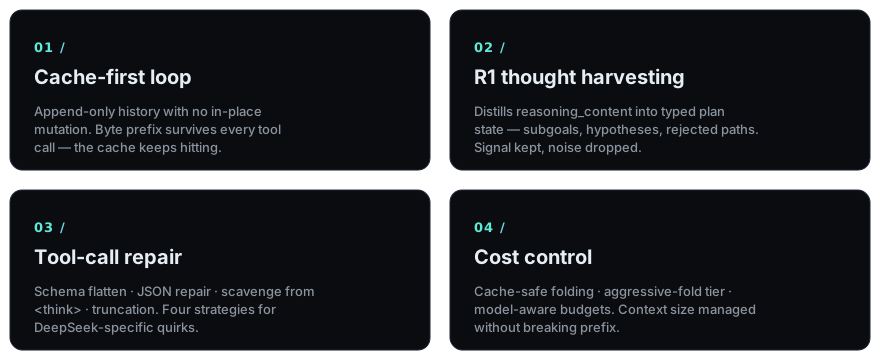
Click any card to read the full architecture writeup → Pillar 1 · Pillar 2 · Pillar 3 · Pillar 4
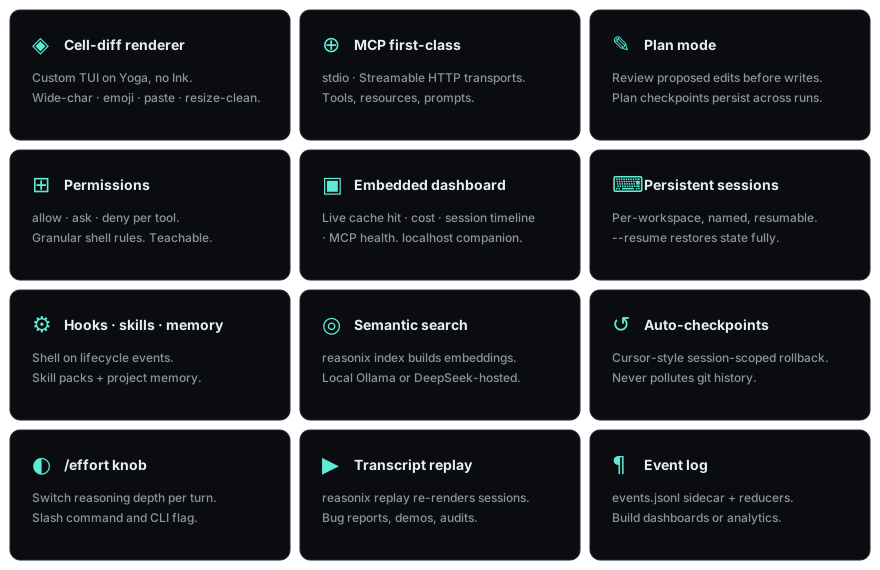
Capabilities
How it compares
| Reasonix | Claude Code | Cursor | Aider | |
|---|---|---|---|---|
| Backend | DeepSeek | Anthropic | OpenAI / Anthropic | any (OpenRouter) |
| License | MIT | closed | closed | Apache 2 |
| Cost profile | low per task | premium | subscription + use | varies |
| DeepSeek prefix-cache | engineered | not applicable | not applicable | incidental |
| Embedded web dashboard | yes | — | n/a (IDE) | — |
| Persistent per-workspace sessions | yes | partial | n/a | — |
| Plan mode · MCP · hooks · skills | yes | yes | yes | partial |
| Open community development | yes | — | — | yes |
For live cache-hit rates, costs, and methodology, see benchmarks/ — the numbers move with model pricing, so they live with the harness, not in the README.
Documentation
- Architecture — the four pillars, cache-first loop, harvesting, scaffolds
- Benchmarks — τ-bench-lite harness, transcripts, cost methodology
- Website — getting started, dashboard mockup, TUI mockup
- Contributing — comment policy, error-handling rules, library-over-hand-rolled
- Code of Conduct · Security policy
Community
[!NOTE]
Reasonix is open source and community-developed. The contributors wall below isn't decoration — every avatar is a real PR that shipped.
Scoped starter tickets — each with background, code pointers, acceptance criteria, and hints — live under the good first issue label. Pick anything open.
Open Discussions — opinions wanted:
- #20 · CLI / TUI design — what's broken, what's missing, what would you change?
- #21 · Dashboard design — react against the proposed mockup
- #22 · Future feature wishlist — what would you build into Reasonix next?
Already using Reasonix and willing to help others discover it? Publish blog posts, articles, screenshots, talks, or videos to Show and tell. The project has no marketing budget — community word of mouth is how new users find it. Sustained advocates earn the badge below, displayed next to the contributors wall once awarded:

Before your first PR: read CONTRIBUTING.md — short, strict rules (comments, errors, libraries-over-hand-rolled). tests/comment-policy.test.ts enforces the comment ones; npm run verify is the pre-push gate. By participating you agree to the Code of Conduct. Security issues → SECURITY.md.
Non-goals
[!IMPORTANT]
Reasonix is opinionated. Some things it deliberately doesn't do — listed here so you can pick the right tool for your work.
- Multi-provider flexibility. DeepSeek-only on purpose. Coupling to one backend is the feature, not a limitation.
- IDE integration. Terminal-first. The diff lives in
git diff, the file tree inls. The dashboard is a companion, not a Cursor replacement. - Hardest-leaderboard reasoning. Claude Opus still wins some benchmarks. DeepSeek is competitive on coding; if your work is "solve this PhD proof" rather than "fix this auth bug," start with Claude.
- Air-gapped / fully-free. Reasonix needs a paid DeepSeek API key. For air-gapped or zero-cost runs see Aider + Ollama or Continue.
Star History
MIT — see LICENSE
Built by the community at esengine/reasonix
Reviews (0)
Sign in to leave a review.
Leave a reviewNo results found