esp32-agent-skills
Health Uyari
- License — License: MIT
- Description — Repository has a description
- Active repo — Last push 0 days ago
- Low visibility — Only 5 GitHub stars
Code Gecti
- Code scan — Scanned 12 files during light audit, no dangerous patterns found
Permissions Gecti
- Permissions — No dangerous permissions requested
Bu listing icin henuz AI raporu yok.
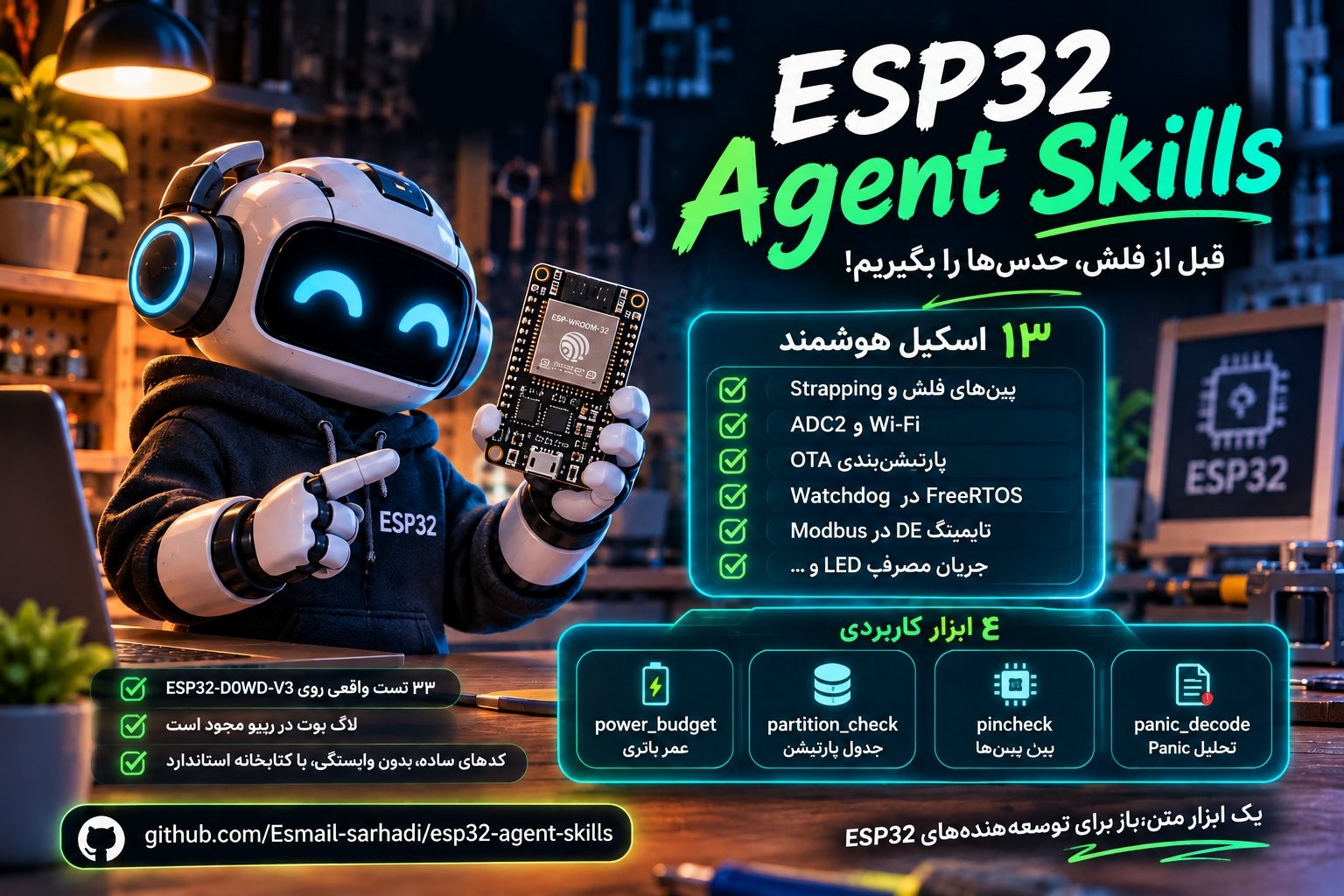
Eleven agent skills and four checkers that stop AI coding agents from writing ESP32 firmware that compiles and then kills the board.
ESP32 Agent Skills
Fourteen skills and four checkers that stop AI coding agents from writing ESP32 firmware that compiles and then kills the board.


Read this on a page instead of a README →
Watch it catch one
Same command twice: the first run exits 1 on a pin wired to the flash, the second
exits 0 after the pin is moved. The text is the real output of those two runs,
replayed line by line; the frame around it is drawn, not a screen recording.
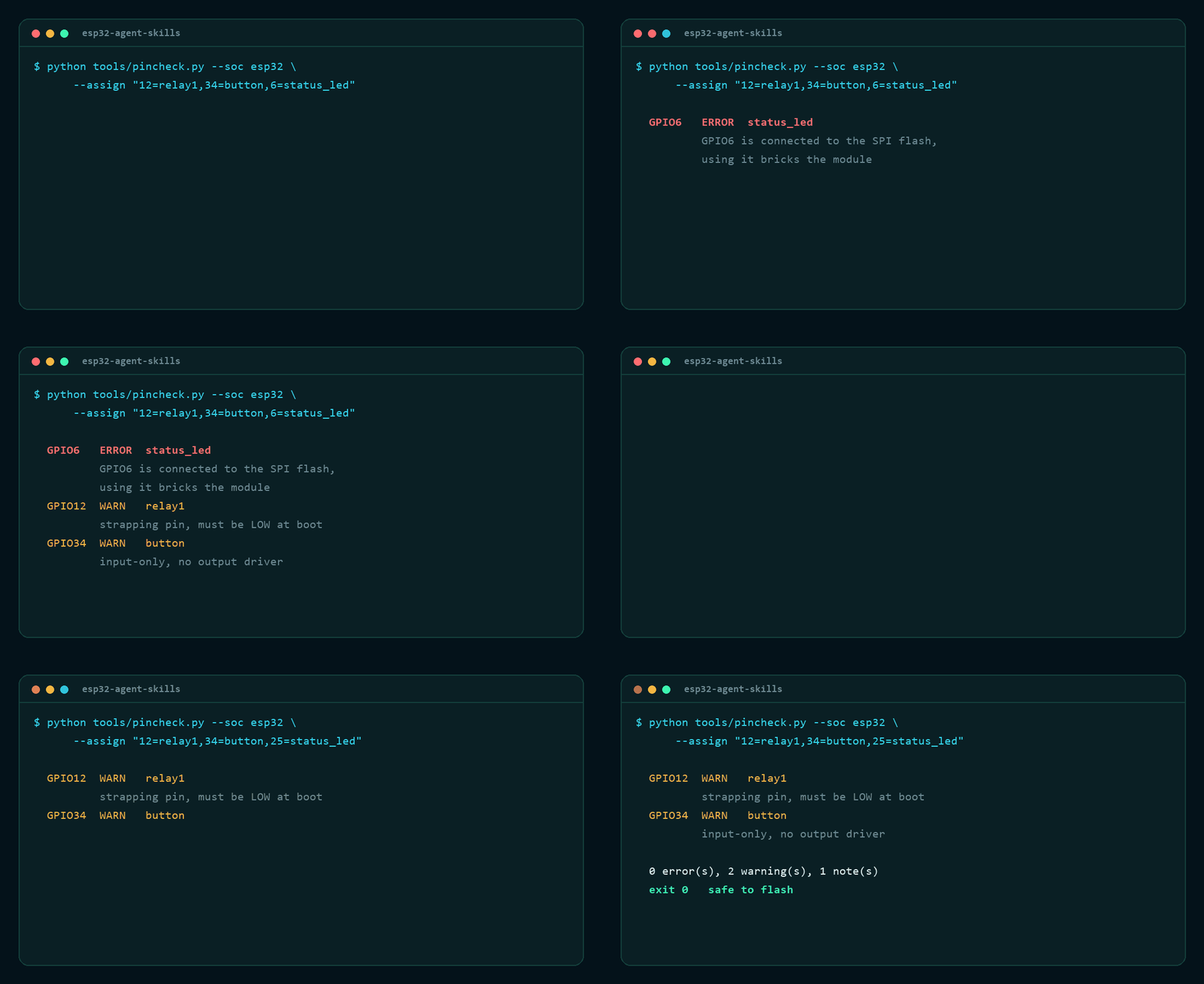
Swap 6 for 25 and the same command goes from 1 error(s) ... exit 1 to0 error(s) ... exit 0. Nothing else changed.
The problem
Ask any coding agent for an ESP32 sketch and you get something that compiles.
Then you flash it and one of four things happens:
| What the agent wrote | What happens on hardware |
|---|---|
#define LED 6 |
GPIO6 is wired to the SPI flash. The module never boots again. |
#define RELAY 34 |
GPIO34 is input-only. The relay never switches, and there is no error. |
#define RELAY 12 |
GPIO12 is a strapping pin. HIGH at reset selects 1.8 V flash and the board stays dark. |
analogRead(2) + Wi-Fi |
GPIO2 is on ADC2. The reading is garbage as soon as the radio is on. |
None of these are logic errors, so no compiler and no unit test will catch them.
They live in the pin map, and the pin map is exactly what an agent invents from
memory.
This repository gives the agent that memory, and gives you a checker that
verifies the result in one command.
Quickstart
git clone https://github.com/Esmail-sarhadi/esp32-agent-skills.git
cd esp32-agent-skills

python tools/pincheck.py --soc esp32 --assign "12=relay1,34=button,6=status_led"
ESP32 (classic, WROOM-32 / WROVER) - 3 pin(s) checked

  GPIO6   ERROR  status_led     GPIO6 is connected to the SPI flash, using it bricks the module
  GPIO12  WARN   relay1         GPIO12 is a strapping pin and must be LOW at boot on 3.3 V flash
                                modules, HIGH selects 1.8 V and the board will not boot; make sure
                                'relay1' cannot hold it there at reset
  GPIO34  WARN   button         GPIO34 is input-only: it cannot drive an output and has no internal
                                pull-up or pull-down, add an external resistor for 'button'
  GPIO12  INFO   relay1         GPIO12 is on ADC2, analogRead() returns garbage while Wi-Fi is active

  1 error(s), 2 warning(s), 1 note(s)
Exit code is 1 when there is at least one error, so it drops straight into CI or
a pre-flash hook. --json gives the same findings as machine-readable output.
Check a whole pin map from a file instead:
python tools/pincheck.py --soc esp32 --file examples/pinmap.txt
Check the partition table before you flash it:
python tools/partition_check.py --file examples/partitions-ota-4mb.csv --flash 4MB --ota
NAME           TYPE   SUBTYPE    OFFSET     SIZE
nvs            data   nvs        0x9000     20KB
otadata        data   ota        0xE000     8KB
app0           app    ota_0      0x10000    1280KB
app1           app    ota_1      0x150000   1280KB
spiffs         data   spiffs     0x290000   1408KB
coredump       data   coredump   0x3F0000   64KB

  INFO  4060KB of 4MB used (99.1%), 36KB free
And the one that matters before a battery-powered build:
python tools/power_budget.py --battery 3000 --wakes-per-hour 12 --wake-ms 2000
  duty cycle      0.67%
  average current 0.677 mA
  battery life    184.7 days (4433.9 hours)

  where the charge goes
    idle      0.467 mA   69.0%
    tx        0.200 mA   29.6%
    sleep     0.010 mA    1.5%

  dominant term: idle (69.0%), fix that one first
That last line is the point of the tool: it tells you which number to attack
instead of letting you guess.
Install as an agent skill
The skills/ directory follows the Agent Skills layout (SKILL.md with name
and description frontmatter), so the agent loads a skill only when the task
actually touches pins or power.
Claude Code
cp -r skills/* ~/.claude/skills/
Cursor / other agents that read project rules
Point the rule file at the skill you need, or paste its body into .cursorrules:
When writing ESP32 firmware, follow skills/esp32-pin-safety/SKILL.md before
choosing any GPIO number. Never invent a pin number.
Any agent with shell access
Let it call the checker directly — that is the whole point of shipping a binary
next to the prose:
python tools/pincheck.py --soc esp32 --assign "$(cat pinmap.txt)"
What is inside
Skills
| Skill | What it stops |
|---|---|
esp32-pin-safety |
Flash pins, input-only pins, strapping pins, ADC2 with Wi-Fi. |
esp32-power-and-boot |
Brownout, boot strap states, deep-sleep leakage — the "random reset" triage. |
esp32-i2c-bus |
Missing pull-ups, address conflicts, a bus that hangs mid-transfer. |
esp32-partitions-and-ota |
Misaligned app slots, overlapping regions, an OTA that silently rolls back. |
esp32-freertos |
Watchdog resets, stack overflow, ISR rules, shared data without a lock. |
esp32-modbus-rs485 |
DE-pin timing, the 3.5 character gap, the CRC, the 40001 off-by-one. |
esp32-addressable-leds |
Power sizing, the 3.3 V data problem, GRB vs RGBW, refresh budget, flicker under Wi-Fi. |
esp32-gaming-rgb |
The OpenRGB SDK wire format, SignalRGB's real options, and what latency Wi-Fi cannot do. |
esp32-debugging |
Reading a panic dump, the exception decoder filter, core dumps, and telling a crash from a watchdog from a brownout. |
esp32-wifi-reliability |
Reconnect storms, power save as a latency setting, AP+STA, and what RSSI actually means. |
esp32-mqtt-and-cloud |
The 256 byte buffer that truncates payloads, keepalive and last will, TLS memory, why QoS 0 loses data. |
esp32-adc-and-sensors |
ADC1 vs ADC2, attenuation and the compressed top of the range, calibration, source impedance, averaging. |
esp32-pwm-and-timing |
LEDC's frequency/resolution trade-off, duty as a count not a percent, servo timing, the core 3.x API change. |
esp32-field-gotchas |
A hundred and sixty failures people actually hit — brownout, dead I2C, garbled UART, watchdog resets, OTA that writes and boots nothing, cameras that brown out, ISRs that fault — indexed by symptom, each linked to the Stack Overflow thread where the cause was found. |
How a skill is laid out
Each skill is a directory, following the layout used by the official Anthropic
skill repository:
skills/esp32-pin-safety/
  SKILL.md          the rules, loaded when the task touches pins
  LICENSE.txt       so the directory can be copied out on its own
  reference/        the long tables, read only when needed
SKILL.md stays short on purpose: an agent loads it for every relevant task, so
it carries the decisions. The tables live in reference/ and are pulled in only
when someone actually needs the full pin map.
The pin table is generated from data/esp32-pins.json bytools/render_pin_table.py, and a test fails if the two drift apart.
Tools
All four use the standard library only. All four exit non-zero on an error, so
they drop straight into CI or a pre-flash hook.
| Tool | Answers |
|---|---|
tools/pincheck.py |
Is this GPIO allowed to do this job on this SoC? |
tools/partition_check.py |
Does this partition table fit the flash and support OTA? |
tools/power_budget.py |
How long does this duty cycle actually last on this battery? |
tools/panic_decode.py |
Which addr2line command turns this crash dump into file:line? |
Data and examples
| Path | What it is |
|---|---|
data/esp32-pins.json |
Machine-readable pin constraints for esp32, esp32s3, esp32c3. |
examples/pinmap.txt |
A realistic pin map with the mistakes agents actually make. |
examples/partitions-ota-4mb.csv |
A correct 4 MB OTA layout. |
examples/partitions-broken.csv |
The same layout with misalignment, overlap and overflow. |
examples/panic-log.txt |
A real LoadProhibited dump with a four frame backtrace. |
tests/ |
30 unit tests covering all four tools. |
Verified on hardware
The pin database is not taken on trust. It was checked against a real module:
| Chip | Flash | Toolchain | Result |
|---|---|---|---|
| ESP32-D0WD-V3 rev 301, 2 cores | 4 MB | Arduino / ESP-IDF 5.5.5 | flashed, booted, serial read back |
=== board facts ===
chip        : ESP32-D0WD-V3 rev 301, 2 core(s)
cpu         : 240 MHz
flash       : 4 MB (4194304 bytes)
sdk         : v5.5.5
free heap   : 331072 bytes
=== end ===
Full boot log and the reproduction steps: docs/hardware.md.
Every rule is compiled
A skill is advice, and advice that does not compile is worthless. So each rule inskills/ also exists as code that the compiler has to accept:
pio run -d examples/compiled
One sketch, one function per skill - PWM duty from the resolution, an ADC1-only
reading in calibrated millivolts, an I2C scan with a timeout, an ISR that hands
work to a task through a queue, the LED current shortfall, the partition
alignment check, the Modbus CRC, the reset reason switch. It is not meant to run;
it exists so that ledcAttach, analogReadMilliVolts, Wire.setTimeOut and the
rest are proven to exist with the signature the skills claim, on the core
version the README names.
CI runs it on every push. If an upstream core renames something, this job goes
red before a reader copies an API that no longer exists - which is exactly the
failure mode a skill library is supposed to prevent.
On accuracy
The database encodes only constraints that are unambiguous across every module
variant, transcribed from the Espressif datasheets and the ESP-IDF GPIO
documentation. Board-specific quirks — the on-board LED on GPIO2, the USB
bridge on GPIO1/GPIO3 — are deliberately excluded, because they differ per
board and a checker that cries wolf gets switched off.
If a constraint is wrong for your module, open an issue with the datasheet page
number and it gets fixed. That is the only way a database like this stays useful.
Roadmap
- ESP32-C6 and ESP32-H2 pin maps
-
--boardprofiles for common dev boards (DevKitC, WROVER-KIT, M5Stack) - Reusable GitHub Action that runs all four checkers on every PR
- Compile the examples against the previous Arduino core, not just the current one
Contributing
The useful contributions here are not code, they are corrections and coverage:
- A wrong constraint. Open an issue with the datasheet page number. A rule
that is wrong for your module is the most valuable bug report this repo can
get, because it means someone else will hit it too. - A chip we do not cover.
data/esp32-pins.jsonhasesp32,esp32s3andesp32c3. C6 and H2 are missing. - A skill from your domain. CAN, BLE, camera, SD card, anything you fight
with weekly. Copy the shape of an existing skill: a shortSKILL.md, areference/folder for the long tables, and a license so it can be copied out
on its own. - A failure we have not written down.
esp32-field-gotchashas a hundred and sixty
entries, each with a link to the thread where it was solved. If you have one
that is not there, send it with the symptom and the fix.
Every skill has to survive python -m unittest discover -s tests, and every
rule that can be expressed as code has to compile - examples/compiled is built
in CI for exactly that reason.
License
MIT — see LICENSE.
Yorumlar (0)
Yorum birakmak icin giris yap.
Yorum birakSonuc bulunamadi